

How to Draw: Scott Robertson's Perspective
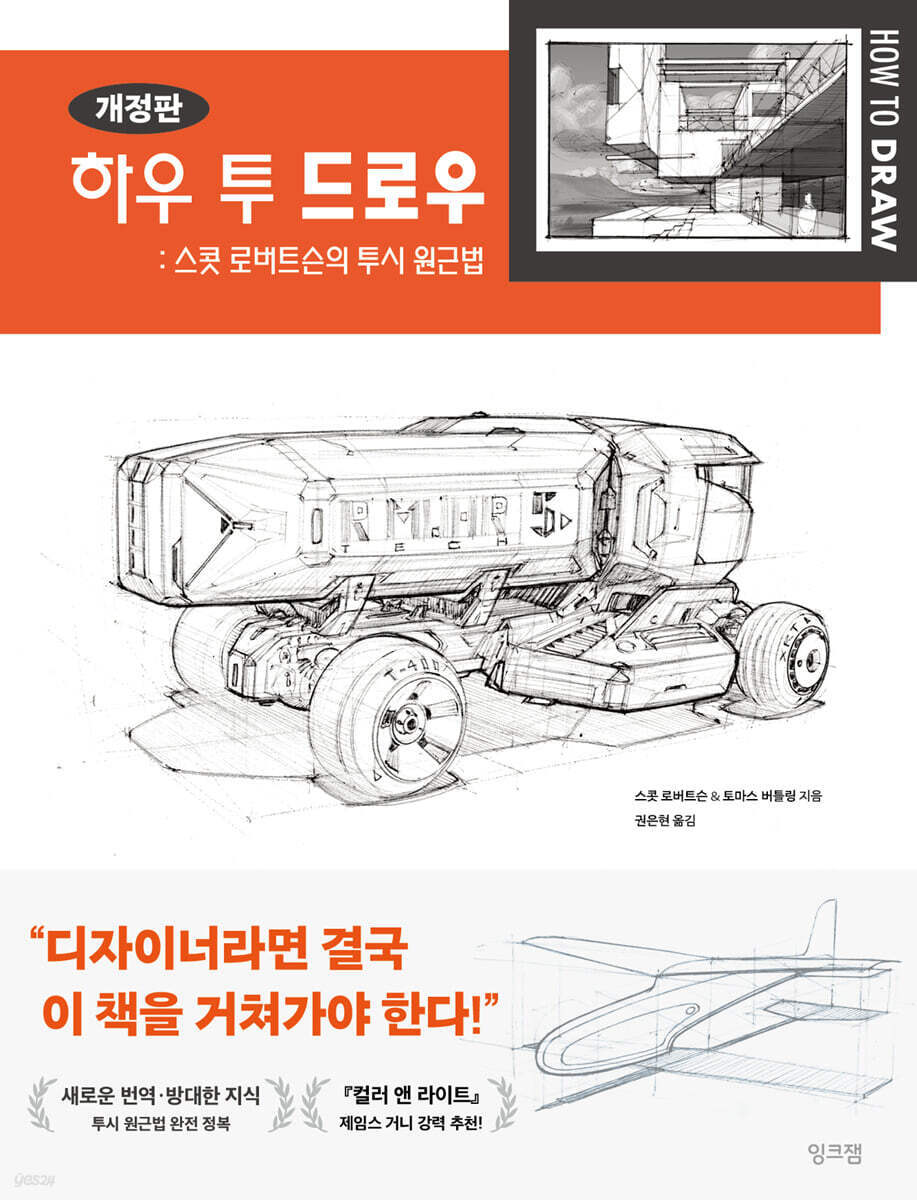 |
Description
Book Introduction
Imaginary objects and spaces as intended!
Perspective drawing techniques to enhance your design competitiveness
When the sketch is shaky and the proportions and angles are off, the standard that restores the persuasiveness of the scene is perspective drawing.
How to Draw: Scott Robertson's Perspective Guide is a comprehensive guide to perspective drawing that covers the principles and procedures for making imaginary objects and spaces appear as intended.
The first half of the book covers the basics of accurate perspective and proportion, while the second half explains placement and composition in complex scenes.
This book organizes knowledge applicable to various fields such as industrial design, architecture, illustration, and concept art, providing a system that allows you to draw any object or space from your imagination.
Step-by-step process explanations and video tutorials via a dedicated app are also provided, so you can follow along step by step, from basic exercises to complex environment descriptions, and design and express not only the cars in front of you but also robots from science fiction movies.
Perspective drawing techniques to enhance your design competitiveness
When the sketch is shaky and the proportions and angles are off, the standard that restores the persuasiveness of the scene is perspective drawing.
How to Draw: Scott Robertson's Perspective Guide is a comprehensive guide to perspective drawing that covers the principles and procedures for making imaginary objects and spaces appear as intended.
The first half of the book covers the basics of accurate perspective and proportion, while the second half explains placement and composition in complex scenes.
This book organizes knowledge applicable to various fields such as industrial design, architecture, illustration, and concept art, providing a system that allows you to draw any object or space from your imagination.
Step-by-step process explanations and video tutorials via a dedicated app are also provided, so you can follow along step by step, from basic exercises to complex environment descriptions, and design and express not only the cars in front of you but also robots from science fiction movies.
- You can preview some of the book's contents.
Preview
index
Entering 8
CHAPTER 01 Drawing Materials and Techniques
Drawing Materials 12
Pen and Paper 13
Drawing Skills 14
Drawing straight lines freehand 15
XYZ Coordinate System 16
Drawing Curves Freehand 17
Drawing an Oval Freehand 18
Draw an ellipse over a shortcut 19
CHAPTER 02 Perspective Terminology
Perspective changes depending on the viewpoint 22
Field of view 23
Finding the Vanishing Point on the Screen 24
Parallel lines of objects converging at a vanishing point 26
Horizon 27, which varies depending on the location of the observation point
CHAPTER 03 PERSPECTIVE
Dividing and Duplicating Space with Perspective 30
Duplicating and Dividing Rectangles 32
Divide odd numbers into equal parts 33
Drawing Planes of Symmetry Using Perspective Drawing 34
Drawing the plane of symmetry of an inclined plane 36
Drawing the plane of symmetry of a rotated inclined plane 37
Drawing a Symmetrical Two-Dimensional Curve 40
Drawing the symmetry of a two-dimensional curve on an inclined plane 42
Combining Two Curves: Drawing Symmetrical Three-Dimensional Curves in Perspective Space 43
CHAPTER 04 Creating a Grid
Perspective Grid Type 46
Creating a Perspective Grid 48
Diagonal Vanishing Point and Viewpoint Technique 49
Creating a Two-Point Perspective Grid Using Vanishing Points on Paper 50
Rotated two-point perspective grid made of equal-sized squares 51
Transferring Proportions in Perspective Drawing 53
Brewer's Method: Grid Construction Using Off-Paper Vanishing Points 54
Creating a Square Grid Without Diagonal Vanishing Points 57
58 When using computer-generated sketches
Other Advantages and Uses of Underdrawing 61
Not all perspective grids are created equal 62
Assembly and disassembly drawings 68
CHAPTER 05 Ellipses and Rotations
Ellipse Basics and Terminology 72
Placing a circle or drawing an ellipse in perspective 73
Drawing a Cube Using an Ellipse 74
Ellipse Offset 74
75 Covers and doors with hinges and pivoting structures
Splitting an Ellipse 76
A Simple Way to Split an Ellipse 78
Drawing a Circle on a Slope 79
CHAPTER 06 Expressing Three-Dimensional Effects
Preliminary Planning for Drawing Perspective Drawings 82
Orthogonal projection 84
Converting a side view to a perspective view 85
Putting it all together: Drawing an XYZ Section 86
Expanding the cross section 88
Combining Two Curves 89
3D cutting 90
Cutting a curved surface using a cross-section line 91
Connecting Boxes with Curved Surfaces: Rounds and Fillets 92
Wrapping graphics on curved surfaces 93
Detail and Surface Sculpting 94
96 Useful Tips for Deforming Complex Solids
Outline, Overlap, Line Thickness 100
Practical Example of XYZ Section 102
CHAPTER 07 Environmental Drawing
Using Photos 108
Space Design 110
Thumbnail Sketch 112
Nonphoto Blue Pencil and Ink Work 115
Step-by-step science fiction environment drawing 116
Grid distortion with a wide-angle lens 118
Step-by-step outdoor environment sketch 120
CHAPTER 08 AIRCRAFT DRAWING
Airplane Structure 124
Visual Resources 126
Observational Drawing 128
Light Concept Sketch 130
Paper Airplane Idea Sketch 132
Paper Airplane Perspective Grid 133
Step-by-step paper airplane drawing 137
Using 3D Sketches 142
Drawing the Final Step Airplane 146
CHAPTER 09 Drawing a Vehicle with Wheels
Visual Resources 154
Before drawing, decide on an idea or goal 157
Automotive Packaging and Architecture Fundamentals 160
Be creative 164
Grid Matters! 166
Drawing a Side Perspective 169
Drawing a Hybrid Side Perspective 170
Building a Basic Body 174
Drawing a Windshield and Greenhouse 175
Drawing wheelhouses, wheels, and tires in perspective 176
Basic line of the car 178
Step-by-step car drawing 180
Sketching a Car with a Wide-Angle Lens 186
CHAPTER 10 Sketch Styles and Materials
Ballpoint pen 190
Copic Marker and Ballpoint Pen 191
Graphite pencil 192
Colored pencil 193
Pilot Hi-Tech Pen 194 in Newsprint
Copic markers and Pilot Hi-Tech 195 pen
Nonphoto Blue Colored Pencil, Marker, Brush Pen 196
Pentel Pocket Brush Pen 197
Copic Markers, Pens, Gouache 198
Gouache on illustration board 199
200 mixed materials on colored paper
Digital Tool: Sketchbook Pro 201
Glossary 202
Index 203
Additional Material 204
Video Link 205
About the Author 206
Acknowledgments 207
CHAPTER 01 Drawing Materials and Techniques
Drawing Materials 12
Pen and Paper 13
Drawing Skills 14
Drawing straight lines freehand 15
XYZ Coordinate System 16
Drawing Curves Freehand 17
Drawing an Oval Freehand 18
Draw an ellipse over a shortcut 19
CHAPTER 02 Perspective Terminology
Perspective changes depending on the viewpoint 22
Field of view 23
Finding the Vanishing Point on the Screen 24
Parallel lines of objects converging at a vanishing point 26
Horizon 27, which varies depending on the location of the observation point
CHAPTER 03 PERSPECTIVE
Dividing and Duplicating Space with Perspective 30
Duplicating and Dividing Rectangles 32
Divide odd numbers into equal parts 33
Drawing Planes of Symmetry Using Perspective Drawing 34
Drawing the plane of symmetry of an inclined plane 36
Drawing the plane of symmetry of a rotated inclined plane 37
Drawing a Symmetrical Two-Dimensional Curve 40
Drawing the symmetry of a two-dimensional curve on an inclined plane 42
Combining Two Curves: Drawing Symmetrical Three-Dimensional Curves in Perspective Space 43
CHAPTER 04 Creating a Grid
Perspective Grid Type 46
Creating a Perspective Grid 48
Diagonal Vanishing Point and Viewpoint Technique 49
Creating a Two-Point Perspective Grid Using Vanishing Points on Paper 50
Rotated two-point perspective grid made of equal-sized squares 51
Transferring Proportions in Perspective Drawing 53
Brewer's Method: Grid Construction Using Off-Paper Vanishing Points 54
Creating a Square Grid Without Diagonal Vanishing Points 57
58 When using computer-generated sketches
Other Advantages and Uses of Underdrawing 61
Not all perspective grids are created equal 62
Assembly and disassembly drawings 68
CHAPTER 05 Ellipses and Rotations
Ellipse Basics and Terminology 72
Placing a circle or drawing an ellipse in perspective 73
Drawing a Cube Using an Ellipse 74
Ellipse Offset 74
75 Covers and doors with hinges and pivoting structures
Splitting an Ellipse 76
A Simple Way to Split an Ellipse 78
Drawing a Circle on a Slope 79
CHAPTER 06 Expressing Three-Dimensional Effects
Preliminary Planning for Drawing Perspective Drawings 82
Orthogonal projection 84
Converting a side view to a perspective view 85
Putting it all together: Drawing an XYZ Section 86
Expanding the cross section 88
Combining Two Curves 89
3D cutting 90
Cutting a curved surface using a cross-section line 91
Connecting Boxes with Curved Surfaces: Rounds and Fillets 92
Wrapping graphics on curved surfaces 93
Detail and Surface Sculpting 94
96 Useful Tips for Deforming Complex Solids
Outline, Overlap, Line Thickness 100
Practical Example of XYZ Section 102
CHAPTER 07 Environmental Drawing
Using Photos 108
Space Design 110
Thumbnail Sketch 112
Nonphoto Blue Pencil and Ink Work 115
Step-by-step science fiction environment drawing 116
Grid distortion with a wide-angle lens 118
Step-by-step outdoor environment sketch 120
CHAPTER 08 AIRCRAFT DRAWING
Airplane Structure 124
Visual Resources 126
Observational Drawing 128
Light Concept Sketch 130
Paper Airplane Idea Sketch 132
Paper Airplane Perspective Grid 133
Step-by-step paper airplane drawing 137
Using 3D Sketches 142
Drawing the Final Step Airplane 146
CHAPTER 09 Drawing a Vehicle with Wheels
Visual Resources 154
Before drawing, decide on an idea or goal 157
Automotive Packaging and Architecture Fundamentals 160
Be creative 164
Grid Matters! 166
Drawing a Side Perspective 169
Drawing a Hybrid Side Perspective 170
Building a Basic Body 174
Drawing a Windshield and Greenhouse 175
Drawing wheelhouses, wheels, and tires in perspective 176
Basic line of the car 178
Step-by-step car drawing 180
Sketching a Car with a Wide-Angle Lens 186
CHAPTER 10 Sketch Styles and Materials
Ballpoint pen 190
Copic Marker and Ballpoint Pen 191
Graphite pencil 192
Colored pencil 193
Pilot Hi-Tech Pen 194 in Newsprint
Copic markers and Pilot Hi-Tech 195 pen
Nonphoto Blue Colored Pencil, Marker, Brush Pen 196
Pentel Pocket Brush Pen 197
Copic Markers, Pens, Gouache 198
Gouache on illustration board 199
200 mixed materials on colored paper
Digital Tool: Sketchbook Pro 201
Glossary 202
Index 203
Additional Material 204
Video Link 205
About the Author 206
Acknowledgments 207
Detailed image

Publisher's Review
Mentor to Hollywood concept designers and illustrators,
Scott Robertson's culmination of knowledge and know-how!
The author of this book, Scott Robertson, is a renowned concept designer and professor who has trained numerous experts at ArtCenter College of Design, a cradle of automotive, industrial, and entertainment design.
His students are active at the forefront of the Hollywood entertainment industry, including Universal Pictures and DreamWorks Animation.
How to Draw: Scott Robertson's Perspective Drawing contains the principles and know-how of perspective drawing that the author has taught in the classroom for over 18 years.
This book provides a drawing standard for aspiring designers, and a system for professionals to elevate the quality and speed of their designs.
Think like a designer and draw things that never existed before.
Feeling is important in drawing, but if you just follow the impression you see, it will look awkward.
Because humans see the world in three dimensions with both eyes.
The author of this book says that a tool that reproduces visual effects similar to the way we see is perspective.
The scope of applications of clairvoyance is wide.
It covers not only buildings and indoor spaces, but also complex machines such as airplanes and vehicles, props and products.
Even in concept art and storyboards, perspective determines the composition, depth, and persuasiveness of a scene.
So for designers, it's important to understand perspective and perspective drawing, not just the senses.
This book first teaches you the terms and principles of perspective, and then teaches you how to create three-dimensional effects through repetition, division, and symmetry of lines and shapes.
Next, you'll learn how to construct your own grid for complex drawings, then step-by-step how to apply the principles you've learned to more challenging subjects like environmental drawing, aircraft, and automotive design.
It also includes a variety of examples utilizing 3D modeling and rendering programs, providing knowledge that can be applied directly to practical work.
Based on this, you can establish standards for expressing your ideas as you intended, not as they appear, like designing a plan.
A must-read for designers, now with a clearer new translation.
Since its publication in 2014, this book has been a must-read for designers.
In response to readers' continued requests for republication even after it went out of print, it returned in 2025 with a new, easier-to-understand translation.
This revised edition reduces translation errors and smooths sentences to clearly convey the core concepts of perspective.
In addition, we have organized the terminology consistently and aligned the names of aircraft devices, automobile models, and parts with expressions commonly used in Korea so that they can be used immediately in the field.
Enhance your learning experience with AR 3D models and tutorial videos!
After installing the dedicated app "h2Dr," scan the page with the play icon on the cover or text with your smartphone or tablet. An AR 3D model will appear, or you can watch a tutorial video.
3D models support rotation, zoom, and scaling functions, allowing you to examine the shape and structure of 2D drawings in three dimensions.
Tutorial videos allow you to watch lectures directly demonstrated by author Scott Robertson, helping you understand the book's text and illustrations more quickly and effectively.
Scott Robertson's culmination of knowledge and know-how!
The author of this book, Scott Robertson, is a renowned concept designer and professor who has trained numerous experts at ArtCenter College of Design, a cradle of automotive, industrial, and entertainment design.
His students are active at the forefront of the Hollywood entertainment industry, including Universal Pictures and DreamWorks Animation.
How to Draw: Scott Robertson's Perspective Drawing contains the principles and know-how of perspective drawing that the author has taught in the classroom for over 18 years.
This book provides a drawing standard for aspiring designers, and a system for professionals to elevate the quality and speed of their designs.
Think like a designer and draw things that never existed before.
Feeling is important in drawing, but if you just follow the impression you see, it will look awkward.
Because humans see the world in three dimensions with both eyes.
The author of this book says that a tool that reproduces visual effects similar to the way we see is perspective.
The scope of applications of clairvoyance is wide.
It covers not only buildings and indoor spaces, but also complex machines such as airplanes and vehicles, props and products.
Even in concept art and storyboards, perspective determines the composition, depth, and persuasiveness of a scene.
So for designers, it's important to understand perspective and perspective drawing, not just the senses.
This book first teaches you the terms and principles of perspective, and then teaches you how to create three-dimensional effects through repetition, division, and symmetry of lines and shapes.
Next, you'll learn how to construct your own grid for complex drawings, then step-by-step how to apply the principles you've learned to more challenging subjects like environmental drawing, aircraft, and automotive design.
It also includes a variety of examples utilizing 3D modeling and rendering programs, providing knowledge that can be applied directly to practical work.
Based on this, you can establish standards for expressing your ideas as you intended, not as they appear, like designing a plan.
A must-read for designers, now with a clearer new translation.
Since its publication in 2014, this book has been a must-read for designers.
In response to readers' continued requests for republication even after it went out of print, it returned in 2025 with a new, easier-to-understand translation.
This revised edition reduces translation errors and smooths sentences to clearly convey the core concepts of perspective.
In addition, we have organized the terminology consistently and aligned the names of aircraft devices, automobile models, and parts with expressions commonly used in Korea so that they can be used immediately in the field.
Enhance your learning experience with AR 3D models and tutorial videos!
After installing the dedicated app "h2Dr," scan the page with the play icon on the cover or text with your smartphone or tablet. An AR 3D model will appear, or you can watch a tutorial video.
3D models support rotation, zoom, and scaling functions, allowing you to examine the shape and structure of 2D drawings in three dimensions.
Tutorial videos allow you to watch lectures directly demonstrated by author Scott Robertson, helping you understand the book's text and illustrations more quickly and effectively.
GOODS SPECIFICS
- Date of issue: November 17, 2025
- Page count, weight, size: 208 pages | 1,030g | 230*297*20mm
- ISBN13: 9788979294675
- ISBN10: 8979294670
You may also like
카테고리
korean


korean

![GQ KOREA Mark (Monthly): December [2025]](http://librairie.coreenne.fr/cdn/shop/files/8ef265dbbfbf186523ed75ba7319009d.jpg?v=1765340328&width=3840)


