

Humanism Museum
 |
Description
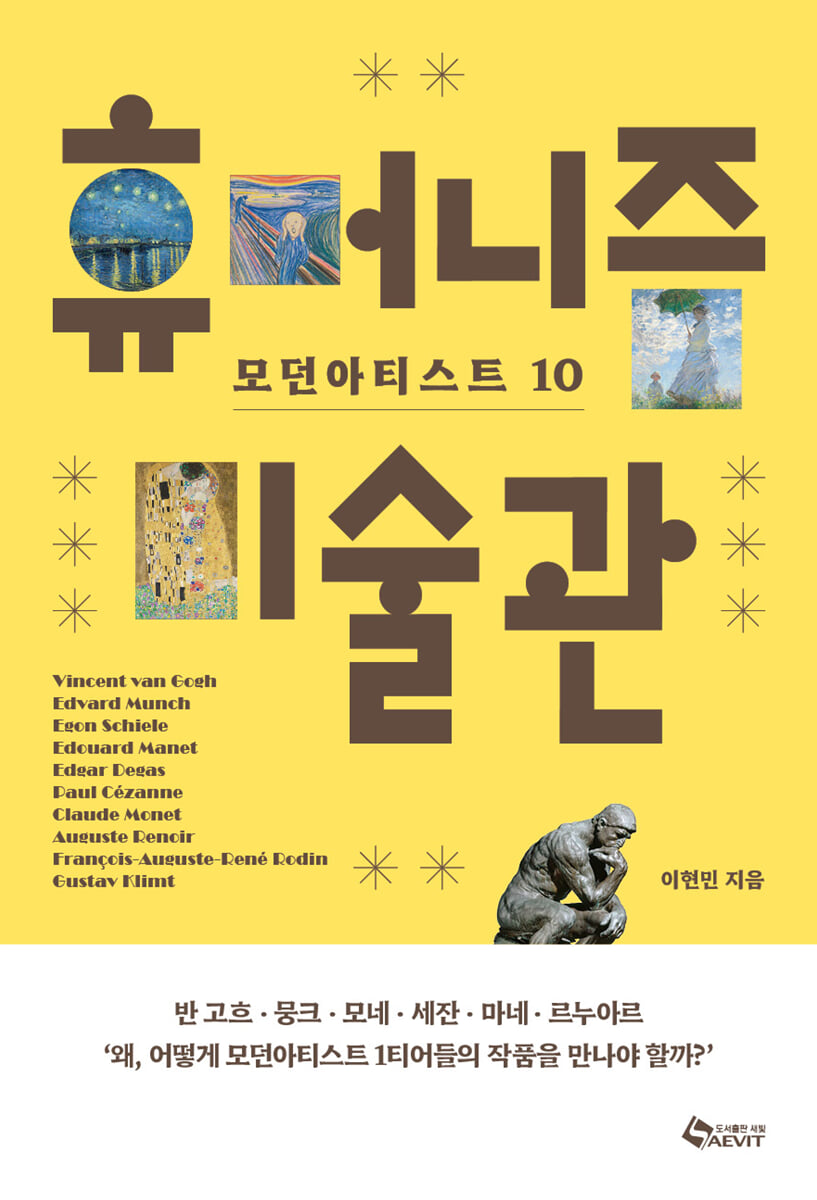
Book Introduction
Van Gogh, Munch, Monet, Cézanne, Manet, Renoir
'Why and how should we encounter the works of top-tier modern artists?'
This book selects 10 representative modern artists and classifies them into four types based on the images and lives of these first-tier modern artists.
· Timid recluse: Vincent van Gogh, Edvard Munch, Egon Schiele
· Rebellious artists born with a silver spoon in their mouths: Edouard Manet, Edgar Degas, Paul Cézanne
· Positive pursuit of happiness: Claude Monet, Auguste Renoir
· Ambitious and ambitious: Auguste Rodin, Gustav Klimt
Art also has character.
Learning the Language of Humanity and Emotions from 10 Modern Artists
In recent years, art has become a more relevant and relevant topic than ever before.
Exhibitions are always crowded, and artworks are passed around like memes on social media.
But many people say to themselves:
“Art is cool, but I don’t know much about it, so it’s difficult.” I was like that too.
As a business administration major, I began studying art in my mid-30s and belatedly realized that 'art is the language of the senses and a sentence that understands humanity.'
This book started from that realization.
So, this author looks at art from the perspective of 'Yerin', a beginner in art.
This book, "The Humanism Museum," addresses the questions: "Why should we understand art?" "What? What kind of art should we see?" "How?" and introduces ten modern artists.
They are not simply artists, but mirrors that reflect the minds of modern people with their different personalities, emotions, and lifestyles.
Even if you don't know art, it's time to learn about art through the human heart.
In an era where AI is changing the world, art remains the "warm language that makes humans human," deeply revealing the essence of humanity.
This book, "Humanism Museum," begins with the message, "It's okay not to know about art," and teaches "how to learn about humanity and life through art" in a way that anyone can understand.
This book talks about 'reading art with emotion' rather than grand art theories.
Why do people stop and stare at paintings? It's because they discover "their own heart" in the tip of the artist's brush.
Art is ultimately an exploration of the human mind, and fine art is the result of translating those emotions into visual language.
This book once again proposes 'a way to understand the world through the language of emotions.'
'Why and how should we encounter the works of top-tier modern artists?'
This book selects 10 representative modern artists and classifies them into four types based on the images and lives of these first-tier modern artists.
· Timid recluse: Vincent van Gogh, Edvard Munch, Egon Schiele
· Rebellious artists born with a silver spoon in their mouths: Edouard Manet, Edgar Degas, Paul Cézanne
· Positive pursuit of happiness: Claude Monet, Auguste Renoir
· Ambitious and ambitious: Auguste Rodin, Gustav Klimt
Art also has character.
Learning the Language of Humanity and Emotions from 10 Modern Artists
In recent years, art has become a more relevant and relevant topic than ever before.
Exhibitions are always crowded, and artworks are passed around like memes on social media.
But many people say to themselves:
“Art is cool, but I don’t know much about it, so it’s difficult.” I was like that too.
As a business administration major, I began studying art in my mid-30s and belatedly realized that 'art is the language of the senses and a sentence that understands humanity.'
This book started from that realization.
So, this author looks at art from the perspective of 'Yerin', a beginner in art.
This book, "The Humanism Museum," addresses the questions: "Why should we understand art?" "What? What kind of art should we see?" "How?" and introduces ten modern artists.
They are not simply artists, but mirrors that reflect the minds of modern people with their different personalities, emotions, and lifestyles.
Even if you don't know art, it's time to learn about art through the human heart.
In an era where AI is changing the world, art remains the "warm language that makes humans human," deeply revealing the essence of humanity.
This book, "Humanism Museum," begins with the message, "It's okay not to know about art," and teaches "how to learn about humanity and life through art" in a way that anyone can understand.
This book talks about 'reading art with emotion' rather than grand art theories.
Why do people stop and stare at paintings? It's because they discover "their own heart" in the tip of the artist's brush.
Art is ultimately an exploration of the human mind, and fine art is the result of translating those emotions into visual language.
This book once again proposes 'a way to understand the world through the language of emotions.'
index
Entering
Chapter 1: The Timid Recluse: I have many existential worries, but I'll persevere.
Vincent van Gogh (1853–1890)
What would Van Gogh think if he saw himself so famous now?
But he is an icon of the unfortunate artist suffering from poverty and mental illness.
Edvard Munch (1863–1944)
Do you think Munch spent his entire life screaming?
They say they waited for the sun to rise brightly like a Teletubbies amusement park.
Egon Schiele (1890–1918)
Isn't the desperate worry Schiele faced something that all young people experience?
They say it's an eternal rebel that depicts human desire.
Chapter 2: The Golden Spoon Rebellion: Father, I Will Become a Painter
Edouard Manet (1832–1883)
Manet is said to be a failure who failed both the military academy and the salon exhibition?
It must have been hard for you to have a grandfather and father who were both judges.
Edgar Degas (1834–1917)
Why did Degas drop out of law school to paint so many ballerinas?
I don't understand misogyny.
Paul Cezanne (1839–1906)
Why did Cezanne drop out of law school and live in his studio?
But, they say he drew apples and mountains countless times.
Chapter 3: Pursuit of Happiness Positive: What will you do if you worry?
Claude Monet (1840-1926)
Monet painted 250 water lilies?
I heard that the sub-character was a gardener.
Auguste Renoir (1841–1919)
Renoir painted with his arthritic hands tied to his brushes?
Bright colors make people who see them happy.
Chapter 4: The Ambition of the Construction Worker: The Challenge for Success is All I Can Do
Francois Auguste Rene Rodin (1840–1917)
Rodin received many commissions for his works during his lifetime and became famous, right?
He said he needed both a celebrity friend and a lover…
Gustav Klimt (1862–1918)
Klimt was a workaholic, like a machine?
They say he was a prodigal painter who had 14 illegitimate children.
Reference books
Chapter 1: The Timid Recluse: I have many existential worries, but I'll persevere.
Vincent van Gogh (1853–1890)
What would Van Gogh think if he saw himself so famous now?
But he is an icon of the unfortunate artist suffering from poverty and mental illness.
Edvard Munch (1863–1944)
Do you think Munch spent his entire life screaming?
They say they waited for the sun to rise brightly like a Teletubbies amusement park.
Egon Schiele (1890–1918)
Isn't the desperate worry Schiele faced something that all young people experience?
They say it's an eternal rebel that depicts human desire.
Chapter 2: The Golden Spoon Rebellion: Father, I Will Become a Painter
Edouard Manet (1832–1883)
Manet is said to be a failure who failed both the military academy and the salon exhibition?
It must have been hard for you to have a grandfather and father who were both judges.
Edgar Degas (1834–1917)
Why did Degas drop out of law school to paint so many ballerinas?
I don't understand misogyny.
Paul Cezanne (1839–1906)
Why did Cezanne drop out of law school and live in his studio?
But, they say he drew apples and mountains countless times.
Chapter 3: Pursuit of Happiness Positive: What will you do if you worry?
Claude Monet (1840-1926)
Monet painted 250 water lilies?
I heard that the sub-character was a gardener.
Auguste Renoir (1841–1919)
Renoir painted with his arthritic hands tied to his brushes?
Bright colors make people who see them happy.
Chapter 4: The Ambition of the Construction Worker: The Challenge for Success is All I Can Do
Francois Auguste Rene Rodin (1840–1917)
Rodin received many commissions for his works during his lifetime and became famous, right?
He said he needed both a celebrity friend and a lover…
Gustav Klimt (1862–1918)
Klimt was a workaholic, like a machine?
They say he was a prodigal painter who had 14 illegitimate children.
Reference books
Into the book
It is said that he left behind about 70 paintings during the two months leading up to his death.
Isn't that amazing? If you were contemplating suicide, you probably wanted to rest when things got tough, even give up. But you're still painting so diligently?
--- From "Chapter 1, 'Vincent van Gogh'"
Don't you hear Munch whispering, "If your soul is so drained that it's about to be drained, heal yourself, recharge, and live on?" If you keep striving, won't you find a bright light at the end of the tunnel?
--- From "Chapter 1, 'Edvard Munch'"
'I guarantee it.
That someday the world will recognize my art.
Because we are human beings like me and have the same heart.
He said, 'I'm going to become famous.'
Aren't you timid? It's the eternal rebel's way of speaking, depicting human desire.
--- From "Chapter 1, 'Egon Schiele'"
His parents eventually gave in and supported his dream of going to art school.
Was his repeated failure truly due to lack of skill and luck? Or was it a larger picture of Manet's quiet resistance? While the truth of the time and Manet's inner thoughts remain unknown, I can somehow hear his unspoken cry, "I am not like my father."
--- From "Chapter 2, 'Edouard Manet'"
Edgar Degas (1834–1917)
From 1870 onwards, he began studying dancers who performed ballet scenes.
Until then, it was a time when I could focus on the paintings I wanted to do.
But Degas finds out later.
At that time, my father was having a hard time due to a business crisis.
Degas's father's death was like a preview of a life that would be completely different from what it had been before.
--- From "Chapter 2, 'Edgar Degas'"
Cézanne, who had suffered a great heartache in Paris, returned to his hometown of Aix and began painting about everyday life in his studio, the atelier.
Cézanne sat in his studio and chose the subjects he saw before him: mountains, apples, oranges, and a jug of water.
What kind of new art are you trying to create with this?
--- From "Chapter 2, 'Paul Cézanne'"
In fact, Monet himself said that the best of his works was the place where the water lilies were born.
He said it was his own garden.
Monet, the main character a painter and the secondary character a gardener, devoted his time to gardening outside of painting.
I guess the garden was a haven of happiness and dreams for him?
--- From "Chapter 3 'Claude Monet'"
What do you feel when you look at this painting? "Doesn't it make you happy?" Why did the artist paint this? Where is this place? These people?
Who is he? What is he doing here?
--- From "Chapter 3, 'Auguste Renoir'"
Rodin, who had never been to such social events, was initially shy, but as his fame grew and he became more well-known, he became sociable to the point of being talkative.
At social gatherings, I gradually became acquainted with a wider range of people, not just artists.
--- From "Chapter 4, 'Auguste Rodin'"
p263.
However, Klimt did not enjoy having his private life exposed to the world like Manet or Rodin in the glamorous modern city of Paris.
Ironically, Klimt, who lived in Vienna, a declining modern city, is said to have had a private and introverted personality, lived a regular life, and worked like a workaholic.
Isn't that amazing? If you were contemplating suicide, you probably wanted to rest when things got tough, even give up. But you're still painting so diligently?
--- From "Chapter 1, 'Vincent van Gogh'"
Don't you hear Munch whispering, "If your soul is so drained that it's about to be drained, heal yourself, recharge, and live on?" If you keep striving, won't you find a bright light at the end of the tunnel?
--- From "Chapter 1, 'Edvard Munch'"
'I guarantee it.
That someday the world will recognize my art.
Because we are human beings like me and have the same heart.
He said, 'I'm going to become famous.'
Aren't you timid? It's the eternal rebel's way of speaking, depicting human desire.
--- From "Chapter 1, 'Egon Schiele'"
His parents eventually gave in and supported his dream of going to art school.
Was his repeated failure truly due to lack of skill and luck? Or was it a larger picture of Manet's quiet resistance? While the truth of the time and Manet's inner thoughts remain unknown, I can somehow hear his unspoken cry, "I am not like my father."
--- From "Chapter 2, 'Edouard Manet'"
Edgar Degas (1834–1917)
From 1870 onwards, he began studying dancers who performed ballet scenes.
Until then, it was a time when I could focus on the paintings I wanted to do.
But Degas finds out later.
At that time, my father was having a hard time due to a business crisis.
Degas's father's death was like a preview of a life that would be completely different from what it had been before.
--- From "Chapter 2, 'Edgar Degas'"
Cézanne, who had suffered a great heartache in Paris, returned to his hometown of Aix and began painting about everyday life in his studio, the atelier.
Cézanne sat in his studio and chose the subjects he saw before him: mountains, apples, oranges, and a jug of water.
What kind of new art are you trying to create with this?
--- From "Chapter 2, 'Paul Cézanne'"
In fact, Monet himself said that the best of his works was the place where the water lilies were born.
He said it was his own garden.
Monet, the main character a painter and the secondary character a gardener, devoted his time to gardening outside of painting.
I guess the garden was a haven of happiness and dreams for him?
--- From "Chapter 3 'Claude Monet'"
What do you feel when you look at this painting? "Doesn't it make you happy?" Why did the artist paint this? Where is this place? These people?
Who is he? What is he doing here?
--- From "Chapter 3, 'Auguste Renoir'"
Rodin, who had never been to such social events, was initially shy, but as his fame grew and he became more well-known, he became sociable to the point of being talkative.
At social gatherings, I gradually became acquainted with a wider range of people, not just artists.
--- From "Chapter 4, 'Auguste Rodin'"
p263.
However, Klimt did not enjoy having his private life exposed to the world like Manet or Rodin in the glamorous modern city of Paris.
Ironically, Klimt, who lived in Vienna, a declining modern city, is said to have had a private and introverted personality, lived a regular life, and worked like a workaholic.
--- From "Chapter 4, 'Gustav Klimt'"
Publisher's Review
Why? Why should we learn about art?
What? What kind of art should I see?
How? How should we view art?
The sequel to Professor Lee Hyeon-min's book, "Steve Jobs's Picasso," selected by Sejong Books in the liberal arts category!
Four "Artist Types" That Are as Interesting as the MBTI
This book introduces ten top-tier modern artists, organized into four artist types. Like the MBTI, it delves into the psychology and lives of artists through personality types, following their struggles, desires, and brilliant artistic moments.
Timid Recluse: Vincent van Gogh, Edvard Munch, Egon Schiele
People who sublimated their inner anxiety and loneliness into art
Golden Spoon Rebels: Edouard Manet, Edgar Degas, Paul Cézanne
Reformers who moved toward a new world even in a stable environment
Positive pursuit of happiness: Claude Monet, Auguste Renoir
Artists who endure and portray the happiness of life with warm light and color.
Ambitious and ambitious: Auguste Rodin, Gustav Klimt
Ambitious artists who pursued success, fame, and love simultaneously.
Each chapter is not a simple biography or art history commentary, but an emotional journey that begins with the question, “What kind of artist am I?”
Readers will find themselves reflecting on their inner selves with questions.
The message conveyed by this book, "The Museum of Humanism"
“I will learn art by awakening my senses and feeling myself and humanity.”
Art is the language of the senses, a mirror reflecting the human mind.
Rather than simply 'studying' paintings through this book, readers will discover their own emotions and the human mind within them.
Van Gogh's solitude, Munch's anxiety, Renoir's warmth, Rodin's desire.
Their lives are ultimately no different from the stories we live through today.
This book is the easiest cultural book to learn about art, awaken your senses, and learn about humanity through art.
It will serve as a friendly introductory book for readers new to art, and a guide to appreciating art from a new perspective for those who already enjoy it.
In an age dominated by AI and technology, wouldn't art be the strongest shield protecting humanity? This book speaks of art through the language of emotion, restoring the "knowledge of feeling" to modern people who have lost the ability to "see."
I recommend this to these people.
Art is the language of the senses, a mirror reflecting the human mind.
Anyone who finds art difficult but wants to get better at it
People who like art museums but find the explanations of the artworks difficult
Those who want to recover 'human emotions' through art
Anyone who wants to understand emotions and the human mind
Anyone who seeks peace of mind and reflection even in the midst of a busy daily life
What? What kind of art should I see?
How? How should we view art?
The sequel to Professor Lee Hyeon-min's book, "Steve Jobs's Picasso," selected by Sejong Books in the liberal arts category!
Four "Artist Types" That Are as Interesting as the MBTI
This book introduces ten top-tier modern artists, organized into four artist types. Like the MBTI, it delves into the psychology and lives of artists through personality types, following their struggles, desires, and brilliant artistic moments.
Timid Recluse: Vincent van Gogh, Edvard Munch, Egon Schiele
People who sublimated their inner anxiety and loneliness into art
Golden Spoon Rebels: Edouard Manet, Edgar Degas, Paul Cézanne
Reformers who moved toward a new world even in a stable environment
Positive pursuit of happiness: Claude Monet, Auguste Renoir
Artists who endure and portray the happiness of life with warm light and color.
Ambitious and ambitious: Auguste Rodin, Gustav Klimt
Ambitious artists who pursued success, fame, and love simultaneously.
Each chapter is not a simple biography or art history commentary, but an emotional journey that begins with the question, “What kind of artist am I?”
Readers will find themselves reflecting on their inner selves with questions.
The message conveyed by this book, "The Museum of Humanism"
“I will learn art by awakening my senses and feeling myself and humanity.”
Art is the language of the senses, a mirror reflecting the human mind.
Rather than simply 'studying' paintings through this book, readers will discover their own emotions and the human mind within them.
Van Gogh's solitude, Munch's anxiety, Renoir's warmth, Rodin's desire.
Their lives are ultimately no different from the stories we live through today.
This book is the easiest cultural book to learn about art, awaken your senses, and learn about humanity through art.
It will serve as a friendly introductory book for readers new to art, and a guide to appreciating art from a new perspective for those who already enjoy it.
In an age dominated by AI and technology, wouldn't art be the strongest shield protecting humanity? This book speaks of art through the language of emotion, restoring the "knowledge of feeling" to modern people who have lost the ability to "see."
I recommend this to these people.
Art is the language of the senses, a mirror reflecting the human mind.
Anyone who finds art difficult but wants to get better at it
People who like art museums but find the explanations of the artworks difficult
Those who want to recover 'human emotions' through art
Anyone who wants to understand emotions and the human mind
Anyone who seeks peace of mind and reflection even in the midst of a busy daily life
GOODS SPECIFICS
- Date of issue: November 27, 2025
- Page count, weight, size: 280 pages | 152*224*20mm
- ISBN13: 9791194885207
- ISBN10: 1194885209
You may also like
카테고리
korean


korean

![GQ KOREA Mark (Monthly): December [2025]](http://librairie.coreenne.fr/cdn/shop/files/8ef265dbbfbf186523ed75ba7319009d.jpg?v=1765340328&width=3840)


