

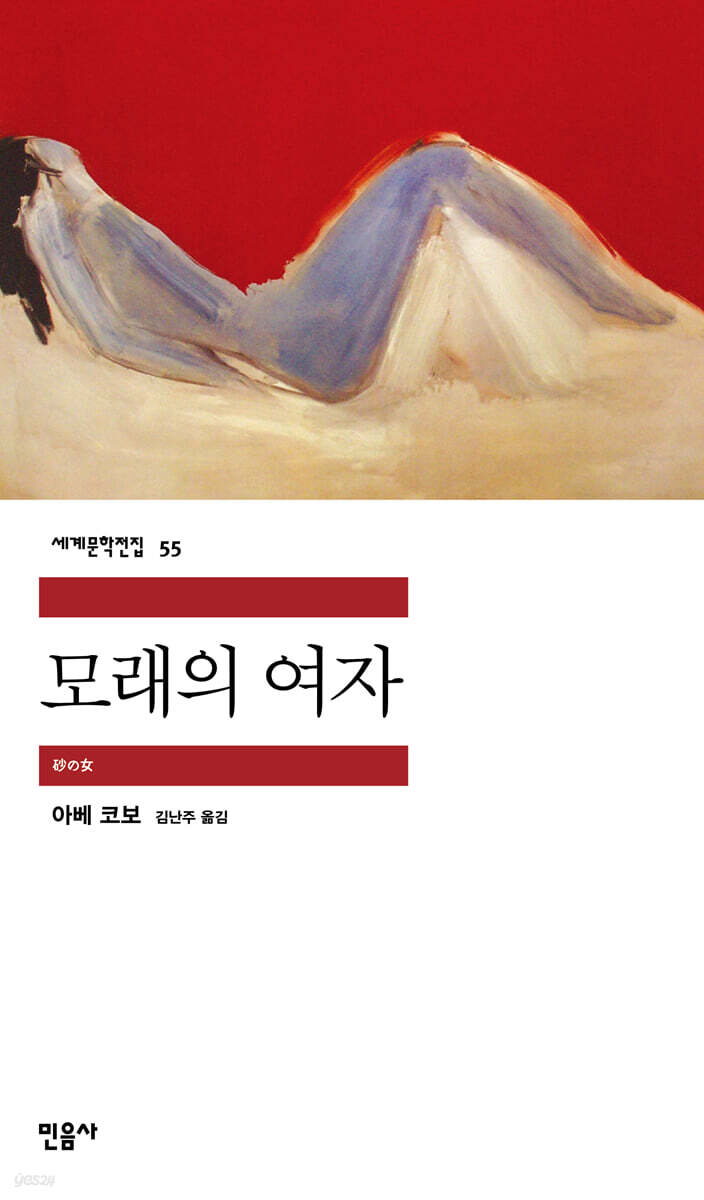
Woman of the Sand
 |
Description
Book Introduction
Kobo Abe, the "Japanese Kafka" who represents postwar Japanese literature
A man who left to escape from his daily life and ended up stuck in another routine.
A masterpiece that delves deeply into the meaning and freedom of everyday life using surrealist techniques.
“The waiting time was painful.
“Time was like a snake’s arrow, folded in several layers, drawing deep wrinkles.”
Japan's Kafka, Kobo Abe
Kobo Abe is a writer who has created a huge sensation worldwide, to the point that he was selected as one of the world's top 10 problem writers by the New York Times.
Representative post-war Japanese writers of the same generation as him include Yukio Mishima and Shohei Ooka.
They are distinct from traditional Japanese novelists who find material in everyday life, and are characterized by an ideological tendency to fundamentally question the nature of human existence and a pursuit of new methodologies.
Abe Kobo has left behind works that delve deeply into issues of modern society, such as human alienation and loss of identity, using surrealist techniques, and is recognized for contributing to the internationality of modern Japanese literature.
Kenzaburo Oe, winner of the 1994 Nobel Prize in Literature, said in his acceptance speech, "If Shohei Ooka and Kobo Abe were alive today, this prize would have gone to them." Haruki Murakami mentioned Yukio Mishima, Kenzaburo Oe, and Kobo Abe as writers representing his generation, and said that Kobo Abe was his favorite among them.
A man who left to escape from his daily life and ended up stuck in another routine.
A masterpiece that delves deeply into the meaning and freedom of everyday life using surrealist techniques.
“The waiting time was painful.
“Time was like a snake’s arrow, folded in several layers, drawing deep wrinkles.”
Japan's Kafka, Kobo Abe
Kobo Abe is a writer who has created a huge sensation worldwide, to the point that he was selected as one of the world's top 10 problem writers by the New York Times.
Representative post-war Japanese writers of the same generation as him include Yukio Mishima and Shohei Ooka.
They are distinct from traditional Japanese novelists who find material in everyday life, and are characterized by an ideological tendency to fundamentally question the nature of human existence and a pursuit of new methodologies.
Abe Kobo has left behind works that delve deeply into issues of modern society, such as human alienation and loss of identity, using surrealist techniques, and is recognized for contributing to the internationality of modern Japanese literature.
Kenzaburo Oe, winner of the 1994 Nobel Prize in Literature, said in his acceptance speech, "If Shohei Ooka and Kobo Abe were alive today, this prize would have gone to them." Haruki Murakami mentioned Yukio Mishima, Kenzaburo Oe, and Kobo Abe as writers representing his generation, and said that Kobo Abe was his favorite among them.
- You can preview some of the book's contents.
Preview
Into the book
A woman came carrying a table.
The side dish was stewed fish with clam broth.
It was a real beach meal, so that was fine, but then a woman held an umbrella over his head as he started eating.
"What are you going to do with the umbrella...?"
Is this a unique custom of this region?
"Oh, otherwise sand will get into the rice..."
"why?"
I looked up at the ceiling in surprise, but there wasn't really a hole in it.
"It's sand......."
The woman said, raising her face to the ceiling.
"It's rooted.
From all sides...
If you don't clean for just one day, it piles up by an inch."
--- p.30
But of course, pretending to be sick wasn't easy.
It's like holding a spring in your hand so tightly that it seems like it might pop out if you wind it too tightly.
It is impossible to tolerate this kind of thing forever.
I can't just leave things to their own devices.
I must thoroughly inform them of how heavy a burden my existence is to them.
Today, at all costs, let's make sure she doesn't get a single wink of sleep.
'Don't sleep...don't sleep...!'
The man groaned loudly, twisting his body.
--- p.81
"But, if I go outside, there's nothing to do..."
"Just walk!"
"Are you walking...?"
"Yeah, I'm walking...
Just walking around is enough.....
“Before I came here, you were free to go wherever you wanted, weren’t you?”
"But if I go out there and there's nothing to do, I'll just get tired..."
"What kind of nonsense are you talking about! Open your heart, I know you don't!......
Even dogs go crazy if they're locked up in a cage!
"I tried walking."
The woman suddenly spoke in a voice as muted as a clam with its shell closed.
"Seriously, it was a terrifying walk......
Until I got here...
Holding the baby, for a long time.......
Now, I'm tired of walking......"
--- p.87
Got a one way ticket to the blues, sing it as much as you want.
In reality, no one who holds a one-way ticket would ever sing like this.
The heels of the shoes of the races that only have one-way tickets are worn down to the point that they crack even if they step on gravel.
I can't walk any more.
What they want to sing is round-trip blues.
A one-way ticket means a life without context, where yesterday and today, and today and tomorrow, are not connected.
Only those who can hum a tune while holding a one-way ticket covered in so many wounds are those who will eventually get a round-trip ticket.
That's why, to avoid losing or having your return ticket stolen, you buy stocks like crazy, take out life insurance, and tell contradictory lies to the union and your bosses.
To avoid hearing the desperate cries of the idiots rising from the bathroom drains and toilet holes, we turn up the volume on the television and hum the idiot blues.
--- p.156
Suddenly, the dawn light brings sadness to me.......
It would be nice if we could lick each other's wounds.
But if you keep licking a wound that will never heal, won't your tongue eventually wear out?
"I didn't understand...
Anyway, life isn't something you can live by understanding every single thing...
But, there's that life and this life, and that one seems a little better...
If I continue to live like this, the thought of what I'm going to do is the most unbearable...
It's obvious that there's no answer to any life...
I have a feeling that it would be better if there were more things that could soothe my mind even a little bit......"
"I'm washing up."
--- pp.
198~199
[Stop talking nonsense.]
[Oh, don't get excited, listen carefully.
Acrophobia, acrophobia, drug addiction, hysteria, homicidal mania, syphilis, idiocy...
Each is 1 percent, and if you add them up, it's 20 percent...
If I could list 80 abnormal cases like this...
Of course, it's entirely possible...
It is statistically proven that humans are 100 percent abnormal.]
The side dish was stewed fish with clam broth.
It was a real beach meal, so that was fine, but then a woman held an umbrella over his head as he started eating.
"What are you going to do with the umbrella...?"
Is this a unique custom of this region?
"Oh, otherwise sand will get into the rice..."
"why?"
I looked up at the ceiling in surprise, but there wasn't really a hole in it.
"It's sand......."
The woman said, raising her face to the ceiling.
"It's rooted.
From all sides...
If you don't clean for just one day, it piles up by an inch."
--- p.30
But of course, pretending to be sick wasn't easy.
It's like holding a spring in your hand so tightly that it seems like it might pop out if you wind it too tightly.
It is impossible to tolerate this kind of thing forever.
I can't just leave things to their own devices.
I must thoroughly inform them of how heavy a burden my existence is to them.
Today, at all costs, let's make sure she doesn't get a single wink of sleep.
'Don't sleep...don't sleep...!'
The man groaned loudly, twisting his body.
--- p.81
"But, if I go outside, there's nothing to do..."
"Just walk!"
"Are you walking...?"
"Yeah, I'm walking...
Just walking around is enough.....
“Before I came here, you were free to go wherever you wanted, weren’t you?”
"But if I go out there and there's nothing to do, I'll just get tired..."
"What kind of nonsense are you talking about! Open your heart, I know you don't!......
Even dogs go crazy if they're locked up in a cage!
"I tried walking."
The woman suddenly spoke in a voice as muted as a clam with its shell closed.
"Seriously, it was a terrifying walk......
Until I got here...
Holding the baby, for a long time.......
Now, I'm tired of walking......"
--- p.87
Got a one way ticket to the blues, sing it as much as you want.
In reality, no one who holds a one-way ticket would ever sing like this.
The heels of the shoes of the races that only have one-way tickets are worn down to the point that they crack even if they step on gravel.
I can't walk any more.
What they want to sing is round-trip blues.
A one-way ticket means a life without context, where yesterday and today, and today and tomorrow, are not connected.
Only those who can hum a tune while holding a one-way ticket covered in so many wounds are those who will eventually get a round-trip ticket.
That's why, to avoid losing or having your return ticket stolen, you buy stocks like crazy, take out life insurance, and tell contradictory lies to the union and your bosses.
To avoid hearing the desperate cries of the idiots rising from the bathroom drains and toilet holes, we turn up the volume on the television and hum the idiot blues.
--- p.156
Suddenly, the dawn light brings sadness to me.......
It would be nice if we could lick each other's wounds.
But if you keep licking a wound that will never heal, won't your tongue eventually wear out?
"I didn't understand...
Anyway, life isn't something you can live by understanding every single thing...
But, there's that life and this life, and that one seems a little better...
If I continue to live like this, the thought of what I'm going to do is the most unbearable...
It's obvious that there's no answer to any life...
I have a feeling that it would be better if there were more things that could soothe my mind even a little bit......"
"I'm washing up."
--- pp.
198~199
[Stop talking nonsense.]
[Oh, don't get excited, listen carefully.
Acrophobia, acrophobia, drug addiction, hysteria, homicidal mania, syphilis, idiocy...
Each is 1 percent, and if you add them up, it's 20 percent...
If I could list 80 abnormal cases like this...
Of course, it's entirely possible...
It is statistically proven that humans are 100 percent abnormal.]
--- p.206
Publisher's Review
Abe Kobo's masterpiece, woven using allegorical techniques
Kobo Abe's masterpiece, "The Woman in the Sand," was published in 1962 and brought him instant worldwide fame. It was translated into English in 1964, and has since been translated into over 20 languages, including French, Czech, Finnish, Danish, and Russian.
The work is based on the disappearance of a man.
The protagonist sets out to collect insects in the sandy land to escape from his gray daily life.
A strange village has formed on the sand dunes along the coast he visited.
The houses are built into sand pits dug nearly 20 meters deep, like a crumbling honeycomb.
The man is trapped in a sand pit where a woman lives alone due to a plot by the villagers, and is forced to dig every day like the mythical Sisyphus, who must roll a boulder without rest to prevent the house from being buried by the flowing sand.
The woman explains to him, who is dumbfounded, that it is difficult for her to endure life there alone.
They said they couldn't stop the work because if one house collapsed, the entire village built on the dunes would collapse.
A man who tries to escape several times, screaming that even a monkey could do something like digging up sand if he were trained, and that he must have a more plausible reason for existing.
The author's voice inserted in the scene where the woman comforts the man after he escapes from the hole under a meticulous plan but is eventually sent back by the villagers, [It would be good to lick each other's wounds.
But if you keep licking a wound that will never heal, won't your tongue eventually wear out?] This part strongly stimulates readers who are enduring the daily repetition of daily life.
But the work doesn't end here.
After accidentally inventing a device to draw water from the sand, which the villagers had to distribute to the man to intimidate him as he attempted to escape, the man postpones his escape even though he is now in a position to do so.
Because of a desire to tell someone in the village about the water pump.
This abrupt ending leaves the reader hesitant and forced to question the very basis of everyday existence from various angles.
The world inside and outside the sand, connected like a Möbius strip
In his collection of essays, “Desert Thoughts,” Abe Kobo writes, “Deserts, or things that are desert-like, always have an indescribable charm.
It could be said that it is a longing for something that is not available in Japan, but I spent my childhood in Manchuria, which was almost like a desert.
It could be explained as nostalgia for the landscapes I saw and grew up in as a child, but in my memory, I think I longed for the desert even though I was surrounded by such a desert-like environment.
On a day when the sky is dyed dark brown and dust rises in the air, making it suffocating, sand that cannot be wiped away no matter how much you wipe it digs into your parched eyelids.
“Behind that irritated feeling was not a feeling of discomfort, but a kind of excited anticipation,” he confessed.
A longing for such a desert-like thing permeates the entire work.
The protagonist in the work is fascinated by the image of constantly flowing sand, which is different from the stifling reality that forces him to hang around all year round, and sets off for the sandy land, eventually acquiring the perspective of “seeing things through the eyes of sand.”
Seeing things through the eyes of sand is symbolized by the worldview that the protagonist acquires, that the world inside the sand pit and the world outside are ultimately connected like a Möbius strip.
After discovering water, he begins to feel “as if he were on top of a tower, even though he is still in a hole,” and he even comes to think of his coworkers outside the sandpit as “like cookie cutters, with no envy, just outlines and no substance.”
An excellent novel that you won't be able to put down once you start reading it.
A house built in a constantly shifting sand pit.
The setting itself is so fictional.
However, the author vividly and sensually portrays the characters in the sand based on his own experience living in the desert-like Manchuria and his detailed imagination.
Yukio Mishima said of this work: [An introduction full of poetry and suspense, several thrilling escape scenes, and an ending as concise, dry, and abrupt as sand.
All of this demonstrates the happy combination of Abe Kobo's talents as a playwright and as a novelist.
The author's creation of a widespread fear of Japan's reality is entirely fabricated, but the fiction is sustained by a persistent, keen sense of urgency.
He praised it as “an excellent novel that you can’t put down once you start reading.”
On the other hand, there is an evaluation that the protagonist's anxiety and sense of futility after falling into a sand pit appealed to the sensibilities of the post-war Japan, which led to its spectacular success.
This work, which won the Yomiuri Literary Award in 1963 and the French Prize for Best Foreign Literature in 1968, was made into a film by Hiroshi Teshigahara in 1964, which won the Special Jury Prize at the Cannes Film Festival and was nominated for the Academy Awards for Best Director and Best Foreign Language Film.
Kobo Abe's masterpiece, "The Woman in the Sand," was published in 1962 and brought him instant worldwide fame. It was translated into English in 1964, and has since been translated into over 20 languages, including French, Czech, Finnish, Danish, and Russian.
The work is based on the disappearance of a man.
The protagonist sets out to collect insects in the sandy land to escape from his gray daily life.
A strange village has formed on the sand dunes along the coast he visited.
The houses are built into sand pits dug nearly 20 meters deep, like a crumbling honeycomb.
The man is trapped in a sand pit where a woman lives alone due to a plot by the villagers, and is forced to dig every day like the mythical Sisyphus, who must roll a boulder without rest to prevent the house from being buried by the flowing sand.
The woman explains to him, who is dumbfounded, that it is difficult for her to endure life there alone.
They said they couldn't stop the work because if one house collapsed, the entire village built on the dunes would collapse.
A man who tries to escape several times, screaming that even a monkey could do something like digging up sand if he were trained, and that he must have a more plausible reason for existing.
The author's voice inserted in the scene where the woman comforts the man after he escapes from the hole under a meticulous plan but is eventually sent back by the villagers, [It would be good to lick each other's wounds.
But if you keep licking a wound that will never heal, won't your tongue eventually wear out?] This part strongly stimulates readers who are enduring the daily repetition of daily life.
But the work doesn't end here.
After accidentally inventing a device to draw water from the sand, which the villagers had to distribute to the man to intimidate him as he attempted to escape, the man postpones his escape even though he is now in a position to do so.
Because of a desire to tell someone in the village about the water pump.
This abrupt ending leaves the reader hesitant and forced to question the very basis of everyday existence from various angles.
The world inside and outside the sand, connected like a Möbius strip
In his collection of essays, “Desert Thoughts,” Abe Kobo writes, “Deserts, or things that are desert-like, always have an indescribable charm.
It could be said that it is a longing for something that is not available in Japan, but I spent my childhood in Manchuria, which was almost like a desert.
It could be explained as nostalgia for the landscapes I saw and grew up in as a child, but in my memory, I think I longed for the desert even though I was surrounded by such a desert-like environment.
On a day when the sky is dyed dark brown and dust rises in the air, making it suffocating, sand that cannot be wiped away no matter how much you wipe it digs into your parched eyelids.
“Behind that irritated feeling was not a feeling of discomfort, but a kind of excited anticipation,” he confessed.
A longing for such a desert-like thing permeates the entire work.
The protagonist in the work is fascinated by the image of constantly flowing sand, which is different from the stifling reality that forces him to hang around all year round, and sets off for the sandy land, eventually acquiring the perspective of “seeing things through the eyes of sand.”
Seeing things through the eyes of sand is symbolized by the worldview that the protagonist acquires, that the world inside the sand pit and the world outside are ultimately connected like a Möbius strip.
After discovering water, he begins to feel “as if he were on top of a tower, even though he is still in a hole,” and he even comes to think of his coworkers outside the sandpit as “like cookie cutters, with no envy, just outlines and no substance.”
An excellent novel that you won't be able to put down once you start reading it.
A house built in a constantly shifting sand pit.
The setting itself is so fictional.
However, the author vividly and sensually portrays the characters in the sand based on his own experience living in the desert-like Manchuria and his detailed imagination.
Yukio Mishima said of this work: [An introduction full of poetry and suspense, several thrilling escape scenes, and an ending as concise, dry, and abrupt as sand.
All of this demonstrates the happy combination of Abe Kobo's talents as a playwright and as a novelist.
The author's creation of a widespread fear of Japan's reality is entirely fabricated, but the fiction is sustained by a persistent, keen sense of urgency.
He praised it as “an excellent novel that you can’t put down once you start reading.”
On the other hand, there is an evaluation that the protagonist's anxiety and sense of futility after falling into a sand pit appealed to the sensibilities of the post-war Japan, which led to its spectacular success.
This work, which won the Yomiuri Literary Award in 1963 and the French Prize for Best Foreign Literature in 1968, was made into a film by Hiroshi Teshigahara in 1964, which won the Special Jury Prize at the Cannes Film Festival and was nominated for the Academy Awards for Best Director and Best Foreign Language Film.
GOODS SPECIFICS
- Date of issue: November 30, 2001
- Page count, weight, size: 241 pages | 334g | 132*224*20mm
- ISBN13: 9788937460555
- ISBN10: 8937460556
You may also like
카테고리
korean


korean

![GQ KOREA Mark (Monthly): December [2025]](http://librairie.coreenne.fr/cdn/shop/files/8ef265dbbfbf186523ed75ba7319009d.jpg?v=1765340328&width=3840)


