

Containing historical sentiments
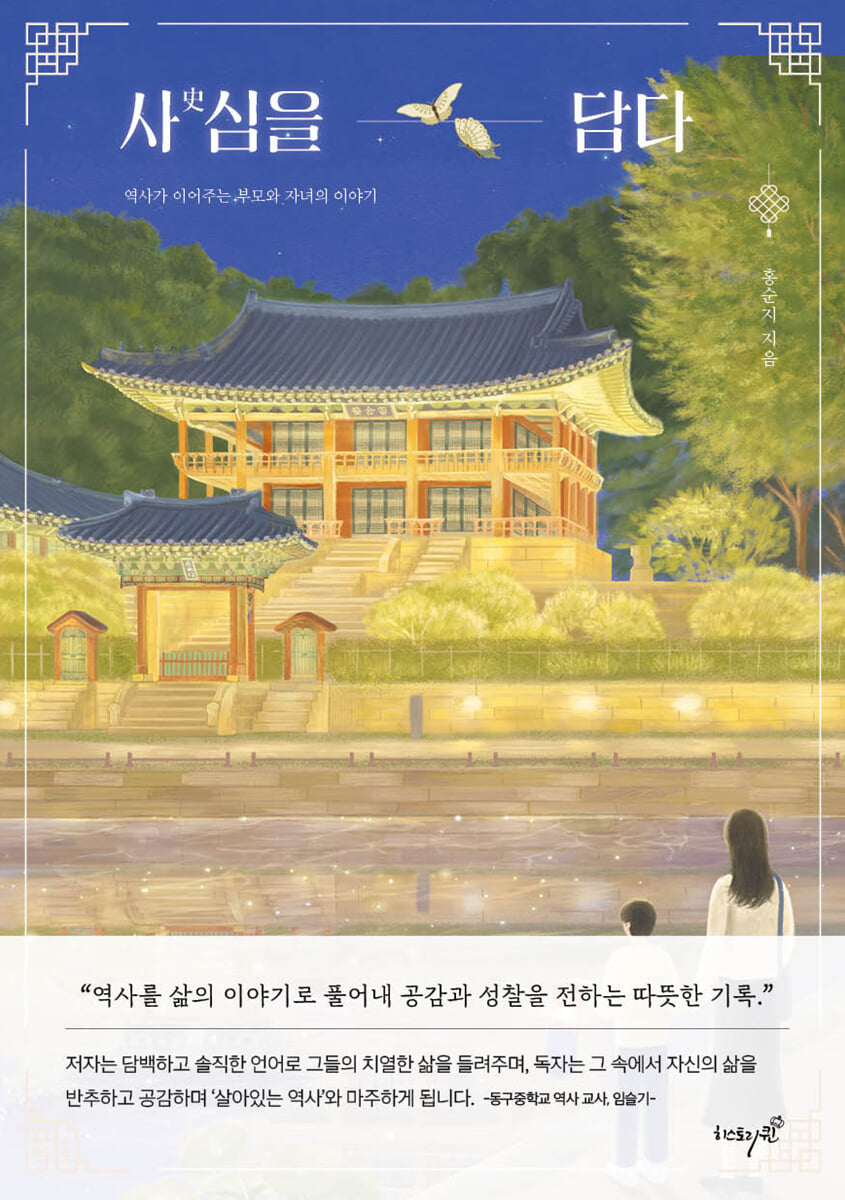 |
Description
Book Introduction
As the saying goes, "A nation that forgets its history has no future," we often learn lessons from history.
The author, a history teacher and mother of two, felt the same way.
He said that he wanted to live as an adult who knows how to understand his children like Taejong, not be a narrow-minded leader like Seonjo, be a warm and humble leader like Ahn Chang-ho, and know how to give of himself like Lee Hoe-young and Yu Il-han.
Because my own life was full of mistakes, and I was constantly laughing, crying, and wrestling with my children, I wanted to trace the lives of many great people and write this work to let parents who are struggling with their children's education know that history can provide answers.
The book is largely divided into four chapters.
Chapter 1 is about the historical mind that governs me, and tells me what I need to learn and what I need to be wary of.
Chapter 2 is about the love of history for children and teaches us how to approach life.
This is a particularly good chapter to read with children.
Chapter 3 is about the historical heart of parents, and it goes beyond the Joseon kings and independence activists to inform parents of the attitude they should have.
Chapter 4 is about parental strategies taught by the mind of history, and provides guidance to parents through great people in history.
In particular, I believe that the mother's "Jingbirok" at the end will be a good guidebook for parents who are interested in their children's education, just like Ryu Seong-ryong, who reflected on himself while recording the Imjin War.
The author, a history teacher and mother of two, felt the same way.
He said that he wanted to live as an adult who knows how to understand his children like Taejong, not be a narrow-minded leader like Seonjo, be a warm and humble leader like Ahn Chang-ho, and know how to give of himself like Lee Hoe-young and Yu Il-han.
Because my own life was full of mistakes, and I was constantly laughing, crying, and wrestling with my children, I wanted to trace the lives of many great people and write this work to let parents who are struggling with their children's education know that history can provide answers.
The book is largely divided into four chapters.
Chapter 1 is about the historical mind that governs me, and tells me what I need to learn and what I need to be wary of.
Chapter 2 is about the love of history for children and teaches us how to approach life.
This is a particularly good chapter to read with children.
Chapter 3 is about the historical heart of parents, and it goes beyond the Joseon kings and independence activists to inform parents of the attitude they should have.
Chapter 4 is about parental strategies taught by the mind of history, and provides guidance to parents through great people in history.
In particular, I believe that the mother's "Jingbirok" at the end will be a good guidebook for parents who are interested in their children's education, just like Ryu Seong-ryong, who reflected on himself while recording the Imjin War.
- You can preview some of the book's contents.
Preview
Detailed image

Into the book
Before I knew it, my worries and history were intertwined.
As I thought about connecting history with myself, my perspective gradually broadened.
When I feel like nagging, I think of my father, King Yeongjo, who constantly interfered and nagged at his son, and of Crown Prince Sado, who must have been anxious and distressed because of it.
When I can't sleep because of mistakes and failures, I think of failures throughout history and look for answers.
I wanted to grow old as a wise and generous adult like countless figures in history, and as I organized the messages of history, my historical thoughts soon became a book.
--- p.6
In the 18th year of his reign, as his health deteriorated, Sejong changed the system of the six ministries, in which the king directly led all state affairs, to the system of the State Council, which strengthened the role of the ministers of the State Council.
It is no exaggeration to say that it was King Munjong's reign, as his son, King Munjong, served as regent for about eight years during the last years of King Sejong's reign.
Sejong, who knew his strengths and weaknesses well and coordinated his work.
If you want to be perfect, you need to be able to make the best choices through communication and distribution rather than trying to grab everything and complete it yourself.
--- p.17
As a wealthy scholar, he could compromise with reality, but Lee Hoe-young was a true scholar who knew how to put into practice the new knowledge he had learned and how to share what he had.
A generous person who knows how to give of what is theirs, a person who is not self-sufficient but constantly dreams of the future and challenges themselves.
A person who can live his life proudly without regrets even at the last moment.
A person who knows when to compromise and resist, makes wise choices, and knows how to take responsibility for and refine his or her choices.
I pray tonight that I can become that kind of person.
--- p.43
The rebellion of the last rank that Silla's unification showed us shows us how we should live.
Rather than getting frustrated and giving up on what you don't have, calmly and steadily expand your skills.
It was a message from the Three Kingdoms period.
--- p.69
Queen Soheon lived up to King Sejong's trust and showed herself to be a leader.
Due to the control of King Taejong, Sejong's father, his father died and his family fell into ruin.
She must have been angry at the thought of her mother living a miserable life as a government slave and her family having fallen apart.
It wasn't unusual for her to get caught up in her emotions and ruin everything, but she remained aloof.
Was it because of Sejong's deep comfort and trust that he was healed?
--- p.78
Parents' excessive greed and restrictions discourage children.
We must accept children as they are, and accept their differences as they are.
Taejong, who acknowledges and accepts his children's differences and prioritizes his relationship with them, and Yeongjo, who forces his children to do what he believes is right.
It cannot be said that either Taejong or Yeongjo is right.
Because it can vary depending on the child and the situation.
But what's important is the attitude of acknowledging that your child is different from you and accepting him or her as an individual being.
And it is the heart that believes in and waits for the child.
--- p.117
Although we cannot compare ourselves to Ahn Chang-ho and his wife, who fought for independence, we are no less loving and cherishing than them.
After going through a time of separation that was like a shower, I became wiser and more mature.
I also learned that the cute promise we made as newlyweds that we would never be a weekend couple because if our bodies were weak, our hearts would also be weak was wrong.
That time, which seemed like it would be poisonous, was actually a time when we gave each other greater trust.
As I think of my husband along with Ahn Chang-ho's heartbreaking letter, I miss him especially today.
I should at least make a quick phone call.
--- p.135
As you learn about the Joseon Dynasty, you wonder what power was that could restrain children, kill nephews, and cause fights between brothers.
I often explain to my children that it is a dynastic state and cannot be fully understood from our current perspective, but if you look back carefully, the essence is no different from now.
Even if it's not power, they hurt their children for fame and greed, and if the children don't move in the direction they want, they interfere and become suspicious.
--- p.160
Jingbirok means to rebuke oneself for shameful mistakes and to reflect on what to do in the future.
Ryu Seong-ryong, who recorded the Imjin War, reflected on the war while recording it in “Jingbirok.”
I wanted to look back on the difficult process I had gone through, examine what went wrong, what I needed to be wary of, and create a better future.
I, too, recall memories of crying and laughing with my children and students, and in the last chapter, I outline strategies for parenting.
--- p.187
I hope to become an adult who thinks about my inner self and my child's inner self.
We emphasize reading and thinking to children, but this isn't limited to children and teenagers.
I hope that we adults can also read, think, and find a clear direction.
Just as children, whose brains are developing at this stage, need books, so too do we, parents, who need to find our way in life.
And I hope we can listen to the messages of history that can point us in that direction.
Isn't the usefulness of the humanities even greater in this era of the Fourth Industrial Revolution?
As I thought about connecting history with myself, my perspective gradually broadened.
When I feel like nagging, I think of my father, King Yeongjo, who constantly interfered and nagged at his son, and of Crown Prince Sado, who must have been anxious and distressed because of it.
When I can't sleep because of mistakes and failures, I think of failures throughout history and look for answers.
I wanted to grow old as a wise and generous adult like countless figures in history, and as I organized the messages of history, my historical thoughts soon became a book.
--- p.6
In the 18th year of his reign, as his health deteriorated, Sejong changed the system of the six ministries, in which the king directly led all state affairs, to the system of the State Council, which strengthened the role of the ministers of the State Council.
It is no exaggeration to say that it was King Munjong's reign, as his son, King Munjong, served as regent for about eight years during the last years of King Sejong's reign.
Sejong, who knew his strengths and weaknesses well and coordinated his work.
If you want to be perfect, you need to be able to make the best choices through communication and distribution rather than trying to grab everything and complete it yourself.
--- p.17
As a wealthy scholar, he could compromise with reality, but Lee Hoe-young was a true scholar who knew how to put into practice the new knowledge he had learned and how to share what he had.
A generous person who knows how to give of what is theirs, a person who is not self-sufficient but constantly dreams of the future and challenges themselves.
A person who can live his life proudly without regrets even at the last moment.
A person who knows when to compromise and resist, makes wise choices, and knows how to take responsibility for and refine his or her choices.
I pray tonight that I can become that kind of person.
--- p.43
The rebellion of the last rank that Silla's unification showed us shows us how we should live.
Rather than getting frustrated and giving up on what you don't have, calmly and steadily expand your skills.
It was a message from the Three Kingdoms period.
--- p.69
Queen Soheon lived up to King Sejong's trust and showed herself to be a leader.
Due to the control of King Taejong, Sejong's father, his father died and his family fell into ruin.
She must have been angry at the thought of her mother living a miserable life as a government slave and her family having fallen apart.
It wasn't unusual for her to get caught up in her emotions and ruin everything, but she remained aloof.
Was it because of Sejong's deep comfort and trust that he was healed?
--- p.78
Parents' excessive greed and restrictions discourage children.
We must accept children as they are, and accept their differences as they are.
Taejong, who acknowledges and accepts his children's differences and prioritizes his relationship with them, and Yeongjo, who forces his children to do what he believes is right.
It cannot be said that either Taejong or Yeongjo is right.
Because it can vary depending on the child and the situation.
But what's important is the attitude of acknowledging that your child is different from you and accepting him or her as an individual being.
And it is the heart that believes in and waits for the child.
--- p.117
Although we cannot compare ourselves to Ahn Chang-ho and his wife, who fought for independence, we are no less loving and cherishing than them.
After going through a time of separation that was like a shower, I became wiser and more mature.
I also learned that the cute promise we made as newlyweds that we would never be a weekend couple because if our bodies were weak, our hearts would also be weak was wrong.
That time, which seemed like it would be poisonous, was actually a time when we gave each other greater trust.
As I think of my husband along with Ahn Chang-ho's heartbreaking letter, I miss him especially today.
I should at least make a quick phone call.
--- p.135
As you learn about the Joseon Dynasty, you wonder what power was that could restrain children, kill nephews, and cause fights between brothers.
I often explain to my children that it is a dynastic state and cannot be fully understood from our current perspective, but if you look back carefully, the essence is no different from now.
Even if it's not power, they hurt their children for fame and greed, and if the children don't move in the direction they want, they interfere and become suspicious.
--- p.160
Jingbirok means to rebuke oneself for shameful mistakes and to reflect on what to do in the future.
Ryu Seong-ryong, who recorded the Imjin War, reflected on the war while recording it in “Jingbirok.”
I wanted to look back on the difficult process I had gone through, examine what went wrong, what I needed to be wary of, and create a better future.
I, too, recall memories of crying and laughing with my children and students, and in the last chapter, I outline strategies for parenting.
--- p.187
I hope to become an adult who thinks about my inner self and my child's inner self.
We emphasize reading and thinking to children, but this isn't limited to children and teenagers.
I hope that we adults can also read, think, and find a clear direction.
Just as children, whose brains are developing at this stage, need books, so too do we, parents, who need to find our way in life.
And I hope we can listen to the messages of history that can point us in that direction.
Isn't the usefulness of the humanities even greater in this era of the Fourth Industrial Revolution?
--- p.190
Publisher's Review
Walking the path of history with your children,
The heart of history that serves as a compass
As I accumulated the countless wisdoms contained in history, one by one, I soon found myself filled with a passion for history.
I began writing to share my full passion and to let people know that history can provide answers.
-From the “Introductory Note”
As the saying goes, "A nation that forgets its history has no future," we often learn lessons from history.
The author, a history teacher and mother of two, felt the same way.
He said that he wanted to live as an adult who knows how to understand his children like Taejong, not be a narrow-minded leader like Seonjo, be a warm and humble leader like Ahn Chang-ho, and know how to give of himself like Lee Hoe-young and Yu Il-han.
Because my own life was full of mistakes, and I was constantly laughing, crying, and wrestling with my children, I wanted to look back on the lives of many great people and write this work to let parents who are struggling with their children's education know that history can provide answers.
When using historical stories to educate children,
Stroll around Independence Gate during the day and Changdeokgung Palace at night, seeking answers in the lives of Joseon's kings and independence activists.
The book is largely divided into four chapters.
Chapter 1 is about the historical mind that governs me, and tells me what I need to learn and what I need to be wary of.
I resolve to become a woman who, like Sejong, appropriately identifies and balances her strengths and weaknesses; like Shin Gyu-sik, uses her wounds as a turning point to reflect on herself without being ashamed of them; and like Na Hye-seok, knows how to confidently express her opinions.
Chapter 2 is about historical interest for children, and teaches the attitude that adults should have through great people in history.
Through Silla, which developed the last of the three kingdoms but eventually achieved unification, we learn the attitude of a teacher who guides children to study without giving up until the end; through Queen Soheon and King Sejong, who loved and cherished each other, we learn the strong loyalty and affection between a married couple; and through Yeo Un-hyeong, who predicted liberation and formed a government in advance, we learn the attitude of a parent who thoroughly prepares.
Chapter 3 is about the historical heart of parents, and it goes beyond the Joseon kings and independence activists to inform parents of the attitude they should have.
It shows us how to set an example as a parent through King Yeongjo, who was overly strict, Crown Prince Sado, who rebelled against him and went astray, eventually dying in a rice chest, and King Yeonsangun, who rebelled against his subjects and decided not to live like his father, who had deposed and killed his mother.
Chapter 4 is about parental strategies taught by the mind of history, and provides guidance to parents through great people in history.
Just like Jeong Do-jeon, who laid the foundation for the Joseon royal family behind the king, he emphasizes the need for a strategy that appropriately utilizes carrots and sticks when raising a child, and he also uses King Injo, who drove his son to death due to suspicions about Crown Prince Sohyeon who returned from Qing, as a negative example.
A history teacher and mother of two tells the story:
Created by Mom's "Jingbirok"
Ryu Seong-ryong, who recorded the Imjin War, reflected on the war while recording it in “Jingbirok.”
I wanted to look back on the difficult process I had gone through, examine what went wrong, what I needed to be wary of, and create a better future.
Like Yu Seong-ryong, the author created the so-called 'Mom's 'Jingbirok' for parents who are working hard to educate their children.
First, consider your promise to your child as the most important.
second.
Always empathize with and listen to children's stories.
Third, give children the initiative.
Fourth, have a formal discussion time.
This is a guidebook that summarizes parents' educational policies through the great people of history, organized in chapters 1 through 4.
In closing, the author concludes his work with the following words:
I hope to become an adult who thinks about my inner self and my child's inner self.
We emphasize reading and thinking to children, but this isn't limited to children and teenagers.
I hope that we adults can also read, think, and find a clear direction.
-From "Concluding Writing"
The heart of history that serves as a compass
As I accumulated the countless wisdoms contained in history, one by one, I soon found myself filled with a passion for history.
I began writing to share my full passion and to let people know that history can provide answers.
-From the “Introductory Note”
As the saying goes, "A nation that forgets its history has no future," we often learn lessons from history.
The author, a history teacher and mother of two, felt the same way.
He said that he wanted to live as an adult who knows how to understand his children like Taejong, not be a narrow-minded leader like Seonjo, be a warm and humble leader like Ahn Chang-ho, and know how to give of himself like Lee Hoe-young and Yu Il-han.
Because my own life was full of mistakes, and I was constantly laughing, crying, and wrestling with my children, I wanted to look back on the lives of many great people and write this work to let parents who are struggling with their children's education know that history can provide answers.
When using historical stories to educate children,
Stroll around Independence Gate during the day and Changdeokgung Palace at night, seeking answers in the lives of Joseon's kings and independence activists.
The book is largely divided into four chapters.
Chapter 1 is about the historical mind that governs me, and tells me what I need to learn and what I need to be wary of.
I resolve to become a woman who, like Sejong, appropriately identifies and balances her strengths and weaknesses; like Shin Gyu-sik, uses her wounds as a turning point to reflect on herself without being ashamed of them; and like Na Hye-seok, knows how to confidently express her opinions.
Chapter 2 is about historical interest for children, and teaches the attitude that adults should have through great people in history.
Through Silla, which developed the last of the three kingdoms but eventually achieved unification, we learn the attitude of a teacher who guides children to study without giving up until the end; through Queen Soheon and King Sejong, who loved and cherished each other, we learn the strong loyalty and affection between a married couple; and through Yeo Un-hyeong, who predicted liberation and formed a government in advance, we learn the attitude of a parent who thoroughly prepares.
Chapter 3 is about the historical heart of parents, and it goes beyond the Joseon kings and independence activists to inform parents of the attitude they should have.
It shows us how to set an example as a parent through King Yeongjo, who was overly strict, Crown Prince Sado, who rebelled against him and went astray, eventually dying in a rice chest, and King Yeonsangun, who rebelled against his subjects and decided not to live like his father, who had deposed and killed his mother.
Chapter 4 is about parental strategies taught by the mind of history, and provides guidance to parents through great people in history.
Just like Jeong Do-jeon, who laid the foundation for the Joseon royal family behind the king, he emphasizes the need for a strategy that appropriately utilizes carrots and sticks when raising a child, and he also uses King Injo, who drove his son to death due to suspicions about Crown Prince Sohyeon who returned from Qing, as a negative example.
A history teacher and mother of two tells the story:
Created by Mom's "Jingbirok"
Ryu Seong-ryong, who recorded the Imjin War, reflected on the war while recording it in “Jingbirok.”
I wanted to look back on the difficult process I had gone through, examine what went wrong, what I needed to be wary of, and create a better future.
Like Yu Seong-ryong, the author created the so-called 'Mom's 'Jingbirok' for parents who are working hard to educate their children.
First, consider your promise to your child as the most important.
second.
Always empathize with and listen to children's stories.
Third, give children the initiative.
Fourth, have a formal discussion time.
This is a guidebook that summarizes parents' educational policies through the great people of history, organized in chapters 1 through 4.
In closing, the author concludes his work with the following words:
I hope to become an adult who thinks about my inner self and my child's inner self.
We emphasize reading and thinking to children, but this isn't limited to children and teenagers.
I hope that we adults can also read, think, and find a clear direction.
-From "Concluding Writing"
GOODS SPECIFICS
- Date of issue: November 15, 2025
- Page count, weight, size: 200 pages | 289g | 148*210*9mm
- ISBN13: 9791199310803
- ISBN10: 1199310808
You may also like
카테고리
korean


korean

![GQ KOREA Mark (Monthly): December [2025]](http://librairie.coreenne.fr/cdn/shop/files/8ef265dbbfbf186523ed75ba7319009d.jpg?v=1765340328&width=3840)


