

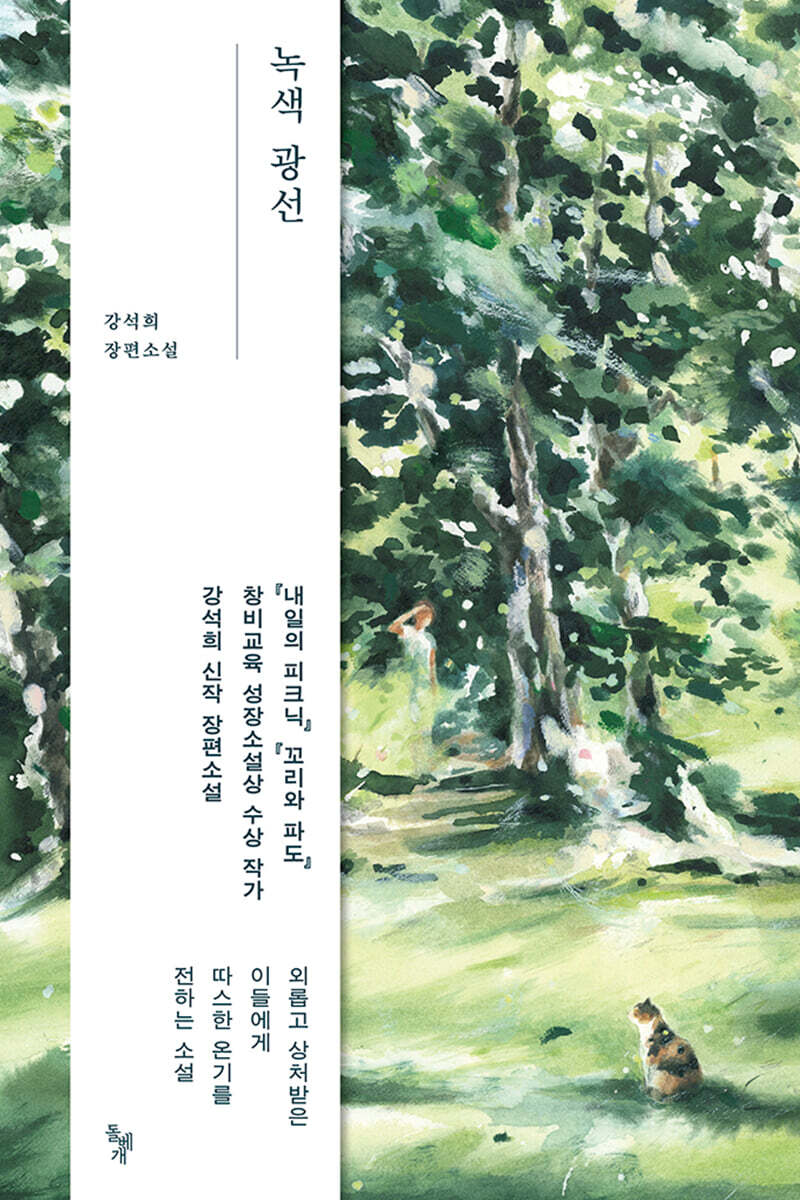
green ray
 |
Description
Book Introduction
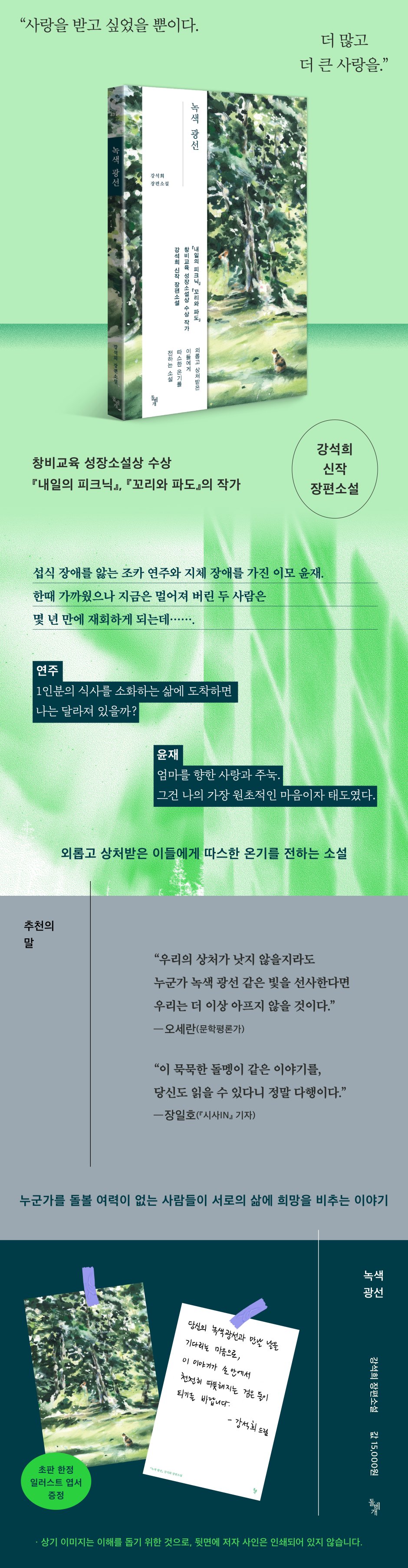
“I just wanted to be loved.
“More and greater love.”
People who don't have the capacity to care for someone
A story that illuminates each other's lives with hope
“Kang Seok-hee’s gaze is directed towards the shaded spot.
The virtue of this work lies in the delicacy of the hands that reveal and embrace the pain.
Even if our wounds do not heal, if someone gives us a light like a green ray
“We will not be sick anymore.”
Recommended by Oh Se-ran (literary critic)
Tomorrow's Picnic, The Tail and the Waves
A new novel by Changbi Education Coming-of-Age Novel Award winner Kang Seok-hee
The new full-length novel, "Green Ray," by Kang Seok-hee, a current Korean language teacher and winner of the Changbi Education Coming-of-Age Novel Award, has been published.
This work unfolds a hidden story by bringing in characters from the short story “Green Ray” included in the anthology “Where Does Your Right Foot Go” (by Kang Seok-hee et al.), which contains various forms of care.
The author, who began her career by winning the Dong-A Ilbo New Year's Literary Contest in 2018, delicately addressed the various aspects of violence that occurred within schools in her previous work, "Tail and Wave," demonstrating a strong solidarity across generations. In "Tomorrow's Picnic," she brought to light the violence in society that a young person preparing for independence and a vocational high school student experiences during a corporate field training.
This new work continues the author's interest in social issues, showing how the lack of a social system shifts the burden of disability and care work onto individuals.
Through this, the narrative was completed with literary lyricism that allows readers to naturally think about 'disability' and 'care'.
“More and greater love.”
People who don't have the capacity to care for someone
A story that illuminates each other's lives with hope
“Kang Seok-hee’s gaze is directed towards the shaded spot.
The virtue of this work lies in the delicacy of the hands that reveal and embrace the pain.
Even if our wounds do not heal, if someone gives us a light like a green ray
“We will not be sick anymore.”
Recommended by Oh Se-ran (literary critic)
Tomorrow's Picnic, The Tail and the Waves
A new novel by Changbi Education Coming-of-Age Novel Award winner Kang Seok-hee
The new full-length novel, "Green Ray," by Kang Seok-hee, a current Korean language teacher and winner of the Changbi Education Coming-of-Age Novel Award, has been published.
This work unfolds a hidden story by bringing in characters from the short story “Green Ray” included in the anthology “Where Does Your Right Foot Go” (by Kang Seok-hee et al.), which contains various forms of care.
The author, who began her career by winning the Dong-A Ilbo New Year's Literary Contest in 2018, delicately addressed the various aspects of violence that occurred within schools in her previous work, "Tail and Wave," demonstrating a strong solidarity across generations. In "Tomorrow's Picnic," she brought to light the violence in society that a young person preparing for independence and a vocational high school student experiences during a corporate field training.
This new work continues the author's interest in social issues, showing how the lack of a social system shifts the burden of disability and care work onto individuals.
Through this, the narrative was completed with literary lyricism that allows readers to naturally think about 'disability' and 'care'.
- You can preview some of the book's contents.
Preview
index
Part 1: The Need for Trapping
Part 2 Light in the Forest
Part 3: Seasons with Aunt
Part 4: Stones and Dance
Author's Note
Recommendation
Part 2 Light in the Forest
Part 3: Seasons with Aunt
Part 4: Stones and Dance
Author's Note
Recommendation
Detailed image
Into the book
My aunt and I had to pause for a moment in front of the apartment's common entrance.
The wheelchair access was blocked by a new coat of paint.
My aunt couldn't climb the three steps that even my short, thin legs could climb.
My aunt looked upset as she turned her back on me and exchanged messages with my mom.
A little later, my aunt told me what my mother had said about what I should eat and where I should be at home for the next two hours.
And he handed me a ten thousand won bill.
I wondered why my aunt couldn't come to our house with me.
I just sat on the sofa blankly without even touching the food my mom told me to eat.
My aunt's spine, which was sharply curved diagonally to the right, kept flashing in my mind.
I wondered if my aunt had taken the right route, which required changing buses twice, and how she had gotten here in the first place.
It was the first time in my life that I saw my aunt's back properly.
--- p.67~68
I didn't want to laugh and have fun with my aunt again like that.
I just needed a familiar, quiet, barrier-free road.
A place where Aunt doesn't have to be conscious of the slope of the ground.
A place where my aunt and I don't have to take care of each other.
We walked in silence.
It was quiet for a long time.
An uncomfortable and heavy silence.
Somehow the mountain seemed to be silent with us.
Animals that could be easily seen were not visible, and the wind was not blowing, so the trees and forest stood still like still life.
It feels like you're inside an oil painting with a rough texture.
Hot and sticky steps.
Steps.
--- p.74
Because I dropped out of school, I couldn't see those kids every day.
Instead, we met once a week and did some life trapping.
The location is Jille Park.
I decided to go to the place where I last saw Bami.
That was my opinion.
The children did so without asking why.
We've now become quite adept at handling fairly difficult objects, such as water balloons, which are easily popped, or golf balls, which have a high rebound.
Hye-young's skills improved, and she performed a trick where she chewed two pieces of bubble gum in one bite, made them into a ball, spat them out, kicked them up with her foot, and chewed them again.
It didn't look very sanitary, but it was so interesting that I asked to see it from time to time.
Hye-young said that one day she would achieve the ultimate trapping, the tofu-catching bet.
We waited and cheered for that day to come.
--- p.125~126
I went to the hospital, got counseling, and kept a journal to escape the word 'perfect,' but I still obsessed with many things.
I wanted the space I lived in with my aunt to be neat, I wanted my relationships with my friends to be strong, and I wanted to become a great person.
Will I be any different when I reach a life where I can digest a single meal? No.
Do I have to change to be able to eat a single meal? And only then will I become a single human being?
--- p.136
My well-being, eating three meals a day to take care of Bami.
I want to see the night for a long time with healthy and clear eyes.
The thought that Bami's life will be shorter than mine.
A lonely certainty based on science made me long for time with Bam-i.
This life could be Bami's last.
When I think about it that way, it becomes clear what state I should be in.
So Bami is healthy, sometimes scratches me and my aunt, and sleeps in my aunt's wheelchair every night.
Watching that scene brings me a definite sense of happiness.
--- p.167
It took a lot of time and effort to get to know Yeonju and her aunt's story.
So I often had to go back to the thoughts I had when I first wrote this novel.
This story began with a travelogue my wife and her family took in 2019, and there was one person in a wheelchair in that story.
He succeeds in discovering something he really wanted to see in the forests and mountains that are usually difficult to access.
My wife's face lit up as she recounted the memories of that day, and it felt like she had witnessed a moment she had always wanted to see, so I also held this story dear to my heart.
And over the years, that story has become an important scene for me when I think of the word 'care,' and I can't help but embrace it happily.
The wheelchair access was blocked by a new coat of paint.
My aunt couldn't climb the three steps that even my short, thin legs could climb.
My aunt looked upset as she turned her back on me and exchanged messages with my mom.
A little later, my aunt told me what my mother had said about what I should eat and where I should be at home for the next two hours.
And he handed me a ten thousand won bill.
I wondered why my aunt couldn't come to our house with me.
I just sat on the sofa blankly without even touching the food my mom told me to eat.
My aunt's spine, which was sharply curved diagonally to the right, kept flashing in my mind.
I wondered if my aunt had taken the right route, which required changing buses twice, and how she had gotten here in the first place.
It was the first time in my life that I saw my aunt's back properly.
--- p.67~68
I didn't want to laugh and have fun with my aunt again like that.
I just needed a familiar, quiet, barrier-free road.
A place where Aunt doesn't have to be conscious of the slope of the ground.
A place where my aunt and I don't have to take care of each other.
We walked in silence.
It was quiet for a long time.
An uncomfortable and heavy silence.
Somehow the mountain seemed to be silent with us.
Animals that could be easily seen were not visible, and the wind was not blowing, so the trees and forest stood still like still life.
It feels like you're inside an oil painting with a rough texture.
Hot and sticky steps.
Steps.
--- p.74
Because I dropped out of school, I couldn't see those kids every day.
Instead, we met once a week and did some life trapping.
The location is Jille Park.
I decided to go to the place where I last saw Bami.
That was my opinion.
The children did so without asking why.
We've now become quite adept at handling fairly difficult objects, such as water balloons, which are easily popped, or golf balls, which have a high rebound.
Hye-young's skills improved, and she performed a trick where she chewed two pieces of bubble gum in one bite, made them into a ball, spat them out, kicked them up with her foot, and chewed them again.
It didn't look very sanitary, but it was so interesting that I asked to see it from time to time.
Hye-young said that one day she would achieve the ultimate trapping, the tofu-catching bet.
We waited and cheered for that day to come.
--- p.125~126
I went to the hospital, got counseling, and kept a journal to escape the word 'perfect,' but I still obsessed with many things.
I wanted the space I lived in with my aunt to be neat, I wanted my relationships with my friends to be strong, and I wanted to become a great person.
Will I be any different when I reach a life where I can digest a single meal? No.
Do I have to change to be able to eat a single meal? And only then will I become a single human being?
--- p.136
My well-being, eating three meals a day to take care of Bami.
I want to see the night for a long time with healthy and clear eyes.
The thought that Bami's life will be shorter than mine.
A lonely certainty based on science made me long for time with Bam-i.
This life could be Bami's last.
When I think about it that way, it becomes clear what state I should be in.
So Bami is healthy, sometimes scratches me and my aunt, and sleeps in my aunt's wheelchair every night.
Watching that scene brings me a definite sense of happiness.
--- p.167
It took a lot of time and effort to get to know Yeonju and her aunt's story.
So I often had to go back to the thoughts I had when I first wrote this novel.
This story began with a travelogue my wife and her family took in 2019, and there was one person in a wheelchair in that story.
He succeeds in discovering something he really wanted to see in the forests and mountains that are usually difficult to access.
My wife's face lit up as she recounted the memories of that day, and it felt like she had witnessed a moment she had always wanted to see, so I also held this story dear to my heart.
And over the years, that story has become an important scene for me when I think of the word 'care,' and I can't help but embrace it happily.
--- From the main text, “Author’s Note”
Publisher's Review
“Will I be different when I reach a life where I can digest a meal for one person?
“Only after doing that will I become a human being?”
The novel "Green Ray" unfolds as the stories of the protagonist, Yeon-ju, who suffers from an eating disorder, and her aunt, Yoon-jae, who has a physical disability, intersect.
After failing the entrance exam for a specialized high school, Yeonju fails her grades at the regular high school she enters, and suffers from rumors spread by her ex-boyfriend, distancing herself from everyone at school.
One morning, after sweeping up all the edible things as if sweeping them up, Yeonju, who was suffering from a high fever of unknown cause as a child, vomits up all the food as the cloudy meat soup in front of her and the front teeth of Somi, the rabbit her maternal grandfather raised, overlap.
Yeonju contacts her aunt, with whom she was once close but has now grown distant, for the first time in years.
The two people who reunited spend two seasons in the same house, maintaining a distance that is neither too close nor too far, staying by each other's side.
A grandmother who had to give up the job she wanted to do after giving birth to her second daughter who has a disability.
An aunt who lived a lonely life, not fully understood even by her mother and family after learning that her daughter had an eating disorder.
A performance where one cannot control the urge to eat.
"Green Ray" delicately reveals how disability permeates the lives of three generations of women: grandmother, mother/aunt, and Yeonju.
It felt like all the misery in the world was pouring down on me.
What used to please me soon became a nuisance.
What bothers me easily makes me addicted.
I was often disappointed in myself.
Actually, every day.
No, every moment… … .
And what's left is chewing and spitting.
I think about it often.
Where Did It Go Wrong? (Page 24)
A novel that brings warmth to the lonely and wounded.
Yeonju, the main character of "Green Ray," experiences children who misunderstand her and say hurtful things to her, and she becomes unable to trust others, leading her to remain quiet at school.
The members of Life Trapping approach the performance.
Hye-young, Da-hae, and Jeong-yeon, who gathered with the goal of “accepting the feeling of things falling and sinking endlessly” by repeatedly practicing receiving various objects with the instep and gently putting them down, unlike the children who judge people by rumors, touch Yeon-ju’s heart in an affectionate and cheerful manner.
Meanwhile, Yeonju decides to get healthy in order to take care of a stray cat named Bami that she meets by chance on her walk, but ends up dropping out of school due to an illness that can be cured but not completely cured.
Yeonju, who has become an out-of-school youth, is accompanied by three children who take turns looking after her aunt and Yeonju's pet doll.
Despite the opposition of her maternal grandmother, who pushed her in a wheelchair her entire life, my aunt finally achieved independence and lives in a small space, spending time with her loved ones, working, and fighting to make the world a better place.
One day, a month after staying at Aunt Yoonjae's house, Yeonju learns that her aunt's regular outings, which used to be twice a week, were actually a struggle for the right to mobility for the disabled.
Since some pain can only be understood through experience, Yeonju stands in her aunt's place and struggles, only then does she realize what kind of world her aunt has lived in.
Just like the 'green ray' that can be seen beyond the horizon if you're lucky when the sun rises or sets, I hope that Yeonju, Aunt Yunjae, and the readers of this book will each have their own green ray waiting for them in the future.
A distorted face.
A mouth that curses.
A mocking laugh.
Hand taking a picture.
Cold lens.
A gaze even colder than that.
A frown of contempt.
(…) While I was sharing warmth with my aunt’s friends, we were there like a deserted island.
That is an undeniable fact.
I had a little idea of the loneliness my aunt endured twice a week, maybe every day, or even her entire life.
(Page 157)
“Only after doing that will I become a human being?”
The novel "Green Ray" unfolds as the stories of the protagonist, Yeon-ju, who suffers from an eating disorder, and her aunt, Yoon-jae, who has a physical disability, intersect.
After failing the entrance exam for a specialized high school, Yeonju fails her grades at the regular high school she enters, and suffers from rumors spread by her ex-boyfriend, distancing herself from everyone at school.
One morning, after sweeping up all the edible things as if sweeping them up, Yeonju, who was suffering from a high fever of unknown cause as a child, vomits up all the food as the cloudy meat soup in front of her and the front teeth of Somi, the rabbit her maternal grandfather raised, overlap.
Yeonju contacts her aunt, with whom she was once close but has now grown distant, for the first time in years.
The two people who reunited spend two seasons in the same house, maintaining a distance that is neither too close nor too far, staying by each other's side.
A grandmother who had to give up the job she wanted to do after giving birth to her second daughter who has a disability.
An aunt who lived a lonely life, not fully understood even by her mother and family after learning that her daughter had an eating disorder.
A performance where one cannot control the urge to eat.
"Green Ray" delicately reveals how disability permeates the lives of three generations of women: grandmother, mother/aunt, and Yeonju.
It felt like all the misery in the world was pouring down on me.
What used to please me soon became a nuisance.
What bothers me easily makes me addicted.
I was often disappointed in myself.
Actually, every day.
No, every moment… … .
And what's left is chewing and spitting.
I think about it often.
Where Did It Go Wrong? (Page 24)
A novel that brings warmth to the lonely and wounded.
Yeonju, the main character of "Green Ray," experiences children who misunderstand her and say hurtful things to her, and she becomes unable to trust others, leading her to remain quiet at school.
The members of Life Trapping approach the performance.
Hye-young, Da-hae, and Jeong-yeon, who gathered with the goal of “accepting the feeling of things falling and sinking endlessly” by repeatedly practicing receiving various objects with the instep and gently putting them down, unlike the children who judge people by rumors, touch Yeon-ju’s heart in an affectionate and cheerful manner.
Meanwhile, Yeonju decides to get healthy in order to take care of a stray cat named Bami that she meets by chance on her walk, but ends up dropping out of school due to an illness that can be cured but not completely cured.
Yeonju, who has become an out-of-school youth, is accompanied by three children who take turns looking after her aunt and Yeonju's pet doll.
Despite the opposition of her maternal grandmother, who pushed her in a wheelchair her entire life, my aunt finally achieved independence and lives in a small space, spending time with her loved ones, working, and fighting to make the world a better place.
One day, a month after staying at Aunt Yoonjae's house, Yeonju learns that her aunt's regular outings, which used to be twice a week, were actually a struggle for the right to mobility for the disabled.
Since some pain can only be understood through experience, Yeonju stands in her aunt's place and struggles, only then does she realize what kind of world her aunt has lived in.
Just like the 'green ray' that can be seen beyond the horizon if you're lucky when the sun rises or sets, I hope that Yeonju, Aunt Yunjae, and the readers of this book will each have their own green ray waiting for them in the future.
A distorted face.
A mouth that curses.
A mocking laugh.
Hand taking a picture.
Cold lens.
A gaze even colder than that.
A frown of contempt.
(…) While I was sharing warmth with my aunt’s friends, we were there like a deserted island.
That is an undeniable fact.
I had a little idea of the loneliness my aunt endured twice a week, maybe every day, or even her entire life.
(Page 157)
GOODS SPECIFICS
- Date of issue: September 4, 2025
- Page count, weight, size: 180 pages | 306g | 140*210*10mm
- ISBN13: 9791194442455
- ISBN10: 1194442455
You may also like
카테고리
korean


korean

![GQ KOREA Mark (Monthly): December [2025]](http://librairie.coreenne.fr/cdn/shop/files/8ef265dbbfbf186523ed75ba7319009d.jpg?v=1765340328&width=3840)


