

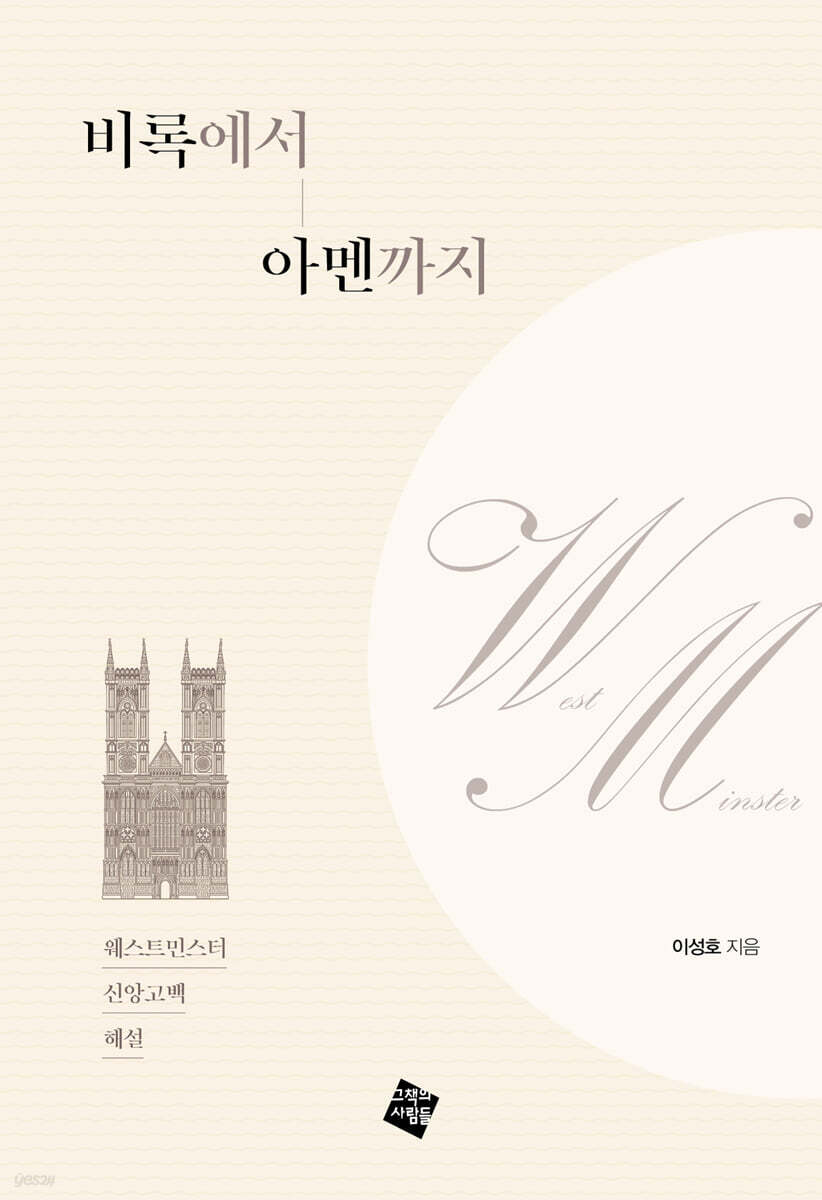
From Even to Amen
 |
Description
Book Introduction
To suit the reality of the Korean church
Explain it clearly
Excellently applied
Commentary on the Westminster Confession of Faith!
The Westminster Confession of Faith is a confession of faith that faithfully summarizes what we must believe about God and what glorious duties God requires of us.
And this book, “From “Although” to “Amen,” is a commentary that clearly explains and excellently applies the Westminster Confession of Faith to the reality of the Korean church.
Following the authors of the "Confessions," the author speaks God's truth as far as the Bible says, and stops where the Bible stops, stating it humbly, yet with great conviction and love.
It also excels at preserving the direction and order of the statements of the authors of the 'Confession', helping readers understand, realize, and love the contents of this excellent 'Confession'.
True and living faith is a faith that believes in God correctly and obeys God with all one's heart.
Readers, you will get a sweet taste of what the Bible says about true and living faith, what it means to possess that faith, and what it means to live by that faith!
Explain it clearly
Excellently applied
Commentary on the Westminster Confession of Faith!
The Westminster Confession of Faith is a confession of faith that faithfully summarizes what we must believe about God and what glorious duties God requires of us.
And this book, “From “Although” to “Amen,” is a commentary that clearly explains and excellently applies the Westminster Confession of Faith to the reality of the Korean church.
Following the authors of the "Confessions," the author speaks God's truth as far as the Bible says, and stops where the Bible stops, stating it humbly, yet with great conviction and love.
It also excels at preserving the direction and order of the statements of the authors of the 'Confession', helping readers understand, realize, and love the contents of this excellent 'Confession'.
True and living faith is a faith that believes in God correctly and obeys God with all one's heart.
Readers, you will get a sweet taste of what the Bible says about true and living faith, what it means to possess that faith, and what it means to live by that faith!
- You can preview some of the book's contents.
Preview
index
Recommendation
How to teach
Explore the Westminster Confession of Faith
Introduction · 27
Faith and Confession · 27
The Bible and Confession · 28
Confessions and Catechism · 29
The Historical Background of the Westminster Confession of Faith · 30
Name · 30
General Assembly and Parliament · 31
The Church of England · 32
The English Revolution: When the General Assembly Meets · 34
After the General Assembly · 36
Structure and Characteristics of the Confession of Faith · 37
Structure · 37
Features · 38
Chapter 1 The Bible
Introduction: The First Article of the Confession of Faith · 46
Article 1: The Necessity of the Bible · 47
1) The Usefulness and Insufficiency of General Revelation · 48
2) Special Revelation: The Limitations of Unrecorded Revelation vs. the Necessity of Recorded Revelation · 49
Points · 51
Articles 2 and 3: The Name and Scope of the Bible · 53
The Recorded Word of God · 53
The Inspiration of the Bible: The Rule of Faith and Life · 55
The Scope of the Bible: 66 Books of the Old and New Testaments · 56
Questions to Consider · 58
Articles 4 and 5: The Autopistis of Scripture (the internal testimony of the Holy Spirit) · 58
Additional Explanation · 61
Articles 6 and 7: Essential Biblical Doctrines and Clarity of Scripture · 62
The Scope of Essential Doctrine: 'The Whole Will of God' & Explicit Precepts & Good and Necessary Inferences · 62
The Illumination of the Holy Spirit & Wise Discernment · 64
Additional Explanation · 66
Perspicuity of the Bible · 66
Application · 68
Article 8: Biblical Texts: Originals, Copies, and Translations · 69
Things to Consider · 71
Articles 9 and 10: Interpreting Scripture: Infallible Rules & the Supreme Judge · 72
The Bible: The Infallible Rule · 72
The Holy Spirit: The Supreme Judge · 74
Chapter 2 God and the Holy Trinity
Introduction: Theology & Theology · 77
Article 1: God's Attributes: What Kind of God Do You Believe in? · 79
God's Existence and Justice · 79
God's Attributes (Character) · 82
God's Work · 87
God's Moral Attributes · 88
Article 2: The Relationship Between God and Creation · 90
God's Self-Existence · 90
Article 3: The Trinity · 93
Additional Explanation · 96
1.
Council of Nicaea (325 AD) · 96
2.
Conceptual Summary: Filioque · 97
3.
Common Misconceptions About the Trinity · 98
Chapter 3 God's Eternal Decree
Introduction: How Does God Decide? · 102
Definition of Article 1 · 104
Basic Concepts · 104
The Problem of Sin and Free Will · 104
Special Lecture: Necessity, Freedom, and Contingency · 105
Distinction of Intentions: Permissive Intentions · 107
Calvin's Explanation: The Example of Job · 107
Article 2: God's Knowledge & God's Decree · 108
Double Schedule and Its Confirmation in Articles 3 and 4 · 109
Article 5 Selection · 111
Article 6: The Soteriological Means of Realizing Choice · 113
Article 7 Organic · 113
How to Teach the Eighth Scheduled Doctrine? · 115
Chapter 4 Creation
Introduction: Determination and Creation · 119
Article 1 Definition of Creation · 120
Article 2: The Creation of Man · 123
1.
The Image of God · 123
2.
Mutable Being · 126
3.
God's Covenant Partner: Why He Gave the Tree of the Knowledge of Good and Evil · 127
Chapter 5: Providence
Article 1: Definition of Providence · 132
Article 2: Providence and Second Causes · 134
Article 3: Providence and Miracles (General Providence vs. Special Providence) · 135
Article 4: Providence and Sin · 136
Articles 5 and 6: Providence for the Believers and Providence for the Wicked · 139
Article 7: Providence for the Church: "Centered on the Church" · 140
Conclusion · 141
Chapter 6: The Fall of Man, Sin, and the Punishment for Sin
Introduction: Why You Need to Know the Fall · 145
Article 1, First Offense · 146
Article 2: The Fall and Its Consequences · 150
Article 3 Original Sin · 152
Article 4 Total Depravity · 155
Article 5: The Corruption Remaining in the Reborn · 157
Punishment for Article 6 · 159
Chapter 7 God's Covenant with Mankind
Introduction: The Most Outstanding Contribution of Reformed Theology · 164
Article 1: The Necessity of the Covenant: The Distance Between God and Man · 167
Article 2: The Covenant of Works: The First Covenant · 169
Article 3: The Covenant of Grace: The Second Covenant · 172
Article 4. Covenant as a Will · 173
The Implementation of Articles 5 and 6 of the Covenant: Differences Between the Old and New Testaments · 174
Chapter 8 Christ the Mediator
Introduction: Important but Neglected Concepts · 181
Definition of mediator in Article 1 · 184
Article 2: The Person of the Mediator (True God, True Man) · 188
Article 3: The Gifts and Qualifications of the Mediator (Holy Spirit) · 192
Article 4: The Duties of the Mediator (Apostles' Creed) · 195
1.
The Duties of a Mediator in a Degraded State · 195
2.
The Duties of the Mediator in the Ascension State · 199
Article 5: The Effects of the Intercessory Ministry: Satisfaction and Redemption · 202
Article 6: The Effect of Redemption: What About the Elect Before the Birth of Jesus? · 204
Article 7: The Intercessory Ministry and the Exchange of Attributes (communicatio idiomatum) · 205
Exchange of Attributes · 205
Article 8: The Certainty of Atonement (Limited Atonement) · 207
Additional Explanation · 210
Hypothetical Universalism · 210
Redemption · 211
Chapter 9 Free Will
Introduction: Is Free Will the Opposite of God's Sovereignty? · 215
Article 1: What is Free Will? · 217
The Fourfold State (Articles 2-5: State of Innocence, State of Sin, State of Grace, State of Glory) · 221
The Importance of This Doctrine · 224
Chapter 10: Effective Calling
Introduction: The Ordo Salutis · 227
Article 1: What is an Effective Calling? · 233
Basic Definition · 233
Intelligence, Mind, Will · 235
Effective Calling & Irresistible Grace · 236
Reasons for the Call in Article 2 · 238
Why do some believe and others don't? · 238
Calling and Rebirth · 239
What about the children selected in Article 3? · 241
Article 4: Those who are not selected? · 243
Chapter 11 Justification
Introduction: God's Righteousness · 247
Article 1 Definition of Justification · 249
Article 2: "What Is Faith Alone?": Limitations and Extensibility · 254
The Purpose of Justification: “Strict Justice” & “Abundant Grace” · 255
Article 4: The Time of Justification: Eternal Past, In the Fullness of Time, and at the Appointed Time · 257
Article 5: The Problem of Sin in Justification · 259
Article 6: The Consistency of Justification: Old and New Testaments · 260
Chapter 12: Becoming a Quantum Being
Introduction: Positioning the Doctrine of Quantum Becoming · 264
Commentary · 266
Enjoying Your Child's Freedom and Privileges · 267
Chapter 13: The Holy Fire
Introduction: The Holy Disappearance · 271
Article 1 Definition of Holy Fire · 273
Death (Mortification) & Life (Vivification): Two Aspects of Sanctification · 276
Article 2: The Wholeness and Imperfection of Sanctification: Spiritual Warfare · 278
Article 3: The Final Completion of the Holy Fire · 279
Chapter 14: The Faith That Saves
Introduction: Different Types of Belief · 282
Article 1: Definition of Saving Faith · 284
Article 2: The Function of Faith · 287
1) Belief that what has been revealed is true · 287
2) Act differently depending on the type of word: Command, Warning, Promise · 288
3) The Principal Act of Faith · 289
Article 3: Degree of Faith · 290
Further Explanation: Weak and Strong Faith (Romans 15) · 291
Chapter 15: Repentance That Leads to Life
Introduction: The Beginnings of the Reformation · 296
Article 1: The Need to Preach Repentance · 298
Article 2 Definition of Repentance: Turning · 302
1) Turning from Sin · 302
2) Moving Toward God · 303
Article 3: The Relationship Between Repentance and Forgiveness of Sins · 304
Article 4: The Gravity of Sin: Are There Gradients of Sin? · 305
Article 5: The Need for Specific Repentance · 306
Article 6: The Importance of Victims · 307
Explanation: On the Gravity of Sin (Larger Catechism, Question 151) · 310
Chapter 16: Good Deeds
Introduction: Why the Controversy? · 315
How do I know what the first clause is? · 317
The Tremendous Benefits of Good Deeds in Article 2 · 319
Where does the ability to do good deeds come from? · 323
Article 4: The Value of Good Deeds: It is bound to be very inadequate · 325
Article 5: Why Good Deeds Cannot Be Merited · 326
Article 6: Reasons why good deeds can be recognized despite many flaws · 327
Article 7: The Good Deeds of the Unregenerate: Beneficial but Not Please God · 328
Chapter 17: The Perseverance of the Saints
Introduction: "Once Saved, Always Saved?" · 331
Article 1: What is the Tow of the Saints? · 333
Where does the force of traction in the second paragraph come from? · 335
Even in the state of grace, Article 3 · 338
Chapter 18: Grace and Assurance of Salvation
Introduction: Confidence and Hope · 342
Article 1: Who Can Be Sure? · 344
Two Results of Hope · 348
Where Does Confidence Come From in the Second Article? · 349
The Foundation of Confidence · 350
Article 3: Is this assurance necessary for all believers? · 351
1) How to Gain Confidence · 351
2) Fruit of Assurance · 354
Assurance and Church Growth · 356
Article 4: May be shaken, but not lead to complete despair · 357
Chapter 19 God's Law
Introduction: Can We Enjoy the Law? · 363
Article 1: The Law as a Covenant of Works: Before the Fall · 366
Article 2: The Fall and the Ten Commandments · 367
Articles 3, 4, and 5: Ceremonial & Civil Law (temporary), Moral Law (permanent) · 370
Article 6: The Great Benefits of the Law · 373
Curbing the Remaining Corruption: The Warnings of the Law & The Promises of the Law · 377
Article 7: The Relationship Between Law and Gospel: A "Sweet" Relationship · 378
Chapter 20: Christian Liberty and Freedom of Conscience
Introduction: The Importance of Freedom · 383
Article 1: The Preciousness of Freedom & the Definition of Freedom · 385
1.
Freedom from ~~ · 386
2.
Freedom Towards ~~ · 389
3.
Christian Freedom in the Old and New Testaments · 390
Article 2 Freedom of Conscience · 391
Article 3: The Purpose of Freedom: Serving the Lord Without Sin · 393
Article 4: Freedom Within the Fence: Superior Powers, Freedom of Thought and Expression, and Church Order · 394
The Power of Godliness · 396
Additional Explanation · 398
Chapter 21: Religious Worship and the Sabbath
Introduction: Worship, the Face of the Church · 402
Historical Background · 405
Article 1: Regulatory Principles of Worship · 407
Article 2: Objects of Worship: The Trinity: Father, Son, and Holy Spirit · 412
Article 3: Elements of Worship: How Should We Pray? · 414
Article 4: Contents of Prayer: What and For Whom Should We Pray? · 417
Prayer for the Dead · 418
“The Sin Leading to Death” · 419
Article 5 Elements of Worship · 420
1) Normal case · 420
2) Special Cases · 429
Article 6: Place, Time, and Type of Worship · 432
Article 7: The Sabbath: A Time for Worship · 433
Article 8: How to Keep the Sabbath Holy · 435
Chapter 22 Legal Oaths and Vows
Introduction: Historical Background · 441
Article 1 Definition of Oath · 444
Article 2: Method of Oath · 446
Article 3 Scope of the Oath · 447
Article 4: The Nature of the Oath · 448
Regarding the Vows in Articles 5, 6, and 7 · 448
Application: How to Put It into Practice? · 450
Wedding Vows · 450
Infant Baptism Vow · 452
Baptismal Vows · 453
Oath of Office · 454
Will (Legacy) · 455
Additional Explanation: How Should We View the Seowon? · 456
Chapter 23: State leaders
Introduction: Political Apathy & Political Addiction · 460
Article 1: Reasons for Establishing a National Leader · 462
Article 2: Can a Believer Become a Leader? · 465
Article 3: The Relationship Between the Government and the Church (The Power of the Sword vs. the Power of the Keys) · 469
Article 4: Believers' Obligations to Government Officials · 472
Chapter 24 Marriage and Divorce
Introduction: Marriage & the Beginning of the English Reformation · 477
Article 1: What is a legal marriage? · 479
Article 2: Why Marry? · 482
Articles 3 and 4 Who Can I Marry? · 485
Articles 5 and 6: Divorce and Remarriage · 488
Chapter 25: The Church
Introduction: "I Believe in the Church" · 493
Articles 1 and 2 Catholic (Universal Church: Invisible & Visible) · 495
Invisible vs. Visible: Choice vs. Confession · 498
Article 3: The Means of Building a Church · 501
Articles 4 and 5: Marks of the True Church · 503
Article 6: Christ is the only head of the Church · 506
Chapter 26: The Fellowship of Saints
Introduction: "We Believe in the Fellowship of Saints" · 509
Article 1: What is the fellowship of saints? · 512
Article 2: How and how much should we help each other? · 516
Article 3: False Teachings on the Fellowship of the Saints · 518
Additional Note: Manna and the Fellowship of the Saints · 522
Chapter 27: Sacraments
Introduction: Indifference to the Sacraments · 525
Article 1: What is a Sacrament? "The Sign and Seal of the Covenant of Grace" · 528
Article 2: Sacramental Union · 530
Article 3: The Power of the Holy Spirit and the Word · 532
Article 4: The Number of Sacraments: Sacraments vs. Holy Rites · 534
Article 5: The Sacraments of the Old and New Testaments · 538
Chapter 28 Baptism
Introduction: The Illusion of Discipleship · 541
Article 1 Definition of Baptism · 542
The Four Signs and Seals of Baptism as a Covenant of Grace · 544
Articles 2 and 3: The Method of Baptism · 548
Article 4: Who Should Be Baptized: Why Infants Should Be Baptized · 551
Article 5: The Relationship Between Baptism and Regeneration: The Importance of Baptism · 553
Article 6: The Effect of Baptism: “At the Appointed Time” · 554
Article 7: Number of Baptisms · 555
Chapter 29: The Lord's Supper (Eucharist)
Introduction: Funerals vs. Weddings · 561
Article 1: What is the Holy Communion? · 563
Article 2: False Communion (Refutation of the Roman Church's Mass) · 568
Article 3: How to Administer the Holy Communion? · 569
Article 4: Examples of Improper Administration of the Holy Communion · 572
Articles 5 and 6: The Relationship Between the Elements and Substance of the Eucharist · 573
Article 7: How to Receive the Holy Communion · 575
Article 8: Meals of the Unjust (manducatio indignorum) · 577
Chapter 30: Discipline (Church Punishment)
Introduction: Can a Church Without Discipline Really Grow? · 580
Article 1 Divine Canon (Jus Divinum) · 582
Article 2: The Keys of Heaven (The Power of the Church) · 585
Article 3: Purpose and Necessity of Disciplinary Action · 587
Article 4 Types of Punishment · 590
Chapter 31: The Council
Introduction: Biblical Examples · 594
Article 1: The Need for the Council: Being & Well-Being · 597
Article 2: Who Can Convene a Council? · 598
Article 3 Functions of the Council · 600
Article 4: Authority of the Council · 602
Article 5: How to Deal with Political Issues · 602
Chapter 32: The State of Man After Death and the Resurrection of the Dead
Introduction: The Last · 605
Article 1: If I die right now...
· 606
Special Lecture: The Larger Catechism's Teaching on Death · 611
Articles 2 and 3 Concerning the Resurrection of the Body on the Last Day · 612
Chapter 33: The Last Judgment
Introduction: "He Will Come to Judge": Can We Long for Judgment? · 617
Article 1: Righteous Judgment · 619
Purpose of the Second Paragraph Judgment · 621
Special Lecture: The Rich Man and Lazarus · 623
Article 3: The Nature of the Day · 625
On the way out · 629
How to teach
Explore the Westminster Confession of Faith
Introduction · 27
Faith and Confession · 27
The Bible and Confession · 28
Confessions and Catechism · 29
The Historical Background of the Westminster Confession of Faith · 30
Name · 30
General Assembly and Parliament · 31
The Church of England · 32
The English Revolution: When the General Assembly Meets · 34
After the General Assembly · 36
Structure and Characteristics of the Confession of Faith · 37
Structure · 37
Features · 38
Chapter 1 The Bible
Introduction: The First Article of the Confession of Faith · 46
Article 1: The Necessity of the Bible · 47
1) The Usefulness and Insufficiency of General Revelation · 48
2) Special Revelation: The Limitations of Unrecorded Revelation vs. the Necessity of Recorded Revelation · 49
Points · 51
Articles 2 and 3: The Name and Scope of the Bible · 53
The Recorded Word of God · 53
The Inspiration of the Bible: The Rule of Faith and Life · 55
The Scope of the Bible: 66 Books of the Old and New Testaments · 56
Questions to Consider · 58
Articles 4 and 5: The Autopistis of Scripture (the internal testimony of the Holy Spirit) · 58
Additional Explanation · 61
Articles 6 and 7: Essential Biblical Doctrines and Clarity of Scripture · 62
The Scope of Essential Doctrine: 'The Whole Will of God' & Explicit Precepts & Good and Necessary Inferences · 62
The Illumination of the Holy Spirit & Wise Discernment · 64
Additional Explanation · 66
Perspicuity of the Bible · 66
Application · 68
Article 8: Biblical Texts: Originals, Copies, and Translations · 69
Things to Consider · 71
Articles 9 and 10: Interpreting Scripture: Infallible Rules & the Supreme Judge · 72
The Bible: The Infallible Rule · 72
The Holy Spirit: The Supreme Judge · 74
Chapter 2 God and the Holy Trinity
Introduction: Theology & Theology · 77
Article 1: God's Attributes: What Kind of God Do You Believe in? · 79
God's Existence and Justice · 79
God's Attributes (Character) · 82
God's Work · 87
God's Moral Attributes · 88
Article 2: The Relationship Between God and Creation · 90
God's Self-Existence · 90
Article 3: The Trinity · 93
Additional Explanation · 96
1.
Council of Nicaea (325 AD) · 96
2.
Conceptual Summary: Filioque · 97
3.
Common Misconceptions About the Trinity · 98
Chapter 3 God's Eternal Decree
Introduction: How Does God Decide? · 102
Definition of Article 1 · 104
Basic Concepts · 104
The Problem of Sin and Free Will · 104
Special Lecture: Necessity, Freedom, and Contingency · 105
Distinction of Intentions: Permissive Intentions · 107
Calvin's Explanation: The Example of Job · 107
Article 2: God's Knowledge & God's Decree · 108
Double Schedule and Its Confirmation in Articles 3 and 4 · 109
Article 5 Selection · 111
Article 6: The Soteriological Means of Realizing Choice · 113
Article 7 Organic · 113
How to Teach the Eighth Scheduled Doctrine? · 115
Chapter 4 Creation
Introduction: Determination and Creation · 119
Article 1 Definition of Creation · 120
Article 2: The Creation of Man · 123
1.
The Image of God · 123
2.
Mutable Being · 126
3.
God's Covenant Partner: Why He Gave the Tree of the Knowledge of Good and Evil · 127
Chapter 5: Providence
Article 1: Definition of Providence · 132
Article 2: Providence and Second Causes · 134
Article 3: Providence and Miracles (General Providence vs. Special Providence) · 135
Article 4: Providence and Sin · 136
Articles 5 and 6: Providence for the Believers and Providence for the Wicked · 139
Article 7: Providence for the Church: "Centered on the Church" · 140
Conclusion · 141
Chapter 6: The Fall of Man, Sin, and the Punishment for Sin
Introduction: Why You Need to Know the Fall · 145
Article 1, First Offense · 146
Article 2: The Fall and Its Consequences · 150
Article 3 Original Sin · 152
Article 4 Total Depravity · 155
Article 5: The Corruption Remaining in the Reborn · 157
Punishment for Article 6 · 159
Chapter 7 God's Covenant with Mankind
Introduction: The Most Outstanding Contribution of Reformed Theology · 164
Article 1: The Necessity of the Covenant: The Distance Between God and Man · 167
Article 2: The Covenant of Works: The First Covenant · 169
Article 3: The Covenant of Grace: The Second Covenant · 172
Article 4. Covenant as a Will · 173
The Implementation of Articles 5 and 6 of the Covenant: Differences Between the Old and New Testaments · 174
Chapter 8 Christ the Mediator
Introduction: Important but Neglected Concepts · 181
Definition of mediator in Article 1 · 184
Article 2: The Person of the Mediator (True God, True Man) · 188
Article 3: The Gifts and Qualifications of the Mediator (Holy Spirit) · 192
Article 4: The Duties of the Mediator (Apostles' Creed) · 195
1.
The Duties of a Mediator in a Degraded State · 195
2.
The Duties of the Mediator in the Ascension State · 199
Article 5: The Effects of the Intercessory Ministry: Satisfaction and Redemption · 202
Article 6: The Effect of Redemption: What About the Elect Before the Birth of Jesus? · 204
Article 7: The Intercessory Ministry and the Exchange of Attributes (communicatio idiomatum) · 205
Exchange of Attributes · 205
Article 8: The Certainty of Atonement (Limited Atonement) · 207
Additional Explanation · 210
Hypothetical Universalism · 210
Redemption · 211
Chapter 9 Free Will
Introduction: Is Free Will the Opposite of God's Sovereignty? · 215
Article 1: What is Free Will? · 217
The Fourfold State (Articles 2-5: State of Innocence, State of Sin, State of Grace, State of Glory) · 221
The Importance of This Doctrine · 224
Chapter 10: Effective Calling
Introduction: The Ordo Salutis · 227
Article 1: What is an Effective Calling? · 233
Basic Definition · 233
Intelligence, Mind, Will · 235
Effective Calling & Irresistible Grace · 236
Reasons for the Call in Article 2 · 238
Why do some believe and others don't? · 238
Calling and Rebirth · 239
What about the children selected in Article 3? · 241
Article 4: Those who are not selected? · 243
Chapter 11 Justification
Introduction: God's Righteousness · 247
Article 1 Definition of Justification · 249
Article 2: "What Is Faith Alone?": Limitations and Extensibility · 254
The Purpose of Justification: “Strict Justice” & “Abundant Grace” · 255
Article 4: The Time of Justification: Eternal Past, In the Fullness of Time, and at the Appointed Time · 257
Article 5: The Problem of Sin in Justification · 259
Article 6: The Consistency of Justification: Old and New Testaments · 260
Chapter 12: Becoming a Quantum Being
Introduction: Positioning the Doctrine of Quantum Becoming · 264
Commentary · 266
Enjoying Your Child's Freedom and Privileges · 267
Chapter 13: The Holy Fire
Introduction: The Holy Disappearance · 271
Article 1 Definition of Holy Fire · 273
Death (Mortification) & Life (Vivification): Two Aspects of Sanctification · 276
Article 2: The Wholeness and Imperfection of Sanctification: Spiritual Warfare · 278
Article 3: The Final Completion of the Holy Fire · 279
Chapter 14: The Faith That Saves
Introduction: Different Types of Belief · 282
Article 1: Definition of Saving Faith · 284
Article 2: The Function of Faith · 287
1) Belief that what has been revealed is true · 287
2) Act differently depending on the type of word: Command, Warning, Promise · 288
3) The Principal Act of Faith · 289
Article 3: Degree of Faith · 290
Further Explanation: Weak and Strong Faith (Romans 15) · 291
Chapter 15: Repentance That Leads to Life
Introduction: The Beginnings of the Reformation · 296
Article 1: The Need to Preach Repentance · 298
Article 2 Definition of Repentance: Turning · 302
1) Turning from Sin · 302
2) Moving Toward God · 303
Article 3: The Relationship Between Repentance and Forgiveness of Sins · 304
Article 4: The Gravity of Sin: Are There Gradients of Sin? · 305
Article 5: The Need for Specific Repentance · 306
Article 6: The Importance of Victims · 307
Explanation: On the Gravity of Sin (Larger Catechism, Question 151) · 310
Chapter 16: Good Deeds
Introduction: Why the Controversy? · 315
How do I know what the first clause is? · 317
The Tremendous Benefits of Good Deeds in Article 2 · 319
Where does the ability to do good deeds come from? · 323
Article 4: The Value of Good Deeds: It is bound to be very inadequate · 325
Article 5: Why Good Deeds Cannot Be Merited · 326
Article 6: Reasons why good deeds can be recognized despite many flaws · 327
Article 7: The Good Deeds of the Unregenerate: Beneficial but Not Please God · 328
Chapter 17: The Perseverance of the Saints
Introduction: "Once Saved, Always Saved?" · 331
Article 1: What is the Tow of the Saints? · 333
Where does the force of traction in the second paragraph come from? · 335
Even in the state of grace, Article 3 · 338
Chapter 18: Grace and Assurance of Salvation
Introduction: Confidence and Hope · 342
Article 1: Who Can Be Sure? · 344
Two Results of Hope · 348
Where Does Confidence Come From in the Second Article? · 349
The Foundation of Confidence · 350
Article 3: Is this assurance necessary for all believers? · 351
1) How to Gain Confidence · 351
2) Fruit of Assurance · 354
Assurance and Church Growth · 356
Article 4: May be shaken, but not lead to complete despair · 357
Chapter 19 God's Law
Introduction: Can We Enjoy the Law? · 363
Article 1: The Law as a Covenant of Works: Before the Fall · 366
Article 2: The Fall and the Ten Commandments · 367
Articles 3, 4, and 5: Ceremonial & Civil Law (temporary), Moral Law (permanent) · 370
Article 6: The Great Benefits of the Law · 373
Curbing the Remaining Corruption: The Warnings of the Law & The Promises of the Law · 377
Article 7: The Relationship Between Law and Gospel: A "Sweet" Relationship · 378
Chapter 20: Christian Liberty and Freedom of Conscience
Introduction: The Importance of Freedom · 383
Article 1: The Preciousness of Freedom & the Definition of Freedom · 385
1.
Freedom from ~~ · 386
2.
Freedom Towards ~~ · 389
3.
Christian Freedom in the Old and New Testaments · 390
Article 2 Freedom of Conscience · 391
Article 3: The Purpose of Freedom: Serving the Lord Without Sin · 393
Article 4: Freedom Within the Fence: Superior Powers, Freedom of Thought and Expression, and Church Order · 394
The Power of Godliness · 396
Additional Explanation · 398
Chapter 21: Religious Worship and the Sabbath
Introduction: Worship, the Face of the Church · 402
Historical Background · 405
Article 1: Regulatory Principles of Worship · 407
Article 2: Objects of Worship: The Trinity: Father, Son, and Holy Spirit · 412
Article 3: Elements of Worship: How Should We Pray? · 414
Article 4: Contents of Prayer: What and For Whom Should We Pray? · 417
Prayer for the Dead · 418
“The Sin Leading to Death” · 419
Article 5 Elements of Worship · 420
1) Normal case · 420
2) Special Cases · 429
Article 6: Place, Time, and Type of Worship · 432
Article 7: The Sabbath: A Time for Worship · 433
Article 8: How to Keep the Sabbath Holy · 435
Chapter 22 Legal Oaths and Vows
Introduction: Historical Background · 441
Article 1 Definition of Oath · 444
Article 2: Method of Oath · 446
Article 3 Scope of the Oath · 447
Article 4: The Nature of the Oath · 448
Regarding the Vows in Articles 5, 6, and 7 · 448
Application: How to Put It into Practice? · 450
Wedding Vows · 450
Infant Baptism Vow · 452
Baptismal Vows · 453
Oath of Office · 454
Will (Legacy) · 455
Additional Explanation: How Should We View the Seowon? · 456
Chapter 23: State leaders
Introduction: Political Apathy & Political Addiction · 460
Article 1: Reasons for Establishing a National Leader · 462
Article 2: Can a Believer Become a Leader? · 465
Article 3: The Relationship Between the Government and the Church (The Power of the Sword vs. the Power of the Keys) · 469
Article 4: Believers' Obligations to Government Officials · 472
Chapter 24 Marriage and Divorce
Introduction: Marriage & the Beginning of the English Reformation · 477
Article 1: What is a legal marriage? · 479
Article 2: Why Marry? · 482
Articles 3 and 4 Who Can I Marry? · 485
Articles 5 and 6: Divorce and Remarriage · 488
Chapter 25: The Church
Introduction: "I Believe in the Church" · 493
Articles 1 and 2 Catholic (Universal Church: Invisible & Visible) · 495
Invisible vs. Visible: Choice vs. Confession · 498
Article 3: The Means of Building a Church · 501
Articles 4 and 5: Marks of the True Church · 503
Article 6: Christ is the only head of the Church · 506
Chapter 26: The Fellowship of Saints
Introduction: "We Believe in the Fellowship of Saints" · 509
Article 1: What is the fellowship of saints? · 512
Article 2: How and how much should we help each other? · 516
Article 3: False Teachings on the Fellowship of the Saints · 518
Additional Note: Manna and the Fellowship of the Saints · 522
Chapter 27: Sacraments
Introduction: Indifference to the Sacraments · 525
Article 1: What is a Sacrament? "The Sign and Seal of the Covenant of Grace" · 528
Article 2: Sacramental Union · 530
Article 3: The Power of the Holy Spirit and the Word · 532
Article 4: The Number of Sacraments: Sacraments vs. Holy Rites · 534
Article 5: The Sacraments of the Old and New Testaments · 538
Chapter 28 Baptism
Introduction: The Illusion of Discipleship · 541
Article 1 Definition of Baptism · 542
The Four Signs and Seals of Baptism as a Covenant of Grace · 544
Articles 2 and 3: The Method of Baptism · 548
Article 4: Who Should Be Baptized: Why Infants Should Be Baptized · 551
Article 5: The Relationship Between Baptism and Regeneration: The Importance of Baptism · 553
Article 6: The Effect of Baptism: “At the Appointed Time” · 554
Article 7: Number of Baptisms · 555
Chapter 29: The Lord's Supper (Eucharist)
Introduction: Funerals vs. Weddings · 561
Article 1: What is the Holy Communion? · 563
Article 2: False Communion (Refutation of the Roman Church's Mass) · 568
Article 3: How to Administer the Holy Communion? · 569
Article 4: Examples of Improper Administration of the Holy Communion · 572
Articles 5 and 6: The Relationship Between the Elements and Substance of the Eucharist · 573
Article 7: How to Receive the Holy Communion · 575
Article 8: Meals of the Unjust (manducatio indignorum) · 577
Chapter 30: Discipline (Church Punishment)
Introduction: Can a Church Without Discipline Really Grow? · 580
Article 1 Divine Canon (Jus Divinum) · 582
Article 2: The Keys of Heaven (The Power of the Church) · 585
Article 3: Purpose and Necessity of Disciplinary Action · 587
Article 4 Types of Punishment · 590
Chapter 31: The Council
Introduction: Biblical Examples · 594
Article 1: The Need for the Council: Being & Well-Being · 597
Article 2: Who Can Convene a Council? · 598
Article 3 Functions of the Council · 600
Article 4: Authority of the Council · 602
Article 5: How to Deal with Political Issues · 602
Chapter 32: The State of Man After Death and the Resurrection of the Dead
Introduction: The Last · 605
Article 1: If I die right now...
· 606
Special Lecture: The Larger Catechism's Teaching on Death · 611
Articles 2 and 3 Concerning the Resurrection of the Body on the Last Day · 612
Chapter 33: The Last Judgment
Introduction: "He Will Come to Judge": Can We Long for Judgment? · 617
Article 1: Righteous Judgment · 619
Purpose of the Second Paragraph Judgment · 621
Special Lecture: The Rich Man and Lazarus · 623
Article 3: The Nature of the Day · 625
On the way out · 629
Publisher's Review
[Opening the text] How to teach?
I feel like I've repaid a huge debt.
From a young age, I have repeatedly recited the Student Faith Movement (SFC) platform, “We take the Westminster Confession of Faith and the Larger and Shorter Catechisms as our creed,” at every high school and middle school gathering.
At the time, I had no idea about the contents of the confession of faith, but the hymn itself seemed quite cool.
After entering seminary, I taught the Small Catechism to Sunday school teachers while serving as an evangelist.
At that time, there were almost no teaching materials, so we had to make our own and use them.
While I was studying abroad, I had the opportunity to study the Confession of Faith in parts, but I did not have time to study the Confession of Faith in depth.
After finishing my studies abroad, by God's providence, I was able to establish two or three families and a church (Gwanggyo Presbyterian Church).
After thinking about what to teach, I started teaching the "Confession of Faith" after the morning service.
There was also a good textbook called "The Westminster Confession of Faith: A Commentary" by Robert Shaw.
Even theological schools have opened courses related to the confession of faith.
While teaching the Confession, I often thought about writing a commentary myself, but I didn't have the opportunity to focus on writing it.
Thankfully, the opportunity presented itself as 2022 began.
If you are a Presbyterian pastor, you will probably feel burdened by the "Confession of Faith."
Strictly speaking, if a pastor does not teach the Confession of Faith, he cannot be called a true Presbyterian pastor.
Because the “Confession of Faith” is the identity of the Presbyterian Church.
It is regrettable that Presbyterian churches, which make up the majority of Korean churches, have no interest in the confession.
In reality, the Korean Presbyterian Church can be said to be a Presbyterian Church in name only.
Sadly, this phenomenon is unlikely to improve much in the future.
Someone might object:
"We've grown up well without teaching the Confession, so why bother teaching it? Why not just teach the Bible well?" I'd like to answer like this.
“Just because things have been going well so far doesn’t guarantee that things will continue to go well.” In times of church revival, churches could grow even with sloppy pastoral care.
But not anymore.
I am convinced that in an age of church decline, only strong churches with a clear identity can survive.
Now, for survival, we must focus on identity rather than size.
In the case of the Presbyterian Church, its identity is the “Confession of Faith.”
Of course, teaching the confession of faith does not automatically secure identity.
No matter how good the content is, if the teaching method is poor, it is better not to teach it at all.
This can be applied especially to the confessions of faith.
The confession of faith was written in the same format as a legal document.
You can teach this in a boring way or you can teach it in a fun way.
When I teach the Confession of Faith, I am interested in teaching it accurately, but I am even more interested in teaching it in an interesting way.
It was never easy, but with a lot of experience, my teaching skills have improved a lot compared to before.
After founding the church, he ran a class called the 'Catechism Class', which was a class on confessions of faith.
It will probably run until the Lord comes.
When a new family comes, they must pass through here.
Therefore, the doctrine class and the new family class are the same class.
This type of operation has great advantages.
I think it's especially beneficial for small churches with less than 100 people.
I don't think small churches need to run a separate new family class.
These days, new families don't come often, but even if they do, they have to manage a class with only one or two members. Not only is the class atmosphere awkward, but small churches rarely have the capacity to manage separate classes.
The doctrine class can be said to be a church within the church.
The doctrine class is made up of a large number of new 'established families' and a small number of new families.
The purpose of the doctrine class is to graduate the 'existing family' within a reasonable period of time and send them to another class.
However, some believers who want to learn properly voluntarily choose to retake the exam.
Some people return to school after 2-3 years.
Although the "Confession of Faith" is organized systematically, there is no need to learn it in order from the beginning.
Also, you don't need to learn everything.
New families can join at any time and learn about the topic together with existing families.
I think this is the greatest strength of the doctrine class.
In fact, it is the same for both new and existing families that they do not know much about the confession.
Not many believers can confidently answer doctrinal questions unless they have fully digested the confession.
How can we teach the Confession of Faith in an engaging way? Understanding the concepts and summarizing the key points are fundamental.
To do this, first of all, you must read the confession of faith as much as you can on a regular basis, just like the Bible.
It's better to read it out loud.
As you do this, you will gradually become familiar with the contents of the confession.
Next, focus on important words and expressions to grasp the core content.
The confession is written with great precision, so that every word is important, but when teaching, there is no need to teach all of it.
One thing to be careful about is not to let it escalate into a doctrinal dispute.
We must never forget that the purpose of catechesis is to foster faith, not debate.1 To achieve this, we must clearly understand the core topics to be taught that day.
After completing the basic research on the confession, the next thing to do is 'think'.
Understanding something well and teaching it well are two entirely different things.
Teaching confession in an interesting way requires constant thought.
This is not something that anyone can teach you.
Because it varies so much depending on the situation and the target.
Of course, worrying a lot doesn't necessarily mean it's a good thing.
But at least the direction of your worries must be clearly defined.
The first question to ask is, “Is this doctrine really necessary?”
Let us take “The Council” (Chapter 31) as an example.
Most believers have lived their lives of faith for decades without even knowing what a presbytery was.
It is never easy to teach such saints the benefits of the council.
The best way to study is to make students aware of the need for the content before teaching it.
For reference, Chapter 1, Section 1, deals with why the Bible is necessary.
The second question to consider is, “Is this doctrine realistic?”
The biggest reason the church is losing power today is because it does not practice what it believes.
Even if you learn the importance of presbyteries or general assemblies through doctrinal study, if you do not actually experience their importance in your local church (for example, if you do not regularly report on important reports from presbyteries or general assemblies), then that study will be of no benefit.
When teaching, you should be able to say at least something like, “Our church is still weak in this area, but we will build the church in this way and that in the future according to this confession.”
The third thing to do is to constantly talk to the Bible.
Believers who do not recognize the authority of the confessions will constantly compare the confessions with the Bible.
They ask, “Where is that in the Bible?”
Fortunately, the Confession provides numerous very helpful supporting passages.
But you will find believers here who do not readily accept this.
Therefore, the confession must always be studied together with the Bible.
The fourth thing to do is to ask good questions.
I think a good teacher is not someone who teaches well, but someone who asks good questions.
Even ordinary questions can be turned into meaningful questions.
For example, “What is death?” is a very common question, but if we change it to “What is death according to the Confessions?” it becomes an interesting question.
Comparing death as we think of it in common sense with death as taught in the Confessions is a good educational tool.
When believers are convinced that the death taught in the Confession is no different from the death taught in the Bible, their attitude toward life will change.
Finally, we must not forget that the Confession is a historical document.
It is difficult to find the confessions of faith interesting if you read them without any knowledge of their historical background.
You might just think that they are all good teachings from the Bible.
The Confession of Faith is a document that was finally compiled through numerous debates at the time.
It is impossible to read such numerous controversies or historical situations through the confession itself.
Therefore, teachers need to study the historical situation of the time separately.
In order to remain true to its purpose, this commentary covers only the historical context to a minimum.
“From “Although” to “Amen”” is a commentary on the confession of faith that arose from such experiences and concerns.
While writing the commentary, I tried to focus as much as possible on the text.
We also tried to help readers understand the central message of each chapter.
Since too much content can actually hinder understanding the main idea, I have boldly omitted relatively minor or controversial parts.
Actually, this part was the most difficult.
To cover each chapter properly, each chapter might require its own book.
I hope that by using this book as a basis and referring to other books, you will deepen your understanding of the Confession.
In the tenth year since I founded the church, I handed it over to my disciple.
Now the number of believers exceeds 150.
I don't want to say that a church can grow unconditionally just by diligently teaching the confession.
However, it is clear that the confession played the biggest role in the growth of Gwanggyo Presbyterian Church.
For the past ten years, biblical sermons have been proclaimed from the pulpit, rich worship has been celebrated through the weekly Eucharist, faithful ministers have been raised to serve in the worship, and the confessions of faith and catechisms have been diligently taught to make disciples of Christ.
As a result, we can enjoy the small but precious fruits of growth today.
I sincerely hope that all who aspire to establish a Reformed church in this age of decline will enjoy the same blessing.
I feel like I've repaid a huge debt.
From a young age, I have repeatedly recited the Student Faith Movement (SFC) platform, “We take the Westminster Confession of Faith and the Larger and Shorter Catechisms as our creed,” at every high school and middle school gathering.
At the time, I had no idea about the contents of the confession of faith, but the hymn itself seemed quite cool.
After entering seminary, I taught the Small Catechism to Sunday school teachers while serving as an evangelist.
At that time, there were almost no teaching materials, so we had to make our own and use them.
While I was studying abroad, I had the opportunity to study the Confession of Faith in parts, but I did not have time to study the Confession of Faith in depth.
After finishing my studies abroad, by God's providence, I was able to establish two or three families and a church (Gwanggyo Presbyterian Church).
After thinking about what to teach, I started teaching the "Confession of Faith" after the morning service.
There was also a good textbook called "The Westminster Confession of Faith: A Commentary" by Robert Shaw.
Even theological schools have opened courses related to the confession of faith.
While teaching the Confession, I often thought about writing a commentary myself, but I didn't have the opportunity to focus on writing it.
Thankfully, the opportunity presented itself as 2022 began.
If you are a Presbyterian pastor, you will probably feel burdened by the "Confession of Faith."
Strictly speaking, if a pastor does not teach the Confession of Faith, he cannot be called a true Presbyterian pastor.
Because the “Confession of Faith” is the identity of the Presbyterian Church.
It is regrettable that Presbyterian churches, which make up the majority of Korean churches, have no interest in the confession.
In reality, the Korean Presbyterian Church can be said to be a Presbyterian Church in name only.
Sadly, this phenomenon is unlikely to improve much in the future.
Someone might object:
"We've grown up well without teaching the Confession, so why bother teaching it? Why not just teach the Bible well?" I'd like to answer like this.
“Just because things have been going well so far doesn’t guarantee that things will continue to go well.” In times of church revival, churches could grow even with sloppy pastoral care.
But not anymore.
I am convinced that in an age of church decline, only strong churches with a clear identity can survive.
Now, for survival, we must focus on identity rather than size.
In the case of the Presbyterian Church, its identity is the “Confession of Faith.”
Of course, teaching the confession of faith does not automatically secure identity.
No matter how good the content is, if the teaching method is poor, it is better not to teach it at all.
This can be applied especially to the confessions of faith.
The confession of faith was written in the same format as a legal document.
You can teach this in a boring way or you can teach it in a fun way.
When I teach the Confession of Faith, I am interested in teaching it accurately, but I am even more interested in teaching it in an interesting way.
It was never easy, but with a lot of experience, my teaching skills have improved a lot compared to before.
After founding the church, he ran a class called the 'Catechism Class', which was a class on confessions of faith.
It will probably run until the Lord comes.
When a new family comes, they must pass through here.
Therefore, the doctrine class and the new family class are the same class.
This type of operation has great advantages.
I think it's especially beneficial for small churches with less than 100 people.
I don't think small churches need to run a separate new family class.
These days, new families don't come often, but even if they do, they have to manage a class with only one or two members. Not only is the class atmosphere awkward, but small churches rarely have the capacity to manage separate classes.
The doctrine class can be said to be a church within the church.
The doctrine class is made up of a large number of new 'established families' and a small number of new families.
The purpose of the doctrine class is to graduate the 'existing family' within a reasonable period of time and send them to another class.
However, some believers who want to learn properly voluntarily choose to retake the exam.
Some people return to school after 2-3 years.
Although the "Confession of Faith" is organized systematically, there is no need to learn it in order from the beginning.
Also, you don't need to learn everything.
New families can join at any time and learn about the topic together with existing families.
I think this is the greatest strength of the doctrine class.
In fact, it is the same for both new and existing families that they do not know much about the confession.
Not many believers can confidently answer doctrinal questions unless they have fully digested the confession.
How can we teach the Confession of Faith in an engaging way? Understanding the concepts and summarizing the key points are fundamental.
To do this, first of all, you must read the confession of faith as much as you can on a regular basis, just like the Bible.
It's better to read it out loud.
As you do this, you will gradually become familiar with the contents of the confession.
Next, focus on important words and expressions to grasp the core content.
The confession is written with great precision, so that every word is important, but when teaching, there is no need to teach all of it.
One thing to be careful about is not to let it escalate into a doctrinal dispute.
We must never forget that the purpose of catechesis is to foster faith, not debate.1 To achieve this, we must clearly understand the core topics to be taught that day.
After completing the basic research on the confession, the next thing to do is 'think'.
Understanding something well and teaching it well are two entirely different things.
Teaching confession in an interesting way requires constant thought.
This is not something that anyone can teach you.
Because it varies so much depending on the situation and the target.
Of course, worrying a lot doesn't necessarily mean it's a good thing.
But at least the direction of your worries must be clearly defined.
The first question to ask is, “Is this doctrine really necessary?”
Let us take “The Council” (Chapter 31) as an example.
Most believers have lived their lives of faith for decades without even knowing what a presbytery was.
It is never easy to teach such saints the benefits of the council.
The best way to study is to make students aware of the need for the content before teaching it.
For reference, Chapter 1, Section 1, deals with why the Bible is necessary.
The second question to consider is, “Is this doctrine realistic?”
The biggest reason the church is losing power today is because it does not practice what it believes.
Even if you learn the importance of presbyteries or general assemblies through doctrinal study, if you do not actually experience their importance in your local church (for example, if you do not regularly report on important reports from presbyteries or general assemblies), then that study will be of no benefit.
When teaching, you should be able to say at least something like, “Our church is still weak in this area, but we will build the church in this way and that in the future according to this confession.”
The third thing to do is to constantly talk to the Bible.
Believers who do not recognize the authority of the confessions will constantly compare the confessions with the Bible.
They ask, “Where is that in the Bible?”
Fortunately, the Confession provides numerous very helpful supporting passages.
But you will find believers here who do not readily accept this.
Therefore, the confession must always be studied together with the Bible.
The fourth thing to do is to ask good questions.
I think a good teacher is not someone who teaches well, but someone who asks good questions.
Even ordinary questions can be turned into meaningful questions.
For example, “What is death?” is a very common question, but if we change it to “What is death according to the Confessions?” it becomes an interesting question.
Comparing death as we think of it in common sense with death as taught in the Confessions is a good educational tool.
When believers are convinced that the death taught in the Confession is no different from the death taught in the Bible, their attitude toward life will change.
Finally, we must not forget that the Confession is a historical document.
It is difficult to find the confessions of faith interesting if you read them without any knowledge of their historical background.
You might just think that they are all good teachings from the Bible.
The Confession of Faith is a document that was finally compiled through numerous debates at the time.
It is impossible to read such numerous controversies or historical situations through the confession itself.
Therefore, teachers need to study the historical situation of the time separately.
In order to remain true to its purpose, this commentary covers only the historical context to a minimum.
“From “Although” to “Amen”” is a commentary on the confession of faith that arose from such experiences and concerns.
While writing the commentary, I tried to focus as much as possible on the text.
We also tried to help readers understand the central message of each chapter.
Since too much content can actually hinder understanding the main idea, I have boldly omitted relatively minor or controversial parts.
Actually, this part was the most difficult.
To cover each chapter properly, each chapter might require its own book.
I hope that by using this book as a basis and referring to other books, you will deepen your understanding of the Confession.
In the tenth year since I founded the church, I handed it over to my disciple.
Now the number of believers exceeds 150.
I don't want to say that a church can grow unconditionally just by diligently teaching the confession.
However, it is clear that the confession played the biggest role in the growth of Gwanggyo Presbyterian Church.
For the past ten years, biblical sermons have been proclaimed from the pulpit, rich worship has been celebrated through the weekly Eucharist, faithful ministers have been raised to serve in the worship, and the confessions of faith and catechisms have been diligently taught to make disciples of Christ.
As a result, we can enjoy the small but precious fruits of growth today.
I sincerely hope that all who aspire to establish a Reformed church in this age of decline will enjoy the same blessing.
GOODS SPECIFICS
- Publication date: December 10, 2022
- Format: Hardcover book binding method guide
- Page count, weight, size: 640 pages | 1,014g | 150*220*35mm
- ISBN13: 9791185248363
- ISBN10: 1185248366
You may also like
카테고리
korean


korean

![GQ KOREA Mark (Monthly): December [2025]](http://librairie.coreenne.fr/cdn/shop/files/8ef265dbbfbf186523ed75ba7319009d.jpg?v=1765340328&width=3840)


