

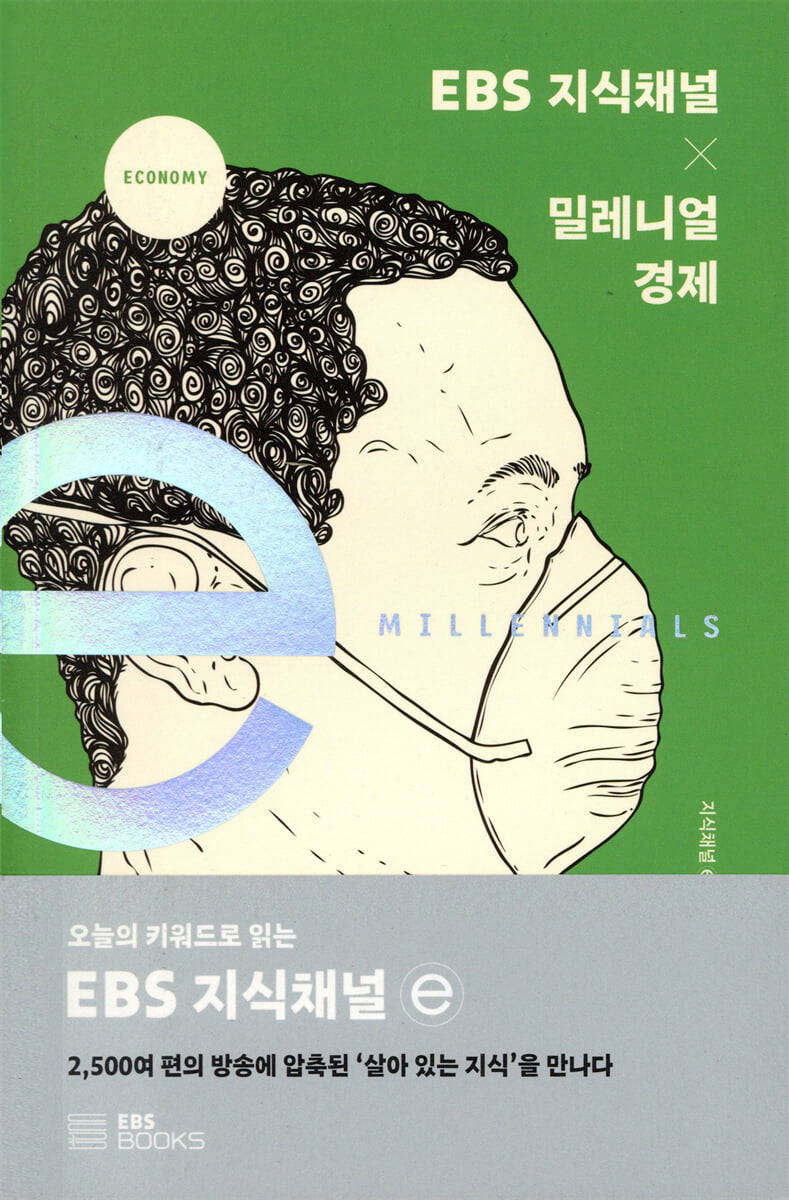
EBS Knowledge Channel × Millennial Economy
 |
Description
Book Introduction
The "Coming Economy" for Millennials
They account for 50 percent of the world's working population.
Millennials have grown into a powerful consumer group and mainstream in organizations.
Tomorrow's economy, built amidst change and crisis
[Knowledge Channel ⓔ], which has delivered meaningful knowledge and information to our lives, sometimes in detail as if examining it through a microscope, and sometimes with deep emotion in short videos, is meeting readers with the 'Knowledge Channel Series', newly compiled into a book.
『EBS Knowledge Channel x Millennial Economy』 examines the economic trends of today and the future, as well as new economic keywords, under the theme of ‘Economy for the Millennial Generation.’
Millennials, born between the early 1980s and early 2000s, make up 50 percent of the global workforce today and have grown into a powerful consumer group and mainstream force in organizations.
With the massive wave of the Fourth Industrial Revolution, the COVID-19 pandemic, and tectonic shifts in the real estate and stock markets, various variables are driving the economy. What kind of economic thinking should millennials have in this time of crisis and change? 『EBS Knowledge Channel × Millennial Economy』 starts from issues directly related to the lives and labor of millennials, such as artificial intelligence and job loss, worker rights, and future jobs, and deals with a shift in economic thinking, an entrepreneurial spirit that creates new value, and ideas for coexistence.
Additionally, this book contains economic knowledge for the millennial generation, focusing on various keywords that predict today's economic trends and the future economy, such as platform labor, subscription economy, food tech, social enterprises, and urban regeneration.
They account for 50 percent of the world's working population.
Millennials have grown into a powerful consumer group and mainstream in organizations.
Tomorrow's economy, built amidst change and crisis
[Knowledge Channel ⓔ], which has delivered meaningful knowledge and information to our lives, sometimes in detail as if examining it through a microscope, and sometimes with deep emotion in short videos, is meeting readers with the 'Knowledge Channel Series', newly compiled into a book.
『EBS Knowledge Channel x Millennial Economy』 examines the economic trends of today and the future, as well as new economic keywords, under the theme of ‘Economy for the Millennial Generation.’
Millennials, born between the early 1980s and early 2000s, make up 50 percent of the global workforce today and have grown into a powerful consumer group and mainstream force in organizations.
With the massive wave of the Fourth Industrial Revolution, the COVID-19 pandemic, and tectonic shifts in the real estate and stock markets, various variables are driving the economy. What kind of economic thinking should millennials have in this time of crisis and change? 『EBS Knowledge Channel × Millennial Economy』 starts from issues directly related to the lives and labor of millennials, such as artificial intelligence and job loss, worker rights, and future jobs, and deals with a shift in economic thinking, an entrepreneurial spirit that creates new value, and ideas for coexistence.
Additionally, this book contains economic knowledge for the millennial generation, focusing on various keywords that predict today's economic trends and the future economy, such as platform labor, subscription economy, food tech, social enterprises, and urban regeneration.
- You can preview some of the book's contents.
Preview
index
PART 1: Millennials' Work and the Future
I became an employee
She drives a car.
The Future of Jobs
Blank Family
1 minute too long
Convenience Store - I thought it was a 'honey-sucking part-time job'...
Have a nice trip
I work today to rest
PART 2: A Shift in Economic Thinking in a Rapidly Changing Era
Think outside the box
An Entrepreneur's Search for Happiness
Technological Revolution for Humanity
A very simple story
Still looking for some juice?
PART 3: An Economy for Coexistence
Dreamers and Activists
Hole in the Wall Project
Sunshine to everyone
The power of spider webs
hit products
I became an employee
She drives a car.
The Future of Jobs
Blank Family
1 minute too long
Convenience Store - I thought it was a 'honey-sucking part-time job'...
Have a nice trip
I work today to rest
PART 2: A Shift in Economic Thinking in a Rapidly Changing Era
Think outside the box
An Entrepreneur's Search for Happiness
Technological Revolution for Humanity
A very simple story
Still looking for some juice?
PART 3: An Economy for Coexistence
Dreamers and Activists
Hole in the Wall Project
Sunshine to everyone
The power of spider webs
hit products
Detailed image
.jpg)
Into the book
The average human lifespan has increased, but the lifespan of occupations has decreased.
We will now live in a society where people will have to have four or five jobs throughout their lives.
In this context, what is newly required is competency-based education.
This education is not simply about memorizing knowledge, but about developing practical skills applicable to real-world situations. The OECD identifies tool-using skills, social interaction skills, self-management skills, creative use of technology and knowledge, and problem-solving skills in conflict as key future competencies.
(…) Anders Sandberg, a computational neuroscientist and professor at Oxford University, says, “The jobs that will survive are those that are difficult to explain in a few words.”
Futurists point out that in the future, university education should not only impart knowledge in specialized fields, but should also include problem-solving skills, social skills, emotional intelligence, and critical thinking skills across various academic fields.
--- p.43~44
Millennials' lifestyles and values are different from those of older generations.
Millennials are highly adept at utilizing various digital technologies.
Focus on enjoying the present rather than sacrificing for the future, invest in health and leisure, and pursue small happiness in everyday life.
Millennials are a generation that pursues work-life balance.
They prefer jobs that guarantee time flexibility to pursue leisure.
Unlike their parents' generation, for whom work was everything in life, they have the characteristic of pursuing various values such as life, leisure, and leisure.
Millennials prefer to take on new challenges or do things that are more valuable to them.
Rather than survival or job security within one workplace, they want new or challenging work.
Find personal meaning through pursuing fun and having fun at work.
(…) Millennials are concerned about what work means to them and whether the work they do helps them develop themselves.
Ask yourself whether your work has a positive impact on others and society and contributes to the public good.
According to the Kelly Global Workforce Index (KGWI), 51 percent of millennials said they would be willing to take a pay cut or a lower title for "meaningful and valuable work."
--- p.115~116
Korean startups sometimes find themselves on the borderline between legal and illegal.
The healthcare industry, which manages health based on information and communication technology (ICT), is also growing globally. However, in Korea, concerns about the distribution of medical data and remote treatment, coupled with personal information use principles, have often prevented product testing, let alone commercialization.
Major areas across the country are designated as drone flight-restricted zones for military and security reasons, and the financial industry has high barriers to entry and numerous regulations.
Examples of the existing legal system failing to keep pace with the paradigm shift toward an intelligent information society can be found everywhere.
Recently, the number of Korean startups that are inevitably moving overseas to avoid regulations is increasing.
Many worry that if companies, which play a crucial role in job creation and driving innovative growth, move overseas, not only the domestic industrial ecosystem but also the human resource ecosystem will collapse.
If our regulatory system doesn't work nimbly, we too could face an irreversible setback, similar to the British automotive industry's past.
--- p.135~136
Just as the 20th-century Industrial Revolution replaced human labor with machines and created new management roles, we may find ourselves working on projects with artificial intelligence or robots in the future.
For example, the task of collecting big data is handled by AI with excellent data processing capabilities, while the task of organizing it into a single context and providing information to customers is handled by humans.
As AI becomes more widespread, "AI tutors"—trainers who teach AI—will also become necessary. AI is nothing more than a child possessing inherent potential, so we need human resources to train it in ways that are useful and necessary to humans.
As driverless cars become more widespread, new types of engineers will be needed to design roads for them and repair them.
Experts predict that new jobs will be created as jobs are reorganized around innovative technologies driving the Fourth Industrial Revolution, including artificial intelligence, robotics, the Internet of Things (IoT), autonomous driving, big data, cloud services, blockchain, 3D printing, drones, biotechnology, fintech, renewable energy, healthcare, virtual reality, and augmented reality.
Accordingly, promising future careers include artificial intelligence experts (developers of technologies that implement artificial intelligence algorithms or programs), big data analysts, virtual reality experts, Internet of Things experts, sharing economy consultants, robot ethicists, smart clothing developers, customized robot developers, drone operators and managers, smart road designers, medical information analysts, smart farm builders, and contour crafting, which involves building houses using 3D printing.
--- p.157~158
The discovery of new materials, the invention of new technologies, and the advancement of science and technology do not simply progress forward and cumulatively as we might think.
It takes time for products to be created and popularized based on discoveries and inventions, and after a considerable amount of time has passed, unexpected harm or risks to human life and the environment are often revealed belatedly.
DDT, asbestos, lead-containing gasoline, benzene, and PCBs (polychlorinated biphenyls), which were once hailed as “miracle pesticides,” all went through this process.
Most recently, diesel vehicle exhaust fumes and plastics have joined the ranks.
The European Union (EU) adopted the precautionary principle in the early 2000s.
This is a system that allows for a preemptive ban on the sale of new substances or technologies, even if there is no immediate evidence of harmful effects, if there is reason to worry about their potential adverse effects.
In accordance with this principle, new products, including new chemicals, foods, pharmaceuticals, and household goods, as well as chemicals manufactured and distributed in quantities exceeding one ton, must be registered to demonstrate their safety before being marketed. Furthermore, since 1998, the EU has required that all biocidal products undergo rat toxicity tests to demonstrate their safety before being approved for sale.
We will now live in a society where people will have to have four or five jobs throughout their lives.
In this context, what is newly required is competency-based education.
This education is not simply about memorizing knowledge, but about developing practical skills applicable to real-world situations. The OECD identifies tool-using skills, social interaction skills, self-management skills, creative use of technology and knowledge, and problem-solving skills in conflict as key future competencies.
(…) Anders Sandberg, a computational neuroscientist and professor at Oxford University, says, “The jobs that will survive are those that are difficult to explain in a few words.”
Futurists point out that in the future, university education should not only impart knowledge in specialized fields, but should also include problem-solving skills, social skills, emotional intelligence, and critical thinking skills across various academic fields.
--- p.43~44
Millennials' lifestyles and values are different from those of older generations.
Millennials are highly adept at utilizing various digital technologies.
Focus on enjoying the present rather than sacrificing for the future, invest in health and leisure, and pursue small happiness in everyday life.
Millennials are a generation that pursues work-life balance.
They prefer jobs that guarantee time flexibility to pursue leisure.
Unlike their parents' generation, for whom work was everything in life, they have the characteristic of pursuing various values such as life, leisure, and leisure.
Millennials prefer to take on new challenges or do things that are more valuable to them.
Rather than survival or job security within one workplace, they want new or challenging work.
Find personal meaning through pursuing fun and having fun at work.
(…) Millennials are concerned about what work means to them and whether the work they do helps them develop themselves.
Ask yourself whether your work has a positive impact on others and society and contributes to the public good.
According to the Kelly Global Workforce Index (KGWI), 51 percent of millennials said they would be willing to take a pay cut or a lower title for "meaningful and valuable work."
--- p.115~116
Korean startups sometimes find themselves on the borderline between legal and illegal.
The healthcare industry, which manages health based on information and communication technology (ICT), is also growing globally. However, in Korea, concerns about the distribution of medical data and remote treatment, coupled with personal information use principles, have often prevented product testing, let alone commercialization.
Major areas across the country are designated as drone flight-restricted zones for military and security reasons, and the financial industry has high barriers to entry and numerous regulations.
Examples of the existing legal system failing to keep pace with the paradigm shift toward an intelligent information society can be found everywhere.
Recently, the number of Korean startups that are inevitably moving overseas to avoid regulations is increasing.
Many worry that if companies, which play a crucial role in job creation and driving innovative growth, move overseas, not only the domestic industrial ecosystem but also the human resource ecosystem will collapse.
If our regulatory system doesn't work nimbly, we too could face an irreversible setback, similar to the British automotive industry's past.
--- p.135~136
Just as the 20th-century Industrial Revolution replaced human labor with machines and created new management roles, we may find ourselves working on projects with artificial intelligence or robots in the future.
For example, the task of collecting big data is handled by AI with excellent data processing capabilities, while the task of organizing it into a single context and providing information to customers is handled by humans.
As AI becomes more widespread, "AI tutors"—trainers who teach AI—will also become necessary. AI is nothing more than a child possessing inherent potential, so we need human resources to train it in ways that are useful and necessary to humans.
As driverless cars become more widespread, new types of engineers will be needed to design roads for them and repair them.
Experts predict that new jobs will be created as jobs are reorganized around innovative technologies driving the Fourth Industrial Revolution, including artificial intelligence, robotics, the Internet of Things (IoT), autonomous driving, big data, cloud services, blockchain, 3D printing, drones, biotechnology, fintech, renewable energy, healthcare, virtual reality, and augmented reality.
Accordingly, promising future careers include artificial intelligence experts (developers of technologies that implement artificial intelligence algorithms or programs), big data analysts, virtual reality experts, Internet of Things experts, sharing economy consultants, robot ethicists, smart clothing developers, customized robot developers, drone operators and managers, smart road designers, medical information analysts, smart farm builders, and contour crafting, which involves building houses using 3D printing.
--- p.157~158
The discovery of new materials, the invention of new technologies, and the advancement of science and technology do not simply progress forward and cumulatively as we might think.
It takes time for products to be created and popularized based on discoveries and inventions, and after a considerable amount of time has passed, unexpected harm or risks to human life and the environment are often revealed belatedly.
DDT, asbestos, lead-containing gasoline, benzene, and PCBs (polychlorinated biphenyls), which were once hailed as “miracle pesticides,” all went through this process.
Most recently, diesel vehicle exhaust fumes and plastics have joined the ranks.
The European Union (EU) adopted the precautionary principle in the early 2000s.
This is a system that allows for a preemptive ban on the sale of new substances or technologies, even if there is no immediate evidence of harmful effects, if there is reason to worry about their potential adverse effects.
In accordance with this principle, new products, including new chemicals, foods, pharmaceuticals, and household goods, as well as chemicals manufactured and distributed in quantities exceeding one ton, must be registered to demonstrate their safety before being marketed. Furthermore, since 1998, the EU has required that all biocidal products undergo rat toxicity tests to demonstrate their safety before being approved for sale.
--- p.253~254
Publisher's Review
EBS Knowledge Channelⓔ: Reading with Today's Keywords
Discover 'living knowledge' compressed into over 2,500 broadcasts!
[Knowledge Channel ⓔ], which began broadcasting on September 5, 2005, has created a massive 'record' of over 2,500 episodes over the past 15 years as of 2020.
In a short video of about 5 minutes, it contained various topics with the keyword 'e' such as nature, society, science, economy, and human, and received a great response for its sensitive and sharp portrayal of topics closely related to our lives.
[Knowledge Channel ⓔ] has been sharpening its senses in every corner of the world and in every part of our lives, selecting keywords for 'today' and delivering knowledge and information that expands from them.
The "Knowledge E" series, published in book form since 2007, has been beloved by readers, selling over one million copies. EBS Books, the EBS book brand, presents the new "EBS Knowledge Channel" series, featuring a single topic for each volume. This series delves deeper and richer into the diverse knowledge and information previously briefly introduced in the "Knowledge Channel E" broadcast.
In an era where artificial intelligence replaces human jobs,
Can the Fourth Industrial Revolution Create New Jobs?
In an era dominated by economic fears such as youth unemployment and poverty among the elderly,
Could basic income become a new welfare model?
『EBS Knowledge Channel x Millennial Economy』 is composed of three parts.
In 'PART 1: Millennials' Work and the Future', we look at the changing world of jobs and work with the 4th Industrial Revolution, the work environment that millennials will face, etc., and in 'PART 2: Rapidly Changing Times, Shifts in Economic Thinking', we look at shifts in economic thinking, the entrepreneurial spirit needed for tomorrow's economic leaders, and the economic values that millennials pursue.
'Part 3: Economy for Coexistence' covers various movements to realize economic value in a broader sense, including public projects such as educational opportunities and urban regeneration.
Discover 'living knowledge' compressed into over 2,500 broadcasts!
[Knowledge Channel ⓔ], which began broadcasting on September 5, 2005, has created a massive 'record' of over 2,500 episodes over the past 15 years as of 2020.
In a short video of about 5 minutes, it contained various topics with the keyword 'e' such as nature, society, science, economy, and human, and received a great response for its sensitive and sharp portrayal of topics closely related to our lives.
[Knowledge Channel ⓔ] has been sharpening its senses in every corner of the world and in every part of our lives, selecting keywords for 'today' and delivering knowledge and information that expands from them.
The "Knowledge E" series, published in book form since 2007, has been beloved by readers, selling over one million copies. EBS Books, the EBS book brand, presents the new "EBS Knowledge Channel" series, featuring a single topic for each volume. This series delves deeper and richer into the diverse knowledge and information previously briefly introduced in the "Knowledge Channel E" broadcast.
In an era where artificial intelligence replaces human jobs,
Can the Fourth Industrial Revolution Create New Jobs?
In an era dominated by economic fears such as youth unemployment and poverty among the elderly,
Could basic income become a new welfare model?
『EBS Knowledge Channel x Millennial Economy』 is composed of three parts.
In 'PART 1: Millennials' Work and the Future', we look at the changing world of jobs and work with the 4th Industrial Revolution, the work environment that millennials will face, etc., and in 'PART 2: Rapidly Changing Times, Shifts in Economic Thinking', we look at shifts in economic thinking, the entrepreneurial spirit needed for tomorrow's economic leaders, and the economic values that millennials pursue.
'Part 3: Economy for Coexistence' covers various movements to realize economic value in a broader sense, including public projects such as educational opportunities and urban regeneration.
GOODS SPECIFICS
- Publication date: December 30, 2020
- Page count, weight, size: 256 pages | 272g | 123*188*15mm
- ISBN13: 9788954756716
- ISBN10: 8954756719
You may also like
카테고리
korean


korean

![GQ KOREA Mark (Monthly): December [2025]](http://librairie.coreenne.fr/cdn/shop/files/8ef265dbbfbf186523ed75ba7319009d.jpg?v=1765340328&width=3840)


