

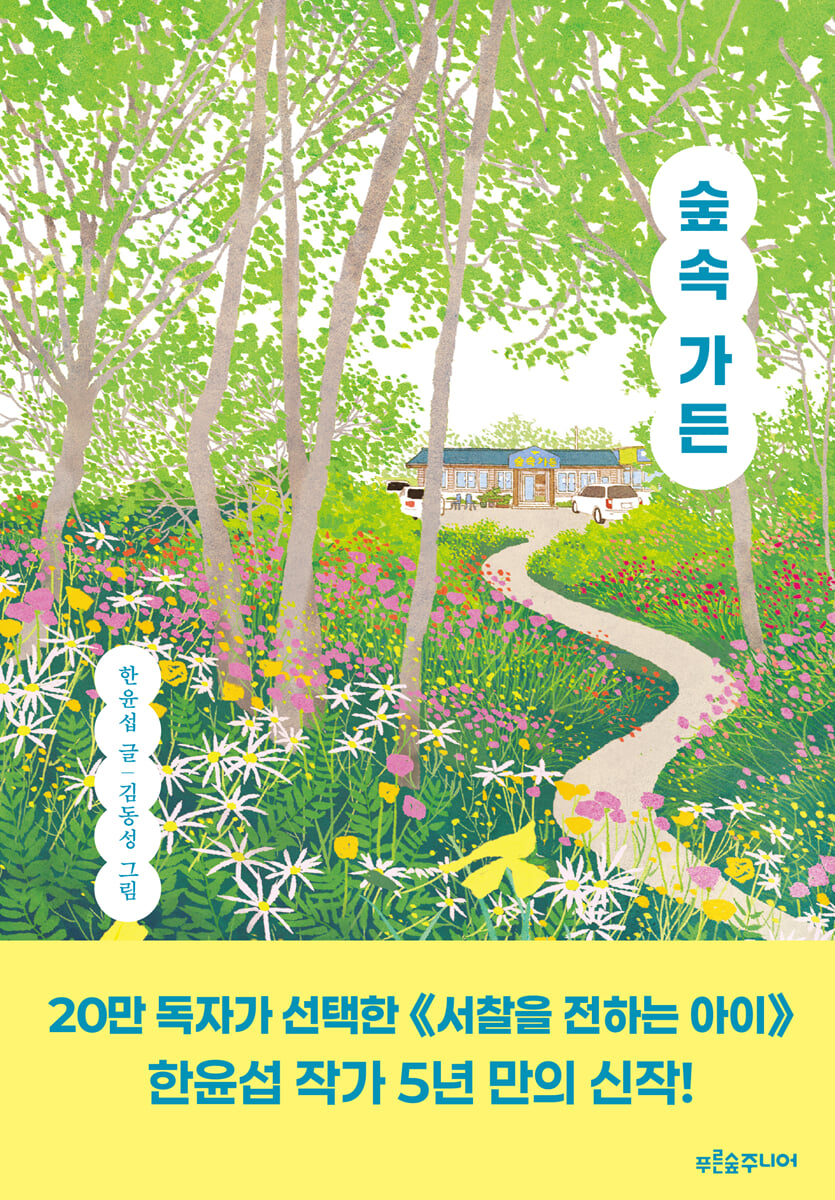
Forest Garden
 |
Description
Book Introduction
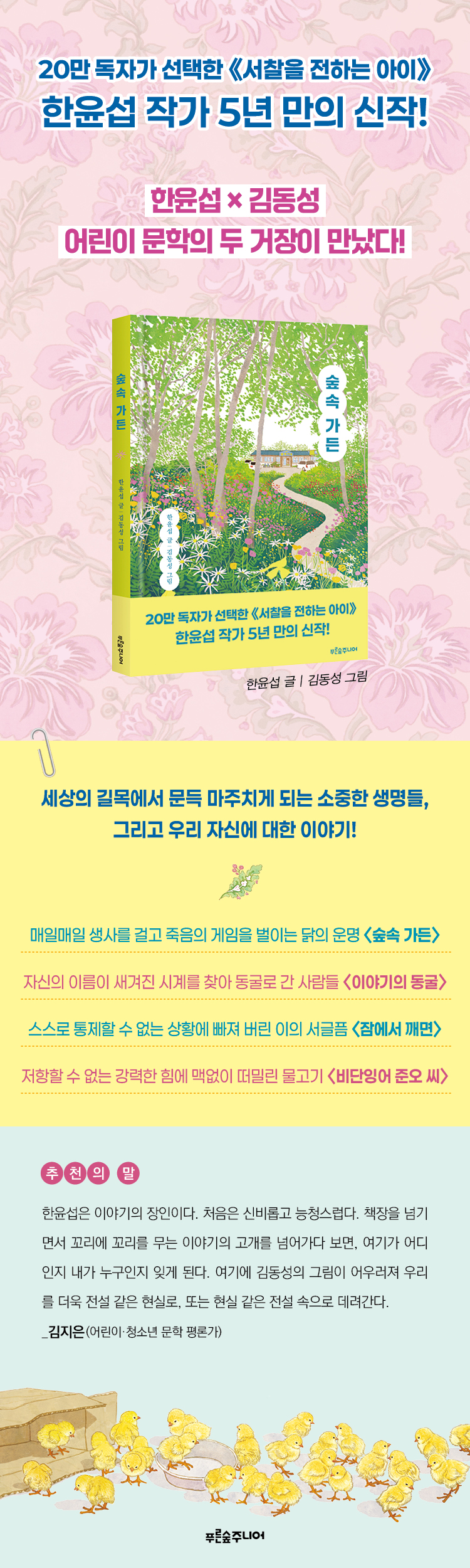
A collaboration between Han Yoon-seop and Kim Dong-seong!
A panorama of stories from two masters of children's literature.
Author Han Yun-seop, who has been greatly loved for his outstanding imagination, novel composition, sophisticated writing style, and unique literary flavor through works such as 『Bonjour, Tour』, 『The Child Who Delivers Letters』, 『Harriet』, and 『Your Destiny』, has returned to readers after five years with a new fairy tale, 『Garden in the Forest』.
If previous works mainly focused on historical space or time, the theme elaborated in this work is 'story'.
He says this in the 'Author's Note':
I meet a lot of children at events where they meet authors, and these days, even children really enjoy being told stories.
Whether you have a child who reads a lot or a child who only likes their smartphone, they all love stories.
No matter how much the world has changed, the power of an interesting story seems to remain unchanged.
Perhaps it's because the story-loving DNA that developed before the advent of writing still remains, as stories were passed down by word of mouth.
This fairy tale is a collection of short stories, so the work begins with, “I’ll tell you a few interesting stories.”
_From the author's note
The author recalls how much fun it was when adults told stories to her as a child, and says that at that time, “we were all ready to get lost in the story.
“I can easily get lost in even the most trivial of stories, and a movie forms in my head while I’m listening to them,” he adds.
Here, author Kim Dong-seong, who has created his own unique world of works such as “Welcoming Mom,” “The House Where Books Play,” and “Kim Crazy About Flowers,” adds illustrations to further enhance the density of the story.
After reading “Garden in the Forest,” critic Kim Ji-eun said, “Han Yun-seop is a master of storytelling.
The beginning is mysterious and ingenious.
As I turn the pages of the book and get lost in the endless series of stories, I find myself forgetting where I am and who I am.
Here, Kim Dong-seong's paintings come together to take us into a more legendary reality, or into a legend that seems like reality.
He adds dynamism to his work with his delicate drawings that can verify things that never happened in this world.”
Now, it's time to get a taste of a truly well-made 'story'.
A panorama of stories from two masters of children's literature.
Author Han Yun-seop, who has been greatly loved for his outstanding imagination, novel composition, sophisticated writing style, and unique literary flavor through works such as 『Bonjour, Tour』, 『The Child Who Delivers Letters』, 『Harriet』, and 『Your Destiny』, has returned to readers after five years with a new fairy tale, 『Garden in the Forest』.
If previous works mainly focused on historical space or time, the theme elaborated in this work is 'story'.
He says this in the 'Author's Note':
I meet a lot of children at events where they meet authors, and these days, even children really enjoy being told stories.
Whether you have a child who reads a lot or a child who only likes their smartphone, they all love stories.
No matter how much the world has changed, the power of an interesting story seems to remain unchanged.
Perhaps it's because the story-loving DNA that developed before the advent of writing still remains, as stories were passed down by word of mouth.
This fairy tale is a collection of short stories, so the work begins with, “I’ll tell you a few interesting stories.”
_From the author's note
The author recalls how much fun it was when adults told stories to her as a child, and says that at that time, “we were all ready to get lost in the story.
“I can easily get lost in even the most trivial of stories, and a movie forms in my head while I’m listening to them,” he adds.
Here, author Kim Dong-seong, who has created his own unique world of works such as “Welcoming Mom,” “The House Where Books Play,” and “Kim Crazy About Flowers,” adds illustrations to further enhance the density of the story.
After reading “Garden in the Forest,” critic Kim Ji-eun said, “Han Yun-seop is a master of storytelling.
The beginning is mysterious and ingenious.
As I turn the pages of the book and get lost in the endless series of stories, I find myself forgetting where I am and who I am.
Here, Kim Dong-seong's paintings come together to take us into a more legendary reality, or into a legend that seems like reality.
He adds dynamism to his work with his delicate drawings that can verify things that never happened in this world.”
Now, it's time to get a taste of a truly well-made 'story'.
- You can preview some of the book's contents.
Preview
index
Forest Garden
Cave of Stories
When I wake up
Mr. Jun-oh, the brocade carp
Author's Note
Cave of Stories
When I wake up
Mr. Jun-oh, the brocade carp
Author's Note
Detailed image
Into the book
The old man went into the restaurant, and I stood in front of the chicken coop again.
And I looked around at the chickens.
Two years have passed, and now there are no more chicks left than the one I brought home.
Yes, that is impossible.
That restaurant is visited by many customers every day for lunch and dinner, and dozens of chickens are slaughtered and cooked each day.
So, two years have passed, and even if you do a quick calculation, it seems that thousands, or even tens of thousands of chickens have been slaughtered.
So, the three hundred and fifty chicks I brought were all already taken away, and it was natural that the chicken coop would be filled with new chickens.
I looked at the chicken coop, thinking that even with the best of luck, it would be impossible to survive that long.
But then, one of the chickens in the flock slowly walked towards me.
It was a scene I felt like I'd seen before.
Just like last time, a dark brown chicken stops right in front of me.
I watched the chicken with a skeptical mind.
Could that chicken from two years ago still be alive? Could it be possible for it to survive two years of this daily game of death by sheer luck?
--- pp.40-41 From "Garden in the Forest"
While the family was packing, the child climbed the hill to say his final goodbyes to the tree.
The sandstorm was particularly strong that day, so the child stopped walking several times and waited for the wind to pass.
The child who climbed the hill hesitated for a moment in front of the tree.
I've been wondering whether I should apologize for lying about it raining or tell him it's going to rain again today.
“What do you want to hear?”
The tree stood silently, just like any other day.
“I’m sorry, I’m just sorry for everything.”
The child hugged the tree with both arms outstretched.
Tears welled up in the child's eyes.
“I have to leave now.
But the radio said it was going to rain soon.
So don't worry.
“I’ll definitely come back when it rains.”
Tears streamed down the child's face.
The child hugged the tree tightly for a while.
But then, a small sound was heard.
'It's going to rain soon.'
The child looked around startled by the sound, but no one was there.
There wasn't any.
The child looked up at the tree.
But strangely enough, there were many leaves attached to the tree.
Moreover, green leaves were gradually increasing in number before the child's eyes.
--- pp.65-66 From "The Cave of Stories"
My uncle's laughter could be heard occasionally from the living room.
Jeong-ah thought of her mother.
Mom hasn't been home for months now.
He said that if things went well, he wouldn't break up with me again, but he still hasn't come back.
Then, Jeong-ah suddenly became worried about her mother.
I couldn't sit still at the thought of my mother coming home alone, carrying heavy luggage after a few months.
I got up.
But strangely, my body felt heavy.
I couldn't move my arms and legs as I wanted because I had no strength in my body.
Jeong-ah barely managed to get up.
I tried to think about what happened before I fell asleep, but no matter how much I thought about it, nothing special happened.
After struggling to lower my legs to the floor, I stood up.
Even walking a few steps was difficult.
I reached out and barely managed to turn on the light switch.
The brightly lit room felt somehow unfamiliar.
As I was about to go out to the living room, I looked at the mirror on the table in the room and slowly walked towards the table.
And I looked in the mirror.
A very wrinkled old woman was looking at Jeong-ah in the mirror.
--- pp.83-84 From "When I Wake Up"
I took a deep breath to clear my head.
I couldn't just sit back and watch the koi talk.
“You……, you……, you…… why are you talking? You shouldn’t talk.”
That was the best I could say to the koi.
Because that wasn't scientifically possible.
Then the koi's mouth blinked again.
“Why can’t I say anything?”
I was speechless.
Because it wasn't a wrong statement.
Besides, asking questions means thinking like a human, and thinking like a human means having that level of intelligence.
Suddenly, a fearful thought occurred to me.
But at the same time, I felt bad.
I don't know why, but I felt bad.
So I spoke more bluntly than before.
“Why? That’s not your area.
Speaking is the domain of people.
But who are you? No, what are you? Why… … do you, a fish like you, keep talking?”
"Why are you talking to me in a bad way? Why do you feel bad when I talk to you?"
The koi's voice grew louder as if he was angry.
Actually, I've never talked to a fish before, so I don't know if it's angry or not.
Anyway, I felt like I was angry.
And I looked around at the chickens.
Two years have passed, and now there are no more chicks left than the one I brought home.
Yes, that is impossible.
That restaurant is visited by many customers every day for lunch and dinner, and dozens of chickens are slaughtered and cooked each day.
So, two years have passed, and even if you do a quick calculation, it seems that thousands, or even tens of thousands of chickens have been slaughtered.
So, the three hundred and fifty chicks I brought were all already taken away, and it was natural that the chicken coop would be filled with new chickens.
I looked at the chicken coop, thinking that even with the best of luck, it would be impossible to survive that long.
But then, one of the chickens in the flock slowly walked towards me.
It was a scene I felt like I'd seen before.
Just like last time, a dark brown chicken stops right in front of me.
I watched the chicken with a skeptical mind.
Could that chicken from two years ago still be alive? Could it be possible for it to survive two years of this daily game of death by sheer luck?
--- pp.40-41 From "Garden in the Forest"
While the family was packing, the child climbed the hill to say his final goodbyes to the tree.
The sandstorm was particularly strong that day, so the child stopped walking several times and waited for the wind to pass.
The child who climbed the hill hesitated for a moment in front of the tree.
I've been wondering whether I should apologize for lying about it raining or tell him it's going to rain again today.
“What do you want to hear?”
The tree stood silently, just like any other day.
“I’m sorry, I’m just sorry for everything.”
The child hugged the tree with both arms outstretched.
Tears welled up in the child's eyes.
“I have to leave now.
But the radio said it was going to rain soon.
So don't worry.
“I’ll definitely come back when it rains.”
Tears streamed down the child's face.
The child hugged the tree tightly for a while.
But then, a small sound was heard.
'It's going to rain soon.'
The child looked around startled by the sound, but no one was there.
There wasn't any.
The child looked up at the tree.
But strangely enough, there were many leaves attached to the tree.
Moreover, green leaves were gradually increasing in number before the child's eyes.
--- pp.65-66 From "The Cave of Stories"
My uncle's laughter could be heard occasionally from the living room.
Jeong-ah thought of her mother.
Mom hasn't been home for months now.
He said that if things went well, he wouldn't break up with me again, but he still hasn't come back.
Then, Jeong-ah suddenly became worried about her mother.
I couldn't sit still at the thought of my mother coming home alone, carrying heavy luggage after a few months.
I got up.
But strangely, my body felt heavy.
I couldn't move my arms and legs as I wanted because I had no strength in my body.
Jeong-ah barely managed to get up.
I tried to think about what happened before I fell asleep, but no matter how much I thought about it, nothing special happened.
After struggling to lower my legs to the floor, I stood up.
Even walking a few steps was difficult.
I reached out and barely managed to turn on the light switch.
The brightly lit room felt somehow unfamiliar.
As I was about to go out to the living room, I looked at the mirror on the table in the room and slowly walked towards the table.
And I looked in the mirror.
A very wrinkled old woman was looking at Jeong-ah in the mirror.
--- pp.83-84 From "When I Wake Up"
I took a deep breath to clear my head.
I couldn't just sit back and watch the koi talk.
“You……, you……, you…… why are you talking? You shouldn’t talk.”
That was the best I could say to the koi.
Because that wasn't scientifically possible.
Then the koi's mouth blinked again.
“Why can’t I say anything?”
I was speechless.
Because it wasn't a wrong statement.
Besides, asking questions means thinking like a human, and thinking like a human means having that level of intelligence.
Suddenly, a fearful thought occurred to me.
But at the same time, I felt bad.
I don't know why, but I felt bad.
So I spoke more bluntly than before.
“Why? That’s not your area.
Speaking is the domain of people.
But who are you? No, what are you? Why… … do you, a fish like you, keep talking?”
"Why are you talking to me in a bad way? Why do you feel bad when I talk to you?"
The koi's voice grew louder as if he was angry.
Actually, I've never talked to a fish before, so I don't know if it's angry or not.
Anyway, I felt like I was angry.
--- pp.99-101 From "Mr. Jun-oh, the Silk Carp"
Publisher's Review
The respect for life that is deeply embedded in the story,
And reveal our true face hidden behind it!
This book consists of four short stories.
“Forest Garden” depicts the fate of a chicken that plays a game of death every day in a restaurant deep in the forest; “Cave of Stories” is the story of people who go to the cave of time in search of a clock that tells the time limit of their remaining life and never return; “When I Wake Up” contains the sadness of a person who is in a confusing situation where he or she constantly travels back and forth between childhood and the present but cannot control his or her life; “Mr. Jun-oh the Koi” is the story of a fish that is as intelligent as humans and is able to distinguish right from wrong but is helplessly pushed around by ruthless forces, etc.
The author draws material for his stories from the various moments in life that we inadvertently encounter as we go through life, breathes life into them, and then, in pursuit of 'truth,' constantly poses philosophical questions about 'existence.'
"The Garden in the Forest" begins with me and my grandfather searching for a restaurant in the forest.
Upon arriving at the restaurant, the old man does not order food and heads straight to the chicken coop at the back of the restaurant.
Then he stands blankly in front of the chicken coop and asks me this.
“Have you ever picked up something on the street?”
Eventually, the grandfather tells the story of a box of chicks he found by chance on the road.
He couldn't just pass by the boxes of chicks that had fallen from the truck on the way to the chicken farm, so he put them in the trunk of his car and took them to a restaurant run by his uncle.
There, about 350 chicks grow up and become chickens.
The restaurant, which originally sold pork ribs, began to gradually introduce chicken dishes to its customers, and soon changed its name to a restaurant specializing in native chicken.
Grandpa goes to that restaurant
Every time I see the chickens playing a game of death with their owner, I feel a complex emotion.
What does life and death mean to chickens who fight every day?
"The Cave of Stories" opens with dozens of people searching for the story god's house on a hill.
The story god creates stories with the words that people order, and then takes them out after they have been cooked to their satisfaction.
The words ordered this time are ‘cave’ and ‘time’!
The Himalayas, the highest place in the world, are so cold that all the peaks are covered in snow and ice.
On one of those many peaks is a giant ice cave called the 'Cave of Time', and inside that ice cave are numerous clocks.
Each clock is engraved with a person's name, and the hands begin to move from the moment a baby is born.
People, in their desire to find their own clock and turn back the hands, go to the cave of time without exception… … .
Will he be able to find his watch and return safely? (There is one more story in this chapter.
Please check the book yourself.^^)
In "When I Wake Up," on a rainy day, Jeong-ah suddenly becomes worried about her mother and goes out the front door with an umbrella.
Mom hasn't been home for months now.
I sit at the bus stop and wait for my mom to come.
Several buses pass by, but Mom never gets off.
Then, a photo studio across the street catches my eye.
Jeong-ah suddenly feels like taking a picture.
The photographer, who was preparing to leave work, willingly takes a picture of Jeong-ah.
After that, I returned home and fell asleep. When I woke up again, I felt a presence and went out to the front door.
The grandfather wearing a bowler hat looks at Jeong-ah with a smile.
Jeong-ah tilts her head as she tries to open the door for her grandfather.
“Your grandfather passed away last year.
“Grandpa, is this a dream?”
When Jeong-ah asks, her grandfather smiles and nods.
What time is Jeong-ah living in now?
"Mr. Jun-oh the Koi" is a story about a koi that lives in a pond in a park called "Green Tree."
As someone who works in the park management department, I am literally in charge of managing the park.
Green Tree is facing increasing difficulties in operating and is being forced to reduce its staff.
The night before I quit Green Tree, I went to feed the fish in the pond and heard a strange noise.
"hey!"
I was so surprised that I was speechless when I realized that it was the sound of a koi fish.
The koi not only knows how to speak human language, but also has a keen understanding of the park's situation, and proposes a koi show to attract an audience.
Deep in my heart, I am filled with respect, so I speak politely to the koi.
Then, after successfully completing the koi show, he goes to bed dreaming of becoming the person in charge of the pond… … .
The world is not that easy.
The next day, we are faced with an unimaginable sight.
No matter how smart you are, are you helpless in the face of an irresistible force?
Again, the era of stories begins!
A philosophical fairy tale by Han Yun-seop that connects thoughts through interesting stories.
In this way, in “Garden in the Forest,” four stories follow each other in an exciting way.
As you turn the pages of the book and get to the heart of the story, you will find yourself completely immersed in the story and forget about your own existence.
At the end of the story, a surprising twist awaits, like the last runner in a relay race winning unexpectedly.
Finally, he sweeps his chest with both hands and swallows his breath, unconsciously wanting to hear the next story.
This is the power of the story that author Han Yun-seop tells.
Critic Kim Ji-eun says this:
The author, who had longed for the freedom of animals in "Harriet," questions the realistic possibility of that freedom in "The Forest Garden."
In "The Boy Who Delivered the Letter," he showed us that the ending we want is not the only one that awaits us, and in "Mr. Jun-oh, the Silk Carp," he makes us look back once again at the behavior of humans toward non-humans.
As you read "When I Wake Up," you experience the story turning inside out, different times coming together in one space.
"The Cave of Stories" is a fairy tale that, as the title suggests, is like a self-introduction of the story itself, telling us what the charm of the story itself is.
《Garden in the Forest》 talks about the 'life' we easily encounter around us and its dignity.
It awakens us to the 'life' that permeates things that we might easily pass by without noticing, and makes us stop and look back without even realizing it.
At the same time, it makes us reflect on ourselves through the selfish and cruel behavior of humans in the face of such fragile life.
Moreover, readers who have experienced the thrill of the story through this book will look at things they had previously overlooked in a new light and imagine how the story will continue next.
This is the virtue of Han Yun-seop's fairy tales.
As always, it doesn't easily grant hope, but it allows us to face the harsh reality head on and take a firm step forward.
It is said that by making people imagine for themselves, they are stimulating and awakening their thinking power.
And reveal our true face hidden behind it!
This book consists of four short stories.
“Forest Garden” depicts the fate of a chicken that plays a game of death every day in a restaurant deep in the forest; “Cave of Stories” is the story of people who go to the cave of time in search of a clock that tells the time limit of their remaining life and never return; “When I Wake Up” contains the sadness of a person who is in a confusing situation where he or she constantly travels back and forth between childhood and the present but cannot control his or her life; “Mr. Jun-oh the Koi” is the story of a fish that is as intelligent as humans and is able to distinguish right from wrong but is helplessly pushed around by ruthless forces, etc.
The author draws material for his stories from the various moments in life that we inadvertently encounter as we go through life, breathes life into them, and then, in pursuit of 'truth,' constantly poses philosophical questions about 'existence.'
"The Garden in the Forest" begins with me and my grandfather searching for a restaurant in the forest.
Upon arriving at the restaurant, the old man does not order food and heads straight to the chicken coop at the back of the restaurant.
Then he stands blankly in front of the chicken coop and asks me this.
“Have you ever picked up something on the street?”
Eventually, the grandfather tells the story of a box of chicks he found by chance on the road.
He couldn't just pass by the boxes of chicks that had fallen from the truck on the way to the chicken farm, so he put them in the trunk of his car and took them to a restaurant run by his uncle.
There, about 350 chicks grow up and become chickens.
The restaurant, which originally sold pork ribs, began to gradually introduce chicken dishes to its customers, and soon changed its name to a restaurant specializing in native chicken.
Grandpa goes to that restaurant
Every time I see the chickens playing a game of death with their owner, I feel a complex emotion.
What does life and death mean to chickens who fight every day?
"The Cave of Stories" opens with dozens of people searching for the story god's house on a hill.
The story god creates stories with the words that people order, and then takes them out after they have been cooked to their satisfaction.
The words ordered this time are ‘cave’ and ‘time’!
The Himalayas, the highest place in the world, are so cold that all the peaks are covered in snow and ice.
On one of those many peaks is a giant ice cave called the 'Cave of Time', and inside that ice cave are numerous clocks.
Each clock is engraved with a person's name, and the hands begin to move from the moment a baby is born.
People, in their desire to find their own clock and turn back the hands, go to the cave of time without exception… … .
Will he be able to find his watch and return safely? (There is one more story in this chapter.
Please check the book yourself.^^)
In "When I Wake Up," on a rainy day, Jeong-ah suddenly becomes worried about her mother and goes out the front door with an umbrella.
Mom hasn't been home for months now.
I sit at the bus stop and wait for my mom to come.
Several buses pass by, but Mom never gets off.
Then, a photo studio across the street catches my eye.
Jeong-ah suddenly feels like taking a picture.
The photographer, who was preparing to leave work, willingly takes a picture of Jeong-ah.
After that, I returned home and fell asleep. When I woke up again, I felt a presence and went out to the front door.
The grandfather wearing a bowler hat looks at Jeong-ah with a smile.
Jeong-ah tilts her head as she tries to open the door for her grandfather.
“Your grandfather passed away last year.
“Grandpa, is this a dream?”
When Jeong-ah asks, her grandfather smiles and nods.
What time is Jeong-ah living in now?
"Mr. Jun-oh the Koi" is a story about a koi that lives in a pond in a park called "Green Tree."
As someone who works in the park management department, I am literally in charge of managing the park.
Green Tree is facing increasing difficulties in operating and is being forced to reduce its staff.
The night before I quit Green Tree, I went to feed the fish in the pond and heard a strange noise.
"hey!"
I was so surprised that I was speechless when I realized that it was the sound of a koi fish.
The koi not only knows how to speak human language, but also has a keen understanding of the park's situation, and proposes a koi show to attract an audience.
Deep in my heart, I am filled with respect, so I speak politely to the koi.
Then, after successfully completing the koi show, he goes to bed dreaming of becoming the person in charge of the pond… … .
The world is not that easy.
The next day, we are faced with an unimaginable sight.
No matter how smart you are, are you helpless in the face of an irresistible force?
Again, the era of stories begins!
A philosophical fairy tale by Han Yun-seop that connects thoughts through interesting stories.
In this way, in “Garden in the Forest,” four stories follow each other in an exciting way.
As you turn the pages of the book and get to the heart of the story, you will find yourself completely immersed in the story and forget about your own existence.
At the end of the story, a surprising twist awaits, like the last runner in a relay race winning unexpectedly.
Finally, he sweeps his chest with both hands and swallows his breath, unconsciously wanting to hear the next story.
This is the power of the story that author Han Yun-seop tells.
Critic Kim Ji-eun says this:
The author, who had longed for the freedom of animals in "Harriet," questions the realistic possibility of that freedom in "The Forest Garden."
In "The Boy Who Delivered the Letter," he showed us that the ending we want is not the only one that awaits us, and in "Mr. Jun-oh, the Silk Carp," he makes us look back once again at the behavior of humans toward non-humans.
As you read "When I Wake Up," you experience the story turning inside out, different times coming together in one space.
"The Cave of Stories" is a fairy tale that, as the title suggests, is like a self-introduction of the story itself, telling us what the charm of the story itself is.
《Garden in the Forest》 talks about the 'life' we easily encounter around us and its dignity.
It awakens us to the 'life' that permeates things that we might easily pass by without noticing, and makes us stop and look back without even realizing it.
At the same time, it makes us reflect on ourselves through the selfish and cruel behavior of humans in the face of such fragile life.
Moreover, readers who have experienced the thrill of the story through this book will look at things they had previously overlooked in a new light and imagine how the story will continue next.
This is the virtue of Han Yun-seop's fairy tales.
As always, it doesn't easily grant hope, but it allows us to face the harsh reality head on and take a firm step forward.
It is said that by making people imagine for themselves, they are stimulating and awakening their thinking power.
GOODS SPECIFICS
- Date of issue: March 17, 2025
- Format: Hardcover book binding method guide
- Page count, weight, size: 128 pages | 322g | 136*200*14mm
- ISBN13: 9791172545413
- ISBN10: 1172545413
- KC Certification: Certification Type: Conformity Confirmation
You may also like
카테고리
korean


korean

![GQ KOREA Mark (Monthly): December [2025]](http://librairie.coreenne.fr/cdn/shop/files/8ef265dbbfbf186523ed75ba7319009d.jpg?v=1765340328&width=3840)


