

Parallel History Class
 |
Description
Book Introduction
What if there were parallel worlds or doppelgangers in history?
Don't memorize Korean history and world history separately!
Read Korean history within the context of world history, and connect world history to Korean history! Many young people study Korean and world history separately, failing to grasp the connections between them and instead focusing solely on memorizing individual events and dates.
But history is not a closed series of events that occurred within a single country.
This is because the East and the West have shared the spirit and sensibilities of the times and developed together in politics, economy, culture, art, scholarship, and science and technology by exchanging cultural artifacts.
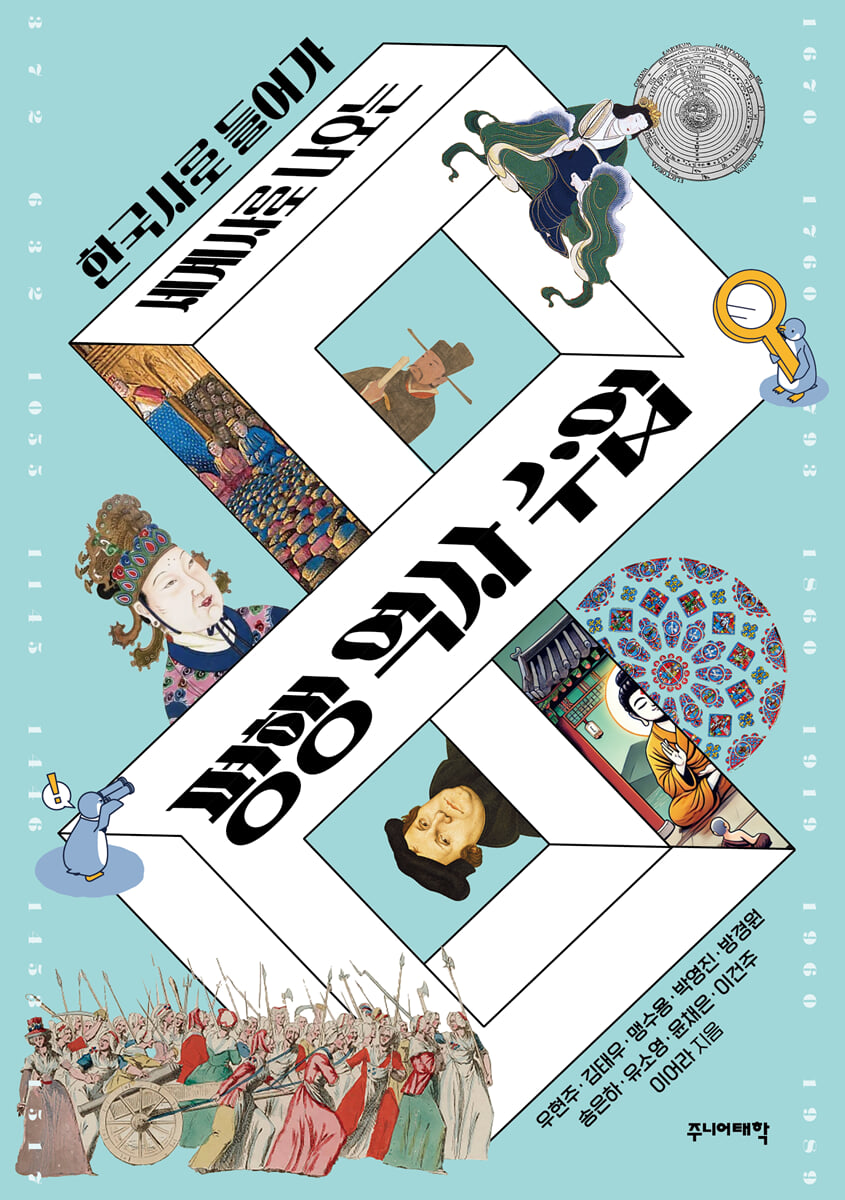
This book connects Korean and world history, which have been studied separately until now, and traces similar events and people from the same era.
Through fourteen historical experiences that occurred similarly in two different worlds at the same time, as if by agreement, we can vividly imagine and feel the sensibilities of the people of the world at that time.
When King Sejong created the Hunminjeongeum, what kind of written life was prevailing in Europe? When Grand Prince Suyang overthrew his nephew and killed his brother to become king, who was the other bloody monarch of the Ottoman Empire? When Luther attempted the Reformation, what kind of reformers emerged in Joseon? When Darwin published "The Origin of Species" and shocked Western society with the theory of evolution, what new ideas were sprouting in Korea? As readers follow the fascinating events and characters, traveling freely between these two worlds, they will experience the thrilling and knowledge-rich experience of "entering Korean history and emerging from it into world history."
Don't memorize Korean history and world history separately!
Read Korean history within the context of world history, and connect world history to Korean history! Many young people study Korean and world history separately, failing to grasp the connections between them and instead focusing solely on memorizing individual events and dates.
But history is not a closed series of events that occurred within a single country.
This is because the East and the West have shared the spirit and sensibilities of the times and developed together in politics, economy, culture, art, scholarship, and science and technology by exchanging cultural artifacts.
This book connects Korean and world history, which have been studied separately until now, and traces similar events and people from the same era.
Through fourteen historical experiences that occurred similarly in two different worlds at the same time, as if by agreement, we can vividly imagine and feel the sensibilities of the people of the world at that time.
When King Sejong created the Hunminjeongeum, what kind of written life was prevailing in Europe? When Grand Prince Suyang overthrew his nephew and killed his brother to become king, who was the other bloody monarch of the Ottoman Empire? When Luther attempted the Reformation, what kind of reformers emerged in Joseon? When Darwin published "The Origin of Species" and shocked Western society with the theory of evolution, what new ideas were sprouting in Korea? As readers follow the fascinating events and characters, traveling freely between these two worlds, they will experience the thrilling and knowledge-rich experience of "entering Korean history and emerging from it into world history."
- You can preview some of the book's contents.
Preview
index
preface
Are you ready for a journey through parallel history? _A sneak peek at fourteen scenes from a parallel world.
01.
Religion, permeating human life
372 AD, Buddhism & Christianity (313)
Amitabha Buddha... The sound of the moktak resonates across the Korean Peninsula / Across the globe, the cross fills Rome / I can't give permission so easily! / Religion, permeating people's lives
02.
Women ascend to the throne
632, Queen Seondeok & Empress Suiko (593) & Empress Wu Zetian (690)
The Age of Queens? / Korea's first female monarch, Queen Seondeok / Was Queen Seondeok a wise monarch or a weak ruler? / Japan's first female monarch, Empress Suiko / Empress Suiko and Prince Shotoku, who brought about the flowering of the Asuka culture / Empress Wu Zetian, who ascended from concubine to empress, and from empress to emperor / Enjoying a stable reign so stable that it was called the "reign of the rulerless" / May the day come again when a female leader emerges
03.
The Birth of the University and the Aspirations for Learning
1055, Choi Chung-ui's 9th anniversary school &.
University of Bologna (1088)
How did students study a thousand years ago? / The first private schools, seething with a passion for learning / What did they study in the Twelve Degrees of Learning? / The Beginnings of European Universities: Bologna and Paris / University Students' Studying and Examinations / The Privileges of Universities / The Twelve Degrees of Learning and Their Meaning for Us
04.
False? True? The Oldest History Book and a Fake Letter
1145, Samguk Sagi & Letter from Prester King John
Repeated rebellions, the birth of a history book that will save the unstable Goryeo royal family / Repeated defeats of the Crusades, the appearance of a letter that will save Europe from crisis / A completely different way to deal with the crisis, what is our choice?
05.
The invention of writing, technological innovation, and the explosion of communication and knowledge
1446, promulgation of Hunminjeongeum and invention of Gutenberg's printing press (1450)
King Sejong creates Hunminjeongeum / How was Hunminjeongeum spread? / From kings to slaves, the nation's wise literate lifestyle / Gutenberg invents the printing press / The printing press spreads throughout Europe / Printing, leading to the Reformation and the Scientific Revolution / Communication among the people, an explosion of knowledge, a new era
06.
Two Bloody Monarchs Use Religion to Strengthen Royal Power
1453, Sejo & Mehmet II
Killing his brother and seizing the throne / How did Sejo strengthen his royal authority? / Supporting a rejected religion / The birth of the Ottoman Empire / Falling to Constantinople, the capital of the Eastern Roman Empire! / Using religion to strengthen his ruling power
07.
Reformers emerge in the East and West
1517, Jo Gwang-jo's reforms and Martin Luther's "95 Theses"
An upright Joseon youth proudly enters politics / The Hungu faction's dominance and Yeonsangun's tyranny / Jo Gwang-jo, the Neo-Confucian scholar who dreamed of reforming Joseon / Weed out the fake public officials! / Martin Luther criticizes the Pope / The wave of religious reform that brought about great change in Europe / Jo Gwang-jo and Martin Luther, reformers with firm convictions
08.
17th-Century Crisis Theory, Climate Crisis, and Human Disaster
1670, Gyeongsin Famine & Stenka Razin's Uprising
What Happened in 1670? / A Severe Disaster, the Great Gyeongsin Famine / The 17th-Century World of the Little Ice Age / The Uprising of Russia's Green Bean General, Stenka Razin / The Sky Is Strange! What to Do?
09.
People who gathered knowledge, Silhak and Encyclopedic Schools
1760, Lee Ik's "Seonghosaseol" & Diderot's "Encyclopédie" (1751-1772)
Joseon's Encyclopedias / The Encyclopedia that Concerned with Reality Reform, Ik Ik's "Seonghosaseol" / The Bookish Fool, Lee Deok-mu's Posthumous Work, "The Complete Works of the Minister of Foreign Affairs" / Diderot's Interest in "Knowledge" / "This is a Dangerous Dictionary, Its Publication Must Be Prevented!" / A World Where We Are All Intellectuals
10.
Women have equal rights as men.
1793, Im Yun-ji-dang & Olympe de Gouges
The first female philosopher of Joseon, Im Yun-ji-dang / “There is no difference between men and women in terms of innate character” / Olympe de Gouges, executed by guillotine during the French Revolution / Announces the “Declaration of the Rights of Woman and of the Female Citizen” / Yun-ji-dang and Gouges, please say a word!
11.
A new voice echoes across the East and West
1860, Choi Je-u's Donghak & Darwin's The Origin of Species (1859)
The birth of Donghak, a voice for equality in a discriminatory society / The Donghak Peasant Movement that spread like wildfire across the nation / The birth of evolution, a new voice that resonated within the Christian worldview / The dark shadow of evolution, social Darwinism and imperialism / The echoes of history: we are still in the midst of that wave today.
12.
Calling for independence from the colonies
1919, March 1st Movement & Irish War of Independence
March 1, 1919, the tidal wave of "Long Live Korean Independence" / The women of the March 1st Movement and what they left behind / The blue-eyed sponsors, the common desire for the independence of the motherland / Ireland becomes a British colony / The disaster fostered by the British, the Irish Famine / The Easter Rising and the Irish War of Independence / Those who have suffered can empathize with the suffering of others
13.
Korea and Ghana: Two Fates, Diverging Yet Similar
1960, April Revolution & Year of Africa
The April Revolution in Korea in 1960 / The Year of Africa in 1960 / The dream of independence and democratization turned into 'integration' and 'unification'
14.
Steps toward peace
1989, Moon Ik-hwan & Nelson Mandela (1990)
A boy born in Myeongdong Village / Beyond the path of theology to the path of democracy and peace / Taking steps toward peace in 1989 / The boy who could not become a black Englishman / The beginning of a long struggle / Mandela on his way to peace with freedom in 1990 / Peace is not made, but created
Are you ready for a journey through parallel history? _A sneak peek at fourteen scenes from a parallel world.
01.
Religion, permeating human life
372 AD, Buddhism & Christianity (313)
Amitabha Buddha... The sound of the moktak resonates across the Korean Peninsula / Across the globe, the cross fills Rome / I can't give permission so easily! / Religion, permeating people's lives
02.
Women ascend to the throne
632, Queen Seondeok & Empress Suiko (593) & Empress Wu Zetian (690)
The Age of Queens? / Korea's first female monarch, Queen Seondeok / Was Queen Seondeok a wise monarch or a weak ruler? / Japan's first female monarch, Empress Suiko / Empress Suiko and Prince Shotoku, who brought about the flowering of the Asuka culture / Empress Wu Zetian, who ascended from concubine to empress, and from empress to emperor / Enjoying a stable reign so stable that it was called the "reign of the rulerless" / May the day come again when a female leader emerges
03.
The Birth of the University and the Aspirations for Learning
1055, Choi Chung-ui's 9th anniversary school &.
University of Bologna (1088)
How did students study a thousand years ago? / The first private schools, seething with a passion for learning / What did they study in the Twelve Degrees of Learning? / The Beginnings of European Universities: Bologna and Paris / University Students' Studying and Examinations / The Privileges of Universities / The Twelve Degrees of Learning and Their Meaning for Us
04.
False? True? The Oldest History Book and a Fake Letter
1145, Samguk Sagi & Letter from Prester King John
Repeated rebellions, the birth of a history book that will save the unstable Goryeo royal family / Repeated defeats of the Crusades, the appearance of a letter that will save Europe from crisis / A completely different way to deal with the crisis, what is our choice?
05.
The invention of writing, technological innovation, and the explosion of communication and knowledge
1446, promulgation of Hunminjeongeum and invention of Gutenberg's printing press (1450)
King Sejong creates Hunminjeongeum / How was Hunminjeongeum spread? / From kings to slaves, the nation's wise literate lifestyle / Gutenberg invents the printing press / The printing press spreads throughout Europe / Printing, leading to the Reformation and the Scientific Revolution / Communication among the people, an explosion of knowledge, a new era
06.
Two Bloody Monarchs Use Religion to Strengthen Royal Power
1453, Sejo & Mehmet II
Killing his brother and seizing the throne / How did Sejo strengthen his royal authority? / Supporting a rejected religion / The birth of the Ottoman Empire / Falling to Constantinople, the capital of the Eastern Roman Empire! / Using religion to strengthen his ruling power
07.
Reformers emerge in the East and West
1517, Jo Gwang-jo's reforms and Martin Luther's "95 Theses"
An upright Joseon youth proudly enters politics / The Hungu faction's dominance and Yeonsangun's tyranny / Jo Gwang-jo, the Neo-Confucian scholar who dreamed of reforming Joseon / Weed out the fake public officials! / Martin Luther criticizes the Pope / The wave of religious reform that brought about great change in Europe / Jo Gwang-jo and Martin Luther, reformers with firm convictions
08.
17th-Century Crisis Theory, Climate Crisis, and Human Disaster
1670, Gyeongsin Famine & Stenka Razin's Uprising
What Happened in 1670? / A Severe Disaster, the Great Gyeongsin Famine / The 17th-Century World of the Little Ice Age / The Uprising of Russia's Green Bean General, Stenka Razin / The Sky Is Strange! What to Do?
09.
People who gathered knowledge, Silhak and Encyclopedic Schools
1760, Lee Ik's "Seonghosaseol" & Diderot's "Encyclopédie" (1751-1772)
Joseon's Encyclopedias / The Encyclopedia that Concerned with Reality Reform, Ik Ik's "Seonghosaseol" / The Bookish Fool, Lee Deok-mu's Posthumous Work, "The Complete Works of the Minister of Foreign Affairs" / Diderot's Interest in "Knowledge" / "This is a Dangerous Dictionary, Its Publication Must Be Prevented!" / A World Where We Are All Intellectuals
10.
Women have equal rights as men.
1793, Im Yun-ji-dang & Olympe de Gouges
The first female philosopher of Joseon, Im Yun-ji-dang / “There is no difference between men and women in terms of innate character” / Olympe de Gouges, executed by guillotine during the French Revolution / Announces the “Declaration of the Rights of Woman and of the Female Citizen” / Yun-ji-dang and Gouges, please say a word!
11.
A new voice echoes across the East and West
1860, Choi Je-u's Donghak & Darwin's The Origin of Species (1859)
The birth of Donghak, a voice for equality in a discriminatory society / The Donghak Peasant Movement that spread like wildfire across the nation / The birth of evolution, a new voice that resonated within the Christian worldview / The dark shadow of evolution, social Darwinism and imperialism / The echoes of history: we are still in the midst of that wave today.
12.
Calling for independence from the colonies
1919, March 1st Movement & Irish War of Independence
March 1, 1919, the tidal wave of "Long Live Korean Independence" / The women of the March 1st Movement and what they left behind / The blue-eyed sponsors, the common desire for the independence of the motherland / Ireland becomes a British colony / The disaster fostered by the British, the Irish Famine / The Easter Rising and the Irish War of Independence / Those who have suffered can empathize with the suffering of others
13.
Korea and Ghana: Two Fates, Diverging Yet Similar
1960, April Revolution & Year of Africa
The April Revolution in Korea in 1960 / The Year of Africa in 1960 / The dream of independence and democratization turned into 'integration' and 'unification'
14.
Steps toward peace
1989, Moon Ik-hwan & Nelson Mandela (1990)
A boy born in Myeongdong Village / Beyond the path of theology to the path of democracy and peace / Taking steps toward peace in 1989 / The boy who could not become a black Englishman / The beginning of a long struggle / Mandela on his way to peace with freedom in 1990 / Peace is not made, but created
Detailed image

Publisher's Review
Decisive scenes from Korean and world history, selected by history teachers.
Find the magic number 14 that opens the door to a parallel world!
The authors of this book are all middle and high school history teachers.
Let's take a time slip journey into the fourteen crucial scenes selected by teachers who constantly ask and study 'what, how, and why do we teach history?'
In 372, Buddhism was officially recognized in our country.
Around the same time, Christianity was also recognized in Rome.
The process by which these two religions spread while enduring long trials and resisting existing indigenous religions and political power was nothing short of miraculous.
Since then, the two religions have deeply permeated people's lives, and many cultural products have been created based on these religions.
What does religion really mean to humans?
In 632, Queen Seondeok ascended to the throne in Silla.
Around the same time, China and Japan also had female monarchs.
These three queens are said to have laid the foundation for the unification of Silla, to have brought Japan's Asuka culture to its peak, or to have brought stability to Chinese society and demonstrated outstanding political leadership.
So, what does our society look like today? How can we create a healthy society where women actively participate in society and more women leaders emerge, demonstrating effective leadership?
In 1055, a scholar named Choi Chung established the first private school called '9jae Hakdang' in Gaegyeong, the capital of Goryeo.
Around the same time, the University of Bologna and the University of Paris were founded in Europe.
In Goryeo's private schools, a passion for learning arose in preparation for the civil service examinations, and in European universities, the limitations of education, previously monopolized by the church, began to be overcome.
What kind of studies did they do in these schools, and how did they do it?
In 1145, the oldest historical book in Korea, Samguk Sagi, was compiled.
It was a compilation of history to prevent the Goryeo royal family's authority from declining due to internal and external chaos.
At that time, Kim Bu-sik, the person in charge of compilation, said that lies could never be recorded in history books, and so did not deal with myths or legends at all.
During this period, the Crusades were in full swing in Europe.
However, as the situation of the war became increasingly unfavorable, there was a Catholic bishop who tried to overcome the crisis with a fake letter.
Both men wanted to overcome the crisis they faced, but their methods were different.
So then, what exactly is ‘truth’ in history?
In 1446, King Sejong of Joseon officially announced Hunminjeongeum.
Around the same time, Gutenberg invented the printing press in Europe.
The two events were similar in their impact, yet also very powerful.
The invention of Hangul enabled people from various social classes who had previously been excluded from knowledge and information to live a smart, literate life.
The printing press also spread knowledge power, which had been concentrated in the hands of a few, to the masses, ultimately leading to the Reformation and the Scientific Revolution.
So what changes will technological innovations like artificial intelligence bring in the future?
In 1453, Prince Suyang started a rebellion to overthrow his nephew, King Danjong, and seize the throne.
This is Sejo, the 7th king of Joseon.
In the same year, the Ottoman Sultan, Mehmed II, captured Constantinople and destroyed the Eastern Roman Empire.
Although the two men share the commonality of being bloody monarchs who murdered their own relatives to seize power, they also share a similar interest in and support for religions that were ostracized at the time.
Religion was used as a means to strengthen ruling power.
How can we evaluate their political leadership?
In 1517, Martin Luther of Germany published the "95 Theses" criticizing the corruption of the papacy and the sale of indulgences.
The Pope's claim that one can be forgiven for one's sins by paying money is a lie, and he refuted it point by point in 95 reasons.
During this period, Jo Gwang-jo, a Neo-Confucian scholar who dreamed of reforming Joseon, was also active in politics.
These two progressive reformers, who were able to look at the existing old order with a critical and rational perspective, later faced tremendous repression.
What were the similarities and differences in their life paths?
In 1670, a great famine struck Joseon, causing many people to starve to death.
But this disaster wasn't just happening in our country.
At that time, abnormal weather, great famine, epidemics, wars, and rebellions were constant throughout the world.
That's why historians also call this the '17th century crisis theory.'
What traces and lessons have the climate crisis and human disaster left on history? So, what efforts should we, in the 21st century, make to ensure human coexistence after experiencing the global disaster of COVID-19?
In 1760, Joseon Dynasty scholar Yi Ik compiled Seonghosaseol.
At the same time, in France, Denis Diderot published the Encyclopédie over a period of about 20 years.
Both the Silhak scholars of the late Joseon Dynasty and the French Enlightenment thinkers created encyclopedias that compiled the knowledge of their time in order to diagnose society and seek alternatives.
So, in today's world, where anyone can acquire and produce knowledge thanks to the incredible power of computers and artificial intelligence, isn't it more important to study together, asking questions and discussing ideas to create your own encyclopedia?
In 1793, two women who lived in a time when even saying that women should have equal rights with men required courage worthy of death, died.
Joseon's Im Yun-ji Party and France's Olympe de Gouges.
Although they lived on opposite sides of the world, their stories were so similar.
Is it because they believe that the human dignity of women, who make up half of the world, must be respected, and that they must speak out to change the world? If so, what enabled them to imagine and muster the courage to do so differently from others?
In 1860, Choi Je-u of Joseon founded a religion called Donghak.
In a society with a strict caste system, this new idea of equality, that “man is heaven,” had a great influence on the people.
Around the same time, Charles Darwin of England published “The Origin of Species” and argued for the theory of evolution.
In a time of turmoil in both the East and the West, these two men demonstrated that the world could be completely transformed by denying what no one had previously suspected.
History always proves that what has been done so far is not always right.
In 1919, the Declaration of Independence was announced in the heart of colonial Korea, and the Manse Movement spread like wildfire throughout the country.
The Irish War of Independence also began in the same year.
Two countries located at the eastern end of Asia and the western end of Europe, geographically very far apart, have historically had much in common.
At that time, there was even a saying that “Korea is the Ireland of the East.”
What happened in both countries? Why did an Irishman actively support Korea's independence movement throughout his life?
In 1960, Korea's April Revolution was the first step in a moving history of democracy achieved through the power of the people.
However, that year was a period in world history called the 'Year of Africa'.
During that year, as many as 17 African countries achieved full independence from long-standing colonial rule.
How have democracy developed in Korea and Africa since then? Looking at the sad borders drawn straight across the map by the great powers during the imperialist era, as if they were staking out land, why not take a closer look at African history and culture?
In 1989, South Korea's Moon Ik-hwan traveled to North Korea via a third country and met with Chairman Kim Il-sung.
It was the first incident that opened the door to dialogue to achieve peace and unification between North and South Korea.
However, Moon Ik-hwan was immediately arrested for visiting North Korea without government approval.
Around the same time, Nelson Mandela of South Africa was released from prison after 27 years and enjoyed freedom.
Moon Ik-hwan and Mandela were born in the same year, dedicated their lives to their cause, and in the same year, one died and the other became president.
What was the source of the beliefs of Moon Ik-hwan, who dedicated his life to the peaceful unification movement, and Mandela, who dedicated his life to the black civil rights movement? These seemingly different yet similar people.
What we want to learn from history
These are exactly the things the authors want to convey to young people through this book.
Demonstrate historical imagination to recreate past figures and events using historical materials.
To deeply empathize and understand the hearts of the people who lived in that era.
Let us carefully examine how the era we are living in now is becoming history.
So ultimately, I think about what kind of person I want to be, and how I want to help others and live with the belief that I can create a future that is better than the past or present.
This book shows that each unique and coincidental historical experience that occurred in different places was a process that transcended time and region, slowly but steadily creating universal human history.
This is because the history of a particular country cannot be unrelated to the history of the global village, and Korean history is also a path that the universal history of humanity has taken.
Find the magic number 14 that opens the door to a parallel world!
The authors of this book are all middle and high school history teachers.
Let's take a time slip journey into the fourteen crucial scenes selected by teachers who constantly ask and study 'what, how, and why do we teach history?'
In 372, Buddhism was officially recognized in our country.
Around the same time, Christianity was also recognized in Rome.
The process by which these two religions spread while enduring long trials and resisting existing indigenous religions and political power was nothing short of miraculous.
Since then, the two religions have deeply permeated people's lives, and many cultural products have been created based on these religions.
What does religion really mean to humans?
In 632, Queen Seondeok ascended to the throne in Silla.
Around the same time, China and Japan also had female monarchs.
These three queens are said to have laid the foundation for the unification of Silla, to have brought Japan's Asuka culture to its peak, or to have brought stability to Chinese society and demonstrated outstanding political leadership.
So, what does our society look like today? How can we create a healthy society where women actively participate in society and more women leaders emerge, demonstrating effective leadership?
In 1055, a scholar named Choi Chung established the first private school called '9jae Hakdang' in Gaegyeong, the capital of Goryeo.
Around the same time, the University of Bologna and the University of Paris were founded in Europe.
In Goryeo's private schools, a passion for learning arose in preparation for the civil service examinations, and in European universities, the limitations of education, previously monopolized by the church, began to be overcome.
What kind of studies did they do in these schools, and how did they do it?
In 1145, the oldest historical book in Korea, Samguk Sagi, was compiled.
It was a compilation of history to prevent the Goryeo royal family's authority from declining due to internal and external chaos.
At that time, Kim Bu-sik, the person in charge of compilation, said that lies could never be recorded in history books, and so did not deal with myths or legends at all.
During this period, the Crusades were in full swing in Europe.
However, as the situation of the war became increasingly unfavorable, there was a Catholic bishop who tried to overcome the crisis with a fake letter.
Both men wanted to overcome the crisis they faced, but their methods were different.
So then, what exactly is ‘truth’ in history?
In 1446, King Sejong of Joseon officially announced Hunminjeongeum.
Around the same time, Gutenberg invented the printing press in Europe.
The two events were similar in their impact, yet also very powerful.
The invention of Hangul enabled people from various social classes who had previously been excluded from knowledge and information to live a smart, literate life.
The printing press also spread knowledge power, which had been concentrated in the hands of a few, to the masses, ultimately leading to the Reformation and the Scientific Revolution.
So what changes will technological innovations like artificial intelligence bring in the future?
In 1453, Prince Suyang started a rebellion to overthrow his nephew, King Danjong, and seize the throne.
This is Sejo, the 7th king of Joseon.
In the same year, the Ottoman Sultan, Mehmed II, captured Constantinople and destroyed the Eastern Roman Empire.
Although the two men share the commonality of being bloody monarchs who murdered their own relatives to seize power, they also share a similar interest in and support for religions that were ostracized at the time.
Religion was used as a means to strengthen ruling power.
How can we evaluate their political leadership?
In 1517, Martin Luther of Germany published the "95 Theses" criticizing the corruption of the papacy and the sale of indulgences.
The Pope's claim that one can be forgiven for one's sins by paying money is a lie, and he refuted it point by point in 95 reasons.
During this period, Jo Gwang-jo, a Neo-Confucian scholar who dreamed of reforming Joseon, was also active in politics.
These two progressive reformers, who were able to look at the existing old order with a critical and rational perspective, later faced tremendous repression.
What were the similarities and differences in their life paths?
In 1670, a great famine struck Joseon, causing many people to starve to death.
But this disaster wasn't just happening in our country.
At that time, abnormal weather, great famine, epidemics, wars, and rebellions were constant throughout the world.
That's why historians also call this the '17th century crisis theory.'
What traces and lessons have the climate crisis and human disaster left on history? So, what efforts should we, in the 21st century, make to ensure human coexistence after experiencing the global disaster of COVID-19?
In 1760, Joseon Dynasty scholar Yi Ik compiled Seonghosaseol.
At the same time, in France, Denis Diderot published the Encyclopédie over a period of about 20 years.
Both the Silhak scholars of the late Joseon Dynasty and the French Enlightenment thinkers created encyclopedias that compiled the knowledge of their time in order to diagnose society and seek alternatives.
So, in today's world, where anyone can acquire and produce knowledge thanks to the incredible power of computers and artificial intelligence, isn't it more important to study together, asking questions and discussing ideas to create your own encyclopedia?
In 1793, two women who lived in a time when even saying that women should have equal rights with men required courage worthy of death, died.
Joseon's Im Yun-ji Party and France's Olympe de Gouges.
Although they lived on opposite sides of the world, their stories were so similar.
Is it because they believe that the human dignity of women, who make up half of the world, must be respected, and that they must speak out to change the world? If so, what enabled them to imagine and muster the courage to do so differently from others?
In 1860, Choi Je-u of Joseon founded a religion called Donghak.
In a society with a strict caste system, this new idea of equality, that “man is heaven,” had a great influence on the people.
Around the same time, Charles Darwin of England published “The Origin of Species” and argued for the theory of evolution.
In a time of turmoil in both the East and the West, these two men demonstrated that the world could be completely transformed by denying what no one had previously suspected.
History always proves that what has been done so far is not always right.
In 1919, the Declaration of Independence was announced in the heart of colonial Korea, and the Manse Movement spread like wildfire throughout the country.
The Irish War of Independence also began in the same year.
Two countries located at the eastern end of Asia and the western end of Europe, geographically very far apart, have historically had much in common.
At that time, there was even a saying that “Korea is the Ireland of the East.”
What happened in both countries? Why did an Irishman actively support Korea's independence movement throughout his life?
In 1960, Korea's April Revolution was the first step in a moving history of democracy achieved through the power of the people.
However, that year was a period in world history called the 'Year of Africa'.
During that year, as many as 17 African countries achieved full independence from long-standing colonial rule.
How have democracy developed in Korea and Africa since then? Looking at the sad borders drawn straight across the map by the great powers during the imperialist era, as if they were staking out land, why not take a closer look at African history and culture?
In 1989, South Korea's Moon Ik-hwan traveled to North Korea via a third country and met with Chairman Kim Il-sung.
It was the first incident that opened the door to dialogue to achieve peace and unification between North and South Korea.
However, Moon Ik-hwan was immediately arrested for visiting North Korea without government approval.
Around the same time, Nelson Mandela of South Africa was released from prison after 27 years and enjoyed freedom.
Moon Ik-hwan and Mandela were born in the same year, dedicated their lives to their cause, and in the same year, one died and the other became president.
What was the source of the beliefs of Moon Ik-hwan, who dedicated his life to the peaceful unification movement, and Mandela, who dedicated his life to the black civil rights movement? These seemingly different yet similar people.
What we want to learn from history
These are exactly the things the authors want to convey to young people through this book.
Demonstrate historical imagination to recreate past figures and events using historical materials.
To deeply empathize and understand the hearts of the people who lived in that era.
Let us carefully examine how the era we are living in now is becoming history.
So ultimately, I think about what kind of person I want to be, and how I want to help others and live with the belief that I can create a future that is better than the past or present.
This book shows that each unique and coincidental historical experience that occurred in different places was a process that transcended time and region, slowly but steadily creating universal human history.
This is because the history of a particular country cannot be unrelated to the history of the global village, and Korean history is also a path that the universal history of humanity has taken.
GOODS SPECIFICS
- Date of issue: February 25, 2025
- Page count, weight, size: 312 pages | 430g | 148*215*20mm
- ISBN13: 9791168103405
- ISBN10: 1168103401
You may also like
카테고리
korean


korean

![GQ KOREA Mark (Monthly): December [2025]](http://librairie.coreenne.fr/cdn/shop/files/8ef265dbbfbf186523ed75ba7319009d.jpg?v=1765340328&width=3840)


