

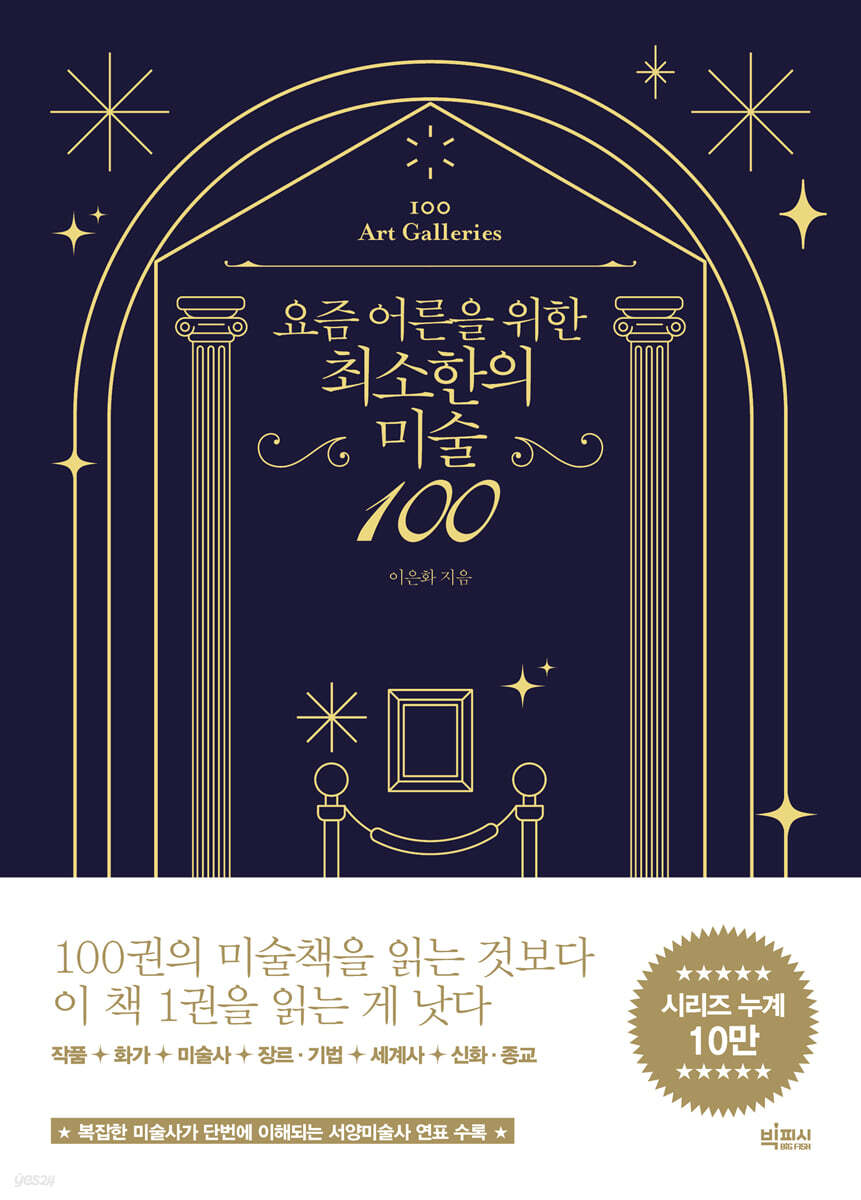
100 Minimal Art Lessons for Adults Today
 |
Description
Book Introduction
Series cumulative sales of 100,000 copies
From ancient art to modern art
100 Masterpieces You Must See Before You Die
“It’s better to read this one book than a hundred art books!”
Wouldn't it be great if you could understand world-renowned paintings, artists, art history, and more in a single book? "100 Essential Art Lessons for Adults Today" provides the bare minimum of art knowledge for adults living in an information-abundant age.
By immersing yourself in stories about art history and world history through must-know works and painters, including well-known artists like Van Gogh and Rembrandt, as well as Kollwitz and Kirchner, and the stories behind their works, you can develop background knowledge and an eye for art.
The writer Goethe said this:
“We need art in both the happiest moments and the most difficult.” Now is the time to encounter beautiful works of art that will always give us strength in both happy and difficult moments.
From ancient art to modern art
100 Masterpieces You Must See Before You Die
“It’s better to read this one book than a hundred art books!”
Wouldn't it be great if you could understand world-renowned paintings, artists, art history, and more in a single book? "100 Essential Art Lessons for Adults Today" provides the bare minimum of art knowledge for adults living in an information-abundant age.
By immersing yourself in stories about art history and world history through must-know works and painters, including well-known artists like Van Gogh and Rembrandt, as well as Kollwitz and Kirchner, and the stories behind their works, you can develop background knowledge and an eye for art.
The writer Goethe said this:
“We need art in both the happiest moments and the most difficult.” Now is the time to encounter beautiful works of art that will always give us strength in both happy and difficult moments.
- You can preview some of the book's contents.
Preview
index
How to read this book
Western Art History Chronology
001.
[Work: Ophelia] The most beautiful death in the world
002.
[Painter: Henri Rousseau] From a civil servant who painted only on weekends to a great painter
003.
[Art History: Double Painting] The Birth of a Painting That Is Both a Portrait and a Still Life
004.
[World History: The Spanish Civil War] A Life's Masterpiece Created by Tragedy
005.
[Artwork: Cafe Terrace at Night] Van Gogh's first work depicting the stars in the night sky.
006.
[Painter: Gustav Klimt] Darkness painted during his most brilliant period
007.
[Art History: Ashcan School] Life Like Cigarette Ashes Discarded in an Ashtray
008.
[World History: The Revolutions of 1848] A Peaceful Mockery of the Peaceful Extinction
009.
[Work: Dance 1] A massive masterpiece completed in a week
010.
[Painter: Honoré Daumier] The arduous lives of workers, filled with the smell of sweat.
011.
[Art History: Camera Obscura] The ill-fated genius painter who became known 200 years after his death
012.
[World History: Brexit] Making the anxious comfortable, the comfortable anxious
013.
[Artwork: Carnation, Lily, Lily, Rose] A painful memory that becomes a beautiful scene
014.
[Painter: William Holman Hunt] Painting Victorian Morality
015.
[Art History: Shorthand] Breaking the Taboo on Religious Painting
016.
[World History: The July Revolution] A Picture So Revolutionary It's Hidden
017.
[Artwork: Rabbit] It's pretty only when you look at it for a long time.
018.
[Painter: Gustave Caillebotte] Would great works have been born without him?
019.
[Art History: Allegory] Secrets Hidden in Paintings
020.
[World History: World War I] Why I Was on the Nazi Blacklist
021.
[Work: Night Patrol] A masterpiece that endured 380 years of hardship and adversity.
022.
[Painter: Pieter Bruegel the Elder] He who does not resist tyranny will perish.
023.
[Art History: Barbizon School] Why did Van Gogh and Park Soo-keun admire him?
024.
[World History: The Mona Lisa Theft] Fame soon became legend.
025.
[Work: American Gothic] A representative work symbolizing 20th-century Americans
026.
[Painter: Artemisia Gentileschi] Fighting Violence Through Painting
027.
[Art History: Expressionism] What Only a Madman Can Draw
028.
[World History: The Bloody Court] A World Where the Blind Lead the Blind
029.
[Artwork: Bridge over the Lotus Pond] The best model chosen by the painter of light
030.
[Painter: William Chase] What I Really Wanted to Say Through My Paintings
031.
[Art History: Cubism] The Birth of a Completely New Style
032.
[World History: The Dutch War of Independence] Can a Beautiful War Exist?
033.
[Work: Kiss] The culmination of a master's life, art, and love.
034.
[Painter: John William Waterhouse] Have you ever risked your life for something you believed in?
035.
[Art History: Modern Art] A painter with nothing to lose risks his life.
036.
[World History: World War II] One Lie Begets Another Lie
037.
[Artwork: Salvator Mundi] The world's most expensive painting, whose whereabouts are unknown
038.
[Painter: Frida Kahlo] A Miracle Created by Desperation
039.
[Art History: Genre Painting] The Simple Family Life That Captured the King's Heart
040.
[World History: The Franco-Prussian Wars] A Dream World Created by Darkness and Silence
041.
[Artwork: The Red Vineyard] The only painting Van Gogh sold
042.
[Painter: Marie Laurencin] An ecstatic world where only women, animals, and music exist.
043.
[Art History: Mannerism] The Last Days of the Painter Who Ignored Michelangelo
044.
[World History: Civil War] Can Books Show Us the Way?
045.
[Artwork: Where do we come from, who are we, where are we going?] A painting drawn with the determination to die
046.
[Painter: Jacques-Louis David] A talent that satisfied both revolutionary and counter-revolutionary forces.
047.
[Art History: Troni] A Timeless Mystery
048.
[World History: 1923 World Heavyweight Championship] Consolation for the Loser
049.
[Artwork: David] A masterpiece of the century that reinterprets the Bible
050.
[Painter: Henri Matisse] Why I Purchased a Painting That Was Criticized as Poor
051.
[Art History: Action Painting] From Outside the Painting to Inside the Painting
052.
[World History: The Paris Commune] The Painter's Wishes That Could Never Be "Goodbye"
053.
[Work: Snowstorm] Not to be understood, but to record
054.
[Painter: Käthe Kollwitz] The greatest folk artist who cried out for reversal throughout her life.
055.
[Art History: Neoplasticism] The Most Basic is the Most Beautiful
056.
[World History: The Sinking of the Medusa] A Catastrophe 200 Years Ago That We Never Want to Empathize With
057.
[Artwork: Portrait of a Soldier with a Halberd] A painting that has become a hot topic, breaking the record for the highest price paid for classical art.
058.
[Painter: Edgar Degas] Cold and unfamiliar, yet realistic and new
059.
[Art History: Abstraction] The first abstract painter, five years before Kandinsky
060.
[World History: Impressionism] The new is unfamiliar, and the unfamiliar makes history.
061.
[Work: The Execution of Jane Grey] A queen deposed after only nine days
062.
[Painter: Cecilia Bo] A great female painter who never put down her brush until her death.
063.
[Art History: Readymade] The World's First Portable Art Museum
064.
[World History: Women's Suffrage] The Unexpected Fruit of Crime
065.
[Artwork: Lunch on the Grass] The Fate of an Artist Ahead of His Time
066.
[Painter: Jean-Frédéric Bazille] An Impressionist painter forgotten too quickly
067.
[Art History: Nude Painting] A Brave Self-Portrait Without Shame
068.
[World History: The Unification of Italy] A Peace Achieved Through Fervent Desire
069.
[Work: Kiss] Their Kiss, the 'Gates of Hell'
070.
[Painter: Diego Velázquez] The weight of power the young princess had to endure
071.
[Art History: Pointillism] The Only Collector Who Recognized Van Gogh's Paintings
072.
[World History: Napoleon] A scene from history that became an important symbol.
073.
[Artwork: Summer evening on the southern beach of Skagen] As dusk passes and darkness descends,
074.
[Painter: Rosa Bonheur] A painter who painted only animals throughout her life.
075.
[Art History: Satire] The Disguise Necessary to Accuse Immorality
076.
[World History: Greek War of Independence] A pretty girl sitting alone in a cemetery
077.
[Artwork: Pink Madonna] Virgin Mary with pierced ears?
078.
[Painter: Augusta Savage] A brilliant achievement amid poverty, discrimination, and exclusion.
079.
[Art History: Religious Painting] Why He Had to Succeed
080.
[World History: The American Declaration of Independence] A Masterpiece More Reproduced Than the Mona Lisa
081.
[Artwork: The Virgin at Prayer] Eternal value painted in the most precious colors
082.
[Painter: Mary Beale] The female painter who received the highest praise for being 'masculine'
083.
[Art History: Secession] A True Homage to the Symphony
084.
[World History: The Venetian School] Leonardo da Vinci of Venice
085.
[Work: Jeanne Hebuterne] An immortal love that could not be separated even in death
086.
[Painter: Sigrid Hjerten] A Lifelong Fight against Prejudice
087.
[Art History: Oil Painting] The Passion of Jesus Painted in Pink
088.
[World History: Ancient Olympics] The sculpture that became the symbol of the Olympics
089.
[Artwork: Children Playing in Enghave Square] A portrait of the most splendid spring day of my life.
090.
[Painter: Otto Dix] The appearance of a dirty, miserable, and devilish being.
091.
[Art History: Modern Art] From Visible Object to Acting Subject
092.
[World History: Decadent Art Exhibition] Even when works disappear, the spirit of the age remains.
093.
[Artwork: Wounded Angel] The most beloved painting of Finns
094.
[Painter: Francis Picabia] Consistency Born from Inconsistency
095.
[Art History: Abstract Expressionism] Paintings That Don't Draw
096.
[World History: The Industrial Revolution] A Moment of Scientific Experimentation on Canvas
097.
[Artwork: A Sacrifice in the Midwinter] A historical painting installed 80 years after its completion
098.
[Painter: John Singer Sargent] A self-portrait that he hung in his room until his death.
099.
[Art History: Photomontage] To escape the stifling reality and move forward freely.
100.
[World History: Germany's Refugee Problem] Awakening Common Sense
Epilogue
Western Art History Chronology
001.
[Work: Ophelia] The most beautiful death in the world
002.
[Painter: Henri Rousseau] From a civil servant who painted only on weekends to a great painter
003.
[Art History: Double Painting] The Birth of a Painting That Is Both a Portrait and a Still Life
004.
[World History: The Spanish Civil War] A Life's Masterpiece Created by Tragedy
005.
[Artwork: Cafe Terrace at Night] Van Gogh's first work depicting the stars in the night sky.
006.
[Painter: Gustav Klimt] Darkness painted during his most brilliant period
007.
[Art History: Ashcan School] Life Like Cigarette Ashes Discarded in an Ashtray
008.
[World History: The Revolutions of 1848] A Peaceful Mockery of the Peaceful Extinction
009.
[Work: Dance 1] A massive masterpiece completed in a week
010.
[Painter: Honoré Daumier] The arduous lives of workers, filled with the smell of sweat.
011.
[Art History: Camera Obscura] The ill-fated genius painter who became known 200 years after his death
012.
[World History: Brexit] Making the anxious comfortable, the comfortable anxious
013.
[Artwork: Carnation, Lily, Lily, Rose] A painful memory that becomes a beautiful scene
014.
[Painter: William Holman Hunt] Painting Victorian Morality
015.
[Art History: Shorthand] Breaking the Taboo on Religious Painting
016.
[World History: The July Revolution] A Picture So Revolutionary It's Hidden
017.
[Artwork: Rabbit] It's pretty only when you look at it for a long time.
018.
[Painter: Gustave Caillebotte] Would great works have been born without him?
019.
[Art History: Allegory] Secrets Hidden in Paintings
020.
[World History: World War I] Why I Was on the Nazi Blacklist
021.
[Work: Night Patrol] A masterpiece that endured 380 years of hardship and adversity.
022.
[Painter: Pieter Bruegel the Elder] He who does not resist tyranny will perish.
023.
[Art History: Barbizon School] Why did Van Gogh and Park Soo-keun admire him?
024.
[World History: The Mona Lisa Theft] Fame soon became legend.
025.
[Work: American Gothic] A representative work symbolizing 20th-century Americans
026.
[Painter: Artemisia Gentileschi] Fighting Violence Through Painting
027.
[Art History: Expressionism] What Only a Madman Can Draw
028.
[World History: The Bloody Court] A World Where the Blind Lead the Blind
029.
[Artwork: Bridge over the Lotus Pond] The best model chosen by the painter of light
030.
[Painter: William Chase] What I Really Wanted to Say Through My Paintings
031.
[Art History: Cubism] The Birth of a Completely New Style
032.
[World History: The Dutch War of Independence] Can a Beautiful War Exist?
033.
[Work: Kiss] The culmination of a master's life, art, and love.
034.
[Painter: John William Waterhouse] Have you ever risked your life for something you believed in?
035.
[Art History: Modern Art] A painter with nothing to lose risks his life.
036.
[World History: World War II] One Lie Begets Another Lie
037.
[Artwork: Salvator Mundi] The world's most expensive painting, whose whereabouts are unknown
038.
[Painter: Frida Kahlo] A Miracle Created by Desperation
039.
[Art History: Genre Painting] The Simple Family Life That Captured the King's Heart
040.
[World History: The Franco-Prussian Wars] A Dream World Created by Darkness and Silence
041.
[Artwork: The Red Vineyard] The only painting Van Gogh sold
042.
[Painter: Marie Laurencin] An ecstatic world where only women, animals, and music exist.
043.
[Art History: Mannerism] The Last Days of the Painter Who Ignored Michelangelo
044.
[World History: Civil War] Can Books Show Us the Way?
045.
[Artwork: Where do we come from, who are we, where are we going?] A painting drawn with the determination to die
046.
[Painter: Jacques-Louis David] A talent that satisfied both revolutionary and counter-revolutionary forces.
047.
[Art History: Troni] A Timeless Mystery
048.
[World History: 1923 World Heavyweight Championship] Consolation for the Loser
049.
[Artwork: David] A masterpiece of the century that reinterprets the Bible
050.
[Painter: Henri Matisse] Why I Purchased a Painting That Was Criticized as Poor
051.
[Art History: Action Painting] From Outside the Painting to Inside the Painting
052.
[World History: The Paris Commune] The Painter's Wishes That Could Never Be "Goodbye"
053.
[Work: Snowstorm] Not to be understood, but to record
054.
[Painter: Käthe Kollwitz] The greatest folk artist who cried out for reversal throughout her life.
055.
[Art History: Neoplasticism] The Most Basic is the Most Beautiful
056.
[World History: The Sinking of the Medusa] A Catastrophe 200 Years Ago That We Never Want to Empathize With
057.
[Artwork: Portrait of a Soldier with a Halberd] A painting that has become a hot topic, breaking the record for the highest price paid for classical art.
058.
[Painter: Edgar Degas] Cold and unfamiliar, yet realistic and new
059.
[Art History: Abstraction] The first abstract painter, five years before Kandinsky
060.
[World History: Impressionism] The new is unfamiliar, and the unfamiliar makes history.
061.
[Work: The Execution of Jane Grey] A queen deposed after only nine days
062.
[Painter: Cecilia Bo] A great female painter who never put down her brush until her death.
063.
[Art History: Readymade] The World's First Portable Art Museum
064.
[World History: Women's Suffrage] The Unexpected Fruit of Crime
065.
[Artwork: Lunch on the Grass] The Fate of an Artist Ahead of His Time
066.
[Painter: Jean-Frédéric Bazille] An Impressionist painter forgotten too quickly
067.
[Art History: Nude Painting] A Brave Self-Portrait Without Shame
068.
[World History: The Unification of Italy] A Peace Achieved Through Fervent Desire
069.
[Work: Kiss] Their Kiss, the 'Gates of Hell'
070.
[Painter: Diego Velázquez] The weight of power the young princess had to endure
071.
[Art History: Pointillism] The Only Collector Who Recognized Van Gogh's Paintings
072.
[World History: Napoleon] A scene from history that became an important symbol.
073.
[Artwork: Summer evening on the southern beach of Skagen] As dusk passes and darkness descends,
074.
[Painter: Rosa Bonheur] A painter who painted only animals throughout her life.
075.
[Art History: Satire] The Disguise Necessary to Accuse Immorality
076.
[World History: Greek War of Independence] A pretty girl sitting alone in a cemetery
077.
[Artwork: Pink Madonna] Virgin Mary with pierced ears?
078.
[Painter: Augusta Savage] A brilliant achievement amid poverty, discrimination, and exclusion.
079.
[Art History: Religious Painting] Why He Had to Succeed
080.
[World History: The American Declaration of Independence] A Masterpiece More Reproduced Than the Mona Lisa
081.
[Artwork: The Virgin at Prayer] Eternal value painted in the most precious colors
082.
[Painter: Mary Beale] The female painter who received the highest praise for being 'masculine'
083.
[Art History: Secession] A True Homage to the Symphony
084.
[World History: The Venetian School] Leonardo da Vinci of Venice
085.
[Work: Jeanne Hebuterne] An immortal love that could not be separated even in death
086.
[Painter: Sigrid Hjerten] A Lifelong Fight against Prejudice
087.
[Art History: Oil Painting] The Passion of Jesus Painted in Pink
088.
[World History: Ancient Olympics] The sculpture that became the symbol of the Olympics
089.
[Artwork: Children Playing in Enghave Square] A portrait of the most splendid spring day of my life.
090.
[Painter: Otto Dix] The appearance of a dirty, miserable, and devilish being.
091.
[Art History: Modern Art] From Visible Object to Acting Subject
092.
[World History: Decadent Art Exhibition] Even when works disappear, the spirit of the age remains.
093.
[Artwork: Wounded Angel] The most beloved painting of Finns
094.
[Painter: Francis Picabia] Consistency Born from Inconsistency
095.
[Art History: Abstract Expressionism] Paintings That Don't Draw
096.
[World History: The Industrial Revolution] A Moment of Scientific Experimentation on Canvas
097.
[Artwork: A Sacrifice in the Midwinter] A historical painting installed 80 years after its completion
098.
[Painter: John Singer Sargent] A self-portrait that he hung in his room until his death.
099.
[Art History: Photomontage] To escape the stifling reality and move forward freely.
100.
[World History: Germany's Refugee Problem] Awakening Common Sense
Epilogue
Detailed image

Into the book
The anecdote surrounding this painting is famous when Paris was occupied by Nazi Germany during World War II.
A Nazi officer who visited Picasso's studio asked him about a photograph of Guernica.
“Did you draw this picture?”
Picasso replied:
"no.
“That’s what you did.”
This statement was not wrong.
If there had been no tragedy in Guernica, there would have been no reason for Picasso, the painter of the muses, to become a painter of reversal.
--- p.20~21, from “[World History: Spanish Civil War] A Life’s Masterpiece Created by Tragedy”
The completed painting was exhibited at the Salon in 1831 and attracted much attention.
While some were offended by the depiction of a goddess, who should have been elegant and beautiful, as a poor commoner, most considered it a masterpiece that would forever commemorate a revolutionary moment.
The French government purchased the painting for 3,000 francs and added it to the royal collection to commemorate Louis Philippe, who became the "Citizen King" after the July Revolution.
But the real intention was completely different.
It was a threatening picture that could incite the public at any time, so it was removed from public view.
“This painting was so revolutionary that it was hidden in the attic.”
This was written by French art critic Champfleury in 1848.
--- p.44~45, from “[World History: July Revolution] A Picture So Revolutionary It Was Hidden”
The Parable of the Blind Man is based on a story from Matthew 15:14.
When the Pharisees were displeased with Jesus' teaching and ridiculed him, Jesus said to his disciples:
“Leave them alone.
They are blind guides of the blind.
“If a blind man leads a blind man, both will fall into a pit.”
Bruegel painted this picture a year before his death, during one of the darkest periods in Dutch history.
It was a time of tyranny under the rule of Philip II of Spain, when rebels and Protestants fighting for Dutch independence were arrested or executed on a large scale.
The special court for the trial of rebels was called the "Court of Blood" because so many innocent people were sacrificed.
Just before he died, Bruegel told his wife to burn many of his paintings.
Because he thought his drawings might be seen as provocative and might cause trouble to his family.
(…) The reason why “The Parable of the Blind Man” resonates so deeply is probably because the message conveyed by the artist 450 years ago is still relevant today.
--- p.68~69, from “[World History: Blood Court] A World Where the Blind Lead the Blind”
"Hello, Monsieur Courbet" depicts the scene where Bruyas comes out to welcome Courbet, who has just arrived in Montpellier.
(…) He takes off his hat and greets a painter he meets on the street politely.
(…) When this painting was exhibited at the Paris World's Fair in 1855, people were astonished.
Because I couldn't understand why a rich patron would take off his hat and bow to a poor artist.
Rather, I thought it was right for the artist to greet his patron politely.
The title of the work was originally “Encounter,” but it came from critics who saw the painting and mocked the patron, asking if he was saying “Hello, Monsieur Courbet.”
(…) ‘Annyeonghada’ means being comfortable without any problems.
It is not easy for a poor artist to be comfortable.
Besides, wasn't he a political artist active in Paris during the turbulent times of revolution?
Perhaps this painting embodies the artist's desire to live in a comfortable world, supported by the wealthy and respected by the common people, and to focus solely on his creations.
--- p.116~117, from “[World History: Paris Commune] The Painter’s Wish That Could Never Be ‘Goodbye’”
Hansen completed this painting at the age of 40, when he was a successful artist and his family was complete, on a perfect and beautiful spring day.
But the following year, unbelievable bad news arrives.
On July 27, 1909, the news came that his eldest son, David, had been one of the leaders of the Barcelona general strike and was assassinated by the Spanish army.
Although he believed his son had become a great martyr of the Spanish anarchist movement, he could not help but feel sad.
From this day onwards, the bright colors in Hansen's paintings are significantly reduced.
The pain of losing a son began to be reflected in his paintings.
Just a year earlier, Hansen had depicted children playing happily in front of their houses in “Children Playing in Enghave Square.”
Could the artist have ever imagined that this painting would become a portrait of the most splendid spring day of his life?
A Nazi officer who visited Picasso's studio asked him about a photograph of Guernica.
“Did you draw this picture?”
Picasso replied:
"no.
“That’s what you did.”
This statement was not wrong.
If there had been no tragedy in Guernica, there would have been no reason for Picasso, the painter of the muses, to become a painter of reversal.
--- p.20~21, from “[World History: Spanish Civil War] A Life’s Masterpiece Created by Tragedy”
The completed painting was exhibited at the Salon in 1831 and attracted much attention.
While some were offended by the depiction of a goddess, who should have been elegant and beautiful, as a poor commoner, most considered it a masterpiece that would forever commemorate a revolutionary moment.
The French government purchased the painting for 3,000 francs and added it to the royal collection to commemorate Louis Philippe, who became the "Citizen King" after the July Revolution.
But the real intention was completely different.
It was a threatening picture that could incite the public at any time, so it was removed from public view.
“This painting was so revolutionary that it was hidden in the attic.”
This was written by French art critic Champfleury in 1848.
--- p.44~45, from “[World History: July Revolution] A Picture So Revolutionary It Was Hidden”
The Parable of the Blind Man is based on a story from Matthew 15:14.
When the Pharisees were displeased with Jesus' teaching and ridiculed him, Jesus said to his disciples:
“Leave them alone.
They are blind guides of the blind.
“If a blind man leads a blind man, both will fall into a pit.”
Bruegel painted this picture a year before his death, during one of the darkest periods in Dutch history.
It was a time of tyranny under the rule of Philip II of Spain, when rebels and Protestants fighting for Dutch independence were arrested or executed on a large scale.
The special court for the trial of rebels was called the "Court of Blood" because so many innocent people were sacrificed.
Just before he died, Bruegel told his wife to burn many of his paintings.
Because he thought his drawings might be seen as provocative and might cause trouble to his family.
(…) The reason why “The Parable of the Blind Man” resonates so deeply is probably because the message conveyed by the artist 450 years ago is still relevant today.
--- p.68~69, from “[World History: Blood Court] A World Where the Blind Lead the Blind”
"Hello, Monsieur Courbet" depicts the scene where Bruyas comes out to welcome Courbet, who has just arrived in Montpellier.
(…) He takes off his hat and greets a painter he meets on the street politely.
(…) When this painting was exhibited at the Paris World's Fair in 1855, people were astonished.
Because I couldn't understand why a rich patron would take off his hat and bow to a poor artist.
Rather, I thought it was right for the artist to greet his patron politely.
The title of the work was originally “Encounter,” but it came from critics who saw the painting and mocked the patron, asking if he was saying “Hello, Monsieur Courbet.”
(…) ‘Annyeonghada’ means being comfortable without any problems.
It is not easy for a poor artist to be comfortable.
Besides, wasn't he a political artist active in Paris during the turbulent times of revolution?
Perhaps this painting embodies the artist's desire to live in a comfortable world, supported by the wealthy and respected by the common people, and to focus solely on his creations.
--- p.116~117, from “[World History: Paris Commune] The Painter’s Wish That Could Never Be ‘Goodbye’”
Hansen completed this painting at the age of 40, when he was a successful artist and his family was complete, on a perfect and beautiful spring day.
But the following year, unbelievable bad news arrives.
On July 27, 1909, the news came that his eldest son, David, had been one of the leaders of the Barcelona general strike and was assassinated by the Spanish army.
Although he believed his son had become a great martyr of the Spanish anarchist movement, he could not help but feel sad.
From this day onwards, the bright colors in Hansen's paintings are significantly reduced.
The pain of losing a son began to be reflected in his paintings.
Just a year earlier, Hansen had depicted children playing happily in front of their houses in “Children Playing in Enghave Square.”
Could the artist have ever imagined that this painting would become a portrait of the most splendid spring day of his life?
--- p.190~191, from “[Work: Children Playing in Enghabe Square] Portrait of the Most Brilliant Spring Day of Life”
Publisher's Review
100 Masterpieces and Stories Every Adult Should Know
“Even in moments of extreme happiness or extreme hardship,
“We need art” _Goethe
"100 Essential Artworks for Adults Today" is a story about 100 masterpieces that adults today must know.
100 works spanning over 2,000 years of time and space, from ancient to modern art, were introduced under four themes: works, artists, art history, and world history.
The purpose is to explore the art history and historical knowledge that formed the background of the creation through interesting stories along with famous paintings.
To this end, we have carefully selected and covered dazzling masterpieces from well-known painters like Van Gogh and Rembrandt, as well as modern painters we are less familiar with, such as Kollwitz and Kirchner, and faithfully included works of art from various genres, including not only paintings but also ancient sculptures and modern installation art.
Among the 100 greatest masterpieces that have graced the history of art, some are well known to us, while others are not.
This is because even works that are not famous but have significance in art history were boldly introduced.
This is why this book includes many works by contemporary painters and female artists that are not easily found in books on Western art history.
This is the moment when art becomes so fun!
★What is the most expensive painting in the world?
★What painting was so revolutionary that the government bought it and hid it?
★There is a controversy over child abuse in this beautiful painting?
★Why did the Virgin Mary have her ears pierced?
★What painting is copied more than the Mona Lisa?
In the midst of a civil war that claimed the lives of over 1,700 people, Picasso's black-and-white painting "Guernica" and Banksy's "Delegated Parliament," featuring chimpanzees taking over the British Parliament, vividly portray the history of over 100 years ago and the present.
Behind Turner's painting "The Snowstorm," which elevated landscape painting to a new level, there was the tragic heart of the artist who risked his life by going out to the stormy sea and tying himself to the mast. And if I hadn't read this book, I would never have known the heart of Vermeer, who used ultramarine dye, which was as expensive as gold, without sparing it in order to portray the girl in "Girl with a Pearl Earring" as the most noble being.
"100 Minimum Art Lessons for Adults Today" is a new work by artist Eunhwa Lee, who majored in art in Europe, the birthplace of Western art, and interacts with the public through various media. Thanks to her unique and exciting storytelling, even readers who are "encountering art for the first time" can easily immerse themselves in the book.
Minimum general knowledge that can be understood in just one volume
★ Includes a timeline of Western art history that allows you to understand complex art history in a single breath.
Looking at the illustrations spread out on the cool surface, you get the feeling that you have the entire art gallery to yourself.
It even includes a chronology of Western art history, allowing you to see the complex history of art at a glance, so you can understand the flow of art history at a glance.
Of course, it is filled with rich cultural knowledge ranging from world history to culture, philosophy, mythology, and religion, interspersed with interesting stories that fill the pages.
The writer Goethe said this:
“We need art in both the happiest moments and the most difficult.” Now is the time to encounter beautiful works of art that will always give us strength in both happy and difficult moments.
“Even in moments of extreme happiness or extreme hardship,
“We need art” _Goethe
"100 Essential Artworks for Adults Today" is a story about 100 masterpieces that adults today must know.
100 works spanning over 2,000 years of time and space, from ancient to modern art, were introduced under four themes: works, artists, art history, and world history.
The purpose is to explore the art history and historical knowledge that formed the background of the creation through interesting stories along with famous paintings.
To this end, we have carefully selected and covered dazzling masterpieces from well-known painters like Van Gogh and Rembrandt, as well as modern painters we are less familiar with, such as Kollwitz and Kirchner, and faithfully included works of art from various genres, including not only paintings but also ancient sculptures and modern installation art.
Among the 100 greatest masterpieces that have graced the history of art, some are well known to us, while others are not.
This is because even works that are not famous but have significance in art history were boldly introduced.
This is why this book includes many works by contemporary painters and female artists that are not easily found in books on Western art history.
This is the moment when art becomes so fun!
★What is the most expensive painting in the world?
★What painting was so revolutionary that the government bought it and hid it?
★There is a controversy over child abuse in this beautiful painting?
★Why did the Virgin Mary have her ears pierced?
★What painting is copied more than the Mona Lisa?
In the midst of a civil war that claimed the lives of over 1,700 people, Picasso's black-and-white painting "Guernica" and Banksy's "Delegated Parliament," featuring chimpanzees taking over the British Parliament, vividly portray the history of over 100 years ago and the present.
Behind Turner's painting "The Snowstorm," which elevated landscape painting to a new level, there was the tragic heart of the artist who risked his life by going out to the stormy sea and tying himself to the mast. And if I hadn't read this book, I would never have known the heart of Vermeer, who used ultramarine dye, which was as expensive as gold, without sparing it in order to portray the girl in "Girl with a Pearl Earring" as the most noble being.
"100 Minimum Art Lessons for Adults Today" is a new work by artist Eunhwa Lee, who majored in art in Europe, the birthplace of Western art, and interacts with the public through various media. Thanks to her unique and exciting storytelling, even readers who are "encountering art for the first time" can easily immerse themselves in the book.
Minimum general knowledge that can be understood in just one volume
★ Includes a timeline of Western art history that allows you to understand complex art history in a single breath.
Looking at the illustrations spread out on the cool surface, you get the feeling that you have the entire art gallery to yourself.
It even includes a chronology of Western art history, allowing you to see the complex history of art at a glance, so you can understand the flow of art history at a glance.
Of course, it is filled with rich cultural knowledge ranging from world history to culture, philosophy, mythology, and religion, interspersed with interesting stories that fill the pages.
The writer Goethe said this:
“We need art in both the happiest moments and the most difficult.” Now is the time to encounter beautiful works of art that will always give us strength in both happy and difficult moments.
GOODS SPECIFICS
- Date of issue: March 20, 2024
- Page count, weight, size: 216 pages | 448g | 165*230*12mm
- ISBN13: 9791193128770
- ISBN10: 1193128773
You may also like
카테고리
korean


korean

![GQ KOREA Mark (Monthly): December [2025]](http://librairie.coreenne.fr/cdn/shop/files/8ef265dbbfbf186523ed75ba7319009d.jpg?v=1765340328&width=3840)


