

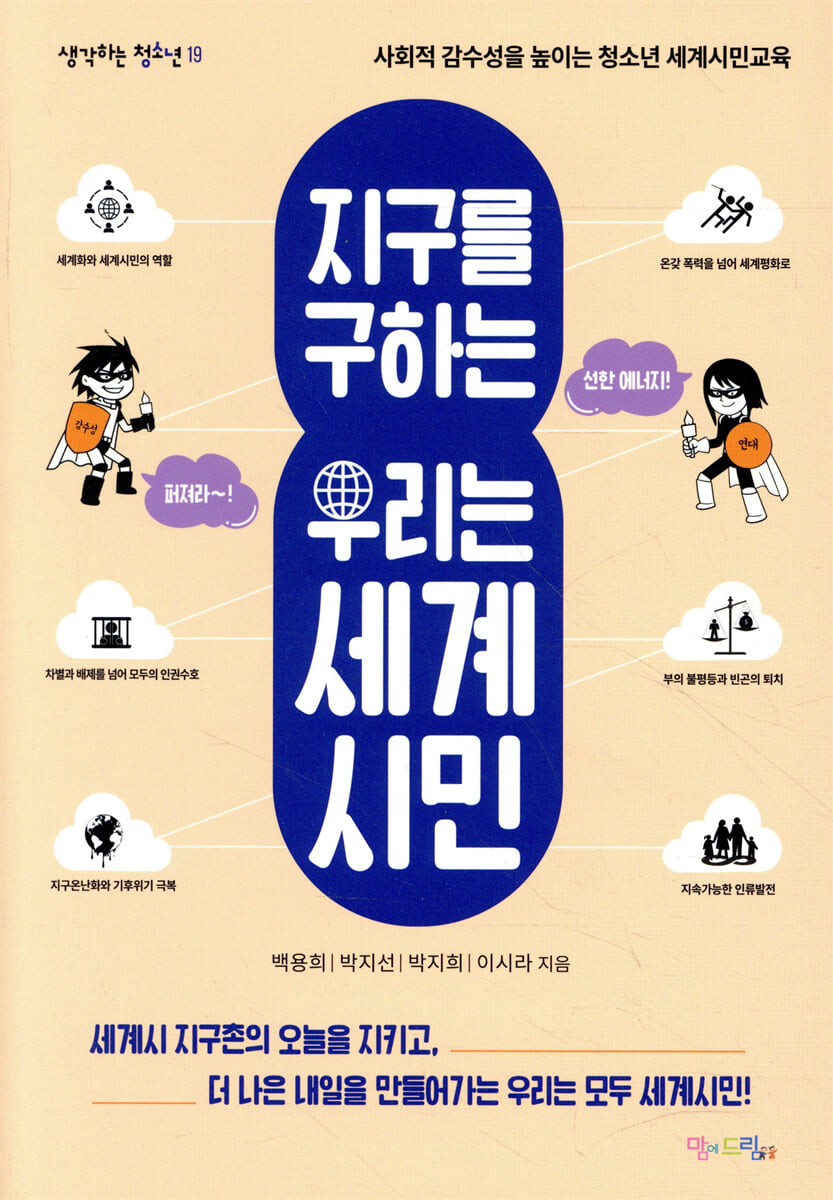
We are global citizens who save the Earth.
 |
Description
Book Introduction
Global Citizenship Education for Youth to Enhance Social Sensitivity
We are global citizens who save the Earth.
The COVID-19 pandemic has become a crisis for all of us living together in this global village, and has also become an opportunity to accelerate the transition to a new world.
Experts warn that unexpected crises will continue to arise in the future.
Moreover, there are already many international problems, including environmental issues, that the world must solve together.
In an age of uncertainty, overflowing with complex and massive problems that cannot be solved by the efforts of individuals or specific countries alone, global cooperation on a humanitarian level is increasingly essential.
Therefore, all of humanity must cultivate global citizenship and join forces to wisely navigate the future.
This book is not a global citizenship education that is detached from everyday life. It helps our youth develop a minimal awareness of the injustice and inequality occurring around them, foster social sensitivity, and view the world with a warm heart.
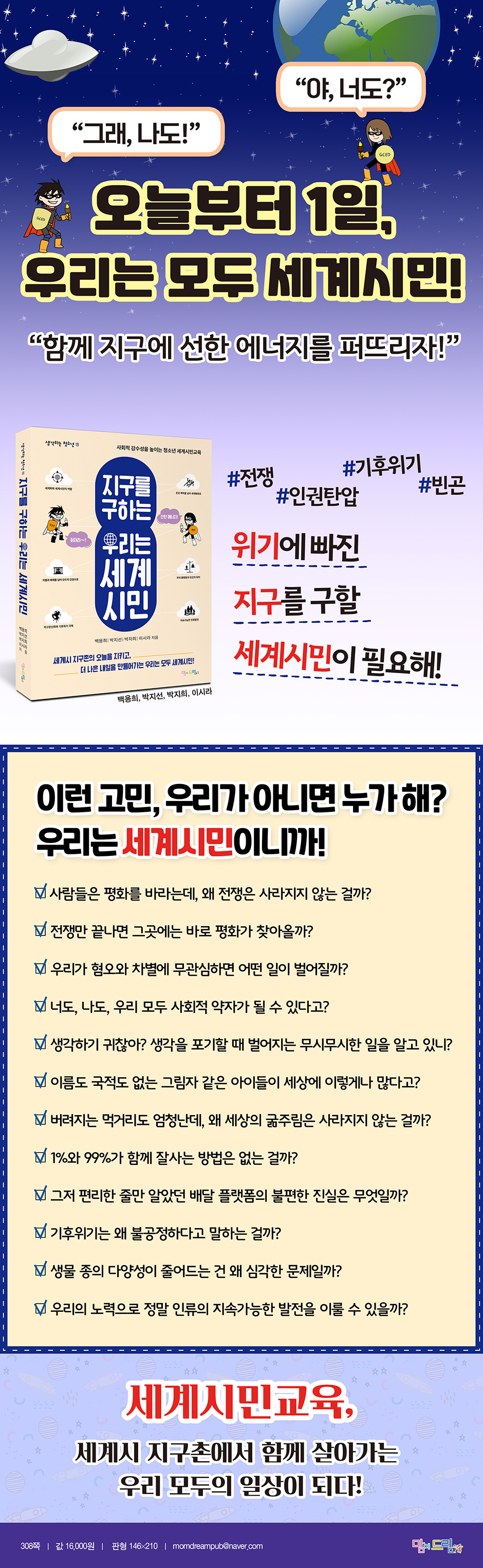
By helping people empathize with and recognize global issues such as world peace, human rights, climate change, and poverty as if they were their own, we will be able to pay deeper attention and even consider ways for all of humanity to achieve sustainable development and coexist with the Earth.
We are global citizens who save the Earth.
The COVID-19 pandemic has become a crisis for all of us living together in this global village, and has also become an opportunity to accelerate the transition to a new world.
Experts warn that unexpected crises will continue to arise in the future.
Moreover, there are already many international problems, including environmental issues, that the world must solve together.
In an age of uncertainty, overflowing with complex and massive problems that cannot be solved by the efforts of individuals or specific countries alone, global cooperation on a humanitarian level is increasingly essential.
Therefore, all of humanity must cultivate global citizenship and join forces to wisely navigate the future.
This book is not a global citizenship education that is detached from everyday life. It helps our youth develop a minimal awareness of the injustice and inequality occurring around them, foster social sensitivity, and view the world with a warm heart.
By helping people empathize with and recognize global issues such as world peace, human rights, climate change, and poverty as if they were their own, we will be able to pay deeper attention and even consider ways for all of humanity to achieve sustainable development and coexist with the Earth.
- You can preview some of the book's contents.
Preview
index
Prologue_ Global Citizenship Education: Does it seem like a distant story that has nothing to do with me?
CHAPTER 1 Perhaps a Community of Destiny
We live together in a global village
01 Starting Point_ What it means to live in a connected world
02 The Spread of Hate: Something More Fearsome and Deadly Than a Virus Is Spreading
CHAPTER 2 WAR AND PEACE
Peace is stronger than any weapon.
01 Definition of Peace_ Can we say peace if there is no war?
02 Physical Violence and Peace_ Whose fault is it that the peace there is broken?
03 Structural Violence and Peace_ How do hatred and discrimination threaten peace?
04 For Peace_ There is an angel of peace living inside of us.
CHAPTER 3 HUMAN RIGHTS
Me, you and us who deserve respect
01 Social Minorities: People who are marginalized from 'us' and called 'them'
02 Women's Rights_ Why just because I'm a woman...
03 Children's Rights: Children Who Lost Their Dreams Due to Abuse
04 Labor Rights_ People who do not receive fair compensation for their labor
05 Refugees and Minorities_ People Expelled Outside the Fence
CHAPTER 4 Poverty Eradication
What has driven them into dire poverty?
01 Current State of Poverty_ How many poor people are there in the world?
02 Climate Crisis and Poverty: The Dire Reality of Absolute Poverty in Underdeveloped Countries
03 Conflict and Poverty_ People unable to escape poverty amidst endless conflict
04 Globalization and Inequality_On What Makes the Poor Poorer
05 Relative Deprivation_ Is there no way for everyone to live well together?
CHAPTER 5: ENVIRONMENT AND CLIMATE DISASTER
No one on Earth is safe
01 Climate Crisis_ Beyond Change to Disaster, Regarding the Reality of the Earth's Climate
02 Marine Pollution_ About the Howling Sea and the Reality of Environmental Disasters
03 Anthropocene_ We humans have become the main culprits of ecosystem destruction.
04 Sustainable Development_ Before it's too late, take the first step toward change starting today!
Epilogue: Solidarity and Coexistence | A Global Village We Will Protect and Create Together
References
CHAPTER 1 Perhaps a Community of Destiny
We live together in a global village
01 Starting Point_ What it means to live in a connected world
02 The Spread of Hate: Something More Fearsome and Deadly Than a Virus Is Spreading
CHAPTER 2 WAR AND PEACE
Peace is stronger than any weapon.
01 Definition of Peace_ Can we say peace if there is no war?
02 Physical Violence and Peace_ Whose fault is it that the peace there is broken?
03 Structural Violence and Peace_ How do hatred and discrimination threaten peace?
04 For Peace_ There is an angel of peace living inside of us.
CHAPTER 3 HUMAN RIGHTS
Me, you and us who deserve respect
01 Social Minorities: People who are marginalized from 'us' and called 'them'
02 Women's Rights_ Why just because I'm a woman...
03 Children's Rights: Children Who Lost Their Dreams Due to Abuse
04 Labor Rights_ People who do not receive fair compensation for their labor
05 Refugees and Minorities_ People Expelled Outside the Fence
CHAPTER 4 Poverty Eradication
What has driven them into dire poverty?
01 Current State of Poverty_ How many poor people are there in the world?
02 Climate Crisis and Poverty: The Dire Reality of Absolute Poverty in Underdeveloped Countries
03 Conflict and Poverty_ People unable to escape poverty amidst endless conflict
04 Globalization and Inequality_On What Makes the Poor Poorer
05 Relative Deprivation_ Is there no way for everyone to live well together?
CHAPTER 5: ENVIRONMENT AND CLIMATE DISASTER
No one on Earth is safe
01 Climate Crisis_ Beyond Change to Disaster, Regarding the Reality of the Earth's Climate
02 Marine Pollution_ About the Howling Sea and the Reality of Environmental Disasters
03 Anthropocene_ We humans have become the main culprits of ecosystem destruction.
04 Sustainable Development_ Before it's too late, take the first step toward change starting today!
Epilogue: Solidarity and Coexistence | A Global Village We Will Protect and Create Together
References
Detailed image
Into the book
No matter how serious an international issue, if no one empathizes with it as if it were their own, no action will be taken to resolve it, and change will remain elusive.
--- p.5
Today, as we dream of a better future, the world needs answers, not just answers.
We need process rather than result, direction rather than speed, and wisdom rather than knowledge.
This could be the answer to overcoming the COVID-19 pandemic and the new normal that lies ahead.
--- p.7
As we have easy access to various cultures from around the world, including movies, dramas, and food, our culture has become more diverse and richer.
And that's not all.
Universal values such as human rights, freedom, and equality have also spread throughout the world through the networks of globalization.
As good values and energy spread across the globe, countries have come to empathize with various issues such as war, climate crisis, poverty, and human rights, and have cooperated to create a better world.
--- p.21
Through encounters and empathy, individuals come to respect each other as individuals with their own stories.
Also, we acknowledge each other as parties to a happy life and cannot ignore each other's pain.
This empathy further empowers us to transform hatred into solidarity.
--- p.32
Have you ever seen a map of Africa? You may have overlooked it, but compared to other continents, its borders are remarkably neatly divided.
--- p.47
Eventually, citizens took action.
At 2:00 PM on February 22, 2021, the Myanmar people's civil disobedience and non-violent resistance movement began.
In what is known as the '2222 Uprising,' citizens took to the streets in record numbers, and the military responded with violence, including blocking communications networks and resorting to bloody suppression.
--- p.62
Why did so many people die? It all started with hatred.
--- p.71
Multiculturalism is not simply limited to the issue of races and ethnicities living in different countries or with different appearances.
Anything that is different from me, such as having a different hometown, a different age, a different gender, or a different job, can be called multicultural.
Education that eliminates discrimination against multicultural people is true multicultural education.
--- p.81
Many things we take for granted today, like the abolition of the caste system, did not suddenly fall from the sky one day.
It is the result of many people resisting and raising their voices over a long period of time to secure their basic rights as human beings.
We live in debt to the world citizens of history.
--- p.89
What we need to be more vigilant about regarding separation, discrimination, and hatred is that when the discriminatory structure inherent in hatred is internalized by people, it makes the victims accept this situation as natural or think that they cannot change the situation.
--- p.100
How about considering hatred and discrimination in a similar context? Generally, the boundaries that divide the socially vulnerable—those who are different from us—vary depending on the classification criteria and categories.
However, this boundary is not objective, but rather vague and subjective.
And as the saying goes, “We are like others~”, while we are infinitely generous, kind, and devoted to ourselves, we tend to be overly strict, harsh, and exclusive to ‘them’.
--- p.104
Sonita Alizadeh, who usually likes American rapper Eminem's rap, rapped about the situation of 650 million friends who are being sold for money.
It is a reminder that addressing the injustice of early marriage and the violation of girls' human rights requires the attention of all of us.
--- p.119
We take it for granted that we have a resident registration number that starts with our date of birth.
However, 7 out of 10 children around the world live as invisible people without a birth certificate.
--- p.122
According to the International Labour Organization, there are 170 million child workers worldwide, accounting for 13% of all children.
Their average daily wage is only about 3,000 won in our currency.
They are suffering from hard labor without even going to school just to earn this much money.
--- p.127
The Japanese government, which had been thoroughly suppressing the Ainu people for over 600 years since the 1400s and had assimilated them into its own country, suddenly enacted the "Ainu Support Act" in 2019, omitting any apology or reflection on the past, and recognizing the Ainu as indigenous people.
--- p.160
According to research by the Center for International Development, regions most affected by the climate crisis include Southeast Asia, South Asia, Africa, and South America, which are relatively economically underdeveloped.
--- p.185
“Access to water is a fundamental right for the dignity of every human being,” said UNESCO Director-General Audrey Azoulay.
It also means that human dignity cannot be maintained if basic human rights are not met due to extreme poverty.
--- p.189
In particular, competitive products and services can generate profits in any country in the global market, but products or services that are not competitive will have difficulty surviving the fierce competition.
In addition, competitive products and services are more likely to be owned by advanced countries or multinational corporations with capital and advanced technology, and this also applies to agricultural products around the world.
--- p.202
While some scholars argue that large-scale aid from developed countries and international organizations is necessary for poor countries to escape the poverty trap, others criticize the fact that Western aid is unilaterally determined by developed countries or international organizations.
--- p.233
Suspicious weather is a phenomenon that occurs not only in our country but also around the world.
Disasters caused by extreme weather phenomena are increasing every year.
The floods caused by heavy rains that hit Western Europe in July 2021, the heat dome phenomenon and heat waves that enveloped the Korean Peninsula in midsummer, wildfires and droughts caused by dry conditions in the western United States, flood damage caused by powerful typhoons and storms, and sudden winter cold waves and heavy snow are all threatening human life.
--- p.243
Although it is invisible, if we consider the concept of virtual water, which is water used throughout the entire process of producing a product, we end up importing a huge amount of water.
--- p.263
No matter what anyone says, we humans are the current owners of the Earth.
But from Earth's perspective, what kind of species are humans? Are we living on Earth with the wisdom and intelligence expected of Sapiens? Perhaps Earth perceives us as villains, intent on destroying everything in our path for our own gain.
--- p.274
Companies around the world are now competing to develop ESG management strategies to ensure their survival.
It is also encouraging that global companies are voluntarily declaring their participation in the RE 100 (Renewable Energy 100) campaign, which aims to source 100% of the electricity used by companies from renewable energy.
--- p.290
More global citizens need to pay attention to and actively address environmental issues such as global warming, climate change, deforestation, desertification, biodiversity issues, marine ecosystem destruction, waste disposal, and new and renewable energy.
Every single citizen of the world who makes these efforts is a true hero who saves the Earth.
--- p.293
Perhaps the desperation that the future could become uncertain if they don't act and the responsibility for change have made Generation Z into Philanthropists.
Therefore, they respond more sensitively to global issues than anyone else, and they lead global solidarity by openly accepting other races, nationalities, and cultures without feeling alienated, transcending borders and race.
It's as if I'm instinctively exercising my global citizenship skills.
--- p.5
Today, as we dream of a better future, the world needs answers, not just answers.
We need process rather than result, direction rather than speed, and wisdom rather than knowledge.
This could be the answer to overcoming the COVID-19 pandemic and the new normal that lies ahead.
--- p.7
As we have easy access to various cultures from around the world, including movies, dramas, and food, our culture has become more diverse and richer.
And that's not all.
Universal values such as human rights, freedom, and equality have also spread throughout the world through the networks of globalization.
As good values and energy spread across the globe, countries have come to empathize with various issues such as war, climate crisis, poverty, and human rights, and have cooperated to create a better world.
--- p.21
Through encounters and empathy, individuals come to respect each other as individuals with their own stories.
Also, we acknowledge each other as parties to a happy life and cannot ignore each other's pain.
This empathy further empowers us to transform hatred into solidarity.
--- p.32
Have you ever seen a map of Africa? You may have overlooked it, but compared to other continents, its borders are remarkably neatly divided.
--- p.47
Eventually, citizens took action.
At 2:00 PM on February 22, 2021, the Myanmar people's civil disobedience and non-violent resistance movement began.
In what is known as the '2222 Uprising,' citizens took to the streets in record numbers, and the military responded with violence, including blocking communications networks and resorting to bloody suppression.
--- p.62
Why did so many people die? It all started with hatred.
--- p.71
Multiculturalism is not simply limited to the issue of races and ethnicities living in different countries or with different appearances.
Anything that is different from me, such as having a different hometown, a different age, a different gender, or a different job, can be called multicultural.
Education that eliminates discrimination against multicultural people is true multicultural education.
--- p.81
Many things we take for granted today, like the abolition of the caste system, did not suddenly fall from the sky one day.
It is the result of many people resisting and raising their voices over a long period of time to secure their basic rights as human beings.
We live in debt to the world citizens of history.
--- p.89
What we need to be more vigilant about regarding separation, discrimination, and hatred is that when the discriminatory structure inherent in hatred is internalized by people, it makes the victims accept this situation as natural or think that they cannot change the situation.
--- p.100
How about considering hatred and discrimination in a similar context? Generally, the boundaries that divide the socially vulnerable—those who are different from us—vary depending on the classification criteria and categories.
However, this boundary is not objective, but rather vague and subjective.
And as the saying goes, “We are like others~”, while we are infinitely generous, kind, and devoted to ourselves, we tend to be overly strict, harsh, and exclusive to ‘them’.
--- p.104
Sonita Alizadeh, who usually likes American rapper Eminem's rap, rapped about the situation of 650 million friends who are being sold for money.
It is a reminder that addressing the injustice of early marriage and the violation of girls' human rights requires the attention of all of us.
--- p.119
We take it for granted that we have a resident registration number that starts with our date of birth.
However, 7 out of 10 children around the world live as invisible people without a birth certificate.
--- p.122
According to the International Labour Organization, there are 170 million child workers worldwide, accounting for 13% of all children.
Their average daily wage is only about 3,000 won in our currency.
They are suffering from hard labor without even going to school just to earn this much money.
--- p.127
The Japanese government, which had been thoroughly suppressing the Ainu people for over 600 years since the 1400s and had assimilated them into its own country, suddenly enacted the "Ainu Support Act" in 2019, omitting any apology or reflection on the past, and recognizing the Ainu as indigenous people.
--- p.160
According to research by the Center for International Development, regions most affected by the climate crisis include Southeast Asia, South Asia, Africa, and South America, which are relatively economically underdeveloped.
--- p.185
“Access to water is a fundamental right for the dignity of every human being,” said UNESCO Director-General Audrey Azoulay.
It also means that human dignity cannot be maintained if basic human rights are not met due to extreme poverty.
--- p.189
In particular, competitive products and services can generate profits in any country in the global market, but products or services that are not competitive will have difficulty surviving the fierce competition.
In addition, competitive products and services are more likely to be owned by advanced countries or multinational corporations with capital and advanced technology, and this also applies to agricultural products around the world.
--- p.202
While some scholars argue that large-scale aid from developed countries and international organizations is necessary for poor countries to escape the poverty trap, others criticize the fact that Western aid is unilaterally determined by developed countries or international organizations.
--- p.233
Suspicious weather is a phenomenon that occurs not only in our country but also around the world.
Disasters caused by extreme weather phenomena are increasing every year.
The floods caused by heavy rains that hit Western Europe in July 2021, the heat dome phenomenon and heat waves that enveloped the Korean Peninsula in midsummer, wildfires and droughts caused by dry conditions in the western United States, flood damage caused by powerful typhoons and storms, and sudden winter cold waves and heavy snow are all threatening human life.
--- p.243
Although it is invisible, if we consider the concept of virtual water, which is water used throughout the entire process of producing a product, we end up importing a huge amount of water.
--- p.263
No matter what anyone says, we humans are the current owners of the Earth.
But from Earth's perspective, what kind of species are humans? Are we living on Earth with the wisdom and intelligence expected of Sapiens? Perhaps Earth perceives us as villains, intent on destroying everything in our path for our own gain.
--- p.274
Companies around the world are now competing to develop ESG management strategies to ensure their survival.
It is also encouraging that global companies are voluntarily declaring their participation in the RE 100 (Renewable Energy 100) campaign, which aims to source 100% of the electricity used by companies from renewable energy.
--- p.290
More global citizens need to pay attention to and actively address environmental issues such as global warming, climate change, deforestation, desertification, biodiversity issues, marine ecosystem destruction, waste disposal, and new and renewable energy.
Every single citizen of the world who makes these efforts is a true hero who saves the Earth.
--- p.293
Perhaps the desperation that the future could become uncertain if they don't act and the responsibility for change have made Generation Z into Philanthropists.
Therefore, they respond more sensitively to global issues than anyone else, and they lead global solidarity by openly accepting other races, nationalities, and cultures without feeling alienated, transcending borders and race.
It's as if I'm instinctively exercising my global citizenship skills.
--- p.296
Publisher's Review
In this era of great change and the COVID-19 pandemic,
We need global citizens to save the Earth!
A virus that spread rapidly within the vast network of globalization
In March 2020, the WHO declared COVID-19 a pandemic.
Within the vast global network where resources, goods, capital, technology, culture, labor, and even ideologies and values are exchanged, the virus also spread rapidly to every corner of the world.
The pandemic has accelerated the trend of deglobalization, including increased social distancing between countries. Coupled with Russia's invasion of Ukraine in 2022, the world is increasingly considering ways to reduce its dependence on other countries, while even extreme protectionist tendencies are emerging.
The position of global citizens pursuing the public good and the position of prioritizing the safety and interests of each country clashed.
However, in a world still deeply interdependent, the climate crisis and various international issues scattered across the globe are complex and intertwined, and cannot be resolved solely through the efforts of individual countries or citizens.
Therefore, to solve the fundamental problem, the international community must join forces.
In particular, the COVID-19 pandemic has rapidly shifted major paradigms across global society and has prompted a reevaluation of the core values that have dominated the world.
In this era of unpredictable transformation, global citizenship has become even more important for the sustainable development of the global village.
It is time for more global citizens to save our planet from crisis.
The indiscriminate spread of discrimination and hatred across the globe amid the COVID-19 pandemic.
The COVID-19 pandemic has brought home to us the uncomfortable truths of globalization, such as discrimination, poverty, the climate crisis, and inequality.
In particular, all over the world, even around us, there are many people who live isolated from their communities, enduring injustice and inequality alone amidst the indifference of others.
As more and more people become indifferent and turn a blind eye to the misfortunes of others, the arrows of injustice and inequality will inevitably be pointed at anyone, at any time.
We must remember that the anti-Chinese sentiment that began in the early days of the COVID-19 pandemic, when China was identified as the source of the virus, eventually spread indiscriminately to all Asians, and that our Korean residents and international students living around the world have also become victims of hate crimes.
In an age where anyone can become a target of discrimination and hatred, rather than categorizing and stigmatizing each other and fighting over who has the upper hand, we should seek coexistence through mutual respect, solidarity, and cooperation based on social sensitivity.
No matter how serious an international problem may be, if no one in the world sympathizes with it as if it were their own, it is difficult to expect any action to resolve it.
Therefore, it is the global citizenship consciousness that allows us to face our own position as members of a global community that transcends our family and our country, and to demonstrate democratic citizenship awareness, morality, and sensitivity that extends to the entire world that will contribute to the sustainable development of humanity.
A global citizen who views global issues based on high social sensitivity
You might be tempted to ignore the problems of people who live far away from you on Earth and whose existence you don't even know about.
But within the vast network of globalization, someone else's problem may become my problem at any time.
Therefore, going forward, we need global citizens who have a sense of belonging to the global community, based on universal humanity that transcends national borders and interconnects not only the region and the world, but also the interconnections between nations.
This book aims to provide opportunities for young people to cultivate a sense of global citizenship based on social sensitivity, to express anger at the inequality and injustice of the world, to empathize with international issues as if they were their own, and to consider solutions.
This helps us to go beyond being citizens of one country and to have a sense of identity and solidarity as global citizens belonging to the global village.
The authors emphasize that global citizenship education should be implemented naturally in everyday life and that relevant experiences should be accumulated.
To this end, we provide opportunities for young people to develop an interest in various international social issues and increase their social sensitivity through various real-life cases covering topics such as peace, human rights, climate change, and poverty.
Small attention and actions can lead to big changes.
Furthermore, we will be able to achieve sustainable development for all of humanity along with the Earth.
From today, we are all citizens of the world,
World Time Protect the world today and tomorrow!
Global Citizenship Education: Becoming a Part of Our Daily Lives!
Global citizenship education is “education that fosters responsible citizens by fostering a broad understanding of universal human values such as human rights, multiculturalism, and world peace, and by considering practical ways to implement them.”
However, rather than approaching global citizenship education conceptually and theoretically, this book focuses more on enhancing readers' social sensitivity so that they can increase their will to solve global problems as global citizens and stakeholders, and furthermore, lead to consistent practice, even if it is only a small thing.
In other words, it provides a platform for recognizing problems on the other side of the world as one's own through various cases, while also allowing one to freely think about solutions.
Through this, young people will come to realize that 'global citizenship education' is not just a campaign slogan that is disconnected from their own lives, but is deeply connected to their current lives and their attitude toward life that is directly connected to their future.
We already live in a world where countries are densely and intricately intertwined.
While examining various examples of hatred, discrimination, and exclusion in the world—things that may not be your current reality but could become your reality at any time—you will be able to fully empathize with the pain and misfortune of others.
It is not a small number of heroes who will save humanity, but the power of citizens of each country armed with a high level of social sensitivity.
If global citizens come together and consider global issues as their own and seek solutions, humanity will surely have a better future.
Creating a sustainable future is a task that all citizens of the world must accomplish through solidarity.
The power of global citizens creating a better world through solidarity and coexistence
The international community is in an uproar over the war in Ukraine in 2022.
Even leaving aside Ukraine's geopolitical importance and the conflicting interests between Russia, the United States, and the Western world, the world's citizens are outraged by the countless civilian casualties, including children, as well as soldiers, resulting from the ravages of war. They are expressing solidarity, praying for peace in Ukraine and supporting them as if it were their own country.
The authors emphasize that this voluntary solidarity among global citizens is the direction in which global citizenship education should proceed and the way to save our planet from crisis.
This book covers the UN's Sustainable Development Goals, including peace, human rights, poverty, and climate change, and provides young people with an opportunity to encounter and truly empathize with the various issues facing the international community.
If global citizens come together to empathize and share their concerns, we will undoubtedly be able to come up with better solutions and create a better planet.
Isn't global citizenship education about recognizing that all of humanity is part of a global community and uniting the people of Earth to consider the best way to coexist and thrive so that humanity can continue to achieve sustainable development on Earth in the future?
As you read stories that are actually happening around the world, including in our country, you will naturally empathize and increase your sensitivity.
Furthermore, it provides an opportunity to think about how the various problems occurring in the global village may be connected to us.
If you can find a connection to something, even if it's just a small thing, it will become a driving force that motivates you to pay attention to it as if it were your own, and to change even the smallest thing in your daily life, one by one, through consistent practice.
We need global citizens to save the Earth!
A virus that spread rapidly within the vast network of globalization
In March 2020, the WHO declared COVID-19 a pandemic.
Within the vast global network where resources, goods, capital, technology, culture, labor, and even ideologies and values are exchanged, the virus also spread rapidly to every corner of the world.
The pandemic has accelerated the trend of deglobalization, including increased social distancing between countries. Coupled with Russia's invasion of Ukraine in 2022, the world is increasingly considering ways to reduce its dependence on other countries, while even extreme protectionist tendencies are emerging.
The position of global citizens pursuing the public good and the position of prioritizing the safety and interests of each country clashed.
However, in a world still deeply interdependent, the climate crisis and various international issues scattered across the globe are complex and intertwined, and cannot be resolved solely through the efforts of individual countries or citizens.
Therefore, to solve the fundamental problem, the international community must join forces.
In particular, the COVID-19 pandemic has rapidly shifted major paradigms across global society and has prompted a reevaluation of the core values that have dominated the world.
In this era of unpredictable transformation, global citizenship has become even more important for the sustainable development of the global village.
It is time for more global citizens to save our planet from crisis.
The indiscriminate spread of discrimination and hatred across the globe amid the COVID-19 pandemic.
The COVID-19 pandemic has brought home to us the uncomfortable truths of globalization, such as discrimination, poverty, the climate crisis, and inequality.
In particular, all over the world, even around us, there are many people who live isolated from their communities, enduring injustice and inequality alone amidst the indifference of others.
As more and more people become indifferent and turn a blind eye to the misfortunes of others, the arrows of injustice and inequality will inevitably be pointed at anyone, at any time.
We must remember that the anti-Chinese sentiment that began in the early days of the COVID-19 pandemic, when China was identified as the source of the virus, eventually spread indiscriminately to all Asians, and that our Korean residents and international students living around the world have also become victims of hate crimes.
In an age where anyone can become a target of discrimination and hatred, rather than categorizing and stigmatizing each other and fighting over who has the upper hand, we should seek coexistence through mutual respect, solidarity, and cooperation based on social sensitivity.
No matter how serious an international problem may be, if no one in the world sympathizes with it as if it were their own, it is difficult to expect any action to resolve it.
Therefore, it is the global citizenship consciousness that allows us to face our own position as members of a global community that transcends our family and our country, and to demonstrate democratic citizenship awareness, morality, and sensitivity that extends to the entire world that will contribute to the sustainable development of humanity.
A global citizen who views global issues based on high social sensitivity
You might be tempted to ignore the problems of people who live far away from you on Earth and whose existence you don't even know about.
But within the vast network of globalization, someone else's problem may become my problem at any time.
Therefore, going forward, we need global citizens who have a sense of belonging to the global community, based on universal humanity that transcends national borders and interconnects not only the region and the world, but also the interconnections between nations.
This book aims to provide opportunities for young people to cultivate a sense of global citizenship based on social sensitivity, to express anger at the inequality and injustice of the world, to empathize with international issues as if they were their own, and to consider solutions.
This helps us to go beyond being citizens of one country and to have a sense of identity and solidarity as global citizens belonging to the global village.
The authors emphasize that global citizenship education should be implemented naturally in everyday life and that relevant experiences should be accumulated.
To this end, we provide opportunities for young people to develop an interest in various international social issues and increase their social sensitivity through various real-life cases covering topics such as peace, human rights, climate change, and poverty.
Small attention and actions can lead to big changes.
Furthermore, we will be able to achieve sustainable development for all of humanity along with the Earth.
From today, we are all citizens of the world,
World Time Protect the world today and tomorrow!
Global Citizenship Education: Becoming a Part of Our Daily Lives!
Global citizenship education is “education that fosters responsible citizens by fostering a broad understanding of universal human values such as human rights, multiculturalism, and world peace, and by considering practical ways to implement them.”
However, rather than approaching global citizenship education conceptually and theoretically, this book focuses more on enhancing readers' social sensitivity so that they can increase their will to solve global problems as global citizens and stakeholders, and furthermore, lead to consistent practice, even if it is only a small thing.
In other words, it provides a platform for recognizing problems on the other side of the world as one's own through various cases, while also allowing one to freely think about solutions.
Through this, young people will come to realize that 'global citizenship education' is not just a campaign slogan that is disconnected from their own lives, but is deeply connected to their current lives and their attitude toward life that is directly connected to their future.
We already live in a world where countries are densely and intricately intertwined.
While examining various examples of hatred, discrimination, and exclusion in the world—things that may not be your current reality but could become your reality at any time—you will be able to fully empathize with the pain and misfortune of others.
It is not a small number of heroes who will save humanity, but the power of citizens of each country armed with a high level of social sensitivity.
If global citizens come together and consider global issues as their own and seek solutions, humanity will surely have a better future.
Creating a sustainable future is a task that all citizens of the world must accomplish through solidarity.
The power of global citizens creating a better world through solidarity and coexistence
The international community is in an uproar over the war in Ukraine in 2022.
Even leaving aside Ukraine's geopolitical importance and the conflicting interests between Russia, the United States, and the Western world, the world's citizens are outraged by the countless civilian casualties, including children, as well as soldiers, resulting from the ravages of war. They are expressing solidarity, praying for peace in Ukraine and supporting them as if it were their own country.
The authors emphasize that this voluntary solidarity among global citizens is the direction in which global citizenship education should proceed and the way to save our planet from crisis.
This book covers the UN's Sustainable Development Goals, including peace, human rights, poverty, and climate change, and provides young people with an opportunity to encounter and truly empathize with the various issues facing the international community.
If global citizens come together to empathize and share their concerns, we will undoubtedly be able to come up with better solutions and create a better planet.
Isn't global citizenship education about recognizing that all of humanity is part of a global community and uniting the people of Earth to consider the best way to coexist and thrive so that humanity can continue to achieve sustainable development on Earth in the future?
As you read stories that are actually happening around the world, including in our country, you will naturally empathize and increase your sensitivity.
Furthermore, it provides an opportunity to think about how the various problems occurring in the global village may be connected to us.
If you can find a connection to something, even if it's just a small thing, it will become a driving force that motivates you to pay attention to it as if it were your own, and to change even the smallest thing in your daily life, one by one, through consistent practice.
GOODS SPECIFICS
- Date of issue: May 16, 2022
- Page count, weight, size: 308 pages | 428g | 148*210*19mm
- ISBN13: 9791189404659
- ISBN10: 1189404656
You may also like
카테고리
korean


korean

![GQ KOREA Mark (Monthly): December [2025]](http://librairie.coreenne.fr/cdn/shop/files/8ef265dbbfbf186523ed75ba7319009d.jpg?v=1765340328&width=3840)


