

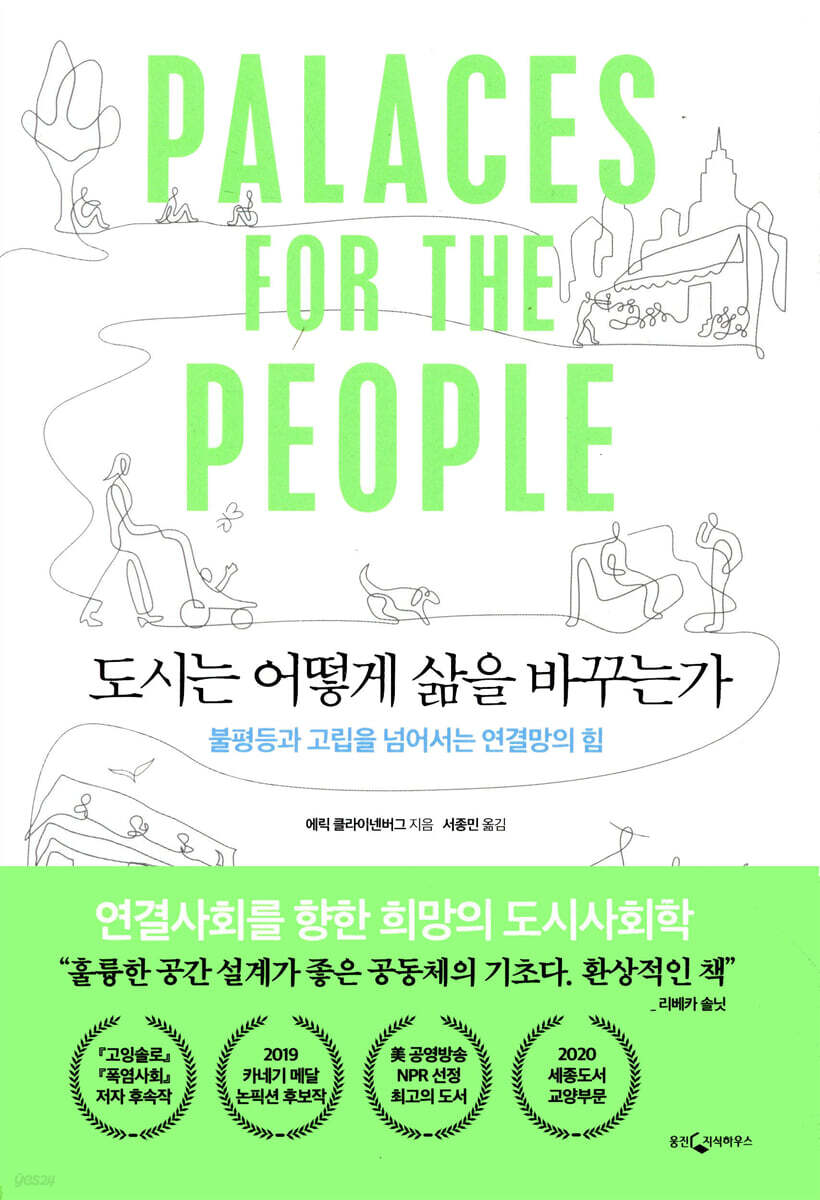
How Cities Change Life
 |
Description
Book Introduction
Will I be left alone and isolated?
Will we be connected freely and abundantly?
The answer lies within the city!
We live in an age of division.
People are divided by various standards and boundaries, and live as if each is surrounded by an invisible, transparent barrier.
Regardless of a country's unique political system or cultural peculiarities, social distance is widening everywhere in the world, and political trust and social participation are at rock bottom, trapping people in polarization.
Sociologist Eric Klinenberg hopefully asserts that isolation, polarization, inequality, and division are not people problems, but planning problems.
According to him, the future of a democratic society is built on shared spaces—places where essential human relationships are formed—and therefore requires means to reach out, stay, build relationships across group boundaries, and strengthen community.
The stronger the social infrastructure, the more prosperous a community becomes, and the more it is neglected, the more vulnerable individuals are put in a misfortune that threatens their survival.
Through extensive research and diverse case studies from around the world, the author demonstrates that coexistence can strengthen and revitalize democracy. He also reveals how social infrastructure can help address some of the most critical social challenges we face, including isolation, crime, education, politics, and the environment.
And it reminds us again that with great design and support, we can create the magical things we call community, belonging, or political systems.
Only by healing the cracks can we empower people to overcome inequality and isolation.
This social glue will be the key to bridging the gaps in our society and preserving democracy.
This book is full of practical ideas that will help all of us who live in difficult times develop that insight.
Will we be connected freely and abundantly?
The answer lies within the city!
We live in an age of division.
People are divided by various standards and boundaries, and live as if each is surrounded by an invisible, transparent barrier.
Regardless of a country's unique political system or cultural peculiarities, social distance is widening everywhere in the world, and political trust and social participation are at rock bottom, trapping people in polarization.
Sociologist Eric Klinenberg hopefully asserts that isolation, polarization, inequality, and division are not people problems, but planning problems.
According to him, the future of a democratic society is built on shared spaces—places where essential human relationships are formed—and therefore requires means to reach out, stay, build relationships across group boundaries, and strengthen community.
The stronger the social infrastructure, the more prosperous a community becomes, and the more it is neglected, the more vulnerable individuals are put in a misfortune that threatens their survival.
Through extensive research and diverse case studies from around the world, the author demonstrates that coexistence can strengthen and revitalize democracy. He also reveals how social infrastructure can help address some of the most critical social challenges we face, including isolation, crime, education, politics, and the environment.
And it reminds us again that with great design and support, we can create the magical things we call community, belonging, or political systems.
Only by healing the cracks can we empower people to overcome inequality and isolation.
This social glue will be the key to bridging the gaps in our society and preserving democracy.
This book is full of practical ideas that will help all of us who live in difficult times develop that insight.
- You can preview some of the book's contents.
Preview
index
Introduction: Life in the City
Chapter 1: Where People Gather: How Spaces Express Trust to People
Chapter 2: Safe Places: Focus on Broken Windows, Not Abandoned Buildings
Chapter 3: A Place to Learn Together: Witnessing People's Growth
Chapter 4: Healthy Bonds: Spending Time in Green Spaces and Gardens
Chapter 5: Common Ground: Building Meaningful Relationships with Others
Chapter 6: Ahead of the Storm: Sustaining Life in the Face of Existential Threats
Conclusion: Before you dig the next hole
Acknowledgements
main
Chapter 1: Where People Gather: How Spaces Express Trust to People
Chapter 2: Safe Places: Focus on Broken Windows, Not Abandoned Buildings
Chapter 3: A Place to Learn Together: Witnessing People's Growth
Chapter 4: Healthy Bonds: Spending Time in Green Spaces and Gardens
Chapter 5: Common Ground: Building Meaningful Relationships with Others
Chapter 6: Ahead of the Storm: Sustaining Life in the Face of Existential Threats
Conclusion: Before you dig the next hole
Acknowledgements
main
Into the book
Social infrastructure refers to the physical environment that determines whether social capital can develop or not.
A strong social infrastructure encourages friends and neighbors to connect, support, and cooperate with one another, while an underdeveloped social infrastructure hinders social activity and forces families and individuals to take care of themselves.
The role of social infrastructure is so important that it can be said to be crucial.
This is because local interactions that take place face-to-face, such as at schools, playgrounds, or local restaurants, constitute their public life.
People form bonds in places with healthy social infrastructure.
These places exist not for the purpose of forming communities, but because when people gather together consistently and repeatedly, especially when they interact and do fun things, relationships inevitably sprout.
--- p.11
Criminologist Ray Jeffrey said, “There are no criminals.
There are only environmental conditions that give rise to criminal acts.
“Given the right environmental structure, anyone can become a criminal or not,” he said.
This suggests that crime control strategies designed to target individual criminals will not work effectively.
Rather, it also means that crime can be best managed by “manipulating the environment in which crime occurs.”
But even now, most policies aimed at reducing crime focus on punishing people rather than improving spaces.
--- p.90
It may sound somewhat surprising to hear that concerns are being raised about a decline in civic capacity.
Because few people think of time spent on swings, slides, or in the sandbox as preparation for participating in democracy.
But when researchers studied playground activities, they noticed behaviors that almost all parents would consider secondary.
How do children decide when to hand over the swing to the next child waiting? What happens when the wait seems too long? How do they react when they include strangers in play, and when do they draw the line? How do they resolve disagreements and arguments? --- p.206
In Pittsburgh, for example, where “No Dogs or Negroes” signs had been posted outside public swimming pools since 1962, it wasn’t until 1975, when a predominantly African-American pool was ordered closed, that blacks began to rise up and protest, chanting, “Swimming pools are a way of life.”
(Omitted) Even today, Americans' swimming ability shows significant differences depending on race.
White children are twice as likely to know how to swim as black children, and black children are three times more likely to drown if they accidentally fall into the water.
--- p.232
One of the most interesting examples of the social infrastructure Rotterdam has built to strengthen climate security is Bentemplein, a water square designed by Dutch architectural firm De Urvanisten.
Located near the city's central station, this square was originally a drab vacant lot surrounded by large buildings, but now houses three water tanks.
The main ecological purpose of the two shallow and one deep tanks is to collect rainwater when heavy rain falls in the city.
Typically, these flood management projects are built underground as invisible infrastructure, keeping the water out of sight, leaving the average person with no way of knowing how much water is collected, where it goes, or how the city's systems work.
The Water Square Bentemplein took the opposite approach.
Not only is the tank exposed above ground, it is also positioned as the most prominent architectural feature in the square.
--- p.286
It's no surprise that Silicon Valley titans constantly try to convince the public that what they do to advance their corporate interests is actually working to create a more peaceful, just, and humane world.
Oil, finance, and auto executives have been saying the same thing for decades.
But seeing Zuckerberg say such things so shamelessly is disheartening.
Because Zuckerberg created Facebook with the idea that social media should be open and transparent.
--- p.311
Politicians often argue that infrastructure development projects are too technical for citizens and civic groups to understand, let alone engage in meaningful discussion in a democratic forum.
They ask engineers and experts to trust them, which ultimately means leaving decisions up to the vertical hierarchy.
But no president or cabinet member should have the authority to unilaterally decide how to rebuild the core systems that sustain us, and history tells us that if that happens, we will never get what we want.
What we need now more than ever is a comprehensive conversation about what kinds of physical and social infrastructure are best suited to support, sustain, and protect us.
A strong social infrastructure encourages friends and neighbors to connect, support, and cooperate with one another, while an underdeveloped social infrastructure hinders social activity and forces families and individuals to take care of themselves.
The role of social infrastructure is so important that it can be said to be crucial.
This is because local interactions that take place face-to-face, such as at schools, playgrounds, or local restaurants, constitute their public life.
People form bonds in places with healthy social infrastructure.
These places exist not for the purpose of forming communities, but because when people gather together consistently and repeatedly, especially when they interact and do fun things, relationships inevitably sprout.
--- p.11
Criminologist Ray Jeffrey said, “There are no criminals.
There are only environmental conditions that give rise to criminal acts.
“Given the right environmental structure, anyone can become a criminal or not,” he said.
This suggests that crime control strategies designed to target individual criminals will not work effectively.
Rather, it also means that crime can be best managed by “manipulating the environment in which crime occurs.”
But even now, most policies aimed at reducing crime focus on punishing people rather than improving spaces.
--- p.90
It may sound somewhat surprising to hear that concerns are being raised about a decline in civic capacity.
Because few people think of time spent on swings, slides, or in the sandbox as preparation for participating in democracy.
But when researchers studied playground activities, they noticed behaviors that almost all parents would consider secondary.
How do children decide when to hand over the swing to the next child waiting? What happens when the wait seems too long? How do they react when they include strangers in play, and when do they draw the line? How do they resolve disagreements and arguments? --- p.206
In Pittsburgh, for example, where “No Dogs or Negroes” signs had been posted outside public swimming pools since 1962, it wasn’t until 1975, when a predominantly African-American pool was ordered closed, that blacks began to rise up and protest, chanting, “Swimming pools are a way of life.”
(Omitted) Even today, Americans' swimming ability shows significant differences depending on race.
White children are twice as likely to know how to swim as black children, and black children are three times more likely to drown if they accidentally fall into the water.
--- p.232
One of the most interesting examples of the social infrastructure Rotterdam has built to strengthen climate security is Bentemplein, a water square designed by Dutch architectural firm De Urvanisten.
Located near the city's central station, this square was originally a drab vacant lot surrounded by large buildings, but now houses three water tanks.
The main ecological purpose of the two shallow and one deep tanks is to collect rainwater when heavy rain falls in the city.
Typically, these flood management projects are built underground as invisible infrastructure, keeping the water out of sight, leaving the average person with no way of knowing how much water is collected, where it goes, or how the city's systems work.
The Water Square Bentemplein took the opposite approach.
Not only is the tank exposed above ground, it is also positioned as the most prominent architectural feature in the square.
--- p.286
It's no surprise that Silicon Valley titans constantly try to convince the public that what they do to advance their corporate interests is actually working to create a more peaceful, just, and humane world.
Oil, finance, and auto executives have been saying the same thing for decades.
But seeing Zuckerberg say such things so shamelessly is disheartening.
Because Zuckerberg created Facebook with the idea that social media should be open and transparent.
--- p.311
Politicians often argue that infrastructure development projects are too technical for citizens and civic groups to understand, let alone engage in meaningful discussion in a democratic forum.
They ask engineers and experts to trust them, which ultimately means leaving decisions up to the vertical hierarchy.
But no president or cabinet member should have the authority to unilaterally decide how to rebuild the core systems that sustain us, and history tells us that if that happens, we will never get what we want.
What we need now more than ever is a comprehensive conversation about what kinds of physical and social infrastructure are best suited to support, sustain, and protect us.
--- p.333
Publisher's Review
Appearances aren't everything
What Makes a Livable City?
According to the '2018 Urban Planning Status Statistics' released by the Ministry of Land, Infrastructure and Transport in June 2019, 92% of the population of South Korea lives in urban areas.
It was in 1988 that Seoul's population exceeded 10 million.
The result of urban planning at the time, when growth was the only answer, is gentrification, with small shops disappearing due to skyrocketing rents.
There is no place where groups with different personalities can mingle, and there is no community that can be considered a place where local residents can participate.
We now live in a modern city characterized by individual isolation, group fragmentation, and class polarization.
We are now experiencing the same problems of the 1990s that Robert Putnam pointed out in Bowling Alone.
Now, more than ever, the importance of a sound vision and policies for cities is growing. This book, "How Cities Change Lives," provides insight into the direction our society should take.
Author Eric Klinenberg, a professor of sociology at New York University, is currently receiving attention and praise from academics, publishing, and media in the United States.
His previous work, Heat Wave Society, looked at the Chicago heat wave that claimed 700 lives not as a natural disaster but as a social tragedy, offering a new perspective on disasters. It was selected as the best book in the sociology and anthropology category by the American Association of Publishers and the best book in the health and disease category by the British Sociological Association.
He then expanded his awareness to include how local resources impact people in normal times, rather than in specific disaster situations, and published his research findings on the relationship between inequality, isolation, division, polarization, and social infrastructure in the book, "How Cities Change Lives."
From a floating school in Bangladesh to an art incubator in Chicago
Invisible Designers Who Change Lives
The problems faced by modern cities are complexly intertwined with many factors, including economy, culture, development and conservation, environment and disaster, population, transportation, and public safety.
It is difficult to accurately grasp the essence of the problem without considering how all these variables are intertwined to produce a certain phenomenon.
A space cut off by a transparent barrier and a symbol of a closed community, is the city truly a place to escape from?
The author visits a library in Brooklyn by chance.
And we witness a moment of hope where the concepts of the “third place” of sociologist Ray Oldenburg and “collective enthusiasm” of Émile Durkheim intersect.
He came to believe that "society can be designed like a building," and that future democratic societies will be built on these small, communal spaces where people can connect and where essential human relationships are formed.
Furthermore, it presents specific sociological, philosophical, and architectural perspectives on how to design real offline spaces rather than virtual online spaces.
The book also presents a discourse centered on global cases that will help readers understand, such as the relationship between the management of abandoned buildings and the increase or decrease in violence in the surrounding area, research results showing that the number of cafes and green spaces affects crime reduction, examples of how the formation of small learning communities increased academic achievement and reduced student crime, examples of how community gardens and farms were built to solve local health problems and develop into tourism resources, and how parks and plazas that improve the quality of life in peacetime can also serve as shelters for residents in times of disaster.
In this book, the author covers six chapters of issues surrounding our society, shedding light on the value and future of cities and emphasizing the importance of forming meaningful relationships with ourselves and others.
Loose connections that connect people change the quality of life.
A City of Hope: A Social Science for the Lonely
In February 2017, Facebook founder and CEO Mark Zuckerberg posed a question to Facebook's 2 billion users in an open letter that began, "To our community."
“Are we creating the world we want?” The author’s answer is skeptical.
Facebook doesn't have a special ability to bridge a divided society, and no matter how social media evolves, building trust and rebuilding society requires repeated social interactions in physical places, rather than just clicking "likes."
The benefits of social infrastructure that the author discusses presuppose that people can develop themselves if given the right opportunities.
In other words, the failure of a city is not a problem of people, but a problem of planning.
The author feels 'uncomfortable' in a society that shifts responsibility to individuals, and believes that 'possibility' can be found in those who seek to constantly connect in their own ways, in their own places.
This has significant implications not only for the United States after Trump's election, which has been mired in a whirlwind of division, focusing on building walls and punishment rather than improvement and design, but also for policies of countries around the world, including ours.
This book, which contains a sociologist's answer to the question of what kind of world we want and want to leave behind, was nominated for the 2019 Andrew Carnegie Medal in the nonfiction category and was also selected as one of the best books of 2018 by National Public Radio (NPR).
The book's message that only when we work together can we create a better world resonates with those studying cities and making policies, as well as readers interested in civic activities and social issues, and will awaken them to the true value of the cities we live in.
Furthermore, it will provide readers with an opportunity to think about what is urgent and important in resolving the global problems of isolation, division, and polarization.
What Makes a Livable City?
According to the '2018 Urban Planning Status Statistics' released by the Ministry of Land, Infrastructure and Transport in June 2019, 92% of the population of South Korea lives in urban areas.
It was in 1988 that Seoul's population exceeded 10 million.
The result of urban planning at the time, when growth was the only answer, is gentrification, with small shops disappearing due to skyrocketing rents.
There is no place where groups with different personalities can mingle, and there is no community that can be considered a place where local residents can participate.
We now live in a modern city characterized by individual isolation, group fragmentation, and class polarization.
We are now experiencing the same problems of the 1990s that Robert Putnam pointed out in Bowling Alone.
Now, more than ever, the importance of a sound vision and policies for cities is growing. This book, "How Cities Change Lives," provides insight into the direction our society should take.
Author Eric Klinenberg, a professor of sociology at New York University, is currently receiving attention and praise from academics, publishing, and media in the United States.
His previous work, Heat Wave Society, looked at the Chicago heat wave that claimed 700 lives not as a natural disaster but as a social tragedy, offering a new perspective on disasters. It was selected as the best book in the sociology and anthropology category by the American Association of Publishers and the best book in the health and disease category by the British Sociological Association.
He then expanded his awareness to include how local resources impact people in normal times, rather than in specific disaster situations, and published his research findings on the relationship between inequality, isolation, division, polarization, and social infrastructure in the book, "How Cities Change Lives."
From a floating school in Bangladesh to an art incubator in Chicago
Invisible Designers Who Change Lives
The problems faced by modern cities are complexly intertwined with many factors, including economy, culture, development and conservation, environment and disaster, population, transportation, and public safety.
It is difficult to accurately grasp the essence of the problem without considering how all these variables are intertwined to produce a certain phenomenon.
A space cut off by a transparent barrier and a symbol of a closed community, is the city truly a place to escape from?
The author visits a library in Brooklyn by chance.
And we witness a moment of hope where the concepts of the “third place” of sociologist Ray Oldenburg and “collective enthusiasm” of Émile Durkheim intersect.
He came to believe that "society can be designed like a building," and that future democratic societies will be built on these small, communal spaces where people can connect and where essential human relationships are formed.
Furthermore, it presents specific sociological, philosophical, and architectural perspectives on how to design real offline spaces rather than virtual online spaces.
The book also presents a discourse centered on global cases that will help readers understand, such as the relationship between the management of abandoned buildings and the increase or decrease in violence in the surrounding area, research results showing that the number of cafes and green spaces affects crime reduction, examples of how the formation of small learning communities increased academic achievement and reduced student crime, examples of how community gardens and farms were built to solve local health problems and develop into tourism resources, and how parks and plazas that improve the quality of life in peacetime can also serve as shelters for residents in times of disaster.
In this book, the author covers six chapters of issues surrounding our society, shedding light on the value and future of cities and emphasizing the importance of forming meaningful relationships with ourselves and others.
Loose connections that connect people change the quality of life.
A City of Hope: A Social Science for the Lonely
In February 2017, Facebook founder and CEO Mark Zuckerberg posed a question to Facebook's 2 billion users in an open letter that began, "To our community."
“Are we creating the world we want?” The author’s answer is skeptical.
Facebook doesn't have a special ability to bridge a divided society, and no matter how social media evolves, building trust and rebuilding society requires repeated social interactions in physical places, rather than just clicking "likes."
The benefits of social infrastructure that the author discusses presuppose that people can develop themselves if given the right opportunities.
In other words, the failure of a city is not a problem of people, but a problem of planning.
The author feels 'uncomfortable' in a society that shifts responsibility to individuals, and believes that 'possibility' can be found in those who seek to constantly connect in their own ways, in their own places.
This has significant implications not only for the United States after Trump's election, which has been mired in a whirlwind of division, focusing on building walls and punishment rather than improvement and design, but also for policies of countries around the world, including ours.
This book, which contains a sociologist's answer to the question of what kind of world we want and want to leave behind, was nominated for the 2019 Andrew Carnegie Medal in the nonfiction category and was also selected as one of the best books of 2018 by National Public Radio (NPR).
The book's message that only when we work together can we create a better world resonates with those studying cities and making policies, as well as readers interested in civic activities and social issues, and will awaken them to the true value of the cities we live in.
Furthermore, it will provide readers with an opportunity to think about what is urgent and important in resolving the global problems of isolation, division, and polarization.
GOODS SPECIFICS
- Publication date: November 18, 2019
- Page count, weight, size: 372 pages | 508g | 145*215*30mm
- ISBN13: 9788901237367
- ISBN10: 8901237369
You may also like
카테고리
korean


korean

![GQ KOREA Mark (Monthly): December [2025]](http://librairie.coreenne.fr/cdn/shop/files/8ef265dbbfbf186523ed75ba7319009d.jpg?v=1765340328&width=3840)


