

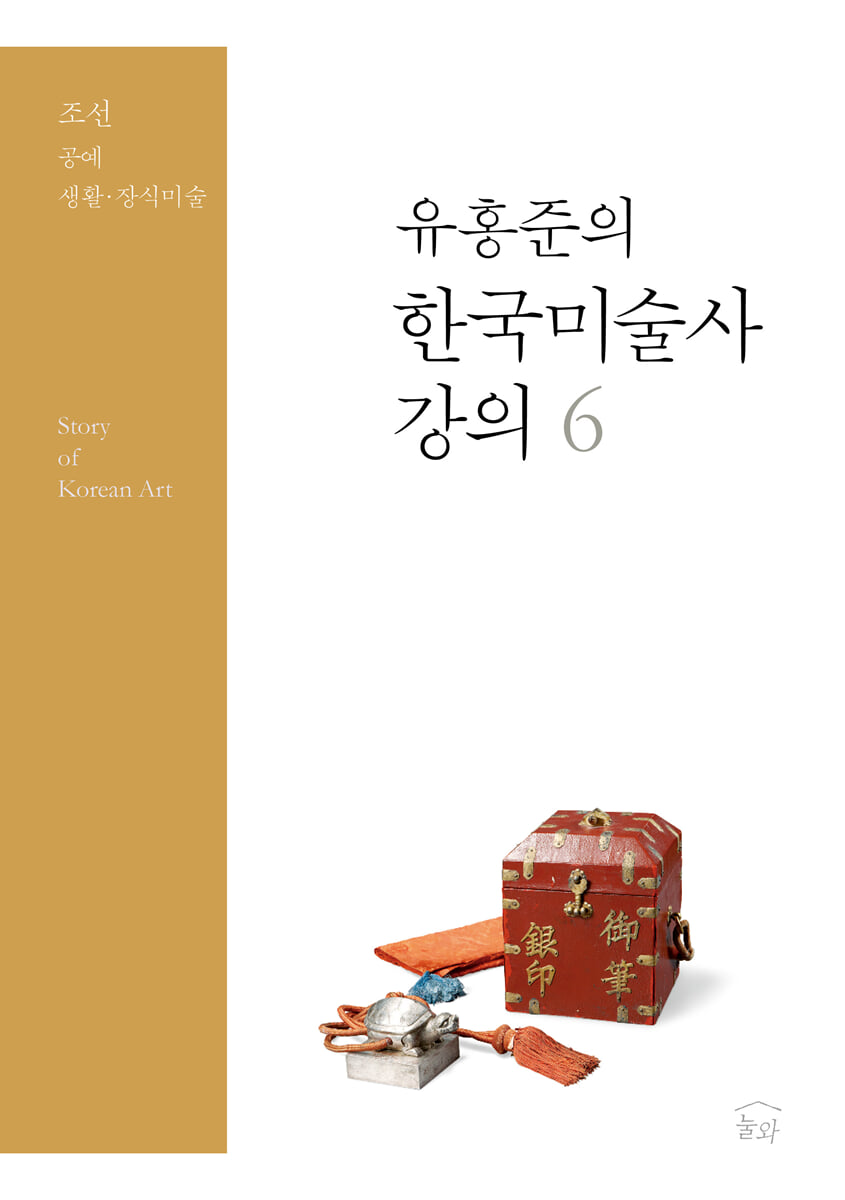
Yoo Hong-jun's Korean Art History Lecture 6
 |
Description
Book Introduction
Yoo Hong-jun's Korean Art History Lectures, now in full print after 13 years!
"Korean Art Evangelist" Yoo Hong-jun Sets New Standards for Korean Art History
『Yoo Hong-jun's Lectures on Korean Art History』, which has been loved by many readers since the publication of the first volume in 2010, has been completed after 13 years with the simultaneous publication of Volumes 5 and 6.
This series, written by Professor Yoo Hong-jun, who calls himself a 'Korean art evangelist', consists of six volumes, totaling over 2,500 pages and containing approximately 2,650 illustrations.
Starting with Volume 1, "Prehistory, the Three Kingdoms, and Balhae," and continuing through Volume 6, "Joseon: Crafts, Lifestyle, and Decorative Arts," it not only clearly organizes the flow of Korean art history, but also includes masterpieces representing each era without exception.
While there have been several books focusing on specific periods or fields in Korean art history, this complete edition is all the more significant in that it is extremely rare for a single author to write a comprehensive history of Korean art from a consistent perspective.
This series, which is a compilation of research achievements accumulated by the academic world, will become the standard for future Korean art history.
Volume 6 of 『Yoo Hong-jun's Lectures on Korean Art History』 deals with crafts of the Joseon Dynasty.
Crafts are the product of human efforts to beautify life.
This book divides Joseon Dynasty crafts into four categories based on their users: royal crafts, boudoir crafts, scholar crafts, and folk crafts, and vividly shows the unique beauty of each category.
Additionally, decorative paintings, folk paintings, and embroidery, which had not been dealt with in earnest in art history due to anonymity, were incorporated into the system of art history under the name of ‘lifestyle and decorative art.’
"Korean Art Evangelist" Yoo Hong-jun Sets New Standards for Korean Art History
『Yoo Hong-jun's Lectures on Korean Art History』, which has been loved by many readers since the publication of the first volume in 2010, has been completed after 13 years with the simultaneous publication of Volumes 5 and 6.
This series, written by Professor Yoo Hong-jun, who calls himself a 'Korean art evangelist', consists of six volumes, totaling over 2,500 pages and containing approximately 2,650 illustrations.
Starting with Volume 1, "Prehistory, the Three Kingdoms, and Balhae," and continuing through Volume 6, "Joseon: Crafts, Lifestyle, and Decorative Arts," it not only clearly organizes the flow of Korean art history, but also includes masterpieces representing each era without exception.
While there have been several books focusing on specific periods or fields in Korean art history, this complete edition is all the more significant in that it is extremely rare for a single author to write a comprehensive history of Korean art from a consistent perspective.
This series, which is a compilation of research achievements accumulated by the academic world, will become the standard for future Korean art history.
Volume 6 of 『Yoo Hong-jun's Lectures on Korean Art History』 deals with crafts of the Joseon Dynasty.
Crafts are the product of human efforts to beautify life.
This book divides Joseon Dynasty crafts into four categories based on their users: royal crafts, boudoir crafts, scholar crafts, and folk crafts, and vividly shows the unique beauty of each category.
Additionally, decorative paintings, folk paintings, and embroidery, which had not been dealt with in earnest in art history due to anonymity, were incorporated into the system of art history under the name of ‘lifestyle and decorative art.’
- You can preview some of the book's contents.
Preview
index
For the art historical reestablishment of crafts
crafts
Chapter 58 Royal Crafts
Crafts for the dignity of the Most High
Chapter 59: Boudoir Crafts
The subtle splendor of Hwa-i-bul-chi
Chapter 60: Scholarly Crafts
The quiet restraint of frugality and no shame
Chapter 61: Folk Crafts
The scent of life, or the smell of living
Living and Decorative Arts
Chapter 62 Decorative Paintings
The beautiful and rich world of decorative screens
Chapter 63 Folk Painting
The beauty of the unconventional and the pleasure of deviation
64 sheets of embroidery
Decorative art born from skill and sincerity
supplement
Partial names of traditional wooden furniture
References
List of plates
crafts
Chapter 58 Royal Crafts
Crafts for the dignity of the Most High
Chapter 59: Boudoir Crafts
The subtle splendor of Hwa-i-bul-chi
Chapter 60: Scholarly Crafts
The quiet restraint of frugality and no shame
Chapter 61: Folk Crafts
The scent of life, or the smell of living
Living and Decorative Arts
Chapter 62 Decorative Paintings
The beautiful and rich world of decorative screens
Chapter 63 Folk Painting
The beauty of the unconventional and the pleasure of deviation
64 sheets of embroidery
Decorative art born from skill and sincerity
supplement
Partial names of traditional wooden furniture
References
List of plates
Detailed image

Publisher's Review
Volume 6 of 『Yoo Hong-jun's Lectures on Korean Art History』 deals with crafts of the Joseon Dynasty.
Crafts are the product of human efforts to beautify life.
This book divides Joseon Dynasty crafts into four categories based on their users: royal crafts, boudoir crafts, scholar crafts, and folk crafts, and vividly shows the unique beauty of each category.
Additionally, decorative paintings, folk paintings, and embroidery, which had not been dealt with in earnest in art history due to anonymity, were incorporated into the system of art history under the name of ‘lifestyle and decorative art.’
Joseon Dynasty Crafts from a User's Perspective
Crafts are the product of efforts to enrich human life, and have long been an important field in the history of art.
However, in the past, crafts were often explained by focusing on materials and techniques, which had the problem of making it difficult to focus on the beauty of the artifacts themselves.
Professor Yoo Hong-jun approached Joseon Dynasty crafts from the perspective of use rather than production, and divided them into four categories: royal crafts, boudoir crafts, scholar crafts, and folk crafts.
Royal Crafts: Since the highest level of skills and materials were used in these crafts, the quality of each artifact is naturally high.
The national seal, a symbol of national power, and the royal seal, royal seal, and royal title, which are ceremonial items representing royal authority, not only have great historical significance, but are also great luxury items in their own right.
Additionally, the royal furniture displays a harmony of red and black with vermilion and black lacquer, creating a solemn atmosphere.
Gyubang Crafts: Gyubang crafts, mainly used by women of the yangban class, display the aesthetics of 'hwaibulchi (gorgeous but not extravagant)', and furniture and props decorated with mother-of-pearl and lacquerware can be said to be the true flowers of gyubang crafts.
Scholarly Crafts: The furniture and crafts placed in the scholars' living quarters are characterized by their understated decoration and elegant beauty.
The wooden table that preserves the wood grain and the four-sided table that exudes a refreshing charm with just a sense of proportion and space without any special decoration seem to embody the spirit of a scholar.
Folk crafts: Folk crafts that are useful in daily life are characterized by their functional beauty that appears according to their actual use and environment.
This can be confirmed through the ban-da-i, which shows a unique aesthetic in each region, the back door characterized by a solid form, and the mok-an (wooden wedding geese) that simultaneously shows realism and abstraction.
A New Life? Decorative Art
The history of Joseon Dynasty painting has been written mainly with a focus on the appreciation paintings of literati painters and Dohwaseo painters, and decorative paintings and folk paintings, which were most closely connected to the lives of Joseon people, tended not to be given much importance due to their characteristic anonymity.
In particular, there were problems with decorative paintings, such as confusion with folk paintings, and even the Ilwol Obongdo, which was placed on the palace throne, being classified as folk paintings.
Fortunately, thanks to the recent research by many scholars on the value of decorative painting, we have been able to clearly understand its true nature, and this book faithfully reflects this.
Decorative paintings: The decorative paintings used in the royal court and the yangban society were not only intricately painted but also large in size, displaying a beauty different from that of sentimental paintings.
These decorative paintings were often made in the form of decorative folding screens that were easy to move and store, as the indoor spaces of Hanok were relatively small due to the climate of the Korean Peninsula with its large annual temperature range.
This book introduces well-known decorative painting masterpieces such as the Ilwol Obongdo, the Ten Longevity Symbols, and the Book of Changes, as well as paintings such as the Gwakbunyang Haengrakdo and the Tiger Hunting Painting, which were only recently discovered to be in overseas museums or brought into Korea, leading readers into the world of diverse decorative paintings.
In the end, the book also covers the fixed paintings and murals of Gyeongbokgung Palace, Unhyeongung Palace, and Donggwanwangmyo, which were only recently discovered, as well as the gate painting confirmed in a photograph of Gwanghwamun Gate from the late Joseon Dynasty.
Folk painting: Folk painting, which appeared in the late Joseon Dynasty, has been loved by folk art scholars and enthusiasts from a relatively early age due to its unique charm.
However, it is also true that because there are so many works and their level is so uneven, it was difficult to decide which painting to use as a reference for explanation.
Professor Yoo Hong-jun says that the characteristic of folk painting lies in its freedom from orthodox painting methods, and that when masterpieces of folk painting are judged based on this, their status as a genre will also be established.
It also explains the origins and content of various folk painting icons, such as tiger painting and bird painting, and presents representative masterpieces to open one's eyes to folk painting.
Embroidery may be seen as a part of boudoir crafts, but in reality, it was not only used to decorate clothing and accessories, but also used on folding screens for appreciation purposes, and even used to decorate furniture.
Accordingly, it was classified as a separate chapter of ‘Life? Decorative Art’.
This chapter explains representative embroidery techniques with illustrations to help you gain a basic understanding of embroidery.
The clothing and accessories that can be considered the essence of embroidery include Princess Bok-on's wedding attire and the breastplates that were decorated on the official uniforms of civil and military officials.
In addition, the embroidered insect painting attributed to Shin Saimdang, the embroidered pine and crane painting based on a painting by Yang Gi-hun, a painter from the late Joseon Dynasty, and the embroidered plum blossom folding screen will allow many people to fall in love with the charm of embroidery that they were not aware of.
Crafts are the product of human efforts to beautify life.
This book divides Joseon Dynasty crafts into four categories based on their users: royal crafts, boudoir crafts, scholar crafts, and folk crafts, and vividly shows the unique beauty of each category.
Additionally, decorative paintings, folk paintings, and embroidery, which had not been dealt with in earnest in art history due to anonymity, were incorporated into the system of art history under the name of ‘lifestyle and decorative art.’
Joseon Dynasty Crafts from a User's Perspective
Crafts are the product of efforts to enrich human life, and have long been an important field in the history of art.
However, in the past, crafts were often explained by focusing on materials and techniques, which had the problem of making it difficult to focus on the beauty of the artifacts themselves.
Professor Yoo Hong-jun approached Joseon Dynasty crafts from the perspective of use rather than production, and divided them into four categories: royal crafts, boudoir crafts, scholar crafts, and folk crafts.
Royal Crafts: Since the highest level of skills and materials were used in these crafts, the quality of each artifact is naturally high.
The national seal, a symbol of national power, and the royal seal, royal seal, and royal title, which are ceremonial items representing royal authority, not only have great historical significance, but are also great luxury items in their own right.
Additionally, the royal furniture displays a harmony of red and black with vermilion and black lacquer, creating a solemn atmosphere.
Gyubang Crafts: Gyubang crafts, mainly used by women of the yangban class, display the aesthetics of 'hwaibulchi (gorgeous but not extravagant)', and furniture and props decorated with mother-of-pearl and lacquerware can be said to be the true flowers of gyubang crafts.
Scholarly Crafts: The furniture and crafts placed in the scholars' living quarters are characterized by their understated decoration and elegant beauty.
The wooden table that preserves the wood grain and the four-sided table that exudes a refreshing charm with just a sense of proportion and space without any special decoration seem to embody the spirit of a scholar.
Folk crafts: Folk crafts that are useful in daily life are characterized by their functional beauty that appears according to their actual use and environment.
This can be confirmed through the ban-da-i, which shows a unique aesthetic in each region, the back door characterized by a solid form, and the mok-an (wooden wedding geese) that simultaneously shows realism and abstraction.
A New Life? Decorative Art
The history of Joseon Dynasty painting has been written mainly with a focus on the appreciation paintings of literati painters and Dohwaseo painters, and decorative paintings and folk paintings, which were most closely connected to the lives of Joseon people, tended not to be given much importance due to their characteristic anonymity.
In particular, there were problems with decorative paintings, such as confusion with folk paintings, and even the Ilwol Obongdo, which was placed on the palace throne, being classified as folk paintings.
Fortunately, thanks to the recent research by many scholars on the value of decorative painting, we have been able to clearly understand its true nature, and this book faithfully reflects this.
Decorative paintings: The decorative paintings used in the royal court and the yangban society were not only intricately painted but also large in size, displaying a beauty different from that of sentimental paintings.
These decorative paintings were often made in the form of decorative folding screens that were easy to move and store, as the indoor spaces of Hanok were relatively small due to the climate of the Korean Peninsula with its large annual temperature range.
This book introduces well-known decorative painting masterpieces such as the Ilwol Obongdo, the Ten Longevity Symbols, and the Book of Changes, as well as paintings such as the Gwakbunyang Haengrakdo and the Tiger Hunting Painting, which were only recently discovered to be in overseas museums or brought into Korea, leading readers into the world of diverse decorative paintings.
In the end, the book also covers the fixed paintings and murals of Gyeongbokgung Palace, Unhyeongung Palace, and Donggwanwangmyo, which were only recently discovered, as well as the gate painting confirmed in a photograph of Gwanghwamun Gate from the late Joseon Dynasty.
Folk painting: Folk painting, which appeared in the late Joseon Dynasty, has been loved by folk art scholars and enthusiasts from a relatively early age due to its unique charm.
However, it is also true that because there are so many works and their level is so uneven, it was difficult to decide which painting to use as a reference for explanation.
Professor Yoo Hong-jun says that the characteristic of folk painting lies in its freedom from orthodox painting methods, and that when masterpieces of folk painting are judged based on this, their status as a genre will also be established.
It also explains the origins and content of various folk painting icons, such as tiger painting and bird painting, and presents representative masterpieces to open one's eyes to folk painting.
Embroidery may be seen as a part of boudoir crafts, but in reality, it was not only used to decorate clothing and accessories, but also used on folding screens for appreciation purposes, and even used to decorate furniture.
Accordingly, it was classified as a separate chapter of ‘Life? Decorative Art’.
This chapter explains representative embroidery techniques with illustrations to help you gain a basic understanding of embroidery.
The clothing and accessories that can be considered the essence of embroidery include Princess Bok-on's wedding attire and the breastplates that were decorated on the official uniforms of civil and military officials.
In addition, the embroidered insect painting attributed to Shin Saimdang, the embroidered pine and crane painting based on a painting by Yang Gi-hun, a painter from the late Joseon Dynasty, and the embroidered plum blossom folding screen will allow many people to fall in love with the charm of embroidery that they were not aware of.
GOODS SPECIFICS
- Date of issue: October 20, 2023
- Page count, weight, size: 364 pages | 856g | 174*247*19mm
- ISBN13: 9791189074623
- ISBN10: 1189074621
You may also like
카테고리
korean


korean

![GQ KOREA Mark (Monthly): December [2025]](http://librairie.coreenne.fr/cdn/shop/files/8ef265dbbfbf186523ed75ba7319009d.jpg?v=1765340328&width=3840)


