

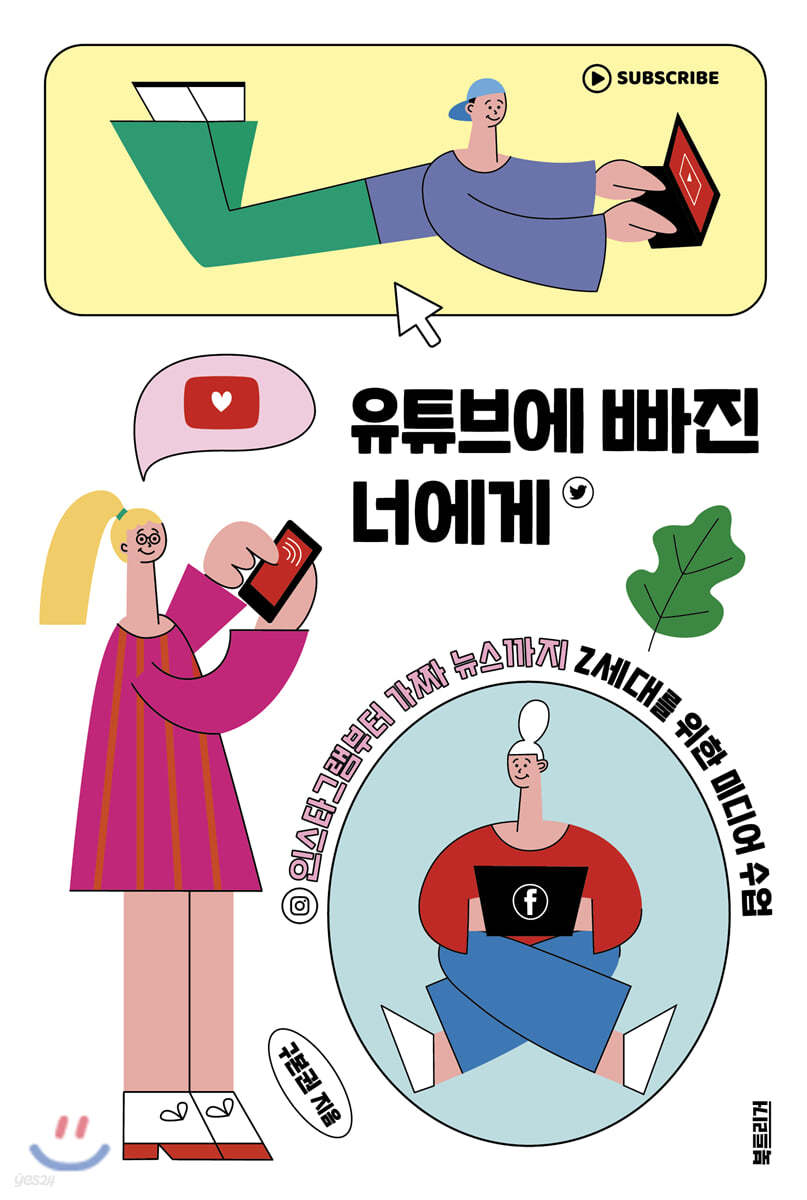
To you who is addicted to YouTube
 |
Description
Book Introduction
We can't live without smartphones,
Learn to rebel against the media!
Digital Humanist Koo Bon-kwon's Media Guide
Koo Bon-kwon, a digital humanist of our time who wrote 『Robot Age, Human Work』 and 『Would You Share Yourself?』, has now written a media guide for young people.
"To You Who Are Obsessed with YouTube" is a book that encompasses new and old media.
First, the author introduces social media, YouTube, and Instagram by topic for Generation Z, who are rapidly becoming accustomed to new media, and then explains the media and fake news in easy language.
Unlike many adults who worry about teenagers' close connection to media, the author does not treat media as a "harmful substance."
Instead, he emphasizes that media can be beneficial to young people if fully understood and used appropriately.
And to the youth who are addicted to the media, he says this:
'Isn't it okay to be anti-media once in a while?' What's important is your attitude and how you use the media.
The author carefully explains how to live a smart media life based on humanistic insight.
Learn to rebel against the media!
Digital Humanist Koo Bon-kwon's Media Guide
Koo Bon-kwon, a digital humanist of our time who wrote 『Robot Age, Human Work』 and 『Would You Share Yourself?』, has now written a media guide for young people.
"To You Who Are Obsessed with YouTube" is a book that encompasses new and old media.
First, the author introduces social media, YouTube, and Instagram by topic for Generation Z, who are rapidly becoming accustomed to new media, and then explains the media and fake news in easy language.
Unlike many adults who worry about teenagers' close connection to media, the author does not treat media as a "harmful substance."
Instead, he emphasizes that media can be beneficial to young people if fully understood and used appropriately.
And to the youth who are addicted to the media, he says this:
'Isn't it okay to be anti-media once in a while?' What's important is your attitude and how you use the media.
The author carefully explains how to live a smart media life based on humanistic insight.
- You can preview some of the book's contents.
Preview
index
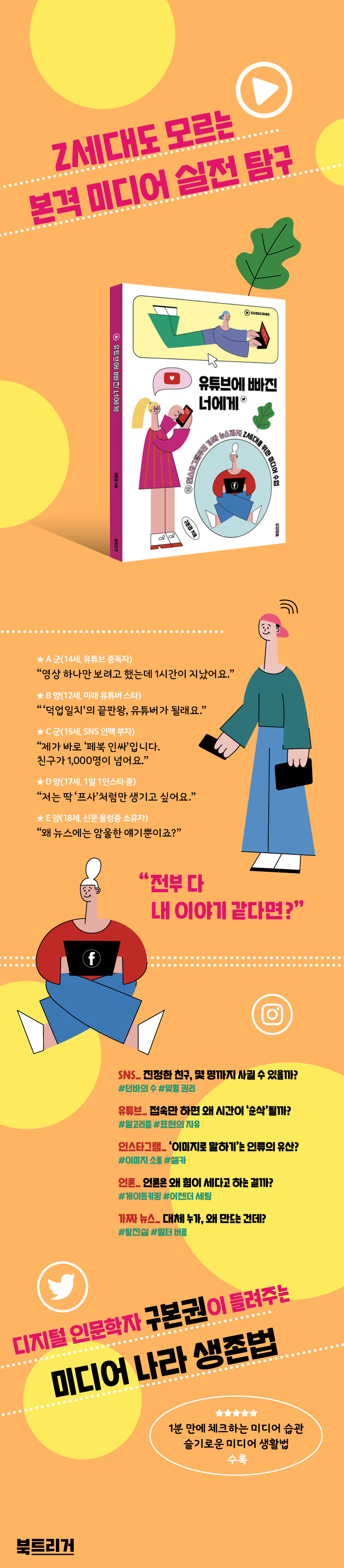
First story. SNS
You and I are connected. · Are SNS friends real? · Is SNS safe? · Forget me now.
★ How to Use SNS Wisely
Second story.
youtube
The History of YouTube · Why We're Hooked on YouTube · Want to Become the Next Dotty? · Is YouTube All That Good? · Should YouTube Be Regulated?
★ Smart Ways to Watch YouTube
The third story.
Instagram
The Birth of 'Instagrammable' · We Communicate Through Images · Why Instagram Is So Popular · Is Myself on Instagram Real?
★ How to Use Instagram Wisely
The fourth story.
media
What Makes News? · Why Do We Need the Media? · The Media as Power · Reading the News in the Smartphone Age
★ Smart News Reading Method
The fifth story.
fake news
Fake news is here! · Social media meets fake news · The human brain believes fiction · Let's kick out fake news!
★ Smart Ways to Spot Fake News
You and I are connected. · Are SNS friends real? · Is SNS safe? · Forget me now.
★ How to Use SNS Wisely
Second story.
youtube
The History of YouTube · Why We're Hooked on YouTube · Want to Become the Next Dotty? · Is YouTube All That Good? · Should YouTube Be Regulated?
★ Smart Ways to Watch YouTube
The third story.
The Birth of 'Instagrammable' · We Communicate Through Images · Why Instagram Is So Popular · Is Myself on Instagram Real?
★ How to Use Instagram Wisely
The fourth story.
media
What Makes News? · Why Do We Need the Media? · The Media as Power · Reading the News in the Smartphone Age
★ Smart News Reading Method
The fifth story.
fake news
Fake news is here! · Social media meets fake news · The human brain believes fiction · Let's kick out fake news!
★ Smart Ways to Spot Fake News
Detailed image
Into the book
According to Professor Dunbar, even if you have over 1,000 Facebook friends, you only keep in touch with about 150 of them.
Among them, there are less than 20 people with whom I communicate closely.
Having a lot of Facebook friends doesn't necessarily mean your relationships will be richer.
As the number of friends increases, the amount of attention you can give to each person decreases, and your relationships become more superficial.
--- p.26 From "First Story. SNS - SNS Friends, Are They Real?"
Let's assume that Les Misérables is set in 2020.
Even if Jean Valjean had changed his name to Madeleine, he might not have been successful.
This is because the posts and photos you left on social media in the past can come back to haunt you and expose your identity.
Even if you're not a criminal like Jean Valjean, there are people who want to erase their past for various reasons.
Anyone who wants to break free from the shackles of the past and start anew can claim the 'right to be forgotten'.
But in the digital age, where our past is recorded in detail, that's not easy.
--- pp.37~38 From "The First Story. SNS - Forget Me Now"
Algorithms can interfere with users' balanced thinking.
The vast majority of people who watch YouTube are not immune to the algorithm's dominance.
··· Information bias fosters division among people and creates unhealthy individuals and societies.
Therefore, we must realize that over-reliance on the personalized algorithms of individual media is dangerous.
There's nothing wrong with enjoying the content you like.
It could be an opportunity to study in depth a topic that interests you.
However, we must recognize that if we rely solely on algorithmic recommendations in the process of forming our values, our thinking may become biased.
--- pp.75~76 「Second story.
YouTube - Is YouTube really that good?
Can false and distorted information be subject to the same penalties as illegal content? No, it can't be.
Because the Constitution guarantees freedom of thought and expression.
Everyone has the right to freely express and disseminate their thoughts and opinions.
The flat Earth theory is also an expression of an idea and an assertion.
Even if it is absurd from a scientific standpoint, it cannot be prevented or punished.
--- p.82 “Second story.
YouTube - Should YouTube be regulated?
It wasn't until Instagram emerged that a generation that primarily communicated through images emerged.
In fact, the history of text communication is shorter.
It has only been about 100 years since most people in our country began communicating through text.
Although Hunminjeongeum was promulgated in 1446, it was not until the Gabo Reform in 1894 that Hangeul was officially recognized as the national alphabet.
However, soon after Japan came under colonial rule, the use of Hangul was banned, and only after liberation and education in schools for all people did written communication become widespread.
So how did you communicate before then?
--- pp.101~102 「The Third Story.
Instagram - We communicate through images
Media is a 'window to the world'.
You can see the outside world through the window.
But you can't see everything in the world.
The reason we liken media to windows is because only the information contained in the window is conveyed to us.
Among the vast amount of information and diverse views in the world, the scenes we encounter are only those that the media has chosen to show us.
Think of gatekeeping and agenda setting.
We must not forget that media reports are not a representation of things as they are, but rather a result of deliberate selection.
--- pp.141~142 「The Fourth Story.
From "The Press - The Press That Became Power"
To avoid being fooled by fake news and to read the news critically, you must develop the habit of checking sources.
Remember that much of the information we encounter on a daily basis has been filtered through filter bubbles and amplified in sound chambers.
If you accept information without critical thinking, you will end up believing that opinions that are heavily biased towards one side are public opinion.
Among them, there are less than 20 people with whom I communicate closely.
Having a lot of Facebook friends doesn't necessarily mean your relationships will be richer.
As the number of friends increases, the amount of attention you can give to each person decreases, and your relationships become more superficial.
--- p.26 From "First Story. SNS - SNS Friends, Are They Real?"
Let's assume that Les Misérables is set in 2020.
Even if Jean Valjean had changed his name to Madeleine, he might not have been successful.
This is because the posts and photos you left on social media in the past can come back to haunt you and expose your identity.
Even if you're not a criminal like Jean Valjean, there are people who want to erase their past for various reasons.
Anyone who wants to break free from the shackles of the past and start anew can claim the 'right to be forgotten'.
But in the digital age, where our past is recorded in detail, that's not easy.
--- pp.37~38 From "The First Story. SNS - Forget Me Now"
Algorithms can interfere with users' balanced thinking.
The vast majority of people who watch YouTube are not immune to the algorithm's dominance.
··· Information bias fosters division among people and creates unhealthy individuals and societies.
Therefore, we must realize that over-reliance on the personalized algorithms of individual media is dangerous.
There's nothing wrong with enjoying the content you like.
It could be an opportunity to study in depth a topic that interests you.
However, we must recognize that if we rely solely on algorithmic recommendations in the process of forming our values, our thinking may become biased.
--- pp.75~76 「Second story.
YouTube - Is YouTube really that good?
Can false and distorted information be subject to the same penalties as illegal content? No, it can't be.
Because the Constitution guarantees freedom of thought and expression.
Everyone has the right to freely express and disseminate their thoughts and opinions.
The flat Earth theory is also an expression of an idea and an assertion.
Even if it is absurd from a scientific standpoint, it cannot be prevented or punished.
--- p.82 “Second story.
YouTube - Should YouTube be regulated?
It wasn't until Instagram emerged that a generation that primarily communicated through images emerged.
In fact, the history of text communication is shorter.
It has only been about 100 years since most people in our country began communicating through text.
Although Hunminjeongeum was promulgated in 1446, it was not until the Gabo Reform in 1894 that Hangeul was officially recognized as the national alphabet.
However, soon after Japan came under colonial rule, the use of Hangul was banned, and only after liberation and education in schools for all people did written communication become widespread.
So how did you communicate before then?
--- pp.101~102 「The Third Story.
Instagram - We communicate through images
Media is a 'window to the world'.
You can see the outside world through the window.
But you can't see everything in the world.
The reason we liken media to windows is because only the information contained in the window is conveyed to us.
Among the vast amount of information and diverse views in the world, the scenes we encounter are only those that the media has chosen to show us.
Think of gatekeeping and agenda setting.
We must not forget that media reports are not a representation of things as they are, but rather a result of deliberate selection.
--- pp.141~142 「The Fourth Story.
From "The Press - The Press That Became Power"
To avoid being fooled by fake news and to read the news critically, you must develop the habit of checking sources.
Remember that much of the information we encounter on a daily basis has been filtered through filter bubbles and amplified in sound chambers.
If you accept information without critical thinking, you will end up believing that opinions that are heavily biased towards one side are public opinion.
--- p.175 “The fifth story.
Fake News - Social Media Meets Fake News
Fake News - Social Media Meets Fake News
Publisher's Review
"For You Who Are Obsessed with YouTube" is a stepping stone to media literacy.
Because it allows you to take the first step toward developing ‘critical thinking skills.’
This book provides realistic advice to teenagers who complain about not having many social media friends by citing Dunbar's number, and to students who believe everything their favorite YouTubers say, it points out the blind spot of YouTube, which lacks gatekeepers.
In addition, it serves as a guide for those new to news, helping them acquire media insight that will not be deceived by fake news.
Above all, it could be an opportunity to form a new relationship with the media by looking at the vast world of media from the perspective of experts.
What if you're stuck on YouTube all day?
You need to know how to use media!
Smartphones are no longer a luxury but a necessity.
Teenagers, who have been exposed to electronic devices as toys since childhood, are developing an even closer relationship with smartphones.
In fact, more than 95% of middle and high school students in our country own smartphones and use them for an average of more than 2 hours a day.
Teenagers are deeply immersed in the media world on their smartphones, such as YouTube.
Is not using a smartphone at all the answer?
Like all tools, media can be harmful to our bodies and minds if used improperly, but when used well, it can enrich our lives.
So the author says that we need to know how to use media properly.
It is necessary to examine the various aspects of media and for young people to establish their own relationship with the media.
This book helps young people develop healthy media usage habits through media literacy.
A world as dangerous as it is fascinating,
Exploring New and Old Media from a Digital Humanists' Perspective
The author views the media this way:
“Everything has two sides.
“The stronger the light, the darker the shadow.” This means that behind attractive media, there are dangers such as addiction and delusion.
"To You Who Are Obsessed with YouTube" is a book that began with this awareness of the problem.
The author divides media into five categories and explains them step by step for teenagers who are interested in new media but have a vague sense of difficulty with old media.
The first story, “SNS,” talks about the “characteristics of social media that connect people.”
First, let's look at the positive aspects of how social media has changed our lives.
Next, he points out the illusion of online space based on 'Dunbar's number' and proves the negative emotions felt while using social media through experiments.
By presenting examples of people who have been hit hard by unforgettable 'digital memories', we encourage young people to be vigilant about sharing their experiences.
The second story, “YouTube,” looks into the “charm and current issues of YouTube.”
The book provides an easy-to-read summary of the industrial background and popularity factors that have made YouTube a "superstar," and points out that the "algorithm," which is considered a key attraction, sometimes leads to a biased consumption of information.
The reality of YouTubers, which will make the eyes of young people dazzle, was also included in 'YouTube Dream Tree'.
The author then addresses both the problem of misinformation spreading on YouTube and the practical difficulties of regulating it.
The third story, “Instagram,” explores the story behind Instagram’s rise as a rising star in the social media world.
We are examining the growth process and characteristics of Instagram in relation to Generation Z.
It also presents an interesting analysis that the grammar of Instagram, where 'image' is the official word, actually boasts a long tradition.
Finally, by showing self-portraits, we encourage teenagers to let go of their obsession with 'Instagrammable' moments.
The fourth story, “The Press,” discusses the “role and responsibility of the press.”
Lay the foundation for understanding media by explaining 'gatekeeping' and 'agenda setting'.
In response to the sharp question, “Why is the media necessary?” the author emphasizes the influence and importance of the media, drawing on historical examples.
After pointing out the weakness of 'mobile news' that allows you to read only the topics you are interested in, we will introduce news reading methods that can be applied immediately.
The fifth story, “Fake News,” examines the origins and dangers of fake news.
The author goes beyond simply examining the background of the proliferation of fake news, examining the current media environment in which fake news has become even more powerful through the use of the "filter bubble" and the "soundbite effect."
Citing Yuval Harari's provocative argument, he adds philosophical considerations that believing fake news is human nature, while also suggesting 'critical thinking' as a practical alternative to fake news.
"For You Who Are Obsessed with YouTube" vividly analyzes new media like social media, YouTube, and Instagram, and explains how old media works, showing us how to use media wisely.
The unique feature of this book is that it doesn't force a single answer on young people, but helps them find their own way to use it.
Above all, the author emphasizes ‘critical thinking skills,’ which are the core and starting point of media literacy.
This book helps young people become proactive media users by teaching them the importance of critical thinking skills.
Because it allows you to take the first step toward developing ‘critical thinking skills.’
This book provides realistic advice to teenagers who complain about not having many social media friends by citing Dunbar's number, and to students who believe everything their favorite YouTubers say, it points out the blind spot of YouTube, which lacks gatekeepers.
In addition, it serves as a guide for those new to news, helping them acquire media insight that will not be deceived by fake news.
Above all, it could be an opportunity to form a new relationship with the media by looking at the vast world of media from the perspective of experts.
What if you're stuck on YouTube all day?
You need to know how to use media!
Smartphones are no longer a luxury but a necessity.
Teenagers, who have been exposed to electronic devices as toys since childhood, are developing an even closer relationship with smartphones.
In fact, more than 95% of middle and high school students in our country own smartphones and use them for an average of more than 2 hours a day.
Teenagers are deeply immersed in the media world on their smartphones, such as YouTube.
Is not using a smartphone at all the answer?
Like all tools, media can be harmful to our bodies and minds if used improperly, but when used well, it can enrich our lives.
So the author says that we need to know how to use media properly.
It is necessary to examine the various aspects of media and for young people to establish their own relationship with the media.
This book helps young people develop healthy media usage habits through media literacy.
A world as dangerous as it is fascinating,
Exploring New and Old Media from a Digital Humanists' Perspective
The author views the media this way:
“Everything has two sides.
“The stronger the light, the darker the shadow.” This means that behind attractive media, there are dangers such as addiction and delusion.
"To You Who Are Obsessed with YouTube" is a book that began with this awareness of the problem.
The author divides media into five categories and explains them step by step for teenagers who are interested in new media but have a vague sense of difficulty with old media.
The first story, “SNS,” talks about the “characteristics of social media that connect people.”
First, let's look at the positive aspects of how social media has changed our lives.
Next, he points out the illusion of online space based on 'Dunbar's number' and proves the negative emotions felt while using social media through experiments.
By presenting examples of people who have been hit hard by unforgettable 'digital memories', we encourage young people to be vigilant about sharing their experiences.
The second story, “YouTube,” looks into the “charm and current issues of YouTube.”
The book provides an easy-to-read summary of the industrial background and popularity factors that have made YouTube a "superstar," and points out that the "algorithm," which is considered a key attraction, sometimes leads to a biased consumption of information.
The reality of YouTubers, which will make the eyes of young people dazzle, was also included in 'YouTube Dream Tree'.
The author then addresses both the problem of misinformation spreading on YouTube and the practical difficulties of regulating it.
The third story, “Instagram,” explores the story behind Instagram’s rise as a rising star in the social media world.
We are examining the growth process and characteristics of Instagram in relation to Generation Z.
It also presents an interesting analysis that the grammar of Instagram, where 'image' is the official word, actually boasts a long tradition.
Finally, by showing self-portraits, we encourage teenagers to let go of their obsession with 'Instagrammable' moments.
The fourth story, “The Press,” discusses the “role and responsibility of the press.”
Lay the foundation for understanding media by explaining 'gatekeeping' and 'agenda setting'.
In response to the sharp question, “Why is the media necessary?” the author emphasizes the influence and importance of the media, drawing on historical examples.
After pointing out the weakness of 'mobile news' that allows you to read only the topics you are interested in, we will introduce news reading methods that can be applied immediately.
The fifth story, “Fake News,” examines the origins and dangers of fake news.
The author goes beyond simply examining the background of the proliferation of fake news, examining the current media environment in which fake news has become even more powerful through the use of the "filter bubble" and the "soundbite effect."
Citing Yuval Harari's provocative argument, he adds philosophical considerations that believing fake news is human nature, while also suggesting 'critical thinking' as a practical alternative to fake news.
"For You Who Are Obsessed with YouTube" vividly analyzes new media like social media, YouTube, and Instagram, and explains how old media works, showing us how to use media wisely.
The unique feature of this book is that it doesn't force a single answer on young people, but helps them find their own way to use it.
Above all, the author emphasizes ‘critical thinking skills,’ which are the core and starting point of media literacy.
This book helps young people become proactive media users by teaching them the importance of critical thinking skills.
GOODS SPECIFICS
- Date of issue: May 8, 2020
- Page count, weight, size: 208 pages | 272g | 138*205*11mm
- ISBN13: 9791189799236
- ISBN10: 1189799235
You may also like
카테고리
korean


korean

![GQ KOREA Mark (Monthly): December [2025]](http://librairie.coreenne.fr/cdn/shop/files/8ef265dbbfbf186523ed75ba7319009d.jpg?v=1765340328&width=3840)


