

A teenager who knows a little about the elements
 |
Description
Book Introduction
A vivid record of elements and civilization, published during the UN-designated International Year of the Periodic Table.
118 is not the end
The beginning is clear, but the end is not yet known.
A world made of elements, a world to be made of elements. Let's immerse ourselves in the boundless excitement.
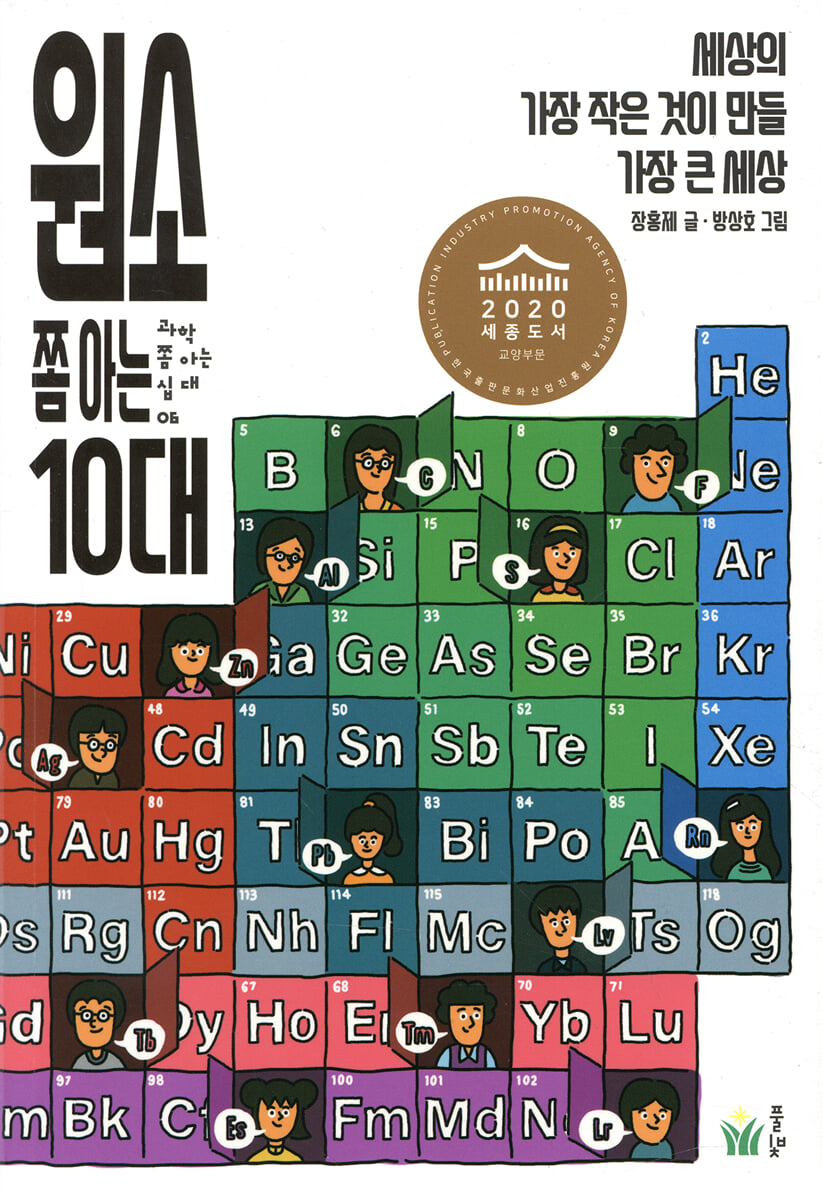
『10 Things You Need to Know About Elements』 is a book that covers the most basic elements of chemistry.
While most books on the elements deal with the 118 elements in the periodic table individually and provide fragmentary knowledge about them, this book helps you understand the scientific definitions of elements as well as the meaning of the periodic table and how to read it.
We examine the history of mankind from its beginnings to the present, looking into the future, and who discovered the 118 elements, how they were named, and the ongoing efforts to find hidden elements.
It also sequentially and three-dimensionally describes how the Earth was born, how humanity evolved, how civilization developed, and how the discipline of chemistry was formed, using the wave origin of elements as the source.
In short, this book is the stage for a concert of history, culture, space, and science, all conducted by the elements.
『10 Things You Should Know About Elements』 gives teenagers the weapon of elements.
The key, the element, that is essential to embracing the history of humanity's evolution and growth, and the universe that will become its future stage.
If you understand the elements properly, you can expand your understanding not only to chemistry, but also to earth science, which deals with the universe, life science, which deals with life, and physics, which deals with particles.
The purpose of this book is to provide insight into the world of science, which unfolds like a net, and the secrets of history and culture.
118 is not the end
The beginning is clear, but the end is not yet known.
A world made of elements, a world to be made of elements. Let's immerse ourselves in the boundless excitement.
『10 Things You Need to Know About Elements』 is a book that covers the most basic elements of chemistry.
While most books on the elements deal with the 118 elements in the periodic table individually and provide fragmentary knowledge about them, this book helps you understand the scientific definitions of elements as well as the meaning of the periodic table and how to read it.
We examine the history of mankind from its beginnings to the present, looking into the future, and who discovered the 118 elements, how they were named, and the ongoing efforts to find hidden elements.
It also sequentially and three-dimensionally describes how the Earth was born, how humanity evolved, how civilization developed, and how the discipline of chemistry was formed, using the wave origin of elements as the source.
In short, this book is the stage for a concert of history, culture, space, and science, all conducted by the elements.
『10 Things You Should Know About Elements』 gives teenagers the weapon of elements.
The key, the element, that is essential to embracing the history of humanity's evolution and growth, and the universe that will become its future stage.
If you understand the elements properly, you can expand your understanding not only to chemistry, but also to earth science, which deals with the universe, life science, which deals with life, and physics, which deals with particles.
The purpose of this book is to provide insight into the world of science, which unfolds like a net, and the secrets of history and culture.
index
Taking a step into the smallest world called the element
Split the first chapter and line it up
A question mark in search of the origin of the world | What is the difference between elements and atoms | The endless push and pull of tiny atoms | Let's systematically arrange them according to their characteristics | Until the periodic table of chemistry was completed | Such an interesting story is not in the periodic table
Chapter 2: Elements, the Making of Life
Introducing the main character of our body | Even though it may seem like a supporting role, without us there would be no life |
Two Beds in One Room, Orbital's Identity | What Kind of Ion Do You Want to Be?
Chapter 3: Elements: Setting a Milestone in Human Civilization
The Beginning of Chemistry or the Beginning of Humanity | The Dawn of Metal Civilization, the Bronze Age | Present Progress, the Iron Age |
Gold, at the pinnacle of desire and class | Lead, between the twists and turns of the times | Silicon, into a second Stone Age
Chapter 4: Alchemy: Magic or Science?
A small curiosity sparked the golden spark of chemistry | East and West joined hands through alchemy |
The Regression of Alchemy Gives Birth to the Evolution of Chemistry | Alchemy's Brilliant Descendants
Chapter 5: Applause to the electricity that brought us the elements!
Twinkle! The elements are lit | Discovering countless elements with electrochemistry |
The Secret of Unbreakable Glass, Boron | Give That Planet a Cool Name | One New Element Name for Each New Planet
Chapter 6: Let's Unmask the Elements
Sweet? Beware! | The Powder of Inheritance | Even trash can be treasure when you look at it again | A staple in mystery novels |
Itai-itai Disease | The Most Expensive Death | The Fluorine Martyr | For a More Effective Death
Chapter 7: Finding New Elements
It's pouring - Lanthanide elements | Natural vs. artificial elements | Elements created by humans |
Radiation - Actinides | How far can we find them? | Somewhere, someday
A step forward into a larger world created by the elements
Split the first chapter and line it up
A question mark in search of the origin of the world | What is the difference between elements and atoms | The endless push and pull of tiny atoms | Let's systematically arrange them according to their characteristics | Until the periodic table of chemistry was completed | Such an interesting story is not in the periodic table
Chapter 2: Elements, the Making of Life
Introducing the main character of our body | Even though it may seem like a supporting role, without us there would be no life |
Two Beds in One Room, Orbital's Identity | What Kind of Ion Do You Want to Be?
Chapter 3: Elements: Setting a Milestone in Human Civilization
The Beginning of Chemistry or the Beginning of Humanity | The Dawn of Metal Civilization, the Bronze Age | Present Progress, the Iron Age |
Gold, at the pinnacle of desire and class | Lead, between the twists and turns of the times | Silicon, into a second Stone Age
Chapter 4: Alchemy: Magic or Science?
A small curiosity sparked the golden spark of chemistry | East and West joined hands through alchemy |
The Regression of Alchemy Gives Birth to the Evolution of Chemistry | Alchemy's Brilliant Descendants
Chapter 5: Applause to the electricity that brought us the elements!
Twinkle! The elements are lit | Discovering countless elements with electrochemistry |
The Secret of Unbreakable Glass, Boron | Give That Planet a Cool Name | One New Element Name for Each New Planet
Chapter 6: Let's Unmask the Elements
Sweet? Beware! | The Powder of Inheritance | Even trash can be treasure when you look at it again | A staple in mystery novels |
Itai-itai Disease | The Most Expensive Death | The Fluorine Martyr | For a More Effective Death
Chapter 7: Finding New Elements
It's pouring - Lanthanide elements | Natural vs. artificial elements | Elements created by humans |
Radiation - Actinides | How far can we find them? | Somewhere, someday
A step forward into a larger world created by the elements
Detailed image

Publisher's Review
1.
A vivid record of elements and civilization
Advances in science and technology have allowed us to understand and directly manipulate the countless substances that make up our surroundings, including their composition and compositional properties.
We learn that the basic building blocks of these substances are very small, round particles called 'atoms'.
However, the particle called an atom is one millionth the size of a strand of hair, which is beyond the level of observation through a microscope.
How on earth did someone conceive, discover, and analyze such tiny atoms? And what are the similarly named elements, atoms, and molecules, and how do they differ? What methods did scientists use to describe the countless elements they discovered? The answers are fully contained in this book, "10 Things You Need to Know About Elements."
If the 'basic elements that make up the world' are elements, then atoms are 'basic units that make up elements', and elements and atoms are clearly distinguished into qualitative and quantitative concepts.
Explains how elements are classified based on the particle properties of atoms, which are composed of protons, neutrons, and electrons.
The book describes the historical process of finding the origin of the world called elements, and even depicts the hidden stories of the chemists who made many sacrifices and made efforts to find various elements, and named the elements they discovered, like a novel.
This alone is interesting, but there's more.
It doesn't stop there.
The book vividly reports that each of these discovered elements became a decisive factor in the development of human civilization.
The discovery and use of 'combustion', the first chemical reaction, enabled our human ancestors (Homo erectus) to engage in simple gathering and hunting activities, and later entered the Neolithic Age, achieving the feat of becoming one of the world's four major civilizations.
The Bronze Age, which freely utilized bronze, an alloy of copper (Cu) and tin (Sn), replaced the Stone Age, which simply used stones, and the Bronze Age gave way to the Iron Age, which made it possible to produce high-strength ironware by mixing carbon (C) with iron (Fe).
What created this turning point in the era was the change in the main elements that were discovered and made usable at the time.
Depending on what specific element dominates the era, the meaning of the name also changes.
In the case of 'gold', the most noble thing and the symbol of the highest power, before it became the shiny yellow 'gold' we know today, 'bronze' meant 'gold' in the Bronze Age, and 'iron' meant 'gold' in the Iron Age.
Scientifically reexamining human history by revealing the intersection and organic relationship between civilization and elements.
This is the magic of this book, which is a science book but reads as smoothly as a history book.
2.
A Masterful Lecture on Decoding the Periodic Table
2019 is the 'International Year of the Periodic Table' designated by the UN.
It is to commemorate the 150th anniversary of the creation of the periodic table.
When and how did the periodic table come into being? The first form of the table we know today was published in 1869 by Russian chemist Dmitry Ivanovich Mendeleev (1834-1907) in a paper titled "On the Relationship Between the Properties of the Elements and Their Atomic Weights."
In fact, Mendeleev's periodic table was a comprehensive expression of the research that had been done up to that point, and for this achievement, Mendeleev earned the name of the father of the periodic table.
Where does the greatness of Mendeleev's periodic table lie?
First, the vertical columns of the periodic table were defined as groups, and the horizontal rows as periods, so that later periodic tables could be continuously supplemented based on this framework, resulting in the current form (18 groups, 7 periods).
Since the characteristic properties of each element are determined by the number of electrons present in the outermost shell of the atom, they can be grouped together and listed as a 'group', and elements in the same group that appear repeatedly are grouped together according to the number of shells in which the electrons are placed and classified into a 'period'.
From these two elements, the universal periodic table has been organized into a two-dimensional form with the vertical and horizontal lines intersecting each other.
Second, Mendeleev created question marks in the periodic table, indicating items that were left blank when arranged according to the periodic table, either to indicate the possibility of unknown elements not yet discovered, or to indicate items that existed in that position but for which the accuracy of the known atomic mass was questionable.
Based on this framework, the gaps left by Mendeleev were filled in one by one through subsequent research.
The periodic table is a table that shows the elements in a certain order, suggesting similar properties that appear periodically.
The periodic table, which contains hundreds of pieces of information about the elements, is the most essential "chemical dictionary" that provides guidance and information to those exploring science, especially chemistry, as it is objectively organized through the efforts and fruits of countless scientists' efforts and sufficient verification.
However, we have mostly tried to memorize the elements in the periodic table in order, but we do not fully understand why the elements are arranged that way.
Just as we need to know how to read a dictionary first to easily find the word we want to know and understand its meaning, we need to know what the arrangement of the periodic table is based on to properly remember the properties of the elements we have memorized, what chemical bonds they form, and in what state they exist stably.
Matching of elements and element names.
The beginning of chemistry ultimately begins there.
This book provides a complete guide to deciphering the periodic table.
The meaning of family and period is not presented in a short answer format or only theoretically, but is guided so that it can be naturally absorbed into the mind along with the characteristics and uses of individual elements.
Now, after reading this book, the periodic table is no longer something to give up, but rather an asset you can embrace and confidently take chemistry classes with.
3.
Uncovering the origins and characteristics of elemental names
Sun-Mercury-Venus-Earth-Moon-Mars-Ceres and Pallas-Jupiter-Saturn-Uranus-Neptune-Pluto.
Is this an earth science class? No.
This is definitely part of chemistry class.
This is because the names of the elements are directly linked to the names of the planets and satellites of our solar system.
When scientists discovered elements, they named them based on their fundamental function, such as making water (Hydrogen) or making acid (Oxygen), the substance in which they were found (Sodium and Potassium), or the location where they were found (Magnesium and Copper).
But unlike the names of these elements that have such clear origins, there are also quite a few elements that are incredibly memorable and cool, but whose names you can't understand until you hear them.
These are elements named after planets.
Since ancient times, stars have not only been objects of curiosity and awe, but have also been used by humans for practical purposes, such as determining time and location through constellations.
There have been ongoing attempts to pair the names of important elements with the names of planets (including their moons and stars) in our solar system, which are very important to humanity, and as a result, the names of the planets listed above have elemental couples that have names derived from them.
Sun (helios) - Helium, Mercury - Mercury, Venus - Copper, Earth (tellus) - Tellurium, Moon (selene) - Selenium, Mars - Iron, Ceres - Cerium, Pallas - Palladium, Jupiter - Tin, Saturn - Lead, Uranus - Uranium, Neptune - Neptunium, Pluto - Plutonium.
All of them are named sequentially by connecting the characteristics of the planets with the characteristics of the discovered elements.
The names of the elements that we simply memorized exist before us, each with its own history.
Although it may seem like it is stuffily trapped inside the periodic table, it is actually alive and breathing with its own genealogy.
This book reveals the origins of element names by type, making it unforgettable once you read it, and reminds us that chemistry and science are fields of history and culture.
4.
Discovered elements and created elements
Are the 118 elements naturally occurring on Earth? Did someone simply stumble upon them, perhaps accidentally, while walking down the street, digging the ground, or conducting an experiment in a chemistry lab? If you find the question questioning questionable, the answer is, again, no.
It means that there are artificial elements rather than natural elements.
It has been discovered that there are approximately 90 types of natural elements on Earth.
The discovery of elements, which has continued since BC, has focused on finding elements in various substances on Earth, such as the atmosphere, ores, and solutions, and has shown results commensurate with the efforts.
From this, various chemical experimental techniques were developed or applied, and technologies for separating various types of complexly mixed elements also continued to develop.
However, since the types of elements that make up the Earth cannot be infinite, it was expected that the discovery of all natural elements would eventually end.
Following the discovery of rhenium (Re, discovered in 1925), francium (Fr) was discovered 14 years later.
However, the fact that the discovery was so late was partly due to the practical constraints of only existing in very small quantities on Earth, and future element discovery was not simply a matter of finding elements that existed in nature, but rather a matter of creating something new.
But humans have done it! The first attempt was Technetium (Tc), element 43.
In 1937, during an accelerator experiment, a new element was observed to appear when a neutron accidentally collided with a plate of molybdenum. This accidental discovery was continuously studied and it was confirmed that it was indeed a new element.
Its name is derived from the Greek word technetos, meaning "artificial," to commemorate its being the first man-made element.
The first human-created transuranium element heavier than uranium, the heaviest natural element, is element 93, neptunium (Np), which was discovered using the same method as technetium.
In this way, scientists' attempts to 'create' elements have continued and are still ongoing.
The hot laboratory of elements and chemistry, which has gone beyond discovery and reached the realm of creation, has now extended beyond Earth to outer space.
There is an expectation that elements that are unstable and difficult to utilize on Earth will be utilized as very useful new resources in space.
It's time to let go of the prideful feeling that comes from memorizing the 118 elements and thinking you've mastered chemistry.
It's time to embrace the map of the periodic table, containing 118 elements, and prepare to freely explore the Earth and the universe beyond.
Teenagers reading this book now will at least understand that it is a key that opens the door to the infinitely vast world of science, not a world of confined elements.
The history of mankind contained in the periodic table is now looking into the future.
With the solid foundation of the past and the sturdy cane of the periodic table as our guide, we are taking honest steps toward the future.
Before you go on your trip, I highly recommend reading this friendly and reliable guide, "10 Things You Need to Know About the Elements."
"Teenagers Who Know a Thing About Science": A Lively Forum for Scientific Debate That Takes Science to the Next Level
The '2015 Revised Curriculum' pursues an image of a human being who is independent, creative, and lives together.
Under this value system, we focus on strengthening basic literacy education in the humanities, social sciences, and science and technology, focusing on core concepts and principles for each subject, while also promoting integrated and convergent education across subjects.
In line with this educational trend of fostering future talent, Poolbit has planned a science series for youth that selects core concepts rather than focusing on the amount of knowledge, and clearly explains the principles behind them and how they can be applied.
A humanistic reflection that encourages questions and discussions on the three pillars of core, principle, and application is what middle school readers, field teachers, and parents want, and is the clear direction that the "Teenagers Who Know a Little About Science" series aims for in science studies.
Starting with the publication of No. 1, “Teenagers Who Know a Little About Artificial Intelligence,” which dissected the reality of artificial intelligence, a cutting-edge science and technology, in conjunction with realistic concerns, No. 2, “Teenagers Who Know a Little About Materials,” which explored the essence of the world filled with numerous colorful components, and No. 3, “Teenagers Who Know a Little About the Environment and Ecology,” which delved into environmental issues through eight easy-to-do consumption practices in everyday life, the “Teenagers Who Know a Little About Science” series has shown an active effort to connect scientific knowledge to our lives.
Book 04, 『10 Things to Know About the Big Bang』, which covers cosmology, book 05, 『10 Things to Know About Light』, which covers the world of light, and book 06, 『10 Things to Know About Elements』, which was recently published, are books that organize keywords representing the fields of earth science, physics, and chemistry, respectively, in the scientific field.
The upcoming books, 『10 Things You Need to Know About Gravity』, 『10 Things You Need to Know About Electromagnetism』, 『10 Things You Need to Know About Genes』, 『10 Things You Need to Know About Climate Change』, and 『10 Things You Need to Know About Future Energy』, will delve into the most basic and core areas of natural science, such as physics, chemistry, life science, and earth science.
From future-oriented real-world materials to core concepts that form the foundation of basic science, "Science for Teens" covers all aspects of science.
Rather than simply describing this knowledge as information, this series is characterized by a very three-dimensional approach: what the principles are, how to apply them, what unresolved scientific problems exist, what issues they raise, and ultimately how we should accept, interpret, and understand them.
Just like having an intimate conversation with a middle school nephew, "Teenagers Who Know a Little About Science" focuses on providing the kindest and easiest explanations at a teenager's eye level.
It has the charm of allowing readers to read it from beginning to end without losing their curiosity, with photos that enrich the content and illustrations that delve into the core but are armed with wit.
I suggest keeping "Teenagers Who Know a Little About Science" by your side as a friend, as it is a book that has put a lot of effort into both content and format for teenagers, without missing even the smallest detail.
A vivid record of elements and civilization
Advances in science and technology have allowed us to understand and directly manipulate the countless substances that make up our surroundings, including their composition and compositional properties.
We learn that the basic building blocks of these substances are very small, round particles called 'atoms'.
However, the particle called an atom is one millionth the size of a strand of hair, which is beyond the level of observation through a microscope.
How on earth did someone conceive, discover, and analyze such tiny atoms? And what are the similarly named elements, atoms, and molecules, and how do they differ? What methods did scientists use to describe the countless elements they discovered? The answers are fully contained in this book, "10 Things You Need to Know About Elements."
If the 'basic elements that make up the world' are elements, then atoms are 'basic units that make up elements', and elements and atoms are clearly distinguished into qualitative and quantitative concepts.
Explains how elements are classified based on the particle properties of atoms, which are composed of protons, neutrons, and electrons.
The book describes the historical process of finding the origin of the world called elements, and even depicts the hidden stories of the chemists who made many sacrifices and made efforts to find various elements, and named the elements they discovered, like a novel.
This alone is interesting, but there's more.
It doesn't stop there.
The book vividly reports that each of these discovered elements became a decisive factor in the development of human civilization.
The discovery and use of 'combustion', the first chemical reaction, enabled our human ancestors (Homo erectus) to engage in simple gathering and hunting activities, and later entered the Neolithic Age, achieving the feat of becoming one of the world's four major civilizations.
The Bronze Age, which freely utilized bronze, an alloy of copper (Cu) and tin (Sn), replaced the Stone Age, which simply used stones, and the Bronze Age gave way to the Iron Age, which made it possible to produce high-strength ironware by mixing carbon (C) with iron (Fe).
What created this turning point in the era was the change in the main elements that were discovered and made usable at the time.
Depending on what specific element dominates the era, the meaning of the name also changes.
In the case of 'gold', the most noble thing and the symbol of the highest power, before it became the shiny yellow 'gold' we know today, 'bronze' meant 'gold' in the Bronze Age, and 'iron' meant 'gold' in the Iron Age.
Scientifically reexamining human history by revealing the intersection and organic relationship between civilization and elements.
This is the magic of this book, which is a science book but reads as smoothly as a history book.
2.
A Masterful Lecture on Decoding the Periodic Table
2019 is the 'International Year of the Periodic Table' designated by the UN.
It is to commemorate the 150th anniversary of the creation of the periodic table.
When and how did the periodic table come into being? The first form of the table we know today was published in 1869 by Russian chemist Dmitry Ivanovich Mendeleev (1834-1907) in a paper titled "On the Relationship Between the Properties of the Elements and Their Atomic Weights."
In fact, Mendeleev's periodic table was a comprehensive expression of the research that had been done up to that point, and for this achievement, Mendeleev earned the name of the father of the periodic table.
Where does the greatness of Mendeleev's periodic table lie?
First, the vertical columns of the periodic table were defined as groups, and the horizontal rows as periods, so that later periodic tables could be continuously supplemented based on this framework, resulting in the current form (18 groups, 7 periods).
Since the characteristic properties of each element are determined by the number of electrons present in the outermost shell of the atom, they can be grouped together and listed as a 'group', and elements in the same group that appear repeatedly are grouped together according to the number of shells in which the electrons are placed and classified into a 'period'.
From these two elements, the universal periodic table has been organized into a two-dimensional form with the vertical and horizontal lines intersecting each other.
Second, Mendeleev created question marks in the periodic table, indicating items that were left blank when arranged according to the periodic table, either to indicate the possibility of unknown elements not yet discovered, or to indicate items that existed in that position but for which the accuracy of the known atomic mass was questionable.
Based on this framework, the gaps left by Mendeleev were filled in one by one through subsequent research.
The periodic table is a table that shows the elements in a certain order, suggesting similar properties that appear periodically.
The periodic table, which contains hundreds of pieces of information about the elements, is the most essential "chemical dictionary" that provides guidance and information to those exploring science, especially chemistry, as it is objectively organized through the efforts and fruits of countless scientists' efforts and sufficient verification.
However, we have mostly tried to memorize the elements in the periodic table in order, but we do not fully understand why the elements are arranged that way.
Just as we need to know how to read a dictionary first to easily find the word we want to know and understand its meaning, we need to know what the arrangement of the periodic table is based on to properly remember the properties of the elements we have memorized, what chemical bonds they form, and in what state they exist stably.
Matching of elements and element names.
The beginning of chemistry ultimately begins there.
This book provides a complete guide to deciphering the periodic table.
The meaning of family and period is not presented in a short answer format or only theoretically, but is guided so that it can be naturally absorbed into the mind along with the characteristics and uses of individual elements.
Now, after reading this book, the periodic table is no longer something to give up, but rather an asset you can embrace and confidently take chemistry classes with.
3.
Uncovering the origins and characteristics of elemental names
Sun-Mercury-Venus-Earth-Moon-Mars-Ceres and Pallas-Jupiter-Saturn-Uranus-Neptune-Pluto.
Is this an earth science class? No.
This is definitely part of chemistry class.
This is because the names of the elements are directly linked to the names of the planets and satellites of our solar system.
When scientists discovered elements, they named them based on their fundamental function, such as making water (Hydrogen) or making acid (Oxygen), the substance in which they were found (Sodium and Potassium), or the location where they were found (Magnesium and Copper).
But unlike the names of these elements that have such clear origins, there are also quite a few elements that are incredibly memorable and cool, but whose names you can't understand until you hear them.
These are elements named after planets.
Since ancient times, stars have not only been objects of curiosity and awe, but have also been used by humans for practical purposes, such as determining time and location through constellations.
There have been ongoing attempts to pair the names of important elements with the names of planets (including their moons and stars) in our solar system, which are very important to humanity, and as a result, the names of the planets listed above have elemental couples that have names derived from them.
Sun (helios) - Helium, Mercury - Mercury, Venus - Copper, Earth (tellus) - Tellurium, Moon (selene) - Selenium, Mars - Iron, Ceres - Cerium, Pallas - Palladium, Jupiter - Tin, Saturn - Lead, Uranus - Uranium, Neptune - Neptunium, Pluto - Plutonium.
All of them are named sequentially by connecting the characteristics of the planets with the characteristics of the discovered elements.
The names of the elements that we simply memorized exist before us, each with its own history.
Although it may seem like it is stuffily trapped inside the periodic table, it is actually alive and breathing with its own genealogy.
This book reveals the origins of element names by type, making it unforgettable once you read it, and reminds us that chemistry and science are fields of history and culture.
4.
Discovered elements and created elements
Are the 118 elements naturally occurring on Earth? Did someone simply stumble upon them, perhaps accidentally, while walking down the street, digging the ground, or conducting an experiment in a chemistry lab? If you find the question questioning questionable, the answer is, again, no.
It means that there are artificial elements rather than natural elements.
It has been discovered that there are approximately 90 types of natural elements on Earth.
The discovery of elements, which has continued since BC, has focused on finding elements in various substances on Earth, such as the atmosphere, ores, and solutions, and has shown results commensurate with the efforts.
From this, various chemical experimental techniques were developed or applied, and technologies for separating various types of complexly mixed elements also continued to develop.
However, since the types of elements that make up the Earth cannot be infinite, it was expected that the discovery of all natural elements would eventually end.
Following the discovery of rhenium (Re, discovered in 1925), francium (Fr) was discovered 14 years later.
However, the fact that the discovery was so late was partly due to the practical constraints of only existing in very small quantities on Earth, and future element discovery was not simply a matter of finding elements that existed in nature, but rather a matter of creating something new.
But humans have done it! The first attempt was Technetium (Tc), element 43.
In 1937, during an accelerator experiment, a new element was observed to appear when a neutron accidentally collided with a plate of molybdenum. This accidental discovery was continuously studied and it was confirmed that it was indeed a new element.
Its name is derived from the Greek word technetos, meaning "artificial," to commemorate its being the first man-made element.
The first human-created transuranium element heavier than uranium, the heaviest natural element, is element 93, neptunium (Np), which was discovered using the same method as technetium.
In this way, scientists' attempts to 'create' elements have continued and are still ongoing.
The hot laboratory of elements and chemistry, which has gone beyond discovery and reached the realm of creation, has now extended beyond Earth to outer space.
There is an expectation that elements that are unstable and difficult to utilize on Earth will be utilized as very useful new resources in space.
It's time to let go of the prideful feeling that comes from memorizing the 118 elements and thinking you've mastered chemistry.
It's time to embrace the map of the periodic table, containing 118 elements, and prepare to freely explore the Earth and the universe beyond.
Teenagers reading this book now will at least understand that it is a key that opens the door to the infinitely vast world of science, not a world of confined elements.
The history of mankind contained in the periodic table is now looking into the future.
With the solid foundation of the past and the sturdy cane of the periodic table as our guide, we are taking honest steps toward the future.
Before you go on your trip, I highly recommend reading this friendly and reliable guide, "10 Things You Need to Know About the Elements."
"Teenagers Who Know a Thing About Science": A Lively Forum for Scientific Debate That Takes Science to the Next Level
The '2015 Revised Curriculum' pursues an image of a human being who is independent, creative, and lives together.
Under this value system, we focus on strengthening basic literacy education in the humanities, social sciences, and science and technology, focusing on core concepts and principles for each subject, while also promoting integrated and convergent education across subjects.
In line with this educational trend of fostering future talent, Poolbit has planned a science series for youth that selects core concepts rather than focusing on the amount of knowledge, and clearly explains the principles behind them and how they can be applied.
A humanistic reflection that encourages questions and discussions on the three pillars of core, principle, and application is what middle school readers, field teachers, and parents want, and is the clear direction that the "Teenagers Who Know a Little About Science" series aims for in science studies.
Starting with the publication of No. 1, “Teenagers Who Know a Little About Artificial Intelligence,” which dissected the reality of artificial intelligence, a cutting-edge science and technology, in conjunction with realistic concerns, No. 2, “Teenagers Who Know a Little About Materials,” which explored the essence of the world filled with numerous colorful components, and No. 3, “Teenagers Who Know a Little About the Environment and Ecology,” which delved into environmental issues through eight easy-to-do consumption practices in everyday life, the “Teenagers Who Know a Little About Science” series has shown an active effort to connect scientific knowledge to our lives.
Book 04, 『10 Things to Know About the Big Bang』, which covers cosmology, book 05, 『10 Things to Know About Light』, which covers the world of light, and book 06, 『10 Things to Know About Elements』, which was recently published, are books that organize keywords representing the fields of earth science, physics, and chemistry, respectively, in the scientific field.
The upcoming books, 『10 Things You Need to Know About Gravity』, 『10 Things You Need to Know About Electromagnetism』, 『10 Things You Need to Know About Genes』, 『10 Things You Need to Know About Climate Change』, and 『10 Things You Need to Know About Future Energy』, will delve into the most basic and core areas of natural science, such as physics, chemistry, life science, and earth science.
From future-oriented real-world materials to core concepts that form the foundation of basic science, "Science for Teens" covers all aspects of science.
Rather than simply describing this knowledge as information, this series is characterized by a very three-dimensional approach: what the principles are, how to apply them, what unresolved scientific problems exist, what issues they raise, and ultimately how we should accept, interpret, and understand them.
Just like having an intimate conversation with a middle school nephew, "Teenagers Who Know a Little About Science" focuses on providing the kindest and easiest explanations at a teenager's eye level.
It has the charm of allowing readers to read it from beginning to end without losing their curiosity, with photos that enrich the content and illustrations that delve into the core but are armed with wit.
I suggest keeping "Teenagers Who Know a Little About Science" by your side as a friend, as it is a book that has put a lot of effort into both content and format for teenagers, without missing even the smallest detail.
GOODS SPECIFICS
- Date of issue: December 31, 2019
- Pages, weight, size: 192 pages | 294g | 140*200*12mm
- ISBN13: 9791161727639
- ISBN10: 1161727639
You may also like
카테고리
korean


korean

![GQ KOREA Mark (Monthly): December [2025]](http://librairie.coreenne.fr/cdn/shop/files/8ef265dbbfbf186523ed75ba7319009d.jpg?v=1765340328&width=3840)


