

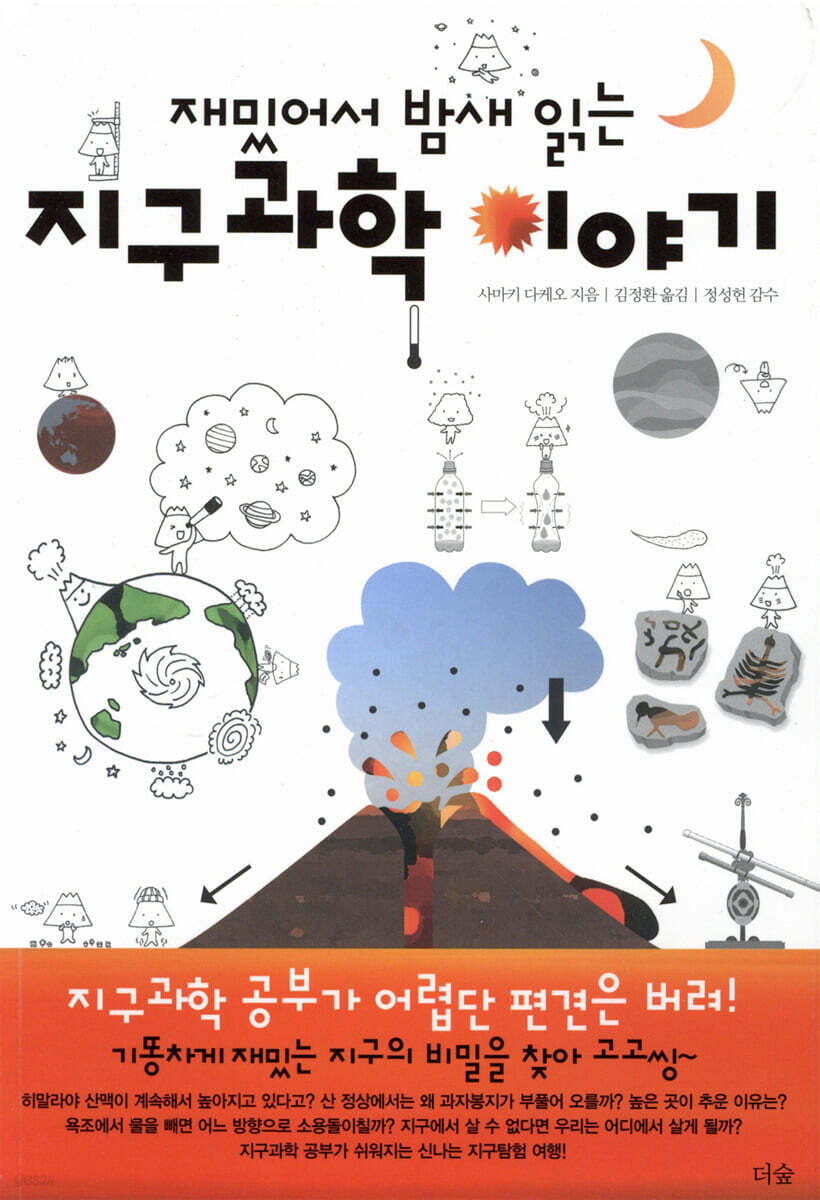
Earth science stories that are so fun you'll read them all night long
 |
Description
Book Introduction
2014 School Library Journal Recommended Books
A science series that has sold over 200,000 copies in Japan and has been selected as an excellent science book in Korea, so fun you'll be able to read it all night!
The Earth Sciences edition has finally been published, amidst a strong response from teachers and parents.
The basic concepts and essential knowledge of the confusing earth sciences are covered!
For students who find Earth Science difficult and mistakenly believe it is the subject that requires the most memorization, the book "Earth Science Stories That Are So Fun You'll Stay Up All Night" has been published to increase their understanding and interest in Earth Science through entertaining stories.
This is the fourth science book in the fun-to-read-all-night science series, which has sold over 200,000 copies in Japan and has been selected as an excellent science book in Korea, receiving great response and interest from teachers.
Earth science is the study of the Earth and the natural world surrounding it, encompassing geology, meteorology, astronomy, oceanography, and geophysics. This book, written by a renowned science education expert with over 30 years of experience in teaching and lecturing, explains the comprehensive content of Earth science in an easy-to-understand way through engaging and engaging stories.
The book is composed of three parts: 'Dynamic Earth Stories', 'Interesting Weather Stories to Know', and 'Space Stories That Are Amazing No Matter How Many Times You Hear Them'.
Starting from the surface of the Earth where we live, the interior of the Earth, and the atmosphere surrounding the Earth, it covers all the way to outer space, which is the future interest of all mankind, showing that Earth science is not simply a discipline that stays on Earth, but a very important and exciting discipline that includes geology, meteorology, astronomy, and oceanography.
Furthermore, stories about weather phenomena that we encounter in our daily lives, such as abnormal weather, earthquakes, and typhoons, also show students who were not interested in earth science why such phenomena occur and why we should study earth science, thereby showing that earth science is not a burdensome subject that must be memorized, but rather a science that can be approached in an interesting way through understanding.
It will be a great introductory book to earth science for students who wish to study it, as well as teachers and parents who guide students in the field, and even the general public who are interested in the Earth and space.
A science series that has sold over 200,000 copies in Japan and has been selected as an excellent science book in Korea, so fun you'll be able to read it all night!
The Earth Sciences edition has finally been published, amidst a strong response from teachers and parents.
The basic concepts and essential knowledge of the confusing earth sciences are covered!
For students who find Earth Science difficult and mistakenly believe it is the subject that requires the most memorization, the book "Earth Science Stories That Are So Fun You'll Stay Up All Night" has been published to increase their understanding and interest in Earth Science through entertaining stories.
This is the fourth science book in the fun-to-read-all-night science series, which has sold over 200,000 copies in Japan and has been selected as an excellent science book in Korea, receiving great response and interest from teachers.
Earth science is the study of the Earth and the natural world surrounding it, encompassing geology, meteorology, astronomy, oceanography, and geophysics. This book, written by a renowned science education expert with over 30 years of experience in teaching and lecturing, explains the comprehensive content of Earth science in an easy-to-understand way through engaging and engaging stories.
The book is composed of three parts: 'Dynamic Earth Stories', 'Interesting Weather Stories to Know', and 'Space Stories That Are Amazing No Matter How Many Times You Hear Them'.
Starting from the surface of the Earth where we live, the interior of the Earth, and the atmosphere surrounding the Earth, it covers all the way to outer space, which is the future interest of all mankind, showing that Earth science is not simply a discipline that stays on Earth, but a very important and exciting discipline that includes geology, meteorology, astronomy, and oceanography.
Furthermore, stories about weather phenomena that we encounter in our daily lives, such as abnormal weather, earthquakes, and typhoons, also show students who were not interested in earth science why such phenomena occur and why we should study earth science, thereby showing that earth science is not a burdensome subject that must be memorized, but rather a science that can be approached in an interesting way through understanding.
It will be a great introductory book to earth science for students who wish to study it, as well as teachers and parents who guide students in the field, and even the general public who are interested in the Earth and space.
- You can preview some of the book's contents.
Preview
index
Reviewer's note
preface
Part 1.
Dynamic Earth Story
Is the legend of Atlantis true? / Was the world originally one? / Iceland, a treasure trove of geology / Isn't Everest the highest mountain in the world? / Are the Himalayas still rising? / Volcanic activity varies depending on the composition of magma / The postmaster who loved volcanoes / Not everything buried underground becomes a fossil / The Earth is a giant magnet / The Earth's magnetic poles are reversing / How did mass extinction occur? / The shock of the 'global freeze' hypothesis that freezes all the way to the equator
Part 2.
Fun weather stories to know
If you drain the water in a bathtub, in which direction will the water swirl? / Why do typhoons come at similar times every year? / If the sunset is beautiful, is it clear the next day? / The secret weapon carried by the jet stream / Why does a bag of chips swell on the top of a mountain? / Why is it cold when you go higher and closer to the sun? / Be careful of hail even in hot summer.
A weather story that becomes even more amazing when you know it
Part 3.
A space story that's still amazing no matter how many times you hear it.
Was the Earth the Center of the Universe? / The Universe Galileo Seen Through His Telescope / The Universe Is Still Expanding / What Divided the Fates of Earth and Venus / Was the Moon Earth's Brother!? / The Secret to Clearly Seeing Shooting Stars / Will the Sun Burn Forever? / Where Will We Live If Earth Is Uninhabitable?
Conclusion
References
preface
Part 1.
Dynamic Earth Story
Is the legend of Atlantis true? / Was the world originally one? / Iceland, a treasure trove of geology / Isn't Everest the highest mountain in the world? / Are the Himalayas still rising? / Volcanic activity varies depending on the composition of magma / The postmaster who loved volcanoes / Not everything buried underground becomes a fossil / The Earth is a giant magnet / The Earth's magnetic poles are reversing / How did mass extinction occur? / The shock of the 'global freeze' hypothesis that freezes all the way to the equator
Part 2.
Fun weather stories to know
If you drain the water in a bathtub, in which direction will the water swirl? / Why do typhoons come at similar times every year? / If the sunset is beautiful, is it clear the next day? / The secret weapon carried by the jet stream / Why does a bag of chips swell on the top of a mountain? / Why is it cold when you go higher and closer to the sun? / Be careful of hail even in hot summer.
A weather story that becomes even more amazing when you know it
Part 3.
A space story that's still amazing no matter how many times you hear it.
Was the Earth the Center of the Universe? / The Universe Galileo Seen Through His Telescope / The Universe Is Still Expanding / What Divided the Fates of Earth and Venus / Was the Moon Earth's Brother!? / The Secret to Clearly Seeing Shooting Stars / Will the Sun Burn Forever? / Where Will We Live If Earth Is Uninhabitable?
Conclusion
References
Detailed image
Into the book
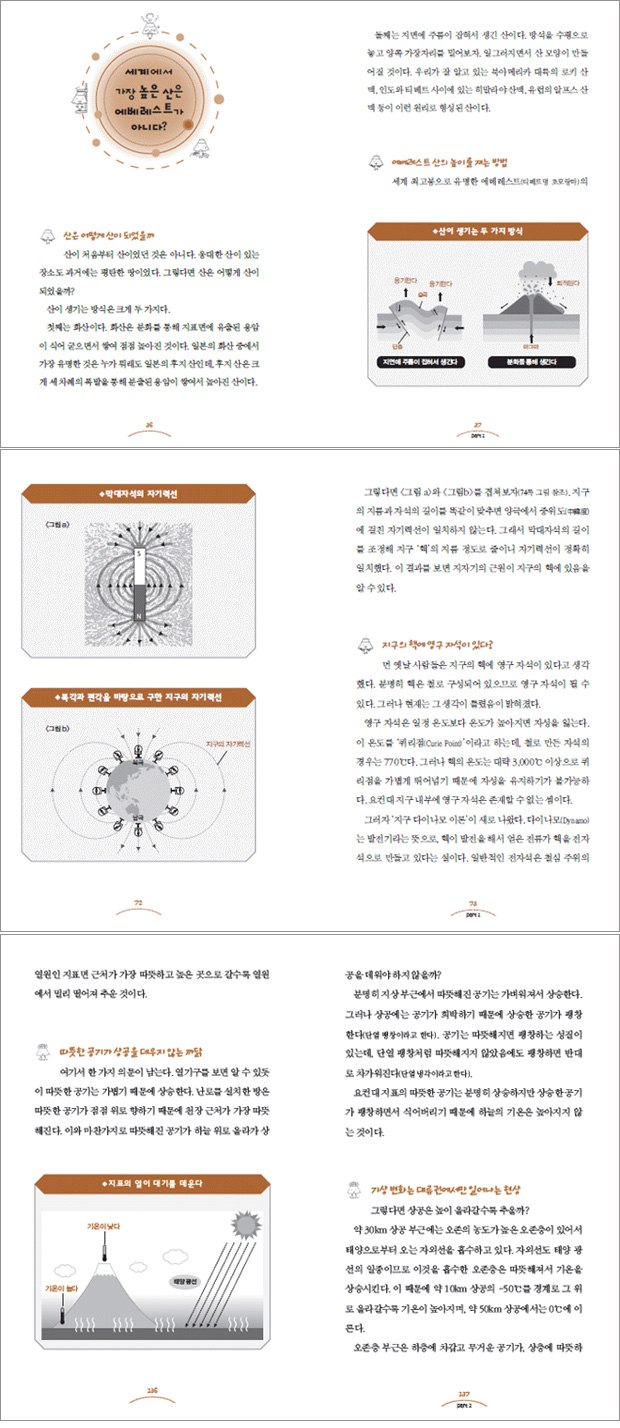
Mount Everest (Tibetan name: Qomolangma), famous as the world's highest peak, is known to be 8,848 meters high.
This figure of 8,848m is the difference between the distance from the center of the Earth to the summit of Everest and the distance from the center of the Earth to the geoid where Everest is located.
The Earth has a vast range of terrain, including mountains over 8,000 meters high and ocean trenches over 10,000 meters deep.
Also, the Earth's gravity is not constant because the density of the crustal structure is not uniform, so in places with high density, gravity acts only on that part.
Therefore, in geodesy, considering that 70% of the Earth's surface is covered by sea, the 'gravitational equipotential surface (equipotential surface)' closest to the average position of the world's sea level is defined as the 'geoid' and is used as an indicator representing the shape of the Earth.
In short, the height of Everest is the height from the mean sea level at the point where Everest is located, that is, from the geoid to the summit.
There is a reason why the height of a mountain is said to be 8,848 meters above sea level.
For a living thing to become a fossil, certain conditions are necessary.
The condition is to 'die whole, without being eaten by animals, and in a place where the body does not rot.'
The only place where such conditions exist is deep underground.
Even if it is not eaten by animals on the ground, there is a high risk of it being broken down (rotted) by mold or bacteria.
However, if buried deep underground, there is no need to worry about animals eating it, and there are no bacteria, so the body does not rot.
And as soil is deposited on top of it, over time, both the soil and the organisms trapped within it gradually change into hard rock.
However, the body of a living creature does not remain intact.
As organisms are trapped underground and tens of thousands, tens of millions, or hundreds of millions of years pass, the easily decomposable parts disappear, leaving behind only a very small portion of the organism's body, which is replaced by minerals.
for example
The rate at which animal bones in nature become fossils is thought to be roughly one in a billion.
Considering that each human has 206 bones, the total number of bones that could become fossils among the world's population (approximately 7.2 billion people) is calculated to be 1,483.
When you go hiking or climb to a high place, the bag of snacks you brought with you may become bulged.
Why does this phenomenon occur? The atmosphere becomes thinner as you go higher, and the atmospheric pressure also decreases accordingly.
For example, if you climb from the foot of a mountain with a sealed bag to a high place where the atmospheric pressure is 1,013 hPa, the pressure inside the bag remains 1,013 hPa, but the pressure outside the bag gradually decreases.
This difference in pressure causes the air inside the bag to expand.
As atmospheric pressure decreases, the temperature at which water boils (boiling point) also decreases.
Water boils at 100℃ at 1 atmosphere of pressure, but it boils at 90℃ on Mt. Halla and at about 87℃ at the summit of Mt. Fuji.
And at the summit of Everest, it boils at about 71℃.
So people who live at altitudes above 3,000m use pressure cookers when cooking.
This is because an ordinary pot cannot cook at high temperatures, so the food will be undercooked.
This figure of 8,848m is the difference between the distance from the center of the Earth to the summit of Everest and the distance from the center of the Earth to the geoid where Everest is located.
The Earth has a vast range of terrain, including mountains over 8,000 meters high and ocean trenches over 10,000 meters deep.
Also, the Earth's gravity is not constant because the density of the crustal structure is not uniform, so in places with high density, gravity acts only on that part.
Therefore, in geodesy, considering that 70% of the Earth's surface is covered by sea, the 'gravitational equipotential surface (equipotential surface)' closest to the average position of the world's sea level is defined as the 'geoid' and is used as an indicator representing the shape of the Earth.
In short, the height of Everest is the height from the mean sea level at the point where Everest is located, that is, from the geoid to the summit.
There is a reason why the height of a mountain is said to be 8,848 meters above sea level.
For a living thing to become a fossil, certain conditions are necessary.
The condition is to 'die whole, without being eaten by animals, and in a place where the body does not rot.'
The only place where such conditions exist is deep underground.
Even if it is not eaten by animals on the ground, there is a high risk of it being broken down (rotted) by mold or bacteria.
However, if buried deep underground, there is no need to worry about animals eating it, and there are no bacteria, so the body does not rot.
And as soil is deposited on top of it, over time, both the soil and the organisms trapped within it gradually change into hard rock.
However, the body of a living creature does not remain intact.
As organisms are trapped underground and tens of thousands, tens of millions, or hundreds of millions of years pass, the easily decomposable parts disappear, leaving behind only a very small portion of the organism's body, which is replaced by minerals.
for example
The rate at which animal bones in nature become fossils is thought to be roughly one in a billion.
Considering that each human has 206 bones, the total number of bones that could become fossils among the world's population (approximately 7.2 billion people) is calculated to be 1,483.
When you go hiking or climb to a high place, the bag of snacks you brought with you may become bulged.
Why does this phenomenon occur? The atmosphere becomes thinner as you go higher, and the atmospheric pressure also decreases accordingly.
For example, if you climb from the foot of a mountain with a sealed bag to a high place where the atmospheric pressure is 1,013 hPa, the pressure inside the bag remains 1,013 hPa, but the pressure outside the bag gradually decreases.
This difference in pressure causes the air inside the bag to expand.
As atmospheric pressure decreases, the temperature at which water boils (boiling point) also decreases.
Water boils at 100℃ at 1 atmosphere of pressure, but it boils at 90℃ on Mt. Halla and at about 87℃ at the summit of Mt. Fuji.
And at the summit of Everest, it boils at about 71℃.
So people who live at altitudes above 3,000m use pressure cookers when cooking.
This is because an ordinary pot cannot cook at high temperatures, so the food will be undercooked.
---From the text
Publisher's Review
A science series that has sold over 200,000 copies in Japan and has been selected as an excellent science book in Korea, so fun you'll be able to read it all night!
The Earth Sciences edition has finally been published, amidst a strong response from teachers and parents.
The basic concepts and essential knowledge of the confusing earth sciences are covered!
For students who find Earth Science difficult and mistakenly believe it is the subject that requires the most memorization, the book "Earth Science Stories That Are So Fun You'll Stay Up All Night" has been published to increase their understanding and interest in Earth Science through entertaining stories.
This is the fourth science book in the fun-to-read-all-night science series, which has sold over 200,000 copies in Japan and has been selected as an excellent science book in Korea, receiving great response and interest from teachers.
Earth science is the study of the Earth and the natural world surrounding it, encompassing geology, meteorology, astronomy, oceanography, and geophysics. This book, written by a renowned science education expert with over 30 years of experience in teaching and lecturing, explains the comprehensive content of Earth science in an easy-to-understand way through engaging and engaging stories.
The book is composed of three parts: 'Dynamic Earth Stories', 'Interesting Weather Stories to Know', and 'Space Stories That Are Amazing No Matter How Many Times You Hear Them'.
Beginning with the surface of the Earth on which we live, its interior, and the atmosphere surrounding it, it covers all the way to outer space, a future concern for all of humanity. This demonstrates that Earth science is not simply a discipline confined to the Earth, but a vital and fascinating discipline encompassing geology, meteorology, astronomy, and oceanography.
Furthermore, stories about weather phenomena that we encounter in our daily lives, such as abnormal weather, earthquakes, and typhoons, also show students who were not interested in earth science why such phenomena occur and why we should study earth science, thereby showing that earth science is not a burdensome subject that must be memorized, but rather a science that can be approached in an interesting way through understanding.
It will be a great introductory book to earth science for students who wish to study it, as well as teachers and parents who guide students in the field, and even the general public who are interested in the Earth and space.
An exciting journey of exploration that follows your curiosity about the Earth and makes studying Earth science easier.
This book conveys scientific knowledge focusing on interesting and exciting topics within the vast field of earth science.
You can learn about the principles of altitude and atmospheric pressure through a bag of cookies that becomes inflated when you climb to the top of a mountain, and about typhoons, such as the principles of typhoon formation and the winds that affect the direction of typhoons, through typhoons that visit around the same time every year.
The amazing volcano stories of Japan, the land of volcanoes, tell us about the secrets of the Earth that are unfolding beneath the Earth we live on.
The book is filled with various interesting elements that can only be found in earth science, such as the Big Bang theory that the universe is still expanding, the Copernican revolution that refers to a turning point in the process in which concepts that were previously considered common sense are suddenly overturned, the reason why Venus, a sibling star, had a different fate from Earth, will the sun shine forever, and the secret to clearly seeing shooting stars.
It also provides insight into the various aspects of earth science and the environmental destruction we indiscriminately commit.
According to many biologists, the various environmental destructions committed by humans and the very existence of humans have had a significant, direct or indirect impact on the Earth's environment and other life forms, and this has quietly led to mass extinction.
This is far exceeding the rate of extinction due to natural selection, and some predict that 20% of species will become extinct in the next 30 years and 50% in the next 100 years.
The author emphasizes that before worrying about mass extinction due to a massive natural disaster, we should once again look at the relationship between humans and nature.
We've gathered together the most essential elements about Earth, space, and natural phenomena that teenagers need to learn!
The hot topic in science education these days is the cultivation of creative and convergent talents.
In that sense, earth science, which covers geology, astronomy, meteorology, oceanography, and geophysics, is not an optional discipline, but a necessary one. Among the fun, all-night-reading science series that covers a wide spectrum of science, the 'Earth Science' edition in particular will help improve integrated thinking by presenting various scientific topics to our youth, who have previously thought of them as separate disciplines, and cultivate the ability to solve various problems they encounter in real life.
Additionally, the controversies and interesting stories about earth science that have occurred throughout history help young people break away from the traditional spoon-fed, memorization-based education and learn and understand subjects in a fun way.
The Earth Sciences edition has finally been published, amidst a strong response from teachers and parents.
The basic concepts and essential knowledge of the confusing earth sciences are covered!
For students who find Earth Science difficult and mistakenly believe it is the subject that requires the most memorization, the book "Earth Science Stories That Are So Fun You'll Stay Up All Night" has been published to increase their understanding and interest in Earth Science through entertaining stories.
This is the fourth science book in the fun-to-read-all-night science series, which has sold over 200,000 copies in Japan and has been selected as an excellent science book in Korea, receiving great response and interest from teachers.
Earth science is the study of the Earth and the natural world surrounding it, encompassing geology, meteorology, astronomy, oceanography, and geophysics. This book, written by a renowned science education expert with over 30 years of experience in teaching and lecturing, explains the comprehensive content of Earth science in an easy-to-understand way through engaging and engaging stories.
The book is composed of three parts: 'Dynamic Earth Stories', 'Interesting Weather Stories to Know', and 'Space Stories That Are Amazing No Matter How Many Times You Hear Them'.
Beginning with the surface of the Earth on which we live, its interior, and the atmosphere surrounding it, it covers all the way to outer space, a future concern for all of humanity. This demonstrates that Earth science is not simply a discipline confined to the Earth, but a vital and fascinating discipline encompassing geology, meteorology, astronomy, and oceanography.
Furthermore, stories about weather phenomena that we encounter in our daily lives, such as abnormal weather, earthquakes, and typhoons, also show students who were not interested in earth science why such phenomena occur and why we should study earth science, thereby showing that earth science is not a burdensome subject that must be memorized, but rather a science that can be approached in an interesting way through understanding.
It will be a great introductory book to earth science for students who wish to study it, as well as teachers and parents who guide students in the field, and even the general public who are interested in the Earth and space.
An exciting journey of exploration that follows your curiosity about the Earth and makes studying Earth science easier.
This book conveys scientific knowledge focusing on interesting and exciting topics within the vast field of earth science.
You can learn about the principles of altitude and atmospheric pressure through a bag of cookies that becomes inflated when you climb to the top of a mountain, and about typhoons, such as the principles of typhoon formation and the winds that affect the direction of typhoons, through typhoons that visit around the same time every year.
The amazing volcano stories of Japan, the land of volcanoes, tell us about the secrets of the Earth that are unfolding beneath the Earth we live on.
The book is filled with various interesting elements that can only be found in earth science, such as the Big Bang theory that the universe is still expanding, the Copernican revolution that refers to a turning point in the process in which concepts that were previously considered common sense are suddenly overturned, the reason why Venus, a sibling star, had a different fate from Earth, will the sun shine forever, and the secret to clearly seeing shooting stars.
It also provides insight into the various aspects of earth science and the environmental destruction we indiscriminately commit.
According to many biologists, the various environmental destructions committed by humans and the very existence of humans have had a significant, direct or indirect impact on the Earth's environment and other life forms, and this has quietly led to mass extinction.
This is far exceeding the rate of extinction due to natural selection, and some predict that 20% of species will become extinct in the next 30 years and 50% in the next 100 years.
The author emphasizes that before worrying about mass extinction due to a massive natural disaster, we should once again look at the relationship between humans and nature.
We've gathered together the most essential elements about Earth, space, and natural phenomena that teenagers need to learn!
The hot topic in science education these days is the cultivation of creative and convergent talents.
In that sense, earth science, which covers geology, astronomy, meteorology, oceanography, and geophysics, is not an optional discipline, but a necessary one. Among the fun, all-night-reading science series that covers a wide spectrum of science, the 'Earth Science' edition in particular will help improve integrated thinking by presenting various scientific topics to our youth, who have previously thought of them as separate disciplines, and cultivate the ability to solve various problems they encounter in real life.
Additionally, the controversies and interesting stories about earth science that have occurred throughout history help young people break away from the traditional spoon-fed, memorization-based education and learn and understand subjects in a fun way.
GOODS SPECIFICS
- Date of issue: December 9, 2013
- Page count, weight, size: 200 pages | 330g | 145*210*20mm
- ISBN13: 9788994418650
- ISBN10: 8994418652
You may also like
카테고리
korean


korean

![GQ KOREA Mark (Monthly): December [2025]](http://librairie.coreenne.fr/cdn/shop/files/8ef265dbbfbf186523ed75ba7319009d.jpg?v=1765340328&width=3840)


