

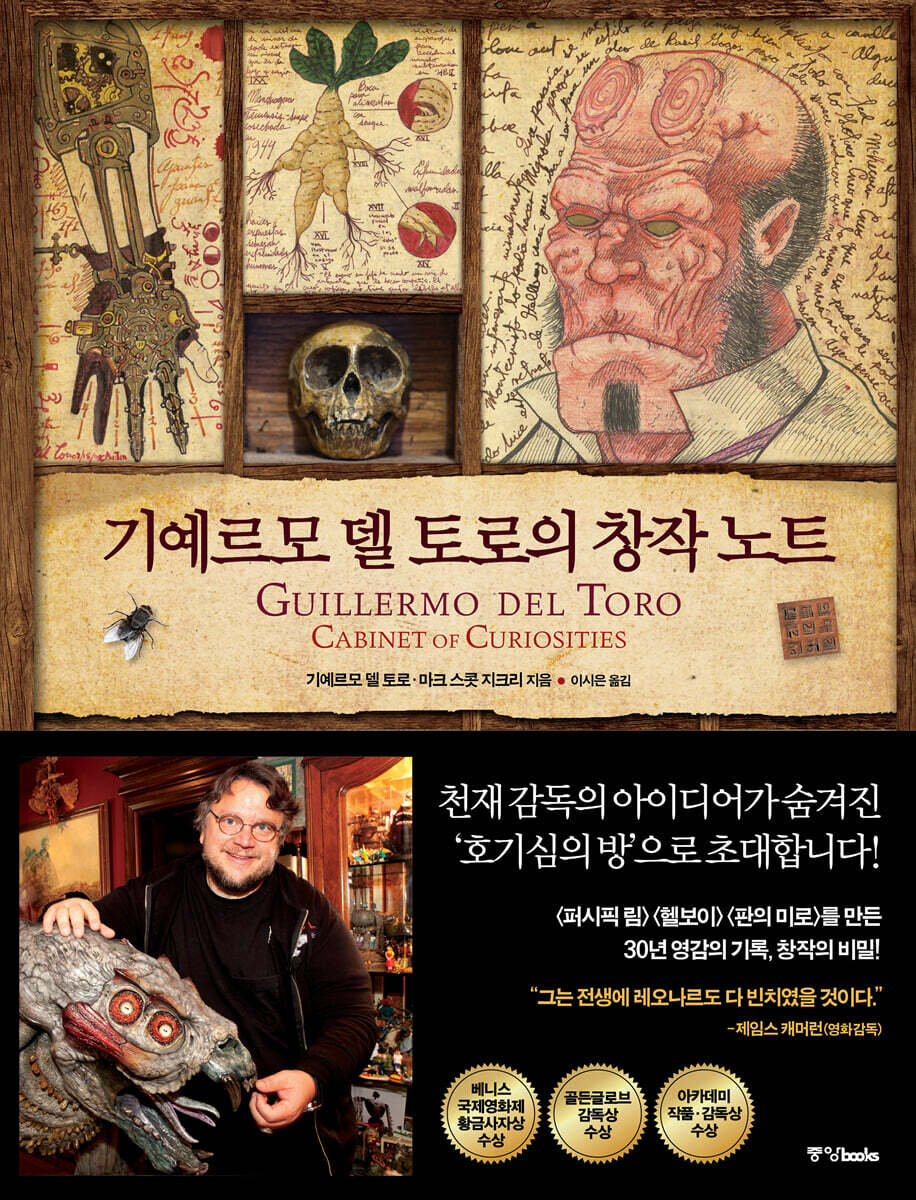
Guillermo del Toro's Creative Notes
 |
Description
Book Introduction
Guillermo del Toro's notebooks are comparable to Leonardo da Vinci's.
The secret door containing the genius director's 30 years of creative secrets opens!
Winner of the Golden Lion Award at the Venice International Film Festival, the Golden Globe Award for Best Director, and the Academy Award for Best Picture and Best Director!
Director Guillermo del Toro, known as the 'Wizard of Fantasy,' has been writing down the ideas and stories that came to his mind in a notebook for nearly 30 years, starting in his 20s.
Guillermo del Toro's notebooks became the blueprint for his films and books.
[Avatar] director James Cameron compared his notes to those of Leonardo da Vinci, saying, “Both show the creative process of a genius rarely seen in his time, let alone in human history.”
Now a master film director, Guillermo del Toro reveals his creative secrets and his studio, Bleak House, where his collection is housed, in 『Guillermo del Toro's Creative Notebook』.
In this book, he begins by explaining how he developed his inspiration and unique story, and introduces the filmmaking process from his debut [Cronus] to [Pan's Labyrinth], [Hellboy], and [Pacific Rim], as well as unfinished projects such as [At the Mountains of Madness], which was supposed to star Tom Cruise but was later canceled.
Packed with breathtaking detail and breathtaking design, this book will transport readers into a vast world of imagination.
The secret door containing the genius director's 30 years of creative secrets opens!
Winner of the Golden Lion Award at the Venice International Film Festival, the Golden Globe Award for Best Director, and the Academy Award for Best Picture and Best Director!
Director Guillermo del Toro, known as the 'Wizard of Fantasy,' has been writing down the ideas and stories that came to his mind in a notebook for nearly 30 years, starting in his 20s.
Guillermo del Toro's notebooks became the blueprint for his films and books.
[Avatar] director James Cameron compared his notes to those of Leonardo da Vinci, saying, “Both show the creative process of a genius rarely seen in his time, let alone in human history.”
Now a master film director, Guillermo del Toro reveals his creative secrets and his studio, Bleak House, where his collection is housed, in 『Guillermo del Toro's Creative Notebook』.
In this book, he begins by explaining how he developed his inspiration and unique story, and introduces the filmmaking process from his debut [Cronus] to [Pan's Labyrinth], [Hellboy], and [Pacific Rim], as well as unfinished projects such as [At the Mountains of Madness], which was supposed to star Tom Cruise but was later canceled.
Packed with breathtaking detail and breathtaking design, this book will transport readers into a vast world of imagination.
- You can preview some of the book's contents.
Preview
index
Foreword by James Cameron
Introduction
Collections
Bleak House
Visual inspiration
Movie Analysis
storytelling
Idea Incubator
Notebooks
Chronos
Mimic
Devil's Backbone
Blade 2
Hellboy
Pan's Labyrinth
Hellboy II: The Golden Army
Pacific Rim
Unfinished Project
Meat Market
Mephisto's Bridge
List of Seven
Left Hand of Darkness
Mountains of Madness
Late Tom Cruise
Acknowledgements
Introduction
Collections
Bleak House
Visual inspiration
Movie Analysis
storytelling
Idea Incubator
Notebooks
Chronos
Mimic
Devil's Backbone
Blade 2
Hellboy
Pan's Labyrinth
Hellboy II: The Golden Army
Pacific Rim
Unfinished Project
Meat Market
Mephisto's Bridge
List of Seven
Left Hand of Darkness
Mountains of Madness
Late Tom Cruise
Acknowledgements
Detailed image

Into the book
As an artist with a vast and elaborate imagination, he naturally found himself in the world of film, the most technically complex and culturally universal canvas of our time.
Had he been born in another era, he would have painted with egg tempera or quill pen and had an equally enormous influence.
(……) Guillermo constantly draws with his pen and takes notes densely, and in the process, he subconsciously brings out new, unprocessed stories that are still stirring.
The stories he obtains in this way become the blueprint for his films and books.
---From the "Preface"
When Guillermo entered the film industry, his mentor Jaime Humberto Hermosillo always advised him to keep records.
Guillermo recalls:
“I used to carry around a Mexican Moleskine notebook, but it was so poorly bound with spirals that the individual pages started to fall off.
Eventually, around 1986 or 1987, I bought the then-revolutionary Day Runner.
When it first came out it was like $80 a volume, but for me it was a replacement for a portable computer.
I immediately fell in love with those blue notebooks, and I still have a set of 60 or 70 of them.
I was planning on buying a Blue Note to use for the rest of my life.
I started writing in those notebooks and I really liked them because they were easy to put together and very sturdy.
I always carried a notebook with me while filming.
Even though it rained, I didn't get wet.
It was truly fantastic.
That was the beginning of note-taking.”
---From "Introduction"
Bleak House is Guillermo's second home, his office, his artistic masterpiece, his cluttered attic, his pride and joy.
(……) Bleak House is bursting with “over 550 original works of art,” says Guillermo.
With the recent expansion of Bleak House, the collection has become even more impressive.
What started out as a single house has now expanded to include neighboring buildings, and the place is still searching for its own identity.
Like the first house, the second house is filled with Guillermo's cherished collection of possessions.
For example, the living room in the second building is filled with beautiful pre-production scale models of creatures from Pacific Rim, flanked by stunning bronze statues by Stanislav Zukalski and a full-body replica of Meg Mucklebones, played by Robert Picardo in Ridley Scott's sci-fi film Legend.
---From "Bleak House"
[Chronos] is Guillermo's first feature film.
For many new directors, their first film is an embarrassing memory they wish to erase.
(……) But Guillermo’s [Chronos] is not like that.
This amazing film shows a visionary already in his mature stage.
This work is a personal, profound, and philosophical reflection on the choices unconditional love demands when faced with the forces beyond our control: sexual compulsion, hunger, and the inevitability of death.
This film asks us how far we can go with our own actions.
---From "Chronos"
As a result, [Hellboy] shares the unique characteristics of all the works Guillermo has made in English with studio support.
Because Guillermo pours his all into his films.
“Everything about me is consistent.
(……) I didn’t make eight films.
I'm trying to make one film that consists of all my films.
To me, that one movie is like Bleak House.
“I’m building the rooms one by one, so the audience can perceive the house as a whole at a glance.”
---From "Hellboy"
In [Pan's Labyrinth], as in all of Guillermo's films, the villains are portrayed in a concrete and vivid manner.
They are evil, real, and fearful beings.
No element in the film is so trivial as to escape Guillermo's meticulous scrutiny, and even the villainous captain's attire is described in detail: "coat on shoulders, gloves, glasses... hair parted in the middle, patent leather shoes."
Finally, the captain breaks the glass of his pocket watch just before he dies to stop the clock so that his son can remember him, but it ends up being a futile effort.
In this way, Guillermo strives to show the audience the mental and physical longings and wounds of the villains, but rather than excuse their cruel acts, he chooses to show the human within the monster and the monster within the human.
Had he been born in another era, he would have painted with egg tempera or quill pen and had an equally enormous influence.
(……) Guillermo constantly draws with his pen and takes notes densely, and in the process, he subconsciously brings out new, unprocessed stories that are still stirring.
The stories he obtains in this way become the blueprint for his films and books.
---From the "Preface"
When Guillermo entered the film industry, his mentor Jaime Humberto Hermosillo always advised him to keep records.
Guillermo recalls:
“I used to carry around a Mexican Moleskine notebook, but it was so poorly bound with spirals that the individual pages started to fall off.
Eventually, around 1986 or 1987, I bought the then-revolutionary Day Runner.
When it first came out it was like $80 a volume, but for me it was a replacement for a portable computer.
I immediately fell in love with those blue notebooks, and I still have a set of 60 or 70 of them.
I was planning on buying a Blue Note to use for the rest of my life.
I started writing in those notebooks and I really liked them because they were easy to put together and very sturdy.
I always carried a notebook with me while filming.
Even though it rained, I didn't get wet.
It was truly fantastic.
That was the beginning of note-taking.”
---From "Introduction"
Bleak House is Guillermo's second home, his office, his artistic masterpiece, his cluttered attic, his pride and joy.
(……) Bleak House is bursting with “over 550 original works of art,” says Guillermo.
With the recent expansion of Bleak House, the collection has become even more impressive.
What started out as a single house has now expanded to include neighboring buildings, and the place is still searching for its own identity.
Like the first house, the second house is filled with Guillermo's cherished collection of possessions.
For example, the living room in the second building is filled with beautiful pre-production scale models of creatures from Pacific Rim, flanked by stunning bronze statues by Stanislav Zukalski and a full-body replica of Meg Mucklebones, played by Robert Picardo in Ridley Scott's sci-fi film Legend.
---From "Bleak House"
[Chronos] is Guillermo's first feature film.
For many new directors, their first film is an embarrassing memory they wish to erase.
(……) But Guillermo’s [Chronos] is not like that.
This amazing film shows a visionary already in his mature stage.
This work is a personal, profound, and philosophical reflection on the choices unconditional love demands when faced with the forces beyond our control: sexual compulsion, hunger, and the inevitability of death.
This film asks us how far we can go with our own actions.
---From "Chronos"
As a result, [Hellboy] shares the unique characteristics of all the works Guillermo has made in English with studio support.
Because Guillermo pours his all into his films.
“Everything about me is consistent.
(……) I didn’t make eight films.
I'm trying to make one film that consists of all my films.
To me, that one movie is like Bleak House.
“I’m building the rooms one by one, so the audience can perceive the house as a whole at a glance.”
---From "Hellboy"
In [Pan's Labyrinth], as in all of Guillermo's films, the villains are portrayed in a concrete and vivid manner.
They are evil, real, and fearful beings.
No element in the film is so trivial as to escape Guillermo's meticulous scrutiny, and even the villainous captain's attire is described in detail: "coat on shoulders, gloves, glasses... hair parted in the middle, patent leather shoes."
Finally, the captain breaks the glass of his pocket watch just before he dies to stop the clock so that his son can remember him, but it ends up being a futile effort.
In this way, Guillermo strives to show the audience the mental and physical longings and wounds of the villains, but rather than excuse their cruel acts, he chooses to show the human within the monster and the monster within the human.
---From "Pan's Labyrinth"
Publisher's Review
“He must have been Leonardo da Vinci in a past life” - James Cameron
Film director Guillermo del Toro has been keeping diaries and field notes since his 20s.
Wherever he went, he would always write down and draw any ideas that came to his mind.
Guillermo del Toro, known as the 'master of dark fantasy' and the pioneer of gothic horror, is about to release 'Crimson Peak'. He reveals his notebook containing his creative secrets and his 'Bleak House', which is also his studio and collection, in 'Guillermo del Toro's Creative Notebook'.
If you've seen even one of Guillermo del Toro's films, such as Hellboy, Pan's Labyrinth, Blade 2, or Pacific Rim, you'll be amazed the moment you open this book.
His notes, in which the characters in the film are elaborately sketched, each prop meticulously designed, and each line and background recorded, can be considered a storyboard and concept art.
James Cameron, director of Avatar, who wrote the book's foreword, compared his notes to those of Leonardo da Vinci, saying, "Both reveal the creative process of a genius rare not only in his time but throughout human history" (p. 8).
Guillermo also said that he must have been Leonardo da Vinci in his previous life, saying, “As an artist with a vast and elaborate imagination, he naturally ended up in the world of cinema, the most technically complex and culturally universal canvas of our time. Had he been born in any other era, he would have painted with egg tempera or quill pen and had an equally enormous influence” (p. 8).
A book that offers a glimpse into the mind of a fantasy master.
This book, which offers the pleasure of peering into del Toro's mind, is divided into three parts.
Part 1, 'Collection', shows how he developed his inspiration and developed his own unique story.
The book first takes readers to the Bleak House, a place filled with memorabilia and collectibles.
The Bleak House houses a collection of toys from his childhood, a bronze mask of his beloved director Hitchcock, a life-size statue of his favorite novelist Lovecraft, and other props from his films.
Bleak House is his second home, his studio for painting and writing, a source of inspiration where he recharges his energy and freely explores creative ideas that strike him.
Additionally, 'Collection' introduces the painters and writers who inspired del Toro and explains how he developed his ideas.
Director Del Toro's filmmaking process, which readers are most curious about, is introduced in Part 2, 'The Notebook'.
He started carrying a notebook and taking notes from the time he began preparing for his feature film debut, Chronos (1993), which won the Critics' Award at the Cannes Film Festival.
This is because his mentor, Mexican director Jaime Humberto Hermosillo, always urged him to keep a record. (Unfortunately, the notebook for “Cronos” was lost while drinking with James Cameron, so only a portion was included in the book.) Part 2 can be said to be a kind of commentary that contains the creative process and behind-the-scenes stories of the films, such as diaries written while making eight films he directed, from “Cronos,” “Blade II,” “Hellboy,” “Pan’s Labyrinth,” and “Pacific Rim,” as well as sketches and production art contained in the film production notebooks.
He said, “I was inspired by my idols like Dick Smith, Ray Harryhausen and Hitchcock who were open about their work processes.
“I, too, need to be open about my creative process,” he says, adding that he hopes ambitious filmmakers “will learn to embrace their passion with complete tenacity, to cherish and collect images, and to study them as code.”
Part 3 introduces 'unfinished projects', including 'At the Mountains of Madness', which was confirmed to star Tom Cruise but fell through.
Tom Cruise, who also wrote a review for the book, said, “I wouldn’t say At the Mountains of Madness was a failure.
This is because there have been many instances where a movie started production, was put on hold, and then was eventually completed.
“At the Mountains of Madness will also come true naturally when the time comes” (page 262), expressing his desire to work with director del Toro, a true artist.
It also makes readers look forward to the 'completion' of the 'unfinished' project.
The secret behind the artist's creative work, a vast and elaborate world of imagination!
When asked how he manages to create a unique character in each of his works, Guillermo del Toro replied, “Everything about me is consistent.
I didn't make eight movies.
I'm trying to make one film that consists of all my films.
To me, that one movie is like Bleak House.
“I am building the rooms one by one, so the audience should perceive the house as a whole at a glance” (p. 135).
In this book, readers will witness the creative process of an artist completing a massive film.
“Opening this book is like looking into Guillermo’s fantasy-filled mind.” - [New York Times]
“It’s filled with stunning illustrations and photographs that explore the mind of a fantasy master, making it hard to know where to begin.” - [Fangoria]
Film director Guillermo del Toro has been keeping diaries and field notes since his 20s.
Wherever he went, he would always write down and draw any ideas that came to his mind.
Guillermo del Toro, known as the 'master of dark fantasy' and the pioneer of gothic horror, is about to release 'Crimson Peak'. He reveals his notebook containing his creative secrets and his 'Bleak House', which is also his studio and collection, in 'Guillermo del Toro's Creative Notebook'.
If you've seen even one of Guillermo del Toro's films, such as Hellboy, Pan's Labyrinth, Blade 2, or Pacific Rim, you'll be amazed the moment you open this book.
His notes, in which the characters in the film are elaborately sketched, each prop meticulously designed, and each line and background recorded, can be considered a storyboard and concept art.
James Cameron, director of Avatar, who wrote the book's foreword, compared his notes to those of Leonardo da Vinci, saying, "Both reveal the creative process of a genius rare not only in his time but throughout human history" (p. 8).
Guillermo also said that he must have been Leonardo da Vinci in his previous life, saying, “As an artist with a vast and elaborate imagination, he naturally ended up in the world of cinema, the most technically complex and culturally universal canvas of our time. Had he been born in any other era, he would have painted with egg tempera or quill pen and had an equally enormous influence” (p. 8).
A book that offers a glimpse into the mind of a fantasy master.
This book, which offers the pleasure of peering into del Toro's mind, is divided into three parts.
Part 1, 'Collection', shows how he developed his inspiration and developed his own unique story.
The book first takes readers to the Bleak House, a place filled with memorabilia and collectibles.
The Bleak House houses a collection of toys from his childhood, a bronze mask of his beloved director Hitchcock, a life-size statue of his favorite novelist Lovecraft, and other props from his films.
Bleak House is his second home, his studio for painting and writing, a source of inspiration where he recharges his energy and freely explores creative ideas that strike him.
Additionally, 'Collection' introduces the painters and writers who inspired del Toro and explains how he developed his ideas.
Director Del Toro's filmmaking process, which readers are most curious about, is introduced in Part 2, 'The Notebook'.
He started carrying a notebook and taking notes from the time he began preparing for his feature film debut, Chronos (1993), which won the Critics' Award at the Cannes Film Festival.
This is because his mentor, Mexican director Jaime Humberto Hermosillo, always urged him to keep a record. (Unfortunately, the notebook for “Cronos” was lost while drinking with James Cameron, so only a portion was included in the book.) Part 2 can be said to be a kind of commentary that contains the creative process and behind-the-scenes stories of the films, such as diaries written while making eight films he directed, from “Cronos,” “Blade II,” “Hellboy,” “Pan’s Labyrinth,” and “Pacific Rim,” as well as sketches and production art contained in the film production notebooks.
He said, “I was inspired by my idols like Dick Smith, Ray Harryhausen and Hitchcock who were open about their work processes.
“I, too, need to be open about my creative process,” he says, adding that he hopes ambitious filmmakers “will learn to embrace their passion with complete tenacity, to cherish and collect images, and to study them as code.”
Part 3 introduces 'unfinished projects', including 'At the Mountains of Madness', which was confirmed to star Tom Cruise but fell through.
Tom Cruise, who also wrote a review for the book, said, “I wouldn’t say At the Mountains of Madness was a failure.
This is because there have been many instances where a movie started production, was put on hold, and then was eventually completed.
“At the Mountains of Madness will also come true naturally when the time comes” (page 262), expressing his desire to work with director del Toro, a true artist.
It also makes readers look forward to the 'completion' of the 'unfinished' project.
The secret behind the artist's creative work, a vast and elaborate world of imagination!
When asked how he manages to create a unique character in each of his works, Guillermo del Toro replied, “Everything about me is consistent.
I didn't make eight movies.
I'm trying to make one film that consists of all my films.
To me, that one movie is like Bleak House.
“I am building the rooms one by one, so the audience should perceive the house as a whole at a glance” (p. 135).
In this book, readers will witness the creative process of an artist completing a massive film.
“Opening this book is like looking into Guillermo’s fantasy-filled mind.” - [New York Times]
“It’s filled with stunning illustrations and photographs that explore the mind of a fantasy master, making it hard to know where to begin.” - [Fangoria]
GOODS SPECIFICS
- Date of issue: January 23, 2023
- Format: Hardcover book binding method guide
- Page count, weight, size: 264 pages | 1,416g | 220*285*27mm
- ISBN13: 9788927879619
- ISBN10: 8927879619
You may also like
카테고리
korean


korean

![GQ KOREA Mark (Monthly): December [2025]](http://librairie.coreenne.fr/cdn/shop/files/8ef265dbbfbf186523ed75ba7319009d.jpg?v=1765340328&width=3840)


