

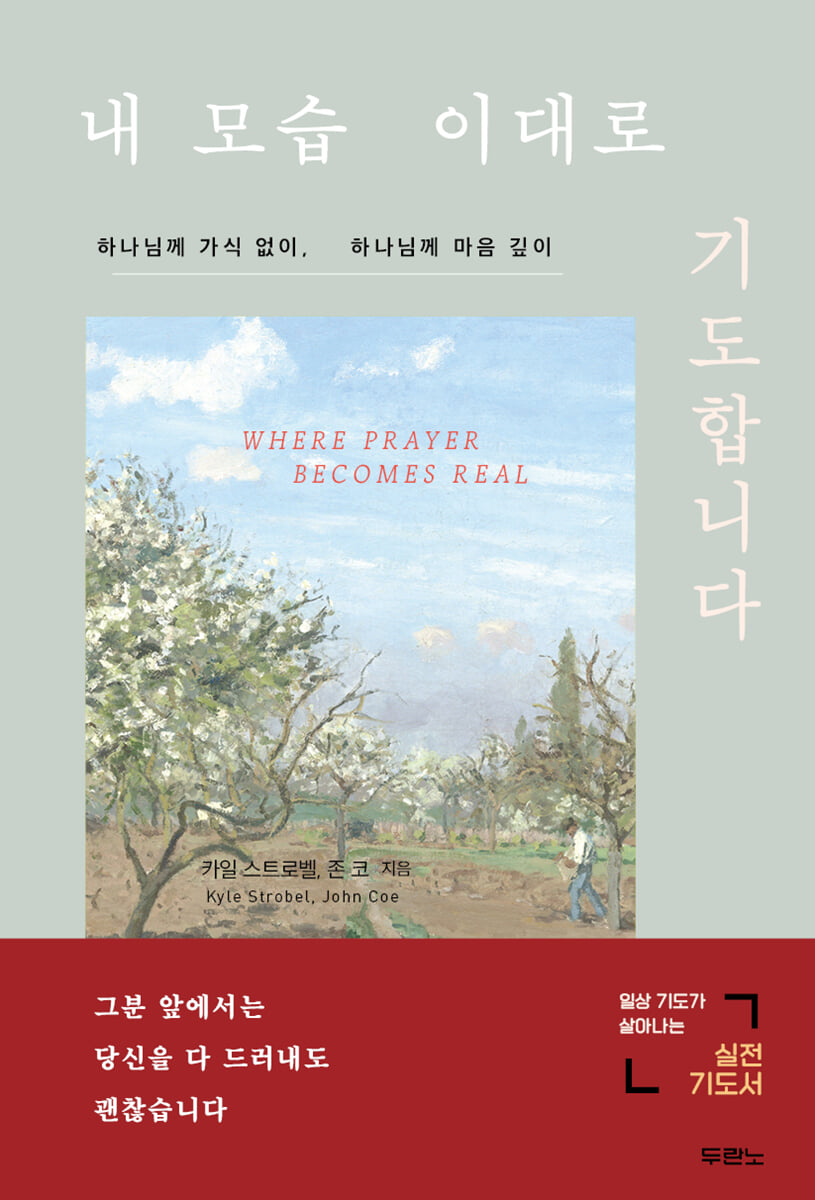
I pray that I remain like this
 |
Description
Book Introduction
A practical prayer book that brings everyday prayer to life
With a new heart, start praying again!
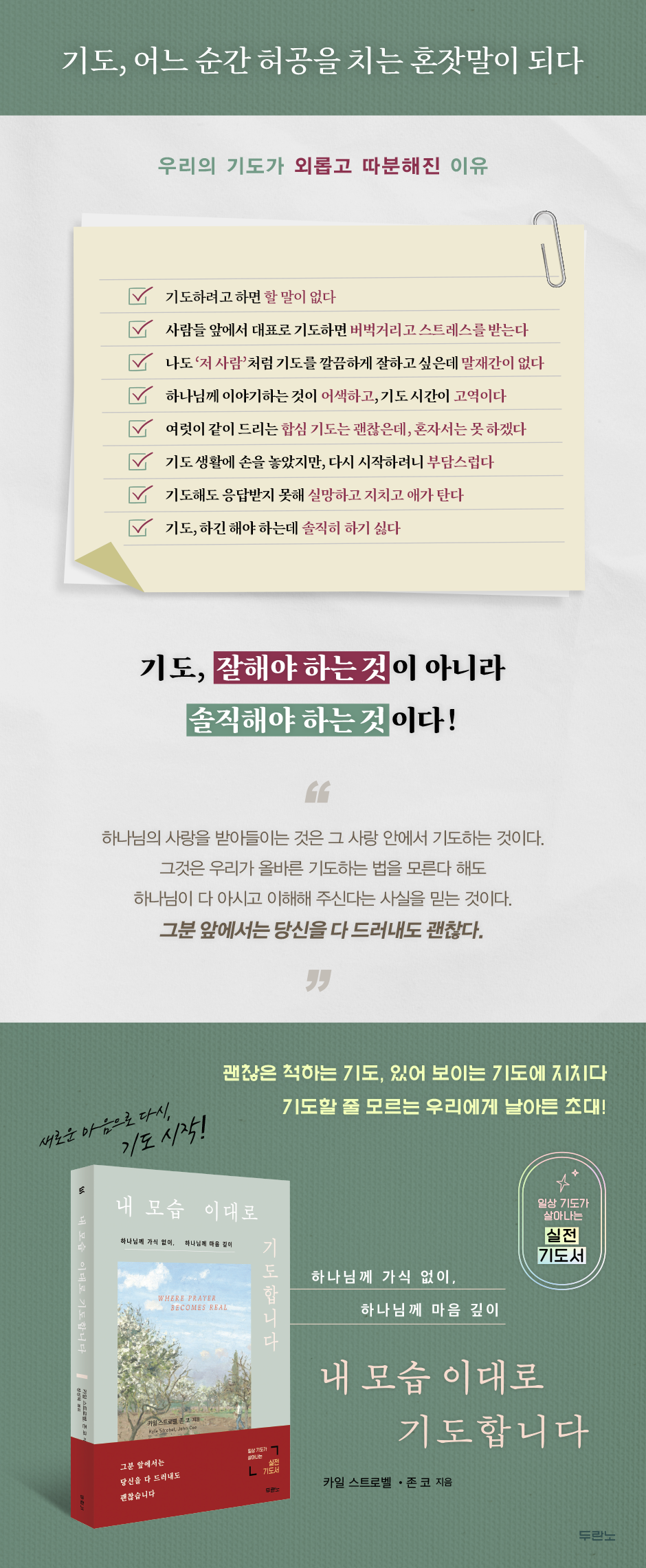
Do you find yourself speechless when you try to pray? Stutter and feel stressed when praying in front of others? You want to pray clearly and effectively like "that person," but you lack the eloquence? Talking to God feels awkward, and prayer time is a struggle? Praying together with others is fine, but you can't do it alone? You've given up on prayer, but starting again feels overwhelming? When you pray and don't receive answers, you feel disappointed, exhausted, and frustrated? Praying is something you need to do, but honestly, you don't want to do it?
Prayer is essential to the life of faith and an amazing privilege to have a one-on-one encounter with God.
There is even a saying that ‘prayer is breathing.’
But how did such prayer become such a burden for so many people, a burden they find tiresome to think about, a burden they find burdensome to do, and a burden they feel uncomfortable not doing? Spiritual development theologians Kyle Strobel and John Coe guide us toward a truly vibrant prayer life, grounded in a solid biblical foundation.
The basic principle of prayer that we miss out on in the midst of so many other things is ‘honest prayer.’
With a new heart, start praying again!
Do you find yourself speechless when you try to pray? Stutter and feel stressed when praying in front of others? You want to pray clearly and effectively like "that person," but you lack the eloquence? Talking to God feels awkward, and prayer time is a struggle? Praying together with others is fine, but you can't do it alone? You've given up on prayer, but starting again feels overwhelming? When you pray and don't receive answers, you feel disappointed, exhausted, and frustrated? Praying is something you need to do, but honestly, you don't want to do it?
Prayer is essential to the life of faith and an amazing privilege to have a one-on-one encounter with God.
There is even a saying that ‘prayer is breathing.’
But how did such prayer become such a burden for so many people, a burden they find tiresome to think about, a burden they find burdensome to do, and a burden they feel uncomfortable not doing? Spiritual development theologians Kyle Strobel and John Coe guide us toward a truly vibrant prayer life, grounded in a solid biblical foundation.
The basic principle of prayer that we miss out on in the midst of so many other things is ‘honest prayer.’
- You can preview some of the book's contents.
Preview
index
Prologue.
An invitation to us who do not know how to pray
Part 1
Prayer, at some point, becomes a soliloquy, striking the air.
―Why Our Prayers Have Become Lonely and Boring
1.
I thought it was a 'sin' to let my mind wander while praying.
2.
I thought my prayers couldn't be a 'means of avoiding God'
3.
I thought there were things you could say and things you couldn't say.
4.
I thought God was burdened by my sins and my painful heart.
Interlude.
Learning Living and Moving Prayer
Part 2
To God without hypocrisy, to God with a deep heart
―Today, I start praying again.
5.
The Psalm Prayer, which reveals my true self
6.
A prayer of intention that renews the direction of your heart every day.
7.
The Prayer of Harvest: Putting Off the World and Putting on Christ
8.
A Prayer of Reflection: A Deep Examination of Your Heart and Life in the Light of Jesus
9.
Intercessory Prayer: Experiencing the Spiritual Reality of Being "One Body in Jesus"
Epilogue.
The Hardships and Full Joy of Prayer
Appendix 1.
Small Group Leader's Guide
Appendix 2.
Psalm Prayer Guide
Appendix 3.
Prayer Guide of Intention
Appendix 4.
Prayer Guide for Harvest
Acknowledgements
main
An invitation to us who do not know how to pray
Part 1
Prayer, at some point, becomes a soliloquy, striking the air.
―Why Our Prayers Have Become Lonely and Boring
1.
I thought it was a 'sin' to let my mind wander while praying.
2.
I thought my prayers couldn't be a 'means of avoiding God'
3.
I thought there were things you could say and things you couldn't say.
4.
I thought God was burdened by my sins and my painful heart.
Interlude.
Learning Living and Moving Prayer
Part 2
To God without hypocrisy, to God with a deep heart
―Today, I start praying again.
5.
The Psalm Prayer, which reveals my true self
6.
A prayer of intention that renews the direction of your heart every day.
7.
The Prayer of Harvest: Putting Off the World and Putting on Christ
8.
A Prayer of Reflection: A Deep Examination of Your Heart and Life in the Light of Jesus
9.
Intercessory Prayer: Experiencing the Spiritual Reality of Being "One Body in Jesus"
Epilogue.
The Hardships and Full Joy of Prayer
Appendix 1.
Small Group Leader's Guide
Appendix 2.
Psalm Prayer Guide
Appendix 3.
Prayer Guide of Intention
Appendix 4.
Prayer Guide for Harvest
Acknowledgements
main
Detailed image
Into the book
Throughout our lives of faith, there have been many times when our prayers were not good.
But that wasn't our biggest problem.
The problem is that we haven't been honest about that fact.
We 'pretended' that there was nothing wrong with our prayers, but in reality, that was not the case at all.
Our prayers were dry and boring.
In my heart, I tried not to pray.
The mealtime prayer was okay.
I could only say a brief prayer for others.
But when I tried to pray with God from deep within, it felt like I was wandering in the middle of a desert.
Unfortunately, we never thought to tell God about those feelings.
Why didn't I ever think of telling you how far away God feels when I pray?
Then I heard good news.
“For we do not know what we ought to pray for, but the Spirit himself intercedes for us with groans that words cannot express” (Romans 8:26).
We don't know how to pray.
And God wants us to know this.
But this is no excuse for us to despair and stop praying.
Because this is God's invitation.
--- p.13
When our minds wander during prayer, we stop praying and try to talk to ourselves.
This kind of self-talk is like pressing the 'pause button' on prayer.
It is an attempt to convince oneself to put God aside for a moment and focus more on prayer.
Sometimes I berate myself for not praying properly, and sometimes I question myself for not being able to focus on myself.
Besides this, self-talk can take many forms.
Among the many 'prayer's' we offer, it can be a story to 'ourselves' about what went wrong, where our hearts have wandered, and how messed up our relationship with God has become.
At such moments, we stop talking to God because we think that this is not what He wants to hear.
I think this is 'our' problem.
I think our hearts are wandering towards idols, worries, and other loves.
Most of the time my mind wanders towards things I can control.
For example, things I want to do in relation to my schedule, work, and home.
These things feel like they are within my control.
It also makes me feel like I'm living well.
But God's presence often makes me feel like I have no control over anything, and it also makes me feel guilty.
We should pray like this:
“God, look at this.
Lord, see in which direction my heart flows before you.
God, deep down, I long for control over my fears and anxieties.
God, help me to leave these things to you.
I believe in the Lord.
“Please help me, who am lost in faith, to truly know that my life is safely in Your hands, not my own.”
--- p.33-34
We must not try to invent or improve our own prayers.
We must enter into prayer through the Son and the Holy Spirit who intercede in us, through us, and for us.
If we forget this profound truth, prayer becomes a time of avoidance from God.
If we have even the slightest idea that prayer is a time to perform well as a Christian, then prayer becomes a time to avoid God.
This is not the essence of prayer.
Prayer is believing in the intercession of Jesus.
Prayer is believing in the intercessory groans of the Holy Spirit.
Prayer is entering into the prayer of two people.
We can speak the truth because the Son and the Holy Spirit speak the truth to the Father for us.
So simply learning a new prayer technique is of no use.
We must pray in the gospel.
Just as when we pray for salvation, we come before God full of sin and brokenness, and receive grace, mercy, and kindness.
--- p.61
When our hearts condemn us, we must not project it onto God and mistake it for God's heart toward us.
We must meet the God of mercy while wrestling with the lies of the flesh.
When we feel condemned, we need to talk to God about why we feel that way and who we are in Christ.
This is real prayer.
To illuminate and change our expectations, we need more than information.
These are the things we need to address in our prayer life.
Only when we address these things in prayer can we truly receive God's forgiveness, presence, and mercy.
Only then, like a river gradually changing its terrain, will prayer slowly deepen.
--- p.79-80
We must pray honestly confessing our doubts about God.
You must tell Him why you have doubts.
But often we don't see these doubts as an invitation to deeper prayer, but rather as an attempt to 'get better' at praying.
If you grit your teeth and try to pray better, it is easy to get lost in your imagination.
Our Father in heaven tells us to tell Him the truth through the Holy Spirit in His Son.
He tells us to come to Him in reality, not in our imagination.
But we pursue imagination.
This is because it gives you peace of mind and you think God won't notice.
It's comforting to imagine God as we want Him to be or to compare our lives to those who seem less faithful (or more wicked).
Conversely, imagination can also drive us to fear.
--- p.93
When negative emotions arise, we stop praying to do what God should be doing.
John says in 1 John 4:18, “Perfect love casts out fear.”
But in our fears, worries, guilt, and shame, instead of looking to our heavenly Father, who is perfect love, we try to deal with these negative emotions ourselves.
The 'idea' of perfect love does not banish fear.
Only perfect love itself can do that.
Only God can cleanse us, but when we try to do it ourselves, prayer becomes a means to gain confidence in our spiritual life.
Prayer to see one's own goodness is not true, life-giving prayer.
As we have seen, this is why our prayers often feel lonely and boring.
This kind of prayer is just a time to manage God.
An intimate prayer life is impossible this way.
--- p.94
Deep down, I (John) intend to rest in God, trust Him, and seek Him in all things.
But as soon as I open my eyes in the morning, my mind does something else.
Still, my heart begins to carry the weight of life on its own and does what it always does.
So my habits must be reconnected to the deep intentions of my heart so that I can offer my entire life to God.
I want to “incline my heart” toward God’s ways (Psalm 119:112).
I want to go into the deep meaning of my heart.
I want to live not by my own strength, but in Him.
Now, when I open my eyes in the morning, I let go of whatever my mind is holding on to and intentionally offer a prayer of intention.
“Lord, here I am.
I give myself to the Lord.
“I want to be with the Lord first before I do anything else.”
My first move of the day after waking up shouldn't be to find a way to solve my worries.
First of all, you must decide to be with God.
This essentially means entering into the presence of God.
It means that we should not try to use God to live according to our own will.
--- p.172-173
As I began to pray the prayer of reflection regularly, I began to reflect on my day every hour.
This is the greatest effect of this prayer.
This prayer trains my mind to be alert and attentive to all things in life.
So, gradually, I begin to pray this prayer already remembering the events of the day.
A prayer of reflection is not simply a simple prayer asking God to fix the situation and move on, but a time to look more deeply into the situations that are happening in my life.
… … (omitted) … … We should not look at sin in order to remember the sin itself.
As 'those who are in Christ' we must examine our lives and sins.
Our goal is to live with God, who calls us to be together in all things.
The prayer of contemplation is a deep examination of one's life and heart in order to offer oneself completely to God as a being who can do nothing without Him (John 15:5).
--- p.216, 219-220
I (Kyle) found this especially difficult in prayer.
Sometimes I only care about the content of the prayer.
There are many times when we only pay attention to our own prayer requests and do not truly come to God.
The same is true when praying for others.
For example, you might be scrolling through your social media feed and come across a prayer request for someone.
I feel like I'd feel guilty if I ignored it (or even thought about wanting to).
So, without even looking at the name or trying to find out the specifics of the situation, I just say a short prayer and move on.
“God, please help that person.” In this kind of prayer, my goal is not to pray for them, but simply to remove my guilt.
I am not entering these people in prayer.
Don't try to feel their pain.
I just throw a prayer request to God about someone who is far from my heart.
But that wasn't our biggest problem.
The problem is that we haven't been honest about that fact.
We 'pretended' that there was nothing wrong with our prayers, but in reality, that was not the case at all.
Our prayers were dry and boring.
In my heart, I tried not to pray.
The mealtime prayer was okay.
I could only say a brief prayer for others.
But when I tried to pray with God from deep within, it felt like I was wandering in the middle of a desert.
Unfortunately, we never thought to tell God about those feelings.
Why didn't I ever think of telling you how far away God feels when I pray?
Then I heard good news.
“For we do not know what we ought to pray for, but the Spirit himself intercedes for us with groans that words cannot express” (Romans 8:26).
We don't know how to pray.
And God wants us to know this.
But this is no excuse for us to despair and stop praying.
Because this is God's invitation.
--- p.13
When our minds wander during prayer, we stop praying and try to talk to ourselves.
This kind of self-talk is like pressing the 'pause button' on prayer.
It is an attempt to convince oneself to put God aside for a moment and focus more on prayer.
Sometimes I berate myself for not praying properly, and sometimes I question myself for not being able to focus on myself.
Besides this, self-talk can take many forms.
Among the many 'prayer's' we offer, it can be a story to 'ourselves' about what went wrong, where our hearts have wandered, and how messed up our relationship with God has become.
At such moments, we stop talking to God because we think that this is not what He wants to hear.
I think this is 'our' problem.
I think our hearts are wandering towards idols, worries, and other loves.
Most of the time my mind wanders towards things I can control.
For example, things I want to do in relation to my schedule, work, and home.
These things feel like they are within my control.
It also makes me feel like I'm living well.
But God's presence often makes me feel like I have no control over anything, and it also makes me feel guilty.
We should pray like this:
“God, look at this.
Lord, see in which direction my heart flows before you.
God, deep down, I long for control over my fears and anxieties.
God, help me to leave these things to you.
I believe in the Lord.
“Please help me, who am lost in faith, to truly know that my life is safely in Your hands, not my own.”
--- p.33-34
We must not try to invent or improve our own prayers.
We must enter into prayer through the Son and the Holy Spirit who intercede in us, through us, and for us.
If we forget this profound truth, prayer becomes a time of avoidance from God.
If we have even the slightest idea that prayer is a time to perform well as a Christian, then prayer becomes a time to avoid God.
This is not the essence of prayer.
Prayer is believing in the intercession of Jesus.
Prayer is believing in the intercessory groans of the Holy Spirit.
Prayer is entering into the prayer of two people.
We can speak the truth because the Son and the Holy Spirit speak the truth to the Father for us.
So simply learning a new prayer technique is of no use.
We must pray in the gospel.
Just as when we pray for salvation, we come before God full of sin and brokenness, and receive grace, mercy, and kindness.
--- p.61
When our hearts condemn us, we must not project it onto God and mistake it for God's heart toward us.
We must meet the God of mercy while wrestling with the lies of the flesh.
When we feel condemned, we need to talk to God about why we feel that way and who we are in Christ.
This is real prayer.
To illuminate and change our expectations, we need more than information.
These are the things we need to address in our prayer life.
Only when we address these things in prayer can we truly receive God's forgiveness, presence, and mercy.
Only then, like a river gradually changing its terrain, will prayer slowly deepen.
--- p.79-80
We must pray honestly confessing our doubts about God.
You must tell Him why you have doubts.
But often we don't see these doubts as an invitation to deeper prayer, but rather as an attempt to 'get better' at praying.
If you grit your teeth and try to pray better, it is easy to get lost in your imagination.
Our Father in heaven tells us to tell Him the truth through the Holy Spirit in His Son.
He tells us to come to Him in reality, not in our imagination.
But we pursue imagination.
This is because it gives you peace of mind and you think God won't notice.
It's comforting to imagine God as we want Him to be or to compare our lives to those who seem less faithful (or more wicked).
Conversely, imagination can also drive us to fear.
--- p.93
When negative emotions arise, we stop praying to do what God should be doing.
John says in 1 John 4:18, “Perfect love casts out fear.”
But in our fears, worries, guilt, and shame, instead of looking to our heavenly Father, who is perfect love, we try to deal with these negative emotions ourselves.
The 'idea' of perfect love does not banish fear.
Only perfect love itself can do that.
Only God can cleanse us, but when we try to do it ourselves, prayer becomes a means to gain confidence in our spiritual life.
Prayer to see one's own goodness is not true, life-giving prayer.
As we have seen, this is why our prayers often feel lonely and boring.
This kind of prayer is just a time to manage God.
An intimate prayer life is impossible this way.
--- p.94
Deep down, I (John) intend to rest in God, trust Him, and seek Him in all things.
But as soon as I open my eyes in the morning, my mind does something else.
Still, my heart begins to carry the weight of life on its own and does what it always does.
So my habits must be reconnected to the deep intentions of my heart so that I can offer my entire life to God.
I want to “incline my heart” toward God’s ways (Psalm 119:112).
I want to go into the deep meaning of my heart.
I want to live not by my own strength, but in Him.
Now, when I open my eyes in the morning, I let go of whatever my mind is holding on to and intentionally offer a prayer of intention.
“Lord, here I am.
I give myself to the Lord.
“I want to be with the Lord first before I do anything else.”
My first move of the day after waking up shouldn't be to find a way to solve my worries.
First of all, you must decide to be with God.
This essentially means entering into the presence of God.
It means that we should not try to use God to live according to our own will.
--- p.172-173
As I began to pray the prayer of reflection regularly, I began to reflect on my day every hour.
This is the greatest effect of this prayer.
This prayer trains my mind to be alert and attentive to all things in life.
So, gradually, I begin to pray this prayer already remembering the events of the day.
A prayer of reflection is not simply a simple prayer asking God to fix the situation and move on, but a time to look more deeply into the situations that are happening in my life.
… … (omitted) … … We should not look at sin in order to remember the sin itself.
As 'those who are in Christ' we must examine our lives and sins.
Our goal is to live with God, who calls us to be together in all things.
The prayer of contemplation is a deep examination of one's life and heart in order to offer oneself completely to God as a being who can do nothing without Him (John 15:5).
--- p.216, 219-220
I (Kyle) found this especially difficult in prayer.
Sometimes I only care about the content of the prayer.
There are many times when we only pay attention to our own prayer requests and do not truly come to God.
The same is true when praying for others.
For example, you might be scrolling through your social media feed and come across a prayer request for someone.
I feel like I'd feel guilty if I ignored it (or even thought about wanting to).
So, without even looking at the name or trying to find out the specifics of the situation, I just say a short prayer and move on.
“God, please help that person.” In this kind of prayer, my goal is not to pray for them, but simply to remove my guilt.
I am not entering these people in prayer.
Don't try to feel their pain.
I just throw a prayer request to God about someone who is far from my heart.
--- p.227-228
Publisher's Review
Tired of pretending to be okay and praying in a way that seems to be okay
An invitation that flew into our hearts, even though we don't know how to pray!
Learn to approach God and tell him your heart.
Rather than talking about prayer in an abstract way, the authors add empathy by easily explaining the feelings, states, and obstacles we encounter when praying.
It also allows each person to look back on their past prayer life and current location, and to begin their prayer journey again from where they stand.
Also, I don't just motivate you and pretend not to know how to do it.
It suggests various methods of prayer, such as the Psalms, prayer of intention, prayer of harvest, and intercessory prayer, and guides readers to practice approaching God step by step while reading the book.
This book is an invitation to accept that God loves us just as we are.
To accept God's love is to pray in that love.
It is believing that God knows and understands even if we do not know how to pray correctly.
It's okay to reveal everything to Him.
Now, let's enter the world of 'real prayer' that is so enjoyable!
An invitation that flew into our hearts, even though we don't know how to pray!
Learn to approach God and tell him your heart.
Rather than talking about prayer in an abstract way, the authors add empathy by easily explaining the feelings, states, and obstacles we encounter when praying.
It also allows each person to look back on their past prayer life and current location, and to begin their prayer journey again from where they stand.
Also, I don't just motivate you and pretend not to know how to do it.
It suggests various methods of prayer, such as the Psalms, prayer of intention, prayer of harvest, and intercessory prayer, and guides readers to practice approaching God step by step while reading the book.
This book is an invitation to accept that God loves us just as we are.
To accept God's love is to pray in that love.
It is believing that God knows and understands even if we do not know how to pray correctly.
It's okay to reveal everything to Him.
Now, let's enter the world of 'real prayer' that is so enjoyable!
GOODS SPECIFICS
- Publication date: April 13, 2022
- Page count, weight, size: 316 pages | 410g | 140*206*30mm
- ISBN13: 9788953141797
- ISBN10: 8953141796
You may also like
카테고리
korean


korean

![GQ KOREA Mark (Monthly): December [2025]](http://librairie.coreenne.fr/cdn/shop/files/8ef265dbbfbf186523ed75ba7319009d.jpg?v=1765340328&width=3840)


