

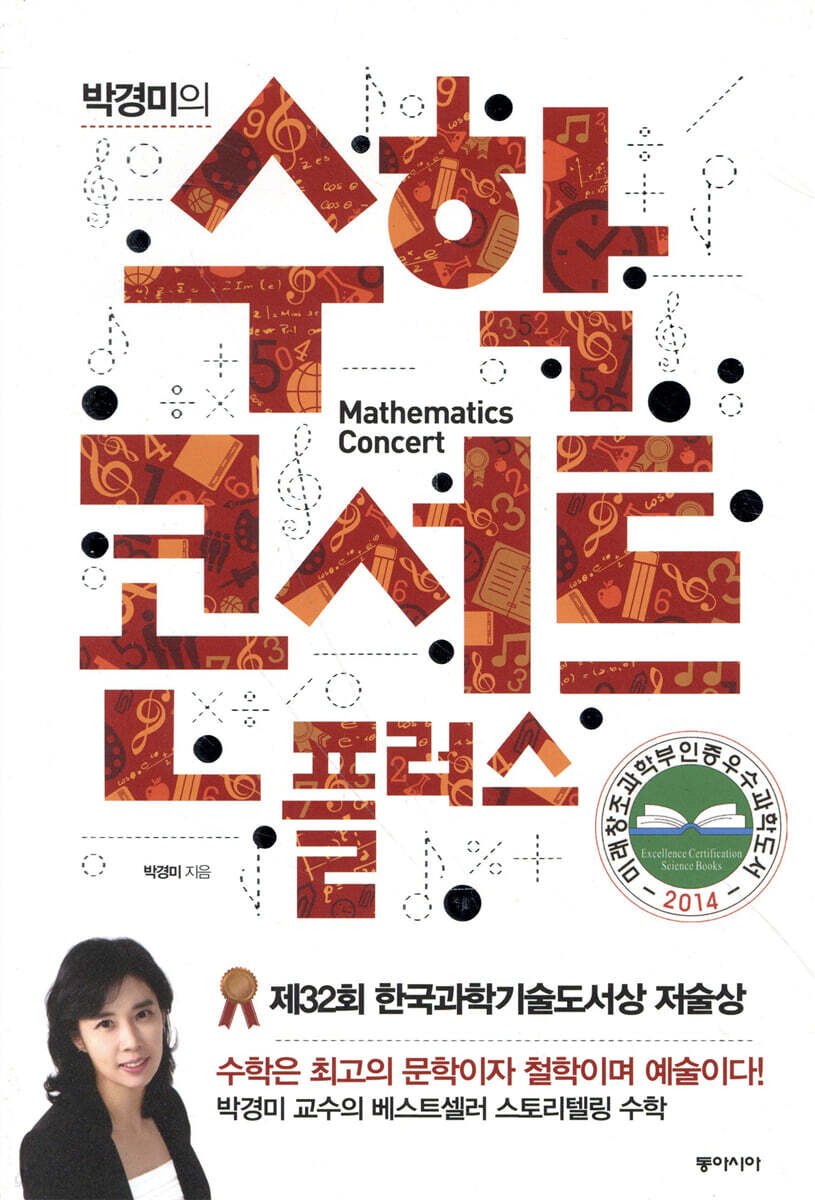
Park Kyung-mi's Math Concert Plus
 |
Description
Book Introduction
“Do you want to be good at math?”
Mathematics is the ultimate literature, philosophy, and art! Professor Park Kyung-mi's bestselling storytelling mathematics.
A must-read math textbook for all students, written by Professor Kyung-mi Park, author of the bestselling math books “Math Concert” and “Math Vitamin Plus.”
Understand advanced mathematical concepts from basic to advanced levels clearly and enjoyably according to the new math textbook.
Mathematics is the ultimate literature, philosophy, and art! Professor Park Kyung-mi's bestselling storytelling mathematics.
A must-read math textbook for all students, written by Professor Kyung-mi Park, author of the bestselling math books “Math Concert” and “Math Vitamin Plus.”
Understand advanced mathematical concepts from basic to advanced levels clearly and enjoyably according to the new math textbook.
- You can preview some of the book's contents.
Preview
index
First Movement: Mathematics is the Foundation of All Things - Concerto
1.
Treasure Chest of Mathematics _ Prime Numbers
2.
The key to open the secret door _ password
Unsolved Problems in the History of Mathematics
Second Movement: Mathematics is Intuition - Impromptu
1.
Flatland and Four-Dimensional Shapes _Dimensions
2.
Necessity within chance, coincidence within necessity _ probability
Expectations for 『Pensees』
Third Movement: Mathematics is Beautiful - Waltz
1.
A Hybrid of Mathematics and Art: Mathematics in Masterpieces
2.
Designing with Mathematics - Tiling and Quadratic Curves
Drawing Pororo with GrafEq
Movement 4: Mathematics is Simple - Etude
1.
The Fairest Mathematical Law in the World: The Law of Distribution
2.
Everything can be simplified: The secret of the greatest common divisor
3.
Barcodes Evolve _ The Secret of Barcodes
4.
Mathematical Shorthand _Matrix
How to Put an Elephant in the Refrigerator by Mathematical Subject
Fifth Movement: Mathematics is Fun - Divertimento
1.
Math is Hidden in Sports: The Math of Baseball
2.
The Evolution of the Calendar: Mathematics in the Calendar
3.
Magic World _Magic Square
Sudoku and Latin squares
6th Movement: Mathematics Evolves - Rhapsody
1.
There's another me inside me _ Fractal
2.
Finding Order in Disorder _ The Game of Life and the Game of Chaos
Apollonius Gasket painted in the desert
7th Movement: Mathematics is Harmonious - Symphony
1.
The never-ending number _Pi
2.
Extending the life of an astronomer _log
3.
Mathematics is the music of reason _ pitch theory
Crazy Math Answers
1.
Treasure Chest of Mathematics _ Prime Numbers
2.
The key to open the secret door _ password
Unsolved Problems in the History of Mathematics
Second Movement: Mathematics is Intuition - Impromptu
1.
Flatland and Four-Dimensional Shapes _Dimensions
2.
Necessity within chance, coincidence within necessity _ probability
Expectations for 『Pensees』
Third Movement: Mathematics is Beautiful - Waltz
1.
A Hybrid of Mathematics and Art: Mathematics in Masterpieces
2.
Designing with Mathematics - Tiling and Quadratic Curves
Drawing Pororo with GrafEq
Movement 4: Mathematics is Simple - Etude
1.
The Fairest Mathematical Law in the World: The Law of Distribution
2.
Everything can be simplified: The secret of the greatest common divisor
3.
Barcodes Evolve _ The Secret of Barcodes
4.
Mathematical Shorthand _Matrix
How to Put an Elephant in the Refrigerator by Mathematical Subject
Fifth Movement: Mathematics is Fun - Divertimento
1.
Math is Hidden in Sports: The Math of Baseball
2.
The Evolution of the Calendar: Mathematics in the Calendar
3.
Magic World _Magic Square
Sudoku and Latin squares
6th Movement: Mathematics Evolves - Rhapsody
1.
There's another me inside me _ Fractal
2.
Finding Order in Disorder _ The Game of Life and the Game of Chaos
Apollonius Gasket painted in the desert
7th Movement: Mathematics is Harmonious - Symphony
1.
The never-ending number _Pi
2.
Extending the life of an astronomer _log
3.
Mathematics is the music of reason _ pitch theory
Crazy Math Answers
Detailed image
.jpg)
Into the book
A representative mathematician who studied the hypothesis in earnest was British mathematician Godfrey H.
Hardy (1877-1947) and John E. Littlewood (1877-1947).
Littlewood, 1885-1977) can be cited.
Hardy and Littlewood, the most powerful mathematician duo of their time, conducted intensive research to prove the Riemann hypothesis and published their results in over 100 papers.
What they proved was that there are infinitely many zeros in the Riemann zeta function whose real part is 1/2, but it was not the Riemann hypothesis itself.
To put it metaphorically, the mountain they climbed was not the one where the Riemann hypothesis is located, but the mountain next to it.
Hardy and Littlewood were ultimately unable to prove the Riemann hypothesis, and the frustration they experienced during the proof led them to argue that the Riemann hypothesis was not true.
The Riemann hypothesis also appears in the movie A Beautiful Mind.
The film's protagonist, genius mathematician John Nash (Russell Crowe), devoted his youth to proving the Riemann hypothesis.
In the film, Nash gives a lecture on the Riemann hypothesis in 1959, the 100th anniversary of its proposition, and in this scene, Nash begins to stutter and exhibit unusual behavior.
In a later interview, Nash actually recalled that the lecture marked the beginning of his mental breakdown.
The Riemann hypothesis, which is incredibly difficult to understand, was a major factor in driving Nash into schizophrenia.
- Chapter 1: Mathematics is the Root of All Things, pages 29-30
Flatland, set in a virtual world inhabited by flat figures, is divided into two parts.
Part 1 describes the flat figures living in Flatland, and the story of their lives and institutions.
Flat figures in Flatland have emotions, think, and live in society just like humans, and their shapes are determined by gender and status.
First of all, a woman is a line segment with no area.
Because sharp lines can cause injury when they collide with other shapes, women's behavior is governed by law.
The entrances to the house are also separated by gender.
As you can see in the picture above included in this novel, men should enter through the door on the left, and women should enter through the door on the right.
Unlike women, who are represented by one-dimensional line segments, men are plane figures with area.
The lower class has an isosceles triangle, the middle class has an equilateral triangle, the professionals have a square or regular pentagon, and the nobility has a regular polygon larger than a regular hexagon, with the higher the status, the more sides it has.
At the time this novel was written, the English clergy held very high status and enjoyed excessive privileges. Since a regular polygon with many sides approaches a circle, the clergy were represented as circles.
-Math is Intuition, Part 2, pages 71-72
Voronoi diagrams are used to partition a surface to increase accessibility to specific points within the area.
For example, when determining the area under the jurisdiction of public institutions such as district offices, fire stations, and police stations, the public institutions should be located as close as possible for the convenience of local residents.
In this case, the public institution is used as the generation point and the jurisdiction of the public institution is determined using a Voronoi polygon.
Since the distance from any point inside the Voronoi polygon to the generation point is shorter than the distance from any point outside the polygon to the generation point, the distance to the public institution will be closer regardless of the location within the jurisdiction.
Of course, dividing jurisdictions in the real world is not simple.
Voronoi polygons assume a plane, but in the real world, public institutions may be located at different elevations, and rivers or mountains may exist between them.
Additionally, factors such as road networks and population distribution must be comprehensively considered.
However, when such factors are excluded, dividing the jurisdiction into Voronoi polygons is the optimal solution.
-Math is Beautiful, Part 3, pages 148-149
Melancholia's Fourth Magic Square appears in Dan Brown's novel, The Lost Symbol.
The protagonist, Robert Langdon, a professor of semiotics at Harvard University, discovers information about the pyramid's code, which dates to 1514 AD.
At first I thought 1514 AD was a reference to the year, but then I realized that AD was an abbreviation for Albrecht Durer, and 1514 refers to his work Melancholia.
Now Langdon could decipher the code by combining the alphabet he had discovered from the pyramid with Dürer's magic square of order 4.
In the 4th magic square, 1 is written in the 4th row and 4th column, so in the alphabet arrangement, it becomes J, which corresponds to the 4th row and 4th column.
Likewise, in the 4th magic square, 2 is written in the 1st row, 3rd column, so the alphabet in the same position is E.
The last number, 16, is written in the first row and first column, so the S in the corresponding position becomes the last alphabet.
When the 16 letters are arranged in this order, it becomes JEOVA SANCTUS UNUS, which means 'one true god' in Latin.
Meanwhile, the 10-digit ISBN of the 2009 American edition of 『Lost Symbol』 is 0385504225, and adding all the digits together gives 0+3+8+5+5+0+4+2+2+5=34.
The constant of the 4th magic square that provides the crucial key to deciphering the code in 『Lost Symbol』 is 34, so if it wasn't intentional, it could be considered a great coincidence.
-Math is Fun, Chapter 5, pages 257-258
Jackson Pollock (1912-1956) was an American painter who pioneered abstract expressionism.
Jackson Pollock, who created his works by dripping paint onto canvas, was nicknamed 'Jack the Dripper'.
Pollock's short life ended in a car rollover accident in 1956 at the age of 44.
As a result, his posthumous works frequently appeared after his death, sparking debates over their authenticity. Fractals play an important role in determining their authenticity.
Richard Taylor, a physics professor at the University of Oregon, and his research team analyzed Pollock's work and discovered the characteristic of fractals, where parts resemble the whole, and published this in Nature in 1999.
Calculating the fractal dimension from Pollock's painting No. 1 from 1948.
The fractal dimension of 14 is 1.45, and the fractal dimension of Blue Poles, the last work in the dripping technique from 1952, is 1.72.
That is, we can see that the fractal dimension increases over time.
In 2003, 24 works believed to be Pollock's were discovered in New York, and after examining them using fractals, they were determined to be forgeries.
Chapter 6: Mathematics Evolves, pages 298-299
What makes Euler's achievements even more remarkable is that he achieved them despite the adverse condition of blindness.
Euler lost the sight in his right eye in his twenties.
Perhaps that is why all of his portraits were painted from the left side so that his right eye could not be seen.
When he lost one eye, he said, "I see everything more clearly with one eye," so it seems that this ordeal was not a great obstacle for Euler.
Euler lost the sight of his left eye in his 60s, but he did not give in and continued his research based on his extraordinary memory.
Euler, who continued to write orally after becoming blind, is known as the most prolific mathematician in the history of mathematics.
Euler's blindness has been compared to the composer Beethoven's loss of hearing.
Beethoven's hearing, which is vital to a musician, began to decline in his 30s and he completely lost his hearing in his late 40s.
However, one of Beethoven's representative works, the 9th Choral Symphony, was composed after he lost his hearing.
I sometimes wonder if it wouldn't have been better if the situations had been reversed and Euler had lost his hearing and Beethoven had lost his sight, but Euler gained insight into the truth of mathematics in the darkness of his sightlessness, and Beethoven, thanks to his hearing loss, was able to hear a deeper inner melody resonating in the silence.
Hardy (1877-1947) and John E. Littlewood (1877-1947).
Littlewood, 1885-1977) can be cited.
Hardy and Littlewood, the most powerful mathematician duo of their time, conducted intensive research to prove the Riemann hypothesis and published their results in over 100 papers.
What they proved was that there are infinitely many zeros in the Riemann zeta function whose real part is 1/2, but it was not the Riemann hypothesis itself.
To put it metaphorically, the mountain they climbed was not the one where the Riemann hypothesis is located, but the mountain next to it.
Hardy and Littlewood were ultimately unable to prove the Riemann hypothesis, and the frustration they experienced during the proof led them to argue that the Riemann hypothesis was not true.
The Riemann hypothesis also appears in the movie A Beautiful Mind.
The film's protagonist, genius mathematician John Nash (Russell Crowe), devoted his youth to proving the Riemann hypothesis.
In the film, Nash gives a lecture on the Riemann hypothesis in 1959, the 100th anniversary of its proposition, and in this scene, Nash begins to stutter and exhibit unusual behavior.
In a later interview, Nash actually recalled that the lecture marked the beginning of his mental breakdown.
The Riemann hypothesis, which is incredibly difficult to understand, was a major factor in driving Nash into schizophrenia.
- Chapter 1: Mathematics is the Root of All Things, pages 29-30
Flatland, set in a virtual world inhabited by flat figures, is divided into two parts.
Part 1 describes the flat figures living in Flatland, and the story of their lives and institutions.
Flat figures in Flatland have emotions, think, and live in society just like humans, and their shapes are determined by gender and status.
First of all, a woman is a line segment with no area.
Because sharp lines can cause injury when they collide with other shapes, women's behavior is governed by law.
The entrances to the house are also separated by gender.
As you can see in the picture above included in this novel, men should enter through the door on the left, and women should enter through the door on the right.
Unlike women, who are represented by one-dimensional line segments, men are plane figures with area.
The lower class has an isosceles triangle, the middle class has an equilateral triangle, the professionals have a square or regular pentagon, and the nobility has a regular polygon larger than a regular hexagon, with the higher the status, the more sides it has.
At the time this novel was written, the English clergy held very high status and enjoyed excessive privileges. Since a regular polygon with many sides approaches a circle, the clergy were represented as circles.
-Math is Intuition, Part 2, pages 71-72
Voronoi diagrams are used to partition a surface to increase accessibility to specific points within the area.
For example, when determining the area under the jurisdiction of public institutions such as district offices, fire stations, and police stations, the public institutions should be located as close as possible for the convenience of local residents.
In this case, the public institution is used as the generation point and the jurisdiction of the public institution is determined using a Voronoi polygon.
Since the distance from any point inside the Voronoi polygon to the generation point is shorter than the distance from any point outside the polygon to the generation point, the distance to the public institution will be closer regardless of the location within the jurisdiction.
Of course, dividing jurisdictions in the real world is not simple.
Voronoi polygons assume a plane, but in the real world, public institutions may be located at different elevations, and rivers or mountains may exist between them.
Additionally, factors such as road networks and population distribution must be comprehensively considered.
However, when such factors are excluded, dividing the jurisdiction into Voronoi polygons is the optimal solution.
-Math is Beautiful, Part 3, pages 148-149
Melancholia's Fourth Magic Square appears in Dan Brown's novel, The Lost Symbol.
The protagonist, Robert Langdon, a professor of semiotics at Harvard University, discovers information about the pyramid's code, which dates to 1514 AD.
At first I thought 1514 AD was a reference to the year, but then I realized that AD was an abbreviation for Albrecht Durer, and 1514 refers to his work Melancholia.
Now Langdon could decipher the code by combining the alphabet he had discovered from the pyramid with Dürer's magic square of order 4.
In the 4th magic square, 1 is written in the 4th row and 4th column, so in the alphabet arrangement, it becomes J, which corresponds to the 4th row and 4th column.
Likewise, in the 4th magic square, 2 is written in the 1st row, 3rd column, so the alphabet in the same position is E.
The last number, 16, is written in the first row and first column, so the S in the corresponding position becomes the last alphabet.
When the 16 letters are arranged in this order, it becomes JEOVA SANCTUS UNUS, which means 'one true god' in Latin.
Meanwhile, the 10-digit ISBN of the 2009 American edition of 『Lost Symbol』 is 0385504225, and adding all the digits together gives 0+3+8+5+5+0+4+2+2+5=34.
The constant of the 4th magic square that provides the crucial key to deciphering the code in 『Lost Symbol』 is 34, so if it wasn't intentional, it could be considered a great coincidence.
-Math is Fun, Chapter 5, pages 257-258
Jackson Pollock (1912-1956) was an American painter who pioneered abstract expressionism.
Jackson Pollock, who created his works by dripping paint onto canvas, was nicknamed 'Jack the Dripper'.
Pollock's short life ended in a car rollover accident in 1956 at the age of 44.
As a result, his posthumous works frequently appeared after his death, sparking debates over their authenticity. Fractals play an important role in determining their authenticity.
Richard Taylor, a physics professor at the University of Oregon, and his research team analyzed Pollock's work and discovered the characteristic of fractals, where parts resemble the whole, and published this in Nature in 1999.
Calculating the fractal dimension from Pollock's painting No. 1 from 1948.
The fractal dimension of 14 is 1.45, and the fractal dimension of Blue Poles, the last work in the dripping technique from 1952, is 1.72.
That is, we can see that the fractal dimension increases over time.
In 2003, 24 works believed to be Pollock's were discovered in New York, and after examining them using fractals, they were determined to be forgeries.
Chapter 6: Mathematics Evolves, pages 298-299
What makes Euler's achievements even more remarkable is that he achieved them despite the adverse condition of blindness.
Euler lost the sight in his right eye in his twenties.
Perhaps that is why all of his portraits were painted from the left side so that his right eye could not be seen.
When he lost one eye, he said, "I see everything more clearly with one eye," so it seems that this ordeal was not a great obstacle for Euler.
Euler lost the sight of his left eye in his 60s, but he did not give in and continued his research based on his extraordinary memory.
Euler, who continued to write orally after becoming blind, is known as the most prolific mathematician in the history of mathematics.
Euler's blindness has been compared to the composer Beethoven's loss of hearing.
Beethoven's hearing, which is vital to a musician, began to decline in his 30s and he completely lost his hearing in his late 40s.
However, one of Beethoven's representative works, the 9th Choral Symphony, was composed after he lost his hearing.
I sometimes wonder if it wouldn't have been better if the situations had been reversed and Euler had lost his hearing and Beethoven had lost his sight, but Euler gained insight into the truth of mathematics in the darkness of his sightlessness, and Beethoven, thanks to his hearing loss, was able to hear a deeper inner melody resonating in the silence.
---From the text
Publisher's Review
1.
A bestseller with the highest sales as a mathematics textbook
A book that stimulates intellectual curiosity and satisfies curiosity about mathematics.
“Do you want to be good at math?”
"Park Kyung-mi's Math Concert," a bestseller and steady seller that has recorded the highest sales among general mathematics textbooks for adults, excluding books for children and young adults, has returned after seven years with a newer and richer version as "Park Kyung-mi's Math Concert Plus"! While there are many books for elementary and middle school students that explain mathematics in an easy and fun way, and there are also many specialized books on mathematics, a general mathematics textbook that is suitable and helpful for high school students and the general public with a strong interest in mathematics is rare.
This book goes beyond the superficial level of simply linking mathematics to everyday life and delves into mathematical content at a level suitable for high school students and above. It stimulates readers' intellectual desires, satisfies their curiosity, and helps them overcome their vague fear of mathematics.
"Park Kyung-mi's Math Concert Plus" introduces advanced mathematical concepts from basic to advanced levels, adding humanistic imagination and logical thinking to help students understand them more clearly and enjoyably.
Covering almost every field, including literature, science, music, art, history, society, sports, and even real-life, the book shatters the stereotype that mathematics is just one of the subjects learned only through textbooks.
To help readers understand the mathematical content, each page of the 372 pages contains a variety of tables/graphs/images/photos/illustrations in full color, allowing readers to remain engrossed in mathematics without losing interest in it throughout the book.
Also, the concept of a "concert" was incorporated to organize the content into seven movements so that even people who instinctively wave their hands when they hear the word "math" can read the book as if they were listening to music with a relaxed mind.
We introduce various websites that allow you to directly solve or try out math problems or games related to the content of the text, and we have included QR codes in the text so that you can use them with your smartphone.
You can solve fun math problems right away with your smartphone using the various QR codes included in the book.
A new curriculum will be implemented for high school mathematics starting in 2014.
According to media reports, the 2014 revised high school mathematics curriculum is characterized by a 20% reduction in content compared to the existing mathematics curriculum and a strengthened connection between mathematics units.
Mathematics is a subject that fundamentally has a lot of interconnectivity between units and subjects. If you focus only on solving problems without understanding the big picture, you may have difficulty in high school mathematics. Therefore, rather than simply memorizing formulas, you should first understand higher-level concepts and then understand the concepts that are further subdivided from them.
This book helps us understand how closely mathematics relates to us today and what its principles are, and serves as an excellent supplementary material to the new mathematics textbook.
The author, Professor Kyung-mi Park, has a great affection for the subject of 'mathematics' to the point that she calls herself an 'evangelist of mathematics' and is spreading mathematics to the general public through various activities.
In addition to teaching students as a mathematics education professor, he has written mathematics textbooks three times, including the 7th National Curriculum, the 2007 Revised Curriculum, and the 2009 Revised Curriculum. He is also active in various media outlets, including the Chosun Ilbo's Park Kyung-mi's Math Prism, Science Donga's Math Camping, Donga Ilbo's guest essayist, SBS News columnist, and YTN Science's Secrets of the World Solved with Mathematics.
He has also contributed to the popularization of mathematics through many publications, including this book, Math Vitamin Plus (Kim Young-sa), and Math Tree that Grows Thought (Random House Korea).
Professor Park Kyung-mi's love for mathematics is encapsulated in this book, "Park Kyung-mi's Math Concert Plus," which is a book that "makes people like mathematics more" and is aimed not only at students studying mathematics but also at general readers who are interested in mathematics and want to do well in mathematics.
『Park Kyung-mi's Math Concert Plus』, which makes math easy to understand through colorful full-color tables/graphs/photos/images/illustrations, etc.
2.
Professor Park Kyung-mi's best-selling storytelling mathematics
An exciting and engaging mathematical story that combines humanistic imagination and logical thinking.
Why did soccer player David Beckham wear the number 23? In Flatland, women are line segments, and men are plane figures. What is the hidden baseball mathematics in the movie Moneyball? Can mathematics be found in art? How can you become good at solving Sudoku?
The secrets of the CIA Kryptos code, Voronoi diagrams and Delaunay triangulations, the never-ending pi, the chaos game that finds order in chaos and the life game of self-replicating algorithms, the 4th magic square that appears in 『Lost Symbols』 and Melancholia, the mathematical laws hidden in music and the theory of scales… In 『Park Kyung-mi's Math Concert Plus』, where storytelling mathematics blends with various fields, the most exciting and attractive math stories that encompass humanistic imagination and logical thinking unfold in a new way.
First Movement: Mathematics is the Foundation of All Things _Concerto
Prime numbers, a treasure chest of mathematics that appears in Goldbach's numbers, Mersenne primes, and the Riemann hypothesis.
Although it is sometimes studied independently, like the central instrument of a concerto, it also leads the development of mathematics when combined with various cryptography such as anagrams, the CIA's Kryptos, and the RSA encryption.
The first movement is full of things to see, including the millennium problem, the Poincaré conjecture, and Fermat's Last Theorem.
Second Movement: Mathematics is Intuition _Impromptu
The most intuitive dimension to deal with Flatland, the fourth dimension, and hyperpolyhedra.
Probability, which deals with necessity in chance and coincidence in necessity, such as the gambler de Méret's problem, Simpson's paradox, conditional probability, and the St. Petersburg paradox.
An impromptu second movement of dimension and probability, faithful to intuition.
Third Movement: Mathematics is Beautiful _ Waltz
What if math could dance? Math isn't just a boring textbook, but can also work its magic to create diverse designs.
Discover the mathematics embedded in works of art, including Raphael's School of Athens, Leonardo da Vinci's The Last Supper, the Alhambra Palace, Seville Cathedral, Sergius' Square, and the Garden of Pythagoras.
Movement 4: Mathematics is Simple _Etude
The fourth movement, which is as simple as a study piece but shows a high level of skill in itself, covers the laws of distribution and the secrets of the greatest common divisor, the mathematics hidden in the barcodes and QR codes we encounter in our daily lives, and even the secrets of matrices discovered in the movies The Matrix and Good Will Hunting.
A new way to put an elephant in the fridge is a bonus.
Fifth Movement: Math is Fun _ Divertimento
The mathematical analysis of sports events, calendars, and magic squares is often entertaining and entertaining.
What mathematical theories lie behind baseball games and the movie "Moneyball"? A comprehensive overview of leagues, tournaments, and brackets, from the history of calendars to figuring out what day of the week you were born, let's delve into the secrets of magic squares and Sudoku puzzles.
Movement 6: Mathematics Evolves _Rhapsody
Rhapsody refers to music in the style of a fantasy.
When I look at beautiful fractal shapes, a fantasy world comes to mind.
From chaos theory, which seeks order in a chaotic world, to the self-replicating algorithm Life Game, to the mysterious and beautiful Apollonius Gasket, you can experience a freedom of mind, like listening to a rhapsody.
Movement 7: Mathematics is Harmonious _Symphony
Symphony is the largest and most magnificent of all musical genres.
Let's look at the never-ending number pi, Buffon's needle problem, logarithms that extended the life of astronomers, and the theory of musical scales that is the starting point of symphonies.
The 7th movement also features some crazy math answers that will be remembered in the history of mathematics.
A bestseller with the highest sales as a mathematics textbook
A book that stimulates intellectual curiosity and satisfies curiosity about mathematics.
“Do you want to be good at math?”
"Park Kyung-mi's Math Concert," a bestseller and steady seller that has recorded the highest sales among general mathematics textbooks for adults, excluding books for children and young adults, has returned after seven years with a newer and richer version as "Park Kyung-mi's Math Concert Plus"! While there are many books for elementary and middle school students that explain mathematics in an easy and fun way, and there are also many specialized books on mathematics, a general mathematics textbook that is suitable and helpful for high school students and the general public with a strong interest in mathematics is rare.
This book goes beyond the superficial level of simply linking mathematics to everyday life and delves into mathematical content at a level suitable for high school students and above. It stimulates readers' intellectual desires, satisfies their curiosity, and helps them overcome their vague fear of mathematics.
"Park Kyung-mi's Math Concert Plus" introduces advanced mathematical concepts from basic to advanced levels, adding humanistic imagination and logical thinking to help students understand them more clearly and enjoyably.
Covering almost every field, including literature, science, music, art, history, society, sports, and even real-life, the book shatters the stereotype that mathematics is just one of the subjects learned only through textbooks.
To help readers understand the mathematical content, each page of the 372 pages contains a variety of tables/graphs/images/photos/illustrations in full color, allowing readers to remain engrossed in mathematics without losing interest in it throughout the book.
Also, the concept of a "concert" was incorporated to organize the content into seven movements so that even people who instinctively wave their hands when they hear the word "math" can read the book as if they were listening to music with a relaxed mind.
We introduce various websites that allow you to directly solve or try out math problems or games related to the content of the text, and we have included QR codes in the text so that you can use them with your smartphone.
You can solve fun math problems right away with your smartphone using the various QR codes included in the book.
A new curriculum will be implemented for high school mathematics starting in 2014.
According to media reports, the 2014 revised high school mathematics curriculum is characterized by a 20% reduction in content compared to the existing mathematics curriculum and a strengthened connection between mathematics units.
Mathematics is a subject that fundamentally has a lot of interconnectivity between units and subjects. If you focus only on solving problems without understanding the big picture, you may have difficulty in high school mathematics. Therefore, rather than simply memorizing formulas, you should first understand higher-level concepts and then understand the concepts that are further subdivided from them.
This book helps us understand how closely mathematics relates to us today and what its principles are, and serves as an excellent supplementary material to the new mathematics textbook.
The author, Professor Kyung-mi Park, has a great affection for the subject of 'mathematics' to the point that she calls herself an 'evangelist of mathematics' and is spreading mathematics to the general public through various activities.
In addition to teaching students as a mathematics education professor, he has written mathematics textbooks three times, including the 7th National Curriculum, the 2007 Revised Curriculum, and the 2009 Revised Curriculum. He is also active in various media outlets, including the Chosun Ilbo's Park Kyung-mi's Math Prism, Science Donga's Math Camping, Donga Ilbo's guest essayist, SBS News columnist, and YTN Science's Secrets of the World Solved with Mathematics.
He has also contributed to the popularization of mathematics through many publications, including this book, Math Vitamin Plus (Kim Young-sa), and Math Tree that Grows Thought (Random House Korea).
Professor Park Kyung-mi's love for mathematics is encapsulated in this book, "Park Kyung-mi's Math Concert Plus," which is a book that "makes people like mathematics more" and is aimed not only at students studying mathematics but also at general readers who are interested in mathematics and want to do well in mathematics.
『Park Kyung-mi's Math Concert Plus』, which makes math easy to understand through colorful full-color tables/graphs/photos/images/illustrations, etc.
2.
Professor Park Kyung-mi's best-selling storytelling mathematics
An exciting and engaging mathematical story that combines humanistic imagination and logical thinking.
Why did soccer player David Beckham wear the number 23? In Flatland, women are line segments, and men are plane figures. What is the hidden baseball mathematics in the movie Moneyball? Can mathematics be found in art? How can you become good at solving Sudoku?
The secrets of the CIA Kryptos code, Voronoi diagrams and Delaunay triangulations, the never-ending pi, the chaos game that finds order in chaos and the life game of self-replicating algorithms, the 4th magic square that appears in 『Lost Symbols』 and Melancholia, the mathematical laws hidden in music and the theory of scales… In 『Park Kyung-mi's Math Concert Plus』, where storytelling mathematics blends with various fields, the most exciting and attractive math stories that encompass humanistic imagination and logical thinking unfold in a new way.
First Movement: Mathematics is the Foundation of All Things _Concerto
Prime numbers, a treasure chest of mathematics that appears in Goldbach's numbers, Mersenne primes, and the Riemann hypothesis.
Although it is sometimes studied independently, like the central instrument of a concerto, it also leads the development of mathematics when combined with various cryptography such as anagrams, the CIA's Kryptos, and the RSA encryption.
The first movement is full of things to see, including the millennium problem, the Poincaré conjecture, and Fermat's Last Theorem.
Second Movement: Mathematics is Intuition _Impromptu
The most intuitive dimension to deal with Flatland, the fourth dimension, and hyperpolyhedra.
Probability, which deals with necessity in chance and coincidence in necessity, such as the gambler de Méret's problem, Simpson's paradox, conditional probability, and the St. Petersburg paradox.
An impromptu second movement of dimension and probability, faithful to intuition.
Third Movement: Mathematics is Beautiful _ Waltz
What if math could dance? Math isn't just a boring textbook, but can also work its magic to create diverse designs.
Discover the mathematics embedded in works of art, including Raphael's School of Athens, Leonardo da Vinci's The Last Supper, the Alhambra Palace, Seville Cathedral, Sergius' Square, and the Garden of Pythagoras.
Movement 4: Mathematics is Simple _Etude
The fourth movement, which is as simple as a study piece but shows a high level of skill in itself, covers the laws of distribution and the secrets of the greatest common divisor, the mathematics hidden in the barcodes and QR codes we encounter in our daily lives, and even the secrets of matrices discovered in the movies The Matrix and Good Will Hunting.
A new way to put an elephant in the fridge is a bonus.
Fifth Movement: Math is Fun _ Divertimento
The mathematical analysis of sports events, calendars, and magic squares is often entertaining and entertaining.
What mathematical theories lie behind baseball games and the movie "Moneyball"? A comprehensive overview of leagues, tournaments, and brackets, from the history of calendars to figuring out what day of the week you were born, let's delve into the secrets of magic squares and Sudoku puzzles.
Movement 6: Mathematics Evolves _Rhapsody
Rhapsody refers to music in the style of a fantasy.
When I look at beautiful fractal shapes, a fantasy world comes to mind.
From chaos theory, which seeks order in a chaotic world, to the self-replicating algorithm Life Game, to the mysterious and beautiful Apollonius Gasket, you can experience a freedom of mind, like listening to a rhapsody.
Movement 7: Mathematics is Harmonious _Symphony
Symphony is the largest and most magnificent of all musical genres.
Let's look at the never-ending number pi, Buffon's needle problem, logarithms that extended the life of astronomers, and the theory of musical scales that is the starting point of symphonies.
The 7th movement also features some crazy math answers that will be remembered in the history of mathematics.
GOODS SPECIFICS
- Date of publication: December 12, 2013
- Page count, weight, size: 372 pages | 554g | 153*224*30mm
- ISBN13: 9788962620764
- ISBN10: 8962620766
You may also like
카테고리
korean


korean

![GQ KOREA Mark (Monthly): December [2025]](http://librairie.coreenne.fr/cdn/shop/files/8ef265dbbfbf186523ed75ba7319009d.jpg?v=1765340328&width=3840)


