

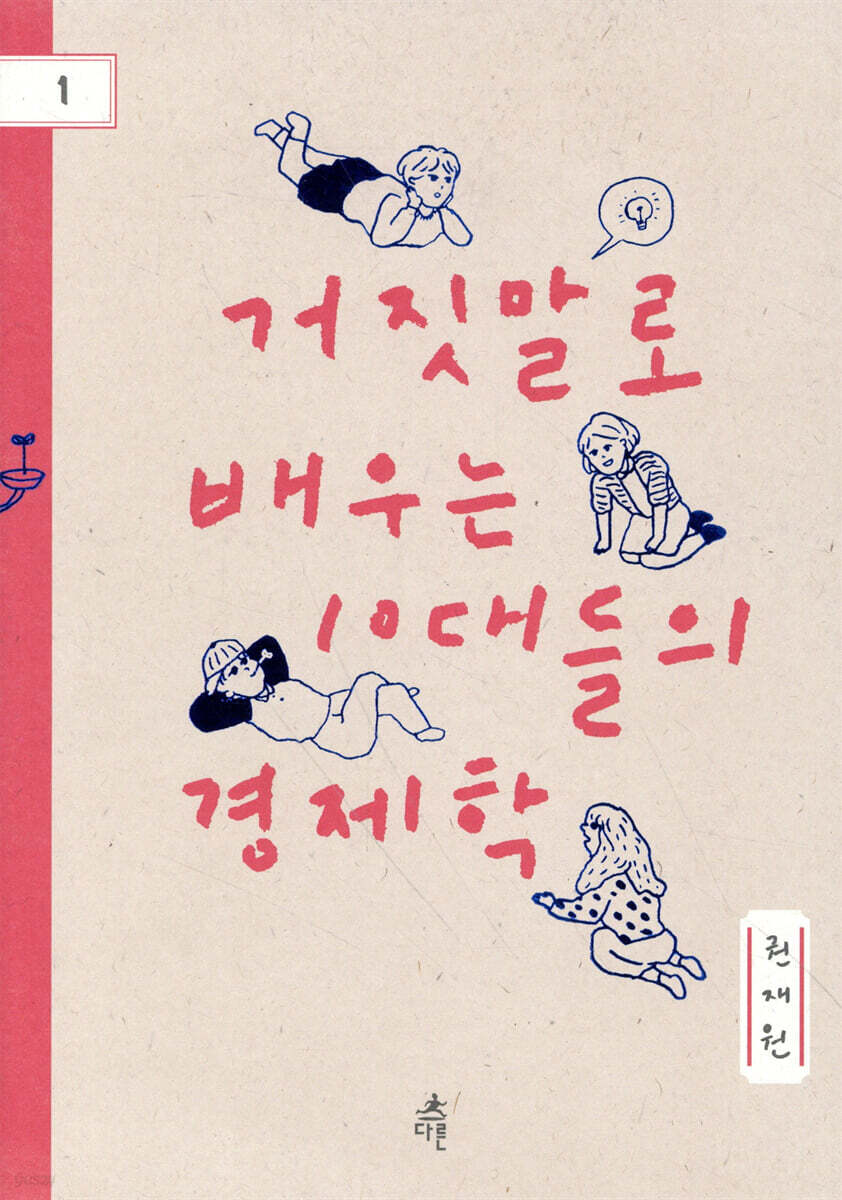
The Economics of Teenagers: What They Learn Through Lies
 |
Description
Book Introduction
“A Harvard economics professor is lying?”
A book that attempts to easily explain and refute Mankiw's '10 Principles of Economics'
『Mankiw's Economics』 is synonymous with the introductory economics textbook among college students.
Following the announcement that university aptitude tests will be strengthened starting this year, high school students are jumping into economics studies early, represented by the TESAT exam.
It is said that a famous high school has adopted 'Mankiw' as a textbook and has students memorize the '10 Principles of Economics', which is the introduction.
A current middle school social studies teacher who became aware of this situation and wrote a book titled "Economics Learned by Teenagers through Lies," which explains Mankiw's basic principles in an easy-to-understand manner and attempts to refute them.
The purpose of this book is not to teach middle and high school students the fundamentals of economics that they learn in college.
It was written with the purpose of opening our eyes to the fact that there can be various positions and interpretations on a single phenomenon before our way of thinking becomes fixed in a certain direction.
By organizing the content into 'economics lectures', 'rebuttals' to them, and voluntary 'discussions' by students, students can develop an attitude toward studying social sciences by comparing and discussing various opinions while studying economics.
The author, a practicing teacher, has spent two years reading humanities and social science books with four students. By using the names and personalities of the students as they are, the author has created a lively book that is relevant to teenagers.
A book that attempts to easily explain and refute Mankiw's '10 Principles of Economics'
『Mankiw's Economics』 is synonymous with the introductory economics textbook among college students.
Following the announcement that university aptitude tests will be strengthened starting this year, high school students are jumping into economics studies early, represented by the TESAT exam.
It is said that a famous high school has adopted 'Mankiw' as a textbook and has students memorize the '10 Principles of Economics', which is the introduction.
A current middle school social studies teacher who became aware of this situation and wrote a book titled "Economics Learned by Teenagers through Lies," which explains Mankiw's basic principles in an easy-to-understand manner and attempts to refute them.
The purpose of this book is not to teach middle and high school students the fundamentals of economics that they learn in college.
It was written with the purpose of opening our eyes to the fact that there can be various positions and interpretations on a single phenomenon before our way of thinking becomes fixed in a certain direction.
By organizing the content into 'economics lectures', 'rebuttals' to them, and voluntary 'discussions' by students, students can develop an attitude toward studying social sciences by comparing and discussing various opinions while studying economics.
The author, a practicing teacher, has spent two years reading humanities and social science books with four students. By using the names and personalities of the students as they are, the author has created a lively book that is relevant to teenagers.
- You can preview some of the book's contents.
Preview
index
Preface: Exciting, new semester
Lecture 1: Choice and the Price / Economic Dream Team Group Notes 1
Lecture 2: Opportunity Cost / Economic Dream Team Group Notes 2
Lecture 3: Economic Incentives / Economic Dream Team Group Notes 3
Lecture Four: Markets and Government/Economic Dream Team Group Notes 4
Lecture 5: Production Capacity and Living Standards / Economic Dream Team Group Notes 5
Lecture Six: Inflation and Unemployment / Economic Dream Team Group Notes 6
Cool vacation
Curriculum Linkage Table
Lecture 1: Choice and the Price / Economic Dream Team Group Notes 1
Lecture 2: Opportunity Cost / Economic Dream Team Group Notes 2
Lecture 3: Economic Incentives / Economic Dream Team Group Notes 3
Lecture Four: Markets and Government/Economic Dream Team Group Notes 4
Lecture 5: Production Capacity and Living Standards / Economic Dream Team Group Notes 5
Lecture Six: Inflation and Unemployment / Economic Dream Team Group Notes 6
Cool vacation
Curriculum Linkage Table
Into the book
Let's say Joo-hwan is explaining to Geun-jin that this car is really good because of this and that, while listing off very complicated machine names.
What cam is this and that, what throttle valve is that and that and that.
Will Geun-jin be able to discern whether Ju-hwan's words are true or not? On the contrary, Geun-jin sells health supplements to Ju-hwan, but he uses a lot of medical terminology Ju-hwan doesn't understand.
Can Joo-hwan truly assess the true value of that health food? If this happens frequently, the economic game in the marketplace will be disrupted.
That's why we need a government that judges.
--- p.97
For a market economy to thrive, we need to be able to transact with confidence not only with family and friends we see face-to-face and within our immediate community, but also with strangers from far away.
If that's the case, the scope of the community I belong to must go far beyond the family or village level.
That way, we can empathize with strangers and trust each other.
Even if people meet for the first time, if they feel a sense of kinship as Koreans, wouldn't they be able to trust and do business with each other?
In this way, the state plays a crucial role in ensuring the existence of markets and free trade.
And yet, that friend of Hankyung Economy is saying that everything is well-regulated in the market, and that the government only needs to deal with the occasional exceptions or side effects.
Let me be blunt: that's a lie.
The existence of the state is essential for the existence and maintenance of the market itself, not as an exceptional side effect.
--- p.115
If the total amount of money circulating in this classroom is ten thousand won, the price of one pencil would be one thousand won.
However, Soo-Jung, the ruler of this classroom, thought that there was too little money, so she added 10,000 won and circulated 20,000 won.
Having a lot of money might feel good right now, but it's hard to maintain a 1,000 to 1 ratio of money to pencils.
The value of money in pencils will fall, so the amount of money you have to pay to buy a pencil will increase.
That is, the price of pencils is rising.
However, if the government continues to increase the money supply, that is, the amount of money in circulation, it will be inevitable that prices will continue to rise.
In fact, since the Great Depression, most countries have steadily increased their money supply.
The money supply was increased in various ways, including by printing money, lowering interest rates, and increasing spending beyond the amount of taxes collected.
So, the primary cause of inflation today must be seen as the government increasing money too much.
--- p.165
If humans were rational beings who make limited choices, as Mankiw said, this wouldn't work, but in reality, most people are mood-conscious.
In particular, they are much more sensitive to the decrease in what they have than to the increase in what they have.
If wages are raised by 2 percent when prices rise by 4 percent, it's easy to mistakenly believe that income has increased.
So, consumption is not reduced either.
But if you try to cut their wages by even 1%, they get really angry and if you insist on cutting them, they'll end up cutting back on their spending.
So, the market will shrink? Okay, let's summarize.
It is a well-known fact that when the government releases money, inflation occurs.
But there are so many different reasons why the government is spending money.
Depending on the reason, it becomes clear who is at an advantage and who is at a disadvantage.
What cam is this and that, what throttle valve is that and that and that.
Will Geun-jin be able to discern whether Ju-hwan's words are true or not? On the contrary, Geun-jin sells health supplements to Ju-hwan, but he uses a lot of medical terminology Ju-hwan doesn't understand.
Can Joo-hwan truly assess the true value of that health food? If this happens frequently, the economic game in the marketplace will be disrupted.
That's why we need a government that judges.
--- p.97
For a market economy to thrive, we need to be able to transact with confidence not only with family and friends we see face-to-face and within our immediate community, but also with strangers from far away.
If that's the case, the scope of the community I belong to must go far beyond the family or village level.
That way, we can empathize with strangers and trust each other.
Even if people meet for the first time, if they feel a sense of kinship as Koreans, wouldn't they be able to trust and do business with each other?
In this way, the state plays a crucial role in ensuring the existence of markets and free trade.
And yet, that friend of Hankyung Economy is saying that everything is well-regulated in the market, and that the government only needs to deal with the occasional exceptions or side effects.
Let me be blunt: that's a lie.
The existence of the state is essential for the existence and maintenance of the market itself, not as an exceptional side effect.
--- p.115
If the total amount of money circulating in this classroom is ten thousand won, the price of one pencil would be one thousand won.
However, Soo-Jung, the ruler of this classroom, thought that there was too little money, so she added 10,000 won and circulated 20,000 won.
Having a lot of money might feel good right now, but it's hard to maintain a 1,000 to 1 ratio of money to pencils.
The value of money in pencils will fall, so the amount of money you have to pay to buy a pencil will increase.
That is, the price of pencils is rising.
However, if the government continues to increase the money supply, that is, the amount of money in circulation, it will be inevitable that prices will continue to rise.
In fact, since the Great Depression, most countries have steadily increased their money supply.
The money supply was increased in various ways, including by printing money, lowering interest rates, and increasing spending beyond the amount of taxes collected.
So, the primary cause of inflation today must be seen as the government increasing money too much.
--- p.165
If humans were rational beings who make limited choices, as Mankiw said, this wouldn't work, but in reality, most people are mood-conscious.
In particular, they are much more sensitive to the decrease in what they have than to the increase in what they have.
If wages are raised by 2 percent when prices rise by 4 percent, it's easy to mistakenly believe that income has increased.
So, consumption is not reduced either.
But if you try to cut their wages by even 1%, they get really angry and if you insist on cutting them, they'll end up cutting back on their spending.
So, the market will shrink? Okay, let's summarize.
It is a well-known fact that when the government releases money, inflation occurs.
But there are so many different reasons why the government is spending money.
Depending on the reason, it becomes clear who is at an advantage and who is at a disadvantage.
--- p.175
Publisher's Review
Let's study economics like this!
▶▶ A New Economics Textbook: An Alternative Study Method for Proper Economic Education
The 2009 revised curriculum will be implemented sequentially starting in 2013.
In line with the 2014 high school curriculum reform, the Ministry of Education, Science and Technology and the Ministry of Finance have formed the 'Economic Education Activation Task Force (TF)' and are preparing to open 'Integrated Social Studies' and 'Practical Economics' subjects, taking into account factors such as the admissions officer selection process for business schools.
Regarding economic education in the current curriculum, there is a well-known debate in academia and the media surrounding the "Next Generation High School Economics Textbook Model," jointly published by the Ministry of Education and the Federation of Korean Industries in 2007.
When the textbook's biased description of the "market economy" and "corporations" was criticized and a new model for economics textbooks was proposed, so-called progressive economists once again counter-criticized it.
In German social studies education, it is said that there is an agreement among educators on the principle that 'what is controversial in academics and politics should also be controversial in school classes.'
As the fact that such debates are taking place surrounding our economics textbooks reveals, 'economics', unlike natural sciences such as mathematics and physics, contains a significant amount of ideological elements.
Forcing young students to advocate for one ideological element or blindly memorize difficult economic theories without properly understanding such elements is far from proper economic education.
In that respect, 『Economics for Teenagers: Learning Through Lies』 proposes studying economics through debate and discussion.
▶▶ A note format that organizes lectures and counterarguments, and even discussion notes with friends
The main characters of this book are Geun-jin, a third-year student at K Middle School, a school for gifted economic students, and Geun-jin's friends Ju-hwan, Eun-ji, and Su-jeong.
Each of your children has a unique personality and actively participates in Professor Han Kyung-je's lectures.
Professor Han Kyung-je is a famous professor who travels around the country giving special lectures on economics. At K Middle School, he lectures for one semester on the '10 Basic Principles of Economics' from the introduction to 'Mankiw's Economics'.
However, Ma Gyeong-je, Geun-jin's uncle and also an economics professor, raises objections to the lecture content that Geun-jin encountered.
Then, an argument breaks out between the two professors without the parties knowing about it.
Children listen to the explanations of the two professors alternately, naturally understand and compare their different opinions, and actively confirm and improve their understanding through discussions with their friends.
I think what we learned in economics class was about the principles of the market.
It does not describe the actual market.
The market isn't perfect, after all, but it doesn't operate in such an outrageous manner without any interference or oversight, right? It's surprisingly rare for people to rip you off or anything like that, and if you go to a restaurant, don't they all have similar prices, as if they had a prearranged arrangement? That's what I'm talking about.
-Eunji-
But my uncle says that the very idea of a free market is a fiction.
Honestly, aren't you completely laughing at what the professor said? You're saying there's never been a market like that in history, and there can never be one.
And then he sends this weird message? Economists often tend to overinterpret conditional clauses like "if" as assertions like "is" or even as demands like "should"? I have absolutely no idea what that means.
Can someone explain it to me so I can understand? -Geunjin-
Author Kwon Jae-won, who has taught social studies to middle school students for over 20 years, uses his experience to explain difficult economic theories with easy and fun examples.
▶'The opportunity cost of giving up my smartphone and choosing to study for exams is too high compared to the benefits, so I can't accept it' (opportunity cost), ▶'You never buy a bowl of tteokbokki when you're with guys, right? But when you're with girls, you suddenly start spending money like a millionaire?' (A choice that runs counter to economic incentives), ▶'You always go to the supermarket and buy ice cream whenever you have time.
That being said, why would you trust the store owner to pay you money? (The government regulates economic activity).
Also, the image of Geunjin actively exchanging opinions with his uncle through KakaoTalk messages and emails on his iPad shows the lives and emotions of teenagers these days.
After a refreshing yet confusing economics lecture, Geunjin asks his uncle.
What on earth do we learn in economics class?
The uncle's answer to Geunjin's question is impressive.
(…) I just didn't like how one professor's argument sounded like humans could calculate cost-benefit ratios like a perfect calculator.
A good attitude toward life is to make choices based on rational judgment, without being swayed by emotions or instincts.
But that doesn't mean we should deny the emotions and instincts that we inevitably have.
We must not be overconfident in our rational calculation ability.
Considering these few things, I agree that humans should strive to live by reducing opportunity costs rather than living as best they can under given conditions.
And economics is the discipline that seeks to find just that method, that is, a method of rational choice.
On a small scale, on an individual level, and on a large scale, on a social and community level.
Do you understand what I'm saying?
“Honestly, I don’t really know what you mean.
But at least I understand that it's wrong to call someone who doesn't hesitate to use any means necessary to make money an economics expert or an economics doctor."
“It is precisely this idea that brings Professor Han and I together.” _ From “Cool Vacation,” page 197
This economics book is recommended for students who want to build a solid foundation in economics, and for confident teenagers who want to understand what truly matters to them in their future economic lives.
Different me, different knowledge, different youth culture
Another publishing company is introducing a new series called “Another Youth Culture.”
This is a series of educational books for young people who dream of a different self and different knowledge.
We aim to foster "open learning," where people with different perspectives can come together to create new knowledge, and we plan to cover a variety of topics in the humanities and social sciences.
▶▶ A New Economics Textbook: An Alternative Study Method for Proper Economic Education
The 2009 revised curriculum will be implemented sequentially starting in 2013.
In line with the 2014 high school curriculum reform, the Ministry of Education, Science and Technology and the Ministry of Finance have formed the 'Economic Education Activation Task Force (TF)' and are preparing to open 'Integrated Social Studies' and 'Practical Economics' subjects, taking into account factors such as the admissions officer selection process for business schools.
Regarding economic education in the current curriculum, there is a well-known debate in academia and the media surrounding the "Next Generation High School Economics Textbook Model," jointly published by the Ministry of Education and the Federation of Korean Industries in 2007.
When the textbook's biased description of the "market economy" and "corporations" was criticized and a new model for economics textbooks was proposed, so-called progressive economists once again counter-criticized it.
In German social studies education, it is said that there is an agreement among educators on the principle that 'what is controversial in academics and politics should also be controversial in school classes.'
As the fact that such debates are taking place surrounding our economics textbooks reveals, 'economics', unlike natural sciences such as mathematics and physics, contains a significant amount of ideological elements.
Forcing young students to advocate for one ideological element or blindly memorize difficult economic theories without properly understanding such elements is far from proper economic education.
In that respect, 『Economics for Teenagers: Learning Through Lies』 proposes studying economics through debate and discussion.
▶▶ A note format that organizes lectures and counterarguments, and even discussion notes with friends
The main characters of this book are Geun-jin, a third-year student at K Middle School, a school for gifted economic students, and Geun-jin's friends Ju-hwan, Eun-ji, and Su-jeong.
Each of your children has a unique personality and actively participates in Professor Han Kyung-je's lectures.
Professor Han Kyung-je is a famous professor who travels around the country giving special lectures on economics. At K Middle School, he lectures for one semester on the '10 Basic Principles of Economics' from the introduction to 'Mankiw's Economics'.
However, Ma Gyeong-je, Geun-jin's uncle and also an economics professor, raises objections to the lecture content that Geun-jin encountered.
Then, an argument breaks out between the two professors without the parties knowing about it.
Children listen to the explanations of the two professors alternately, naturally understand and compare their different opinions, and actively confirm and improve their understanding through discussions with their friends.
I think what we learned in economics class was about the principles of the market.
It does not describe the actual market.
The market isn't perfect, after all, but it doesn't operate in such an outrageous manner without any interference or oversight, right? It's surprisingly rare for people to rip you off or anything like that, and if you go to a restaurant, don't they all have similar prices, as if they had a prearranged arrangement? That's what I'm talking about.
-Eunji-
But my uncle says that the very idea of a free market is a fiction.
Honestly, aren't you completely laughing at what the professor said? You're saying there's never been a market like that in history, and there can never be one.
And then he sends this weird message? Economists often tend to overinterpret conditional clauses like "if" as assertions like "is" or even as demands like "should"? I have absolutely no idea what that means.
Can someone explain it to me so I can understand? -Geunjin-
Author Kwon Jae-won, who has taught social studies to middle school students for over 20 years, uses his experience to explain difficult economic theories with easy and fun examples.
▶'The opportunity cost of giving up my smartphone and choosing to study for exams is too high compared to the benefits, so I can't accept it' (opportunity cost), ▶'You never buy a bowl of tteokbokki when you're with guys, right? But when you're with girls, you suddenly start spending money like a millionaire?' (A choice that runs counter to economic incentives), ▶'You always go to the supermarket and buy ice cream whenever you have time.
That being said, why would you trust the store owner to pay you money? (The government regulates economic activity).
Also, the image of Geunjin actively exchanging opinions with his uncle through KakaoTalk messages and emails on his iPad shows the lives and emotions of teenagers these days.
After a refreshing yet confusing economics lecture, Geunjin asks his uncle.
What on earth do we learn in economics class?
The uncle's answer to Geunjin's question is impressive.
(…) I just didn't like how one professor's argument sounded like humans could calculate cost-benefit ratios like a perfect calculator.
A good attitude toward life is to make choices based on rational judgment, without being swayed by emotions or instincts.
But that doesn't mean we should deny the emotions and instincts that we inevitably have.
We must not be overconfident in our rational calculation ability.
Considering these few things, I agree that humans should strive to live by reducing opportunity costs rather than living as best they can under given conditions.
And economics is the discipline that seeks to find just that method, that is, a method of rational choice.
On a small scale, on an individual level, and on a large scale, on a social and community level.
Do you understand what I'm saying?
“Honestly, I don’t really know what you mean.
But at least I understand that it's wrong to call someone who doesn't hesitate to use any means necessary to make money an economics expert or an economics doctor."
“It is precisely this idea that brings Professor Han and I together.” _ From “Cool Vacation,” page 197
This economics book is recommended for students who want to build a solid foundation in economics, and for confident teenagers who want to understand what truly matters to them in their future economic lives.
Different me, different knowledge, different youth culture
Another publishing company is introducing a new series called “Another Youth Culture.”
This is a series of educational books for young people who dream of a different self and different knowledge.
We aim to foster "open learning," where people with different perspectives can come together to create new knowledge, and we plan to cover a variety of topics in the humanities and social sciences.
GOODS SPECIFICS
- Date of issue: January 25, 2013
- Page count, weight, size: 200 pages | 280g | 150*210*20mm
- ISBN13: 9788992711883
- ISBN10: 8992711883
You may also like
카테고리
korean


korean

![GQ KOREA Mark (Monthly): December [2025]](http://librairie.coreenne.fr/cdn/shop/files/8ef265dbbfbf186523ed75ba7319009d.jpg?v=1765340328&width=3840)


