

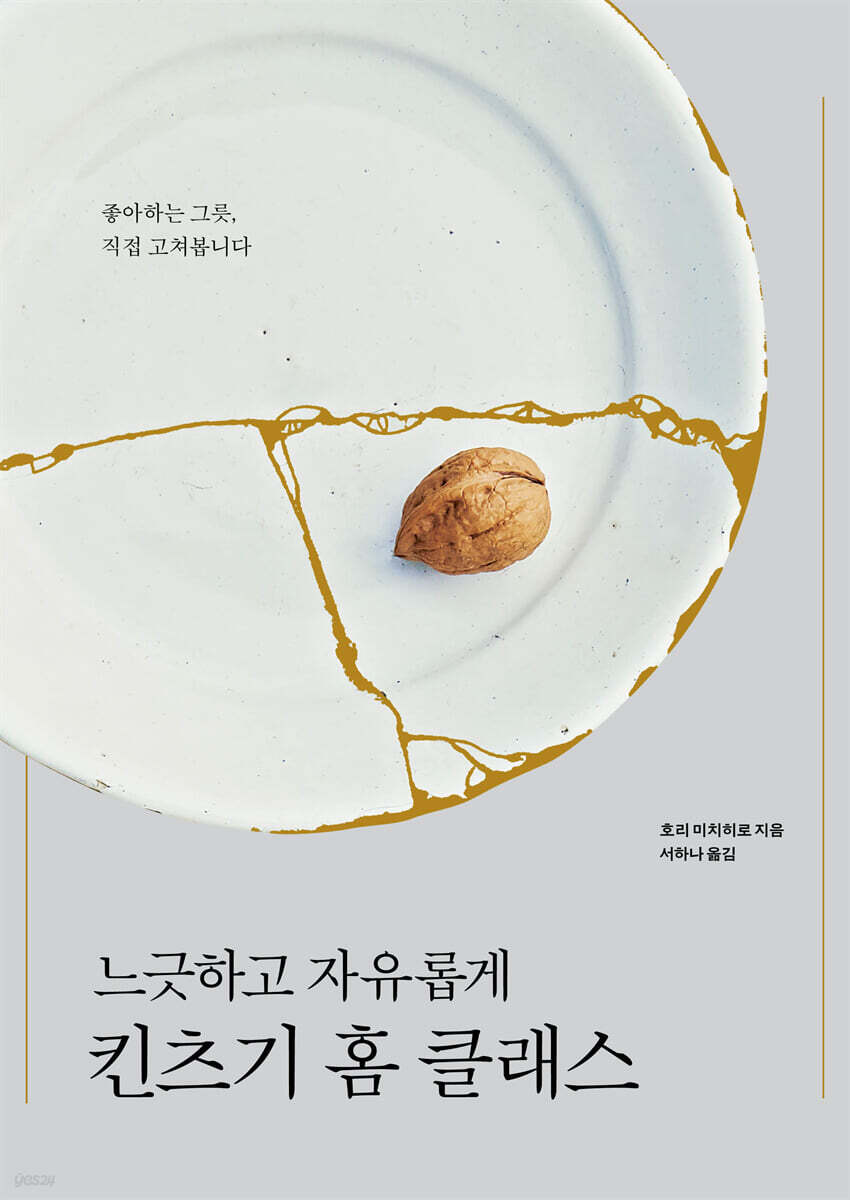
Kintsugi Home Class: Relaxing and Free
 |
Description
Book Introduction
Haven't you ever been upset because your favorite dish broke?
Introducing the four 'best' ways to repair dishes.
Kintsugi (金? ぎ) is a traditional Japanese craft technique for repairing chipped, cracked, or broken pottery.
In the past, it was a craftsman's skill, but with the recent climate crisis and growing interest in upcycling, more and more people in Japan and Korea are taking on the challenge of repairing dishes themselves.
This book, "Kintsugi Home Class: Relaxing and Free," is a practical guide that teaches kintsugi methods that can be done at home using lacquer, from beginners to intermediate users.
This book introduces four 'best' ones.
① The 'most' traditional method using natural lacquer, ② The 'most' harmless method to the body as it does not use organic solvents such as thinner or benzene, ③ The 'most' simplified method that is fun and easy to understand, and ④ The 'least' cost-effective method as the purpose is repair.
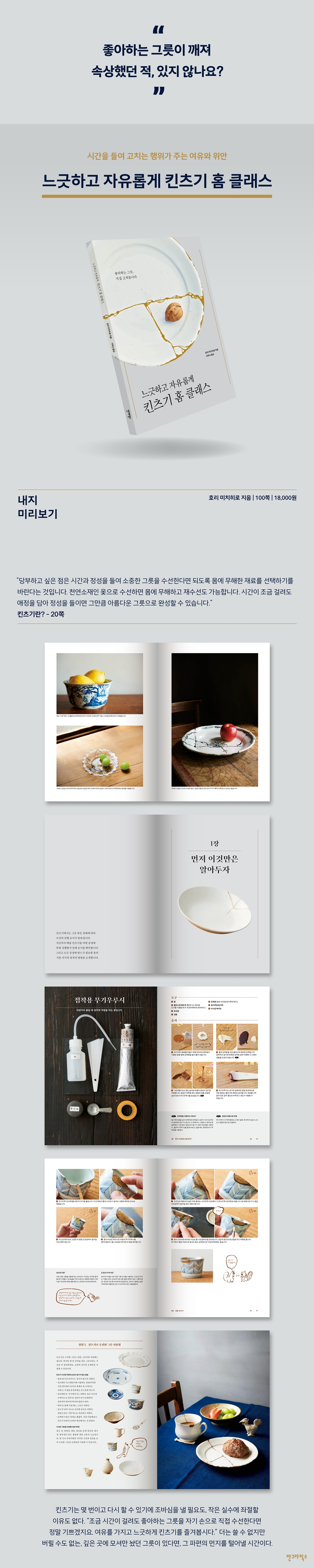
The detailed process photos, which make it seem like you're watching a craftsman at work, and the illustrated explanations that fully utilize the author's characteristics as a cartoonist are also useful.
The squirrels 'Kkaerami' and 'Geumjji' serve as guides in this book, pointing out important points during the work.
Above all, what author Michihiro Hori repeatedly emphasizes is to be ‘relaxed and free.’
Since Kintsugi can be done over and over again, there is no need to be impatient or frustrated by small mistakes.
“It would be really nice to repair your favorite dishes with your own hands, even if it takes a little time.
Let's take our time and enjoy Kintsugi leisurely." If you have a vessel that is no longer usable but cannot be thrown away, and so has been kept in a deep place, it is time to dust off the fragments.
Introducing the four 'best' ways to repair dishes.
Kintsugi (金? ぎ) is a traditional Japanese craft technique for repairing chipped, cracked, or broken pottery.
In the past, it was a craftsman's skill, but with the recent climate crisis and growing interest in upcycling, more and more people in Japan and Korea are taking on the challenge of repairing dishes themselves.
This book, "Kintsugi Home Class: Relaxing and Free," is a practical guide that teaches kintsugi methods that can be done at home using lacquer, from beginners to intermediate users.
This book introduces four 'best' ones.
① The 'most' traditional method using natural lacquer, ② The 'most' harmless method to the body as it does not use organic solvents such as thinner or benzene, ③ The 'most' simplified method that is fun and easy to understand, and ④ The 'least' cost-effective method as the purpose is repair.
The detailed process photos, which make it seem like you're watching a craftsman at work, and the illustrated explanations that fully utilize the author's characteristics as a cartoonist are also useful.
The squirrels 'Kkaerami' and 'Geumjji' serve as guides in this book, pointing out important points during the work.
Above all, what author Michihiro Hori repeatedly emphasizes is to be ‘relaxed and free.’
Since Kintsugi can be done over and over again, there is no need to be impatient or frustrated by small mistakes.
“It would be really nice to repair your favorite dishes with your own hands, even if it takes a little time.
Let's take our time and enjoy Kintsugi leisurely." If you have a vessel that is no longer usable but cannot be thrown away, and so has been kept in a deep place, it is time to dust off the fragments.
- You can preview some of the book's contents.
Preview
index
To begin with
How to use this book
Chapter 1: First, let's just know this.
I can fix this kind of bowl
What is Kintsugi?
Preprocessing
Adhesive inorganic urushi
Sabiurushi for filling holes
Column 1.
About poison ivy allergies
Chapter 2: The Basics of Kintsugi
broken bowl
A bowl with a chip
Column 2.
Tool care and usage
A bowl with gold or silver in it
scratches
Chapter 3: Finishing Kintsugi
Sprinkle gold dust
Column 3.
Types of gold powder
Sprinkling silver powder, suzu powder, and new autumn powder
Column 4.
About metal powder
Chapter 4: Applied Kintsugi
How to repair a shackle joint
Yobitsuki repair method
Glass Kintsugi Repair Method
reinforcement
Yakitsugi repair method
Column 5.
How to Use Kintsugi-Repaired Bowls
List of stores specializing in Kintsugi ingredients
Q&A
Americas
How to use this book
Chapter 1: First, let's just know this.
I can fix this kind of bowl
What is Kintsugi?
Preprocessing
Adhesive inorganic urushi
Sabiurushi for filling holes
Column 1.
About poison ivy allergies
Chapter 2: The Basics of Kintsugi
broken bowl
A bowl with a chip
Column 2.
Tool care and usage
A bowl with gold or silver in it
scratches
Chapter 3: Finishing Kintsugi
Sprinkle gold dust
Column 3.
Types of gold powder
Sprinkling silver powder, suzu powder, and new autumn powder
Column 4.
About metal powder
Chapter 4: Applied Kintsugi
How to repair a shackle joint
Yobitsuki repair method
Glass Kintsugi Repair Method
reinforcement
Yakitsugi repair method
Column 5.
How to Use Kintsugi-Repaired Bowls
List of stores specializing in Kintsugi ingredients
Q&A
Americas
Detailed image
Into the book
One thing I would like to emphasize is that if you are going to spend time and effort repairing your precious dishes, I hope you will choose materials that are as harmless to your body as possible.
If you repair it with lacquer, a natural material, it is harmless to the body and can be repaired again.
Even if it takes a little time, if you put in the love and care, you can complete it into a beautiful bowl.
---From "What is Kintsugi?"
If a crack squeaks when pressure is applied to the cracked area, repair it.
If you don't hear that sound, there's no need to repair it.
---From "Cracked and Broken Vessels"
Each metal powder, such as silver powder, silver powder, and silver powder, has different characteristics and luster than gold powder.
Kintsugi can be enjoyed in a wider range of ways by using it according to the design, atmosphere, taste, and purpose of the bowl.
---「Column 4.
From “About Metal Powder”
Lacquer is an excellent natural polymer paint that is resistant to acids, alkalis, salts, alcohol, etc., is water-resistant, and has antiseptic properties.
With just a few precautions, you can ensure that your carefully crafted dishes will last for a long time.
---From "How to Use Kintsugi-Repaired Dishes"
Glass does not generally go well with lacquer, so it is recommended for intermediate users.
If you repair it with lacquer, a natural material, it is harmless to the body and can be repaired again.
Even if it takes a little time, if you put in the love and care, you can complete it into a beautiful bowl.
---From "What is Kintsugi?"
If a crack squeaks when pressure is applied to the cracked area, repair it.
If you don't hear that sound, there's no need to repair it.
---From "Cracked and Broken Vessels"
Each metal powder, such as silver powder, silver powder, and silver powder, has different characteristics and luster than gold powder.
Kintsugi can be enjoyed in a wider range of ways by using it according to the design, atmosphere, taste, and purpose of the bowl.
---「Column 4.
From “About Metal Powder”
Lacquer is an excellent natural polymer paint that is resistant to acids, alkalis, salts, alcohol, etc., is water-resistant, and has antiseptic properties.
With just a few precautions, you can ensure that your carefully crafted dishes will last for a long time.
---From "How to Use Kintsugi-Repaired Dishes"
Glass does not generally go well with lacquer, so it is recommended for intermediate users.
---From "Q&A"
Publisher's Review
A non-hazardous repair method using natural lacquer
The leisure and comfort that comes from taking the time to fix things
Everyone has probably broken a dish or glass at least once.
Unfortunately, the more you like a dish, the more likely it is to get scratched because you use it often.
If you actually break a favorite bowl and learn kintsugi, you will find that more people than you would expect will bring you the ones they broke to practice with.
A glass cup you received as a travel gift, a ceramic box you made yourself, a new plate that was damaged in shipping but you couldn't return because it was too much of a hassle... everyone has a story.
The editor, having learned simple kintsugi, wanted to learn honkintsugi, so he planned the Korean version of this book, “Leisurely and Freely Kintsugi Home Class.”
Honkintsugi and simple kintsugi are terms that broadly classify kintsugi.
Honkintsugi is a traditional technique that uses natural lacquer in all processes from bonding to finishing, while kintsugi is a modern technique that uses synthetic resin (putty) or adhesive to bond and finish with synthetic or natural lacquer.
It is relatively easy and quick, but it is true that after repairing it, you may feel anxious about whether you can put food in it.
However, the dishes repaired with Honkintsugi are harmless enough to be used as everyday tableware because they use lacquer, a natural material.
This book is a good compromise between tradition and modernity, as it follows the tradition while also providing the 'most' simplified method based on the Honkintsugi.
The translator also learned Honkintsugi, which helped improve the accuracy of the translation.
Because it was a Japanese book, the design of the interior was completely redesigned, and the cover design was an opportunity to make optimal use of gold leaf post-processing.
Kintsugi “has the meaning of affirming the imperfect beauty of vessels that still bear the traces of accidental events, along with the intention of not carelessly throwing away broken objects but reusing them.” (Wabi-Sabi: Just Like This, Angraphics, 2022) This background may feel grandiose or like an excessive imposition of meaning.
The saying, “Healing the wounds of the heart by mending the bowl” may not resonate with you yet.
But if you try repairing dishes yourself, you will experience the comfort that comes from knowing that you can fix something and use it again.
The leisure and comfort that comes from taking the time to fix things
Everyone has probably broken a dish or glass at least once.
Unfortunately, the more you like a dish, the more likely it is to get scratched because you use it often.
If you actually break a favorite bowl and learn kintsugi, you will find that more people than you would expect will bring you the ones they broke to practice with.
A glass cup you received as a travel gift, a ceramic box you made yourself, a new plate that was damaged in shipping but you couldn't return because it was too much of a hassle... everyone has a story.
The editor, having learned simple kintsugi, wanted to learn honkintsugi, so he planned the Korean version of this book, “Leisurely and Freely Kintsugi Home Class.”
Honkintsugi and simple kintsugi are terms that broadly classify kintsugi.
Honkintsugi is a traditional technique that uses natural lacquer in all processes from bonding to finishing, while kintsugi is a modern technique that uses synthetic resin (putty) or adhesive to bond and finish with synthetic or natural lacquer.
It is relatively easy and quick, but it is true that after repairing it, you may feel anxious about whether you can put food in it.
However, the dishes repaired with Honkintsugi are harmless enough to be used as everyday tableware because they use lacquer, a natural material.
This book is a good compromise between tradition and modernity, as it follows the tradition while also providing the 'most' simplified method based on the Honkintsugi.
The translator also learned Honkintsugi, which helped improve the accuracy of the translation.
Because it was a Japanese book, the design of the interior was completely redesigned, and the cover design was an opportunity to make optimal use of gold leaf post-processing.
Kintsugi “has the meaning of affirming the imperfect beauty of vessels that still bear the traces of accidental events, along with the intention of not carelessly throwing away broken objects but reusing them.” (Wabi-Sabi: Just Like This, Angraphics, 2022) This background may feel grandiose or like an excessive imposition of meaning.
The saying, “Healing the wounds of the heart by mending the bowl” may not resonate with you yet.
But if you try repairing dishes yourself, you will experience the comfort that comes from knowing that you can fix something and use it again.
GOODS SPECIFICS
- Date of issue: August 31, 2022
- Page count, weight, size: 100 pages | 382g | 180*257*9mm
- ISBN13: 9791168230156
You may also like
카테고리
korean


korean

![GQ KOREA Mark (Monthly): December [2025]](http://librairie.coreenne.fr/cdn/shop/files/8ef265dbbfbf186523ed75ba7319009d.jpg?v=1765340328&width=3840)


