

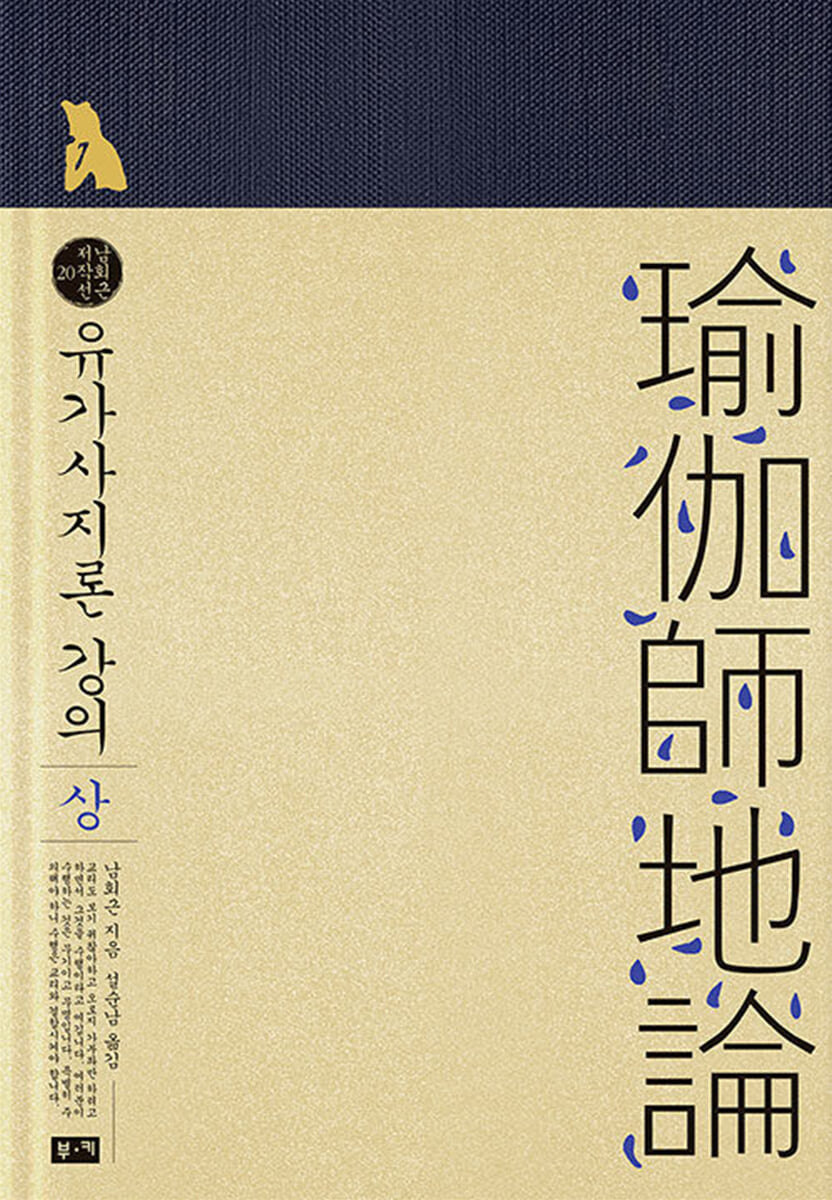
Lecture on the theory of yoga (Part 1)
 |
Description
Book Introduction
In learning, practicing and keeping the law,
The most basic is the highest and deepest
Listen to the right teachings, think about them, and practice them diligently.
『Yogasajiron』 is a comprehensive treatise on Yogacara, consisting of 100 volumes.
This book is a compilation of various Mahayana and Hinayana practice methods, practice stages, and the process of attaining samadhi and achieving perfection, collected and classified from various sutras.
This lecture guides both monastics and laypeople on the path of proper practice by interpreting the sutra of the "Yogasajiron" that explains the principles of practice.
It serves as a guide using the scriptures as a map.
The author encourages practitioners to deal with the various difficulties they encounter along the way, and motivates them to know where they stand and move forward.
The book vividly and broadly discusses the author's own practice experiences, cases from those around him, and examples from each sect, revealing the true principles of practice.
It examines everything from the conditions a practitioner must have to practice, such as where they should live, how much they should eat, what posture they should have, and what temperament and affinity they must have to practice, to how to recognize and break free from wrong thoughts that cause problems in practice.
Through this, it becomes clear why one cannot achieve concentration through practice, how one should cultivate concentration, why one must cultivate concentration in order to obtain wisdom, what obstacles bind the mind and how to escape them, and how the doctrine is related to practice.
There are many different methods of practice, including breathing, chanting, meditation on the topic of the topic, and contemplation, but there is one thing that is emphasized.
Putting the teachings into practice through continuous practice.
This is the basics.
The most basic is the highest and deepest
Listen to the right teachings, think about them, and practice them diligently.
『Yogasajiron』 is a comprehensive treatise on Yogacara, consisting of 100 volumes.
This book is a compilation of various Mahayana and Hinayana practice methods, practice stages, and the process of attaining samadhi and achieving perfection, collected and classified from various sutras.
This lecture guides both monastics and laypeople on the path of proper practice by interpreting the sutra of the "Yogasajiron" that explains the principles of practice.
It serves as a guide using the scriptures as a map.
The author encourages practitioners to deal with the various difficulties they encounter along the way, and motivates them to know where they stand and move forward.
The book vividly and broadly discusses the author's own practice experiences, cases from those around him, and examples from each sect, revealing the true principles of practice.
It examines everything from the conditions a practitioner must have to practice, such as where they should live, how much they should eat, what posture they should have, and what temperament and affinity they must have to practice, to how to recognize and break free from wrong thoughts that cause problems in practice.
Through this, it becomes clear why one cannot achieve concentration through practice, how one should cultivate concentration, why one must cultivate concentration in order to obtain wisdom, what obstacles bind the mind and how to escape them, and how the doctrine is related to practice.
There are many different methods of practice, including breathing, chanting, meditation on the topic of the topic, and contemplation, but there is one thing that is emphasized.
Putting the teachings into practice through continuous practice.
This is the basics.
index
Translator's Note | Publication Description | Structure and Contents of the "Yogasajiron"
Lecture 1
On the 『Yogasa-saji-ron』|Yogasa and the Five Masters|[Volume 20, The Division of the Origin and the Place of Cultivation for Achievement in the Middle, Part 12] Why can’t one achieve jeong even if one practices?|The mistake of having no companion, no bright teacher, and a lack of mind|The mistake of only listening, wanting respect, and not knowing what is enough|The mistake of being busy with useless things and being lazy|The mistake of nitpicking, losing one’s temper, and not paying attention|The mistake of eating carelessly, sleeping too much, and not guarding the six faculties|The mistake of not knowing the method of practicing jigwan and causing it|It is because one does not know the method and one’s practice is lax or wrong|If evil karma is heavy, one cannot achieve jeong|[Volume 21, The Division of the Origin and the Place of Cultivation in the Middle, Part 13, The Place of Cultivation for Achievement in the Middle, Part 1] What is called sravaka-saji|What is final nature
Lecture 2
Good and bad causes of practice|Did you obtain your body through good deeds|How to become a proper monk|Food is a big problem|The realm of a clear mind, whether awake or asleep|[Volume 22, The Division of the Main Land, The Level of Hearing Sounds, Chapter 13, The Level of Leaving the Home, Part 1] Why should one receive, keep, and practice the precepts|A true monk should not make these mistakes|What was your motivation for becoming a monk|[Volume 11, The Division of the Main Land, The Level of Samadhi, Part 6] The four kinds of meditation, the eight kinds of liberation|The Level of wisdom and wisdom etc.
Lecture 3
The boundaries of adulthood|How to lead oneself well to meditation|Achieve the first meditation and escape from the five mental states|The evil obstacles caused by the joy of meditation practice|Evil karma committed out of joy or worry|A true monk must attain pure joy and comfortable bliss|Consider the cause in detail and correctly|Do you cultivate meditation first or observe emptiness first?
Lecture 4
Five obstacles to the mind when cultivating the mind|Check the greed of your own mind|Are you also very temperamental|Who is not troubled and not in a trance|The mind is clouded, dark, and foolish|The mind wavers and turns back and regrets
Lecture 5
The mind is full of doubts, so it hesitates, doubts, and reconsider|Greed thrives on incorrect thinking|The mind arises from a beautiful and excellent attitude|How to eliminate greed|Why is intention the first step in practice|The seven fundamental intentions and the remaining forty intentions|The Vipassana practice where consciousness creates a boundary|Why can't we observe the white bones|The Samatha practice where we empty our thoughts and remain in the boundary of emptiness|Practice centered on knowledge, practice centered on observation
Lecture 6
The Key to Mastering the Imagery | Have You Obtained the Awakening? | The Mind, Covered and Bound, Follows Purity to Liberation | Practice of the Samadhi of the Passionate One, Taking Suffering as Your Teacher | The Various Awakenings of the Sravakas | The Awakenings of the Solitary Monks and Bodhisattvas | Reflecting on and Inducing the Forty Awakenings | Capital is Needed in Practice | Problems Arising from the Practice of the Righteous One
Lecture 7
The inside and outside of the mind and body are dirty|Relying on the body of color to make plans|Intentions affect the body of color|Let go of worldly thinking habits and examine your own mind|All defilements follow and entangle you|About the four-way, four-sided, light-like, and observational signs|The state of virtuous meditation that can control all greed|Entering into, staying in, and coming out of concentration|If you induce the thirty-two signs of cultivating concentration, you will find one sign of desire
Lesson 8
[Volume 12, The Threefold Division of the Main Land, Part 6 of the Many Lands] The path of right practice is all intention and thought|The four powers that make up meditation: human power, expedient power, and teaching power|Practitioners who enjoy practicing meditation but do not know the expedient means of leaving|Practitioners who cultivate meditation with the views of external paths|Practitioners who enter meditation with pride and rely on doubt|The basis for practicing meditation is different|How to practice the realm of righteousness of the fruit of non-rule|There is advancement and retreat in practice, and there is determination in the method
Lesson 9
Purity of mind becomes perfect and cultivates emotion again|What does it mean to cultivate emotion|Entering emotion and being free does not mean obtaining the fruit|Even if liberated, the karmic consequences remain|If even a little bit of love and desire does not go away|There are eight kinds of liberation|The first of the eight liberations: The desires of the world of desire have gone away, but the desires of the world of form remain|Practice of leaving desires using the light and color of the world of desire|The second to eighth of the eight liberations|The ability when practice reaches the boundary|What increases emptiness?
Lecture 10
If the mind is turned, it is completed|It is, after all, the mind that is not moved|The method of practice without delusion and without attachment to form|Two ways to enter the state of non-form|Whipping and encouraging until reaching the state of non-form equanimity|Knowing that one has attained the state of fruition|Saying again about emptiness, non-form, non-aspiration, and mind|The Samadhi of the mind that is like, the mind that is not like, and the mind that is not|[Volume 13, The Sixth Third of the Main Ground Division] Essential subject of the path of the monk Sravaka, the realm of the samadhi of the earthly vision
Search
Lecture 1
On the 『Yogasa-saji-ron』|Yogasa and the Five Masters|[Volume 20, The Division of the Origin and the Place of Cultivation for Achievement in the Middle, Part 12] Why can’t one achieve jeong even if one practices?|The mistake of having no companion, no bright teacher, and a lack of mind|The mistake of only listening, wanting respect, and not knowing what is enough|The mistake of being busy with useless things and being lazy|The mistake of nitpicking, losing one’s temper, and not paying attention|The mistake of eating carelessly, sleeping too much, and not guarding the six faculties|The mistake of not knowing the method of practicing jigwan and causing it|It is because one does not know the method and one’s practice is lax or wrong|If evil karma is heavy, one cannot achieve jeong|[Volume 21, The Division of the Origin and the Place of Cultivation in the Middle, Part 13, The Place of Cultivation for Achievement in the Middle, Part 1] What is called sravaka-saji|What is final nature
Lecture 2
Good and bad causes of practice|Did you obtain your body through good deeds|How to become a proper monk|Food is a big problem|The realm of a clear mind, whether awake or asleep|[Volume 22, The Division of the Main Land, The Level of Hearing Sounds, Chapter 13, The Level of Leaving the Home, Part 1] Why should one receive, keep, and practice the precepts|A true monk should not make these mistakes|What was your motivation for becoming a monk|[Volume 11, The Division of the Main Land, The Level of Samadhi, Part 6] The four kinds of meditation, the eight kinds of liberation|The Level of wisdom and wisdom etc.
Lecture 3
The boundaries of adulthood|How to lead oneself well to meditation|Achieve the first meditation and escape from the five mental states|The evil obstacles caused by the joy of meditation practice|Evil karma committed out of joy or worry|A true monk must attain pure joy and comfortable bliss|Consider the cause in detail and correctly|Do you cultivate meditation first or observe emptiness first?
Lecture 4
Five obstacles to the mind when cultivating the mind|Check the greed of your own mind|Are you also very temperamental|Who is not troubled and not in a trance|The mind is clouded, dark, and foolish|The mind wavers and turns back and regrets
Lecture 5
The mind is full of doubts, so it hesitates, doubts, and reconsider|Greed thrives on incorrect thinking|The mind arises from a beautiful and excellent attitude|How to eliminate greed|Why is intention the first step in practice|The seven fundamental intentions and the remaining forty intentions|The Vipassana practice where consciousness creates a boundary|Why can't we observe the white bones|The Samatha practice where we empty our thoughts and remain in the boundary of emptiness|Practice centered on knowledge, practice centered on observation
Lecture 6
The Key to Mastering the Imagery | Have You Obtained the Awakening? | The Mind, Covered and Bound, Follows Purity to Liberation | Practice of the Samadhi of the Passionate One, Taking Suffering as Your Teacher | The Various Awakenings of the Sravakas | The Awakenings of the Solitary Monks and Bodhisattvas | Reflecting on and Inducing the Forty Awakenings | Capital is Needed in Practice | Problems Arising from the Practice of the Righteous One
Lecture 7
The inside and outside of the mind and body are dirty|Relying on the body of color to make plans|Intentions affect the body of color|Let go of worldly thinking habits and examine your own mind|All defilements follow and entangle you|About the four-way, four-sided, light-like, and observational signs|The state of virtuous meditation that can control all greed|Entering into, staying in, and coming out of concentration|If you induce the thirty-two signs of cultivating concentration, you will find one sign of desire
Lesson 8
[Volume 12, The Threefold Division of the Main Land, Part 6 of the Many Lands] The path of right practice is all intention and thought|The four powers that make up meditation: human power, expedient power, and teaching power|Practitioners who enjoy practicing meditation but do not know the expedient means of leaving|Practitioners who cultivate meditation with the views of external paths|Practitioners who enter meditation with pride and rely on doubt|The basis for practicing meditation is different|How to practice the realm of righteousness of the fruit of non-rule|There is advancement and retreat in practice, and there is determination in the method
Lesson 9
Purity of mind becomes perfect and cultivates emotion again|What does it mean to cultivate emotion|Entering emotion and being free does not mean obtaining the fruit|Even if liberated, the karmic consequences remain|If even a little bit of love and desire does not go away|There are eight kinds of liberation|The first of the eight liberations: The desires of the world of desire have gone away, but the desires of the world of form remain|Practice of leaving desires using the light and color of the world of desire|The second to eighth of the eight liberations|The ability when practice reaches the boundary|What increases emptiness?
Lecture 10
If the mind is turned, it is completed|It is, after all, the mind that is not moved|The method of practice without delusion and without attachment to form|Two ways to enter the state of non-form|Whipping and encouraging until reaching the state of non-form equanimity|Knowing that one has attained the state of fruition|Saying again about emptiness, non-form, non-aspiration, and mind|The Samadhi of the mind that is like, the mind that is not like, and the mind that is not|[Volume 13, The Sixth Third of the Main Ground Division] Essential subject of the path of the monk Sravaka, the realm of the samadhi of the earthly vision
Search
Into the book
What is it that is lacking and weak in the will to do something?
There is no desire to seek the Way.
Whether you become a monk and practice asceticism or learn about Buddha at home, you always fish for three days and dry your net for two days.
Whenever I hear that someone is reading Buddhist scriptures, I always go, but I always feel miserable when I do.
Sometimes, we hear about it, but our hearts are weak and inadequate, and we do not have the strength to carry it out, so even if we listen to the Buddhist scriptures all our lives, it is of no use.
--- p.38
What does it mean to care?
If you hear something and immediately forget it, what good is it? This is the "fault of delusion," and if you have it, you must correct it.
You say that hair is something that our parents gave us and that it wasn't that good to begin with.
To be honest, it's not a question of being smart or not, it's a question of whether or not you try to put your heart into it.
You should study these words of mine carefully.
A smart person remembers what he hears once.
I was dull, so I read it a hundred more times and succeeded.
Therefore, we must remember the four characters “diligence can make up for clumsiness” which means “diligence can make up for clumsiness”.
--- p.48
When you realize the Tao, do you no longer need to practice?
The time after realizing the Tao is the best time to practice.
That is why the Fifth Patriarch of Seon Buddhism said to the Sixth Patriarch, “If you cannot see your true nature, practicing Buddhism is useless.”
Why was it said that practicing the Dharma was useless? For example, bowing to the Buddha and reciting Buddhist scriptures are both forms of practice! However, as I said before, strictly speaking, these are merely the beginning stages of practicing the Dharma.
Right practice is at the center of righteousness, from precepts to concentration and wisdom.
Therefore, Samadhi is the center of wisdom.
--- p.128
What are the boundaries of justice, and how are they established?
Nowadays, ordinary people sit in meditation, protecting their belly button, facing the light with their eyes, and paying attention to their breathing.
I sit down and count my breaths one by one, like an accountant counting money.
After counting half a day like that, it is let go and then caught again, and this is called a formula.
Or, you can cleanse your body's meridians or recite mantras! It's hard to call it true.
(...) How can you talk about love when your mind is not even pure?
--- p.131
Can we attain liberation through understanding the law alone?
If you know purity in theory, it is only a theory and is only liberation in terms of knowledge, not liberation through practice.
If you haven't achieved that, it's not true purity.
That is why ordinary Buddhists, whether they are monks or laymen, talk about merit at every turn, but they walk a path of error at every step.
They all talk about emptiness, but when they lose their temper, their minds are immediately shaken.
What kind of emptiness is this? Even if I encounter a boundary, I cannot be liberated or emptied.
Why is it like this? It's useless because there are no boundaries for definition.
Although there are various expedient methods in the Buddha's teachings, the important point is still to cultivate your emotions.
--- p.160~161
What does it look like to listen but not reflect on it yourself?
In your case, while learning here, people surround me every day and say, “Master, you are good,” or “Master, you are like this,” but it is of no use.
The reason is that even though I tell you all, you all say “yes” with your mouth, but in reality, you don’t listen properly at all.
Everyone is just talking about themselves.
After that, the question I come to ask today is this question, and the question I come to ask tomorrow is this question.
It is also the same problem to leave and come back three or four years later to ask about it, so there is no wisdom in it.
--- p.206
What is it that makes the eyes, ears, nose, tongue, and body act carelessly?
If you watch too much television, you will soon become confused even if you sit down.
Because the root of the eye was not protected.
If you listen to other people's stories or listen to too many songs, you will become dizzy when you sit down, because you have not protected the root gate of your ears.
I practice qigong every day, but if I practice too much, it's easy to become drowsy.
If you breathe too hard and it lasts a long time, you can easily become dizzy due to lack of energy, because you have not protected the root of the nose.
There was something like this once upon a time.
A certain monk, who fell into a trance as soon as he sat down, went to the Buddha and asked him.
The Buddha said that there is grass (tobacco) in the mountains, and that it can relieve one's fatigue.
--- p.184
Do you truly believe in cause and effect and reincarnation?
If those who study and believe in the Buddha were to discuss this openly, would they themselves believe in the three realms of cause and effect and the six realms of reincarnation? No one believes in it. Everyone is simply opening their mouths and deceiving themselves.
If you say you believe, blindly believing is of no use.
If you do not make this part clear, saying that you believe in Buddha is deceiving yourself and deceiving others.
The foundation of the Buddhist law of the twelve divisions of the Tripitaka, the teachings of each sect, all expedient means, and the realm of saints is built on the foundation of the three realms of existence and the six realms of reincarnation.
--- p.208
Why can't I properly observe it?
It is because your karma is too heavy, and that is the cause and effect of the three times.
But I won't say that.
The reason you cannot observe properly is because your wisdom is lacking and your intellect is lacking.
If you can properly manage it, it will be achieved right away.
There is no one who cannot achieve.
Ordinary people are quite adept at discussing doctrine.
But if we talk about real practice, there is not even a little bit of ability.
--- p.219~221
Why doesn't the practice of the negative and white bone meditation have any effect?
Even if you see many rotten corpses, you will not be able to eat for about three days and the affection between a man and a woman will not move your heart, but after three more days, pretty things will still look pretty to you.
That's why practice is difficult! Greed is difficult to eliminate! This is still only the Hinayana Dharma. If you can't even achieve the practice of the Hinayana Dharma, how can you possibly achieve the Mahayana?
--- p.224
When you get into love, you don't know anything.
Even when not a single thought arises, the fivefold action still exists.
Therefore, if you do not understand the principle properly, you will think that you will not know anything once you enter concentration, but that is wrong.
Then how can we say that “fire is awake” when it is just like a piece of wood or a lump of clay?
--- p.228~229
If you've made up your mind, shouldn't you stop thinking about it?
The line is originally a private number.
But you have to think without thinking after you have reached the boundary of justice.
It is within this very boundary of justice that we learn all of the twelve chapters of the Buddhist scriptures and study them little by little.
The essence of Zen meditation is thinking, so you must think wholeheartedly and properly focus on one problem.
If it really worked, then I'd say, "Ah! So that's how it was originally."
This is a great realization.
--- p.247
What does it mean to capture a video?
It's like a painter envisioning a scene, and it's essentially an illusion, but the painter has this image.
(...) The image has a counterproductive effect, so when the mind stops, the consciousness of the sixth sense gradually stops.
After you stop eating meat, you reach a stage where your consciousness becomes clear and your body and mind naturally become in harmony.
“Contemplating the bones, contemplating the Buddha statue, contemplating the wheel are all like this.”
--- p.258
Why is the double-headed scepter important?
After practicing the mind and cultivating the mind, all the bad psychological problems of the five senses, anger, and ignorance will become lighter and less severe.
I always observe you, and no matter how much you practice, your current actions become more and more covered and heavier.
It's like covering it with cotton and then adding a lime cover on top of it.
Therefore, if you truly cultivate and reach this point, these five things will all be a test of yourself.
We must check ourselves to see if we have any wrong views in the way we generate our own thoughts and move our own minds.
When the five problems are eliminated, the mind immediately reaches liberation.
--- p.268
What does it mean to have a peaceful and pure mind?
Practice is not just about talking about faith, nor is it just about sitting in meditation or learning about academic principles and ideas.
The question is how to transcend the world and enter the “light world.”
To achieve this goal, one must first attain the perfect and pure Baekjeon karma in the major and minor boundaries of the four seon-eight samsaras. (...) When all the pure aspects of the mind are perfected, that is the back-up, and in the place where the mind arises and thoughts move, there is not the slightest impurity or evil thought, but only the samsaras.
--- p.392
What is pan-negativity?
Even if countless people sit in meditation, they cannot be said to be practicing meditation.
I just laugh when they say they're cultivating their own emotions while everyone else is on the edge of chaos.
However, this is also a type of denial, and you will get a weapon, so your memory will get worse, your wisdom will also get worse, and your stomach will get fat.
So please be absolutely careful.
Jeong is “this place, this time, and this situation,” and if you want to enter into a certain kind of Jeong, you will enter into that Jeong.
--- p.399
Why should we cultivate the light and practice various customs?
This is because one must practice and purify oneself to correct and change one's own mental conduct, and control one's own delusions and ignorance to reverse one's karma.
Since only by practicing meditation can one transform one's karma, the "practice" of cultivating meditation can change one's karma and cut off one's afflictions.
There is no desire to seek the Way.
Whether you become a monk and practice asceticism or learn about Buddha at home, you always fish for three days and dry your net for two days.
Whenever I hear that someone is reading Buddhist scriptures, I always go, but I always feel miserable when I do.
Sometimes, we hear about it, but our hearts are weak and inadequate, and we do not have the strength to carry it out, so even if we listen to the Buddhist scriptures all our lives, it is of no use.
--- p.38
What does it mean to care?
If you hear something and immediately forget it, what good is it? This is the "fault of delusion," and if you have it, you must correct it.
You say that hair is something that our parents gave us and that it wasn't that good to begin with.
To be honest, it's not a question of being smart or not, it's a question of whether or not you try to put your heart into it.
You should study these words of mine carefully.
A smart person remembers what he hears once.
I was dull, so I read it a hundred more times and succeeded.
Therefore, we must remember the four characters “diligence can make up for clumsiness” which means “diligence can make up for clumsiness”.
--- p.48
When you realize the Tao, do you no longer need to practice?
The time after realizing the Tao is the best time to practice.
That is why the Fifth Patriarch of Seon Buddhism said to the Sixth Patriarch, “If you cannot see your true nature, practicing Buddhism is useless.”
Why was it said that practicing the Dharma was useless? For example, bowing to the Buddha and reciting Buddhist scriptures are both forms of practice! However, as I said before, strictly speaking, these are merely the beginning stages of practicing the Dharma.
Right practice is at the center of righteousness, from precepts to concentration and wisdom.
Therefore, Samadhi is the center of wisdom.
--- p.128
What are the boundaries of justice, and how are they established?
Nowadays, ordinary people sit in meditation, protecting their belly button, facing the light with their eyes, and paying attention to their breathing.
I sit down and count my breaths one by one, like an accountant counting money.
After counting half a day like that, it is let go and then caught again, and this is called a formula.
Or, you can cleanse your body's meridians or recite mantras! It's hard to call it true.
(...) How can you talk about love when your mind is not even pure?
--- p.131
Can we attain liberation through understanding the law alone?
If you know purity in theory, it is only a theory and is only liberation in terms of knowledge, not liberation through practice.
If you haven't achieved that, it's not true purity.
That is why ordinary Buddhists, whether they are monks or laymen, talk about merit at every turn, but they walk a path of error at every step.
They all talk about emptiness, but when they lose their temper, their minds are immediately shaken.
What kind of emptiness is this? Even if I encounter a boundary, I cannot be liberated or emptied.
Why is it like this? It's useless because there are no boundaries for definition.
Although there are various expedient methods in the Buddha's teachings, the important point is still to cultivate your emotions.
--- p.160~161
What does it look like to listen but not reflect on it yourself?
In your case, while learning here, people surround me every day and say, “Master, you are good,” or “Master, you are like this,” but it is of no use.
The reason is that even though I tell you all, you all say “yes” with your mouth, but in reality, you don’t listen properly at all.
Everyone is just talking about themselves.
After that, the question I come to ask today is this question, and the question I come to ask tomorrow is this question.
It is also the same problem to leave and come back three or four years later to ask about it, so there is no wisdom in it.
--- p.206
What is it that makes the eyes, ears, nose, tongue, and body act carelessly?
If you watch too much television, you will soon become confused even if you sit down.
Because the root of the eye was not protected.
If you listen to other people's stories or listen to too many songs, you will become dizzy when you sit down, because you have not protected the root gate of your ears.
I practice qigong every day, but if I practice too much, it's easy to become drowsy.
If you breathe too hard and it lasts a long time, you can easily become dizzy due to lack of energy, because you have not protected the root of the nose.
There was something like this once upon a time.
A certain monk, who fell into a trance as soon as he sat down, went to the Buddha and asked him.
The Buddha said that there is grass (tobacco) in the mountains, and that it can relieve one's fatigue.
--- p.184
Do you truly believe in cause and effect and reincarnation?
If those who study and believe in the Buddha were to discuss this openly, would they themselves believe in the three realms of cause and effect and the six realms of reincarnation? No one believes in it. Everyone is simply opening their mouths and deceiving themselves.
If you say you believe, blindly believing is of no use.
If you do not make this part clear, saying that you believe in Buddha is deceiving yourself and deceiving others.
The foundation of the Buddhist law of the twelve divisions of the Tripitaka, the teachings of each sect, all expedient means, and the realm of saints is built on the foundation of the three realms of existence and the six realms of reincarnation.
--- p.208
Why can't I properly observe it?
It is because your karma is too heavy, and that is the cause and effect of the three times.
But I won't say that.
The reason you cannot observe properly is because your wisdom is lacking and your intellect is lacking.
If you can properly manage it, it will be achieved right away.
There is no one who cannot achieve.
Ordinary people are quite adept at discussing doctrine.
But if we talk about real practice, there is not even a little bit of ability.
--- p.219~221
Why doesn't the practice of the negative and white bone meditation have any effect?
Even if you see many rotten corpses, you will not be able to eat for about three days and the affection between a man and a woman will not move your heart, but after three more days, pretty things will still look pretty to you.
That's why practice is difficult! Greed is difficult to eliminate! This is still only the Hinayana Dharma. If you can't even achieve the practice of the Hinayana Dharma, how can you possibly achieve the Mahayana?
--- p.224
When you get into love, you don't know anything.
Even when not a single thought arises, the fivefold action still exists.
Therefore, if you do not understand the principle properly, you will think that you will not know anything once you enter concentration, but that is wrong.
Then how can we say that “fire is awake” when it is just like a piece of wood or a lump of clay?
--- p.228~229
If you've made up your mind, shouldn't you stop thinking about it?
The line is originally a private number.
But you have to think without thinking after you have reached the boundary of justice.
It is within this very boundary of justice that we learn all of the twelve chapters of the Buddhist scriptures and study them little by little.
The essence of Zen meditation is thinking, so you must think wholeheartedly and properly focus on one problem.
If it really worked, then I'd say, "Ah! So that's how it was originally."
This is a great realization.
--- p.247
What does it mean to capture a video?
It's like a painter envisioning a scene, and it's essentially an illusion, but the painter has this image.
(...) The image has a counterproductive effect, so when the mind stops, the consciousness of the sixth sense gradually stops.
After you stop eating meat, you reach a stage where your consciousness becomes clear and your body and mind naturally become in harmony.
“Contemplating the bones, contemplating the Buddha statue, contemplating the wheel are all like this.”
--- p.258
Why is the double-headed scepter important?
After practicing the mind and cultivating the mind, all the bad psychological problems of the five senses, anger, and ignorance will become lighter and less severe.
I always observe you, and no matter how much you practice, your current actions become more and more covered and heavier.
It's like covering it with cotton and then adding a lime cover on top of it.
Therefore, if you truly cultivate and reach this point, these five things will all be a test of yourself.
We must check ourselves to see if we have any wrong views in the way we generate our own thoughts and move our own minds.
When the five problems are eliminated, the mind immediately reaches liberation.
--- p.268
What does it mean to have a peaceful and pure mind?
Practice is not just about talking about faith, nor is it just about sitting in meditation or learning about academic principles and ideas.
The question is how to transcend the world and enter the “light world.”
To achieve this goal, one must first attain the perfect and pure Baekjeon karma in the major and minor boundaries of the four seon-eight samsaras. (...) When all the pure aspects of the mind are perfected, that is the back-up, and in the place where the mind arises and thoughts move, there is not the slightest impurity or evil thought, but only the samsaras.
--- p.392
What is pan-negativity?
Even if countless people sit in meditation, they cannot be said to be practicing meditation.
I just laugh when they say they're cultivating their own emotions while everyone else is on the edge of chaos.
However, this is also a type of denial, and you will get a weapon, so your memory will get worse, your wisdom will also get worse, and your stomach will get fat.
So please be absolutely careful.
Jeong is “this place, this time, and this situation,” and if you want to enter into a certain kind of Jeong, you will enter into that Jeong.
--- p.399
Why should we cultivate the light and practice various customs?
This is because one must practice and purify oneself to correct and change one's own mental conduct, and control one's own delusions and ignorance to reverse one's karma.
Since only by practicing meditation can one transform one's karma, the "practice" of cultivating meditation can change one's karma and cut off one's afflictions.
--- p.418
Publisher's Review
The theory of yuga-sa-ji
It is a representative treatise on consciousness-raising.
『Yogasajiron』 is a representative treatise of the Vijñāna-dharmasana lineage belonging to the later Mahayana Buddhism.
It is one of the two axes of Mahayana Buddhism along with the Prajna Madhyamaka lineage of Bodhisattva Yongsu, which belongs to the Buddhist school of electric Buddhism.
It is said that it was written in India in the 4th century and that the Tang Dynasty monk Xuanzang brought it back to his country after studying in India in the 7th century and translated it into Chinese with about 20 monks over the course of a year.
Historically, this treatise is evaluated as having been compiled to establish a system of Mahayana doctrines by collecting, classifying, and synthesizing various doctrines expounded in sectarian Buddhism and Mahayana sutras.
『Yogisaji-ron』 divides the scope of practice of a yogisa who has achieved success through yoga practice into 17 areas, and this lecture focuses on the most important of these areas: the sravaka area and the sammahi-da area.
In 'Seongmunji', the entire process of becoming a Hinayana saint and practicing is revealed.
The book logically and meticulously develops various concepts necessary for the practice of both monks and laypeople, such as what a saint is, what proper monasticism is, what kind of connections and qualities are required, what are the conditions for practice, and what the practitioner's status should be, how to practice samatha and vipassana, what are the boundaries of the four jhanas and eightfold concentration, and how to escape from defilements.
In 'Sammaji', the various mental obstacles that arise when practicing samadhi (sammaji, 定) are revealed one by one, as well as the principles and methods of practicing jigwan.
Following the lectures that interpret the sutras will make you see the desires that reside within you, and will naturally make you reflect on why your mind is anxious, what causes your foolish and untrustworthy mind, and why, whether you are working or practicing, you end up catching fish for two days and drying your nets for three days.
The theory of yuga-sa-ji
It is a doctrine for practice and attainment.
The author states that this discourse delves into “everything from human life to the physical and material worlds and the entire universe,” and also argues how one can “cultivate the mind and body and attain the supreme Way.”
In the process, he explained the significance of the 『Yogasajiron』 as “a treatise consisting of a total of 100 volumes that divides the methods of Hinayana and Mahayana and leads to Buddhahood.”
He warns that if you don't know the 『Yogasajiron』, it's like "a blind man touching an elephant," and that you shouldn't practice it "carelessly."
We must avoid the situation where we “find it bothersome to look at the doctrines and only want to sit in the meditation position, thinking that that is the practice.”
If you study these “one hundred volumes of sutras clearly, you will find that they contain the entire system, theory, and doctrine of the entire Buddhist law, as well as the methods of practice of both the present and esoteric Buddhism.”
This is probably why the author lectured on the 『Yuga Saji Theory』.
Doctrine and practice are not separate.
Even if you perform
Why can't I achieve samadhi?
This lecture begins with the question, “Why can’t you achieve samadhi (samādhi) even though you practice and sit in meditation?”
To achieve righteousness, there must be no twenty faults.
'These are the errors of not having a companion, not having a bright teacher, and not having a sufficient mind; the error of only listening and expecting respect and not knowing what is enough; the error of being busy with useless things and being lazy; the error of nitpicking and losing one's temper and not paying attention; the error of eating carelessly and sleeping too much and not being able to guard one's eyes, ears, nose, tongue, body, and will; the error of not knowing how to practice the mind.'
Almost all of these are problematic, let alone any of them.
Moreover, even if you have all twenty of these, you are not satisfied with your relationship.
“This boundary of justice is only a prelude to the first jhana,” so it is said that “if you want to achieve it by practicing the jhana, the first jhana is so difficult.”
The author also says that, regardless of sect, “I have not seen a single person who has truly achieved the first dhyana in decades.”
It may have been a sarcastic remark intended to motivate the young monks who make up the majority of the lecture audience.
But, “practicing the righteousness is like this.
"Are you afraid? This path is so difficult," he emphasizes again.
In an age when enlightenment has become overly popular, and when all kinds of meditation, both Eastern and Western, have become commercialized, you will encounter true knowledge about what practice is through 『Lectures on the Yogacara』.
The plot, the video,
The key is to practice the branch.
The concepts that were carefully explained from the basics in this lecture are the intention and visualization, and the practice of the mind through them.
'Intention' means concentration of consciousness and attention.
‘Image-image’ is an object of perception that has an image, and ‘Ji-gwan’ is, as is known, the practice of Samatha and Vipassana.
All practice begins with arousing the mind, and then focusing solely on one object so that the mind is not confused.
What is important at this time is that the intention must be ‘reasonable [如理]’.
What makes sense?
It is about targeting light, targeting mantras, targeting Buddha statues.
It can also target dharmas such as the koan or the twelve links of dependent origination.
Chanting, contemplation, breathing, koan, meditation practice, etc. are all reasonable actions, and this is the principle of all practice methods.
Here, depending on whether the target image is discerned or not, it is divided into the Ji and Guan practice methods.
Only by cultivating the mind and body together can one attain enlightenment and wisdom.
The author said that “the first step in practice begins with intention.”
"Why must those who have converted to Buddhism receive the precepts? If an ordinary person does not receive the promise of the precepts, he will not know it even when he commits a bad deed because he has no precepts in his heart.
When you receive a precept, you cause your consciousness to plant the seed of the precept, and that is the “intention.”
“Changing the Buddha’s name, reciting a single word of Amitabha Buddha or reciting a single mantra” are all intentions, “practicing counting breaths is also intentions, and the practice methods of the 84,000 Dharma gates all begin with intentions.”
"Can you establish a determination? First, you must establish a determination, and then, with this determination, you must firmly establish a foundation for practice."
However, because they do not study the principles or read the scriptures and are in delusion, their practice does not gain strength.
By performing
Reveals the principles of Mahayana
A question may arise here.
What is the difference between a deliberately created image and a psychotic fantasy or drug-induced hallucination?
“Of course it’s not the same.
One I can do as I please, and one I cannot.
“What I can do as I please is because I created it myself, and what I cannot do as I please is because it came to me without me knowing why, and I don’t know what happened.”
Another question arises.
How can images created from one's own consciousness transform one's body and mind?
“There are many meditation methods that use the image of the oily substance.
If you are sick, you can visualize the Medicine Buddha or the White-robed Avalokitesvara Bodhisattva.
Some old-fashioned people don't even have an image of Guanyin no matter how much I tell them.
Then I say this:
It is observing the image of Avalokitesvara in your sixth consciousness, the image of Avalokitesvara that has emerged as the boundary of consciousness.
“If you observe Guanyin holding a willow branch and sprinkling pure water on your head, there is no illness that cannot be cured.”
The changes that occur by changing consciousness in this way are in line with the principles that were previously considered to be a verbal line.
“If you say, ‘This is my intention, so what does it have to do with Avalokitesvara?’ I would answer like this:
‘Isn’t it true that self and other are not two?’ You are the Bodhisattva Avalokitesvara, and the Bodhisattva Avalokitesvara is you.
Moreover, if you yourself contemplate and contemplate the Avalokitesvara Bodhisattva or the Medicine Buddha, and sprinkle water on them, the power of the Buddha and Bodhisattva will protect you, and there will be no illness that cannot be cured.
No matter how much I tell you how great it is, your faith is lacking.
But please know this:
If you tell it to be empty, it becomes empty, and if you tell it to be something, it becomes something. This is called success through causal origination (性空) and success through causal origination (性空緣起).
Otherwise, you are just a talkative monk, useless.”
This is the process by which the practice of the Holy Scriptures reveals the Mahayana principle that “the nature of dependent origination is emptiness and the nature of emptiness is dependent origination.”
The author's lectures in this series offer guidance on the "path to proper practice" for both monastics and lay practitioners, and for those interested in Buddhism, they present the "realities of practice" from the basics to the process of Buddhahood, unfolding through experience, logic, and evidence.
It is a representative treatise on consciousness-raising.
『Yogasajiron』 is a representative treatise of the Vijñāna-dharmasana lineage belonging to the later Mahayana Buddhism.
It is one of the two axes of Mahayana Buddhism along with the Prajna Madhyamaka lineage of Bodhisattva Yongsu, which belongs to the Buddhist school of electric Buddhism.
It is said that it was written in India in the 4th century and that the Tang Dynasty monk Xuanzang brought it back to his country after studying in India in the 7th century and translated it into Chinese with about 20 monks over the course of a year.
Historically, this treatise is evaluated as having been compiled to establish a system of Mahayana doctrines by collecting, classifying, and synthesizing various doctrines expounded in sectarian Buddhism and Mahayana sutras.
『Yogisaji-ron』 divides the scope of practice of a yogisa who has achieved success through yoga practice into 17 areas, and this lecture focuses on the most important of these areas: the sravaka area and the sammahi-da area.
In 'Seongmunji', the entire process of becoming a Hinayana saint and practicing is revealed.
The book logically and meticulously develops various concepts necessary for the practice of both monks and laypeople, such as what a saint is, what proper monasticism is, what kind of connections and qualities are required, what are the conditions for practice, and what the practitioner's status should be, how to practice samatha and vipassana, what are the boundaries of the four jhanas and eightfold concentration, and how to escape from defilements.
In 'Sammaji', the various mental obstacles that arise when practicing samadhi (sammaji, 定) are revealed one by one, as well as the principles and methods of practicing jigwan.
Following the lectures that interpret the sutras will make you see the desires that reside within you, and will naturally make you reflect on why your mind is anxious, what causes your foolish and untrustworthy mind, and why, whether you are working or practicing, you end up catching fish for two days and drying your nets for three days.
The theory of yuga-sa-ji
It is a doctrine for practice and attainment.
The author states that this discourse delves into “everything from human life to the physical and material worlds and the entire universe,” and also argues how one can “cultivate the mind and body and attain the supreme Way.”
In the process, he explained the significance of the 『Yogasajiron』 as “a treatise consisting of a total of 100 volumes that divides the methods of Hinayana and Mahayana and leads to Buddhahood.”
He warns that if you don't know the 『Yogasajiron』, it's like "a blind man touching an elephant," and that you shouldn't practice it "carelessly."
We must avoid the situation where we “find it bothersome to look at the doctrines and only want to sit in the meditation position, thinking that that is the practice.”
If you study these “one hundred volumes of sutras clearly, you will find that they contain the entire system, theory, and doctrine of the entire Buddhist law, as well as the methods of practice of both the present and esoteric Buddhism.”
This is probably why the author lectured on the 『Yuga Saji Theory』.
Doctrine and practice are not separate.
Even if you perform
Why can't I achieve samadhi?
This lecture begins with the question, “Why can’t you achieve samadhi (samādhi) even though you practice and sit in meditation?”
To achieve righteousness, there must be no twenty faults.
'These are the errors of not having a companion, not having a bright teacher, and not having a sufficient mind; the error of only listening and expecting respect and not knowing what is enough; the error of being busy with useless things and being lazy; the error of nitpicking and losing one's temper and not paying attention; the error of eating carelessly and sleeping too much and not being able to guard one's eyes, ears, nose, tongue, body, and will; the error of not knowing how to practice the mind.'
Almost all of these are problematic, let alone any of them.
Moreover, even if you have all twenty of these, you are not satisfied with your relationship.
“This boundary of justice is only a prelude to the first jhana,” so it is said that “if you want to achieve it by practicing the jhana, the first jhana is so difficult.”
The author also says that, regardless of sect, “I have not seen a single person who has truly achieved the first dhyana in decades.”
It may have been a sarcastic remark intended to motivate the young monks who make up the majority of the lecture audience.
But, “practicing the righteousness is like this.
"Are you afraid? This path is so difficult," he emphasizes again.
In an age when enlightenment has become overly popular, and when all kinds of meditation, both Eastern and Western, have become commercialized, you will encounter true knowledge about what practice is through 『Lectures on the Yogacara』.
The plot, the video,
The key is to practice the branch.
The concepts that were carefully explained from the basics in this lecture are the intention and visualization, and the practice of the mind through them.
'Intention' means concentration of consciousness and attention.
‘Image-image’ is an object of perception that has an image, and ‘Ji-gwan’ is, as is known, the practice of Samatha and Vipassana.
All practice begins with arousing the mind, and then focusing solely on one object so that the mind is not confused.
What is important at this time is that the intention must be ‘reasonable [如理]’.
What makes sense?
It is about targeting light, targeting mantras, targeting Buddha statues.
It can also target dharmas such as the koan or the twelve links of dependent origination.
Chanting, contemplation, breathing, koan, meditation practice, etc. are all reasonable actions, and this is the principle of all practice methods.
Here, depending on whether the target image is discerned or not, it is divided into the Ji and Guan practice methods.
Only by cultivating the mind and body together can one attain enlightenment and wisdom.
The author said that “the first step in practice begins with intention.”
"Why must those who have converted to Buddhism receive the precepts? If an ordinary person does not receive the promise of the precepts, he will not know it even when he commits a bad deed because he has no precepts in his heart.
When you receive a precept, you cause your consciousness to plant the seed of the precept, and that is the “intention.”
“Changing the Buddha’s name, reciting a single word of Amitabha Buddha or reciting a single mantra” are all intentions, “practicing counting breaths is also intentions, and the practice methods of the 84,000 Dharma gates all begin with intentions.”
"Can you establish a determination? First, you must establish a determination, and then, with this determination, you must firmly establish a foundation for practice."
However, because they do not study the principles or read the scriptures and are in delusion, their practice does not gain strength.
By performing
Reveals the principles of Mahayana
A question may arise here.
What is the difference between a deliberately created image and a psychotic fantasy or drug-induced hallucination?
“Of course it’s not the same.
One I can do as I please, and one I cannot.
“What I can do as I please is because I created it myself, and what I cannot do as I please is because it came to me without me knowing why, and I don’t know what happened.”
Another question arises.
How can images created from one's own consciousness transform one's body and mind?
“There are many meditation methods that use the image of the oily substance.
If you are sick, you can visualize the Medicine Buddha or the White-robed Avalokitesvara Bodhisattva.
Some old-fashioned people don't even have an image of Guanyin no matter how much I tell them.
Then I say this:
It is observing the image of Avalokitesvara in your sixth consciousness, the image of Avalokitesvara that has emerged as the boundary of consciousness.
“If you observe Guanyin holding a willow branch and sprinkling pure water on your head, there is no illness that cannot be cured.”
The changes that occur by changing consciousness in this way are in line with the principles that were previously considered to be a verbal line.
“If you say, ‘This is my intention, so what does it have to do with Avalokitesvara?’ I would answer like this:
‘Isn’t it true that self and other are not two?’ You are the Bodhisattva Avalokitesvara, and the Bodhisattva Avalokitesvara is you.
Moreover, if you yourself contemplate and contemplate the Avalokitesvara Bodhisattva or the Medicine Buddha, and sprinkle water on them, the power of the Buddha and Bodhisattva will protect you, and there will be no illness that cannot be cured.
No matter how much I tell you how great it is, your faith is lacking.
But please know this:
If you tell it to be empty, it becomes empty, and if you tell it to be something, it becomes something. This is called success through causal origination (性空) and success through causal origination (性空緣起).
Otherwise, you are just a talkative monk, useless.”
This is the process by which the practice of the Holy Scriptures reveals the Mahayana principle that “the nature of dependent origination is emptiness and the nature of emptiness is dependent origination.”
The author's lectures in this series offer guidance on the "path to proper practice" for both monastics and lay practitioners, and for those interested in Buddhism, they present the "realities of practice" from the basics to the process of Buddhahood, unfolding through experience, logic, and evidence.
GOODS SPECIFICS
- Publication date: November 25, 2021
- Format: Hardcover book binding method guide
- Page count, weight, size: 488 pages | 774g | 147*219*30mm
- ISBN13: 9788960518964
- ISBN10: 8960518964
You may also like
카테고리
korean


korean

![GQ KOREA Mark (Monthly): December [2025]](http://librairie.coreenne.fr/cdn/shop/files/8ef265dbbfbf186523ed75ba7319009d.jpg?v=1765340328&width=3840)


