

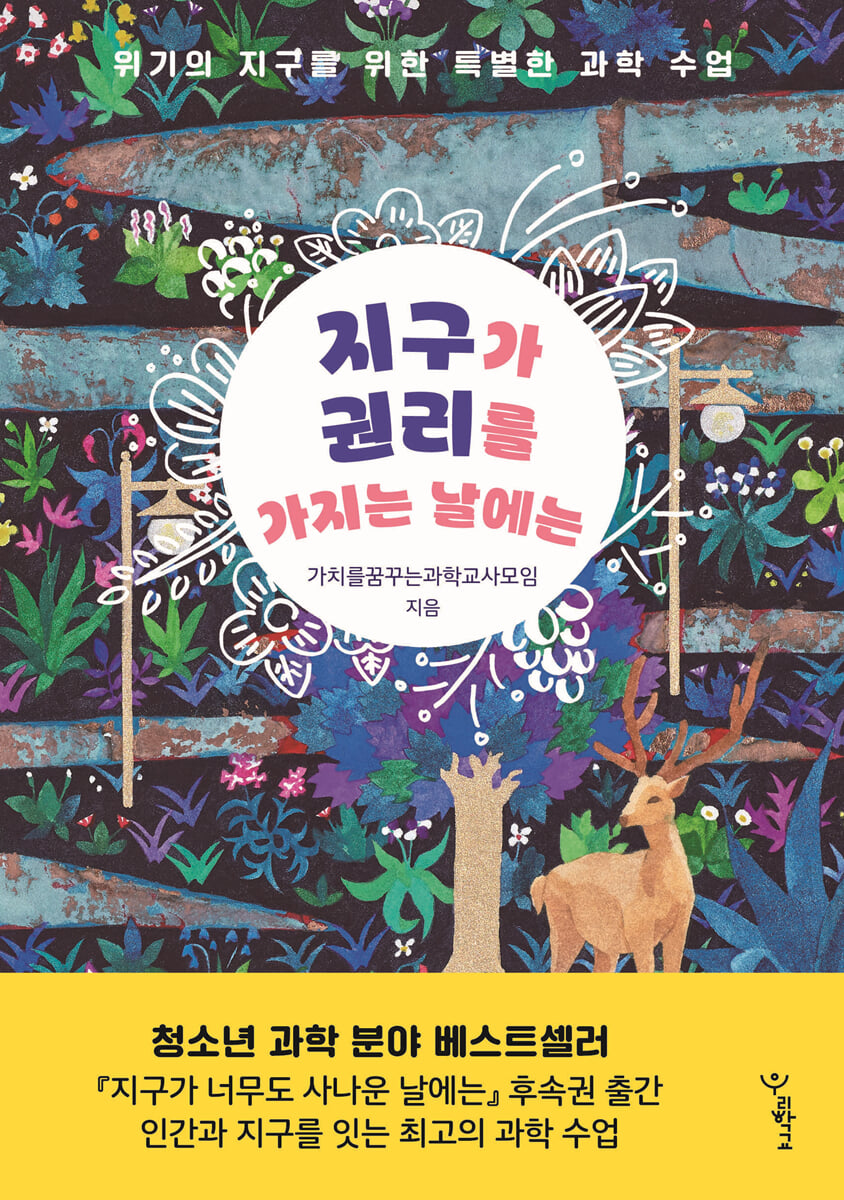
On the day when the Earth has rights
 |
Description
Book Introduction
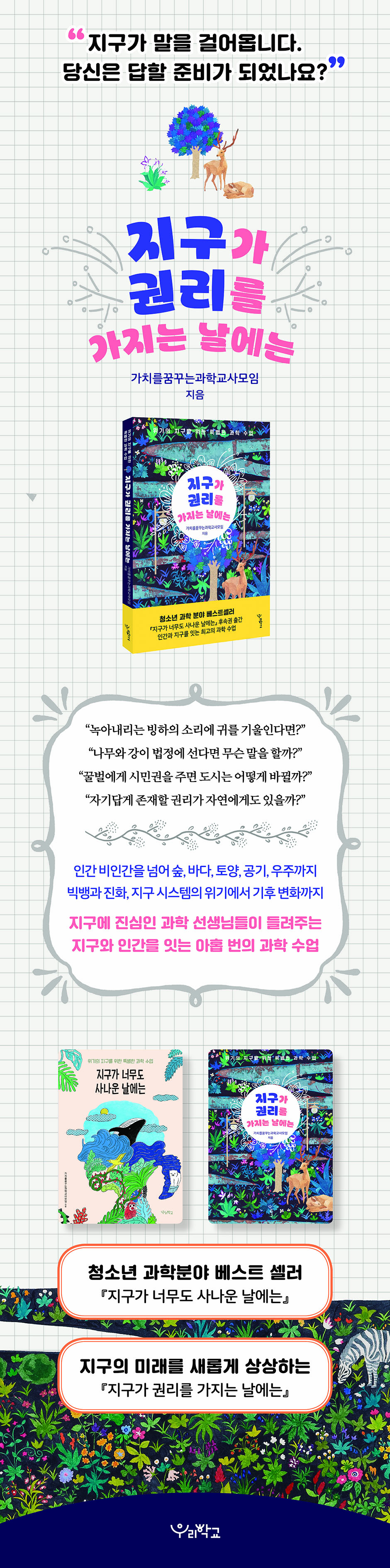
The Earth's true science teachers are back!
The sequel to the youth science bestseller "When the Earth is Too Wild"
A very special climate environment class that connects humans and the Earth
40 degree heat wave, unprecedented floods and torrential rain, massive wildfires… .
The Earth is clearly in crisis.
Yet, climate disaster, carbon neutrality, and environmental protection have long since become uninspiring everyday words, and even the phrase "saving the planet" is becoming increasingly tiresome.
Debates that divide people into two groups, such as “Humans or Earth first?” or “Development or conservation?”, are no longer helpful in solving the problems facing the Earth and its people.
What we need now are unfamiliar stories and new questions that will allow us to imagine a new future.
The teachers of the "Science Teachers' Association for Dreaming Values," who are more sincere than anyone else about the Earth and future generations, have published this book filled with such stories.
“What if you could actually hear the sound of melting glaciers?” “What would trees and rivers say if they stood in court?” “How would cities change if bees were given citizenship?” “Just as humans have human rights and animals have animal rights, does nature also have the right to exist as itself?” These endless questions invite readers to a place where they encounter all beings on Earth, beyond humans and non-humans.
This is a science book that makes us listen to the voices of the world we have missed before it is too late.
The sequel to the youth science bestseller "When the Earth is Too Wild"
A very special climate environment class that connects humans and the Earth
40 degree heat wave, unprecedented floods and torrential rain, massive wildfires… .
The Earth is clearly in crisis.
Yet, climate disaster, carbon neutrality, and environmental protection have long since become uninspiring everyday words, and even the phrase "saving the planet" is becoming increasingly tiresome.
Debates that divide people into two groups, such as “Humans or Earth first?” or “Development or conservation?”, are no longer helpful in solving the problems facing the Earth and its people.
What we need now are unfamiliar stories and new questions that will allow us to imagine a new future.
The teachers of the "Science Teachers' Association for Dreaming Values," who are more sincere than anyone else about the Earth and future generations, have published this book filled with such stories.
“What if you could actually hear the sound of melting glaciers?” “What would trees and rivers say if they stood in court?” “How would cities change if bees were given citizenship?” “Just as humans have human rights and animals have animal rights, does nature also have the right to exist as itself?” These endless questions invite readers to a place where they encounter all beings on Earth, beyond humans and non-humans.
This is a science book that makes us listen to the voices of the world we have missed before it is too late.
- You can preview some of the book's contents.
Preview
index
Did you ask Earth about departure? … 6
1.
Are rights only for humans? … 21
2.
Can a tree sue? … 35
3.
What would change if rivers had rights? … 53
4.
What if we gave bees citizenship? … 77
5.
Will the deer of Anmado Island be free? … 93
6.
Why did the Seoraksan mountain goats come down to the village? … 115
7.
Bacteria, fungi, waves, the moon… How far do the rights of nature extend? … 137
8.
Nature has rights.
… 161
1.
Are rights only for humans? … 21
2.
Can a tree sue? … 35
3.
What would change if rivers had rights? … 53
4.
What if we gave bees citizenship? … 77
5.
Will the deer of Anmado Island be free? … 93
6.
Why did the Seoraksan mountain goats come down to the village? … 115
7.
Bacteria, fungi, waves, the moon… How far do the rights of nature extend? … 137
8.
Nature has rights.
… 161
Detailed image
Into the book
Debates that seem to divide people into two groups, such as “Humans first or Earth first?” or “Development first or conservation first?”, do not seem to be of much help in resolving the complex problems facing the Earth and humans today.
Because we are beings living together in a closed space called Earth, it is perhaps natural and inevitable that conflicts arise between nature and humans.
So how should we best resolve this conflict? What kind of relationship should the Earth and humans have to maintain so that humanity can live a long and prosperous life?
--- p.15
At some point in history, humans and nature became separated, and since then, humans have regarded nature as an object that can be used at will.
It will take a long time to change that mindset.
Some scholars say it could take centuries.
So if we're going to change, we're going to have to hurry, right? Even if it means pulling back a day, say, by a few hundred years.
--- p.17
To date, most environmental damage lawsuits have not recognized natural entities as parties to the lawsuit.
However, if we recognize natural objects as legal entities, we can legally protect the rights of nature.
And just as a representative of a company or organization represents the rights of the corporation, nature can also have a legal representative to assert its rights.
--- p.46
When humans deal with nature, we must consider not short-term effects but what changes will occur in the ecosystem in the long term.
When solving a problem, you have to consider how the solution will affect other areas.
Because the Earth is not just a planet that provides a home for life, it is a huge system that maintains its own balance.
Everything that exists on Earth is connected to each other within this system, moving, changing, and maintaining balance.
--- p.104
Chile designated fungi as "essential organisms" in its 2012 environmental law, which assesses ecosystems before development.
It is essential to investigate what types of fungi are present in the area to be developed, and if there is a possibility that the fungi will disappear due to development, the construction should be adjusted. If the fungi are truly important, development should be abandoned and a protected area should be designated.
It is about respecting not only visible plants and animals but also invisible fungi as members of the ecosystem.
In other words, it is acknowledging the right of mold to exist.
--- p.147
Evolution is not a process of progress toward a better existence, but rather a process of increasing diversity.
In other words, it is a process in which the forms, characteristics, and lifestyles of living things become increasingly diverse and abundant.
If humans were the only species left on Earth today through evolution, evolution could be seen as progress. However, on Earth, for billions of years, various species, from viruses to bacteria, pine trees, octopuses, rats, and chimpanzees, have been born, grown, reproduced, and survived in their own unique ways.
Because we are beings living together in a closed space called Earth, it is perhaps natural and inevitable that conflicts arise between nature and humans.
So how should we best resolve this conflict? What kind of relationship should the Earth and humans have to maintain so that humanity can live a long and prosperous life?
--- p.15
At some point in history, humans and nature became separated, and since then, humans have regarded nature as an object that can be used at will.
It will take a long time to change that mindset.
Some scholars say it could take centuries.
So if we're going to change, we're going to have to hurry, right? Even if it means pulling back a day, say, by a few hundred years.
--- p.17
To date, most environmental damage lawsuits have not recognized natural entities as parties to the lawsuit.
However, if we recognize natural objects as legal entities, we can legally protect the rights of nature.
And just as a representative of a company or organization represents the rights of the corporation, nature can also have a legal representative to assert its rights.
--- p.46
When humans deal with nature, we must consider not short-term effects but what changes will occur in the ecosystem in the long term.
When solving a problem, you have to consider how the solution will affect other areas.
Because the Earth is not just a planet that provides a home for life, it is a huge system that maintains its own balance.
Everything that exists on Earth is connected to each other within this system, moving, changing, and maintaining balance.
--- p.104
Chile designated fungi as "essential organisms" in its 2012 environmental law, which assesses ecosystems before development.
It is essential to investigate what types of fungi are present in the area to be developed, and if there is a possibility that the fungi will disappear due to development, the construction should be adjusted. If the fungi are truly important, development should be abandoned and a protected area should be designated.
It is about respecting not only visible plants and animals but also invisible fungi as members of the ecosystem.
In other words, it is acknowledging the right of mold to exist.
--- p.147
Evolution is not a process of progress toward a better existence, but rather a process of increasing diversity.
In other words, it is a process in which the forms, characteristics, and lifestyles of living things become increasingly diverse and abundant.
If humans were the only species left on Earth today through evolution, evolution could be seen as progress. However, on Earth, for billions of years, various species, from viruses to bacteria, pine trees, octopuses, rats, and chimpanzees, have been born, grown, reproduced, and survived in their own unique ways.
--- p.178~179
Publisher's Review
Science teachers who are sincere about the Earth
The only science class that connects humans and the Earth
The "Science Teachers' Association for Dreaming Value," which has continuously pondered and discussed the path science should take amidst climate crises and disasters, is holding a special class that connects all beings on Earth.
??On Earth Day,?? presents a new proposal for a world where humans and non-humans, living and non-living things can coexist on Earth.
The strange and bizarre idea that city bees should be our neighbors, that waves should have the right to crash and crash perfectly, that mold, rocks, and every living thing on Earth should be able to exist as they are.
This is a story about the 'rights of nature'.
Things you can only see when you stop
Things that need to be changed to start properly
4.6 billion years ago, Earth, a pale blue dot in our solar system at the edge of the Milky Way galaxy, was born.
On this planet, countless life forms were born and went extinct repeatedly, and then humanity emerged.
Humanity has built a civilization on Earth in a short period of several million years, and has fought wars to seize the Earth's resources.
We developed nature to create cities, factories and buildings, power plants and roads, houses and cars.
Humanity has exploited nature for the benefit of convenience, but has also created disasters such as heat waves, droughts, and floods.
Yet, we have never thought about the Earth's perspective, using nature as a resource, destroying it, or protecting it to undo our mistakes.
Perhaps the environmental movement, which has sought to halt development, limit plastic use, and promote wildlife conservation and breeding, also stemmed from a desire to benefit humanity alone.
Isn't the common belief that we must preserve nature so that future generations can live better lives also an extremely anthropocentric way of thinking?
There are things that can only be seen when you stop.
When development stops, we see burning forests, dried-up rivers and lakes, and suffering nature.
But now is not the time to stop, but to change our thinking.
Beyond protection and development, growth and degrowth, coexisting with other beings on Earth as “us.”
It means treating all plants and animals, mountains and forests, rivers and seas, air and land as beings of equal 'status' to me.
The 'rights' that we took for granted
If it happens to Earth today
The Science Teachers' Association for Value Dreaming, a group of current science teachers who seek the values hidden behind science and ponder the restoration and coexistence of nature and ecology, has returned with "On the Day the Earth is Too Wild" and "On the Day the Earth Has Rights".
This book, which embraces the Earth and nature in crisis through science, not only provides young people, the future generation directly facing the climate crisis, with new knowledge about the environment and ecology, but also helps them overcome the limitations of existing perspectives on environmental issues.
In this book, the authors pose unfamiliar questions to young people.
“If humans have human rights, do animals, plants, mountains and rivers, and all beings in nature also have rights?”
This book tells a variety of stories about nature's right to exist as nature, based on scientific knowledge, including the story of mountain goats that lost their habitat due to the Seoraksan cable car, the Whanganui River Accord Act of 2017 in New Zealand, which legally recognized the rights of the river, and the case of Costa Rica, which recognized the citizenship of honeybees as pollinators.
Furthermore, it provides food for thought on things we have never thought about before, such as 'the right of the moon to exist as a celestial body' and 'musical copyrights related to the sounds of nature'.
It also follows a series of processes, starting from the Big Bang and the birth of the Earth, to the formation of the Earth system through atmospheric circulation and differentiation, and to the evolution of various species through reproduction and extinction, and presents a new direction for the coexistence of humanity and nature based on scientific evidence.
I know, in every stone and tree and living thing
That there is life, there is soul, and there is a name.
The following lyrics appear in 『Colors of the Wind』, one of the theme songs from Walt Disney's animated film 『Pocahontas』.
“You think you can have it wherever your feet set foot.
Land is a dead thing that can be owned.
But I know.
“Every stone, tree, and living thing has life, a soul, and a name.” If we feel that, like this song says, all beings in nature have their own lives, the right to live those lives fully and safely, not to be exploited by others, and the right to exist as themselves, wouldn’t the future of the Earth be different?
Perhaps nature has been waiting until now.
I hope that people will listen to their voices, put themselves in their shoes, and truly empathize and embrace them.
Today, we are talking about a future where humanity can live together in its own place, not a sustainable future, but a future where tiny moss and sand, and all of nature, can live together in their own place.
The only science class that connects humans and the Earth
The "Science Teachers' Association for Dreaming Value," which has continuously pondered and discussed the path science should take amidst climate crises and disasters, is holding a special class that connects all beings on Earth.
??On Earth Day,?? presents a new proposal for a world where humans and non-humans, living and non-living things can coexist on Earth.
The strange and bizarre idea that city bees should be our neighbors, that waves should have the right to crash and crash perfectly, that mold, rocks, and every living thing on Earth should be able to exist as they are.
This is a story about the 'rights of nature'.
Things you can only see when you stop
Things that need to be changed to start properly
4.6 billion years ago, Earth, a pale blue dot in our solar system at the edge of the Milky Way galaxy, was born.
On this planet, countless life forms were born and went extinct repeatedly, and then humanity emerged.
Humanity has built a civilization on Earth in a short period of several million years, and has fought wars to seize the Earth's resources.
We developed nature to create cities, factories and buildings, power plants and roads, houses and cars.
Humanity has exploited nature for the benefit of convenience, but has also created disasters such as heat waves, droughts, and floods.
Yet, we have never thought about the Earth's perspective, using nature as a resource, destroying it, or protecting it to undo our mistakes.
Perhaps the environmental movement, which has sought to halt development, limit plastic use, and promote wildlife conservation and breeding, also stemmed from a desire to benefit humanity alone.
Isn't the common belief that we must preserve nature so that future generations can live better lives also an extremely anthropocentric way of thinking?
There are things that can only be seen when you stop.
When development stops, we see burning forests, dried-up rivers and lakes, and suffering nature.
But now is not the time to stop, but to change our thinking.
Beyond protection and development, growth and degrowth, coexisting with other beings on Earth as “us.”
It means treating all plants and animals, mountains and forests, rivers and seas, air and land as beings of equal 'status' to me.
The 'rights' that we took for granted
If it happens to Earth today
The Science Teachers' Association for Value Dreaming, a group of current science teachers who seek the values hidden behind science and ponder the restoration and coexistence of nature and ecology, has returned with "On the Day the Earth is Too Wild" and "On the Day the Earth Has Rights".
This book, which embraces the Earth and nature in crisis through science, not only provides young people, the future generation directly facing the climate crisis, with new knowledge about the environment and ecology, but also helps them overcome the limitations of existing perspectives on environmental issues.
In this book, the authors pose unfamiliar questions to young people.
“If humans have human rights, do animals, plants, mountains and rivers, and all beings in nature also have rights?”
This book tells a variety of stories about nature's right to exist as nature, based on scientific knowledge, including the story of mountain goats that lost their habitat due to the Seoraksan cable car, the Whanganui River Accord Act of 2017 in New Zealand, which legally recognized the rights of the river, and the case of Costa Rica, which recognized the citizenship of honeybees as pollinators.
Furthermore, it provides food for thought on things we have never thought about before, such as 'the right of the moon to exist as a celestial body' and 'musical copyrights related to the sounds of nature'.
It also follows a series of processes, starting from the Big Bang and the birth of the Earth, to the formation of the Earth system through atmospheric circulation and differentiation, and to the evolution of various species through reproduction and extinction, and presents a new direction for the coexistence of humanity and nature based on scientific evidence.
I know, in every stone and tree and living thing
That there is life, there is soul, and there is a name.
The following lyrics appear in 『Colors of the Wind』, one of the theme songs from Walt Disney's animated film 『Pocahontas』.
“You think you can have it wherever your feet set foot.
Land is a dead thing that can be owned.
But I know.
“Every stone, tree, and living thing has life, a soul, and a name.” If we feel that, like this song says, all beings in nature have their own lives, the right to live those lives fully and safely, not to be exploited by others, and the right to exist as themselves, wouldn’t the future of the Earth be different?
Perhaps nature has been waiting until now.
I hope that people will listen to their voices, put themselves in their shoes, and truly empathize and embrace them.
Today, we are talking about a future where humanity can live together in its own place, not a sustainable future, but a future where tiny moss and sand, and all of nature, can live together in their own place.
GOODS SPECIFICS
- Date of issue: September 8, 2025
- Page count, weight, size: 192 pages | 322g | 148*210*11mm
- ISBN13: 9791167553447
- ISBN10: 1167553446
You may also like
카테고리
korean


korean

![GQ KOREA Mark (Monthly): December [2025]](http://librairie.coreenne.fr/cdn/shop/files/8ef265dbbfbf186523ed75ba7319009d.jpg?v=1765340328&width=3840)


