

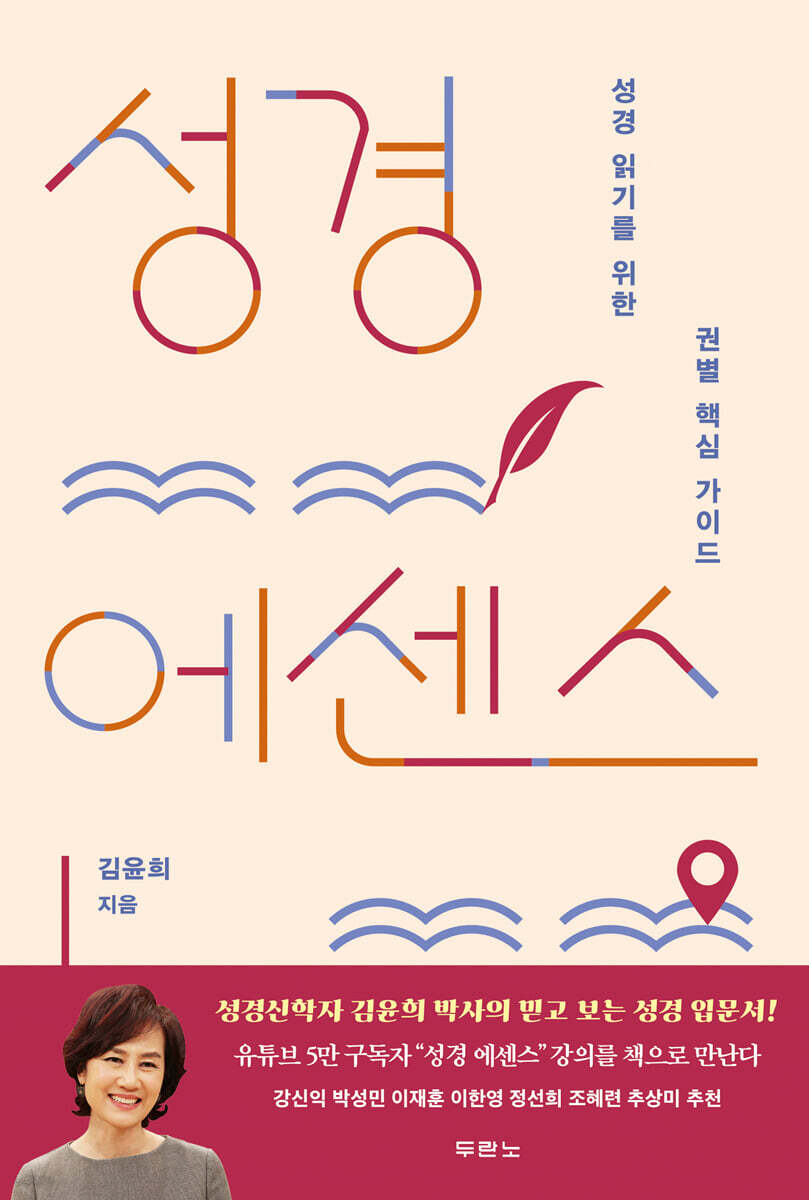
Bible Essence
 |
Description
Book Introduction
An introductory book to the Bible by biblical theologian Dr. Kim Yun-hee!
Recommended by Kang Shin-ik, Park Sung-min, Lee Jae-hoon, Lee Han-young, Jeong Seon-hee, Jo Hye-ryeon, and Chu Sang-mi "Bible Essence," a YouTube lecture with 50,000 subscribers, now available as a book. "I don't understand a single word of it." "I read it because you told me to, but I don't understand it." "I feel like I'm just meditating on it on my own because I don't have any knowledge of the Bible." Are these common confessions from new believers? No. The Bible is full of unfamiliar and difficult terms, just as it is a vast collection of 66 books. If you accept it without knowledge, you can easily fall into spiritual error. Evangelical biblical theologian Dr. Kim Yun-hee has received many requests from people to “explain the Bible in an easy-to-understand way.” This book is the author's response to these requests, and is a core introductory book for believers who are reading the Bible from beginning to end. The eponymous “Bible Essence” channel has garnered much love from over 50,000 subscribers. It has played a significant role in introducing the Bible to the saints. |
- You can preview some of the book's contents.
Preview
index
Recommendation
introduction
Part 1 Old Testament
Old Testament Overview
1 Genesis
2 Exodus
Leviticus 3
Numbers 4
5 Deuteronomy
6 Joshua
7 Judges
8 Ruth
1 Samuel 9
10 2 Samuel
11-12 Kings 1 and 2
13-14 Chronicles 1 and 2
15 Ezra
16 Nehemiah
17 Esther
Job 18
Psalm 19
20 Proverbs
21 Ecclesiastes
22 Baby
23 Isaiah
24 Jeremiah
25 Lamentations
26 Ezekiel
27 Daniel
28 Hosea
29 Joel
30 Amos
31 Obadiah
32 Jonah
33 Micah
34 Nahum
35 Habakkuk
36 Zephaniah
37 Haggai
38 Zechariah
39 Malachi
Part 2 New Testament
New Testament Overview
1 Matthew
2 Mark
3 Luke
4 Gospel of John
Acts 5
Romans 6
1 Corinthians 7
2 Corinthians 8
9 Galatians
10 Ephesians
11 Philippians
12 Colossians
13 1 Thessalonians
2 Thessalonians 14
1 Timothy 15
2 Timothy 16
17 Titus
18 Philemon
Hebrews 19
20 James
1 Peter 21
2 Peter 22
1 John 23
24 2 John
25 3 John
Jude 26
27 Revelation
main
introduction
Part 1 Old Testament
Old Testament Overview
1 Genesis
2 Exodus
Leviticus 3
Numbers 4
5 Deuteronomy
6 Joshua
7 Judges
8 Ruth
1 Samuel 9
10 2 Samuel
11-12 Kings 1 and 2
13-14 Chronicles 1 and 2
15 Ezra
16 Nehemiah
17 Esther
Job 18
Psalm 19
20 Proverbs
21 Ecclesiastes
22 Baby
23 Isaiah
24 Jeremiah
25 Lamentations
26 Ezekiel
27 Daniel
28 Hosea
29 Joel
30 Amos
31 Obadiah
32 Jonah
33 Micah
34 Nahum
35 Habakkuk
36 Zephaniah
37 Haggai
38 Zechariah
39 Malachi
Part 2 New Testament
New Testament Overview
1 Matthew
2 Mark
3 Luke
4 Gospel of John
Acts 5
Romans 6
1 Corinthians 7
2 Corinthians 8
9 Galatians
10 Ephesians
11 Philippians
12 Colossians
13 1 Thessalonians
2 Thessalonians 14
1 Timothy 15
2 Timothy 16
17 Titus
18 Philemon
Hebrews 19
20 James
1 Peter 21
2 Peter 22
1 John 23
24 2 John
25 3 John
Jude 26
27 Revelation
main
Detailed image
.jpg)
Into the book
*If you spend just 5 minutes on each of the 66 books of the Bible, you can learn a very short and concise introduction to the Bible at the level of a first-year seminary student.
You can study the author, historical background, purpose, audience, and basic theological core of each volume at once.
If you read the essence like this and read the Bible through, many parts of the Bible will stand out and you will understand them. (Omitted)
I believe that "Bible Essence" can elevate your understanding and depth of reading and meditating on the Bible by several levels.
While there are many Bible outlines and introductory books for reading the entire Bible, it's not easy to find a book that conveys only the essential points from a balanced perspective of a biblical theologian.
As a scholar who has been directly or indirectly involved in the Bible reading movement for a long time, I believed that Korean church members absolutely needed a Bible overview based on sound theological foundations.
In this regard, I recommend that believers always carry this book with them and utilize it.
Bible study is not a one-time thing, but must be repeated and sustained. It is sharper than any sword and can prevent the relativization of truth.
In this age where truth is becoming increasingly relativized, I recommend the book "Bible Essence" to help us remember the verse, "The grass withers, the flower fades, but the word of our God stands forever" (Isaiah 40:8), and get closer to the unchanging word of God, even as everything else changes.
---From the "Preface"
*Genesis is a book about ‘beginnings’ and is the foundation of Old Testament theology.
Genesis begins with God's creation of the world and ends with the death of Joseph, the patriarch of Israel.
It begins with the birth of the universe and ends with the death of a human being, so birth and death, the macro and micro scales are contrasted.
God is presented as both grand and expansive, yet detailed and caring, showing that He is interested and involved on both scales.
The Hebrew title of Genesis is derived from the first word, "In the beginning" (Bereshit).
Meanwhile, the title of the Greek translation is 'Genesis', a word that has various meanings such as occurrence, origin, source, source, birth, and lineage, and here it means 'the origin, beginning of all things'.
Indeed, Genesis deals with many beginnings: the beginning of the universe, the beginning of humanity, the beginning of sin, the beginning of redemption, the beginning of the covenant, the beginning of patriarchal history, the beginning of God's chosen people, the beginning of the 12 tribes, and so on.
The Korean title, 'Genesis', was created with the meaning of 'a record of the creation of the world'.
--- p.20~21
*Moses asks, “What does the Lord your God require of you, Israel?” and gives the following four answers (Deut. 10:12-13).
1) Fear the Lord your God.
2) Walk and love all His ways.
3) Serve the Lord with all your heart and with all your soul.
4) Keep the commandments and decrees that God has given you for your own good.
These four spiritual principles (the four spiritual laws) that Moses gave to the Israelites are the core of Deuteronomy.
Deuteronomy is the conclusion of the Pentateuch from Genesis to Deuteronomy, and it also serves as the theological foundation for the Old Testament historical books that will unfold in the future.
It is also one of the most quoted books in the Old and New Testaments.
It is quoted more than 350 times in the Old Testament alone and more than 190 times in the New Testament.
Jesus also overcomes all three of Satan's temptations by quoting Deuteronomy.
--- p.38
*It is no exaggeration to say that the Psalms contain all the theological thoughts of the Old Testament.
It is also a book filled with the expectation that the Messiah will come and rule.
That is why David, who can be said to be a shadow of the coming of the Messiah, is highlighted.
The Psalms are appropriate for funerals, weddings, and will forever remain a book of comfort and strength for our prayers, praise, and worship, regardless of the circumstances: sad, happy, wronged, grateful, in need, or afraid.
If you don't know where to start reading the Old Testament, I recommend starting with the Psalms.
--- p.88
*The Gospel of John describes Jesus Christ using a deductive approach.
From the introduction, the word 'logos' is used to clearly state that Jesus Christ is God (John 1:1-18), the Creator (John 1:3), the incarnate One (John 1:14), and the only begotten God (John 1:18).
Moreover, compared to the Synoptic Gospels, the Gospel of John expresses the divinity of Christ more boldly and actively.
From the words, “If you believed Moses, you would believe me” (John 5:46) to the expression, “Before Abraham was, I am” (John 8:58), we meet Jesus speaking about himself without hesitation.
--- p.193
* Regarding human sinfulness, the book of Romans clearly states, “There is none righteous, not even one” (Romans 3:10).
That is the current state of humanity.
Consequently, humans cannot become righteous through their own actions or by keeping the laws of Judaism.
But there is another way.
It is the only way to be justified freely by God's grace (Romans 3:24).
It is possible only through ‘faith’ (Romans 3:22).
The good news, the core of the gospel, is that God sent His only begotten Son, Jesus Christ, to be the atonement for mankind.
The core of 'justification by faith' is that anyone can be declared righteous through faith.
But the letter does not stop at justifying oneself by faith alone.
Chapter 12 onwards emphasizes how faith should be manifested in ‘life.’
In short, we must demonstrate in our daily lives the behavior befitting those who are “clothed with righteousness” (Romans 12-15).
You can study the author, historical background, purpose, audience, and basic theological core of each volume at once.
If you read the essence like this and read the Bible through, many parts of the Bible will stand out and you will understand them. (Omitted)
I believe that "Bible Essence" can elevate your understanding and depth of reading and meditating on the Bible by several levels.
While there are many Bible outlines and introductory books for reading the entire Bible, it's not easy to find a book that conveys only the essential points from a balanced perspective of a biblical theologian.
As a scholar who has been directly or indirectly involved in the Bible reading movement for a long time, I believed that Korean church members absolutely needed a Bible overview based on sound theological foundations.
In this regard, I recommend that believers always carry this book with them and utilize it.
Bible study is not a one-time thing, but must be repeated and sustained. It is sharper than any sword and can prevent the relativization of truth.
In this age where truth is becoming increasingly relativized, I recommend the book "Bible Essence" to help us remember the verse, "The grass withers, the flower fades, but the word of our God stands forever" (Isaiah 40:8), and get closer to the unchanging word of God, even as everything else changes.
---From the "Preface"
*Genesis is a book about ‘beginnings’ and is the foundation of Old Testament theology.
Genesis begins with God's creation of the world and ends with the death of Joseph, the patriarch of Israel.
It begins with the birth of the universe and ends with the death of a human being, so birth and death, the macro and micro scales are contrasted.
God is presented as both grand and expansive, yet detailed and caring, showing that He is interested and involved on both scales.
The Hebrew title of Genesis is derived from the first word, "In the beginning" (Bereshit).
Meanwhile, the title of the Greek translation is 'Genesis', a word that has various meanings such as occurrence, origin, source, source, birth, and lineage, and here it means 'the origin, beginning of all things'.
Indeed, Genesis deals with many beginnings: the beginning of the universe, the beginning of humanity, the beginning of sin, the beginning of redemption, the beginning of the covenant, the beginning of patriarchal history, the beginning of God's chosen people, the beginning of the 12 tribes, and so on.
The Korean title, 'Genesis', was created with the meaning of 'a record of the creation of the world'.
--- p.20~21
*Moses asks, “What does the Lord your God require of you, Israel?” and gives the following four answers (Deut. 10:12-13).
1) Fear the Lord your God.
2) Walk and love all His ways.
3) Serve the Lord with all your heart and with all your soul.
4) Keep the commandments and decrees that God has given you for your own good.
These four spiritual principles (the four spiritual laws) that Moses gave to the Israelites are the core of Deuteronomy.
Deuteronomy is the conclusion of the Pentateuch from Genesis to Deuteronomy, and it also serves as the theological foundation for the Old Testament historical books that will unfold in the future.
It is also one of the most quoted books in the Old and New Testaments.
It is quoted more than 350 times in the Old Testament alone and more than 190 times in the New Testament.
Jesus also overcomes all three of Satan's temptations by quoting Deuteronomy.
--- p.38
*It is no exaggeration to say that the Psalms contain all the theological thoughts of the Old Testament.
It is also a book filled with the expectation that the Messiah will come and rule.
That is why David, who can be said to be a shadow of the coming of the Messiah, is highlighted.
The Psalms are appropriate for funerals, weddings, and will forever remain a book of comfort and strength for our prayers, praise, and worship, regardless of the circumstances: sad, happy, wronged, grateful, in need, or afraid.
If you don't know where to start reading the Old Testament, I recommend starting with the Psalms.
--- p.88
*The Gospel of John describes Jesus Christ using a deductive approach.
From the introduction, the word 'logos' is used to clearly state that Jesus Christ is God (John 1:1-18), the Creator (John 1:3), the incarnate One (John 1:14), and the only begotten God (John 1:18).
Moreover, compared to the Synoptic Gospels, the Gospel of John expresses the divinity of Christ more boldly and actively.
From the words, “If you believed Moses, you would believe me” (John 5:46) to the expression, “Before Abraham was, I am” (John 8:58), we meet Jesus speaking about himself without hesitation.
--- p.193
* Regarding human sinfulness, the book of Romans clearly states, “There is none righteous, not even one” (Romans 3:10).
That is the current state of humanity.
Consequently, humans cannot become righteous through their own actions or by keeping the laws of Judaism.
But there is another way.
It is the only way to be justified freely by God's grace (Romans 3:24).
It is possible only through ‘faith’ (Romans 3:22).
The good news, the core of the gospel, is that God sent His only begotten Son, Jesus Christ, to be the atonement for mankind.
The core of 'justification by faith' is that anyone can be declared righteous through faith.
But the letter does not stop at justifying oneself by faith alone.
Chapter 12 onwards emphasizes how faith should be manifested in ‘life.’
In short, we must demonstrate in our daily lives the behavior befitting those who are “clothed with righteousness” (Romans 12-15).
--- p.201~202
Publisher's Review
An introductory book to the Bible by biblical theologian Dr. Kim Yun-hee!
Recommended by Kang Shin-ik, Park Sung-min, Lee Jae-hoon, Lee Han-young, Jeong Seon-hee, Jo Hye-ryeon, and Chu Sang-mi
"Bible Essence," a YouTube lecture with 50,000 subscribers, now available as a book.
"I don't understand a single word of it." "I read it because you told me to, but I don't understand it." "I feel like I'm just meditating on it on my own because I don't have any knowledge of the Bible." Are these common confessions from new believers? No.
The Bible is full of unfamiliar and difficult terms, just as it is a vast collection of 66 books.
If you accept it without knowledge, you can easily fall into spiritual error.
Evangelical biblical theologian Dr. Kim Yun-hee has received many requests from people to “explain the Bible in an easy-to-understand way.”
This book is the author's response to these requests, and is a core introductory book for believers who are reading the Bible from beginning to end.
The eponymous “Bible Essence” channel has garnered much love from over 50,000 subscribers.
It has played a significant role in introducing the Bible to the saints.
Now, you can follow along with the lecture text and memorize it in a more organized manner.
Additionally, 66 5-minute lecture videos are included in the text, allowing you to enjoy the audiovisual effect along with 3-4 pages of text and enjoy the effect of review.
Each volume includes author, writing period, theme, characters, purpose, and plot, as well as key themes and summary boxes to effectively assist in Bible study.
In particular, since you can refer to it over and over again and check it whenever you have questions, you can fully enjoy the spiritual training and benefits of 'reading the Bible'.
This will be a reliable and helpful introduction to the Bible for those who want to read it on their own or begin studying the Bible, teach the Bible, or lead small groups.
Rather than trying to understand it deeply, let's start studying the word easily and accurately.
#ReaderBenefits
v.
You can learn the contents of the 66 books of the Bible most easily and quickly.
v.
You can study the author, historical background, purpose, and target audience of each volume at once.
v.
It delivers only the essential points with the balanced perspective of a biblical theologian.
v.
It can be carried around and used in conjunction with reading the entire Bible.
v.
Videos of lectures on the 66 books of the Bible are included as QR codes.
v.
It is effective as an introductory book when reading alone or studying the Bible.
#For readers
v.
For those who want to know only the core of the Bible
v.
Believers who want to know only the key points, such as the characteristics and contents of the 66 books of the Bible.
v.
Pastors looking for an introductory Bible study book
v.
Those who want to read the Bible in small groups or individually
v.
For believers and pastors looking for a new and easy Bible outline
Recommended by Kang Shin-ik, Park Sung-min, Lee Jae-hoon, Lee Han-young, Jeong Seon-hee, Jo Hye-ryeon, and Chu Sang-mi
"Bible Essence," a YouTube lecture with 50,000 subscribers, now available as a book.
"I don't understand a single word of it." "I read it because you told me to, but I don't understand it." "I feel like I'm just meditating on it on my own because I don't have any knowledge of the Bible." Are these common confessions from new believers? No.
The Bible is full of unfamiliar and difficult terms, just as it is a vast collection of 66 books.
If you accept it without knowledge, you can easily fall into spiritual error.
Evangelical biblical theologian Dr. Kim Yun-hee has received many requests from people to “explain the Bible in an easy-to-understand way.”
This book is the author's response to these requests, and is a core introductory book for believers who are reading the Bible from beginning to end.
The eponymous “Bible Essence” channel has garnered much love from over 50,000 subscribers.
It has played a significant role in introducing the Bible to the saints.
Now, you can follow along with the lecture text and memorize it in a more organized manner.
Additionally, 66 5-minute lecture videos are included in the text, allowing you to enjoy the audiovisual effect along with 3-4 pages of text and enjoy the effect of review.
Each volume includes author, writing period, theme, characters, purpose, and plot, as well as key themes and summary boxes to effectively assist in Bible study.
In particular, since you can refer to it over and over again and check it whenever you have questions, you can fully enjoy the spiritual training and benefits of 'reading the Bible'.
This will be a reliable and helpful introduction to the Bible for those who want to read it on their own or begin studying the Bible, teach the Bible, or lead small groups.
Rather than trying to understand it deeply, let's start studying the word easily and accurately.
#ReaderBenefits
v.
You can learn the contents of the 66 books of the Bible most easily and quickly.
v.
You can study the author, historical background, purpose, and target audience of each volume at once.
v.
It delivers only the essential points with the balanced perspective of a biblical theologian.
v.
It can be carried around and used in conjunction with reading the entire Bible.
v.
Videos of lectures on the 66 books of the Bible are included as QR codes.
v.
It is effective as an introductory book when reading alone or studying the Bible.
#For readers
v.
For those who want to know only the core of the Bible
v.
Believers who want to know only the key points, such as the characteristics and contents of the 66 books of the Bible.
v.
Pastors looking for an introductory Bible study book
v.
Those who want to read the Bible in small groups or individually
v.
For believers and pastors looking for a new and easy Bible outline
GOODS SPECIFICS
- Publication date: September 15, 2021
- Page count, weight, size: 288 pages | 402g | 135*200*20mm
- ISBN13: 9788953140622
- ISBN10: 8953140625
You may also like
카테고리
korean


korean

![GQ KOREA Mark (Monthly): December [2025]](http://librairie.coreenne.fr/cdn/shop/files/8ef265dbbfbf186523ed75ba7319009d.jpg?v=1765340328&width=3840)


