

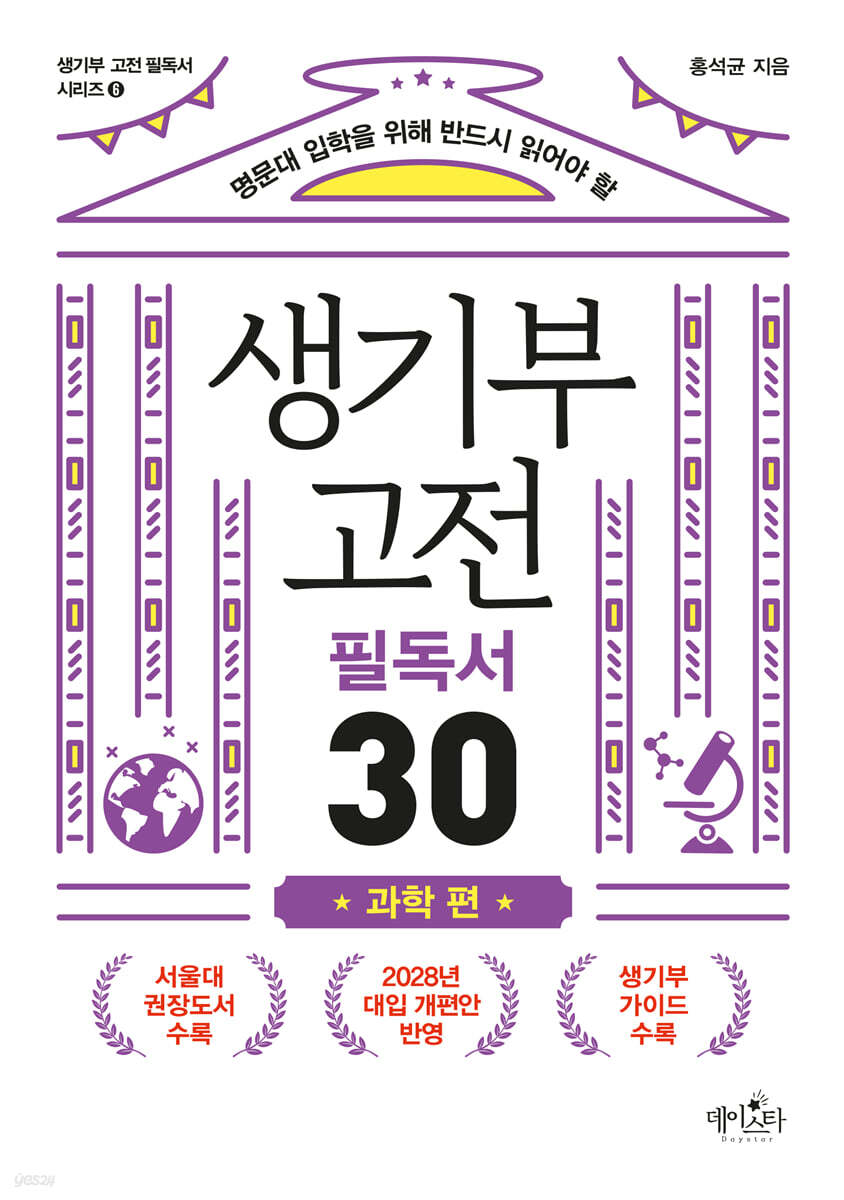
30 Must-Read Classics for Science Students
 |
Description
Book Introduction
A collection of 30 must-read science classics for all Korean youth.
In line with the drastically changed 2028 college entrance reform plan, not only the special features of the life science department but also in-depth reading activities
A 10-Minute Daily Classic Reading Plan to Develop the Integrated Thinking Skills and Insights Desired by Top-Ranking Universities
The flow of education and college entrance examination systems has been changing rapidly recently.
This also means that the type of talent our society and universities desire is changing.
Universities, especially top-tier universities, now want well-rounded and integrated students who are not only cognitively gifted but also able to actively communicate and collaborate within a community.
How can we cultivate these capabilities? In a rapidly changing world, the fastest way to discover unchanging values, find fundamental questions and answers to solve problems, and cultivate the ability to gain insight into objects and phenomena is through reading, and especially through reading the classics.
The 『30 Essential Readings for the Living Classics』 series was designed to help students develop integrated and holistic capabilities through reading a variety of classics.
Six current teachers who share the importance of classics have carefully selected 180 representative classic works from various fields, including Korean literature, foreign literature, economics, science, history, and philosophy.
This book focuses on recommended or required readings from leading domestic universities, and contains representative works that students must review. In particular, it reflects the changes in the educational field, where the importance of detailed academic abilities and special skills in school records is increasing ahead of the implementation of the 2022 revised curriculum and 2028 college entrance reform plan.
The sixth book in this series, 『30 Must-Read Classics from the Life Sciences』, introduces thirty carefully selected classics of science that have led the advancement of human knowledge and expanded the limits of humanity.
This book helps students develop scientific and logical thinking skills and gain insight into new problems by providing easy-to-understand explanations of various must-read science books, including The Selfish Gene, Cosmos, The Structure of Scientific Revolutions, Fish Do Not Exist, The Unthinkable, and When Breath Becomes Air.
Above all, it focuses on increasing accessibility to science by concisely conveying the key concepts of classic science to busy students preparing for college entrance exams and explaining difficult scientific concepts in an easy-to-understand manner using everyday examples and analogies.
In particular, it introduces research topics and directions that can be utilized in conjunction with the curriculum, as well as specific examples and methods to reflect career activities and special features in the school life record, making it the best way to prepare for the comprehensive student evaluation in conjunction with reading.
In line with the drastically changed 2028 college entrance reform plan, not only the special features of the life science department but also in-depth reading activities
A 10-Minute Daily Classic Reading Plan to Develop the Integrated Thinking Skills and Insights Desired by Top-Ranking Universities
The flow of education and college entrance examination systems has been changing rapidly recently.
This also means that the type of talent our society and universities desire is changing.
Universities, especially top-tier universities, now want well-rounded and integrated students who are not only cognitively gifted but also able to actively communicate and collaborate within a community.
How can we cultivate these capabilities? In a rapidly changing world, the fastest way to discover unchanging values, find fundamental questions and answers to solve problems, and cultivate the ability to gain insight into objects and phenomena is through reading, and especially through reading the classics.
The 『30 Essential Readings for the Living Classics』 series was designed to help students develop integrated and holistic capabilities through reading a variety of classics.
Six current teachers who share the importance of classics have carefully selected 180 representative classic works from various fields, including Korean literature, foreign literature, economics, science, history, and philosophy.
This book focuses on recommended or required readings from leading domestic universities, and contains representative works that students must review. In particular, it reflects the changes in the educational field, where the importance of detailed academic abilities and special skills in school records is increasing ahead of the implementation of the 2022 revised curriculum and 2028 college entrance reform plan.
The sixth book in this series, 『30 Must-Read Classics from the Life Sciences』, introduces thirty carefully selected classics of science that have led the advancement of human knowledge and expanded the limits of humanity.
This book helps students develop scientific and logical thinking skills and gain insight into new problems by providing easy-to-understand explanations of various must-read science books, including The Selfish Gene, Cosmos, The Structure of Scientific Revolutions, Fish Do Not Exist, The Unthinkable, and When Breath Becomes Air.
Above all, it focuses on increasing accessibility to science by concisely conveying the key concepts of classic science to busy students preparing for college entrance exams and explaining difficult scientific concepts in an easy-to-understand manner using everyday examples and analogies.
In particular, it introduces research topics and directions that can be utilized in conjunction with the curriculum, as well as specific examples and methods to reflect career activities and special features in the school life record, making it the best way to prepare for the comprehensive student evaluation in conjunction with reading.
- You can preview some of the book's contents.
Preview
index
Series Preface
Author's Preface
▶ First book - "Fish Don't Exist" by Lulu Miller
▶ Second book - The Old Future, Helena Norberg-Hodge
▶ Third book - Silent Spring, Rachel Carson
▶ Fourth Book - When Breath Becomes Air, Paul Kalanithi
▶ Fifth Book - Physics of Every Moment, Carlo Rovelli
▶ Book Six - Guns, Germs, and Steel, Jared Diamond
▶ Seventh Book - Reasons for Hope, Jane Goodall
▶ Eighth Book - The Unthinking, Nicholas Carr
▶ Book 9 - The Structure of Scientific Revolutions, Thomas S.
Kun
▶ Book 10 - The Man Who Mistook His Wife for a Hat, Oliver Sacks
▶ Eleventh Book - The Selfish Gene, Richard Dawkins
▶ Book 12 - "The Same and the Different," by Roald Hoffman
▶ Book 13 - The Part and the Whole, Werner Heisenberg
▶ Fourteenth Book - Cosmos, Carl Sagan
▶ Fifteenth Book - The Interpretation of Dreams, Sigmund Freud
▶ Book 16 - The Origin of Species, Charles Darwin
▶ Seventeenth Book - Entropy, Jeremy Rifkin
▶ Eighteenth Book - "When Math is Needed," by Kim Min-hyung
▶ Nineteenth Book - The Double Helix, James Watson
▶ Book 20 - A Brief History of Time, Stephen Hawking
▶ Book 21 - Six Physics Lessons from Feynman, Richard Feynman
▶ Book 22 - 10 Drugs That Changed World History, by Kentaro Sato
▶ Book 23 - Parallel Universes, Michio Kaku
▶ Book 24 - A Short History of Nearly Everything, Bill Bryson
Book Twenty-Fifth - Chaos, James Gleick
Book 26 - Nine Algorithms That Changed the Future, by John McCormick
Book 27 - Animal Liberation, Peter Singer
▶ Book 28 - Machine Criticism, by Lee Young-jun
▶ Book 29 - "Chat GPT Revolution" by Kwon Ki-dae
▶ Book 30 - Fermat's Last Theorem, Simon Singh
Author's Preface
▶ First book - "Fish Don't Exist" by Lulu Miller
▶ Second book - The Old Future, Helena Norberg-Hodge
▶ Third book - Silent Spring, Rachel Carson
▶ Fourth Book - When Breath Becomes Air, Paul Kalanithi
▶ Fifth Book - Physics of Every Moment, Carlo Rovelli
▶ Book Six - Guns, Germs, and Steel, Jared Diamond
▶ Seventh Book - Reasons for Hope, Jane Goodall
▶ Eighth Book - The Unthinking, Nicholas Carr
▶ Book 9 - The Structure of Scientific Revolutions, Thomas S.
Kun
▶ Book 10 - The Man Who Mistook His Wife for a Hat, Oliver Sacks
▶ Eleventh Book - The Selfish Gene, Richard Dawkins
▶ Book 12 - "The Same and the Different," by Roald Hoffman
▶ Book 13 - The Part and the Whole, Werner Heisenberg
▶ Fourteenth Book - Cosmos, Carl Sagan
▶ Fifteenth Book - The Interpretation of Dreams, Sigmund Freud
▶ Book 16 - The Origin of Species, Charles Darwin
▶ Seventeenth Book - Entropy, Jeremy Rifkin
▶ Eighteenth Book - "When Math is Needed," by Kim Min-hyung
▶ Nineteenth Book - The Double Helix, James Watson
▶ Book 20 - A Brief History of Time, Stephen Hawking
▶ Book 21 - Six Physics Lessons from Feynman, Richard Feynman
▶ Book 22 - 10 Drugs That Changed World History, by Kentaro Sato
▶ Book 23 - Parallel Universes, Michio Kaku
▶ Book 24 - A Short History of Nearly Everything, Bill Bryson
Book Twenty-Fifth - Chaos, James Gleick
Book 26 - Nine Algorithms That Changed the Future, by John McCormick
Book 27 - Animal Liberation, Peter Singer
▶ Book 28 - Machine Criticism, by Lee Young-jun
▶ Book 29 - "Chat GPT Revolution" by Kwon Ki-dae
▶ Book 30 - Fermat's Last Theorem, Simon Singh
Detailed image

Into the book
The knowledge provided by scientific classics transcends time.
Newton's law of universal gravitation laid the foundation for classical mechanics, and Darwin's theory of evolution established the fundamental concepts of biology.
These classics go beyond mere scientific facts, providing a way to view new problems and a framework for logical thinking, thereby developing readers' ability to solve problems on their own.
The classics covered in this book will be of great help to students preparing for college, developing their scientific thinking skills and furthering their academic journey.
--- p.10 From the author's preface
Fish do not exist, but people still 'intuitively' believe that fish exist.
But even though it may be counterintuitive, facts are facts.
Just as Galileo rejected geocentrism and insisted on heliocentrism, we can learn more truth by abandoning intuition.
If we give up the fish (acknowledging that fish don't exist) and question the order (categories) we took for granted, what will we gain? We will gain insight into the real world.
--- p.20-21 From “Fish Does Not Exist”
This book is a well-written reflection on the author's thoughts on the meaning of life and death as a doctor and a patient, the philosophical meaning of life as a writer, and the dignity of life as a biologist.
We usually avoid thinking about death.
But is it really best to avoid discussing and thinking about death? Death is something we all will experience someday.
I think that if we talk about this together with sincerity, we can make life more valuable.
--- p.51 From "When Breath Becomes the Wind"
Is science, as Karl Popper and the logical positivists argued, a progressive discipline that steadily advances by proving and revealing objective facts? Or is it, as Thomas Kuhn argued, a discipline of ideology or belief that deludes itself into seeking reality? Does this judgment also depend on your paradigm? After reading Thomas Kuhn's "The Structure of Scientific Revolutions," I decided to answer.
I hope you too can think deeply about what science is.
--- p.100 From “The Structure of Scientific Revolutions”
In chemistry, imitation is a very important creative tool.
This also includes the 'somewhat similar and not similar' feature.
Among the molecules in our bodies, there are some that play a very important role in the survival of bacteria.
However, this molecule is almost identical to the molecule of an antibiotic called 'sulfamethoxazole', which was developed around 1935, except for some parts.
Antibiotics work by chemical trickery through mimicry.
In other words, it has a similar shape to a molecule that is very important for the survival of bacteria, but it has become a substance that threatens the survival of bacteria.
--- p.128 From “It’s the same, but it’s not the same”
Therefore, we must embrace mathematical thinking as a tool for deep thinking, beyond simple calculations or statistical analysis.
Mathematical thinking plays an important role in how humans understand the universe and make ethical judgments.
This is why we need mathematics now.
--- p.193 From "When Mathematics is Needed"
The Double Helix demonstrates that the process of scientific discovery is not simply the tedious labor of scholars confined to a laboratory, but rather a fascinating journey intertwined with complex, dynamic human relationships and tense tensions.
It also reminds us that scientists are just like us, ordinary people, and that their great achievements are the result of their persistent passion and consistent support toward their goals.
--- p.203 From "The Double Helix"
Parallel Universes uses various modern physics theories, including quantum mechanics, cosmic inflation, and string theory, to demonstrate that parallel universes may be possible.
These theories go beyond conventional thinking about the universe, suggesting that reality as we know it may be just one of many possibilities, offering new perspectives on our lives and the choices we make.
Through "Parallel Universe," we will be able to think about how we view our universe and reality, and how we should accept the possibility of the existence of parallel universes.
--- p.252 From "Parallel Universe"
Chaos theory arose from the efforts of scientists to understand the nature of complex systems, moving beyond the traditional linear and deterministic perspective.
Concepts like the butterfly effect, fractals, and strange attractors have changed the way we see the world and given us new ways to understand patterns in unpredictable systems.
--- p.276 From "Chaos"
The importance of machine criticism, the author argues, lies in going beyond simple technical analysis to delving into the social and historical context of machines.
We live in a rapidly evolving machine civilization, where machines are no longer mere tools but have become a part of human life.
Machine criticism plays an important role in helping us understand the relationship between machines and humans more deeply and in finding the direction we should take within it.
Newton's law of universal gravitation laid the foundation for classical mechanics, and Darwin's theory of evolution established the fundamental concepts of biology.
These classics go beyond mere scientific facts, providing a way to view new problems and a framework for logical thinking, thereby developing readers' ability to solve problems on their own.
The classics covered in this book will be of great help to students preparing for college, developing their scientific thinking skills and furthering their academic journey.
--- p.10 From the author's preface
Fish do not exist, but people still 'intuitively' believe that fish exist.
But even though it may be counterintuitive, facts are facts.
Just as Galileo rejected geocentrism and insisted on heliocentrism, we can learn more truth by abandoning intuition.
If we give up the fish (acknowledging that fish don't exist) and question the order (categories) we took for granted, what will we gain? We will gain insight into the real world.
--- p.20-21 From “Fish Does Not Exist”
This book is a well-written reflection on the author's thoughts on the meaning of life and death as a doctor and a patient, the philosophical meaning of life as a writer, and the dignity of life as a biologist.
We usually avoid thinking about death.
But is it really best to avoid discussing and thinking about death? Death is something we all will experience someday.
I think that if we talk about this together with sincerity, we can make life more valuable.
--- p.51 From "When Breath Becomes the Wind"
Is science, as Karl Popper and the logical positivists argued, a progressive discipline that steadily advances by proving and revealing objective facts? Or is it, as Thomas Kuhn argued, a discipline of ideology or belief that deludes itself into seeking reality? Does this judgment also depend on your paradigm? After reading Thomas Kuhn's "The Structure of Scientific Revolutions," I decided to answer.
I hope you too can think deeply about what science is.
--- p.100 From “The Structure of Scientific Revolutions”
In chemistry, imitation is a very important creative tool.
This also includes the 'somewhat similar and not similar' feature.
Among the molecules in our bodies, there are some that play a very important role in the survival of bacteria.
However, this molecule is almost identical to the molecule of an antibiotic called 'sulfamethoxazole', which was developed around 1935, except for some parts.
Antibiotics work by chemical trickery through mimicry.
In other words, it has a similar shape to a molecule that is very important for the survival of bacteria, but it has become a substance that threatens the survival of bacteria.
--- p.128 From “It’s the same, but it’s not the same”
Therefore, we must embrace mathematical thinking as a tool for deep thinking, beyond simple calculations or statistical analysis.
Mathematical thinking plays an important role in how humans understand the universe and make ethical judgments.
This is why we need mathematics now.
--- p.193 From "When Mathematics is Needed"
The Double Helix demonstrates that the process of scientific discovery is not simply the tedious labor of scholars confined to a laboratory, but rather a fascinating journey intertwined with complex, dynamic human relationships and tense tensions.
It also reminds us that scientists are just like us, ordinary people, and that their great achievements are the result of their persistent passion and consistent support toward their goals.
--- p.203 From "The Double Helix"
Parallel Universes uses various modern physics theories, including quantum mechanics, cosmic inflation, and string theory, to demonstrate that parallel universes may be possible.
These theories go beyond conventional thinking about the universe, suggesting that reality as we know it may be just one of many possibilities, offering new perspectives on our lives and the choices we make.
Through "Parallel Universe," we will be able to think about how we view our universe and reality, and how we should accept the possibility of the existence of parallel universes.
--- p.252 From "Parallel Universe"
Chaos theory arose from the efforts of scientists to understand the nature of complex systems, moving beyond the traditional linear and deterministic perspective.
Concepts like the butterfly effect, fractals, and strange attractors have changed the way we see the world and given us new ways to understand patterns in unpredictable systems.
--- p.276 From "Chaos"
The importance of machine criticism, the author argues, lies in going beyond simple technical analysis to delving into the social and historical context of machines.
We live in a rapidly evolving machine civilization, where machines are no longer mere tools but have become a part of human life.
Machine criticism plays an important role in helping us understand the relationship between machines and humans more deeply and in finding the direction we should take within it.
--- p.310 From "Machine Criticism"
Publisher's Review
The secret to developing skills that remain constant despite the changing college entrance exam system: reading the classics.
The sixth book in the "30 Must-Read Classics for the Life Sciences" series, selected by current teachers.
《30 Must-Read Classics of Life Science》
The current educational and college entrance examination systems are undergoing significant changes, including the implementation of the high school credit system, the integration of liberal arts and sciences, and the expansion of the comprehensive student admissions system.
This also means that it has become very important for students to explore their own career paths, choose their subjects, and create their own portfolios when preparing for college entrance exams.
Top universities, in particular, want creative and comprehensive thinkers who can create and demonstrate new value.
Not just cognitive abilities.
We seek talented individuals who are well-developed, including the ability to actively communicate and cooperate within the community.
How can we cultivate these capabilities? In a rapidly changing world, the fastest way to discover unchanging values, find fundamental questions and answers to solve problems, and cultivate the ability to gain insight into objects and phenomena is through reading, and especially through reading the classics.
The "30 Essential Readings for the Living Classics" series was designed to help students develop integrated and holistic capabilities through reading a variety of classics.
This series introduces 180 representative classic works carefully selected by six current teachers who share the importance of classics in various fields, including Korean literature, foreign literature, economics, science, history, and philosophy.
These are representative works that students must review, focusing on recommended and required readings presented by leading domestic universities.
A guide to in-depth study of classic must-reads and the use of the life cycle.
From preparing for school exams to career guidance and tax specials, all in one book.
Above all, this series summarizes the core content of classic must-reads, lowering the psychological hurdles for students to read the classics and allowing them to comfortably accept them.
With detailed explanations, you can prepare for your internal exams, and we have put a lot of effort into ensuring that it goes beyond simple reading and is connected to academics by providing a guide to in-depth exploration activities.
In particular, as the importance of detailed academic abilities and special skills in school records is increasing due to the 2022 revised curriculum and the 2028 college entrance reform plan, we wanted to specifically show the direction of connection with the life history record.
It presents research topics and directions to be explored in connection with classics for each subject, and also introduces specific examples and methods that can be reflected in connection with the specific subjects in the school life record after reading the classics.
This book will help students create their own portfolios by reading classics from various fields and drawing up a roadmap for their school records.
Above all, I hope that it will help you learn the joy of reading and the value of life, and serve as a guide in making choices on your journey toward college entrance.
A selection of 30 classic science books that will help you develop scientific thinking and insight.
From "The Selfish Gene" to "There Are No Fish," a classic introduction that will kick-start your scientific exploration journey.
The final installment in the series, “30 Must-Read Classics from the Life Sciences,” introduces a variety of must-read science books that will help you develop scientific thinking and insight, from famous science classics like “The Selfish Gene,” “Cosmos,” and “The Structure of Scientific Revolutions” to cutting-edge science books from various fields such as “Fish Don’t Exist,” “People Who Don’t Think,” and “When Breath Becomes Air.”
In reality, it is by no means easy for students who are pressed for time during the college entrance exam preparation process to read and deeply understand scientific classics.
Many students tend to feel impatient, especially when they encounter books that deal with complex scientific concepts.
This book concisely conveys the essential core content of science classics for busy students preparing for college entrance exams, focusing on making science more accessible by explaining difficult scientific concepts using everyday examples and analogies.
Hong Seok-gyun, a science teacher and author of this book, says that science classics are not simply relics of the past.
He said that even today, many scientific problems are being discussed as an extension of ideas that originated from the classics, and many of them are connected to the development of modern science. He said that if high school students are exposed to classical science through this book before starting their studies in college, they will be able to build a foundation for understanding the world more broadly and deeply, beyond simply being competitive in college entrance exams.
This book will serve as a valuable guide to classic science, helping students discover their interest and passion for science and embark on their own journey of inquiry.
The sixth book in the "30 Must-Read Classics for the Life Sciences" series, selected by current teachers.
《30 Must-Read Classics of Life Science》
The current educational and college entrance examination systems are undergoing significant changes, including the implementation of the high school credit system, the integration of liberal arts and sciences, and the expansion of the comprehensive student admissions system.
This also means that it has become very important for students to explore their own career paths, choose their subjects, and create their own portfolios when preparing for college entrance exams.
Top universities, in particular, want creative and comprehensive thinkers who can create and demonstrate new value.
Not just cognitive abilities.
We seek talented individuals who are well-developed, including the ability to actively communicate and cooperate within the community.
How can we cultivate these capabilities? In a rapidly changing world, the fastest way to discover unchanging values, find fundamental questions and answers to solve problems, and cultivate the ability to gain insight into objects and phenomena is through reading, and especially through reading the classics.
The "30 Essential Readings for the Living Classics" series was designed to help students develop integrated and holistic capabilities through reading a variety of classics.
This series introduces 180 representative classic works carefully selected by six current teachers who share the importance of classics in various fields, including Korean literature, foreign literature, economics, science, history, and philosophy.
These are representative works that students must review, focusing on recommended and required readings presented by leading domestic universities.
A guide to in-depth study of classic must-reads and the use of the life cycle.
From preparing for school exams to career guidance and tax specials, all in one book.
Above all, this series summarizes the core content of classic must-reads, lowering the psychological hurdles for students to read the classics and allowing them to comfortably accept them.
With detailed explanations, you can prepare for your internal exams, and we have put a lot of effort into ensuring that it goes beyond simple reading and is connected to academics by providing a guide to in-depth exploration activities.
In particular, as the importance of detailed academic abilities and special skills in school records is increasing due to the 2022 revised curriculum and the 2028 college entrance reform plan, we wanted to specifically show the direction of connection with the life history record.
It presents research topics and directions to be explored in connection with classics for each subject, and also introduces specific examples and methods that can be reflected in connection with the specific subjects in the school life record after reading the classics.
This book will help students create their own portfolios by reading classics from various fields and drawing up a roadmap for their school records.
Above all, I hope that it will help you learn the joy of reading and the value of life, and serve as a guide in making choices on your journey toward college entrance.
A selection of 30 classic science books that will help you develop scientific thinking and insight.
From "The Selfish Gene" to "There Are No Fish," a classic introduction that will kick-start your scientific exploration journey.
The final installment in the series, “30 Must-Read Classics from the Life Sciences,” introduces a variety of must-read science books that will help you develop scientific thinking and insight, from famous science classics like “The Selfish Gene,” “Cosmos,” and “The Structure of Scientific Revolutions” to cutting-edge science books from various fields such as “Fish Don’t Exist,” “People Who Don’t Think,” and “When Breath Becomes Air.”
In reality, it is by no means easy for students who are pressed for time during the college entrance exam preparation process to read and deeply understand scientific classics.
Many students tend to feel impatient, especially when they encounter books that deal with complex scientific concepts.
This book concisely conveys the essential core content of science classics for busy students preparing for college entrance exams, focusing on making science more accessible by explaining difficult scientific concepts using everyday examples and analogies.
Hong Seok-gyun, a science teacher and author of this book, says that science classics are not simply relics of the past.
He said that even today, many scientific problems are being discussed as an extension of ideas that originated from the classics, and many of them are connected to the development of modern science. He said that if high school students are exposed to classical science through this book before starting their studies in college, they will be able to build a foundation for understanding the world more broadly and deeply, beyond simply being competitive in college entrance exams.
This book will serve as a valuable guide to classic science, helping students discover their interest and passion for science and embark on their own journey of inquiry.
GOODS SPECIFICS
- Date of issue: December 20, 2024
- Page count, weight, size: 340 pages | 466g | 148*210*21mm
- ISBN13: 9791168272644
- ISBN10: 1168272645
You may also like
카테고리
korean


korean

![GQ KOREA Mark (Monthly): December [2025]](http://librairie.coreenne.fr/cdn/shop/files/8ef265dbbfbf186523ed75ba7319009d.jpg?v=1765340328&width=3840)


