

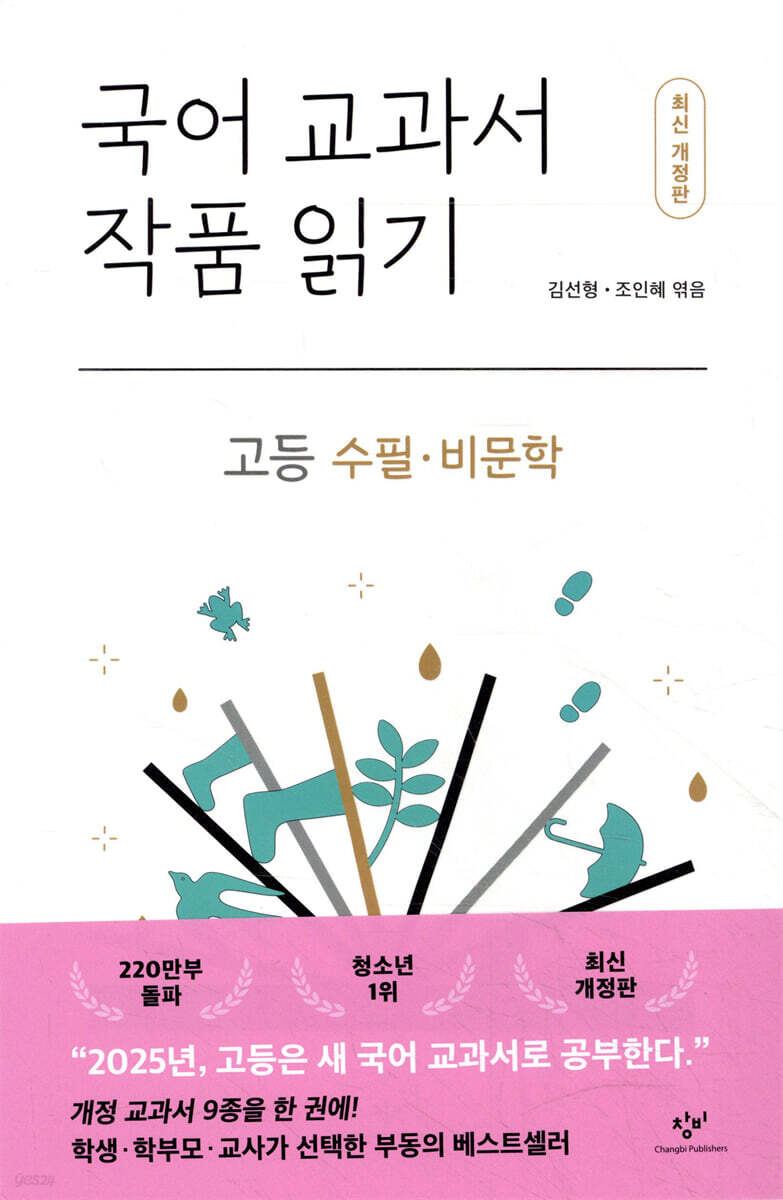
Reading Korean Language Textbook Works: High School Essays and Non-Fiction
 |
Description
Book Introduction
The foundation of literacy is ‘reading Korean language textbooks’!
We will be a friendly guide for studying the increasingly difficult Korean language.
Starting in 2025, high school Korean language will be reorganized into Common Korean 1 and 2, and students will learn using nine new Common Korean language textbooks.
They say that these days, the Korean language is becoming more difficult and literacy is declining.
The more so, the more important it is to build a strong foundation from the beginning.
The Korean language is the foundation of all subjects.
The latest revised edition of Changbi's "Reading Korean Language Textbooks" introduces poetry, novels, essays, and non-fiction works that students studying any of the nine common Korean language textbooks according to the revised curriculum must read.
This book is a diverse collection of essential works that are repeatedly included in various textbooks, as well as works that are being included in textbooks for the first time to keep pace with the changing times.
Additionally, it contains commentary tailored to students' level and a wealth of post-reading activity questions to help students learn independently.
We will help students understand and enjoy the work on their own and develop their Korean language skills.
We will be a friendly guide for studying the increasingly difficult Korean language.
Starting in 2025, high school Korean language will be reorganized into Common Korean 1 and 2, and students will learn using nine new Common Korean language textbooks.
They say that these days, the Korean language is becoming more difficult and literacy is declining.
The more so, the more important it is to build a strong foundation from the beginning.
The Korean language is the foundation of all subjects.
The latest revised edition of Changbi's "Reading Korean Language Textbooks" introduces poetry, novels, essays, and non-fiction works that students studying any of the nine common Korean language textbooks according to the revised curriculum must read.
This book is a diverse collection of essential works that are repeatedly included in various textbooks, as well as works that are being included in textbooks for the first time to keep pace with the changing times.
Additionally, it contains commentary tailored to students' level and a wealth of post-reading activity questions to help students learn independently.
We will help students understand and enjoy the work on their own and develop their Korean language skills.
- You can preview some of the book's contents.
Preview
index
Publishing the latest revised edition of 'Reading Korean Language Textbook Works'
Part 1
First Yard: A Communicative Life
Park Jun / Some words never die
Jeong Yeo-ul / We have a habit of giving up on our dreams easily.
Jeong Hye-yoon / The Invention of Life
Second Yard: Ecology and Life
Na Hee-deok / About the smell of grass
Lee Tae-jun / Hwadan
Park Wan-seo / For a Dead Bird
Choi Won-hyung / A Day Without Buying Anything
Third Yard: A Life of Reflection
Hong Min-ji / The things I don't want to do and the things I want to do are all in one bucket.
Jaeseung Jeong / How to Draw Your Own Map
Gong Seon-ok / Our Home in Those Days
Jang Dae-ik / What makes a whale dance
Jeong Yak-yong / Suojaegi
Fourth Yard: Living Together
Kim Geum-hee / The Difficulty of Believing in Good Intentions
Isul-ah / Parents who are not taken for granted
Lee Ho-jun / A grain warehouse transformed into a cradle of art.
Gong Seon-ok / Let's talk
Part 2
First Yard, Humanities and Arts
Kim Min-seop / Humanities are necessary in any era.
Lee Dong-jin / Criticism of the film "Up"
Song Gil-young / 10 years later, I'm embarrassed again
Park Chan-guk / What is a true friend?
Second Yard: Society and Culture
Shin Ji-young / High Jump of Language
Jang Dae-ik / Radius of Empathy
Jang Eun-su / Why do we read books together?
Jeong Ji-woo / Another Background to the Literacy Crisis
Go Bong-jun / Can humans become companions of animals?
Third Yard: Science and Technology
Kim Sang-wook / Human Brain and Artificial Intelligence
Shin Sang-gyu / The Moral Status of Artificial Intelligence Robots
Kim Dae-sik / Can we become friends with artificial intelligence?
Choi Seon-ju / Artificial Intelligence in Art
Nam Seong-hyeon / What is the most dangerous thing on a warming planet?
Hong Jong-ho / The Era of Decarbonization Competitiveness Becoming National Competitiveness
Fourth Yard ㆍ Media
Lee Jeong-hee / How to Use the Wise MBTI
Yoon Yeo-tak et al. / Changes in Media and Communication Culture
Kim Soo-ah / Social Participation and Internet Culture
Jo Byeong-yeong / Developing the ability to discern fakes
About the author
Source of the work
View included textbooks
Part 1
First Yard: A Communicative Life
Park Jun / Some words never die
Jeong Yeo-ul / We have a habit of giving up on our dreams easily.
Jeong Hye-yoon / The Invention of Life
Second Yard: Ecology and Life
Na Hee-deok / About the smell of grass
Lee Tae-jun / Hwadan
Park Wan-seo / For a Dead Bird
Choi Won-hyung / A Day Without Buying Anything
Third Yard: A Life of Reflection
Hong Min-ji / The things I don't want to do and the things I want to do are all in one bucket.
Jaeseung Jeong / How to Draw Your Own Map
Gong Seon-ok / Our Home in Those Days
Jang Dae-ik / What makes a whale dance
Jeong Yak-yong / Suojaegi
Fourth Yard: Living Together
Kim Geum-hee / The Difficulty of Believing in Good Intentions
Isul-ah / Parents who are not taken for granted
Lee Ho-jun / A grain warehouse transformed into a cradle of art.
Gong Seon-ok / Let's talk
Part 2
First Yard, Humanities and Arts
Kim Min-seop / Humanities are necessary in any era.
Lee Dong-jin / Criticism of the film "Up"
Song Gil-young / 10 years later, I'm embarrassed again
Park Chan-guk / What is a true friend?
Second Yard: Society and Culture
Shin Ji-young / High Jump of Language
Jang Dae-ik / Radius of Empathy
Jang Eun-su / Why do we read books together?
Jeong Ji-woo / Another Background to the Literacy Crisis
Go Bong-jun / Can humans become companions of animals?
Third Yard: Science and Technology
Kim Sang-wook / Human Brain and Artificial Intelligence
Shin Sang-gyu / The Moral Status of Artificial Intelligence Robots
Kim Dae-sik / Can we become friends with artificial intelligence?
Choi Seon-ju / Artificial Intelligence in Art
Nam Seong-hyeon / What is the most dangerous thing on a warming planet?
Hong Jong-ho / The Era of Decarbonization Competitiveness Becoming National Competitiveness
Fourth Yard ㆍ Media
Lee Jeong-hee / How to Use the Wise MBTI
Yoon Yeo-tak et al. / Changes in Media and Communication Culture
Kim Soo-ah / Social Participation and Internet Culture
Jo Byeong-yeong / Developing the ability to discern fakes
About the author
Source of the work
View included textbooks
Detailed image

Publisher's Review
“In 2025, high school students will study using the new Korean language textbook.”
Nine revised textbooks in one volume!
A bestseller chosen by students, parents, and teachers
The proven series 'Reading Korean Language Textbooks', which was first introduced in 2010 and has been chosen by 2.2 million readers, has been republished in its latest revised edition.
Changbi's 'Reading Korean Textbooks' has been published in revised editions in accordance with the new curriculum since its first edition, and with the implementation of the '2022 Revised Curriculum', it is publishing the latest revised edition in preparation for the new Korean textbooks in 2025.
In this curriculum, high school Korean language textbooks were reorganized into ‘Common Korean Language 1’ and ‘Common Korean Language 2’.
With the introduction of the 'high school credit system' where credits are earned each semester, high school students earn credits through various elective subjects, but the common Korean language is still required to be learned, not as an elective.
Recently, as students' literacy skills have been declining due to not knowing the meaning of words and having difficulty understanding texts or understanding the context of texts they read, this has become a hot topic in schools.
Current Korean language teachers agree that starting with reading the original text of a Korean language textbook and building reading skills helps improve literacy.
Korean is the foundation for learning all subjects, and by establishing a solid foundation in Korean, critical and creative thinking skills can also be strengthened.
The latest revised edition of Changbi's 'Reading Korean Textbooks' has been strengthened with a customized structure that helps build a foundation for literacy and improve Korean language skills.
The latest revised edition of Changbi's 'Reading Korean Language Textbook Works' is organized by genre: poetry, novels, essays, and non-fiction, with the works included in the 18 volumes of the newly revised common Korean language textbooks in 9 categories.
This book is a diverse collection of essential works that are repeatedly included in various textbooks, works that convey a new era and sensibility, and works that should be read carefully and thoughtfully even if they may seem unfamiliar and difficult at first.
We also provide helpful texts for deeper appreciation, provide detailed definitions for each work, and provide activities to help students reach the new curriculum's achievement standards and improve literacy.
With nearly 15 years of accumulated expertise and the trust of countless readers, "Reading Korean Textbooks" is not only the perfect preparation for the changing textbooks, but also serves as a stepping stone for building a solid foundation in the Korean language.
*The latest revised edition of the 'Reading Korean Language Textbooks' series is scheduled to be published in 2025 for the 2nd grade middle school series and in 2026 for the 3rd grade middle school series, in line with the development of new textbooks.
Features of "Reading Korean Language Textbook Works: Advanced Essays and Non-Fiction" (Revised Edition)
ㆍ Based on the 9 revised high school common Korean language textbooks, carefully selected by current Korean language teachers
According to the revised 2022 curriculum, high school students will be required to study common Korean language starting in 2025.
All essays and non-fiction texts included in 18 volumes of 9 common Korean language textbooks were carefully read and analyzed by current Korean language teachers.
Considering the objectives of the curriculum, 35 essays and non-fiction pieces selected from nine textbooks were included, along with classic essays.
Strengthening the inclusion of non-literary prose, including media areas added in the revised curriculum.
In order to prepare for the non-literature section of the Korean language section of the College Scholastic Ability Test, the number of non-literature prose pieces has been increased, and they have been organized by subject, such as humanities and arts, society and culture, and science and technology, which students find particularly difficult, to make them easy to understand at a glance.
In particular, media was grouped into a separate topic to help with learning the newly established media area in the 2022 revised curriculum.
Strengthening of post-reading activities and supportive writing to enhance self-directed appreciation and literacy.
Each work includes helpful notes and post-reading activities tailored to the curriculum, allowing students to digest the text on their own and expand their thinking.
In particular, to support media convergence learning, which is emphasized in this revised curriculum, we have strengthened reading activities and added vocabulary learning activities that form the basis of literacy.
Nine revised textbooks in one volume!
A bestseller chosen by students, parents, and teachers
The proven series 'Reading Korean Language Textbooks', which was first introduced in 2010 and has been chosen by 2.2 million readers, has been republished in its latest revised edition.
Changbi's 'Reading Korean Textbooks' has been published in revised editions in accordance with the new curriculum since its first edition, and with the implementation of the '2022 Revised Curriculum', it is publishing the latest revised edition in preparation for the new Korean textbooks in 2025.
In this curriculum, high school Korean language textbooks were reorganized into ‘Common Korean Language 1’ and ‘Common Korean Language 2’.
With the introduction of the 'high school credit system' where credits are earned each semester, high school students earn credits through various elective subjects, but the common Korean language is still required to be learned, not as an elective.
Recently, as students' literacy skills have been declining due to not knowing the meaning of words and having difficulty understanding texts or understanding the context of texts they read, this has become a hot topic in schools.
Current Korean language teachers agree that starting with reading the original text of a Korean language textbook and building reading skills helps improve literacy.
Korean is the foundation for learning all subjects, and by establishing a solid foundation in Korean, critical and creative thinking skills can also be strengthened.
The latest revised edition of Changbi's 'Reading Korean Textbooks' has been strengthened with a customized structure that helps build a foundation for literacy and improve Korean language skills.
The latest revised edition of Changbi's 'Reading Korean Language Textbook Works' is organized by genre: poetry, novels, essays, and non-fiction, with the works included in the 18 volumes of the newly revised common Korean language textbooks in 9 categories.
This book is a diverse collection of essential works that are repeatedly included in various textbooks, works that convey a new era and sensibility, and works that should be read carefully and thoughtfully even if they may seem unfamiliar and difficult at first.
We also provide helpful texts for deeper appreciation, provide detailed definitions for each work, and provide activities to help students reach the new curriculum's achievement standards and improve literacy.
With nearly 15 years of accumulated expertise and the trust of countless readers, "Reading Korean Textbooks" is not only the perfect preparation for the changing textbooks, but also serves as a stepping stone for building a solid foundation in the Korean language.
*The latest revised edition of the 'Reading Korean Language Textbooks' series is scheduled to be published in 2025 for the 2nd grade middle school series and in 2026 for the 3rd grade middle school series, in line with the development of new textbooks.
Features of "Reading Korean Language Textbook Works: Advanced Essays and Non-Fiction" (Revised Edition)
ㆍ Based on the 9 revised high school common Korean language textbooks, carefully selected by current Korean language teachers
According to the revised 2022 curriculum, high school students will be required to study common Korean language starting in 2025.
All essays and non-fiction texts included in 18 volumes of 9 common Korean language textbooks were carefully read and analyzed by current Korean language teachers.
Considering the objectives of the curriculum, 35 essays and non-fiction pieces selected from nine textbooks were included, along with classic essays.
Strengthening the inclusion of non-literary prose, including media areas added in the revised curriculum.
In order to prepare for the non-literature section of the Korean language section of the College Scholastic Ability Test, the number of non-literature prose pieces has been increased, and they have been organized by subject, such as humanities and arts, society and culture, and science and technology, which students find particularly difficult, to make them easy to understand at a glance.
In particular, media was grouped into a separate topic to help with learning the newly established media area in the 2022 revised curriculum.
Strengthening of post-reading activities and supportive writing to enhance self-directed appreciation and literacy.
Each work includes helpful notes and post-reading activities tailored to the curriculum, allowing students to digest the text on their own and expand their thinking.
In particular, to support media convergence learning, which is emphasized in this revised curriculum, we have strengthened reading activities and added vocabulary learning activities that form the basis of literacy.
GOODS SPECIFICS
- Date of issue: December 20, 2024
- Page count, weight, size: 240 pages | 400g | 141*216*16mm
- ISBN13: 9788936431501
- ISBN10: 8936431501
You may also like
카테고리
korean


korean

![GQ KOREA Mark (Monthly): December [2025]](http://librairie.coreenne.fr/cdn/shop/files/8ef265dbbfbf186523ed75ba7319009d.jpg?v=1765340328&width=3840)


