

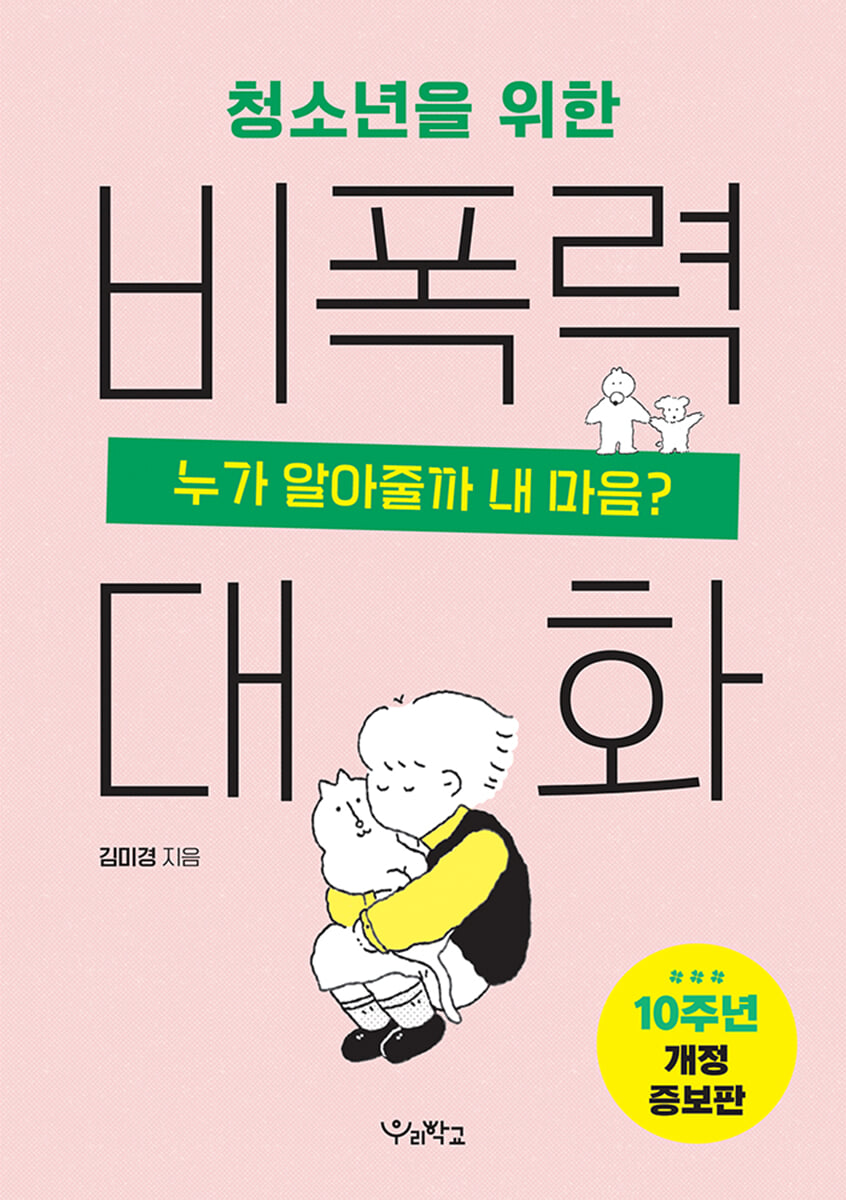
Nonviolent Communication for Youth
 |
Description
Book Introduction
Young readers read and practice it themselves
A steady seller that has experienced changes at school and home!
Nonviolent Communication for Youth, 10th Anniversary Revised and Expanded Edition
This is a revised and expanded edition of "Nonviolent Communication for Youth: Who Will Understand My Heart?", which garnered attention for suggesting "nonviolent communication" that fits the current reality of Korean youth. This edition marks the 10th anniversary of the book.
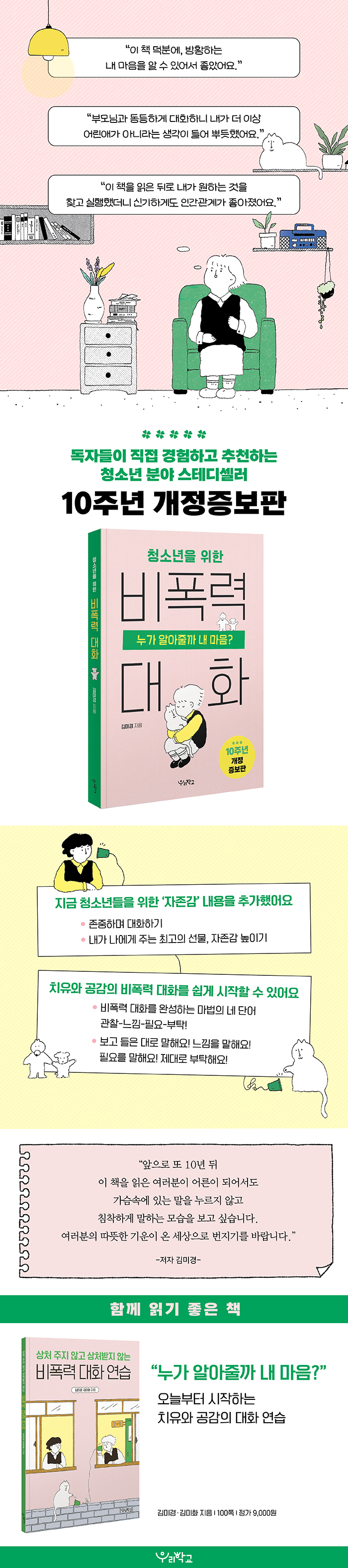
The author deeply felt the need for nonviolent communication and the practical changes it brought about through encounters with youth, teachers, parents, and youth education experts in various educational settings. He commemorated the 10th anniversary by adding a section on "self-esteem," a topic he wishes to share with youth today, 10 years later.
In addition, the author simultaneously published "Practice Nonviolent Communication Without Hurt or Being Hurt," which contains specific activity tips and exercises to help readers understand nonviolent communication more easily and put it into practice in their daily lives through over 2,000 lectures.
A steady seller that has experienced changes at school and home!
Nonviolent Communication for Youth, 10th Anniversary Revised and Expanded Edition
This is a revised and expanded edition of "Nonviolent Communication for Youth: Who Will Understand My Heart?", which garnered attention for suggesting "nonviolent communication" that fits the current reality of Korean youth. This edition marks the 10th anniversary of the book.
The author deeply felt the need for nonviolent communication and the practical changes it brought about through encounters with youth, teachers, parents, and youth education experts in various educational settings. He commemorated the 10th anniversary by adding a section on "self-esteem," a topic he wishes to share with youth today, 10 years later.
In addition, the author simultaneously published "Practice Nonviolent Communication Without Hurt or Being Hurt," which contains specific activity tips and exercises to help readers understand nonviolent communication more easily and put it into practice in their daily lives through over 2,000 lectures.
- You can preview some of the book's contents.
Preview
index
PART 1_The First Step to Nonviolent Communication
01 I see my heart
02 You have to talk to me to know
03 Recognize the words that hurt you
PART 2_It's Not Difficult! Nonviolent Communication
04 Say what you see and hear
05 Tell me how you feel
06 Tell me what you need
07 Please do it properly
PART 3_Nonviolent Communication for Me
08 If you sympathize, you become friends.
09 Gratitude makes life shine
10. Talk with respect.
01 I see my heart
02 You have to talk to me to know
03 Recognize the words that hurt you
PART 2_It's Not Difficult! Nonviolent Communication
04 Say what you see and hear
05 Tell me how you feel
06 Tell me what you need
07 Please do it properly
PART 3_Nonviolent Communication for Me
08 If you sympathize, you become friends.
09 Gratitude makes life shine
10. Talk with respect.
Detailed image
Into the book
When your mind is calm and then becomes angry, anxious, or sad due to some condition, you become aware of that anger, anxiety, or sadness.
This act of looking at my mind from a little distance is called ‘awareness.’
I am looking at myself to see what my mind is like right now.
--- p.19
If you sense anger coming from yourself or from someone else, I recommend that you don't react immediately, but instead say to yourself, "Stop," and then sit still for a moment.
Feel the waves rippling in your heart and in the heart of others.
No one throws themselves into the rough waves.
In such cases, first understand your own feelings, and when you have the time to listen to the other person, listen to everything, and when you feel a calm ripple from him, start talking.
If you don't have the time, it's better to put it off by saying, "Let's talk about it later."
--- p.57
When you use 'you' as the subject, you don't know what the other person's situation is and you expect them to do as you wish, so it can easily sound like you are criticizing or forcing them.
So arguments sometimes break out.
Also, if you use 'you' as the subject, the person speaking is likely to become emotional.
--- p.87
Observation is possible when the mind is calm and peaceful.
It's easy to get emotional when you're feeling depressed or angry.
So when emotions run high or low, the other person may seem more unhappy or the situation may seem more pessimistic.
In situations like this, judgments and evaluations immediately come to mind, so it is better to postpone the conversation until later.
--- p.97
Once you know what you want, your focus shifts from blaming others to finding the means or methods to achieve it.
When you pay attention to what you need, want, and desire, you are more likely to find it.
--- p.128
There are two ways to listen with empathy.
One is ‘mirror listening’, which means repeating back what you heard, and the other is understanding the needs of the speaker.
This act of looking at my mind from a little distance is called ‘awareness.’
I am looking at myself to see what my mind is like right now.
--- p.19
If you sense anger coming from yourself or from someone else, I recommend that you don't react immediately, but instead say to yourself, "Stop," and then sit still for a moment.
Feel the waves rippling in your heart and in the heart of others.
No one throws themselves into the rough waves.
In such cases, first understand your own feelings, and when you have the time to listen to the other person, listen to everything, and when you feel a calm ripple from him, start talking.
If you don't have the time, it's better to put it off by saying, "Let's talk about it later."
--- p.57
When you use 'you' as the subject, you don't know what the other person's situation is and you expect them to do as you wish, so it can easily sound like you are criticizing or forcing them.
So arguments sometimes break out.
Also, if you use 'you' as the subject, the person speaking is likely to become emotional.
--- p.87
Observation is possible when the mind is calm and peaceful.
It's easy to get emotional when you're feeling depressed or angry.
So when emotions run high or low, the other person may seem more unhappy or the situation may seem more pessimistic.
In situations like this, judgments and evaluations immediately come to mind, so it is better to postpone the conversation until later.
--- p.97
Once you know what you want, your focus shifts from blaming others to finding the means or methods to achieve it.
When you pay attention to what you need, want, and desire, you are more likely to find it.
--- p.128
There are two ways to listen with empathy.
One is ‘mirror listening’, which means repeating back what you heard, and the other is understanding the needs of the speaker.
--- p.171
Publisher's Review
Young readers read and practice it themselves
A steady seller that has experienced changes at school and home!
Nonviolent Communication for Youth, 10th Anniversary Revised and Expanded Edition
"Nonviolent Communication for Youth: Who Will Understand My Heart?", which garnered attention at the time of its publication for suggesting a "nonviolent communication" method suited to our reality under the theme of "dialogue for healing and empathy for wounded teenagers," has published a revised and expanded edition to celebrate its 10th anniversary.
This book has been a long-term bestseller in the youth field for 10 years, drawing sympathy and understanding of nonviolent communication from not only youth but also teachers, parents, and educators in various educational settings.
The author, who has worked as a Korean language teacher for nearly 30 years, obtained a Level 1 Counseling Teacher Certificate and completed a Nonviolent Communication Instructor course to reach out to the hearts of youth who are exhausted and hurt by school violence, bullying, and academic stress.
He said that while meeting students in various educational settings across the country and introducing non-violent communication, he came to understand the complaints, hopes, and real concerns that young people have toward adults.
Through various consultations and lectures, I have included in “Nonviolent Communication for Youth” how youth can understand, need, and practice nonviolent communication, and what changes they experience.
10 years after publication.
The author continues to promote nonviolent communication to diverse readers across various fields, and as a result, he has published a revised and expanded edition with a section on "self-esteem," a topic that was not included ten years ago but is essential for our youth today.
Observation/Feeling/Need/Request
Nonviolent communication, easy for anyone to start right now
It is not easy for anyone to realize what they 'really' want and to 'properly' express it.
In fact, it is no exaggeration to say that most of the misunderstandings and conflicts that occur around us arise from our inability to properly express our thoughts and feelings, so it is important to have a mature way of communicating.
Nonviolent communication can be defined as the process of properly expressing one's own intentions and listening to the other person's words to find common ground in situations of conflict.
This book, "Nonviolent Communication for Youth," explains the process of communication through text and examples that young people can easily relate to: observing without blame or evaluation, examining the needs and feelings of both themselves and the other person, expressing them properly, and making specific requests.
That is, we help young people express their thoughts and feelings at home and at school, listen to others, and recognize, understand, and take responsibility for the meaning of their words and the state of their bodies and minds.
This book encourages young people to open their mouths and ears to practice and experience nonviolent communication, thereby helping them experience small changes, joy, and a sense of accomplishment in their daily lives.
Through the experiences of young people told in their own words
Nonviolent communication, making it easier to empathize and understand
“Teacher, is there a nonviolent dialogue screen? Is there also violent dialogue?” For the youth who ask, “It sounds like the name of a station, Nonviolent Station,” this book contains various examples of dialogue and experiences so that young readers can empathize with what nonviolent communication is and what changes it can bring to our lives.
The vivid concerns and experiences of 16- and 17-year-olds, highlighted in color throughout the book, will allow readers to easily empathize with the stories, as if they were reading their own stories or peering into their own hearts.
Another strength of this book is that it contains the author's vivid experiences as a teacher for nearly 30 years and as a lecturer on nonviolent communication given over 2,000 times.
It contains a variety of real-life examples of youth encountering various relationships, including those with parents, siblings, friends, and teachers, as well as the experiences of children encountered at school, so it can provide readers with practical help in practicing conversation skills in their daily lives.
Additionally, to commemorate the 10th anniversary, the author simultaneously published a workbook that allows people to practice nonviolent communication through various body/language/art activities.
The revised and expanded edition of 『Nonviolent Communication for Youth』 and the workbook 『Practice Nonviolent Communication Without Hurt or Being Hurt』 will provide our youth with the experience of speaking, listening, communicating, and resonating with others through nonviolent communication, which will serve as a solid foundation for their growth.
A steady seller that has experienced changes at school and home!
Nonviolent Communication for Youth, 10th Anniversary Revised and Expanded Edition
"Nonviolent Communication for Youth: Who Will Understand My Heart?", which garnered attention at the time of its publication for suggesting a "nonviolent communication" method suited to our reality under the theme of "dialogue for healing and empathy for wounded teenagers," has published a revised and expanded edition to celebrate its 10th anniversary.
This book has been a long-term bestseller in the youth field for 10 years, drawing sympathy and understanding of nonviolent communication from not only youth but also teachers, parents, and educators in various educational settings.
The author, who has worked as a Korean language teacher for nearly 30 years, obtained a Level 1 Counseling Teacher Certificate and completed a Nonviolent Communication Instructor course to reach out to the hearts of youth who are exhausted and hurt by school violence, bullying, and academic stress.
He said that while meeting students in various educational settings across the country and introducing non-violent communication, he came to understand the complaints, hopes, and real concerns that young people have toward adults.
Through various consultations and lectures, I have included in “Nonviolent Communication for Youth” how youth can understand, need, and practice nonviolent communication, and what changes they experience.
10 years after publication.
The author continues to promote nonviolent communication to diverse readers across various fields, and as a result, he has published a revised and expanded edition with a section on "self-esteem," a topic that was not included ten years ago but is essential for our youth today.
Observation/Feeling/Need/Request
Nonviolent communication, easy for anyone to start right now
It is not easy for anyone to realize what they 'really' want and to 'properly' express it.
In fact, it is no exaggeration to say that most of the misunderstandings and conflicts that occur around us arise from our inability to properly express our thoughts and feelings, so it is important to have a mature way of communicating.
Nonviolent communication can be defined as the process of properly expressing one's own intentions and listening to the other person's words to find common ground in situations of conflict.
This book, "Nonviolent Communication for Youth," explains the process of communication through text and examples that young people can easily relate to: observing without blame or evaluation, examining the needs and feelings of both themselves and the other person, expressing them properly, and making specific requests.
That is, we help young people express their thoughts and feelings at home and at school, listen to others, and recognize, understand, and take responsibility for the meaning of their words and the state of their bodies and minds.
This book encourages young people to open their mouths and ears to practice and experience nonviolent communication, thereby helping them experience small changes, joy, and a sense of accomplishment in their daily lives.
Through the experiences of young people told in their own words
Nonviolent communication, making it easier to empathize and understand
“Teacher, is there a nonviolent dialogue screen? Is there also violent dialogue?” For the youth who ask, “It sounds like the name of a station, Nonviolent Station,” this book contains various examples of dialogue and experiences so that young readers can empathize with what nonviolent communication is and what changes it can bring to our lives.
The vivid concerns and experiences of 16- and 17-year-olds, highlighted in color throughout the book, will allow readers to easily empathize with the stories, as if they were reading their own stories or peering into their own hearts.
Another strength of this book is that it contains the author's vivid experiences as a teacher for nearly 30 years and as a lecturer on nonviolent communication given over 2,000 times.
It contains a variety of real-life examples of youth encountering various relationships, including those with parents, siblings, friends, and teachers, as well as the experiences of children encountered at school, so it can provide readers with practical help in practicing conversation skills in their daily lives.
Additionally, to commemorate the 10th anniversary, the author simultaneously published a workbook that allows people to practice nonviolent communication through various body/language/art activities.
The revised and expanded edition of 『Nonviolent Communication for Youth』 and the workbook 『Practice Nonviolent Communication Without Hurt or Being Hurt』 will provide our youth with the experience of speaking, listening, communicating, and resonating with others through nonviolent communication, which will serve as a solid foundation for their growth.
GOODS SPECIFICS
- Date of issue: June 26, 2024
- Page count, weight, size: 232 pages | 378g | 148*210*15mm
- ISBN13: 9791167552457
You may also like
카테고리
korean


korean

![GQ KOREA Mark (Monthly): December [2025]](http://librairie.coreenne.fr/cdn/shop/files/8ef265dbbfbf186523ed75ba7319009d.jpg?v=1765340328&width=3840)


