

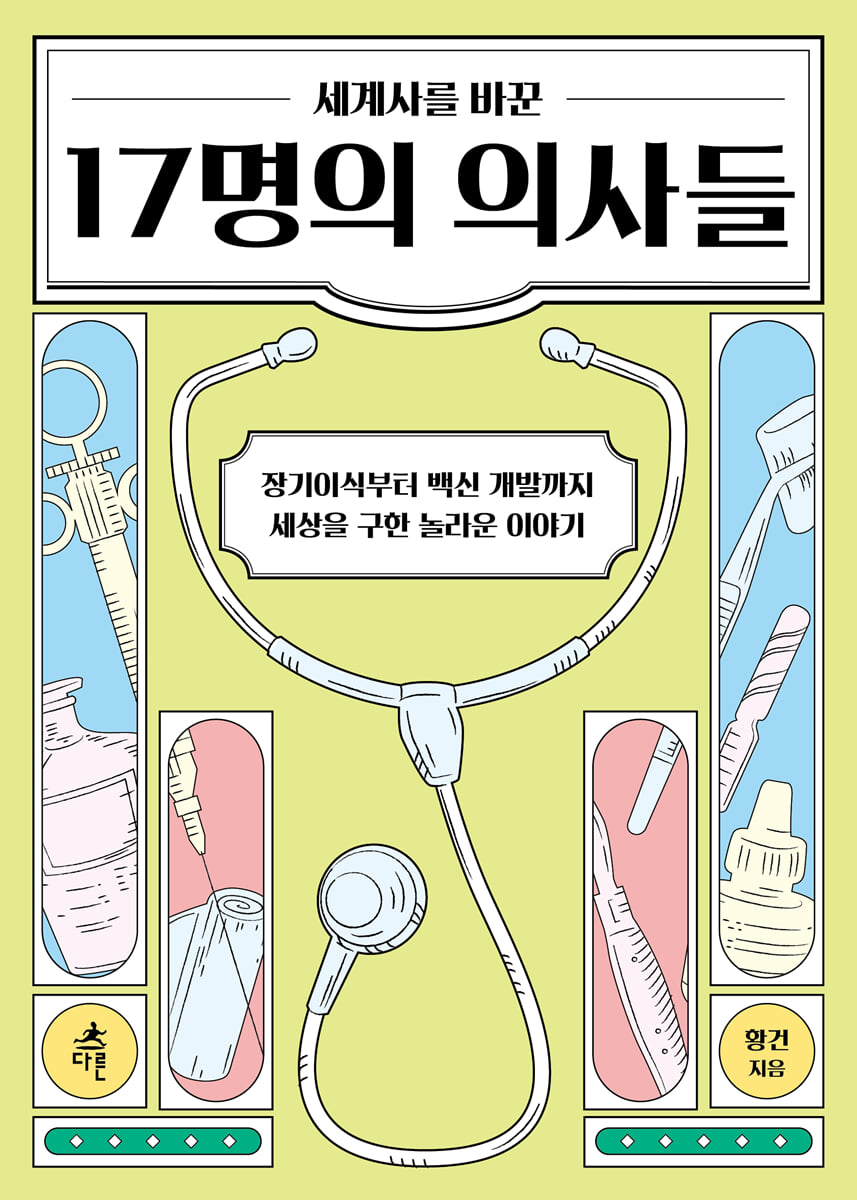
17 Doctors Who Changed World History
 |
Description
Book Introduction
From thoracic surgery, which often appears in dramas,
Infectious disease department that blocks viruses
Doctors who made history as 'firsts' in each field
Today, we live in the '100-year era'.
However, until 30 to 40 years ago, the average life expectancy of humans was 60 years.
The dramatic increase in life expectancy is thanks to advances in medical technology to treat various diseases.
Who drove medical advancements to this point? "17 Doctors Who Changed World History" illuminates the lives and research of these medical figures who left significant marks on the history of medicine.
Their achievements are introduced in 15 different medical fields, including thoracic surgery, internal medicine, emergency medicine, and neurosurgery, allowing readers to read important scenes from the history of medicine in detail and with ease in one volume.
From Carel, who developed the vascular suturing technique necessary for organ transplantation, to Larre, who created emergency medicine, and Landsteiner, who discovered blood types, all 17 medical scientists are figures who made history as 'firsts' in their respective fields.
The author has been treating patients in the medical field for nearly 40 years and lectures to students as a professor at a medical school.
The author wrote this book as if telling an exciting story to young people who dream of becoming medical professionals in a classroom.
Adding to this his long experience and thoughts as a practicing doctor, it gives a moving and resonant feeling.
You can read this book from beginning to end, but you can also change the order depending on your interest in the medical field.
It would be an interesting read to find out which doctor you would most like to meet first if you could go back in time.
Infectious disease department that blocks viruses
Doctors who made history as 'firsts' in each field
Today, we live in the '100-year era'.
However, until 30 to 40 years ago, the average life expectancy of humans was 60 years.
The dramatic increase in life expectancy is thanks to advances in medical technology to treat various diseases.
Who drove medical advancements to this point? "17 Doctors Who Changed World History" illuminates the lives and research of these medical figures who left significant marks on the history of medicine.
Their achievements are introduced in 15 different medical fields, including thoracic surgery, internal medicine, emergency medicine, and neurosurgery, allowing readers to read important scenes from the history of medicine in detail and with ease in one volume.
From Carel, who developed the vascular suturing technique necessary for organ transplantation, to Larre, who created emergency medicine, and Landsteiner, who discovered blood types, all 17 medical scientists are figures who made history as 'firsts' in their respective fields.
The author has been treating patients in the medical field for nearly 40 years and lectures to students as a professor at a medical school.
The author wrote this book as if telling an exciting story to young people who dream of becoming medical professionals in a classroom.
Adding to this his long experience and thoughts as a practicing doctor, it gives a moving and resonant feeling.
You can read this book from beginning to end, but you can also change the order depending on your interest in the medical field.
It would be an interesting read to find out which doctor you would most like to meet first if you could go back in time.
- You can preview some of the book's contents.
Preview
index
Introduction _Doctors who changed the fate of mankind
1.
The First Successful Heart Transplant_Christian Barnard
Stopping the Heart to Save It | The First Successful Heart Transplant | Incomplete Surgeries Become a Trend | The Hidden Helper: Hamilton Naki
One Step Further: A Heart Transplant Surgery That Even Requires a Helicopter
2.
Laying the Foundations of Plastic Surgery on the Battlefield_Gillis and MacIndoe
Gillis Restores Dignity to Veterans | McIndoe Soothes Burn Patients | Patients Come First, No Matter What
One Step Further_Can Scars Be Completely Removed?
3.
Taking the First Steps in Organ Transplantation_Alexey Carell
Connecting Blood Vessels Keeps Tissues Alive | Learning to Sew from an Embroidery Master | The Vascular Suture Method That Formed the Foundation of Organ Transplantation | Creating the World's Most Famous Cells
One Step Further: Eugenics, the Academic Science That Justified Racism
4.
Jonas Salk, the first to develop a polio vaccine
Polio, as terrifying as the atomic bomb | The first vaccine that saved humanity from polio | A vaccine that only requires one dose | Which vaccine is more effective?
One Step Further_Pasteur's Great Discovery
5.
Ignaz Semmelweis, the first to discover the importance of handwashing
Pondering ways to prevent puerperal fever | The first doctor to emphasize the importance of hygiene | Research continued through a lonely fight | Recognized 20 years after his death
One Step Further_Essentials for Medical Papers
6.
Building the World's First Ambulance_Dominique Jean Larre
Inventing the 'Flying Ambulance' | Triage Methods That Removed All Ranks | Traveling the Battlefields of Europe and Africa | Humanitarianism That Distinguishes Allies and Enemies
One Step Further_Doctor Helicopter and Golden Time
7.
Karl Landsteiner, the first to discover blood types
Why Blood Transfusions Were Banned for 150 Years | Distinguishing Blood into Four Types | The Study That Saved the Most Lives in Human History
Efforts to prevent clotting
One Step Further_Blood Transfusion Methods Developed in War
8.
Frederick Banting: Creating the Key to Diabetes Treatment
A disease that causes sweet-tasting urine | Efforts to find the cause of diabetes | A new hypothesis developed by an anonymous medical student | Success in extracting insulin
One Step Further: Advances in Diabetes Treatment
9.
Creating the Operating Room Essential: The Bobby_William Bobby
The signal exchanged in the operating room: "Bobby On" | Surgery without Bobby is unimaginable | Living in poverty, but leaving a mark.
One Step Further: Essential Tools for the Operating Room
10.
Developing the gastroscope_Tatsuro Uji
Attempts to observe the inside of the body through metal tubes|Doctors and engineers meet|From high-definition displays to colonoscopes|Becoming the world's leading endoscopy company
One Step Further: A Capsule Endoscope That Can Be Swallowed Like a Pill
11.
Discovering the Cause of Leprosy_Gerhard Hansen
Leprosy Patients Exiled from Society | Discovering the Leprosy Bacteria | The Battle Between Hansen's Disease and Leprosy | Dispelling Misconceptions
One step further, the poet of leprosy, Han Ha-un
12.
William Morton, the first to successfully administer general anesthesia
Attempting anesthesia with 'laughing gas' | Confirming the effectiveness of ether | Patent disputes | Another anesthetic: chloroform
One Step Further: A Look Inside Standard Anesthesia
13.
Hunter and Jenner: Developing the World's First Vaccine
The Master's Passionate Experimental Spirit | Research Still in Use Today | The Student Who Created the First Vaccine | Overcoming Prejudice and Criticism
One Step Further_Chickenpox and Measles
14.
Mapping the Brain_Wilder Penfield
Exploring the Cerebral Cortex | The Homunculus with the Big Hand | Laying the Foundation for Hallucination Research
One Step Further: The Principles of the Nervous System That Inspired Science Fiction
15.
Discovering X-rays_Wilhelm Röntgen
In Search of the Mysterious Light | Photographing the Bones Inside the Body | The Use of X-Rays
One Step Further_Radiation to Treat Cancer
supplement
References | Photo source
1.
The First Successful Heart Transplant_Christian Barnard
Stopping the Heart to Save It | The First Successful Heart Transplant | Incomplete Surgeries Become a Trend | The Hidden Helper: Hamilton Naki
One Step Further: A Heart Transplant Surgery That Even Requires a Helicopter
2.
Laying the Foundations of Plastic Surgery on the Battlefield_Gillis and MacIndoe
Gillis Restores Dignity to Veterans | McIndoe Soothes Burn Patients | Patients Come First, No Matter What
One Step Further_Can Scars Be Completely Removed?
3.
Taking the First Steps in Organ Transplantation_Alexey Carell
Connecting Blood Vessels Keeps Tissues Alive | Learning to Sew from an Embroidery Master | The Vascular Suture Method That Formed the Foundation of Organ Transplantation | Creating the World's Most Famous Cells
One Step Further: Eugenics, the Academic Science That Justified Racism
4.
Jonas Salk, the first to develop a polio vaccine
Polio, as terrifying as the atomic bomb | The first vaccine that saved humanity from polio | A vaccine that only requires one dose | Which vaccine is more effective?
One Step Further_Pasteur's Great Discovery
5.
Ignaz Semmelweis, the first to discover the importance of handwashing
Pondering ways to prevent puerperal fever | The first doctor to emphasize the importance of hygiene | Research continued through a lonely fight | Recognized 20 years after his death
One Step Further_Essentials for Medical Papers
6.
Building the World's First Ambulance_Dominique Jean Larre
Inventing the 'Flying Ambulance' | Triage Methods That Removed All Ranks | Traveling the Battlefields of Europe and Africa | Humanitarianism That Distinguishes Allies and Enemies
One Step Further_Doctor Helicopter and Golden Time
7.
Karl Landsteiner, the first to discover blood types
Why Blood Transfusions Were Banned for 150 Years | Distinguishing Blood into Four Types | The Study That Saved the Most Lives in Human History
Efforts to prevent clotting
One Step Further_Blood Transfusion Methods Developed in War
8.
Frederick Banting: Creating the Key to Diabetes Treatment
A disease that causes sweet-tasting urine | Efforts to find the cause of diabetes | A new hypothesis developed by an anonymous medical student | Success in extracting insulin
One Step Further: Advances in Diabetes Treatment
9.
Creating the Operating Room Essential: The Bobby_William Bobby
The signal exchanged in the operating room: "Bobby On" | Surgery without Bobby is unimaginable | Living in poverty, but leaving a mark.
One Step Further: Essential Tools for the Operating Room
10.
Developing the gastroscope_Tatsuro Uji
Attempts to observe the inside of the body through metal tubes|Doctors and engineers meet|From high-definition displays to colonoscopes|Becoming the world's leading endoscopy company
One Step Further: A Capsule Endoscope That Can Be Swallowed Like a Pill
11.
Discovering the Cause of Leprosy_Gerhard Hansen
Leprosy Patients Exiled from Society | Discovering the Leprosy Bacteria | The Battle Between Hansen's Disease and Leprosy | Dispelling Misconceptions
One step further, the poet of leprosy, Han Ha-un
12.
William Morton, the first to successfully administer general anesthesia
Attempting anesthesia with 'laughing gas' | Confirming the effectiveness of ether | Patent disputes | Another anesthetic: chloroform
One Step Further: A Look Inside Standard Anesthesia
13.
Hunter and Jenner: Developing the World's First Vaccine
The Master's Passionate Experimental Spirit | Research Still in Use Today | The Student Who Created the First Vaccine | Overcoming Prejudice and Criticism
One Step Further_Chickenpox and Measles
14.
Mapping the Brain_Wilder Penfield
Exploring the Cerebral Cortex | The Homunculus with the Big Hand | Laying the Foundation for Hallucination Research
One Step Further: The Principles of the Nervous System That Inspired Science Fiction
15.
Discovering X-rays_Wilhelm Röntgen
In Search of the Mysterious Light | Photographing the Bones Inside the Body | The Use of X-Rays
One Step Further_Radiation to Treat Cancer
supplement
References | Photo source
Into the book
In the United States, Karel was finally able to develop a new method to reconnect blood vessels.
He connected the two ends of the veins using a very thin needle and a delicate silk thread, as he had learned from a master seamstress.
In particular, a method was developed to change the round cross-section of blood vessels into a triangular shape using only three stitches.
This is the triangular suture method, which can be called Karel's great achievement.
--- p.47 From “Taking the First Step to Organ Transplantation”
Semmelweis argued that there were invisible particles that moved from the corpse to the mother.
The identity of the particles was not revealed to be bacteria until the 1880s, long after his death, by Pasteur.
This led to his claim being belatedly recognized.
Joseph Lister, the physician who first implemented sterilization, also acknowledged Semmelweis's achievements, reaching the same conclusion.
Semmelweis's paper, which even suggested a method of preventing infection, was registered as a UNESCO Memory of the World in 2013.
--- pp.75~76 From “Discovering the Importance of Hand Washing for the First Time”
Larre was deployed as a military doctor to fight against counter-revolutionary forces.
At the scene, he was faced with a sad reality.
Many soldiers could have survived if they had received timely treatment, but they died because they did not.
This was because the injured soldiers could not be quickly transported to a doctor.
How could he treat the wounded more quickly? He saw the newly formed unit created by Napoleon, a former artillery officer, and came up with a new method.
--- pp.84~85 From “Creating the First Ambulance in Humanity”
Landsteiner's paper on blood types was a very important discovery that changed the fate of mankind.
However, his thesis is considered to be one of the most recent studies to be made known to the world.
It was not until 30 years later that his achievements were recognized and he was awarded the Nobel Prize in Physiology or Medicine.
This is because the aversion to and fear of blood transfusions has been prevalent in the medical community for hundreds of years, so not many people are willing to accept blood transfusions based on their blood type.
--- p.100 From “The First Discovery of Blood Types”
Hansen failed to cultivate leprosy bacteria on artificial media.
(…) He was afraid that he could not do anything.
He became anxious and tried to infect a woman with the fungus without obtaining her consent.
It was an action that a doctor responsible for a patient's life should never commit, and it was also against Norwegian health law.
He connected the two ends of the veins using a very thin needle and a delicate silk thread, as he had learned from a master seamstress.
In particular, a method was developed to change the round cross-section of blood vessels into a triangular shape using only three stitches.
This is the triangular suture method, which can be called Karel's great achievement.
--- p.47 From “Taking the First Step to Organ Transplantation”
Semmelweis argued that there were invisible particles that moved from the corpse to the mother.
The identity of the particles was not revealed to be bacteria until the 1880s, long after his death, by Pasteur.
This led to his claim being belatedly recognized.
Joseph Lister, the physician who first implemented sterilization, also acknowledged Semmelweis's achievements, reaching the same conclusion.
Semmelweis's paper, which even suggested a method of preventing infection, was registered as a UNESCO Memory of the World in 2013.
--- pp.75~76 From “Discovering the Importance of Hand Washing for the First Time”
Larre was deployed as a military doctor to fight against counter-revolutionary forces.
At the scene, he was faced with a sad reality.
Many soldiers could have survived if they had received timely treatment, but they died because they did not.
This was because the injured soldiers could not be quickly transported to a doctor.
How could he treat the wounded more quickly? He saw the newly formed unit created by Napoleon, a former artillery officer, and came up with a new method.
--- pp.84~85 From “Creating the First Ambulance in Humanity”
Landsteiner's paper on blood types was a very important discovery that changed the fate of mankind.
However, his thesis is considered to be one of the most recent studies to be made known to the world.
It was not until 30 years later that his achievements were recognized and he was awarded the Nobel Prize in Physiology or Medicine.
This is because the aversion to and fear of blood transfusions has been prevalent in the medical community for hundreds of years, so not many people are willing to accept blood transfusions based on their blood type.
--- p.100 From “The First Discovery of Blood Types”
Hansen failed to cultivate leprosy bacteria on artificial media.
(…) He was afraid that he could not do anything.
He became anxious and tried to infect a woman with the fungus without obtaining her consent.
It was an action that a doctor responsible for a patient's life should never commit, and it was also against Norwegian health law.
--- pp.151~152 From “Discovering the Cause of ‘Leprosy’”
Publisher's Review
Today, we live in the '100-year era'.
However, until 30 to 40 years ago, the average life expectancy of humans was 60 years.
The dramatic increase in life expectancy is thanks to advances in medical technology to treat various diseases.
Not only have we eradicated infectious diseases like smallpox and polio, we are also gradually unraveling the mysteries of diseases that were once considered incurable, such as stroke, cancer, and heart attack.
There are even predictions that in the future, we may reach the age of 120, exceeding 100.
All of this would be impossible without advances in medicine.
Who drove medical advancements to this point? "17 Doctors Who Changed World History" illuminates the lives and research of medical figures who left significant marks on the history of medicine.
Their achievements are introduced in 15 different medical fields, including thoracic surgery, internal medicine, emergency medicine, and neurosurgery, allowing readers to read important scenes from the history of medicine in detail and with ease in one volume.
From Carel, who developed the vascular suturing technique necessary for organ transplantation, to Larre, who created emergency medicine, and Landsteiner, who discovered blood types, all 17 medical scientists are figures who made history as 'firsts' in their respective fields.
Vascular suturing techniques required for organ transplantation,
Development of gastroscopes, invention of surgical instruments…
Crucial moments in medical advancement that extended human lifespan
Doctors that even doctors are curious about
The doctors featured in this book have studied in various fields, worked in various periods, and lived different lives.
While some doctors, like Barnard, who performed the first successful heart transplant, achieved both fame and fortune, others, like the Hungarian obstetrician Semmelweis, were not recognized during their lifetime.
While there are those who boldly gave up their patents for the public good, like Salk, who created the polio vaccine, there are also those who committed wrongdoings to satisfy their own selfish desires.
But one thing in common is clear.
It means that you did something that was 'necessary' at that time.
Doctors boldly tackled veiled problems, such as unknown viruses and the limitations of surgical techniques.
He used his rich imagination to formulate groundbreaking hypotheses and never gave up on research and experiments to prove them.
★Doctors in this book★
Christian Barnard, the first successful heart transplant patient
[Plastic Surgery] Gillis and McIndoe, who laid the foundation for plastic surgery
[Transplant Surgery] Alexi Carell, the pioneer in organ transplantation
[Pediatrics] Jonas Salk, who developed the polio vaccine
[Obstetrics and Gynecology] Ignaz Semmelweis, who taught us the importance of handwashing.
[Emergency Medicine] Dominique Jean Larre, the inventor of the world's first ambulance
[Vascular Surgery] Karl Landsteiner, the discoverer of blood types
[Endocrinology] Frederick Banting, the man who pioneered diabetes treatment
[Department of Biomedical Engineering] William Bovey, inventor of the electrosurgical device
[Gastroenterological Surgery] Tatsuro Uji, the developer of the gastroscopy
[Dermatology] Gerhard Hansen, who discovered the cause of leprosy
William Morton, a successful anesthesiologist
[Infectious Diseases] Hunter and Jenner: Developing the World's First Vaccine
[Neurosurgery] Wilder Penfield, who mapped the brain
[Department of Radiology] Wilhelm Röntgen, the discoverer of X-rays
However, until 30 to 40 years ago, the average life expectancy of humans was 60 years.
The dramatic increase in life expectancy is thanks to advances in medical technology to treat various diseases.
Not only have we eradicated infectious diseases like smallpox and polio, we are also gradually unraveling the mysteries of diseases that were once considered incurable, such as stroke, cancer, and heart attack.
There are even predictions that in the future, we may reach the age of 120, exceeding 100.
All of this would be impossible without advances in medicine.
Who drove medical advancements to this point? "17 Doctors Who Changed World History" illuminates the lives and research of medical figures who left significant marks on the history of medicine.
Their achievements are introduced in 15 different medical fields, including thoracic surgery, internal medicine, emergency medicine, and neurosurgery, allowing readers to read important scenes from the history of medicine in detail and with ease in one volume.
From Carel, who developed the vascular suturing technique necessary for organ transplantation, to Larre, who created emergency medicine, and Landsteiner, who discovered blood types, all 17 medical scientists are figures who made history as 'firsts' in their respective fields.
Vascular suturing techniques required for organ transplantation,
Development of gastroscopes, invention of surgical instruments…
Crucial moments in medical advancement that extended human lifespan
Doctors that even doctors are curious about
The doctors featured in this book have studied in various fields, worked in various periods, and lived different lives.
While some doctors, like Barnard, who performed the first successful heart transplant, achieved both fame and fortune, others, like the Hungarian obstetrician Semmelweis, were not recognized during their lifetime.
While there are those who boldly gave up their patents for the public good, like Salk, who created the polio vaccine, there are also those who committed wrongdoings to satisfy their own selfish desires.
But one thing in common is clear.
It means that you did something that was 'necessary' at that time.
Doctors boldly tackled veiled problems, such as unknown viruses and the limitations of surgical techniques.
He used his rich imagination to formulate groundbreaking hypotheses and never gave up on research and experiments to prove them.
★Doctors in this book★
Christian Barnard, the first successful heart transplant patient
[Plastic Surgery] Gillis and McIndoe, who laid the foundation for plastic surgery
[Transplant Surgery] Alexi Carell, the pioneer in organ transplantation
[Pediatrics] Jonas Salk, who developed the polio vaccine
[Obstetrics and Gynecology] Ignaz Semmelweis, who taught us the importance of handwashing.
[Emergency Medicine] Dominique Jean Larre, the inventor of the world's first ambulance
[Vascular Surgery] Karl Landsteiner, the discoverer of blood types
[Endocrinology] Frederick Banting, the man who pioneered diabetes treatment
[Department of Biomedical Engineering] William Bovey, inventor of the electrosurgical device
[Gastroenterological Surgery] Tatsuro Uji, the developer of the gastroscopy
[Dermatology] Gerhard Hansen, who discovered the cause of leprosy
William Morton, a successful anesthesiologist
[Infectious Diseases] Hunter and Jenner: Developing the World's First Vaccine
[Neurosurgery] Wilder Penfield, who mapped the brain
[Department of Radiology] Wilhelm Röntgen, the discoverer of X-rays
GOODS SPECIFICS
- Publication date: March 25, 2021
- Page count, weight, size: 212 pages | 354g | 150*210*13mm
- ISBN13: 9791156333333
- ISBN10: 1156333334
You may also like
카테고리
korean


korean

![GQ KOREA Mark (Monthly): December [2025]](http://librairie.coreenne.fr/cdn/shop/files/8ef265dbbfbf186523ed75ba7319009d.jpg?v=1765340328&width=3840)


