

Outcasts of the Screen
 |
Description
Book Introduction
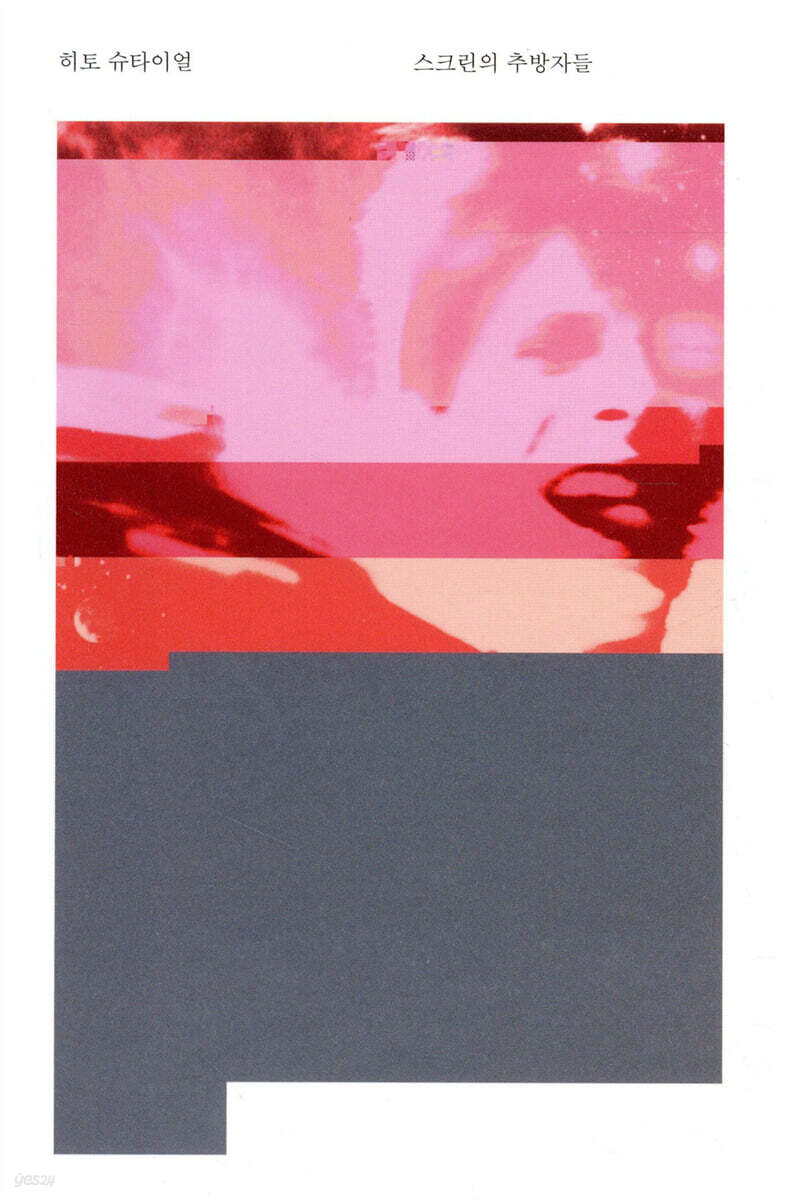
This is a revised edition of The Wretched of the Screen by Berlin-based filmmaker and author Hito Steyerl.
Recently named the most influential figure in the global art scene (Art Review 2017), he has consistently provided a source of inspiration to fellow artists, curators, and contemporary theorists through his work, writing, and lectures.
This revised edition addresses more rigorously the two dimensions of the book's implications: as a contemporary art practice and as a theoretical work discussing art discourse and the politics of image.
For the latter, we added the review and annotations of Kim Ji-hoon, a video, film theory, and media researcher, and included an introduction that analyzed Hito Steyerl's theory and art project around the three concepts of 'post-representation,' 'post-truth,' and 'post-internet.'
Recently named the most influential figure in the global art scene (Art Review 2017), he has consistently provided a source of inspiration to fellow artists, curators, and contemporary theorists through his work, writing, and lectures.
This revised edition addresses more rigorously the two dimensions of the book's implications: as a contemporary art practice and as a theoretical work discussing art discourse and the politics of image.
For the latter, we added the review and annotations of Kim Ji-hoon, a video, film theory, and media researcher, and included an introduction that analyzed Hito Steyerl's theory and art project around the three concepts of 'post-representation,' 'post-truth,' and 'post-internet.'
index
Entering
Foreword / Franco 'Before' Berardi
Free Fall: A Thought Experiment on Vertical Perspective
Defending the image of poverty
Things like you and me
Is the art museum a factory?
Joint of protest
The Politics of Art: Contemporary Art and the Transition to Post-Democracy
The Art Profession: Arguments for Autonomy in Life
Freedom from Everything: Freelancers and Mercenaries
Missing Persons: A Site of Uncertainty: Entanglement, Overlap, and Excavation
Spam on Earth: Retreating from Reproduction
Cut! Reproduction and Recombination
Acknowledgements
List of illustrations
Translator's Note
Release - Post-reproduction, post-truth, post-internet:
Hito Steyerl's Theory and Art Project / Kim Ji-hoon
Foreword / Franco 'Before' Berardi
Free Fall: A Thought Experiment on Vertical Perspective
Defending the image of poverty
Things like you and me
Is the art museum a factory?
Joint of protest
The Politics of Art: Contemporary Art and the Transition to Post-Democracy
The Art Profession: Arguments for Autonomy in Life
Freedom from Everything: Freelancers and Mercenaries
Missing Persons: A Site of Uncertainty: Entanglement, Overlap, and Excavation
Spam on Earth: Retreating from Reproduction
Cut! Reproduction and Recombination
Acknowledgements
List of illustrations
Translator's Note
Release - Post-reproduction, post-truth, post-internet:
Hito Steyerl's Theory and Art Project / Kim Ji-hoon
Publisher's Review
A revised edition of Berlin-based filmmaker and author Hito Steyerl's The Wretched of the Screen has been published.
Recently named the most influential figure in the global art scene (ArtReview, 2017), he has consistently provided a source of inspiration to fellow artists, curators, and contemporary theorists through his work, writing, and lectures.
The revised edition addresses more rigorously the two dimensions of the book's implications: as a contemporary art practice and as a theoretical work discussing art discourse and image politics.
For the latter, we added the review and annotations of Kim Ji-hoon, a video, film theory, and media researcher, and included an introduction that analyzed Hito Steyerl's theory and art project around the three concepts of 'post-representation,' 'post-truth,' and 'post-internet.'
Meanwhile, 「Duty Free Art」(2015) and 「The Terror of Total Dasein: Economies of Presence in the Art Field」(2015), which were added to the first Korean edition (2016), will be included in Hito Steyerl's follow-up work, 「Duty Free Art: Art in the Age of Planetary Civil War」 (tentative title), to be published by Workroom Press.
How to Cope in a Free-Falling World
Hito Steyerl's writings often begin by reminding us of points we might not have thought of.
What if the ground we stand on isn't solid? What if we, along with the world, are in free fall? From the very first article, "Free Fall: A Thought Experiment on Vertical Perspective," he challenges the reader.
From this, doubts arise about the world you believed in, the images you saw, and the art you enjoyed.
His examination of linear perspective as a key device that made modernity possible goes on to reveal that the aerial perspective that has become so familiar to us in the 21st century is also false, that we no longer have a solid foundation.
And then ask again.
But did we ever need a foundation as a foundation in the first place? Isn't forming a line, enjoying the free fall, and encountering the dizziness that comes from that dizzying drop the right way to cope with this era?
His speech, which overturns reality with such a groundbreaking imagination, is also prominent in his famous writing, “In Defense of the Image of Poverty.”
In the hierarchy of images, where value is measured by resolution and sharpness, where do the discarded images go—those that are copied, edited, and endlessly circulated, becoming blurred in the process? Banished from the official screen, they wander the wasteland of the digital world.
What can this image do?
nothing.
And everything.
Steyerl argues that “apart from resolution and exchange value, we must adopt another form of value defined by speed, intensity, and diffusion” as the new standard for defining contemporary images.
And the mission these poor images perform runs through the entire book.
For example, according to "Spam on Earth: Retreating from Representation," image spam acts as a surprisingly real-world double agent, providing us with a refuge from the surveillance that permeates modern society.
Are you serious? The truth is, you've never even looked at image spam, so you don't know what they really look like, why they're always smiling, or what they do when we're not looking.
The screen of contemporary art
Hito Steyerl's writing also exposes the way contemporary art operates.
He does not hesitate to call art galleries, as social factories, “official agents of the cultural industry, staffed by interns who work tirelessly for free.”
In this economy, even the audience cannot avoid the labor of watching.
No, the art museum that extends across the world does not allow exit.
Because art's long-held desire for unity with life has been realized today in a life dominated by art.
“You might answer that you only occasionally encounter art or something, but that it has nothing to do with you.
How does art take over your life? Perhaps some of these apply to you.
Has art taken over you, disguised as a boundless self-practice? Do you wake up feeling like a replica of yourself? Are you constantly on display? Have you ever felt beautified, improved, or elevated by someone or something, or sought to be one? Has your rent ever doubled because a few paintbrush-wielding kids moved into the crumbling building next door? Have your emotions ever been designed, or rather, does your iPhone seem to design you? […] Do you live in a city where a staggering chunk of the city's cultural budget is dedicated to one-off art exhibitions? Do exploitative banks privatize local conceptual art? All of these are signs of artistic occupation.”
Contemporary art is also a major tool for reinforcing the neoliberal order by spreading its branches around the world.
“Contemporary art is unpredictable, inexplicable, sparkling, volatile, moody, driven by inspiration and genius.
Just as any oligarchy that dreams of dictatorship would want to portray itself as such.
The traditional understanding of the artist's role is too similar to the self-portrait of anyone who aspires to be a dictator.
For them, government is potentially, and dangerously, a form of art. “A country where human rights are violated? Just build a museum designed by Frank Gehry!” Throughout Hito Steyerl’s writings, we encounter contemporary art that functions as a screen to obscure a sordid reality.
Thaw it.
Accelerate.
Live there.
Occupy
Steyerl's writing always leads us back to reality itself.
The discussion of art quickly turns to the freedom we face in the neoliberal era, and it is revealed that it is not “the enjoyment of civil liberties, but rather the freedom of free fall, a common experience for many people thrown into an uncertain and unpredictable future.”
Today, when all labor has been transformed into a job, “at the end of the day, people leave their workplace, go home, and perform tasks that were previously called labor.”
Moreover, he does not stop at revealing the true face of contemporary art and reality, but jumps into it as an activist.
Sometimes I excavate mass graves from the Spanish Civil War, touching the testimonies left by the missing with their bodies, and mourning the traces of friends executed in Turkey.
And all of these things are linked to his work and intervene in the real world.
Rather than lamenting or being discouraged by the bleak reality, we always find a way to face it head-on (or bypass it) and call for action.
His writing is a powerful propaganda in itself.
He shows the fragments of shattered reality and says:
“Let’s edit this again.
Rebuild.
Redeploy.
Break it.
Join.
Make it strange.
Thaw it.
Accelerate.
Live there.
Occupy.” In Hito Steyerl’s writing, we learn that the place where images banished from the screen reside is a commons granted to us, a territory to be occupied.
GOODS SPECIFICS
- Date of issue: February 1, 2018
- Page count, weight, size: 328 pages | 124*188*27mm
- ISBN13: 9788994207940
- ISBN10: 8994207945
You may also like
카테고리
korean


korean

![GQ KOREA Mark (Monthly): December [2025]](http://librairie.coreenne.fr/cdn/shop/files/8ef265dbbfbf186523ed75ba7319009d.jpg?v=1765340328&width=3840)


