

Art Makes History
 |
Description
Book Introduction
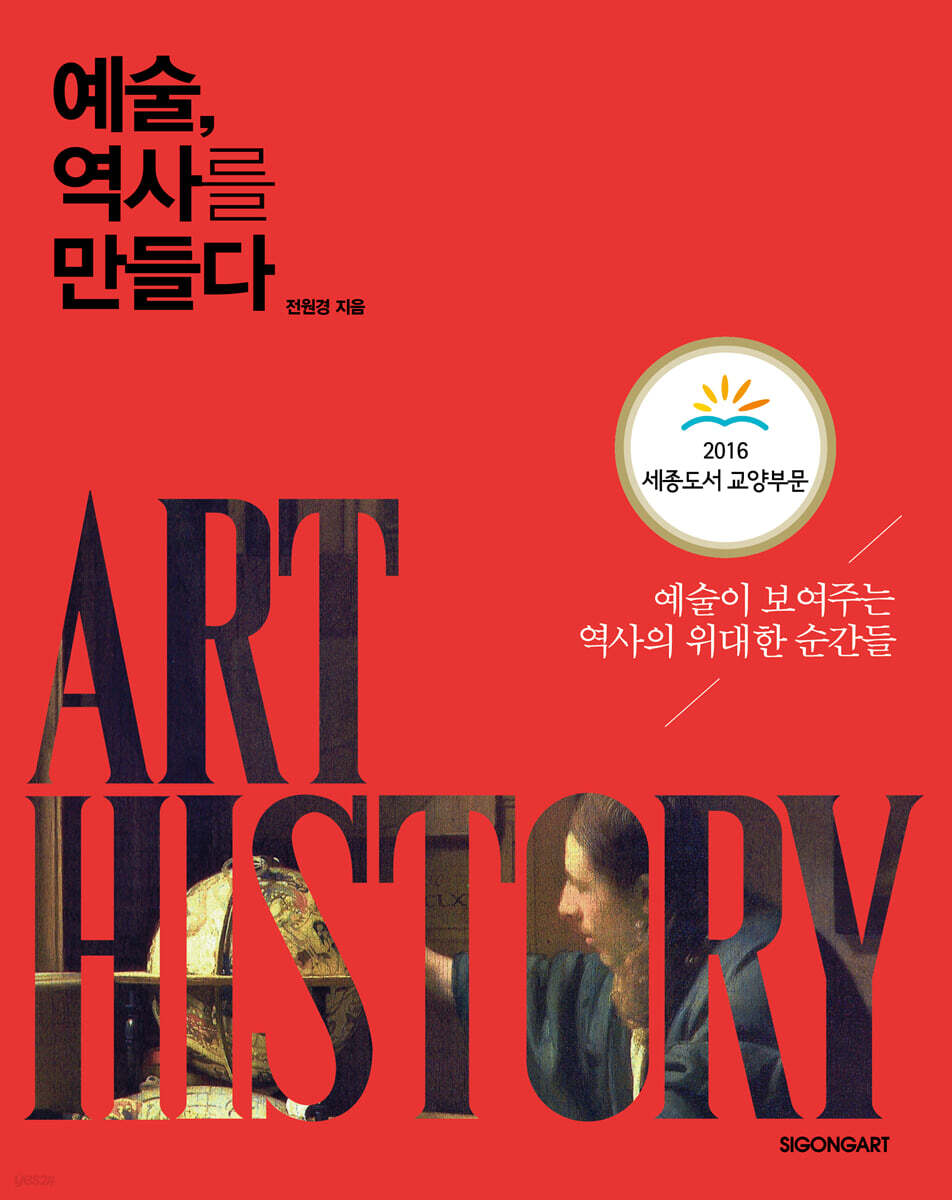
Meet the popular lectures of the Seoul Arts Center Humanities Academy in book form! This book was completed by organizing the lectures given at the Arts Center Humanities Academy over a period of two years and including approximately 300 illustrations. As a lecture that brings together numerous students every week, it is filled with fascinating stories of art and history that catch the eye. Although the table of contents is organized chronologically, the story unfolds in a wondrous way, crossing time and space. If you expect that when we talk about ancient Egypt, it will only be about the Sphinx and the pyramids, you would be very mistaken. From the glass pyramid built by French President Mitterrand to address the lack of a clear entrance to the vast museum during his 1980s reconstruction project, to the fact that Mozart's final work, The Magic Flute, was set in ancient Egypt in 1791, and the story of how Napoleon's expedition to Egypt between 1798 and 1801 revived a lost Egyptian civilization, this book will broaden your perspective as you explore every corner of history. |
- You can preview some of the book's contents.
Preview
index
Entering
01 Ancient Egypt: Kings and Queens Who Dreamed of Eternity
02 Greece and Rome: Conquerors or Invaders
03 Early Christianity: Belief in Eternal Life
04 Byzantium and Constantinople: The Forgotten Empire
05 Middle Ages, Crusades and Gothic: Weird or Holy
06 Renaissance: Spring Comes to the City of Flowers
07 The Beginning of Opera, Theatre, and Ballet: The Stage Opens
08 The Reformation: A Divided Europe
09 Absolute Monarchy and Baroque: My Lord is a Strong Castle
10 Rococo and the Enlightenment: Art Flourished by Nobles and Citizens
11 18th-Century Europe: Why Turkey Was an Object of Envy for Artists
12 The French Revolution: Revolution Spreads Throughout Europe
13 German Music and Romanticism: 'Winterreise' Wanders Through the Black Forest
14 Italian Unification and Opera: Viva Verdi!
15 Industrial Revolution: Parisian Bohemians Fall in Love
16 Impressionist Art and Program Music: Capturing Sunlight and Waves in Art
17 The Growth of the Art Industry: The Emergence of Professional Artists and Collectors
18 The Victorian Era: The Strange Decline of Island Britain
19 The United States and Russia: Two Frontiers
20 Imperialism in Art: Longing for the Distant Country of Japan
Art of the Early 20th Century: 1913, the Last Great Year
22 World War I and II: Europe in Trouble
References
Appendix Chronology
01 Ancient Egypt: Kings and Queens Who Dreamed of Eternity
02 Greece and Rome: Conquerors or Invaders
03 Early Christianity: Belief in Eternal Life
04 Byzantium and Constantinople: The Forgotten Empire
05 Middle Ages, Crusades and Gothic: Weird or Holy
06 Renaissance: Spring Comes to the City of Flowers
07 The Beginning of Opera, Theatre, and Ballet: The Stage Opens
08 The Reformation: A Divided Europe
09 Absolute Monarchy and Baroque: My Lord is a Strong Castle
10 Rococo and the Enlightenment: Art Flourished by Nobles and Citizens
11 18th-Century Europe: Why Turkey Was an Object of Envy for Artists
12 The French Revolution: Revolution Spreads Throughout Europe
13 German Music and Romanticism: 'Winterreise' Wanders Through the Black Forest
14 Italian Unification and Opera: Viva Verdi!
15 Industrial Revolution: Parisian Bohemians Fall in Love
16 Impressionist Art and Program Music: Capturing Sunlight and Waves in Art
17 The Growth of the Art Industry: The Emergence of Professional Artists and Collectors
18 The Victorian Era: The Strange Decline of Island Britain
19 The United States and Russia: Two Frontiers
20 Imperialism in Art: Longing for the Distant Country of Japan
Art of the Early 20th Century: 1913, the Last Great Year
22 World War I and II: Europe in Trouble
References
Appendix Chronology
Detailed image

Into the book
Art tells the stories of people and the history they create together.
Indeed, all outstanding works of art, without exception, brilliantly express the spirit and sensibility of their times.
El Greco's [The Burial of the Count of Orgaz] reflects the artist's anxiety as he had to survive in late 16th-century Spain, when the storm of the Inquisition was raging.
Handel's [Messiah] borrows the oratorio form of praise to God to praise the 18th century British bourgeoisie who were building independent lives without being subservient to the aristocracy.
Without the refined leisure life of Parisians, Degas's paintings of ballerinas would not have been possible.
Chagall's painting of lovers flying over the Eiffel Tower overlaps with the image of the artist who had to wander his entire life because of his Russian Jewish origins.
---From "Entering"
Why was Egyptian art, once so brilliantly radiant in the desert, not inherited by later Western art? Unlike the art of ancient Greece, Rome, and Christianity, why did Egypt's legacy end up as mere images from horror films? --- From "Ancient Egypt: Kings and Queens Who Dreamed of Eternity"
The word 'Renaissance' means 'rebirth'.
'Renaissance' is a term that describes the changes that began to spread in art throughout Europe, centered in Italy, in the 15th century.
However, it is important to note that the term was ‘regeneration’, not ‘newness’ or ‘beginning’.
---From "Renaissance: Spring Comes to the City of Flowers"
Reading in the 16th and 17th centuries meant the act of one reader reading a book aloud in front of a large audience.
The crowd wanted to see the contents of the book on stage at once rather than just hearing them with their ears.
It is no mere coincidence that Cervantes and England's greatest playwright, William Shakespeare, were contemporaries.
---From "The Beginning of Opera, Play, and Ballet: The Stage Opens"
The early 20th century was certainly a time of innovation, a time when geniuses shone like stars everywhere.
In almost every field of art, whether painting, music, or ballet, outstanding works of art are being produced almost every day.
New art poured down on the public like a shower, and the public was ready to enjoy avant-garde art.
But this period of joyful genius lasted less than ten years.
The works that appeared in 1913, at the tail end of the 'time of geniuses', heralded the end of this feast.
---From "Art of the Early 20th Century: 1913, the Last Great Year"
The greatest benefit that art gives us is probably ‘healing and freedom.’
There is certainly sadness and pain in life that we cannot do anything about.
Our lives are finite, and in that finite life, we suffer the loss of loved ones, the suffering caused by others, and sometimes the betrayal of our closest family or friends.
Excellent works of art can soothe our hearts and help us move beyond sadness and toward the joy of life.
Indeed, all outstanding works of art, without exception, brilliantly express the spirit and sensibility of their times.
El Greco's [The Burial of the Count of Orgaz] reflects the artist's anxiety as he had to survive in late 16th-century Spain, when the storm of the Inquisition was raging.
Handel's [Messiah] borrows the oratorio form of praise to God to praise the 18th century British bourgeoisie who were building independent lives without being subservient to the aristocracy.
Without the refined leisure life of Parisians, Degas's paintings of ballerinas would not have been possible.
Chagall's painting of lovers flying over the Eiffel Tower overlaps with the image of the artist who had to wander his entire life because of his Russian Jewish origins.
---From "Entering"
Why was Egyptian art, once so brilliantly radiant in the desert, not inherited by later Western art? Unlike the art of ancient Greece, Rome, and Christianity, why did Egypt's legacy end up as mere images from horror films? --- From "Ancient Egypt: Kings and Queens Who Dreamed of Eternity"
The word 'Renaissance' means 'rebirth'.
'Renaissance' is a term that describes the changes that began to spread in art throughout Europe, centered in Italy, in the 15th century.
However, it is important to note that the term was ‘regeneration’, not ‘newness’ or ‘beginning’.
---From "Renaissance: Spring Comes to the City of Flowers"
Reading in the 16th and 17th centuries meant the act of one reader reading a book aloud in front of a large audience.
The crowd wanted to see the contents of the book on stage at once rather than just hearing them with their ears.
It is no mere coincidence that Cervantes and England's greatest playwright, William Shakespeare, were contemporaries.
---From "The Beginning of Opera, Play, and Ballet: The Stage Opens"
The early 20th century was certainly a time of innovation, a time when geniuses shone like stars everywhere.
In almost every field of art, whether painting, music, or ballet, outstanding works of art are being produced almost every day.
New art poured down on the public like a shower, and the public was ready to enjoy avant-garde art.
But this period of joyful genius lasted less than ten years.
The works that appeared in 1913, at the tail end of the 'time of geniuses', heralded the end of this feast.
---From "Art of the Early 20th Century: 1913, the Last Great Year"
The greatest benefit that art gives us is probably ‘healing and freedom.’
There is certainly sadness and pain in life that we cannot do anything about.
Our lives are finite, and in that finite life, we suffer the loss of loved ones, the suffering caused by others, and sometimes the betrayal of our closest family or friends.
Excellent works of art can soothe our hearts and help us move beyond sadness and toward the joy of life.
---From "World War I and II: Europe in Anxiety"
Publisher's Review
The cultural history of world art reinterpreted through our perspective
The first story in the 'Art Trilogy' by art storyteller Jeon Won-kyung, author of 'A Walk Through London Art Galleries'.
This book is not simply a history of art, but a story of the people who lived in each era, and the history and art that they created together.
Aiming to be a "friendly book that helps people understand art in an accessible way," "Art, Making History" vividly unfolds the story of how art has been influenced by the grand flow of history, and conversely, what role art has played in each decisive moment of each era.
Although the book is organized chronologically, from ancient Egypt to World War II, it also presents works of art that have influenced each other across time and place, allowing for a broad approach to world history and art.
Moreover, while books on the history of art have primarily dealt with painting up to now, this book transcends genres and covers all art created by humans, including painting, music, theater, ballet, and literature, so it can be called a true art book.
Another virtue of this book is the recommended music representing each era at the end of each chapter, and the timeline that provides a glimpse into the artistic achievements that led each era along with the flow of history.
The 'Art Trilogy', which seeks to uncover the hidden aspects of works of art through a new humanistic perspective, will continue with the themes of art and the city, and art and humanity.
Meet the popular lectures of the Seoul Arts Center Humanities Academy in book form!
This book was completed by organizing the lectures given at the Arts Center Humanities Academy over a period of two years and including approximately 300 illustrations.
As a lecture that brings together numerous students every week, it is filled with fascinating stories of art and history that catch the eye.
Although the table of contents is organized chronologically, the story unfolds in a wondrous way, crossing time and space.
If you expect that when we talk about ancient Egypt, it will only be about the Sphinx and the pyramids, you would be very mistaken.
From the glass pyramid built by French President Mitterrand to address the lack of a clear entrance to the vast museum during his 1980s reconstruction project, to the fact that Mozart's final work, The Magic Flute, was set in ancient Egypt in 1791, and the story of how Napoleon's expedition to Egypt between 1798 and 1801 revived a lost Egyptian civilization, this book will broaden your perspective as you explore every corner of history.
The Eyes of the Times in Masterpieces
We encounter countless works of art throughout our lives.
Of course, each person's point of inspiration is different, but the more things in a work that evoke empathy, the greater the resonance.
In fact, many outstanding works of art are excellent expressions of the spirit and sensibility of their time.
Therefore, appreciating a work of art without knowing its history is like looking at a half-hidden work of art.
This book chose 'history' as a keyword for understanding works of art, and at the same time, 'art' as a means for gaining insight into history.
The French Revolution of 1789, which is often depicted in movies and paintings, was actually influenced by the American War of Independence against Britain that took place across the sea. As the ideas of freedom, equality, and human rights that originated in America flowed into France, they were naturally expressed in art as well.
In a backlash against the decorative Rococo trend that swept France in the mid-18th century, art became a means of expressing social ideology, the most successful of which was Jacques-Louis David's [Oath of the Horatii].
This work became the first opportunity for the French public at the time to realize that ideology and art could become one.
Also, the story of Symphony No. 3 [Heroic], which Beethoven composed for Napoleon, who emerged as a hero after the revolution, is interesting.
The original title of this piece was [Napoleon Bonaparte], but upon hearing the news that Napoleon had ascended to the throne, Beethoven was so disappointed that he changed the title to [Hero - In Memory of a Great Man].
In this way, every work of art contains a story, and that story is the history of the world.
That is why, as you read this book, art becomes history, and history becomes art.
As you discover the stories behind each painting and each piece of music, the history of the world will unfold before your eyes.
A cross-genre collaboration of art and history
『Art, Making History』 cannot be categorized as either an art book or a history book.
Moreover, it covers painting, music, literature, theater, ballet, and opera, giving it a broad perspective on art.
You might wonder how so many stories can fit into one volume, but as you follow the connections between history and art, the distinctions between genres will soon disappear, giving you insight into human life.
For example, the changing lives of women amidst the rapid industrialization and urbanization of the 19th century are depicted in Degas and Toulouse-Lautrec's painting [The Laundress], and the lives of young women in poverty at the time are also depicted in Puccini's opera [La Bohème].
This book will be an 'interesting art story' to some, an 'exciting historical story' to others, or a 'book where you can look at pictures and listen to music'.
It doesn't matter how it's distinguished.
However, this book shows that art cannot be separated from our lives and that it plays a role in recording the times we live in.
“The works of art that give people the greatest satisfaction are those that embody the knowledge and sensibility of the time, that is, the spirit of the times.”
- Jacques Barzun (historian)
The first story in the 'Art Trilogy' by art storyteller Jeon Won-kyung, author of 'A Walk Through London Art Galleries'.
This book is not simply a history of art, but a story of the people who lived in each era, and the history and art that they created together.
Aiming to be a "friendly book that helps people understand art in an accessible way," "Art, Making History" vividly unfolds the story of how art has been influenced by the grand flow of history, and conversely, what role art has played in each decisive moment of each era.
Although the book is organized chronologically, from ancient Egypt to World War II, it also presents works of art that have influenced each other across time and place, allowing for a broad approach to world history and art.
Moreover, while books on the history of art have primarily dealt with painting up to now, this book transcends genres and covers all art created by humans, including painting, music, theater, ballet, and literature, so it can be called a true art book.
Another virtue of this book is the recommended music representing each era at the end of each chapter, and the timeline that provides a glimpse into the artistic achievements that led each era along with the flow of history.
The 'Art Trilogy', which seeks to uncover the hidden aspects of works of art through a new humanistic perspective, will continue with the themes of art and the city, and art and humanity.
Meet the popular lectures of the Seoul Arts Center Humanities Academy in book form!
This book was completed by organizing the lectures given at the Arts Center Humanities Academy over a period of two years and including approximately 300 illustrations.
As a lecture that brings together numerous students every week, it is filled with fascinating stories of art and history that catch the eye.
Although the table of contents is organized chronologically, the story unfolds in a wondrous way, crossing time and space.
If you expect that when we talk about ancient Egypt, it will only be about the Sphinx and the pyramids, you would be very mistaken.
From the glass pyramid built by French President Mitterrand to address the lack of a clear entrance to the vast museum during his 1980s reconstruction project, to the fact that Mozart's final work, The Magic Flute, was set in ancient Egypt in 1791, and the story of how Napoleon's expedition to Egypt between 1798 and 1801 revived a lost Egyptian civilization, this book will broaden your perspective as you explore every corner of history.
The Eyes of the Times in Masterpieces
We encounter countless works of art throughout our lives.
Of course, each person's point of inspiration is different, but the more things in a work that evoke empathy, the greater the resonance.
In fact, many outstanding works of art are excellent expressions of the spirit and sensibility of their time.
Therefore, appreciating a work of art without knowing its history is like looking at a half-hidden work of art.
This book chose 'history' as a keyword for understanding works of art, and at the same time, 'art' as a means for gaining insight into history.
The French Revolution of 1789, which is often depicted in movies and paintings, was actually influenced by the American War of Independence against Britain that took place across the sea. As the ideas of freedom, equality, and human rights that originated in America flowed into France, they were naturally expressed in art as well.
In a backlash against the decorative Rococo trend that swept France in the mid-18th century, art became a means of expressing social ideology, the most successful of which was Jacques-Louis David's [Oath of the Horatii].
This work became the first opportunity for the French public at the time to realize that ideology and art could become one.
Also, the story of Symphony No. 3 [Heroic], which Beethoven composed for Napoleon, who emerged as a hero after the revolution, is interesting.
The original title of this piece was [Napoleon Bonaparte], but upon hearing the news that Napoleon had ascended to the throne, Beethoven was so disappointed that he changed the title to [Hero - In Memory of a Great Man].
In this way, every work of art contains a story, and that story is the history of the world.
That is why, as you read this book, art becomes history, and history becomes art.
As you discover the stories behind each painting and each piece of music, the history of the world will unfold before your eyes.
A cross-genre collaboration of art and history
『Art, Making History』 cannot be categorized as either an art book or a history book.
Moreover, it covers painting, music, literature, theater, ballet, and opera, giving it a broad perspective on art.
You might wonder how so many stories can fit into one volume, but as you follow the connections between history and art, the distinctions between genres will soon disappear, giving you insight into human life.
For example, the changing lives of women amidst the rapid industrialization and urbanization of the 19th century are depicted in Degas and Toulouse-Lautrec's painting [The Laundress], and the lives of young women in poverty at the time are also depicted in Puccini's opera [La Bohème].
This book will be an 'interesting art story' to some, an 'exciting historical story' to others, or a 'book where you can look at pictures and listen to music'.
It doesn't matter how it's distinguished.
However, this book shows that art cannot be separated from our lives and that it plays a role in recording the times we live in.
“The works of art that give people the greatest satisfaction are those that embody the knowledge and sensibility of the time, that is, the spirit of the times.”
- Jacques Barzun (historian)
GOODS SPECIFICS
- Date of issue: June 14, 2016
- Format: Hardcover book binding method guide
- Page count, weight, size: 632 pages | 1,350g | 172*218*40mm
- ISBN13: 9788952776280
- ISBN10: 8952776283
You may also like
카테고리
korean


korean

![GQ KOREA Mark (Monthly): December [2025]](http://librairie.coreenne.fr/cdn/shop/files/8ef265dbbfbf186523ed75ba7319009d.jpg?v=1765340328&width=3840)


