

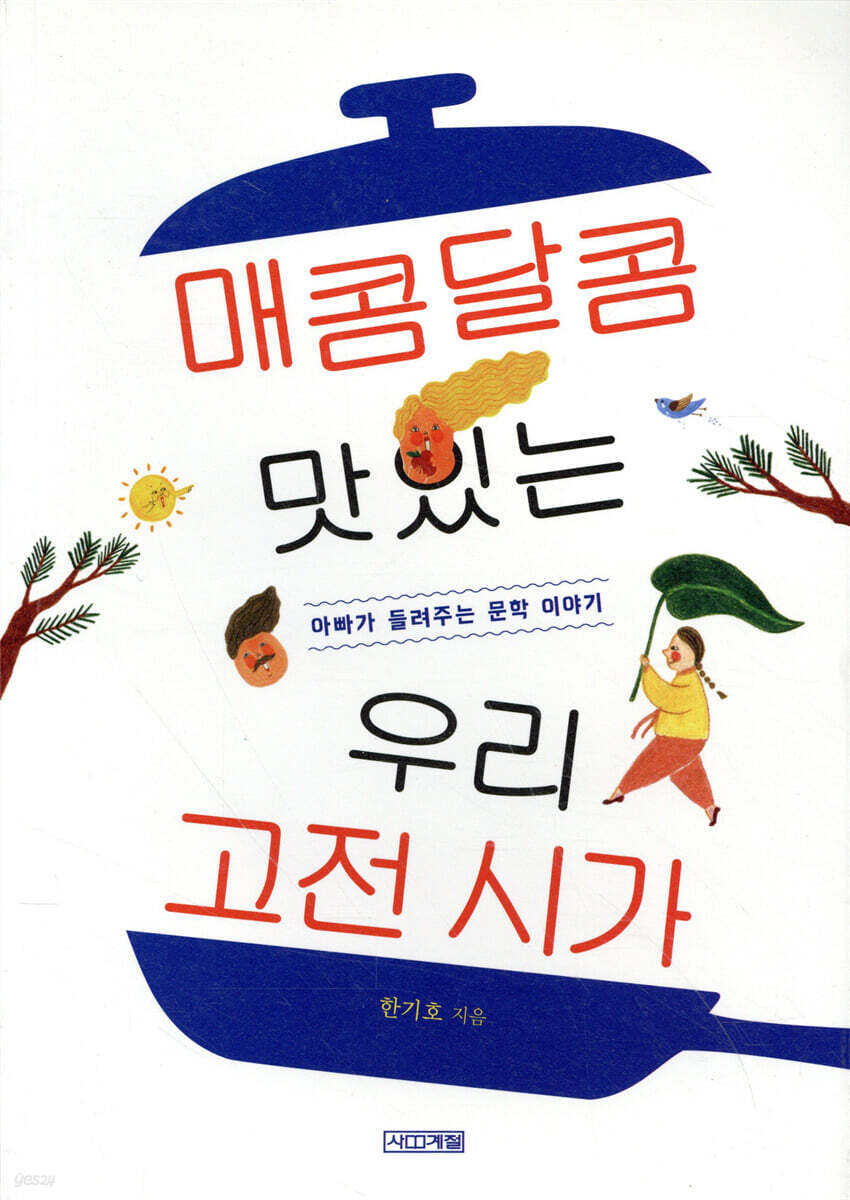
Our classic, sweet and spicy poetry
 |
Description
Book Introduction
A Communicative Father's Classic Poetry Story Wins Grand Prize in Manuscript Contest
Unfamiliar and difficult classical poetry, gently explained at a level suitable for teenagers.
It is not easy to look at literary works created a long time ago.
Our classical poetry includes poems translated from the era before Hangul existed, songs written in hyangchal, and songs written after Hangul was created but whose meaning is difficult to understand due to different vocabulary and grammar.
So, it is natural that young people find classical poetry the most unfamiliar and difficult to understand.
Without any interest or understanding of the meaning, I just mechanically skim through the original poem, translation, background explanation, and commentary.
I believe that is how you can prepare for the CSAT.
It's difficult to learn without context.
In 『Spicy and Sweet Delicious Our Classical Poetry』, the author quietly recite representative works of classical poetry, from 'Gujiga' to Hyangga, Goryeo Gayo, and Sijo.
In doing so, it shows an interesting insight into human nature, preventing classical poetry from being scattered with fragmentary information.
It unfolds myths and anthropological stories about initiation ceremonies, prohibitions, and taboos, and it also provides a perspective on understanding history, and it also reflects on life by reminiscing about childhood experiences.
Furthermore, it does not stop at our country, but also contrasts Jumong's story with Moses' exodus from Egypt.
In this way, literature and humanities come together to lead to a proper understanding of classical poetry.
It's not difficult.
It approaches you with a savory charm like an old story, making you listen intently.
Unfamiliar and difficult classical poetry, gently explained at a level suitable for teenagers.
It is not easy to look at literary works created a long time ago.
Our classical poetry includes poems translated from the era before Hangul existed, songs written in hyangchal, and songs written after Hangul was created but whose meaning is difficult to understand due to different vocabulary and grammar.
So, it is natural that young people find classical poetry the most unfamiliar and difficult to understand.
Without any interest or understanding of the meaning, I just mechanically skim through the original poem, translation, background explanation, and commentary.
I believe that is how you can prepare for the CSAT.
It's difficult to learn without context.
In 『Spicy and Sweet Delicious Our Classical Poetry』, the author quietly recite representative works of classical poetry, from 'Gujiga' to Hyangga, Goryeo Gayo, and Sijo.
In doing so, it shows an interesting insight into human nature, preventing classical poetry from being scattered with fragmentary information.
It unfolds myths and anthropological stories about initiation ceremonies, prohibitions, and taboos, and it also provides a perspective on understanding history, and it also reflects on life by reminiscing about childhood experiences.
Furthermore, it does not stop at our country, but also contrasts Jumong's story with Moses' exodus from Egypt.
In this way, literature and humanities come together to lead to a proper understanding of classical poetry.
It's not difficult.
It approaches you with a savory charm like an old story, making you listen intently.
- You can preview some of the book's contents.
Preview
index
Chapter 1: There Was a Song in Ancient Mythology
Gujiga 1, a song sung while digging the ground
There are 2 rituals that must be performed
Endless story bans and taboos
Challenge! Dangun Myth 1
Challenge! Dangun Myth 2
My lord, do not cross the water, for the public servants are
Poor King Yuri Hwangjo
Chapter 2: The Taste of Sweet and Spicy Fragrance
It's not absolute love, Seodongyo
How to overcome sadness by my sister-in-law
Silla's most beautiful woman, Heonhwaga
Dosolga, a song that shouldn't be sung now
Who Should Study Literature? An Min-ga
Not suitable for ages 19 and under? Cheoyongga
The only Baekje pop song, Jeongeupsa
Chapter 3: Rainbow Goryeo Songs
Songs of the Goryeo Dynasty
There is a thorn, there is a thorn
Beautiful but not beautiful Cheongsanbyeolgok
The Story of Seogyeongbyeolgok
A robotics expert from the Goryeo Dynasty
Folklore in Song 1 Dongdong
Folklore in Song 2 Dongdong
The Battle of the Hoe and the Sickle
Chapter 4: Strong! Sijo
Let's memorize the poem and find out
Jeong Mong-ju's mother in the valley where crows fight
I am so moved by the beauty of the pear tree that it brings tears to my eyes.
The clouds that speak in secret say careless words
In the same era, different perspectives show rise and fall.
What is a friend? Ouga
A private sijo has appeared, Jang Jin-ju
A poetic lyric poem that seems like it's not poetry, a spring song
Gujiga 1, a song sung while digging the ground
There are 2 rituals that must be performed
Endless story bans and taboos
Challenge! Dangun Myth 1
Challenge! Dangun Myth 2
My lord, do not cross the water, for the public servants are
Poor King Yuri Hwangjo
Chapter 2: The Taste of Sweet and Spicy Fragrance
It's not absolute love, Seodongyo
How to overcome sadness by my sister-in-law
Silla's most beautiful woman, Heonhwaga
Dosolga, a song that shouldn't be sung now
Who Should Study Literature? An Min-ga
Not suitable for ages 19 and under? Cheoyongga
The only Baekje pop song, Jeongeupsa
Chapter 3: Rainbow Goryeo Songs
Songs of the Goryeo Dynasty
There is a thorn, there is a thorn
Beautiful but not beautiful Cheongsanbyeolgok
The Story of Seogyeongbyeolgok
A robotics expert from the Goryeo Dynasty
Folklore in Song 1 Dongdong
Folklore in Song 2 Dongdong
The Battle of the Hoe and the Sickle
Chapter 4: Strong! Sijo
Let's memorize the poem and find out
Jeong Mong-ju's mother in the valley where crows fight
I am so moved by the beauty of the pear tree that it brings tears to my eyes.
The clouds that speak in secret say careless words
In the same era, different perspectives show rise and fall.
What is a friend? Ouga
A private sijo has appeared, Jang Jin-ju
A poetic lyric poem that seems like it's not poetry, a spring song
Into the book
The literary stories my father is about to tell me will probably be similar to climbing a mountain.
The climb is difficult and painful, but the joy you experience at the top is incomparable to anything else.
Besides, I don't know how many things you can enjoy while climbing.
So, even if it is a bit difficult and challenging, I hope you will listen to Dad's story slowly and enjoy it.
Okay, are you ready? --- p.5
As you may have already noticed, the turtle in this song is not a real animal turtle.
If the turtle is a literal turtle, then there's something wrong with this song, right? If it were a literal turtle, its head would pop out, but it doesn't.
--- p.21
My father watched many pharmacist shows, and although each of them had a different show, almost all of them said the same thing at the end.
“Kids go, kids go.”
If they heard that, would all the kids go? Would you have gone? With a truck about to pass over the old man's boat, would any kid say, "I'll obey 100 percent," and then get up and go home without a word? Apparently, no one obeyed.
Of course, Dad didn't go either.
Instead, he opened his eyes even wider and sat down next to the onlookers.
The words, “Kids, go away,” actually had the power to attract more onlookers.
Why would that be? Why do people feel more drawn to something when they're told to go? --- p.44
Many people (especially some religious people) say that myths are absolutely false, but they often don't know the exact content.
People often have a bad habit of easily judging something based on their existing thoughts and judgments about it, but we shouldn't do that.
To evaluate something, you need to know the subject well.
You shouldn't so easily judge something you don't even know, right? Dad, I remember reading an article criticizing the Dangun myth from people opposing the erection of a statue of Dangun. I was so embarrassed.
Those people are criticizing the Dangun myth as an absurd myth, but in fact, they have not even properly interpreted the content of the Dangun myth.
--- p.70
When Yuri returned home, she fell down in front of her mother and cried loudly.
“Where on earth is my father?”
It was only then that Yuri's mother told her the riddle Jumong had left behind.
From then on, Yuri began to wander the mountains in search of the evidence her father had left behind.
But there can't be a rock with seven corners in the world.
And a pine tree on top of a rock like that? What a ridiculous riddle.
This story of a man wandering the world in search of his father is said to be a common theme not only in our country but also in stories scattered all over the world.
In mythology, ‘finding the father’ appears as a very important subject.
--- p.106
The emperor is of course talking about the cuckoo, which is an important subject in this song.
You could say that this is a song that expresses one's feelings through the cuckoo.
Looking at the rich sensibility of King Yuri, who expressed his loneliness by comparing it to the cuckoo, Goguryeo must have been a very attractive country.
If a country's leader does not hesitate to express his feelings through poetry, it can be said that he has conducted politics with a lot of emotion and compassion.
But anyway, to my father, as an individual, King Yuri is remembered as an infinitely pitiful man.
--- p.112
The man in the "Seo-gyeong-byeolgok" we read earlier seemed to love and break up very easily, which broke our hearts.
However, the speaker of "Jeongseokga" makes a firm promise to never, ever be separated from the person he loves.
Some people interpret that the person singing in "Jeongseokga" is a subject, and the person to whom this person is confessing his love is the king.
It is a song in which a loyal subject promises his king that his loyalty will never change.
But Dad, I just want to believe that it's a song between two people who love each other.
Love, be eternal… … .
Well, I hope that Dad still has some of this romance left.
--- p.197
Poetry, novels, essays, and all other writings that feature mothers always have the power to shake people's hearts.
This may be because mothers are the driving force of our lives, the lifeline, the beginning of our breathing, and the foundation for our growth.
So, if someone asks you the absurd question, 'Do you like your mom or dad?', answer without hesitation.
They say there is no one better in this world than a mother.
The climb is difficult and painful, but the joy you experience at the top is incomparable to anything else.
Besides, I don't know how many things you can enjoy while climbing.
So, even if it is a bit difficult and challenging, I hope you will listen to Dad's story slowly and enjoy it.
Okay, are you ready? --- p.5
As you may have already noticed, the turtle in this song is not a real animal turtle.
If the turtle is a literal turtle, then there's something wrong with this song, right? If it were a literal turtle, its head would pop out, but it doesn't.
--- p.21
My father watched many pharmacist shows, and although each of them had a different show, almost all of them said the same thing at the end.
“Kids go, kids go.”
If they heard that, would all the kids go? Would you have gone? With a truck about to pass over the old man's boat, would any kid say, "I'll obey 100 percent," and then get up and go home without a word? Apparently, no one obeyed.
Of course, Dad didn't go either.
Instead, he opened his eyes even wider and sat down next to the onlookers.
The words, “Kids, go away,” actually had the power to attract more onlookers.
Why would that be? Why do people feel more drawn to something when they're told to go? --- p.44
Many people (especially some religious people) say that myths are absolutely false, but they often don't know the exact content.
People often have a bad habit of easily judging something based on their existing thoughts and judgments about it, but we shouldn't do that.
To evaluate something, you need to know the subject well.
You shouldn't so easily judge something you don't even know, right? Dad, I remember reading an article criticizing the Dangun myth from people opposing the erection of a statue of Dangun. I was so embarrassed.
Those people are criticizing the Dangun myth as an absurd myth, but in fact, they have not even properly interpreted the content of the Dangun myth.
--- p.70
When Yuri returned home, she fell down in front of her mother and cried loudly.
“Where on earth is my father?”
It was only then that Yuri's mother told her the riddle Jumong had left behind.
From then on, Yuri began to wander the mountains in search of the evidence her father had left behind.
But there can't be a rock with seven corners in the world.
And a pine tree on top of a rock like that? What a ridiculous riddle.
This story of a man wandering the world in search of his father is said to be a common theme not only in our country but also in stories scattered all over the world.
In mythology, ‘finding the father’ appears as a very important subject.
--- p.106
The emperor is of course talking about the cuckoo, which is an important subject in this song.
You could say that this is a song that expresses one's feelings through the cuckoo.
Looking at the rich sensibility of King Yuri, who expressed his loneliness by comparing it to the cuckoo, Goguryeo must have been a very attractive country.
If a country's leader does not hesitate to express his feelings through poetry, it can be said that he has conducted politics with a lot of emotion and compassion.
But anyway, to my father, as an individual, King Yuri is remembered as an infinitely pitiful man.
--- p.112
The man in the "Seo-gyeong-byeolgok" we read earlier seemed to love and break up very easily, which broke our hearts.
However, the speaker of "Jeongseokga" makes a firm promise to never, ever be separated from the person he loves.
Some people interpret that the person singing in "Jeongseokga" is a subject, and the person to whom this person is confessing his love is the king.
It is a song in which a loyal subject promises his king that his loyalty will never change.
But Dad, I just want to believe that it's a song between two people who love each other.
Love, be eternal… … .
Well, I hope that Dad still has some of this romance left.
--- p.197
Poetry, novels, essays, and all other writings that feature mothers always have the power to shake people's hearts.
This may be because mothers are the driving force of our lives, the lifeline, the beginning of our breathing, and the foundation for our growth.
So, if someone asks you the absurd question, 'Do you like your mom or dad?', answer without hesitation.
They say there is no one better in this world than a mother.
--- p.233
Publisher's Review
Reading Classic Literature in an Era of Rapidly Changing Language and Sensibility
We cannot now fully understand the world in which the protagonists of classical poetry lived.
Just keep asking questions and digging.
The process of reasoning and finding answers, with questions following questions, is reassuring because of my father, who is an expert.
Moreover, the process is more persuasive and fun because it contains rational reasoning and humorous twists that break conventional wisdom.
'What song should not be sung now?' It is 'Dosolga', which is sung to wish for one of the two rising suns to disappear.
Dad whines that it would be a disaster if even the last sun disappeared.
Also, is "Cheoyongga," where the wife sleeps with a demon, a song that is rated 19+? No.
It is highly likely that Cheoyong was a shaman, and so it is likely that the song was a ritual song to cure an epidemic.
There is a claim that, based on Cheoyong's appearance and appearance in 'Cheoyongga', he may have been an Arabian merchant who was trading with Silla at the time.
But then, the father asks, what would become of the evil spirit lying with Cheoyong's wife?
If Cheoyong was a shaman, the situation where she dances and sings while performing a ritual for someone who has been infected with an epidemic, or where she vows to never enter a house where Cheoyong's face is hung up again after the epidemic has passed away, is consistent with the situation.
Besides, it is said that politicians are the ones who must study literature by reading 'Anmin-ga'.
There was already an idea for a robot in the Goryeo Dynasty, and that was the story of the iron ox in Jeongseokga.
In this way, the author constantly reinterprets classical poetry with a fresh perspective and modern language and sensibility so that modern youth do not think of classical poetry as a story from the distant past.
Reading classic poetry that unites life and literature
As with any literary story, its meaning ultimately lies in drawing out and embodying life's values.
The author also has something to say to the children and youth who read the book.
There is no single, definitive answer to the question, "How should we live?"
All I'm doing is planting seeds in your mind to make you think.
The author uses classical poetry appropriately, not just as a textbook, but as a medium for reflecting on life.
For example, it is easy to think that 'Seodongyo' is a song based on the love between Seodong and Princess Seonhwa, but the author, Dad, firmly states that 'it is absolutely not love.'
It is a fraudulent marriage obtained by spreading lies.
How can the ancient mindset reflected in these ancient songs apply to us? There's also Cheongsanbyeolgok, which many consider a beautiful poem.
It is a literature of resignation and ignorance of reality, with a beautiful refrain in pure Korean and an outstanding sense of rhythm, but the speaker of the poem ultimately escapes into alcohol.
Life is not easy even for modern people.
How should I live?
Classical poetry is full of things to read and think about.
The author cooks it with skillful skill, making it sweet and spicy and delicious.
We cannot now fully understand the world in which the protagonists of classical poetry lived.
Just keep asking questions and digging.
The process of reasoning and finding answers, with questions following questions, is reassuring because of my father, who is an expert.
Moreover, the process is more persuasive and fun because it contains rational reasoning and humorous twists that break conventional wisdom.
'What song should not be sung now?' It is 'Dosolga', which is sung to wish for one of the two rising suns to disappear.
Dad whines that it would be a disaster if even the last sun disappeared.
Also, is "Cheoyongga," where the wife sleeps with a demon, a song that is rated 19+? No.
It is highly likely that Cheoyong was a shaman, and so it is likely that the song was a ritual song to cure an epidemic.
There is a claim that, based on Cheoyong's appearance and appearance in 'Cheoyongga', he may have been an Arabian merchant who was trading with Silla at the time.
But then, the father asks, what would become of the evil spirit lying with Cheoyong's wife?
If Cheoyong was a shaman, the situation where she dances and sings while performing a ritual for someone who has been infected with an epidemic, or where she vows to never enter a house where Cheoyong's face is hung up again after the epidemic has passed away, is consistent with the situation.
Besides, it is said that politicians are the ones who must study literature by reading 'Anmin-ga'.
There was already an idea for a robot in the Goryeo Dynasty, and that was the story of the iron ox in Jeongseokga.
In this way, the author constantly reinterprets classical poetry with a fresh perspective and modern language and sensibility so that modern youth do not think of classical poetry as a story from the distant past.
Reading classic poetry that unites life and literature
As with any literary story, its meaning ultimately lies in drawing out and embodying life's values.
The author also has something to say to the children and youth who read the book.
There is no single, definitive answer to the question, "How should we live?"
All I'm doing is planting seeds in your mind to make you think.
The author uses classical poetry appropriately, not just as a textbook, but as a medium for reflecting on life.
For example, it is easy to think that 'Seodongyo' is a song based on the love between Seodong and Princess Seonhwa, but the author, Dad, firmly states that 'it is absolutely not love.'
It is a fraudulent marriage obtained by spreading lies.
How can the ancient mindset reflected in these ancient songs apply to us? There's also Cheongsanbyeolgok, which many consider a beautiful poem.
It is a literature of resignation and ignorance of reality, with a beautiful refrain in pure Korean and an outstanding sense of rhythm, but the speaker of the poem ultimately escapes into alcohol.
Life is not easy even for modern people.
How should I live?
Classical poetry is full of things to read and think about.
The author cooks it with skillful skill, making it sweet and spicy and delicious.
GOODS SPECIFICS
- Date of publication: January 22, 2016
- Page count, weight, size: 308 pages | 534g | 153*224*18mm
- ISBN13: 9788958289319
- ISBN10: 8958289317
You may also like
카테고리
korean


korean

![GQ KOREA Mark (Monthly): December [2025]](http://librairie.coreenne.fr/cdn/shop/files/8ef265dbbfbf186523ed75ba7319009d.jpg?v=1765340328&width=3840)


