

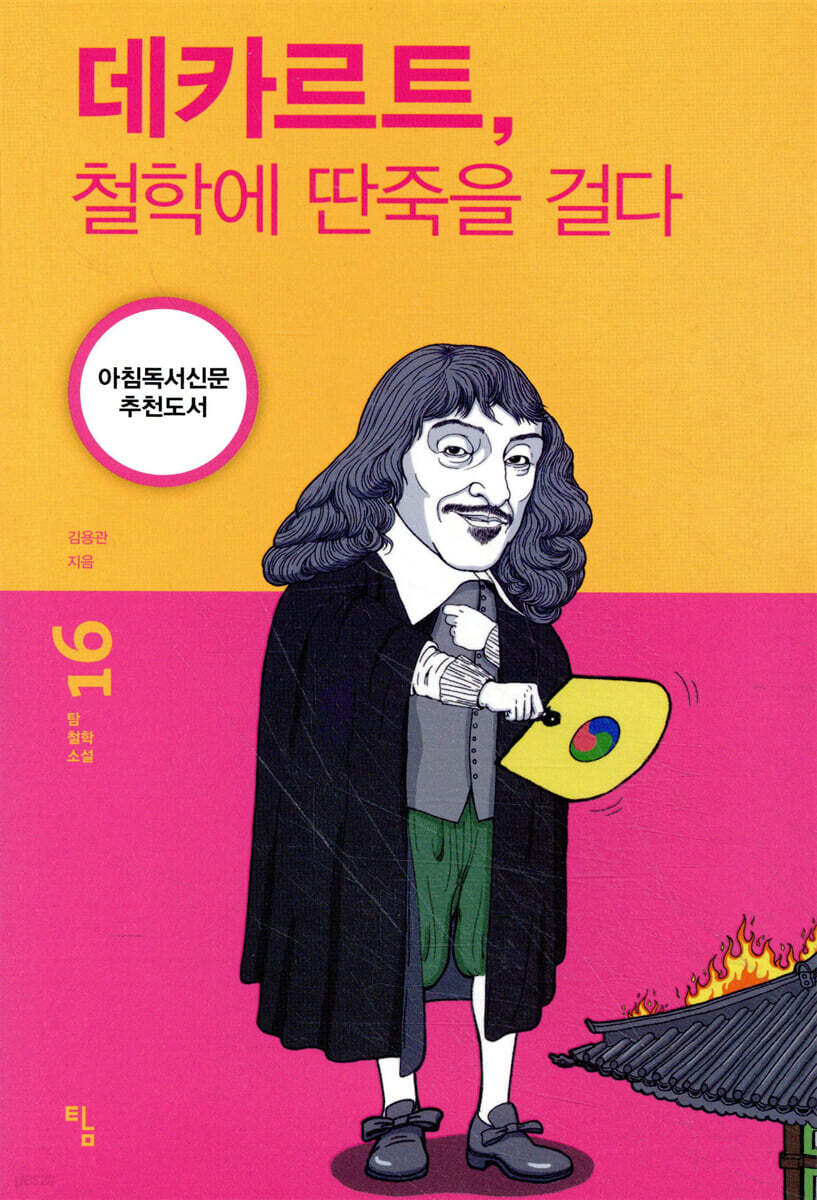
Descartes, a challenge to philosophy
 |
Description
Book Introduction
Descartes' book "Discourse on the Method" was adapted into a novel.
In order to keep Descartes, who is to become the Swedish royal philosophy tutor, the servant Schluter constantly tries to talk to Descartes.
In the process, you come to understand the relationship between 'the thinking self and the truth', and finally, through methodological doubts that constantly doubt everything, you vaguely realize Descartes' philosophy of 'I think, therefore I am'.
By following Hein Schlueter's thought process of maturation, even middle school students who read the book will understand how to think rationally and logically.
In order to keep Descartes, who is to become the Swedish royal philosophy tutor, the servant Schluter constantly tries to talk to Descartes.
In the process, you come to understand the relationship between 'the thinking self and the truth', and finally, through methodological doubts that constantly doubt everything, you vaguely realize Descartes' philosophy of 'I think, therefore I am'.
By following Hein Schlueter's thought process of maturation, even middle school students who read the book will understand how to think rationally and logically.
- You can preview some of the book's contents.
Preview
index
Preface _ Opening a New World with Mathematics
Character introduction
Prologue _ The dream returns again
1.
Netherlands or Sweden?
2.
Is it science? Is it God's will?
3.
Doubting and denying everything
4.
I, who think, cannot doubt
5.
Descartes, caught in a trap
6.
Realize how to think
7.
Prove the existence of God
8.
Philosophy with mathematics
9.
Let's go to Sweden!
supplement
Introduction to Descartes' Philosophy | Descartes' Life | Reading and Answering
Character introduction
Prologue _ The dream returns again
1.
Netherlands or Sweden?
2.
Is it science? Is it God's will?
3.
Doubting and denying everything
4.
I, who think, cannot doubt
5.
Descartes, caught in a trap
6.
Realize how to think
7.
Prove the existence of God
8.
Philosophy with mathematics
9.
Let's go to Sweden!
supplement
Introduction to Descartes' Philosophy | Descartes' Life | Reading and Answering
Into the book
"If thinking is the true nature of a person, then does that mean those who are poor thinkers or possess low standards are inhuman? There must be a difference in the character of someone like you, a good thinker, and someone like me, who lives in mediocre thoughts."
"hmm…….
yes.
They say that how deeply and accurately a person thinks shows his or her character.
“Uncivilized people who have not developed the ability to think have human forms, but it is difficult to see them as truly human.”
Schlueter was offended by these words.
This was because I thought that although I was not a savage, it was difficult to see that my level of thinking was outstanding.
He had never thought of himself as not human.
It had two eyes and two ears, a nose and a mouth, hands and feet, so it was obviously a human.
But according to Descartes, appearances were not certain.
It was difficult to determine whether it was human or not.
The ability to think, this was the only proof that one was human.
Schlueter was not confident in the evidence and therefore felt bad.
I felt like grabbing the tail.
I wanted to find fault with Descartes' words.
“What’s going on? A thoughtful person like you, Master, fell asleep because he was tired.
We don't think while we sleep.
So, are the people at that time and the people thinking about it the same or different? While sleeping, we don't think as much as savages.
No, you don't even think about it."
This time, Descartes had a stinging expression.
- From [I, the Thinker, Cannot Doubt]
“Just because you have teeth doesn’t mean you can chew food on your own.
You have to chew your food.
The same goes for reason.
You can't taste or utilize the power of reason before you use it.
There are also problems for those who use it.
If you don't use it properly, you may end up insisting that something is right when it's wrong.
“How much do you think 1+1 is?”
“That’s 2.
“If you add one apple to one apple, you get two.”
"yes.
But there are people who don't answer like that.
Some people say 11.
It's just a 1 added right next to 1.
Some people say it's 1.
If you add one drop of water to another, you still end up with one drop.
There is also a person named 3.
It's a funny story that when a man and a woman meet, they have a child.
Even if you have reason, if you use it wrongly, the answer will be different like this.
And don't fight each other, saying you're right.
The problem is more when you use your reason clumsily.
This was the problem I was struggling to solve.
The reason we misuse our reason is because we don't know how to use it well.
If you knew how, you could think like me, Schluter.
Even those who were thinking wrongly will come to know what was wrong and what is right.”
Schlueter was shocked to hear that even a servant like himself had the capacity for thought like Descartes.
I became interested in the method the owner found.
“Master! I... I also want to learn that method.
So, I want to imitate you at least as well as you, even if not as well as you.”
“You are already learning how to do it.”
“You’re learning?”
"huh.
You'll realize it later."
- From [Realizing How to Think]
“First of all,
The point is, don't accept anything as fact unless you are absolutely certain of it.
Always keep this attitude when solving problems, but you need to have a plan.
The second method is to break the problem down into as many pieces as possible.
If the problem is too big, it's difficult to deal with.
“It’s the same principle as cutting pizza into appropriately sized pieces to make it easier to eat.”
“I know that method very well.
That's the first thing I do when doing housework.
If you divide the work that needs to be done into items and then assign a person in charge, it will be very easy to do.
“What about the third one?”
“Third, think about the order.
There is a principle here.
It starts with easy and simple things and progresses step by step to difficult and complex things.
We need to start with something that is easy and simple and that everyone recognizes.
Then, the last thing to do is to go through the order and check that you haven't missed anything.
“That’s all there is to it.”
- From [Proving the Existence of God]
"hmm…….
yes.
They say that how deeply and accurately a person thinks shows his or her character.
“Uncivilized people who have not developed the ability to think have human forms, but it is difficult to see them as truly human.”
Schlueter was offended by these words.
This was because I thought that although I was not a savage, it was difficult to see that my level of thinking was outstanding.
He had never thought of himself as not human.
It had two eyes and two ears, a nose and a mouth, hands and feet, so it was obviously a human.
But according to Descartes, appearances were not certain.
It was difficult to determine whether it was human or not.
The ability to think, this was the only proof that one was human.
Schlueter was not confident in the evidence and therefore felt bad.
I felt like grabbing the tail.
I wanted to find fault with Descartes' words.
“What’s going on? A thoughtful person like you, Master, fell asleep because he was tired.
We don't think while we sleep.
So, are the people at that time and the people thinking about it the same or different? While sleeping, we don't think as much as savages.
No, you don't even think about it."
This time, Descartes had a stinging expression.
- From [I, the Thinker, Cannot Doubt]
“Just because you have teeth doesn’t mean you can chew food on your own.
You have to chew your food.
The same goes for reason.
You can't taste or utilize the power of reason before you use it.
There are also problems for those who use it.
If you don't use it properly, you may end up insisting that something is right when it's wrong.
“How much do you think 1+1 is?”
“That’s 2.
“If you add one apple to one apple, you get two.”
"yes.
But there are people who don't answer like that.
Some people say 11.
It's just a 1 added right next to 1.
Some people say it's 1.
If you add one drop of water to another, you still end up with one drop.
There is also a person named 3.
It's a funny story that when a man and a woman meet, they have a child.
Even if you have reason, if you use it wrongly, the answer will be different like this.
And don't fight each other, saying you're right.
The problem is more when you use your reason clumsily.
This was the problem I was struggling to solve.
The reason we misuse our reason is because we don't know how to use it well.
If you knew how, you could think like me, Schluter.
Even those who were thinking wrongly will come to know what was wrong and what is right.”
Schlueter was shocked to hear that even a servant like himself had the capacity for thought like Descartes.
I became interested in the method the owner found.
“Master! I... I also want to learn that method.
So, I want to imitate you at least as well as you, even if not as well as you.”
“You are already learning how to do it.”
“You’re learning?”
"huh.
You'll realize it later."
- From [Realizing How to Think]
“First of all,
The point is, don't accept anything as fact unless you are absolutely certain of it.
Always keep this attitude when solving problems, but you need to have a plan.
The second method is to break the problem down into as many pieces as possible.
If the problem is too big, it's difficult to deal with.
“It’s the same principle as cutting pizza into appropriately sized pieces to make it easier to eat.”
“I know that method very well.
That's the first thing I do when doing housework.
If you divide the work that needs to be done into items and then assign a person in charge, it will be very easy to do.
“What about the third one?”
“Third, think about the order.
There is a principle here.
It starts with easy and simple things and progresses step by step to difficult and complex things.
We need to start with something that is easy and simple and that everyone recognizes.
Then, the last thing to do is to go through the order and check that you haven't missed anything.
“That’s all there is to it.”
- From [Proving the Existence of God]
--- From the text
Publisher's Review
The sixteenth book in the "Tham Philosophy Novel" series
“The reason people are human is because they think.”
Through methodological skepticism that constantly questions everything
What is the essence of truth that Descartes discovered?
Book Introduction
Descartes' book "Discourse on the Method" was adapted into a novel.
In order to keep Descartes, who is to become the Swedish royal philosophy tutor, the servant Schluter constantly tries to talk to Descartes.
In the process, you come to understand the relationship between 'the thinking self and the truth', and finally, through methodological doubt that constantly doubts everything, you vaguely realize Descartes' philosophy of 'I think, therefore I am'.
By following Hein Schlueter's thought process of maturation, even middle school students who read the book will understand how to think rationally and logically.
The reason humans are different from animals is because they 'think' based on reason.
Descartes, who was invited by the Queen of Sweden to become the royal philosophy teacher of Sweden.
A Swedish fleet comes to the Netherlands to take Descartes away, but for some reason Descartes delays making a decision and is lost in thought.
The loyal servant Schluter, wondering if his master was in trouble, was talking to him when he heard a shocking news from Descartes.
They say that a person who does not think is not human, that he should doubt the existence of his own body, and if God is truth itself, then we should be able to prove his existence?
In Schlueter's eyes, his master, Descartes, seems like a man armed with doubts, wandering around the world, picking up stray thoughts.
Why does Descartes seem so unbelievable? Does he believe anything to be true?
Through methodological skepticism that constantly questions everything
Descartes realized the truth with the proposition, 'I think, therefore I am.'
Let's think together about why he was able to remain as the father of modern philosophy.
* After reading the text, you can download the post-reading activity sheet from blog.naver.com/totobook9.
A series of philosophical novels for young readers just beginning their studies in the humanities.
[Exploring Philosophy Novels], which is considered an innovation in the field of youth humanities literature and has been well-received by middle and high school teachers and students, is a series of educational novels for youth that unravel the thoughts of philosophers who occupy important positions in the history of Eastern and Western thought in a single novel.
As you read along, enjoying it as if you were reading a novel, you will soon find yourself easily understanding the philosophers' rigid theories and relating them to your own life.
The [Tam Philosophy Novel] series has been recognized for its excellent content and has been selected as an excellent book by several public institutions and youth-related organizations.
★Selected as an excellent liberal arts book by the Ministry of Culture, Sports and Tourism ★Selected as a recommended book for youth by the Korea Publication Ethics Commission
★Youth Book of the Year by the Korean Publishers Association ★Book of the Month by the Korean Publishers Association
★Recommended books for teachers who create a warm world through books ★Recommended books of the year selected by the Hanuri Reading Movement Headquarters
★Morning Reading Newspaper Recommended Books
Introduction of the main character - Descartes
He was a philosopher and mathematician born in France in 1596.
He is called the father of modern philosophy and is also the founder of analytical geometry.
After doubting everything, he considered the existence of his doubting self to be a clear truth and made the proposition, 'I think, therefore I am', the foundation of his philosophy.
“The reason people are human is because they think.”
Through methodological skepticism that constantly questions everything
What is the essence of truth that Descartes discovered?
Book Introduction
Descartes' book "Discourse on the Method" was adapted into a novel.
In order to keep Descartes, who is to become the Swedish royal philosophy tutor, the servant Schluter constantly tries to talk to Descartes.
In the process, you come to understand the relationship between 'the thinking self and the truth', and finally, through methodological doubt that constantly doubts everything, you vaguely realize Descartes' philosophy of 'I think, therefore I am'.
By following Hein Schlueter's thought process of maturation, even middle school students who read the book will understand how to think rationally and logically.
The reason humans are different from animals is because they 'think' based on reason.
Descartes, who was invited by the Queen of Sweden to become the royal philosophy teacher of Sweden.
A Swedish fleet comes to the Netherlands to take Descartes away, but for some reason Descartes delays making a decision and is lost in thought.
The loyal servant Schluter, wondering if his master was in trouble, was talking to him when he heard a shocking news from Descartes.
They say that a person who does not think is not human, that he should doubt the existence of his own body, and if God is truth itself, then we should be able to prove his existence?
In Schlueter's eyes, his master, Descartes, seems like a man armed with doubts, wandering around the world, picking up stray thoughts.
Why does Descartes seem so unbelievable? Does he believe anything to be true?
Through methodological skepticism that constantly questions everything
Descartes realized the truth with the proposition, 'I think, therefore I am.'
Let's think together about why he was able to remain as the father of modern philosophy.
* After reading the text, you can download the post-reading activity sheet from blog.naver.com/totobook9.
A series of philosophical novels for young readers just beginning their studies in the humanities.
[Exploring Philosophy Novels], which is considered an innovation in the field of youth humanities literature and has been well-received by middle and high school teachers and students, is a series of educational novels for youth that unravel the thoughts of philosophers who occupy important positions in the history of Eastern and Western thought in a single novel.
As you read along, enjoying it as if you were reading a novel, you will soon find yourself easily understanding the philosophers' rigid theories and relating them to your own life.
The [Tam Philosophy Novel] series has been recognized for its excellent content and has been selected as an excellent book by several public institutions and youth-related organizations.
★Selected as an excellent liberal arts book by the Ministry of Culture, Sports and Tourism ★Selected as a recommended book for youth by the Korea Publication Ethics Commission
★Youth Book of the Year by the Korean Publishers Association ★Book of the Month by the Korean Publishers Association
★Recommended books for teachers who create a warm world through books ★Recommended books of the year selected by the Hanuri Reading Movement Headquarters
★Morning Reading Newspaper Recommended Books
Introduction of the main character - Descartes
He was a philosopher and mathematician born in France in 1596.
He is called the father of modern philosophy and is also the founder of analytical geometry.
After doubting everything, he considered the existence of his doubting self to be a clear truth and made the proposition, 'I think, therefore I am', the foundation of his philosophy.
GOODS SPECIFICS
- Date of issue: January 2, 2015
- Page count, weight, size: 204 pages | 338g | 144*210*12mm
- ISBN13: 9788964962404
- ISBN10: 8964962400
You may also like
카테고리
korean


korean

![GQ KOREA Mark (Monthly): December [2025]](http://librairie.coreenne.fr/cdn/shop/files/8ef265dbbfbf186523ed75ba7319009d.jpg?v=1765340328&width=3840)


