

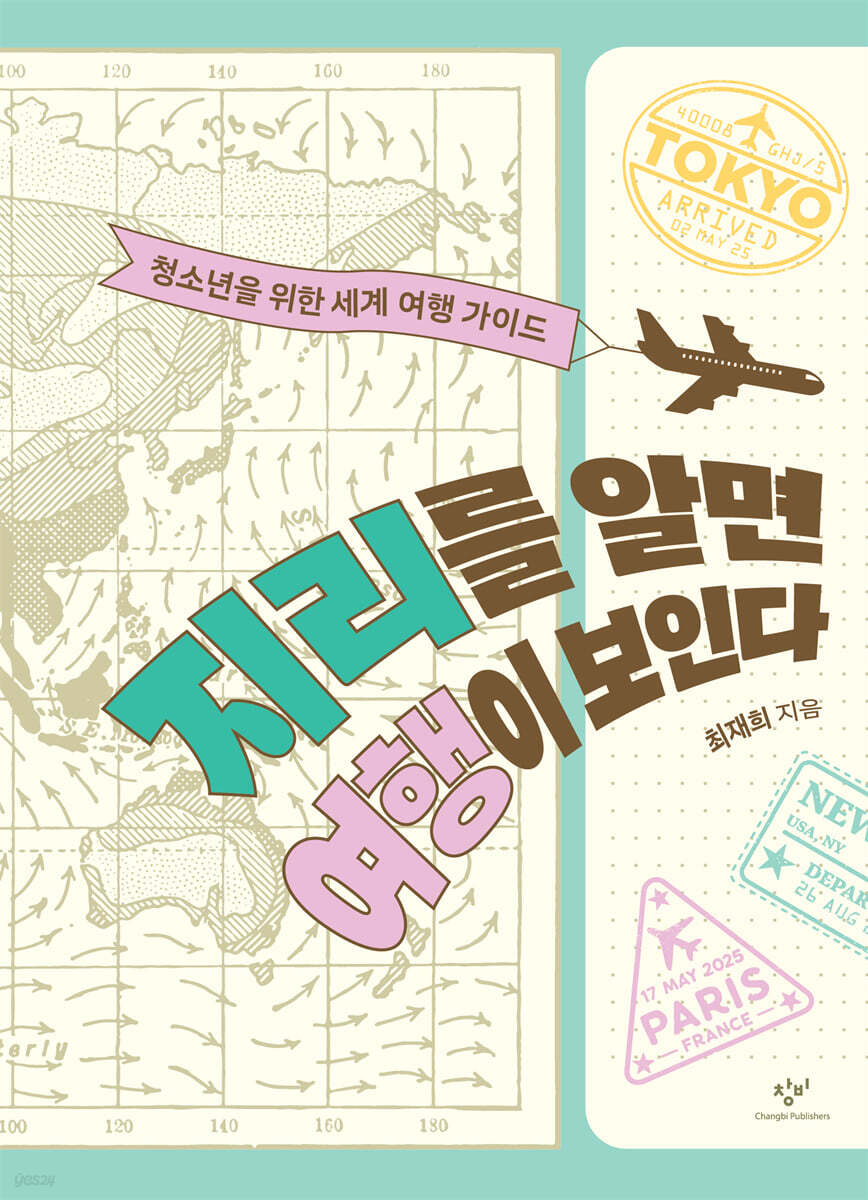
If you know geography, you can see the travel.
 |
Description
Book Introduction
The world is waiting for you!
Practical travel geography for young people who want to get away
A special journey that explores culture, nature, reflection, coexistence, and the future.
『If you know geography, you can see travel』(Changbi Youth Library 44), a travel guide to various travel destinations around the world with diverse stories, has been published by Choi Jae-hee, a current geography teacher and EBS instructor.
This book fosters a deeper and broader understanding of the world by taking readers on a geographical journey through the world's most famous landmarks, rich in culture and nature.
"Travel Geography," a newly emerging elective in the 2022 revised curriculum, combines travel and geography. It focuses on the meaning of travel, transportation, culture, and nature, as well as reflection and coexistence.
This subject also considers the direction in which travel will flow in future society and what sustainable travel methods will be.
This book vividly explores countries such as the United States, India, Thailand, Brazil, New Zealand, Colombia, and Ethiopia from the perspective of travel geography, as if you were actually traveling there. It is an extension of travel geography classes and also serves as a practical travel guide.
This enriching, indirect journey, accompanied by thoughtful commentary, will broaden the horizons of young readers as they embark on their journey into a larger world, enhancing their perspective on the world.
Practical travel geography for young people who want to get away
A special journey that explores culture, nature, reflection, coexistence, and the future.
『If you know geography, you can see travel』(Changbi Youth Library 44), a travel guide to various travel destinations around the world with diverse stories, has been published by Choi Jae-hee, a current geography teacher and EBS instructor.
This book fosters a deeper and broader understanding of the world by taking readers on a geographical journey through the world's most famous landmarks, rich in culture and nature.
"Travel Geography," a newly emerging elective in the 2022 revised curriculum, combines travel and geography. It focuses on the meaning of travel, transportation, culture, and nature, as well as reflection and coexistence.
This subject also considers the direction in which travel will flow in future society and what sustainable travel methods will be.
This book vividly explores countries such as the United States, India, Thailand, Brazil, New Zealand, Colombia, and Ethiopia from the perspective of travel geography, as if you were actually traveling there. It is an extension of travel geography classes and also serves as a practical travel guide.
This enriching, indirect journey, accompanied by thoughtful commentary, will broaden the horizons of young readers as they embark on their journey into a larger world, enhancing their perspective on the world.
- You can preview some of the book's contents.
Preview
index
Introduction - The magic that makes travel more enjoyable
Starting Your Journey - Incheon International Airport, the World's Best Hub Airport
Part 1: A Journey to the Big City Where Capital and People Gather
New York, USA - the world's economic center boasting skyscrapers
Paris, France - The Legacy of Imperialism Behind Romanticism
Tokyo, Japan - A megacity traversed by high-speed trains
Part 2: A Journey Through Cultural Landscapes Created by People
Varanasi, India - A city where life and death coexist
Bilbao, Spain - The Art Museum That Changed the City's Fate
Bangkok, Thailand - A festival celebrating the blessings of water
Part 3: The World Created by Nature, and Humans Breathing on It
Rio de Janeiro, Brazil - A dazzling port of color
Lake Baikal, Russia - A vast and mysterious lake of life
Wellington, New Zealand - A two-faced island with volcanic traces
Part 4: To become a traveler who respects the world
Medellin, Colombia - The City of Spring, Reborn
Addis Ababa, Ethiopia - A Story in a Cup of Coffee
Auschwitz, Poland - A Journey to Learn to Remember
Ending the Journey - Travel Museum, Jeju Special Self-Governing Province
References
Photo source
Starting Your Journey - Incheon International Airport, the World's Best Hub Airport
Part 1: A Journey to the Big City Where Capital and People Gather
New York, USA - the world's economic center boasting skyscrapers
Paris, France - The Legacy of Imperialism Behind Romanticism
Tokyo, Japan - A megacity traversed by high-speed trains
Part 2: A Journey Through Cultural Landscapes Created by People
Varanasi, India - A city where life and death coexist
Bilbao, Spain - The Art Museum That Changed the City's Fate
Bangkok, Thailand - A festival celebrating the blessings of water
Part 3: The World Created by Nature, and Humans Breathing on It
Rio de Janeiro, Brazil - A dazzling port of color
Lake Baikal, Russia - A vast and mysterious lake of life
Wellington, New Zealand - A two-faced island with volcanic traces
Part 4: To become a traveler who respects the world
Medellin, Colombia - The City of Spring, Reborn
Addis Ababa, Ethiopia - A Story in a Cup of Coffee
Auschwitz, Poland - A Journey to Learn to Remember
Ending the Journey - Travel Museum, Jeju Special Self-Governing Province
References
Photo source
Detailed image

Into the book
Travel! What emotions come to mind when you hear this word? A sense of adventure, a journey into the unknown? A sense of liberation, a brief escape from the monotony of everyday life? Just as the words convey, travel is about experiencing something special in an unfamiliar place.
Familiar environments make your mind hard, but when you go to an unfamiliar environment, your brain starts to work harder and new sensibilities emerge.
The artist, who grew up near a rainforest, will never forget the moment he encountered the snow-covered landscape.
Because it will be a unique experience that will open up your horizons.
--- p.6
Skyscrapers are a great way to expand space upwards.
Think about the blocks you played with as a child.
What would happen if we stacked ten identical blocks one by one, rather than spreading them out on the floor? The floor area occupied by a single block would produce the same effect as ten blocks.
In large cities like Manhattan, New York, land prices are so high that it is difficult to have a lot of horizontal space.
So, the idea of expanding vertically to secure space arose, and this led to the full-scale growth of skyscrapers.
--- p.23
The final thing to note about the Arc de Triomphe de l'Étoile is its network of 12 branching roads.
Centered around Place Charles de Gaulle, which surrounds the Arc de Triomphe, twelve roads stretch out in their respective directions.
The catalyst for the creation of this unique road network was, surprisingly, the French Revolution.
Civil uprisings like the French Revolution are a terrifying thing for those in power.
So the radial road network was designed to control the gathering of people to make it difficult for similar uprisings to occur.
If the entrance to the large square is controlled, the only space left for citizens to gather and protest is the narrow road.
So, I thought it would be effective in preventing it from spreading into a large-scale protest.
--- p.45-46
Geotourism is a form of travel that goes beyond the idea that unique geographical landscapes are the core of travel, and also focuses on the history, culture, and ecological heritage of the area.
If we fully embrace the spirit of geotourism, we can adopt an attitude of actively protecting the heritage of that region.
(...) It is a virtue that all global citizens must possess to understand the natural environment and geological values that make travel enjoyable and to strive to preserve them in a sustainable manner.
--- p.129-130
Lake Baikal is nicknamed the Galapagos of Russia.
The Galapagos Islands are a group of volcanic islands in the Pacific Ocean where Charles Darwin formulated his ideas about evolution.
An important thing in evolution is isolation for a period of time.
Because in a space completely isolated from its surroundings, organisms can differentiate into new species suited to their environment.
Of the approximately 2,600 species of creatures living in Lake Baikal, more than 60% are endemic.
This means that this place has been an isolated space for a long time.
--- p.134-135
The world is getting smaller day by day due to advancements in transportation and communication.
You can easily reach a country on the other side of the world in less than a day.
Once you arrive at the airport, you can explore every corner of the country using another fast-moving means of transportation.
As transportation has developed, the travel industry has also grown significantly.
But there are also many side effects.
It's a global citizen's responsibility to consider whether the travel expenses I pay are fairly distributed to the people of my destination and what impact my travel has on the environment.
--- p.168
In European and colonial cities, the square is the city's starting point and the center of power.
The square is where the city's core facilities, such as churches, government offices, markets, and shops, are concentrated. Since so much stone was used to build the churches, the space where building materials were stored often became the square when the church was completed.
The architectural space for the church becomes a plaza, and other facilities are also concentrated around religious power.
The urban design principles of the colonies would inevitably resemble those of European cities.
Colonial city planning was often strictly centered around the rulers.
--- p.175-176
The installation of the escalator has also changed the lives of the residents of Comuna 13.
The narrow alley gradually came to life as small shops opened to accommodate travelers.
It's hard to imagine that Comuna 13, with its abundance of things to see and do, was once Colombia's most dangerous and dangerous crime hotspot.
Now it is a vibrant space symbolizing change and recovery.
This is a place where the term 'urban regeneration', meaning a city reborn brightly and healthily, is very fitting.
--- p.179
Recently, history-inspired travel, also known as dark tourism, has become quite popular.
It refers to a trip to places where historically atrocities occurred, places that suffered unbearable disasters or catastrophes, and to reflect on the lessons learned.
We can preserve historical sites that can easily be forgotten, and above all, we can strengthen our resolve to never repeat the mistakes and pains of the past.
--- p.216
Our country also has enough tourist destinations to stand shoulder to shoulder with famous places around the world.
Designated a UNESCO World Natural Heritage Site, Biosphere Reserve, and Global Geopark, Jeju is the only place in the world to have achieved the UNESCO Triple Crown.
Jeju Island is a travel museum.
Thanks to its outstanding natural environment recognized by UNESCO, you can enjoy a vivid nature tour.
A cultural tour that explores the island's stone wall culture and haenyeo culture, which have been gradually cultivated, is also interesting.
Furthermore, the traces of exile, drift, and colonial history stemming from its geographical conditions have made Jeju a space for even more diverse stories.
Familiar environments make your mind hard, but when you go to an unfamiliar environment, your brain starts to work harder and new sensibilities emerge.
The artist, who grew up near a rainforest, will never forget the moment he encountered the snow-covered landscape.
Because it will be a unique experience that will open up your horizons.
--- p.6
Skyscrapers are a great way to expand space upwards.
Think about the blocks you played with as a child.
What would happen if we stacked ten identical blocks one by one, rather than spreading them out on the floor? The floor area occupied by a single block would produce the same effect as ten blocks.
In large cities like Manhattan, New York, land prices are so high that it is difficult to have a lot of horizontal space.
So, the idea of expanding vertically to secure space arose, and this led to the full-scale growth of skyscrapers.
--- p.23
The final thing to note about the Arc de Triomphe de l'Étoile is its network of 12 branching roads.
Centered around Place Charles de Gaulle, which surrounds the Arc de Triomphe, twelve roads stretch out in their respective directions.
The catalyst for the creation of this unique road network was, surprisingly, the French Revolution.
Civil uprisings like the French Revolution are a terrifying thing for those in power.
So the radial road network was designed to control the gathering of people to make it difficult for similar uprisings to occur.
If the entrance to the large square is controlled, the only space left for citizens to gather and protest is the narrow road.
So, I thought it would be effective in preventing it from spreading into a large-scale protest.
--- p.45-46
Geotourism is a form of travel that goes beyond the idea that unique geographical landscapes are the core of travel, and also focuses on the history, culture, and ecological heritage of the area.
If we fully embrace the spirit of geotourism, we can adopt an attitude of actively protecting the heritage of that region.
(...) It is a virtue that all global citizens must possess to understand the natural environment and geological values that make travel enjoyable and to strive to preserve them in a sustainable manner.
--- p.129-130
Lake Baikal is nicknamed the Galapagos of Russia.
The Galapagos Islands are a group of volcanic islands in the Pacific Ocean where Charles Darwin formulated his ideas about evolution.
An important thing in evolution is isolation for a period of time.
Because in a space completely isolated from its surroundings, organisms can differentiate into new species suited to their environment.
Of the approximately 2,600 species of creatures living in Lake Baikal, more than 60% are endemic.
This means that this place has been an isolated space for a long time.
--- p.134-135
The world is getting smaller day by day due to advancements in transportation and communication.
You can easily reach a country on the other side of the world in less than a day.
Once you arrive at the airport, you can explore every corner of the country using another fast-moving means of transportation.
As transportation has developed, the travel industry has also grown significantly.
But there are also many side effects.
It's a global citizen's responsibility to consider whether the travel expenses I pay are fairly distributed to the people of my destination and what impact my travel has on the environment.
--- p.168
In European and colonial cities, the square is the city's starting point and the center of power.
The square is where the city's core facilities, such as churches, government offices, markets, and shops, are concentrated. Since so much stone was used to build the churches, the space where building materials were stored often became the square when the church was completed.
The architectural space for the church becomes a plaza, and other facilities are also concentrated around religious power.
The urban design principles of the colonies would inevitably resemble those of European cities.
Colonial city planning was often strictly centered around the rulers.
--- p.175-176
The installation of the escalator has also changed the lives of the residents of Comuna 13.
The narrow alley gradually came to life as small shops opened to accommodate travelers.
It's hard to imagine that Comuna 13, with its abundance of things to see and do, was once Colombia's most dangerous and dangerous crime hotspot.
Now it is a vibrant space symbolizing change and recovery.
This is a place where the term 'urban regeneration', meaning a city reborn brightly and healthily, is very fitting.
--- p.179
Recently, history-inspired travel, also known as dark tourism, has become quite popular.
It refers to a trip to places where historically atrocities occurred, places that suffered unbearable disasters or catastrophes, and to reflect on the lessons learned.
We can preserve historical sites that can easily be forgotten, and above all, we can strengthen our resolve to never repeat the mistakes and pains of the past.
--- p.216
Our country also has enough tourist destinations to stand shoulder to shoulder with famous places around the world.
Designated a UNESCO World Natural Heritage Site, Biosphere Reserve, and Global Geopark, Jeju is the only place in the world to have achieved the UNESCO Triple Crown.
Jeju Island is a travel museum.
Thanks to its outstanding natural environment recognized by UNESCO, you can enjoy a vivid nature tour.
A cultural tour that explores the island's stone wall culture and haenyeo culture, which have been gradually cultivated, is also interesting.
Furthermore, the traces of exile, drift, and colonial history stemming from its geographical conditions have made Jeju a space for even more diverse stories.
--- p.221-222
Publisher's Review
The world is waiting for you!
Practical travel geography for young people who want to get away
A special journey that explores culture, nature, reflection, coexistence, and the future.
『If you know geography, you can see travel』(Changbi Youth Library 44), a travel guide to various travel destinations around the world with diverse stories, has been published by Choi Jae-hee, a current geography teacher and EBS instructor.
This book fosters a deeper and broader understanding of the world by taking readers on a geographical journey through the world's most famous landmarks, rich in culture and nature.
"Travel Geography," a newly emerging elective in the 2022 revised curriculum, combines travel and geography. It focuses on the meaning of travel, transportation, culture, and nature, as well as reflection and coexistence.
This subject also considers the direction in which travel will flow in future society and what sustainable travel methods will be.
This book vividly explores countries such as the United States, India, Thailand, Brazil, New Zealand, Colombia, and Ethiopia from the perspective of travel geography, as if you were actually traveling there. It is an extension of travel geography classes and also serves as a practical travel guide.
This enriching, indirect journey, accompanied by thoughtful commentary, will broaden the horizons of young readers as they embark on their journey into a larger world, enhancing their perspective on the world.
World cities New York, Paris, Tokyo!
There's a reason it's famous
In an era where overseas travel has become widespread and smartphones and the internet have made us connected to the world, the term "global citizen" is no longer unfamiliar.
However, it is easy to get lost and feel tired in the midst of so much information.
In "Know Geography, See Travel," a current geography teacher becomes your guide, providing quality information and guidance to help you fully enjoy the world's fascinating travel destinations.
By following the process of forming the natural features and culture of a region, we learn to recognize their value and develop the ability to imagine and respect different forms of life.
This book begins at Incheon International Airport, where overseas travel begins.
Let's look at airports from a network perspective and think about how we are connected to the world.
In Part 1, we walk through world-class cities such as New York, USA, Paris, France, and Tokyo, Japan.
Going beyond just visiting famous tourist destinations, we explore cities that have a significant impact on the world's politics, economy, society, and culture, taking a look at the past, present, and future.
In New York, the center of modern finance, we explore the formation of Central Park and its towering buildings; in Paris, we explore the traces of imperialism and war hidden behind its splendid and historic architecture; and in Tokyo, we explore the "metropolis," the massive cities created by the world's first high-speed train, the Shinkansen.
A landscape created by nature and humans together
Into the story that space holds
Islands, mountains, seas, volcanoes… … .
How have humans established their own habitats and written their own history across Earth's diverse geographic environments? This book examines the diverse landscapes of the Earth, shaped by the interaction between nature and humans, from various perspectives, telling the stories embedded within these spaces.
Part 2 focuses on human-created cultural landscapes.
From Varanasi, India, where life and death coexist; Bilbao, Spain, where a single art museum transformed the entire city; to Bangkok, Thailand, where the world's largest water festival is held, the film sheds light on three cities, each with their own themes of religion, architecture, and festivals, helping us understand their different cultures and societies.
In Part 3, we learn how to travel from a 'geotourism' perspective, rather than simply appreciating natural landscapes.
“Geotourism is a form of travel that goes beyond the idea that unique geographical landscapes are the core of travel and also focuses on the history, culture, and ecological heritage of the region” (p. 129).
The author states, “If we fully embrace the spirit of geotourism, we can adopt an attitude of actively protecting the heritage of the region” (p. 129).
In Brazil's dazzling port city of Rio de Janeiro, the question is how to preserve its natural landscape sustainably.
In Russia, many travelers take the Trans-Siberian Railway, a dream come true, and visit Lake Baikal, the world's largest lake and a unique ecosystem in its own right.
In New Zealand, known as a 'natural wonderland', we explore how the two different islands, the North Island of Fire and the South Island of Ice, came into being.
Advice for Young People Who Want to Live as Global Citizens
About reflection and coexistence in travel destinations
So, how do our travels impact our destinations? The final part, Part 4, encourages young people, as global citizens, to carefully consider the mindset they need when setting foot on a travel destination.
To achieve sustainable travel, we need to consider whether the money we spend on food, lodging, and souvenirs at our destinations is fairly distributed among the people of the destination, and whether our activities at our destinations harm the local environment.
In Medellín, Colombia, we explore 'urban regeneration' by following how a narrow, dangerous hillside slum was transformed into a bright, healthy city through the idea of an escalator.
In Ethiopia, the birthplace of coffee, we explore "fair travel," which involves purchasing coffee from street vendors rather than large chain stores, "fair trade," which ensures that producers receive a fair price for their sweat and effort, and the impact of climate change on coffee production and consumption.
In Poland, we visit Warsaw, where Chopin's heart rests, and Auschwitz, a remnant of the Holocaust, and learn about reflection and coexistence through dark tourism, a journey that teaches us about history.
It is a way of traveling that encourages us to visit places where cruelty or disasters have occurred, and to reflect on the importance of remembering so that the pain of the past is not forgotten and repeated.
If you know geography, you can see the world!
The power to read the world with a wide field of view and high resolution
To help you experience a vivid, indirect journey, the book is filled with real photos of world travel destinations, aligned with the flow of the text.
There are also plenty of illustrations, including travel routes, terrain, and schematic diagrams, that help readers understand and make reading more enjoyable.
The "Geographical Knowledge for Travelers" section at the end of each chapter provides in-depth knowledge by kindly explaining how the travel destination became what it is today through the geographical features of each country and city.
Additionally, the 'Knowledge Station' corner was designed to help readers develop general knowledge by introducing interesting anecdotes and common sense related to travel destinations.
"Knowing Geography Will Make You See Travel" can be used as a learning resource linked to the curriculum, as a guide for those who want to go on a trip, or as a general guide for readers who want to better understand the world we live in.
The time spent reading this book will become the starting point for a meaningful journey for young readers who will one day depart.
Practical travel geography for young people who want to get away
A special journey that explores culture, nature, reflection, coexistence, and the future.
『If you know geography, you can see travel』(Changbi Youth Library 44), a travel guide to various travel destinations around the world with diverse stories, has been published by Choi Jae-hee, a current geography teacher and EBS instructor.
This book fosters a deeper and broader understanding of the world by taking readers on a geographical journey through the world's most famous landmarks, rich in culture and nature.
"Travel Geography," a newly emerging elective in the 2022 revised curriculum, combines travel and geography. It focuses on the meaning of travel, transportation, culture, and nature, as well as reflection and coexistence.
This subject also considers the direction in which travel will flow in future society and what sustainable travel methods will be.
This book vividly explores countries such as the United States, India, Thailand, Brazil, New Zealand, Colombia, and Ethiopia from the perspective of travel geography, as if you were actually traveling there. It is an extension of travel geography classes and also serves as a practical travel guide.
This enriching, indirect journey, accompanied by thoughtful commentary, will broaden the horizons of young readers as they embark on their journey into a larger world, enhancing their perspective on the world.
World cities New York, Paris, Tokyo!
There's a reason it's famous
In an era where overseas travel has become widespread and smartphones and the internet have made us connected to the world, the term "global citizen" is no longer unfamiliar.
However, it is easy to get lost and feel tired in the midst of so much information.
In "Know Geography, See Travel," a current geography teacher becomes your guide, providing quality information and guidance to help you fully enjoy the world's fascinating travel destinations.
By following the process of forming the natural features and culture of a region, we learn to recognize their value and develop the ability to imagine and respect different forms of life.
This book begins at Incheon International Airport, where overseas travel begins.
Let's look at airports from a network perspective and think about how we are connected to the world.
In Part 1, we walk through world-class cities such as New York, USA, Paris, France, and Tokyo, Japan.
Going beyond just visiting famous tourist destinations, we explore cities that have a significant impact on the world's politics, economy, society, and culture, taking a look at the past, present, and future.
In New York, the center of modern finance, we explore the formation of Central Park and its towering buildings; in Paris, we explore the traces of imperialism and war hidden behind its splendid and historic architecture; and in Tokyo, we explore the "metropolis," the massive cities created by the world's first high-speed train, the Shinkansen.
A landscape created by nature and humans together
Into the story that space holds
Islands, mountains, seas, volcanoes… … .
How have humans established their own habitats and written their own history across Earth's diverse geographic environments? This book examines the diverse landscapes of the Earth, shaped by the interaction between nature and humans, from various perspectives, telling the stories embedded within these spaces.
Part 2 focuses on human-created cultural landscapes.
From Varanasi, India, where life and death coexist; Bilbao, Spain, where a single art museum transformed the entire city; to Bangkok, Thailand, where the world's largest water festival is held, the film sheds light on three cities, each with their own themes of religion, architecture, and festivals, helping us understand their different cultures and societies.
In Part 3, we learn how to travel from a 'geotourism' perspective, rather than simply appreciating natural landscapes.
“Geotourism is a form of travel that goes beyond the idea that unique geographical landscapes are the core of travel and also focuses on the history, culture, and ecological heritage of the region” (p. 129).
The author states, “If we fully embrace the spirit of geotourism, we can adopt an attitude of actively protecting the heritage of the region” (p. 129).
In Brazil's dazzling port city of Rio de Janeiro, the question is how to preserve its natural landscape sustainably.
In Russia, many travelers take the Trans-Siberian Railway, a dream come true, and visit Lake Baikal, the world's largest lake and a unique ecosystem in its own right.
In New Zealand, known as a 'natural wonderland', we explore how the two different islands, the North Island of Fire and the South Island of Ice, came into being.
Advice for Young People Who Want to Live as Global Citizens
About reflection and coexistence in travel destinations
So, how do our travels impact our destinations? The final part, Part 4, encourages young people, as global citizens, to carefully consider the mindset they need when setting foot on a travel destination.
To achieve sustainable travel, we need to consider whether the money we spend on food, lodging, and souvenirs at our destinations is fairly distributed among the people of the destination, and whether our activities at our destinations harm the local environment.
In Medellín, Colombia, we explore 'urban regeneration' by following how a narrow, dangerous hillside slum was transformed into a bright, healthy city through the idea of an escalator.
In Ethiopia, the birthplace of coffee, we explore "fair travel," which involves purchasing coffee from street vendors rather than large chain stores, "fair trade," which ensures that producers receive a fair price for their sweat and effort, and the impact of climate change on coffee production and consumption.
In Poland, we visit Warsaw, where Chopin's heart rests, and Auschwitz, a remnant of the Holocaust, and learn about reflection and coexistence through dark tourism, a journey that teaches us about history.
It is a way of traveling that encourages us to visit places where cruelty or disasters have occurred, and to reflect on the importance of remembering so that the pain of the past is not forgotten and repeated.
If you know geography, you can see the world!
The power to read the world with a wide field of view and high resolution
To help you experience a vivid, indirect journey, the book is filled with real photos of world travel destinations, aligned with the flow of the text.
There are also plenty of illustrations, including travel routes, terrain, and schematic diagrams, that help readers understand and make reading more enjoyable.
The "Geographical Knowledge for Travelers" section at the end of each chapter provides in-depth knowledge by kindly explaining how the travel destination became what it is today through the geographical features of each country and city.
Additionally, the 'Knowledge Station' corner was designed to help readers develop general knowledge by introducing interesting anecdotes and common sense related to travel destinations.
"Knowing Geography Will Make You See Travel" can be used as a learning resource linked to the curriculum, as a guide for those who want to go on a trip, or as a general guide for readers who want to better understand the world we live in.
The time spent reading this book will become the starting point for a meaningful journey for young readers who will one day depart.
▶ From the author's words
The 'Travel Geography' course included in the curriculum is a subject that teaches geography along with all kinds of experiences encountered while traveling.
Travel geography focuses on the meaning of travel, transportation, culture and nature, as well as reflection and coexistence.
It is also fun to learn indirectly through experience what direction travel in future society will take.
This book seeks to look at travel destinations in a unique way through the lens of travel geography.
People who have studied geography can look at a travel destination from a slightly different perspective than the average traveler.
Because you can understand why so many people visit this tourist destination and what kind of history it went through to become what it is today.
This book is a travel geography guide for readers who wish to broaden their horizons and gain inspiration through travel.
We've designed it so you can start from the airport and vividly explore diverse travel destinations around the world.
I would be delighted if these efforts enriched the world travels of our readers.
I hope that the indirect journey through this book will become the starting point for your own meaningful journey that you will embark on someday.
▶ From the author's words
The 'Travel Geography' course included in the curriculum is a subject that teaches geography along with all kinds of experiences encountered while traveling.
Travel geography focuses on the meaning of travel, transportation, culture and nature, as well as reflection and coexistence.
It is also fun to learn indirectly through experience what direction travel in future society will take.
This book seeks to look at travel destinations in a unique way through the lens of travel geography.
People who have studied geography can look at a travel destination from a slightly different perspective than the average traveler.
Because you can understand why so many people visit this tourist destination and what kind of history it went through to become what it is today.
This book is a travel geography guide for readers who wish to broaden their horizons and gain inspiration through travel.
We've designed it so you can start from the airport and vividly explore diverse travel destinations around the world.
I would be delighted if these efforts enriched the world travels of our readers.
I hope that the indirect journey through this book will become the starting point for your own meaningful journey that you will embark on someday.
The 'Travel Geography' course included in the curriculum is a subject that teaches geography along with all kinds of experiences encountered while traveling.
Travel geography focuses on the meaning of travel, transportation, culture and nature, as well as reflection and coexistence.
It is also fun to learn indirectly through experience what direction travel in future society will take.
This book seeks to look at travel destinations in a unique way through the lens of travel geography.
People who have studied geography can look at a travel destination from a slightly different perspective than the average traveler.
Because you can understand why so many people visit this tourist destination and what kind of history it went through to become what it is today.
This book is a travel geography guide for readers who wish to broaden their horizons and gain inspiration through travel.
We've designed it so you can start from the airport and vividly explore diverse travel destinations around the world.
I would be delighted if these efforts enriched the world travels of our readers.
I hope that the indirect journey through this book will become the starting point for your own meaningful journey that you will embark on someday.
▶ From the author's words
The 'Travel Geography' course included in the curriculum is a subject that teaches geography along with all kinds of experiences encountered while traveling.
Travel geography focuses on the meaning of travel, transportation, culture and nature, as well as reflection and coexistence.
It is also fun to learn indirectly through experience what direction travel in future society will take.
This book seeks to look at travel destinations in a unique way through the lens of travel geography.
People who have studied geography can look at a travel destination from a slightly different perspective than the average traveler.
Because you can understand why so many people visit this tourist destination and what kind of history it went through to become what it is today.
This book is a travel geography guide for readers who wish to broaden their horizons and gain inspiration through travel.
We've designed it so you can start from the airport and vividly explore diverse travel destinations around the world.
I would be delighted if these efforts enriched the world travels of our readers.
I hope that the indirect journey through this book will become the starting point for your own meaningful journey that you will embark on someday.
GOODS SPECIFICS
- Date of issue: September 26, 2025
- Format: Paperback book binding method guide
- Page count, weight, size: 228 pages | 398g | 152*210*14mm
- ISBN13: 9788936452445
You may also like
카테고리
korean


korean

![GQ KOREA Mark (Monthly): December [2025]](http://librairie.coreenne.fr/cdn/shop/files/8ef265dbbfbf186523ed75ba7319009d.jpg?v=1765340328&width=3840)


