

doll's house
 |
Description
Book Introduction
The first feminist play published in the late 19th century A Doll's House is a play in three acts that premiered in Copenhagen, Denmark in 1879 and has been performed around the world since. Known as the first feminist play, it features the female protagonist, Nora, who struggles to find herself in a male-dominated society. It also raises questions about marriage and the roles of men and women. This book is a translation that has restored all parts that were previously revised or deleted, allowing readers to experience the original atmosphere of the work, which questioned marriage, the roles of men and women, and religion, all of which were considered sacred in Europe in the late 19th century. The protagonist, Nora, is a mother of three and a beloved wife. Her life begins to unravel when her friend, Mrs. Linde, visits her while she is happily preparing for Christmas. Krogstad, who knew Nora's secret when he hired her to help a friend, is fired and tells her husband Helmer that she had been borrowing money without his knowledge. When her husband finds out about this, he blames her and declares that their marriage is only for show and that Nora is not qualified to educate the children. As she is criticized by her husband for her actions for his sake, she comes to realize her true self and leaves the 'doll house' of lies and hypocrisy to find herself. |
- You can preview some of the book's contents.
Preview
Into the book
I have never been happy.
I thought I was happy.
But I was never happy.
(......) It was just fun.
And you have always been kind to me.
But our house was just a playroom.
I was your doll wife.
It's just like being a doll baby to my father at my parents' house.
And the children were my dolls again.
I thought you would enjoy playing with me.
Just like when I take my children out to play, they have fun.
Thorvald, that was our wedding.
I thought I was happy.
But I was never happy.
(......) It was just fun.
And you have always been kind to me.
But our house was just a playroom.
I was your doll wife.
It's just like being a doll baby to my father at my parents' house.
And the children were my dolls again.
I thought you would enjoy playing with me.
Just like when I take my children out to play, they have fun.
Thorvald, that was our wedding.
--- From the text
Publisher's Review
Find yourself as a human being before being a wife or mother
Nora, who wants to leave the 'Doll's House' filled with lies and hypocrisy,
The first feminist play by Henrik Ibsen, a pioneer of modern drama, which gave birth to 'Norahism'
“In today’s society, women cannot be themselves.”
A Doll's House is a play in three acts that was first performed in Copenhagen, Denmark in 1879 and has been performed around the world since.
It was first performed in Korea at the Joseon Actors School in 1925.
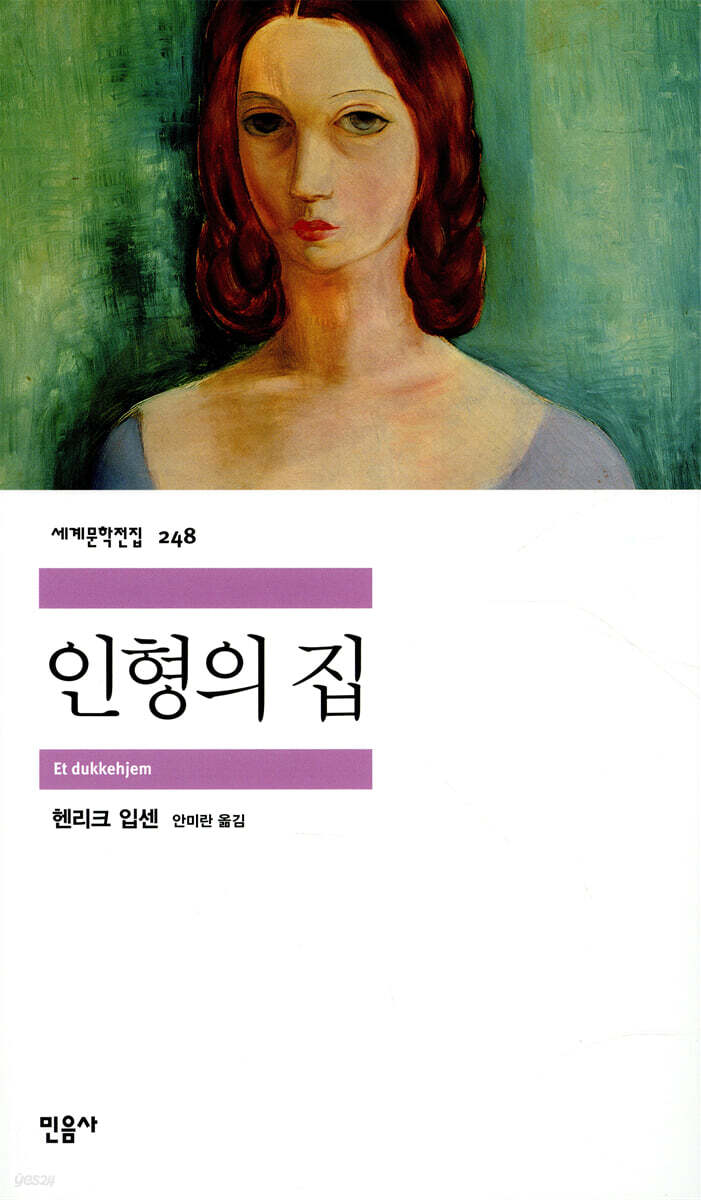
A Doll's House, the masterpiece of Henrik Ibsen, a pioneer of modern drama, has been published in Minumsa's World Literature Collection (volume 248).
A Doll's House is well known as the first feminist play to feature Nora, a woman trying to find herself in a male-dominated society.
This work, which raises questions about marriage and the roles of men and women, was a major event in the late 19th century and caused great controversy as soon as it was published.
The translation of "A Doll's House," which is being published as part of the World Literature Collection, not only uses the Norwegian version of "A Doll's House" as the original text, but also restores all parts that were revised or deleted.
The translator, Ahn Mi-ran, is the eldest daughter of novelist and translator Ahn Jung-hyo. She is fluent in 13 languages, including Norwegian, and is currently a lecturer at La Sapienza University of Rome in Italy.
A Doll's House's new value in a society where individual choice is not respected
A Doll's House ends with Nora leaving home to find herself as a human being, not just as a wife or mother.
She questions not only social conventions, values, and laws, but also religion, saying, “I don’t even know what religion is.”
This caused a great deal of controversy and criticism when the work was first published in 1879.
This work, which raised questions about marriage, the roles of men and women, and religion, which were considered sacred in Europe at the end of the 19th century, was like an event in itself.
At that time, Ibsen published a number of social plays dealing with themes such as manipulation of the press, dual ethics, and conflicts between society and the individual. In particular, he sparked worldwide controversy with A Doll's House, which was published with the statement that "in today's society, women cannot be themselves."
Since then, discussions have continued about the character of Nora in A Doll's House and what fate awaits her after she leaves home.
Elfriede Jelinek, the Nobel Prize-winning author, has made headlines for portraying Nora as failing to become independent in the outside world.
As Ibsen stated, "A Doll's House" deals with the themes of women's rights and independence, but it is also a work that raises questions about individuals and society, as well as social conventions and individual judgment.
This work, published over 130 years ago, still holds new value in that it reflects the reality that customs created by a certain group are imposed on all individuals, and that those who do not follow them cannot survive in that society.
A young and sensuous adaptation of the Norwegian original, A Doll's House
Ahn Mi-ran, who translated “A Doll’s House,” is also the eldest daughter of Ahn Jeong-hyo, a well-known novelist and translator.
An Jeong-hyo published numerous novels, including “The White War,” “The Silver Horse Never Comes,” and “The Life of a Hollywood Kid,” and translated approximately 150 works, including “The Last Temptation,” “War and the Bride,” “Autobiography of the Soul,” and “Roots,” for which he won the first Korea Translation Culture Award.
Ahn Mi-ran, who received her doctorate from the Department of Linguistics at the University of Kiel in Germany and is currently working as a lecturer at the University of Rome La Sapienza in Italy, is also fluent in 13 languages, including Danish and Norwegian.
Although Henrik Ibsen's work, A Doll's House, was written in Norwegian, most of the versions published in Korea so far have been translated into English or Japanese.
In accordance with the principle of excluding middlemen, Minumsa translated the original Norwegian text professionally to preserve the author's intentions.
Additionally, by using the University of Oslo edition, which electronically publishes all of Ibsen's works in their original, unedited form, as the original source, you can encounter the author's works in Korean as they were first published.
Nora, who wants to leave the 'Doll's House' filled with lies and hypocrisy,
The first feminist play by Henrik Ibsen, a pioneer of modern drama, which gave birth to 'Norahism'
“In today’s society, women cannot be themselves.”
A Doll's House is a play in three acts that was first performed in Copenhagen, Denmark in 1879 and has been performed around the world since.
It was first performed in Korea at the Joseon Actors School in 1925.
A Doll's House, the masterpiece of Henrik Ibsen, a pioneer of modern drama, has been published in Minumsa's World Literature Collection (volume 248).
A Doll's House is well known as the first feminist play to feature Nora, a woman trying to find herself in a male-dominated society.
This work, which raises questions about marriage and the roles of men and women, was a major event in the late 19th century and caused great controversy as soon as it was published.
The translation of "A Doll's House," which is being published as part of the World Literature Collection, not only uses the Norwegian version of "A Doll's House" as the original text, but also restores all parts that were revised or deleted.
The translator, Ahn Mi-ran, is the eldest daughter of novelist and translator Ahn Jung-hyo. She is fluent in 13 languages, including Norwegian, and is currently a lecturer at La Sapienza University of Rome in Italy.
A Doll's House's new value in a society where individual choice is not respected
A Doll's House ends with Nora leaving home to find herself as a human being, not just as a wife or mother.
She questions not only social conventions, values, and laws, but also religion, saying, “I don’t even know what religion is.”
This caused a great deal of controversy and criticism when the work was first published in 1879.
This work, which raised questions about marriage, the roles of men and women, and religion, which were considered sacred in Europe at the end of the 19th century, was like an event in itself.
At that time, Ibsen published a number of social plays dealing with themes such as manipulation of the press, dual ethics, and conflicts between society and the individual. In particular, he sparked worldwide controversy with A Doll's House, which was published with the statement that "in today's society, women cannot be themselves."
Since then, discussions have continued about the character of Nora in A Doll's House and what fate awaits her after she leaves home.
Elfriede Jelinek, the Nobel Prize-winning author, has made headlines for portraying Nora as failing to become independent in the outside world.
As Ibsen stated, "A Doll's House" deals with the themes of women's rights and independence, but it is also a work that raises questions about individuals and society, as well as social conventions and individual judgment.
This work, published over 130 years ago, still holds new value in that it reflects the reality that customs created by a certain group are imposed on all individuals, and that those who do not follow them cannot survive in that society.
A young and sensuous adaptation of the Norwegian original, A Doll's House
Ahn Mi-ran, who translated “A Doll’s House,” is also the eldest daughter of Ahn Jeong-hyo, a well-known novelist and translator.
An Jeong-hyo published numerous novels, including “The White War,” “The Silver Horse Never Comes,” and “The Life of a Hollywood Kid,” and translated approximately 150 works, including “The Last Temptation,” “War and the Bride,” “Autobiography of the Soul,” and “Roots,” for which he won the first Korea Translation Culture Award.
Ahn Mi-ran, who received her doctorate from the Department of Linguistics at the University of Kiel in Germany and is currently working as a lecturer at the University of Rome La Sapienza in Italy, is also fluent in 13 languages, including Danish and Norwegian.
Although Henrik Ibsen's work, A Doll's House, was written in Norwegian, most of the versions published in Korea so far have been translated into English or Japanese.
In accordance with the principle of excluding middlemen, Minumsa translated the original Norwegian text professionally to preserve the author's intentions.
Additionally, by using the University of Oslo edition, which electronically publishes all of Ibsen's works in their original, unedited form, as the original source, you can encounter the author's works in Korean as they were first published.
GOODS SPECIFICS
- Date of issue: June 30, 2010
- Pages, weight, size: 137 pages | 220g | 134*224*20mm
- ISBN13: 9788937462481
- ISBN10: 8937462486
You may also like
카테고리
korean


korean

![GQ KOREA Mark (Monthly): December [2025]](http://librairie.coreenne.fr/cdn/shop/files/8ef265dbbfbf186523ed75ba7319009d.jpg?v=1765340328&width=3840)


