

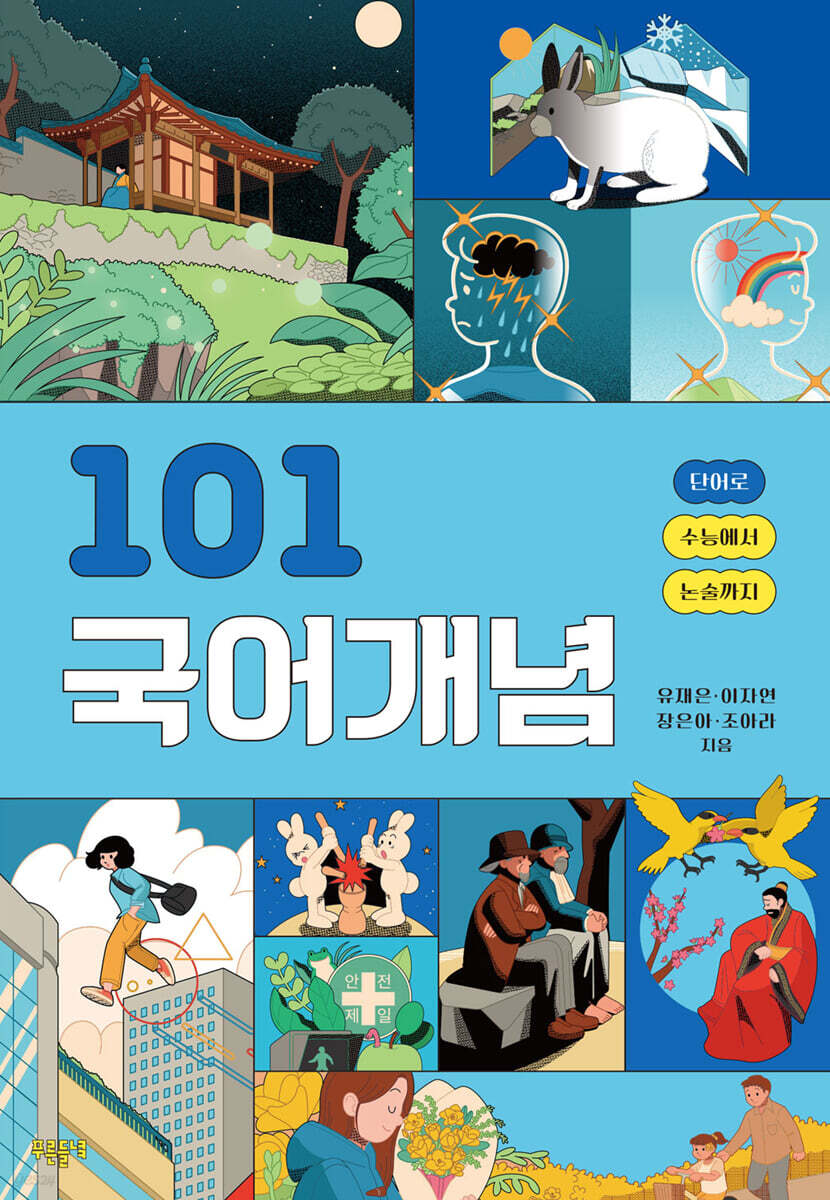
101 Korean Language Concepts
 |
Description
Book Introduction
EBS Middle School Premium Teacher Kim Se-eun participates in the project!
“If you understand the concepts, your grades, college entrance exam scores, and essay scores will change!”
Grade 1, determined by Korean language proficiency
Why? Because all tests are conducted in Korean!
Korean is the foundational subject for all learning.
Even when learning social studies, science, math, and art subjects, it is difficult to properly understand the content and keep up with the progress if Korean language skills are not supported.
And that's not all? Korean language proficiency directly impacts not only your ability to solve various exam questions, but also your ability to prepare essays and write personal statements.
This is because long conditional statements in math problems, explanatory texts in scientific experiment reports, and analytical writing in social studies are all ultimately based on the ability to read and understand Korean.
Especially in the Korean language section, there are voices from the field that say that many people choose the wrong answer due to a lack of understanding of the concepts in the question rather than the work itself.
The same goes for other subjects.
Computational ability and the ability to solve mathematical problems are separate things.
Even if you are usually good at mental calculation, there are many cases where you cannot solve math problems.
For mathematical reasoning problems, understanding the problem and figuring out how to solve it is much more important than calculating it.
《101 Korean Language Concepts》 started from this very problem awareness.
The authors selected 101 key concepts that appear repeatedly in the curriculum, the college entrance exam, and mock exams, and explained them so that students could understand and internalize them on their own.
Rather than simply listing definitions of concepts, it vividly portrays unfamiliar concepts by presenting a variety of short stories, everyday examples, and classic and modern literary works.
“If you understand the concepts, your grades, college entrance exam scores, and essay scores will change!”
Grade 1, determined by Korean language proficiency
Why? Because all tests are conducted in Korean!
Korean is the foundational subject for all learning.
Even when learning social studies, science, math, and art subjects, it is difficult to properly understand the content and keep up with the progress if Korean language skills are not supported.
And that's not all? Korean language proficiency directly impacts not only your ability to solve various exam questions, but also your ability to prepare essays and write personal statements.
This is because long conditional statements in math problems, explanatory texts in scientific experiment reports, and analytical writing in social studies are all ultimately based on the ability to read and understand Korean.
Especially in the Korean language section, there are voices from the field that say that many people choose the wrong answer due to a lack of understanding of the concepts in the question rather than the work itself.
The same goes for other subjects.
Computational ability and the ability to solve mathematical problems are separate things.
Even if you are usually good at mental calculation, there are many cases where you cannot solve math problems.
For mathematical reasoning problems, understanding the problem and figuring out how to solve it is much more important than calculating it.
《101 Korean Language Concepts》 started from this very problem awareness.
The authors selected 101 key concepts that appear repeatedly in the curriculum, the college entrance exam, and mock exams, and explained them so that students could understand and internalize them on their own.
Rather than simply listing definitions of concepts, it vividly portrays unfamiliar concepts by presenting a variety of short stories, everyday examples, and classic and modern literary works.
- You can preview some of the book's contents.
Preview
index
001 Assumption _ You know, if
002 Conflict - The driving force behind the story
003 Senses _ Stimuli that bring about changes in thinking
004 Objective Correlatives and Empathy _ Concrete Objects that Reveal the Speaker's Emotions
005 Awe _ Fear that comes from reverence for the Absolute Being
006 Gojo _ Even if it's so hard that you feel like you're going to die, this situation will be resolved!
007 Space _ A vessel containing meaning
008 Embodying the idea - Express it vividly through your five senses!
009 Tolerance _ Even though their actions and thoughts are different from mine, I understand and accept them.
010 Observation _ Let's look at it from a distance and think again.
011 Spoken and Written Language _Spoken or Written?
012 Positive _ An attitude of seeking out and seeing what is right, good, and desirable
013 Optimistic vs. Pessimistic _ “It’ll be okay, our future is bright.” “No way, our future is dark.”
014 Romantic _ Ecstatic and ideal, so I can never give it up
015 Cynical _ Coldly mocking and mocking
016 Deontological _ It absolutely must happen that way!
017 Daegu _ The writer puts similar words side by side and we call it Daegu
018 Confrontation _ Standing on the Opposing Side
019 Compare _ Let's compare them side by side?
020 Response _ We are a match for each other
021 Monologue _ Talking to yourself can help you make your choices.
022 Tokyo _ It might be a mirage in the endless desert.
023 Identification _ You are me, I am you
024 Fairy Tale _ If you want to be like me, come closer
025 Parameter _ I'll connect you two!
026 Justification - It can be an excuse or a shining value.
027 Explicit _You know even if I don't say it? I have to say it to know!
028 Description _ Shall we try to express the invisible as visible?
029 Helplessness _ It's useless! I have no strength.
030 Feeling of Nothingness _ I opened my hand, which I had clenched with all my might, and there was nothing there.
031 Background _ Everything around us that makes up the world we live in
032 Variation _ Renewing the familiar, deepening the emotions
033 Juxtaposition _ When you put them side by side, do you see something new?
034 Relief _ I prepared this once to make it stand out!
035 Negative _No, that's not right!
036 The inside story of the incident _ You have to look into the inner details that are not visible on the surface!
037 Correlation and causality _ If there is a relationship, it is correlation. If it is cause and effect, it is causality.
038 Symbol _ Surface Area, Meaning Beyond It
039 Color Image _ Evokes colors, shapes, appearances, movements, etc.
040 Narrative _ Flow of meaningful events
041 Seonkyunghujeong _ Let me show you the scenery first and then express my emotions.
042 Declarative Expression - It seems like a question, but it's meant to emphasize the meaning.
043 Reflection _ Reflect deeply and examine past events.
044 Secular _ It's hard to go against it, so I want to follow the world's customs.
045 Petit Bourgeois _Why are there so many cowardly and selfish people?
046 Adaptation _ Rather than trying to change the situation, I will try to adapt to the environment!
047 Time _ Literature is a time capsule containing time.
048 Time Reversal _ Let's travel back in time to the past!
049 Award _ Thoughts and feelings contained in poetry
050 The Strangeness _ Something strange and strange that draws us in
051 Aesthetic _ Attitude toward beauty
052 Deepening _Emotions and conflicts are deepening.
053 Hint _ What is the hidden meaning?
054 Sadness _ Sadness is something felt on top of a great stream of water
055 Enumeration and chaining _ similar expressions are listed and linked one after another
056 Lamentation Method _ Expressing overwhelming emotions with emphasis
057 Praise _ Accept my love and respect!
058 Appearance _ We also get information through outward appearance.
059 Fables _ A look into human life through animals, plants, and objects
060 Unchi _ Noble and elegant style and feel
061 Distant and Near Views _ Distant and Near Views
062 Retirement _ Retire from office and live a leisurely life
Image 063 _ The Key to Open the Drawer of Memory
064 Idealization _Decision to be mistaken
065 Conflict of Interests - A Relationship Intertwined with Profit and Loss
066 Personification _ Give emotions and will to objects
067 3D _ If you look at it from different angles and sides and understand it, it looks different!
068 The Providence of Nature _ Mysterious Order and Law
069 Self-deprecating expression _ It's an expression that makes fun of oneself, but it's actually reflective.
070 Self-sufficiency _ Feeling abundance in oneself
071 Jeonwon _ A space where you can feel nature with your whole body, with a different charm from the city.
072 Gradually _ Going forward little by little
073 Scenery _ Scenery that evokes emotion
074 Justification and Justification - It's a cowardly excuse
075 Emotion _ The feelings or moods felt by the speaker due to the poetic situation
076 Emotional Distance _ The thickness of the invisible wall between us
077 Static and Dynamic Images - Can you feel the movement of the object? Or not?
078 Correspondence _ The front and back of things, words, and writing correspond to each other in agreement.
079 Resignation _ I must give up and give up the thoughts and hopes I had in my heart.
080 Transcendence _ No limits, no standards!
081 Focusing _If you focus, you can capture things that were previously invisible.
082 Pursuit _The direction you pursue in life determines your attitude and posture!
083 Loyalty _ A heart that firmly upholds loyalty and integrity without bending
084 Insight _ Eureka! The sudden awakening of a solution
085 Projection _ I see myself in you
086 Editorial Commentary _Shall we hear the narrator's story?
087 Surface speaker and hidden speaker _Whether the speaker is revealed or not in the poem
088 Representation _ A concrete object presented through the concretization of an idea
089 Pungryu _ A stylish and scenic event
090 Inevitable _ It had to happen that way
091 Implied _ meaning contained in words or writing
092 Fiction _ It seems true, but it's not true?
093 Sense of presence _ As if it were right here, right now
094 Present Tense _ It unfolds so vividly as if it were happening right in front of me!
095 Scholarly _ I am the most knowledgeable!
096 Visualization _ A picture drawn in the mind
097 Ventilation _ It evokes a certain state of mind, action, or state.
098 Skeptical _ Suspicious Eyes
099 Olfactory _ A scent that brings back memories
100 Excitement _ Exciting, fun! Exhilarating!
101 Humor _ Let's make it funny and point it out
002 Conflict - The driving force behind the story
003 Senses _ Stimuli that bring about changes in thinking
004 Objective Correlatives and Empathy _ Concrete Objects that Reveal the Speaker's Emotions
005 Awe _ Fear that comes from reverence for the Absolute Being
006 Gojo _ Even if it's so hard that you feel like you're going to die, this situation will be resolved!
007 Space _ A vessel containing meaning
008 Embodying the idea - Express it vividly through your five senses!
009 Tolerance _ Even though their actions and thoughts are different from mine, I understand and accept them.
010 Observation _ Let's look at it from a distance and think again.
011 Spoken and Written Language _Spoken or Written?
012 Positive _ An attitude of seeking out and seeing what is right, good, and desirable
013 Optimistic vs. Pessimistic _ “It’ll be okay, our future is bright.” “No way, our future is dark.”
014 Romantic _ Ecstatic and ideal, so I can never give it up
015 Cynical _ Coldly mocking and mocking
016 Deontological _ It absolutely must happen that way!
017 Daegu _ The writer puts similar words side by side and we call it Daegu
018 Confrontation _ Standing on the Opposing Side
019 Compare _ Let's compare them side by side?
020 Response _ We are a match for each other
021 Monologue _ Talking to yourself can help you make your choices.
022 Tokyo _ It might be a mirage in the endless desert.
023 Identification _ You are me, I am you
024 Fairy Tale _ If you want to be like me, come closer
025 Parameter _ I'll connect you two!
026 Justification - It can be an excuse or a shining value.
027 Explicit _You know even if I don't say it? I have to say it to know!
028 Description _ Shall we try to express the invisible as visible?
029 Helplessness _ It's useless! I have no strength.
030 Feeling of Nothingness _ I opened my hand, which I had clenched with all my might, and there was nothing there.
031 Background _ Everything around us that makes up the world we live in
032 Variation _ Renewing the familiar, deepening the emotions
033 Juxtaposition _ When you put them side by side, do you see something new?
034 Relief _ I prepared this once to make it stand out!
035 Negative _No, that's not right!
036 The inside story of the incident _ You have to look into the inner details that are not visible on the surface!
037 Correlation and causality _ If there is a relationship, it is correlation. If it is cause and effect, it is causality.
038 Symbol _ Surface Area, Meaning Beyond It
039 Color Image _ Evokes colors, shapes, appearances, movements, etc.
040 Narrative _ Flow of meaningful events
041 Seonkyunghujeong _ Let me show you the scenery first and then express my emotions.
042 Declarative Expression - It seems like a question, but it's meant to emphasize the meaning.
043 Reflection _ Reflect deeply and examine past events.
044 Secular _ It's hard to go against it, so I want to follow the world's customs.
045 Petit Bourgeois _Why are there so many cowardly and selfish people?
046 Adaptation _ Rather than trying to change the situation, I will try to adapt to the environment!
047 Time _ Literature is a time capsule containing time.
048 Time Reversal _ Let's travel back in time to the past!
049 Award _ Thoughts and feelings contained in poetry
050 The Strangeness _ Something strange and strange that draws us in
051 Aesthetic _ Attitude toward beauty
052 Deepening _Emotions and conflicts are deepening.
053 Hint _ What is the hidden meaning?
054 Sadness _ Sadness is something felt on top of a great stream of water
055 Enumeration and chaining _ similar expressions are listed and linked one after another
056 Lamentation Method _ Expressing overwhelming emotions with emphasis
057 Praise _ Accept my love and respect!
058 Appearance _ We also get information through outward appearance.
059 Fables _ A look into human life through animals, plants, and objects
060 Unchi _ Noble and elegant style and feel
061 Distant and Near Views _ Distant and Near Views
062 Retirement _ Retire from office and live a leisurely life
Image 063 _ The Key to Open the Drawer of Memory
064 Idealization _Decision to be mistaken
065 Conflict of Interests - A Relationship Intertwined with Profit and Loss
066 Personification _ Give emotions and will to objects
067 3D _ If you look at it from different angles and sides and understand it, it looks different!
068 The Providence of Nature _ Mysterious Order and Law
069 Self-deprecating expression _ It's an expression that makes fun of oneself, but it's actually reflective.
070 Self-sufficiency _ Feeling abundance in oneself
071 Jeonwon _ A space where you can feel nature with your whole body, with a different charm from the city.
072 Gradually _ Going forward little by little
073 Scenery _ Scenery that evokes emotion
074 Justification and Justification - It's a cowardly excuse
075 Emotion _ The feelings or moods felt by the speaker due to the poetic situation
076 Emotional Distance _ The thickness of the invisible wall between us
077 Static and Dynamic Images - Can you feel the movement of the object? Or not?
078 Correspondence _ The front and back of things, words, and writing correspond to each other in agreement.
079 Resignation _ I must give up and give up the thoughts and hopes I had in my heart.
080 Transcendence _ No limits, no standards!
081 Focusing _If you focus, you can capture things that were previously invisible.
082 Pursuit _The direction you pursue in life determines your attitude and posture!
083 Loyalty _ A heart that firmly upholds loyalty and integrity without bending
084 Insight _ Eureka! The sudden awakening of a solution
085 Projection _ I see myself in you
086 Editorial Commentary _Shall we hear the narrator's story?
087 Surface speaker and hidden speaker _Whether the speaker is revealed or not in the poem
088 Representation _ A concrete object presented through the concretization of an idea
089 Pungryu _ A stylish and scenic event
090 Inevitable _ It had to happen that way
091 Implied _ meaning contained in words or writing
092 Fiction _ It seems true, but it's not true?
093 Sense of presence _ As if it were right here, right now
094 Present Tense _ It unfolds so vividly as if it were happening right in front of me!
095 Scholarly _ I am the most knowledgeable!
096 Visualization _ A picture drawn in the mind
097 Ventilation _ It evokes a certain state of mind, action, or state.
098 Skeptical _ Suspicious Eyes
099 Olfactory _ A scent that brings back memories
100 Excitement _ Exciting, fun! Exhilarating!
101 Humor _ Let's make it funny and point it out
Detailed image

Into the book
The four of us, working together in the same faculty office, were discussing our concerns about class and came to a common desire: "Can't we convey literary concepts in a more vivid and approachable way?"
This desire, starting from the confusion and curiosity students experience when encountering literary concepts, led to the resolution to write a concept book that would go beyond simple definitions and explanations to achieve "understanding."
Some concepts are vague even when explained, and some concepts only seem unfamiliar in the context of a problem.
This book is for those moments.
I wanted to share the experience of concepts that I didn't understand becoming a little more familiar and words that were unfamiliar becoming my own words.
We've selected key concepts that frequently appear in the Korean language section of the College Scholastic Ability Test (CSAT) and essential concepts emphasized in school classes, and put them into short stories and specific examples.
Rather than just listing rigid definitions, I wanted to create a flow that would help people understand and use the words.
--- From the opening text
conflict.
It's a word we use a lot in our daily lives, isn't it? When you think of "conflict," words like "quarrel," "fight," and "argument" might come to mind.
The word ‘conflict’ is a combination of the word for kudzu ‘gal’ (葛) and the word for wisteria ‘deung’ (藤).
It refers to a situation where things or circumstances are complicated and tangled like tangled kudzu and wisteria branches, and cannot be reconciled.
We experience countless conflicts in our daily lives.
You may have trouble deciding on a career path because what you are good at and what you want to do are different, or you may argue with a friend because of differences in perspectives on how to approach something.
Sometimes we experience suffering when we are forced to do things that go against our values and beliefs because of the organization.
The fact that worries, quarrels, and suffering arise like this means that our daily lives are a series of conflicts.
And in the process of resolving conflict, we sometimes experience a sense of accomplishment, and sometimes frustration.
In literary works, conflict acts as the driving force that drives the story.
A monotonous, list-like story without conflict has a hard time capturing the reader's interest or creating tension.
Think of the most entertaining drama or movie you've seen recently.
There is always conflict in dramas and movies.
The film "The First Slam Dunk" depicts Song Tae-seop, who was trapped in the past due to his brother's death, overcoming his inner pain and wounds and growing up.
How about the movie Concrete Utopia?
--- From the text "002 Conflict: The driving force that drives the story"
Confucian scholars of the Joseon Dynasty considered abandoning worldly desires and living a pure life in nature to end one's life as the best life.
So many noblemen wrote about their hopes for a clean and poor life in nature, or expressed their pride in already living that way in their literature.
Let's look at the poem above. The house he built after saving for ten years is only a three-room thatched hut. He doesn't keep it all for himself, giving one room to the moon and another to the wind. Since there's no room left in the river or the mountains, he says he'll live in a house surrounded by houses.
Rather than feeling ashamed of his poor home, he expressed his pride in how wonderful it was to live in harmony with nature.
Living a life of abandoning greed in nature was considered the best by the nobles of the time, so he is proud of himself for realizing the dream of many people.
--- From the text "007 Space: A Vessel Containing Meaning"
After the test, I had a short conversation with a student during break time.
When asked if it was okay, the student gave an unexpected answer.
He said that thanks to the fever reducer, his body started to feel better from the middle of the first period and he was able to finish the problems, and that he was glad that he was able to take the CSAT in a separate testing room.
And then he expressed his gratitude.
He could have been upset, wondering why he had to be sick on such an important day, why he had to be in such a difficult situation, but the student was accepting the situation positively.
Let's first think about the fortunate parts and the things we are grateful for.
I was a student who looked at a glass half full of water and thought, “There’s half water left,” rather than saying, “There’s only half water left.”
The word 'positive' means 'to view a fact or idea favorably or to acknowledge it as correct', and is a word related to the perspective on a thing or object, and further, to our attitude towards life.
Although it was objectively a bad situation to have to take the exam in a separate testing room on the day of the CSAT due to COVID-19 symptoms, the student was fortunate to be able to take the exam safely and accepted the situation positively.
In literature, too, the perspective from which a character views a specific object or subject, or the attitude the character exhibits in a situation or environment, can become a point of interpretation for the work.
Let's take a look at the works and choices actually presented in the 2023 school year.
--- From the text "012 Positive: An attitude of seeking and seeing what is right, good, and desirable"
“Everyone over forty is responsible for their own face.”
These are the words of Abraham Lincoln, the 16th President of the United States.
Why did Lincoln say this? Immediately after being elected president, Lincoln gathered his advisors at the White House to form his cabinet.
One of them recommended a man with a good background and good skills, but Lincoln declined because he did not like his appearance.
Lincoln was told by his recommender that he should not be troubled by his innate talents.
He said as follows:
(omitted) .
In this way, the description of a character's appearance in a work can indirectly convey more information about the character.
Question 32 of the 2025 College Scholastic Ability Test related to the above work
Option 1: '① Describe the subject's appearance using a Daegu expression to reveal the subject's situation' is an appropriate explanation, right?
--- From the text "058 Appearance: Information can also be obtained through outward appearance"
The word '조응' is a combination of '조照', meaning to shine, and '응', meaning to respond.
It is a type of expression that means 'the front and back of two or more objects or words and writings correspond to each other'.
(Omitted) The above work is one that effectively expresses the theme through harmony.
The time of the 'abundant year' originating from the first number is subdivided into 'Sin-O-Seok', the time of 'dawn-noon-evening' from the 6th to the 8th numbers.
Each number presents the daily life of a farmer, going out early in the morning to work in the fields, eating lunch, and returning home after work as the sun sets.
In this way, the way nature and humans coexist in time within the work reveals that the daily life of the farm follows the natural laws of the flow and cycle of time.
Among classical poems, there are many that express poetic situations or the speaker's emotions through harmony with nature, so be sure to remember them!
--- From the text "078 Correspondence: The front and back of things, words, and writing correspond to each other"
Our five senses help us recall past experiences and remember specific moments more vividly.
I think the best of these is smell.
Even now, when I pass by on the street and smell the perfume my first love used to wear, I get lost in vague memories.
In fact, according to research from Rockefeller University, the sensory ratios we remember in the short term are 1% touch, 2% hearing, 5% sight, 15% taste, and 35% smell.
In addition, academic circles have published research results showing that '75% of all emotions generated daily are caused by smell.'
If you think about it, there are quite a few memories where the emotions you feel when going to a certain place or meeting someone are determined by scent.
This desire, starting from the confusion and curiosity students experience when encountering literary concepts, led to the resolution to write a concept book that would go beyond simple definitions and explanations to achieve "understanding."
Some concepts are vague even when explained, and some concepts only seem unfamiliar in the context of a problem.
This book is for those moments.
I wanted to share the experience of concepts that I didn't understand becoming a little more familiar and words that were unfamiliar becoming my own words.
We've selected key concepts that frequently appear in the Korean language section of the College Scholastic Ability Test (CSAT) and essential concepts emphasized in school classes, and put them into short stories and specific examples.
Rather than just listing rigid definitions, I wanted to create a flow that would help people understand and use the words.
--- From the opening text
conflict.
It's a word we use a lot in our daily lives, isn't it? When you think of "conflict," words like "quarrel," "fight," and "argument" might come to mind.
The word ‘conflict’ is a combination of the word for kudzu ‘gal’ (葛) and the word for wisteria ‘deung’ (藤).
It refers to a situation where things or circumstances are complicated and tangled like tangled kudzu and wisteria branches, and cannot be reconciled.
We experience countless conflicts in our daily lives.
You may have trouble deciding on a career path because what you are good at and what you want to do are different, or you may argue with a friend because of differences in perspectives on how to approach something.
Sometimes we experience suffering when we are forced to do things that go against our values and beliefs because of the organization.
The fact that worries, quarrels, and suffering arise like this means that our daily lives are a series of conflicts.
And in the process of resolving conflict, we sometimes experience a sense of accomplishment, and sometimes frustration.
In literary works, conflict acts as the driving force that drives the story.
A monotonous, list-like story without conflict has a hard time capturing the reader's interest or creating tension.
Think of the most entertaining drama or movie you've seen recently.
There is always conflict in dramas and movies.
The film "The First Slam Dunk" depicts Song Tae-seop, who was trapped in the past due to his brother's death, overcoming his inner pain and wounds and growing up.
How about the movie Concrete Utopia?
--- From the text "002 Conflict: The driving force that drives the story"
Confucian scholars of the Joseon Dynasty considered abandoning worldly desires and living a pure life in nature to end one's life as the best life.
So many noblemen wrote about their hopes for a clean and poor life in nature, or expressed their pride in already living that way in their literature.
Let's look at the poem above. The house he built after saving for ten years is only a three-room thatched hut. He doesn't keep it all for himself, giving one room to the moon and another to the wind. Since there's no room left in the river or the mountains, he says he'll live in a house surrounded by houses.
Rather than feeling ashamed of his poor home, he expressed his pride in how wonderful it was to live in harmony with nature.
Living a life of abandoning greed in nature was considered the best by the nobles of the time, so he is proud of himself for realizing the dream of many people.
--- From the text "007 Space: A Vessel Containing Meaning"
After the test, I had a short conversation with a student during break time.
When asked if it was okay, the student gave an unexpected answer.
He said that thanks to the fever reducer, his body started to feel better from the middle of the first period and he was able to finish the problems, and that he was glad that he was able to take the CSAT in a separate testing room.
And then he expressed his gratitude.
He could have been upset, wondering why he had to be sick on such an important day, why he had to be in such a difficult situation, but the student was accepting the situation positively.
Let's first think about the fortunate parts and the things we are grateful for.
I was a student who looked at a glass half full of water and thought, “There’s half water left,” rather than saying, “There’s only half water left.”
The word 'positive' means 'to view a fact or idea favorably or to acknowledge it as correct', and is a word related to the perspective on a thing or object, and further, to our attitude towards life.
Although it was objectively a bad situation to have to take the exam in a separate testing room on the day of the CSAT due to COVID-19 symptoms, the student was fortunate to be able to take the exam safely and accepted the situation positively.
In literature, too, the perspective from which a character views a specific object or subject, or the attitude the character exhibits in a situation or environment, can become a point of interpretation for the work.
Let's take a look at the works and choices actually presented in the 2023 school year.
--- From the text "012 Positive: An attitude of seeking and seeing what is right, good, and desirable"
“Everyone over forty is responsible for their own face.”
These are the words of Abraham Lincoln, the 16th President of the United States.
Why did Lincoln say this? Immediately after being elected president, Lincoln gathered his advisors at the White House to form his cabinet.
One of them recommended a man with a good background and good skills, but Lincoln declined because he did not like his appearance.
Lincoln was told by his recommender that he should not be troubled by his innate talents.
He said as follows:
(omitted) .
In this way, the description of a character's appearance in a work can indirectly convey more information about the character.
Question 32 of the 2025 College Scholastic Ability Test related to the above work
Option 1: '① Describe the subject's appearance using a Daegu expression to reveal the subject's situation' is an appropriate explanation, right?
--- From the text "058 Appearance: Information can also be obtained through outward appearance"
The word '조응' is a combination of '조照', meaning to shine, and '응', meaning to respond.
It is a type of expression that means 'the front and back of two or more objects or words and writings correspond to each other'.
(Omitted) The above work is one that effectively expresses the theme through harmony.
The time of the 'abundant year' originating from the first number is subdivided into 'Sin-O-Seok', the time of 'dawn-noon-evening' from the 6th to the 8th numbers.
Each number presents the daily life of a farmer, going out early in the morning to work in the fields, eating lunch, and returning home after work as the sun sets.
In this way, the way nature and humans coexist in time within the work reveals that the daily life of the farm follows the natural laws of the flow and cycle of time.
Among classical poems, there are many that express poetic situations or the speaker's emotions through harmony with nature, so be sure to remember them!
--- From the text "078 Correspondence: The front and back of things, words, and writing correspond to each other"
Our five senses help us recall past experiences and remember specific moments more vividly.
I think the best of these is smell.
Even now, when I pass by on the street and smell the perfume my first love used to wear, I get lost in vague memories.
In fact, according to research from Rockefeller University, the sensory ratios we remember in the short term are 1% touch, 2% hearing, 5% sight, 15% taste, and 35% smell.
In addition, academic circles have published research results showing that '75% of all emotions generated daily are caused by smell.'
If you think about it, there are quite a few memories where the emotions you feel when going to a certain place or meeting someone are determined by scent.
--- From the text "099 Olfactory: A scent that reminds you of the moment"
Publisher's Review
Grade 1, determined by Korean language proficiency
Why? Because all tests are conducted in Korean!
Korean is the foundational subject for all learning.
Even when learning social studies, science, math, and art subjects, it is difficult to properly understand the content and keep up with the progress if Korean language skills are not supported.
And that's not all? Korean language proficiency directly impacts not only your ability to solve various exam questions, but also your ability to prepare essays and write personal statements.
This is because long conditional statements in math problems, explanatory texts in scientific experiment reports, and analytical writing in social studies are all ultimately based on the ability to read and understand Korean.
Especially in the Korean language section, there are voices from the field that say that many people choose the wrong answer due to a lack of understanding of the concepts in the question rather than the work itself.
The same goes for other subjects.
Computational ability and the ability to solve mathematical problems are separate things.
Even if you are usually good at mental calculation, there are many cases where you cannot solve math problems.
For mathematical reasoning problems, understanding the problem and figuring out how to solve it is much more important than calculating it.
《101 Korean Language Concepts》 started from this very problem awareness.
The authors selected 101 key concepts that appear repeatedly in the curriculum, the college entrance exam, and mock exams, and explained them so that students could understand and internalize them on their own.
Rather than simply listing definitions of concepts, it vividly portrays unfamiliar concepts by presenting a variety of short stories, everyday examples, and classic and modern literary works.
For example, ‘family’ was expressed through the Goryeo song ‘Jeongseokga’.
First, we show a scene of a conversation between lovers, “What if we break up?” and then we connect it to how it was used as a device to emphasize the impossibility of breaking up with Im in the actual work.
'Objective Correlative' shows how the speaker's lost love is projected onto objects through a pair of cuckoos in King Yuri's "Hwangjoga."
By connecting abstract concepts to concrete scenes, readers can accept the concepts not simply by 'memorizing' them but by 'feeling' them.
《101 Korean Language Concepts》 is not a glossary for memorization, but a friendly guide that you can always keep by your side and refer to.
This book will serve as a guide to help you change 'words you've heard' into 'words you can use' and expand your 'reading skills' into 'writing skills'.
With this book, you can develop the ability to 'read' questions in the exam room.
The foundation of literacy and thinking is word comprehension.
Four current high school Korean language teachers participated in the writing.
Based on real-life questions and experiences encountered in the classroom, we addressed the root of questions such as “I don’t know what ‘self-deprecating expression’ in the options is” and “What does sentimental emotion mean?” in a friendly and specific way.
Furthermore, the concept words and problem solving were directly connected.
For example, in Lee Yuk-sa's poem "Green Grapes," the sensory expressions such as the blue of the sea, the brightness of white sails, and the coolness of grape juice were used to help readers understand the hope of the work.
Through Yun Dong-ju's "Another Hometown," the speaker examines the attitude of "contemplation" in which he looks at himself from a distance, confirming that it is not a simple description of emotions, but a concept that fosters the power of reflection and thought.
《101 Korean Language Concepts》 helps students avoid being blocked by concept words when facing exams, while also guiding them to develop literacy and thinking skills.
Additionally, EBS Middle School Premium teacher Kim Se-eun participated in planning this series, and it reflected the needs of both classroom practice and entrance exam preparation.
This book will be a reliable companion not only for teenagers preparing for school grades, the college entrance exam, and essay writing, but also for teachers and parents who want to organize Korean language concepts, and general readers who want to re-establish the fundamentals of Korean language and literature.
Why? Because all tests are conducted in Korean!
Korean is the foundational subject for all learning.
Even when learning social studies, science, math, and art subjects, it is difficult to properly understand the content and keep up with the progress if Korean language skills are not supported.
And that's not all? Korean language proficiency directly impacts not only your ability to solve various exam questions, but also your ability to prepare essays and write personal statements.
This is because long conditional statements in math problems, explanatory texts in scientific experiment reports, and analytical writing in social studies are all ultimately based on the ability to read and understand Korean.
Especially in the Korean language section, there are voices from the field that say that many people choose the wrong answer due to a lack of understanding of the concepts in the question rather than the work itself.
The same goes for other subjects.
Computational ability and the ability to solve mathematical problems are separate things.
Even if you are usually good at mental calculation, there are many cases where you cannot solve math problems.
For mathematical reasoning problems, understanding the problem and figuring out how to solve it is much more important than calculating it.
《101 Korean Language Concepts》 started from this very problem awareness.
The authors selected 101 key concepts that appear repeatedly in the curriculum, the college entrance exam, and mock exams, and explained them so that students could understand and internalize them on their own.
Rather than simply listing definitions of concepts, it vividly portrays unfamiliar concepts by presenting a variety of short stories, everyday examples, and classic and modern literary works.
For example, ‘family’ was expressed through the Goryeo song ‘Jeongseokga’.
First, we show a scene of a conversation between lovers, “What if we break up?” and then we connect it to how it was used as a device to emphasize the impossibility of breaking up with Im in the actual work.
'Objective Correlative' shows how the speaker's lost love is projected onto objects through a pair of cuckoos in King Yuri's "Hwangjoga."
By connecting abstract concepts to concrete scenes, readers can accept the concepts not simply by 'memorizing' them but by 'feeling' them.
《101 Korean Language Concepts》 is not a glossary for memorization, but a friendly guide that you can always keep by your side and refer to.
This book will serve as a guide to help you change 'words you've heard' into 'words you can use' and expand your 'reading skills' into 'writing skills'.
With this book, you can develop the ability to 'read' questions in the exam room.
The foundation of literacy and thinking is word comprehension.
Four current high school Korean language teachers participated in the writing.
Based on real-life questions and experiences encountered in the classroom, we addressed the root of questions such as “I don’t know what ‘self-deprecating expression’ in the options is” and “What does sentimental emotion mean?” in a friendly and specific way.
Furthermore, the concept words and problem solving were directly connected.
For example, in Lee Yuk-sa's poem "Green Grapes," the sensory expressions such as the blue of the sea, the brightness of white sails, and the coolness of grape juice were used to help readers understand the hope of the work.
Through Yun Dong-ju's "Another Hometown," the speaker examines the attitude of "contemplation" in which he looks at himself from a distance, confirming that it is not a simple description of emotions, but a concept that fosters the power of reflection and thought.
《101 Korean Language Concepts》 helps students avoid being blocked by concept words when facing exams, while also guiding them to develop literacy and thinking skills.
Additionally, EBS Middle School Premium teacher Kim Se-eun participated in planning this series, and it reflected the needs of both classroom practice and entrance exam preparation.
This book will be a reliable companion not only for teenagers preparing for school grades, the college entrance exam, and essay writing, but also for teachers and parents who want to organize Korean language concepts, and general readers who want to re-establish the fundamentals of Korean language and literature.
GOODS SPECIFICS
- Date of issue: September 1, 2025
- Page count, weight, size: 376 pages | 148*210*30mm
- ISBN13: 9791159259807
- ISBN10: 1159259801
You may also like
카테고리
korean


korean

![GQ KOREA Mark (Monthly): December [2025]](http://librairie.coreenne.fr/cdn/shop/files/8ef265dbbfbf186523ed75ba7319009d.jpg?v=1765340328&width=3840)


