

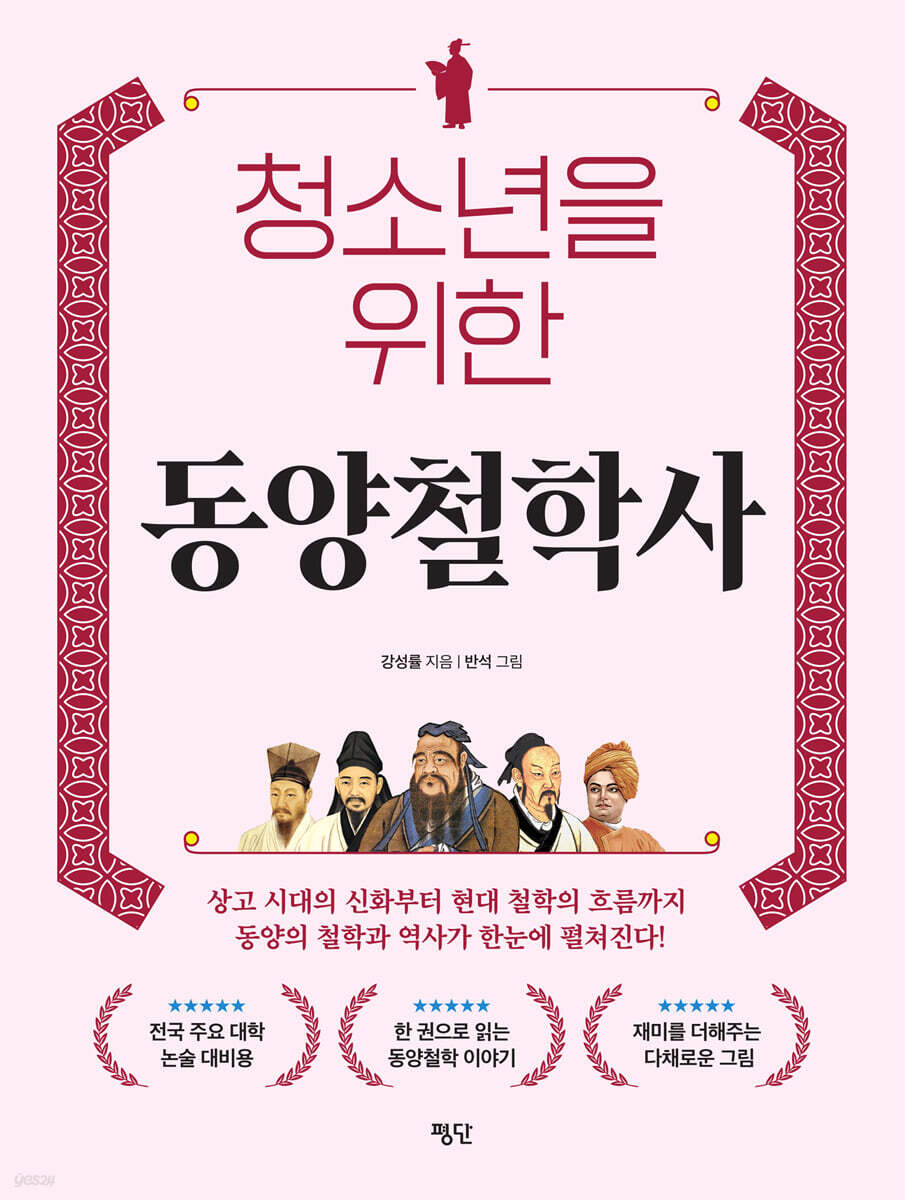
A History of Oriental Philosophy for Youth
 |
Description
Book Introduction
“From the mythology of ancient China to Yangmingism
From ancient Indian philosophy to the flourishing of Buddhist philosophy
From the Korean Hongik Ingan ideology to the flow of modern philosophy
“All of Eastern philosophy in one volume!”
A philosophy textbook that covers the entire history of philosophy in China, India, and Korea!
Rich annotations and various illustrations make it even more fun to look at and read!
It shows at a glance how the history of Eastern philosophy has changed, from the myths of ancient China to the flow of modern philosophy.
When we talk about Eastern philosophy, we usually mean philosophy that originated and developed in the East, but this includes not only the commonly known Chinese philosophy, but also the philosophy of India and Korea.
The author, who studied philosophy at university and has been teaching philosophy for over 30 years, emphasizes that China is where Eastern philosophy flourished the most, and devotes the most space to explaining the history of Chinese philosophy from the myths of ancient times to the flow of time.
Meanwhile, we looked at the ancient philosophy of India, the emergence of materialism, Jainism, Hinduism, and the truth of Buddhism, and in Korean philosophy, we organized the meaning of the Dangun myth, which presented the ideology of Hongik Ingan, as well as the founding myths of the Three Kingdoms, the philosophy and thought of Goryeo, the great thinkers of Joseon, and the flow of philosophy during the Japanese colonial period and modern times.
"A History of Eastern Philosophy for Youth" provides a comprehensive overview of Eastern philosophy, examining the daily lives of leading Eastern philosophers and the core ideas they have studied throughout their lives.
It vividly depicts a story that you may have heard somewhere before, and along these lines, it includes many illustrations and episodes to make the book more accessible to readers.
From ancient Indian philosophy to the flourishing of Buddhist philosophy
From the Korean Hongik Ingan ideology to the flow of modern philosophy
“All of Eastern philosophy in one volume!”
A philosophy textbook that covers the entire history of philosophy in China, India, and Korea!
Rich annotations and various illustrations make it even more fun to look at and read!
It shows at a glance how the history of Eastern philosophy has changed, from the myths of ancient China to the flow of modern philosophy.
When we talk about Eastern philosophy, we usually mean philosophy that originated and developed in the East, but this includes not only the commonly known Chinese philosophy, but also the philosophy of India and Korea.
The author, who studied philosophy at university and has been teaching philosophy for over 30 years, emphasizes that China is where Eastern philosophy flourished the most, and devotes the most space to explaining the history of Chinese philosophy from the myths of ancient times to the flow of time.
Meanwhile, we looked at the ancient philosophy of India, the emergence of materialism, Jainism, Hinduism, and the truth of Buddhism, and in Korean philosophy, we organized the meaning of the Dangun myth, which presented the ideology of Hongik Ingan, as well as the founding myths of the Three Kingdoms, the philosophy and thought of Goryeo, the great thinkers of Joseon, and the flow of philosophy during the Japanese colonial period and modern times.
"A History of Eastern Philosophy for Youth" provides a comprehensive overview of Eastern philosophy, examining the daily lives of leading Eastern philosophers and the core ideas they have studied throughout their lives.
It vividly depicts a story that you may have heard somewhere before, and along these lines, it includes many illustrations and episodes to make the book more accessible to readers.
- You can preview some of the book's contents.
Preview
index
Preface: A Story of Eastern Philosophy Closest to Our Emotions
Part 1: Chinese Philosophy: Building a Golden Tower That Will Last
Chapter 1: Myths of the Ancient World
Fuxi, with a human head and a snake body | Shennong, the founder of farming and barter | Emperor, the creator of transportation and writing | Yao and Shun, the sages who brought about a peaceful era
Chapter 2: The Roots of Advanced Confucianism
The Dog at the Shang House, Confucius | The Saint Created by Mencius's Mother, Mencius | The Simple and Unpretentious Life, Xunzi | Life and Philosophy: Confucius vs. Socrates, Mencius vs. Plato, Xunzi vs. Aristotle
Chapter 3: The Development of Taoist Thought
A child born old, Lao-tzu | A philosopher who sought to transcend the world, Zhuangzi | Clear and pure discourse, Cheongdam | Aspiration to become a hermit, Taoism
Chapter 4: Formation of the Disciple's Philosophy
Strict application of rules, Mozi | Don't hit a dog, Yangzi | Absurd sophists, Mingjia | A wealthy and strong nation is the only way to survive, Legalist | Confucian tradition
Chapter 5: The Establishment of Chinese Buddhism
The spread and development of Buddhism | Washing the heart in water, Bulldojing | The ugly boy genius, Doan | The founder of chanting, Huiyuan | Kumarajiva, one of the three great translators of Chinese Buddhism | Suddenly enlightened in silence, Seungjo | Anyone can become a Buddha, Dosaeng | Life and philosophy - Chinese Buddhist scholars with different achievements | Zhiyi, the perfecter of Tiantai thought | Xuanzang, the monk Tripitaka who appeared in Journey to the West | Persuading Empress Wu Zetian, Fazhang | Anyone can practice Zen
Chapter 6: The Emergence of Neo-Confucianism
Anrak Seonsaeng, who ultimately rejected the will, So Kang-jeol; Zhu Lianjie, a Confucian scholar who loved lotus flowers; Jang Heng-geo, a scholar instead of a soldier; Lee Jeong-hyeong, restoring the thousand-year-old Daoist tradition; What is above the sky, Zhu Xi
Chapter 7 Understanding the Mind and Yangming Studies
Where is the End of Heaven and Earth? by Yuk Sang-san | Wang Yangming, a Descendant of the Master Calligrapher Wang Xizhi
Part 2: Indian Philosophy, Buddhism, and Emotions Meet
Chapter 1: The World of Ancient Philosophy
The Age of Praise and Doubt of the Gods, the Age of Hymns | The Age of the Four Castes, Devotional Mysticism | The Age of the Upanishads, the Turn to Pessimism
Chapter 2: The Age Before Buddhist Philosophy
Materialism and Jainism | The Emergence of Hinduism | Life and Philosophy | Characters and Heroes of Indian Mythology
Chapter 3: The Golden Age of Buddhist Philosophy
Maya's Dream | The Truth of Buddhism | The Similarities and Differences of the World's Four Great Saints | Life and Philosophy | Various Common Sense About Buddhism
Part 3: Korean Philosophy: Opening a New Chapter in History
Chapter 1: The Ideology of Hongik Ingan
Chapter 2: The Founding Myth of the Three Kingdoms
Descendants of the Same Heaven | Confucianism, embodying Confucian ideals | Buddhism, a new political ideology | Taoism, pursuing immortality and seclusion
Chapter 3: Representative Masters of Unified Silla
Petition for the Ten Articles of the Shimu Policy, Choi Chi-won | Drinking Water from a Skull, Wonhyo | Harmony through Oneness, Uisang
Chapter 4 Philosophy and Thought of Goryeo
Buddhism as the state religion | Taoism and Taoist thought | Introduction of Neo-Confucianism
Chapter 5: Great Thinkers of Joseon
The Beginning of Neo-Confucianism | Buddhism in the Early Joseon Dynasty | The Development of Neo-Confucianism | Buddhism Thereafter | Confucianism and the Emergence of Silhak in the Late Joseon Dynasty
Chapter 6: Philosophy Blossomed During the Japanese Colonial Period
Responding to Imperialism | The Rise of New Religions | The Age of Philosophy in the Pedestal
Chapter 7: The Flow of Modern Philosophy
Characteristics of Eastern Philosophy | The Influence of Western Philosophy | The Influence of Christianity
References
Part 1: Chinese Philosophy: Building a Golden Tower That Will Last
Chapter 1: Myths of the Ancient World
Fuxi, with a human head and a snake body | Shennong, the founder of farming and barter | Emperor, the creator of transportation and writing | Yao and Shun, the sages who brought about a peaceful era
Chapter 2: The Roots of Advanced Confucianism
The Dog at the Shang House, Confucius | The Saint Created by Mencius's Mother, Mencius | The Simple and Unpretentious Life, Xunzi | Life and Philosophy: Confucius vs. Socrates, Mencius vs. Plato, Xunzi vs. Aristotle
Chapter 3: The Development of Taoist Thought
A child born old, Lao-tzu | A philosopher who sought to transcend the world, Zhuangzi | Clear and pure discourse, Cheongdam | Aspiration to become a hermit, Taoism
Chapter 4: Formation of the Disciple's Philosophy
Strict application of rules, Mozi | Don't hit a dog, Yangzi | Absurd sophists, Mingjia | A wealthy and strong nation is the only way to survive, Legalist | Confucian tradition
Chapter 5: The Establishment of Chinese Buddhism
The spread and development of Buddhism | Washing the heart in water, Bulldojing | The ugly boy genius, Doan | The founder of chanting, Huiyuan | Kumarajiva, one of the three great translators of Chinese Buddhism | Suddenly enlightened in silence, Seungjo | Anyone can become a Buddha, Dosaeng | Life and philosophy - Chinese Buddhist scholars with different achievements | Zhiyi, the perfecter of Tiantai thought | Xuanzang, the monk Tripitaka who appeared in Journey to the West | Persuading Empress Wu Zetian, Fazhang | Anyone can practice Zen
Chapter 6: The Emergence of Neo-Confucianism
Anrak Seonsaeng, who ultimately rejected the will, So Kang-jeol; Zhu Lianjie, a Confucian scholar who loved lotus flowers; Jang Heng-geo, a scholar instead of a soldier; Lee Jeong-hyeong, restoring the thousand-year-old Daoist tradition; What is above the sky, Zhu Xi
Chapter 7 Understanding the Mind and Yangming Studies
Where is the End of Heaven and Earth? by Yuk Sang-san | Wang Yangming, a Descendant of the Master Calligrapher Wang Xizhi
Part 2: Indian Philosophy, Buddhism, and Emotions Meet
Chapter 1: The World of Ancient Philosophy
The Age of Praise and Doubt of the Gods, the Age of Hymns | The Age of the Four Castes, Devotional Mysticism | The Age of the Upanishads, the Turn to Pessimism
Chapter 2: The Age Before Buddhist Philosophy
Materialism and Jainism | The Emergence of Hinduism | Life and Philosophy | Characters and Heroes of Indian Mythology
Chapter 3: The Golden Age of Buddhist Philosophy
Maya's Dream | The Truth of Buddhism | The Similarities and Differences of the World's Four Great Saints | Life and Philosophy | Various Common Sense About Buddhism
Part 3: Korean Philosophy: Opening a New Chapter in History
Chapter 1: The Ideology of Hongik Ingan
Chapter 2: The Founding Myth of the Three Kingdoms
Descendants of the Same Heaven | Confucianism, embodying Confucian ideals | Buddhism, a new political ideology | Taoism, pursuing immortality and seclusion
Chapter 3: Representative Masters of Unified Silla
Petition for the Ten Articles of the Shimu Policy, Choi Chi-won | Drinking Water from a Skull, Wonhyo | Harmony through Oneness, Uisang
Chapter 4 Philosophy and Thought of Goryeo
Buddhism as the state religion | Taoism and Taoist thought | Introduction of Neo-Confucianism
Chapter 5: Great Thinkers of Joseon
The Beginning of Neo-Confucianism | Buddhism in the Early Joseon Dynasty | The Development of Neo-Confucianism | Buddhism Thereafter | Confucianism and the Emergence of Silhak in the Late Joseon Dynasty
Chapter 6: Philosophy Blossomed During the Japanese Colonial Period
Responding to Imperialism | The Rise of New Religions | The Age of Philosophy in the Pedestal
Chapter 7: The Flow of Modern Philosophy
Characteristics of Eastern Philosophy | The Influence of Western Philosophy | The Influence of Christianity
References
Detailed image

Into the book
Is human nature good or evil? There are two theories on this.
One is the theory of human nature being good, advocated by Mencius, and the other is the theory of human nature being evil, advocated by Xunzi.
Mencius argues that human nature is good.
Human nature, like water, always flows downward, and follows only what is good.
To be born into this world and walk the right path, a human being simply needs to draw out what is in his heart, and there is no need to learn separately the exemplary lives of the wise.
All you have to do is listen to the good voice of conscience whispering in your heart.
From this perspective, all human errors and sins stem from the imperfections of the social system that binds people from the outside, and from the mistakes of those who rule the country.
---p.35
The Tao (道) spoken of in Confucianism was limited to human ethics.
However, the Tao that Laozi is talking about is the fundamental source of the universe, the law of nature and all things in heaven and earth.
In other words, Tao is the ultimate cause of the world that cannot be understood by our human minds, and it is the law of all laws and the measure of all measures.
Regarding this, Lao Tzu said, “Man imitates the earth, the earth imitates heaven, heaven imitates the Tao, and the Tao imitates nature.”
Therefore, this Tao cannot be conceptually defined in the human mind, nor can it be expressed in words or writing.
It is something we cannot see even if we try to see it, cannot hear even if we try to hear it, and cannot grasp even if we try to grasp it.
Because the Tao has no color, no sound, and no form.
---p.56~60
In a way, Taoism is nothing more than a miscellaneous doctrine other than the idea of leaving the mundane world and becoming a god.
All the methods they pursued not only led to abstract ecstasy, but also to a veil of mystery surrounding them, causing those who believed in them and tried to learn them to waste time and energy in vain.
I think it is difficult to expect that a person will attain the Way and ascend to heaven, or that he will prolong his life by strengthening his body.
---p.105
In order for the laws created in a country to be properly observed, the authority of the monarch must be established above all else.
A monarch must have absolute authority and know how to treat his subjects like servants.
Only when we are able to walk barefoot through hot water or burning fire with a single command can we truly practice law with peace of mind.
Han Feizi accepted the concept of 'force' in the New Testament and argued that the rule of law was superior to the rule of man and that 'law' and 'force' could complement each other.
Han Feizi likened the 'se' of a monarch to the sharp teeth of a tiger and the claws of a leopard, and believed that a monarch without 'se' was as powerless as a toothless tiger.
He said that the 'three' comes not from the personality or morality of the monarch, but from the status of the monarch.
---p.154
We need to distinguish here between the terms 'Chinese Buddhism' and 'Buddhism in China'.
For example, if the sect introduced by Xuanzang, who returned from studying Buddhism in India, is called “Buddhism in China,” then the Buddhism that has already entered China and developed alongside China’s philosophical tradition can be called “Chinese Buddhism.”
Buddhism and Taoism merged to form Zen Buddhism, a sect of Buddhism that seeks to elucidate the truth through sitting meditation.
Also, in Buddhism, there are Mahayana and Hinayana.
However, among these, the one that remained in Chinese Buddhism was Mahayana.
---p.176
Here we must understand that enlightenment and sudden enlightenment are not the same.
Confucianism in ancient times and Buddhism to this day have emphasized methods of self-cultivation, such as 'an experienced ox destroying a carriage.'
However, when Do-saeng thought about it, he thought that in this case, he might be able to become a great scholar by reading many books, but he would not be able to become a great thinker.
In the process of enlightenment, there must be a moment when one suddenly realizes something.
It is not something that can be obtained by studying a certain philosophy step by step, but rather by discarding all the ideas that have been studied so far.
---p.203
In this way, the body of the Infinite Supreme Ultimate has two possibilities.
One is moving, which we call yang, and the other is stationary, which we call yin.
When the Taegeuk moves, it creates yang, and when this movement reaches its peak, it becomes stillness and creates yin, and when this stillness reaches its peak, it begins to move again.
In other words, yin and yang are divided depending on whether they are moving or standing still, and this turns around and around again, so they do not stay still forever.
---p.246
Indian philosophy refers to the philosophical speculations of all thinkers, ancient and modern, Hindu and non-Hindu, theist and atheist.
And its most distinctive feature is that different schools of thought coexist and find common ground through long-term deliberation and discussion.
If Indian philosophy can maintain this attitude in the future, a great philosophy may emerge that embraces all the ideas coming into India from the West, the East, and other sources.
---p.286
But on the other hand, if you think about it, pain is also something that comes from our hearts.
Frustration, sadness, and sorrow follow because we think that something fleeting will always remain in the same place, or because we stubbornly insist on being ourselves when there is nothing that can be called our true self.
Therefore, once we realize the true principles of impermanence of all things and non-self of all dharmas, suffering naturally disappears.
If we can see ourselves in our true state, all suffering can be overcome through the wisdom of this realization.
---p.323
The challenge Wonhyo felt was how to organize and systematize Buddhist theories that seemed contradictory.
So, while he classified almost all the scriptures, he annotated them with his own interpretations.
In particular, he used his unique concept of reconciliation to overcome contradictory and opposing views.
Wonhyo tried to spread Buddhism, which was accepted only by the royal family and the nobility at the time, to the common people.
However, he had no intention of training disciples, and was not highly regarded in Silla at the time.
Instead, he became widely known in China and played a pioneering role in the establishment of Chinese Huayanism, and began to be re-evaluated during the Goryeo Dynasty when he was posthumously awarded the title of National Preceptor Hwajeong by Uicheon.
One is the theory of human nature being good, advocated by Mencius, and the other is the theory of human nature being evil, advocated by Xunzi.
Mencius argues that human nature is good.
Human nature, like water, always flows downward, and follows only what is good.
To be born into this world and walk the right path, a human being simply needs to draw out what is in his heart, and there is no need to learn separately the exemplary lives of the wise.
All you have to do is listen to the good voice of conscience whispering in your heart.
From this perspective, all human errors and sins stem from the imperfections of the social system that binds people from the outside, and from the mistakes of those who rule the country.
---p.35
The Tao (道) spoken of in Confucianism was limited to human ethics.
However, the Tao that Laozi is talking about is the fundamental source of the universe, the law of nature and all things in heaven and earth.
In other words, Tao is the ultimate cause of the world that cannot be understood by our human minds, and it is the law of all laws and the measure of all measures.
Regarding this, Lao Tzu said, “Man imitates the earth, the earth imitates heaven, heaven imitates the Tao, and the Tao imitates nature.”
Therefore, this Tao cannot be conceptually defined in the human mind, nor can it be expressed in words or writing.
It is something we cannot see even if we try to see it, cannot hear even if we try to hear it, and cannot grasp even if we try to grasp it.
Because the Tao has no color, no sound, and no form.
---p.56~60
In a way, Taoism is nothing more than a miscellaneous doctrine other than the idea of leaving the mundane world and becoming a god.
All the methods they pursued not only led to abstract ecstasy, but also to a veil of mystery surrounding them, causing those who believed in them and tried to learn them to waste time and energy in vain.
I think it is difficult to expect that a person will attain the Way and ascend to heaven, or that he will prolong his life by strengthening his body.
---p.105
In order for the laws created in a country to be properly observed, the authority of the monarch must be established above all else.
A monarch must have absolute authority and know how to treat his subjects like servants.
Only when we are able to walk barefoot through hot water or burning fire with a single command can we truly practice law with peace of mind.
Han Feizi accepted the concept of 'force' in the New Testament and argued that the rule of law was superior to the rule of man and that 'law' and 'force' could complement each other.
Han Feizi likened the 'se' of a monarch to the sharp teeth of a tiger and the claws of a leopard, and believed that a monarch without 'se' was as powerless as a toothless tiger.
He said that the 'three' comes not from the personality or morality of the monarch, but from the status of the monarch.
---p.154
We need to distinguish here between the terms 'Chinese Buddhism' and 'Buddhism in China'.
For example, if the sect introduced by Xuanzang, who returned from studying Buddhism in India, is called “Buddhism in China,” then the Buddhism that has already entered China and developed alongside China’s philosophical tradition can be called “Chinese Buddhism.”
Buddhism and Taoism merged to form Zen Buddhism, a sect of Buddhism that seeks to elucidate the truth through sitting meditation.
Also, in Buddhism, there are Mahayana and Hinayana.
However, among these, the one that remained in Chinese Buddhism was Mahayana.
---p.176
Here we must understand that enlightenment and sudden enlightenment are not the same.
Confucianism in ancient times and Buddhism to this day have emphasized methods of self-cultivation, such as 'an experienced ox destroying a carriage.'
However, when Do-saeng thought about it, he thought that in this case, he might be able to become a great scholar by reading many books, but he would not be able to become a great thinker.
In the process of enlightenment, there must be a moment when one suddenly realizes something.
It is not something that can be obtained by studying a certain philosophy step by step, but rather by discarding all the ideas that have been studied so far.
---p.203
In this way, the body of the Infinite Supreme Ultimate has two possibilities.
One is moving, which we call yang, and the other is stationary, which we call yin.
When the Taegeuk moves, it creates yang, and when this movement reaches its peak, it becomes stillness and creates yin, and when this stillness reaches its peak, it begins to move again.
In other words, yin and yang are divided depending on whether they are moving or standing still, and this turns around and around again, so they do not stay still forever.
---p.246
Indian philosophy refers to the philosophical speculations of all thinkers, ancient and modern, Hindu and non-Hindu, theist and atheist.
And its most distinctive feature is that different schools of thought coexist and find common ground through long-term deliberation and discussion.
If Indian philosophy can maintain this attitude in the future, a great philosophy may emerge that embraces all the ideas coming into India from the West, the East, and other sources.
---p.286
But on the other hand, if you think about it, pain is also something that comes from our hearts.
Frustration, sadness, and sorrow follow because we think that something fleeting will always remain in the same place, or because we stubbornly insist on being ourselves when there is nothing that can be called our true self.
Therefore, once we realize the true principles of impermanence of all things and non-self of all dharmas, suffering naturally disappears.
If we can see ourselves in our true state, all suffering can be overcome through the wisdom of this realization.
---p.323
The challenge Wonhyo felt was how to organize and systematize Buddhist theories that seemed contradictory.
So, while he classified almost all the scriptures, he annotated them with his own interpretations.
In particular, he used his unique concept of reconciliation to overcome contradictory and opposing views.
Wonhyo tried to spread Buddhism, which was accepted only by the royal family and the nobility at the time, to the common people.
However, he had no intention of training disciples, and was not highly regarded in Silla at the time.
Instead, he became widely known in China and played a pioneering role in the establishment of Chinese Huayanism, and began to be re-evaluated during the Goryeo Dynasty when he was posthumously awarded the title of National Preceptor Hwajeong by Uicheon.
---p.361~362
Publisher's Review
A story of Eastern philosophy closest to our emotions
"A History of Eastern Philosophy for Youth" is a book that reflects the author's tireless efforts to present the roots and history of Eastern philosophy to young people.
This volume presents a comprehensive overview of the history of Eastern philosophy, from ancient myths to the currents of modern philosophy.
‘Oriental philosophy’ was not limited to Chinese philosophy.
Oriental philosophy usually refers to philosophy that originated and developed in the East, and it should be used to encompass not only the commonly known Chinese philosophy, but also the philosophy of India and Korea.
This book is a history of Eastern philosophy 'for teenagers,' but it is not just for teenagers.
This book provides a comprehensive overview of Eastern philosophy, covering not only Chinese philosophy, which is the mainstream of Eastern philosophy, but also Indian and Korean philosophy, enabling readers, from college students to the general public, to acquire the basic knowledge of philosophy that is essential for any cultured person.
In particular, the ideas conveyed by Eastern philosophers were truly diverse.
Moreover, this book thoroughly introduces the birth and death of Eastern philosophers who influenced their time.
Therefore, there will be many scenes that will make you exclaim, “Is there such a side to this thinker?”
Rather than simply listing familiar characters, the story unfolded in a more bold, honest, and detailed manner.
For example, each character's private life and episodes keep the reader captivated for even a moment.
We can get a glimpse of their various appearances and even their human aspects that we didn't know much about before, such as Lao Tzu, who looked old from birth; Bao Shu, who was synonymous with Guan Zhong and helped Guan Zhong his whole life; Han Feizi, the supreme figure of Legalism, who died at the hands of a friend; Buddha, who decided to become a monk and practice asceticism to avoid a woman lying in his bed; and Yi Hwang, who is said to have said to his wife on their wedding night, "Don't talk nonsense, I'll intervene."
The tips inserted here and there by comparing them to Western philosophers are another unique feature of this book.
When philosophy, painting, and argumentation meet
This book contains real-life photos, famous paintings, and illustrations, and each plate is accompanied by a friendly and vivid explanation to help convey the situation at the time more chronologically. In addition, it includes 'Philosophical Essay' to foster argumentative comprehension and 'Life and Philosophy', an episode with interesting material.
Readers will be able to read the book with a more familiar feel, free from the preconceived notion that 'philosophy' only involves lofty theories or lofty lectures.
Moreover, in a global era that demands integrated leadership and the ability to synthesize, reading this book will help you develop a balanced, unbiased thinking.
China, the birthplace of Eastern philosophy
The author emphasized that China was the place where Eastern philosophy flourished the most, and used the most space to organize the history of Chinese philosophy.
Around the time when China was honored as the birthplace of the four great civilizations of mankind, Confucius, one of the four great sages of the world whom we all know so well, also appeared. The period in which Confucius, Mencius, and Xunzi were active was the Spring and Autumn Period and the Warring States Period, a period of great turmoil not only politically but also socially.
In the era before the Qin Dynasty unified China, these 'Confucians' called for benevolence and righteousness in order to correct the chaos of the times, and 'Taoists' such as Laozi and Zhuangzi, who witnessed the evils of these views, advocated for inaction and naturalness.
On the other hand, in the same situation, Mohism advocated for humility and self-restraint, while Legalism focused on the actual aspect of governing the country and suggested ruling with strong laws.
My mind has already been conveyed to 'Kasyapa'
Here, it covers a wide range of topics, including the various schools of thought that each voiced their own opinions.
It also introduced how Buddhism, which originated in India, was transmitted to China through Master Bodhidharma, and the origin of the telepathy that Zen Buddhism talks about.
Meanwhile, it delves into how Buddhism in China merged with Confucian and Taoist thought to create their own unique culture, and naturally leads the discussion on Neo-Confucianism and Simhak, adding interesting illustrations.
Confucius, the founder of Confucianism, was a 'dog from a wealthy family'?
Why did Sima Qian call Confucius "a dog from a poor family"? Why did Mencius's mother have to buy pork for her son? What prompted Laozi to write the Tao Te Ching? This book not only answers these "whys" but also provides accessible insights into the lives and anecdotes of leading philosophers from China, India, and Korea, as well as the core of their thought.
It explains the principles of a crooked tree enjoying its life, water gathering in a hollow, and the use of an empty space in a vessel, through the voice of Lao-tzu, and explains why Zhuangzi said that the mistakes of Bai Yishujie, who starved to death for a cause, and Do-chie, who was caught and killed while stealing, were the same, and why he said not to cut off the legs of a crane or to reattach the legs of a duck.
Rediscovery of Indian Philosophy
India has never stopped its intellectual journey, from ancient philosophy to materialism, Jainism, Hinduism and the Buddhism of Gautama Buddha.
It explains how we moved from an age that praised the gods to the extremely cynical Upanishadic age, why materialists insisted on enjoying pleasures even at the cost of debt, and why Jainism taught us to blow on water while drinking.
It also explains why meat consumption is prohibited in Hinduism, which practices asceticism and yoga, and provides useful and interesting information such as the symbolic meaning of the lotus flower emphasized in Buddhism, the six types of offerings and the meanings behind them, the origin of chanting, and why people roll prayer beads with their hands while chanting.
The genealogy of Korean philosophy that rose above the water
Entering Korean philosophy, we look back on the meaning of the Dangun myth, which presented the ideology of Hongik Ingan, and reveal that the three countries of Goguryeo, Baekje, and Silla were originally descendants of the same heaven.
Furthermore, it briefly examines the dynamics of Confucianism, Buddhism, and Taoism with the powers of the time, according to the historical environment of the Goryeo and Joseon Dynasties, as well as the general content and significance of the new religions that arose before and after the Japanese colonial period, and the flow of modern Korean philosophy.
It also includes various field photos that capture the footsteps of these philosophers across our country.
"A History of Eastern Philosophy for Youth" is a book that reflects the author's tireless efforts to present the roots and history of Eastern philosophy to young people.
This volume presents a comprehensive overview of the history of Eastern philosophy, from ancient myths to the currents of modern philosophy.
‘Oriental philosophy’ was not limited to Chinese philosophy.
Oriental philosophy usually refers to philosophy that originated and developed in the East, and it should be used to encompass not only the commonly known Chinese philosophy, but also the philosophy of India and Korea.
This book is a history of Eastern philosophy 'for teenagers,' but it is not just for teenagers.
This book provides a comprehensive overview of Eastern philosophy, covering not only Chinese philosophy, which is the mainstream of Eastern philosophy, but also Indian and Korean philosophy, enabling readers, from college students to the general public, to acquire the basic knowledge of philosophy that is essential for any cultured person.
In particular, the ideas conveyed by Eastern philosophers were truly diverse.
Moreover, this book thoroughly introduces the birth and death of Eastern philosophers who influenced their time.
Therefore, there will be many scenes that will make you exclaim, “Is there such a side to this thinker?”
Rather than simply listing familiar characters, the story unfolded in a more bold, honest, and detailed manner.
For example, each character's private life and episodes keep the reader captivated for even a moment.
We can get a glimpse of their various appearances and even their human aspects that we didn't know much about before, such as Lao Tzu, who looked old from birth; Bao Shu, who was synonymous with Guan Zhong and helped Guan Zhong his whole life; Han Feizi, the supreme figure of Legalism, who died at the hands of a friend; Buddha, who decided to become a monk and practice asceticism to avoid a woman lying in his bed; and Yi Hwang, who is said to have said to his wife on their wedding night, "Don't talk nonsense, I'll intervene."
The tips inserted here and there by comparing them to Western philosophers are another unique feature of this book.
When philosophy, painting, and argumentation meet
This book contains real-life photos, famous paintings, and illustrations, and each plate is accompanied by a friendly and vivid explanation to help convey the situation at the time more chronologically. In addition, it includes 'Philosophical Essay' to foster argumentative comprehension and 'Life and Philosophy', an episode with interesting material.
Readers will be able to read the book with a more familiar feel, free from the preconceived notion that 'philosophy' only involves lofty theories or lofty lectures.
Moreover, in a global era that demands integrated leadership and the ability to synthesize, reading this book will help you develop a balanced, unbiased thinking.
China, the birthplace of Eastern philosophy
The author emphasized that China was the place where Eastern philosophy flourished the most, and used the most space to organize the history of Chinese philosophy.
Around the time when China was honored as the birthplace of the four great civilizations of mankind, Confucius, one of the four great sages of the world whom we all know so well, also appeared. The period in which Confucius, Mencius, and Xunzi were active was the Spring and Autumn Period and the Warring States Period, a period of great turmoil not only politically but also socially.
In the era before the Qin Dynasty unified China, these 'Confucians' called for benevolence and righteousness in order to correct the chaos of the times, and 'Taoists' such as Laozi and Zhuangzi, who witnessed the evils of these views, advocated for inaction and naturalness.
On the other hand, in the same situation, Mohism advocated for humility and self-restraint, while Legalism focused on the actual aspect of governing the country and suggested ruling with strong laws.
My mind has already been conveyed to 'Kasyapa'
Here, it covers a wide range of topics, including the various schools of thought that each voiced their own opinions.
It also introduced how Buddhism, which originated in India, was transmitted to China through Master Bodhidharma, and the origin of the telepathy that Zen Buddhism talks about.
Meanwhile, it delves into how Buddhism in China merged with Confucian and Taoist thought to create their own unique culture, and naturally leads the discussion on Neo-Confucianism and Simhak, adding interesting illustrations.
Confucius, the founder of Confucianism, was a 'dog from a wealthy family'?
Why did Sima Qian call Confucius "a dog from a poor family"? Why did Mencius's mother have to buy pork for her son? What prompted Laozi to write the Tao Te Ching? This book not only answers these "whys" but also provides accessible insights into the lives and anecdotes of leading philosophers from China, India, and Korea, as well as the core of their thought.
It explains the principles of a crooked tree enjoying its life, water gathering in a hollow, and the use of an empty space in a vessel, through the voice of Lao-tzu, and explains why Zhuangzi said that the mistakes of Bai Yishujie, who starved to death for a cause, and Do-chie, who was caught and killed while stealing, were the same, and why he said not to cut off the legs of a crane or to reattach the legs of a duck.
Rediscovery of Indian Philosophy
India has never stopped its intellectual journey, from ancient philosophy to materialism, Jainism, Hinduism and the Buddhism of Gautama Buddha.
It explains how we moved from an age that praised the gods to the extremely cynical Upanishadic age, why materialists insisted on enjoying pleasures even at the cost of debt, and why Jainism taught us to blow on water while drinking.
It also explains why meat consumption is prohibited in Hinduism, which practices asceticism and yoga, and provides useful and interesting information such as the symbolic meaning of the lotus flower emphasized in Buddhism, the six types of offerings and the meanings behind them, the origin of chanting, and why people roll prayer beads with their hands while chanting.
The genealogy of Korean philosophy that rose above the water
Entering Korean philosophy, we look back on the meaning of the Dangun myth, which presented the ideology of Hongik Ingan, and reveal that the three countries of Goguryeo, Baekje, and Silla were originally descendants of the same heaven.
Furthermore, it briefly examines the dynamics of Confucianism, Buddhism, and Taoism with the powers of the time, according to the historical environment of the Goryeo and Joseon Dynasties, as well as the general content and significance of the new religions that arose before and after the Japanese colonial period, and the flow of modern Korean philosophy.
It also includes various field photos that capture the footsteps of these philosophers across our country.
GOODS SPECIFICS
- Date of issue: July 3, 2025
- Page count, weight, size: 400 pages | 170*225*30mm
- ISBN13: 9788973435869
- ISBN10: 8973435868
You may also like
카테고리
korean


korean

![GQ KOREA Mark (Monthly): December [2025]](http://librairie.coreenne.fr/cdn/shop/files/8ef265dbbfbf186523ed75ba7319009d.jpg?v=1765340328&width=3840)


