

30 Must-Read Chemistry Books for Middle and High School Students
 |
Description
Book Introduction
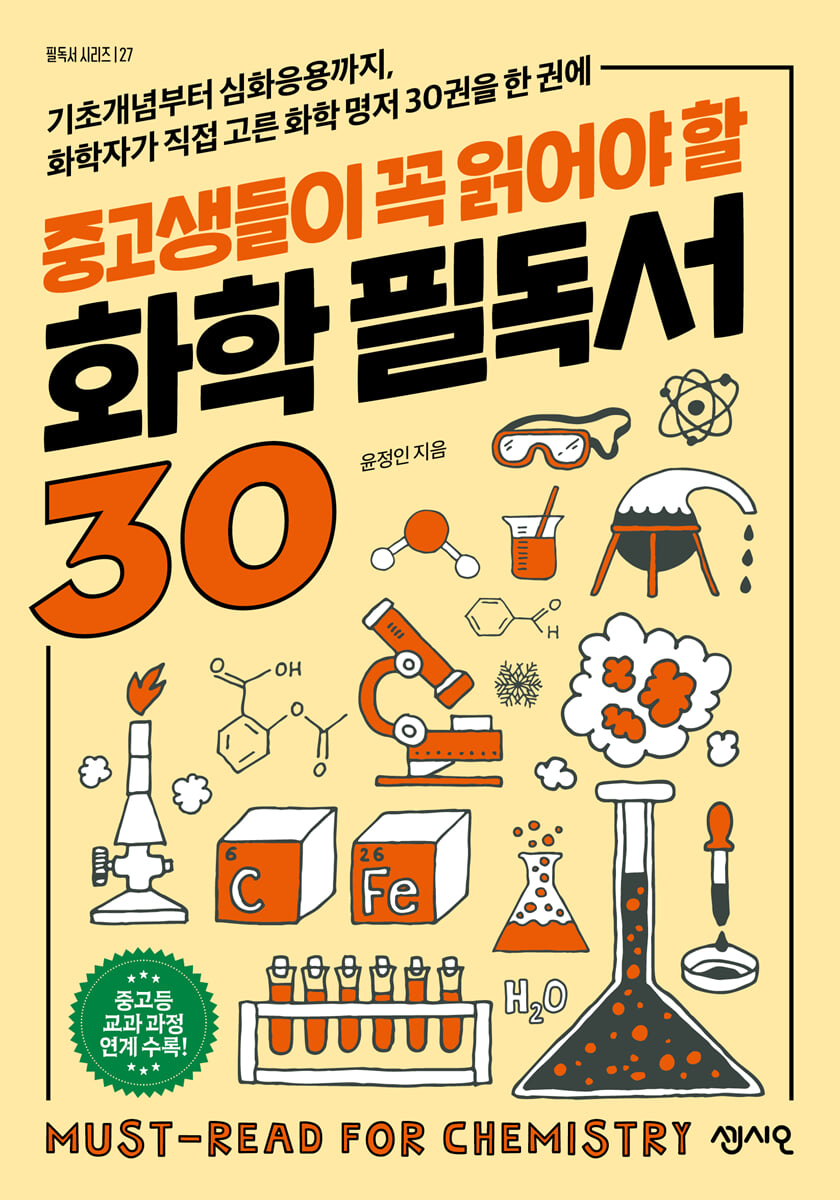
From basic concepts to advanced applications, 30 classic chemistry books hand-picked by chemists, all in one volume!
* Included in the middle and high school curriculum!
* Covers everything from basic chemistry books to classic masterpieces!
* Real lab stories told by a working mom chemist!
《30 Must-Read Chemistry Books for Middle and High School Students》 is a single chemistry guidebook that carefully selects 30 books, from basic concepts to advanced applications and classic masterpieces, covering the most difficult chemistry subject for middle and high school students. It introduces the core contents of each book and covers everything from curriculum linkage to follow-up activities.
The author is a practicing chemist with a Master's degree in Organic Chemistry and a PhD in Biopharmaceutics, a university lecturer, and the CEO of a cosmetics startup company.
He says that if chemistry is approached simply as a school subject, with its cryptic periodic table and complex formulas, anyone is bound to end up hating it.
Chemistry is a discipline that can be enjoyed and enjoyed only when you understand not only the theory but also the background knowledge and context.
So, he emphasizes that it is more helpful to read various classic chemistry books rather than just diligently digging through textbooks.
In fact, just by reading the author's carefully selected 30 books, you can solidify a solid foundation in chemistry, from elementary-level fundamentals to introductory university courses.
The must-read list introduced in this book includes "The Book for Twelve-Year-Old Spiders," which reinforces textbook concepts; "The Science of a Candle," by Michael Faraday, the oldest popular science book; and "Time to Read the Periodic Table," which highlights the beauty of chemistry through the periodic table.
In addition, it also includes books that vividly portray the light and dark sides of chemists and the world of applied chemistry, such as James Watson's "The Double Helix," which discovered the structure of DNA, and "The Search for Penicillin," which deals with the relationship between World War II and chemistry.
But no matter how good a book is, it's useless if you can't read it all the way through.
Science books, in particular, are a genre that is easy to give up on halfway through due to their difficulty.
Here, the author introduces easy reading methods and reading techniques that maintain interest according to the nature of the book based on his own experience.
For example, we suggest a method of expanding around a common theme, such as comparing and reading several books on the subject of the 'Periodic Table'.
This method is not only effective in fostering the scientific thinking skills required in the curriculum, but also helps in the evaluation of thinking skills that expands to reading discussions, essays, and descriptive assessments.
If you're a middle or high school student who wants to kill two birds with one stone—enjoying chemistry and learning about it—why not try breaking down the high wall of chemistry little by little through "30 Must-Read Chemistry Books for Middle and High School Students"?
* Included in the middle and high school curriculum!
* Covers everything from basic chemistry books to classic masterpieces!
* Real lab stories told by a working mom chemist!
《30 Must-Read Chemistry Books for Middle and High School Students》 is a single chemistry guidebook that carefully selects 30 books, from basic concepts to advanced applications and classic masterpieces, covering the most difficult chemistry subject for middle and high school students. It introduces the core contents of each book and covers everything from curriculum linkage to follow-up activities.
The author is a practicing chemist with a Master's degree in Organic Chemistry and a PhD in Biopharmaceutics, a university lecturer, and the CEO of a cosmetics startup company.
He says that if chemistry is approached simply as a school subject, with its cryptic periodic table and complex formulas, anyone is bound to end up hating it.
Chemistry is a discipline that can be enjoyed and enjoyed only when you understand not only the theory but also the background knowledge and context.
So, he emphasizes that it is more helpful to read various classic chemistry books rather than just diligently digging through textbooks.
In fact, just by reading the author's carefully selected 30 books, you can solidify a solid foundation in chemistry, from elementary-level fundamentals to introductory university courses.
The must-read list introduced in this book includes "The Book for Twelve-Year-Old Spiders," which reinforces textbook concepts; "The Science of a Candle," by Michael Faraday, the oldest popular science book; and "Time to Read the Periodic Table," which highlights the beauty of chemistry through the periodic table.
In addition, it also includes books that vividly portray the light and dark sides of chemists and the world of applied chemistry, such as James Watson's "The Double Helix," which discovered the structure of DNA, and "The Search for Penicillin," which deals with the relationship between World War II and chemistry.
But no matter how good a book is, it's useless if you can't read it all the way through.
Science books, in particular, are a genre that is easy to give up on halfway through due to their difficulty.
Here, the author introduces easy reading methods and reading techniques that maintain interest according to the nature of the book based on his own experience.
For example, we suggest a method of expanding around a common theme, such as comparing and reading several books on the subject of the 'Periodic Table'.
This method is not only effective in fostering the scientific thinking skills required in the curriculum, but also helps in the evaluation of thinking skills that expands to reading discussions, essays, and descriptive assessments.
If you're a middle or high school student who wants to kill two birds with one stone—enjoying chemistry and learning about it—why not try breaking down the high wall of chemistry little by little through "30 Must-Read Chemistry Books for Middle and High School Students"?
- You can preview some of the book's contents.
Preview
index
prolog.
We invite you to the mysterious and fascinating world of chemistry.
Part 1.
Welcome, this is your first time in chemistry.
book 01.
Chemistry for Twelve-Year-Old Spiders by Lynn Huggins Cooper
: The first chemistry book I ever read
book 02.
Beaker and Friends' Hilarious Chemistry Experiment · The Uetanis
:Are you curious about what happens in a chemistry lab?
book 03.
What Soap Did Madame Curie Use? 2.0 · Female Type
: The world of chemistry explored by Madame Curie
book 04.
The Science of Candlelight · Michael Faraday
: The oldest popular science book for children, published in the 1860s
book 05.
Time to Read the Periodic Table · Kim Byeong-min
: The periodic table is so interesting when you know it
book 06.
Friendly Chemistry Textbook · Yoo Su-jin
: Complete middle and high school chemistry concepts in just one book.
Part 2.
Really useful chemistry knowledge to know
book 07.
Chemistry: Knowing it will help you live · C.E.G.Yang
: Special Mission: Catch Fake News About Chemistry!
book 08.
The world made of chemistry · K.
Medepezel Herman and two others
: Your 24 Hours Through the Eyes of Chemistry
book 09.
Eating is science?: Learning Chemistry through Taste · Wonseok Choi
: 21st century people eat chemistry
book 10.
The World is All Chemistry · Mai Thi Nguyen Kim
:Exploring everyday chemistry in an easy and fun way
book 11.
Silent Spring · Rachel Carson
: A monumental book that changed the course of environmental history
book 12.
Chemistry Stories for Worried Adults · Yoon Jeong-in
: No more worries about chemicals, it's easier when you know.
Part 3.
I never knew chemistry could be this fun
book 13.
Chemistry Cheat Keys for Smart Use · Cheonfading
: Chemistry experiments in everyday life linked to textbooks
book 14.
Chemist Jeon Chang-rim Visits an Art Museum
: Art is an art that is born from chemistry and lives off of chemistry.
book 15.
Killing Chemistry: Agatha Christie's Mysteries and 14 Poisons · Kathryn Harkuff
: A book that dissects the theory of inference from a chemist's perspective.
book 16.
The Double Helix · James Watson
: A classic of modern chemistry that elucidated the structure of DNA
book 17.
Learning Life from Chemistry · Hwang Young-ae
: Deep insights into chemistry and life
book 18.
The Lost Spoon · Sam Keen
: Madness, love, and world history entangled with the periodic table
Part 4.
It all starts with chemistry
book 19.
The Origin of Everything · David Berkovich
: Meet Yale's best science lectures
book 20.
The Alchemy of Air · Thomas Hager
: A story of research and development that is like a movie
book 21.
Oxygen · Nick Lane
: Everything in all things comes from oxygen.
book 22.
The Elemental Kingdom · Peter Atkins
: Peter Atkins' Guide to the Kingdom of the Periodic Table
book 23.
How We Get Addicted to Chemicals · Laurent Chevalier
: How to find your own standards in the controversial world of chemistry.
book 24.
The Story of a Great and Dangerous Drug · Jin-ho Jeong
: Humanity's aspirations and science in the fight against disease
Part 5.
The Story of Chemistry Through History
book 25.
Cambridge History of Science for Young People 3 - The Story of Chemistry · Arthur Sutcliffe
: An easy and fun history of science book officially published by the University of Cambridge.
book 26.
10 Drugs That Changed World History · Kentaro Sato
: The history of mankind is the history of disease.
book 27.
In Search of Penicillin · David Wilson
: Atomic bombs, radar, synthetic rubber, and penicillin
book 28.
The Age of Chemistry · Philip Ball
: A classic that covers all areas of chemistry
book 29.
The Story of Chemistry That Changed World History 1, 2 · Osamu Omiya
: Easy and fun chemistry stories that read like a snack
book 30.
A History of Chemistry · William H. Brock
: The epic story of human material research
We invite you to the mysterious and fascinating world of chemistry.
Part 1.
Welcome, this is your first time in chemistry.
book 01.
Chemistry for Twelve-Year-Old Spiders by Lynn Huggins Cooper
: The first chemistry book I ever read
book 02.
Beaker and Friends' Hilarious Chemistry Experiment · The Uetanis
:Are you curious about what happens in a chemistry lab?
book 03.
What Soap Did Madame Curie Use? 2.0 · Female Type
: The world of chemistry explored by Madame Curie
book 04.
The Science of Candlelight · Michael Faraday
: The oldest popular science book for children, published in the 1860s
book 05.
Time to Read the Periodic Table · Kim Byeong-min
: The periodic table is so interesting when you know it
book 06.
Friendly Chemistry Textbook · Yoo Su-jin
: Complete middle and high school chemistry concepts in just one book.
Part 2.
Really useful chemistry knowledge to know
book 07.
Chemistry: Knowing it will help you live · C.E.G.Yang
: Special Mission: Catch Fake News About Chemistry!
book 08.
The world made of chemistry · K.
Medepezel Herman and two others
: Your 24 Hours Through the Eyes of Chemistry
book 09.
Eating is science?: Learning Chemistry through Taste · Wonseok Choi
: 21st century people eat chemistry
book 10.
The World is All Chemistry · Mai Thi Nguyen Kim
:Exploring everyday chemistry in an easy and fun way
book 11.
Silent Spring · Rachel Carson
: A monumental book that changed the course of environmental history
book 12.
Chemistry Stories for Worried Adults · Yoon Jeong-in
: No more worries about chemicals, it's easier when you know.
Part 3.
I never knew chemistry could be this fun
book 13.
Chemistry Cheat Keys for Smart Use · Cheonfading
: Chemistry experiments in everyday life linked to textbooks
book 14.
Chemist Jeon Chang-rim Visits an Art Museum
: Art is an art that is born from chemistry and lives off of chemistry.
book 15.
Killing Chemistry: Agatha Christie's Mysteries and 14 Poisons · Kathryn Harkuff
: A book that dissects the theory of inference from a chemist's perspective.
book 16.
The Double Helix · James Watson
: A classic of modern chemistry that elucidated the structure of DNA
book 17.
Learning Life from Chemistry · Hwang Young-ae
: Deep insights into chemistry and life
book 18.
The Lost Spoon · Sam Keen
: Madness, love, and world history entangled with the periodic table
Part 4.
It all starts with chemistry
book 19.
The Origin of Everything · David Berkovich
: Meet Yale's best science lectures
book 20.
The Alchemy of Air · Thomas Hager
: A story of research and development that is like a movie
book 21.
Oxygen · Nick Lane
: Everything in all things comes from oxygen.
book 22.
The Elemental Kingdom · Peter Atkins
: Peter Atkins' Guide to the Kingdom of the Periodic Table
book 23.
How We Get Addicted to Chemicals · Laurent Chevalier
: How to find your own standards in the controversial world of chemistry.
book 24.
The Story of a Great and Dangerous Drug · Jin-ho Jeong
: Humanity's aspirations and science in the fight against disease
Part 5.
The Story of Chemistry Through History
book 25.
Cambridge History of Science for Young People 3 - The Story of Chemistry · Arthur Sutcliffe
: An easy and fun history of science book officially published by the University of Cambridge.
book 26.
10 Drugs That Changed World History · Kentaro Sato
: The history of mankind is the history of disease.
book 27.
In Search of Penicillin · David Wilson
: Atomic bombs, radar, synthetic rubber, and penicillin
book 28.
The Age of Chemistry · Philip Ball
: A classic that covers all areas of chemistry
book 29.
The Story of Chemistry That Changed World History 1, 2 · Osamu Omiya
: Easy and fun chemistry stories that read like a snack
book 30.
A History of Chemistry · William H. Brock
: The epic story of human material research
Detailed image

Into the book
I believe that the ever-changing landscape of chemistry, whether it's biochemistry, which reached its peak thanks to James Watson, medicinal chemistry, which underwent even greater changes with the success of anticancer drugs, or nanochemistry and quantum chemistry, is very similar to our lives.
Just as humans try not to be left behind by the times, chemistry also tries hard.
I hope that these diverse books, spanning the past to the present, will serve as a valuable starting point for you to understand the flow of the times and pursue a better life.
---From the "Prologue"
What do you think is the foundation of chemistry? Many chemistry students would answer, "The periodic table."
you're right.
The basics of chemistry are the periodic table, which students hate the most.
In chemistry, the periodic table is a language that everyone must be familiar with.
The periodic table is made up of alphabets and numbers, like a code.
---「Part 01.
Welcome, this is your first time in chemistry.
As mentioned before, “The Lost Spoon” is a story about the periodic table.
But there is something different about this periodic table book.
The point is that it is a historical story based on the periodic table.
The author of the book explains various stories related to the elements of the periodic table.
Rather than explaining all the elements on the periodic table, it explains discoveries that made a mark in the history of science, how the power struggles between countries over these elements developed, and small episodes of the scientists who discovered or studied the elements.
---「Part 03.
From "Chemistry is so fun!"
The beginning of chemistry begins with the birth of the universe.
It is said that the universe has been steadily expanding for nearly 14 billion years since its birth with the Big Bang, reaching its current state.
What happened in the universe after the Big Bang? Immediately after the Big Bang, the universe was a tiny, super-hot, super-dense ball.
And as this ball rapidly expanded and its temperature decreased, various states of matter and energy were created, and the originally single force was separated into four types.
The birth of this substance marks the beginning of chemistry.
Chemistry studies the changes in matter.
More precisely, it comprehensively studies why matter changes and how energy changes in this process.
So, if matter had not been born in the Big Bang, chemistry could not have been born either, so the birth of the universe is bound to be extremely important.
---「Part 04.
From "Everything Starts with Chemistry"
This book shows how the entire process of developing new drugs was carried out in the past and how passionately scientists at the time continued their research to end the war.
It makes us realize how much effort went into making each and every medicine we take.
We take it for granted as part of our daily lives, but the process was never taken for granted.
But the funny thing is, if we were to make penicillin now, there's a good chance it would fail preclinically.
Modern drug development standards are more stringent than those of the past, so penicillin would not meet these standards.
It would also be a fun activity to compare and contrast the past and present methods of making medicine.
Just as humans try not to be left behind by the times, chemistry also tries hard.
I hope that these diverse books, spanning the past to the present, will serve as a valuable starting point for you to understand the flow of the times and pursue a better life.
---From the "Prologue"
What do you think is the foundation of chemistry? Many chemistry students would answer, "The periodic table."
you're right.
The basics of chemistry are the periodic table, which students hate the most.
In chemistry, the periodic table is a language that everyone must be familiar with.
The periodic table is made up of alphabets and numbers, like a code.
---「Part 01.
Welcome, this is your first time in chemistry.
As mentioned before, “The Lost Spoon” is a story about the periodic table.
But there is something different about this periodic table book.
The point is that it is a historical story based on the periodic table.
The author of the book explains various stories related to the elements of the periodic table.
Rather than explaining all the elements on the periodic table, it explains discoveries that made a mark in the history of science, how the power struggles between countries over these elements developed, and small episodes of the scientists who discovered or studied the elements.
---「Part 03.
From "Chemistry is so fun!"
The beginning of chemistry begins with the birth of the universe.
It is said that the universe has been steadily expanding for nearly 14 billion years since its birth with the Big Bang, reaching its current state.
What happened in the universe after the Big Bang? Immediately after the Big Bang, the universe was a tiny, super-hot, super-dense ball.
And as this ball rapidly expanded and its temperature decreased, various states of matter and energy were created, and the originally single force was separated into four types.
The birth of this substance marks the beginning of chemistry.
Chemistry studies the changes in matter.
More precisely, it comprehensively studies why matter changes and how energy changes in this process.
So, if matter had not been born in the Big Bang, chemistry could not have been born either, so the birth of the universe is bound to be extremely important.
---「Part 04.
From "Everything Starts with Chemistry"
This book shows how the entire process of developing new drugs was carried out in the past and how passionately scientists at the time continued their research to end the war.
It makes us realize how much effort went into making each and every medicine we take.
We take it for granted as part of our daily lives, but the process was never taken for granted.
But the funny thing is, if we were to make penicillin now, there's a good chance it would fail preclinically.
Modern drug development standards are more stringent than those of the past, so penicillin would not meet these standards.
It would also be a fun activity to compare and contrast the past and present methods of making medicine.
---「Part 05.
From “Chemistry Stories Through History”
From “Chemistry Stories Through History”
Publisher's Review
《Time to Read the Periodic Table》, 《Double Helix》, 《Science of Candlelight》…
A fun chemistry story that will help even complete beginners who know nothing about chemistry quickly gain a wealth of knowledge!
There are few subjects that students fear as much as chemistry.
A subject that requires memorizing the periodic table, solving unfamiliar symbols and long chemical formulas, and writing lab reports.
That's why chemistry doesn't come easily even after class.
But chemistry is actually not that difficult a subject.
Everything around us is made of chemistry, and understanding its principles makes the world a much more interesting place.
“30 Must-Read Chemistry Books for Middle and High School Students” is the book that starts at that very point.
This book introduces a selection of essential readings and classics that help students connect textbook chemistry to real-life contexts, while also providing an in-depth exploration of the history and development of chemistry.
Moreover, rather than simply listing recommended books, it provides detailed advice from the perspective of a practicing chemist on how to read them through comparison and analysis of each book.
For example, there are several books on the 'Periodic Table', and the author recommends, "Don't read just one, but compare several books."
Through stories about the periodic table presented from different perspectives and approaches, readers can gain a more three-dimensional understanding, which serves as a foundation for strong thinking skills in essay-type problems and inquiry activities.
The author is a practicing chemist with a master's degree in organic chemistry and a doctorate in biopharmaceutics, and is the CEO of a startup cosmetics company.
For a long time, I have been active in lecturing, research, and development in the field of chemistry, and I have worked hard to spread the word that chemistry is not a subject for memorization, but rather an interesting and practical discipline that helps us understand the world.
And at the same time, as a parent, I have long wondered, “How can I make chemistry more accessible and fun for my child?”
This book is the result of that struggle, and is a warm guide that helps students who find chemistry unfamiliar and difficult to approach in an interesting way.
We invite you to the mysterious and fascinating world of chemistry.
This book is divided into five parts.
Part 1, "Welcome, First Time Chemistry," introduces books that make it easier to understand the curriculum, such as "Chemistry for Twelve-Year-Old Spiders," which covers the basic concepts in one book for beginners who are new to chemistry, "Science of a Candle," the oldest popular science book, and "Time to Read the Periodic Table," the best periodic table textbook.
Part 2, "Really Useful Chemistry Knowledge," focuses on everyday chemical phenomena such as shampoo, cosmetics, food, and the environment, showing how closely chemistry is connected to our lives.
Part 3, 'Chemistry was so fun!' introduces interesting applied chemistry fields such as 'The Chemist Who Went to the Art Museum 1, 2' and 'The Double Helix' by James Watson, who discovered the structure of DNA, and unfolds the light and dark sides of chemists and the exciting stories surrounding applied chemistry.
Next, Part 4, 'Everything Starts with Chemistry', delves into the role of chemistry from the perspective of modern science through works such as 'The Origin of Everything' and 'Oxygen', and Part 5, 'The Story of Chemistry Through History', broadly examines the long journey of chemistry that has accompanied the beginning of mankind, starting with the story of chemistry that created important turning points in the history of science.
In this way, "30 Must-Read Chemistry Books for Middle and High School Students" is a reading guide that guides students through the study of chemistry step by step and in a three-dimensional manner, helping them approach the essence of chemistry without losing interest.
This book contains a living reading activity that connects textbooks and reality, theory and career path.
This book will be an invaluable guide for students who find chemistry unfamiliar and difficult, or for parents and teachers who want to introduce science to their children in a fun way.
Through this book, students will gain a curiosity for chemistry beyond the textbook and gain a perspective on exploring the world, which will solidify their future learning and career paths.
A fun chemistry story that will help even complete beginners who know nothing about chemistry quickly gain a wealth of knowledge!
There are few subjects that students fear as much as chemistry.
A subject that requires memorizing the periodic table, solving unfamiliar symbols and long chemical formulas, and writing lab reports.
That's why chemistry doesn't come easily even after class.
But chemistry is actually not that difficult a subject.
Everything around us is made of chemistry, and understanding its principles makes the world a much more interesting place.
“30 Must-Read Chemistry Books for Middle and High School Students” is the book that starts at that very point.
This book introduces a selection of essential readings and classics that help students connect textbook chemistry to real-life contexts, while also providing an in-depth exploration of the history and development of chemistry.
Moreover, rather than simply listing recommended books, it provides detailed advice from the perspective of a practicing chemist on how to read them through comparison and analysis of each book.
For example, there are several books on the 'Periodic Table', and the author recommends, "Don't read just one, but compare several books."
Through stories about the periodic table presented from different perspectives and approaches, readers can gain a more three-dimensional understanding, which serves as a foundation for strong thinking skills in essay-type problems and inquiry activities.
The author is a practicing chemist with a master's degree in organic chemistry and a doctorate in biopharmaceutics, and is the CEO of a startup cosmetics company.
For a long time, I have been active in lecturing, research, and development in the field of chemistry, and I have worked hard to spread the word that chemistry is not a subject for memorization, but rather an interesting and practical discipline that helps us understand the world.
And at the same time, as a parent, I have long wondered, “How can I make chemistry more accessible and fun for my child?”
This book is the result of that struggle, and is a warm guide that helps students who find chemistry unfamiliar and difficult to approach in an interesting way.
We invite you to the mysterious and fascinating world of chemistry.
This book is divided into five parts.
Part 1, "Welcome, First Time Chemistry," introduces books that make it easier to understand the curriculum, such as "Chemistry for Twelve-Year-Old Spiders," which covers the basic concepts in one book for beginners who are new to chemistry, "Science of a Candle," the oldest popular science book, and "Time to Read the Periodic Table," the best periodic table textbook.
Part 2, "Really Useful Chemistry Knowledge," focuses on everyday chemical phenomena such as shampoo, cosmetics, food, and the environment, showing how closely chemistry is connected to our lives.
Part 3, 'Chemistry was so fun!' introduces interesting applied chemistry fields such as 'The Chemist Who Went to the Art Museum 1, 2' and 'The Double Helix' by James Watson, who discovered the structure of DNA, and unfolds the light and dark sides of chemists and the exciting stories surrounding applied chemistry.
Next, Part 4, 'Everything Starts with Chemistry', delves into the role of chemistry from the perspective of modern science through works such as 'The Origin of Everything' and 'Oxygen', and Part 5, 'The Story of Chemistry Through History', broadly examines the long journey of chemistry that has accompanied the beginning of mankind, starting with the story of chemistry that created important turning points in the history of science.
In this way, "30 Must-Read Chemistry Books for Middle and High School Students" is a reading guide that guides students through the study of chemistry step by step and in a three-dimensional manner, helping them approach the essence of chemistry without losing interest.
This book contains a living reading activity that connects textbooks and reality, theory and career path.
This book will be an invaluable guide for students who find chemistry unfamiliar and difficult, or for parents and teachers who want to introduce science to their children in a fun way.
Through this book, students will gain a curiosity for chemistry beyond the textbook and gain a perspective on exploring the world, which will solidify their future learning and career paths.
GOODS SPECIFICS
- Date of issue: May 30, 2025
- Page count, weight, size: 272 pages | 402g | 140*200*15mm
- ISBN13: 9791166571992
- ISBN10: 1166571998
You may also like
카테고리
korean


korean

![GQ KOREA Mark (Monthly): December [2025]](http://librairie.coreenne.fr/cdn/shop/files/8ef265dbbfbf186523ed75ba7319009d.jpg?v=1765340328&width=3840)


