

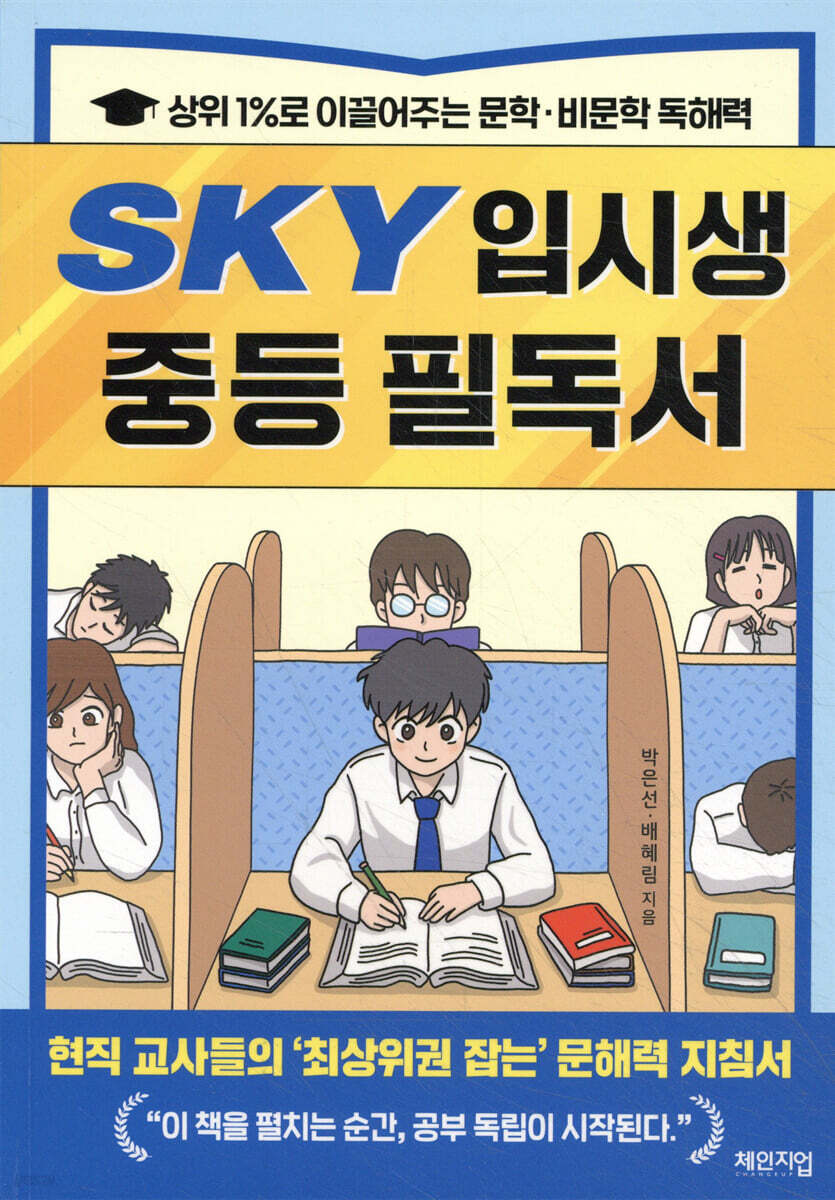
Must-read for SKY entrance exam takers in middle school
 |
Description
Book Introduction
The most reliable study method that won't be swayed by the changing college entrance exam system is reading.
"50 must-read books for achieving top 1% grades," selected and read by current teachers, all in one volume!
Although the college entrance exam policy changed every year, the overall framework remained the same.
But things will change a lot from 2025 onwards.
With the sudden introduction of the 'high school credit system', students who fail to meet the designated credit requirements may be held back a grade.
In addition, the direction was set toward raising the level of the middle school curriculum.
The ability to study without being shaken by these changes comes from 'reading,' and top students read good books properly.
For middle school students who dream of achieving top grades but don't know how to do so, veteran teachers have published "Must-read for SKY Entrance Exam Prep Students."
I personally read and carefully selected works ranging from literary works included in Korean language textbooks to must-read books that can be called classics in each field.
Bae Hye-rim, a current Korean language teacher with 22 years of experience, was in charge of literature, and Park Eun-seon, a current teacher who has consistently written study method books, was in charge of non-literature.
The book is largely divided into 1st and 2nd periods.
The first period contains 25 literary works, and the second period contains 25 non-literary works in mathematics, science, humanities, and art.
In particular, the illustrations convey an intuitive message about the topic and help with understanding, and the 'Questions to Think About' and 'Books to Read Together' at the end are also worth noting.
Rather than simply reading the work, you can expand your thinking and learn a three-dimensional perspective by cross-referencing it with other books.
I hope that you will succeed in the SKY entrance exam you desire through the power of reading. If you read this book repeatedly, victory in the entrance exam will be yours.
*** Students who 'must' read this book ***
- Students who want to develop literacy skills that will not be shaken by the high school credit system.
- Students who want to understand the essence rather than memorize and become enlightened on their own.
- Students who dream of 'study independence' with the goal of entering a prestigious university without private education.
"50 must-read books for achieving top 1% grades," selected and read by current teachers, all in one volume!
Although the college entrance exam policy changed every year, the overall framework remained the same.
But things will change a lot from 2025 onwards.
With the sudden introduction of the 'high school credit system', students who fail to meet the designated credit requirements may be held back a grade.
In addition, the direction was set toward raising the level of the middle school curriculum.
The ability to study without being shaken by these changes comes from 'reading,' and top students read good books properly.
For middle school students who dream of achieving top grades but don't know how to do so, veteran teachers have published "Must-read for SKY Entrance Exam Prep Students."
I personally read and carefully selected works ranging from literary works included in Korean language textbooks to must-read books that can be called classics in each field.
Bae Hye-rim, a current Korean language teacher with 22 years of experience, was in charge of literature, and Park Eun-seon, a current teacher who has consistently written study method books, was in charge of non-literature.
The book is largely divided into 1st and 2nd periods.
The first period contains 25 literary works, and the second period contains 25 non-literary works in mathematics, science, humanities, and art.
In particular, the illustrations convey an intuitive message about the topic and help with understanding, and the 'Questions to Think About' and 'Books to Read Together' at the end are also worth noting.
Rather than simply reading the work, you can expand your thinking and learn a three-dimensional perspective by cross-referencing it with other books.
I hope that you will succeed in the SKY entrance exam you desire through the power of reading. If you read this book repeatedly, victory in the entrance exam will be yours.
*** Students who 'must' read this book ***
- Students who want to develop literacy skills that will not be shaken by the high school credit system.
- Students who want to understand the essence rather than memorize and become enlightened on their own.
- Students who dream of 'study independence' with the goal of entering a prestigious university without private education.
- You can preview some of the book's contents.
Preview
index
prolog
Part 1.
literature
01.
Park Jong-ho and Joo Ye-ji, "Reading Korean Language Textbooks: Essays for Middle School 1st Graders"
02.
Shin Bo-kyung, "Korean Language Textbook Journey: Middle School 1st-3rd Grade: Poetry"
03.
National Korean Language Teachers Association, "Reading Poetry in Korean Class 1-4"
04.
Na Tae-ju, "Yoon Dong-ju's Poetry Collection as Told by Poet Na Tae-ju"
05.
Seoul Korean Language Teachers' Association, "Reading Kim Yu-jeong"
06.
Michael Ende, Momo
07.
Antoine de Saint-Exupéry, The Little Prince
08.
Kim Seon-yeong, "The Shop That Sells Time"
09.
Peter Bixel, A Desk is a Desk
10.
Kim Ryeo-ryeong, "Elegant Lies"
11.
Lee Geum-i, "You Are a Skyflower Too"
12.
Jang Jae-hwa, "Rabbit Story"
13.
Andrew Clements, "Please Give Me a Fringe"
14.
Patrick Süskind, The Story of Mr. Sommer
15.
Kim Ryeo-ryeong, "Wandeukie"
16.
Hyun-deok, "The Sky is Clear"
17.
Wendelin Van Denarin, Flip
18.
Trina Paulus, Hope for the Flowers
19.
Richard Bach, Jonathan Livingston Livingston
20.
Lois Lowry, The Giver
21.
Jang Yoo-seung, Park Dong-wook, Lee Eun-joo, Kim Young-jook, Lee Guk-jin, Son Yu-kyung, "One Poem a Day"
22.
Kwon Soon-geung, The Story of Hong Gildong
23.
Park Ji-won, "Reading the Story of Heo Saeng/Yangban with Professor Choi Seong-yoon"
24.
Ha Geun-chan, "Sunanidae"
25.
George Orwell, Animal Farm
Part 2.
Non-literature
26.
Park Sung-hyuk, "The Moment When Studying Becomes Fun"
27.
Hakyeon Plus Editorial Department, "My First Career Class, Starting at Age 14"
28.
Matthew Said, Grit for Teens
29.
Choi Tae-seong, The Usefulness of History
30.
Lee Young-sook, World History on the Table
31.
Kim Yong-gyu, "Canned Philosophy: Spicy Taste"
32.
Kim Gu, "Baekbeom Ilji: An Easy-to-Read Guide"
33.
Kim Kyung-seo, "There Are No Two Reds Identical"
34.
Jo Won-jae, "Corner Art Gallery"
35.
Kim Jin-yeop, "A History of Eight Answers to Art"
36.
Stephen Isserlis, The Freaks of Classical Music
37.
Tak Min-hyeok, "Sports Stories for Teens"
38.
Hans Magnus Enzensberger, The Math Demon
39.
Choi Jae-cheon, The Scientist's Study
40.
Emmanuel Baudouin et al., Cosmos for Youth
41.
Jaeseung Jeong, "Jaeseung Jeong's Science Concert"
42.
Lee Eun-hee, "Harihara's 24 Hours of Science"
43.
Park Ji-hye, "Who Put a Brand in My Head?"
44.
Gong Yun-hee and Yoon Ye-rim, "From Today On, I Am a Global Citizen"
45.
Michael Sandel, Justice for Teens
46.
Kim Cheong-yeon, "Why, What's Wrong with That?"
47.
Kim Jeong-nim, "Guns, Germs, and Steel Lessons for Teenagers"
48.
Koo Bon-kwon, "To You Who Are Obsessed with YouTube"
49.
Kim Seo-yoon, Saturday Psychology Club
50.
Jeon Seung-min, "What Teenagers Need to Know About Artificial Intelligence and the Future of the Fourth Industrial Revolution"
List of reference books
Epilogue
Part 1.
literature
01.
Park Jong-ho and Joo Ye-ji, "Reading Korean Language Textbooks: Essays for Middle School 1st Graders"
02.
Shin Bo-kyung, "Korean Language Textbook Journey: Middle School 1st-3rd Grade: Poetry"
03.
National Korean Language Teachers Association, "Reading Poetry in Korean Class 1-4"
04.
Na Tae-ju, "Yoon Dong-ju's Poetry Collection as Told by Poet Na Tae-ju"
05.
Seoul Korean Language Teachers' Association, "Reading Kim Yu-jeong"
06.
Michael Ende, Momo
07.
Antoine de Saint-Exupéry, The Little Prince
08.
Kim Seon-yeong, "The Shop That Sells Time"
09.
Peter Bixel, A Desk is a Desk
10.
Kim Ryeo-ryeong, "Elegant Lies"
11.
Lee Geum-i, "You Are a Skyflower Too"
12.
Jang Jae-hwa, "Rabbit Story"
13.
Andrew Clements, "Please Give Me a Fringe"
14.
Patrick Süskind, The Story of Mr. Sommer
15.
Kim Ryeo-ryeong, "Wandeukie"
16.
Hyun-deok, "The Sky is Clear"
17.
Wendelin Van Denarin, Flip
18.
Trina Paulus, Hope for the Flowers
19.
Richard Bach, Jonathan Livingston Livingston
20.
Lois Lowry, The Giver
21.
Jang Yoo-seung, Park Dong-wook, Lee Eun-joo, Kim Young-jook, Lee Guk-jin, Son Yu-kyung, "One Poem a Day"
22.
Kwon Soon-geung, The Story of Hong Gildong
23.
Park Ji-won, "Reading the Story of Heo Saeng/Yangban with Professor Choi Seong-yoon"
24.
Ha Geun-chan, "Sunanidae"
25.
George Orwell, Animal Farm
Part 2.
Non-literature
26.
Park Sung-hyuk, "The Moment When Studying Becomes Fun"
27.
Hakyeon Plus Editorial Department, "My First Career Class, Starting at Age 14"
28.
Matthew Said, Grit for Teens
29.
Choi Tae-seong, The Usefulness of History
30.
Lee Young-sook, World History on the Table
31.
Kim Yong-gyu, "Canned Philosophy: Spicy Taste"
32.
Kim Gu, "Baekbeom Ilji: An Easy-to-Read Guide"
33.
Kim Kyung-seo, "There Are No Two Reds Identical"
34.
Jo Won-jae, "Corner Art Gallery"
35.
Kim Jin-yeop, "A History of Eight Answers to Art"
36.
Stephen Isserlis, The Freaks of Classical Music
37.
Tak Min-hyeok, "Sports Stories for Teens"
38.
Hans Magnus Enzensberger, The Math Demon
39.
Choi Jae-cheon, The Scientist's Study
40.
Emmanuel Baudouin et al., Cosmos for Youth
41.
Jaeseung Jeong, "Jaeseung Jeong's Science Concert"
42.
Lee Eun-hee, "Harihara's 24 Hours of Science"
43.
Park Ji-hye, "Who Put a Brand in My Head?"
44.
Gong Yun-hee and Yoon Ye-rim, "From Today On, I Am a Global Citizen"
45.
Michael Sandel, Justice for Teens
46.
Kim Cheong-yeon, "Why, What's Wrong with That?"
47.
Kim Jeong-nim, "Guns, Germs, and Steel Lessons for Teenagers"
48.
Koo Bon-kwon, "To You Who Are Obsessed with YouTube"
49.
Kim Seo-yoon, Saturday Psychology Club
50.
Jeon Seung-min, "What Teenagers Need to Know About Artificial Intelligence and the Future of the Fourth Industrial Revolution"
List of reference books
Epilogue
Detailed image

Into the book
Unlike elementary school, middle school students don't have time.
Middle school serves as a bridge to high school, and students are encouraged to focus on studying English and math.
A lot of time is spent studying English and math, and Korean tends to take a back seat.
There is even a perception that 'do we really need to study our language any more?'
I don't even have time to read books, so I need to make a big commitment to study Korean thoroughly.
But remember,
Korean is a very important subject, just like English and math.
Because it serves as the basis for learning other subjects such as English, math, social studies, and science.
The ability to handle letters well, such as reading comprehension and writing skills, comes from Korean language skills.
Without the ability to read, interpret, and express text, it is difficult to properly understand knowledge from other subjects.
People with high Korean language skills have an advantage in reading textbooks properly and acquiring knowledge in any subject.
--- p.13
Poetry is generally short and concise.
But the content is never easy.
This is because the poetic language that makes up the poem is not simple.
Poetry contains the poet's emotions, and each reader can interpret it in different ways.
Poetry has a variety of meanings that cannot be interpreted using a Korean dictionary alone.
This is called implicitness.
The Japanese colonial period was a dark time when sovereignty was taken away.
If this sentiment is expressed as a cold and lonely winter, the poetic word 'winter' can mean the season of winter as defined in the dictionary, but it can also mean the Japanese colonial period, which is not included in the dictionary.
While reading a poem, it is essential to take an interest in the poet, broaden one's perspective to the era in which the poet lived, and infer the various meanings of the poetic language in order to understand the poem.
--- p.20
Nick, a student at Lincoln Elementary School, is popular among his students for his quirky and quirky personality.
He is a smart kid who knows how to use his abilities well.
In cold February, they decorate the classroom like a tropical island to give their classmates a taste of summer, and they also tease their teachers all year round by imitating bird calls during class.
Then, the school year changes and Nick meets Mr. Granger, a strict teacher who makes him study vocabulary thoroughly using a dictionary.
Nick tried to avoid his homework by asking questions from the first class, but instead he was given a presentation assignment, and while giving the presentation, he tried to stall for time, but it didn't go as he had planned.
--- p.73
"Jonathan Livingston Livingston" tells us that we should not settle for mediocrity, but must constantly grow and challenge ourselves.
It is important to see the world in your own way and to pioneer new paths.
Through this, you can find true freedom and happiness, and also have a positive impact on others.
This book makes us reflect on whether we are so comfortable with ordinariness that we are not taking the flight we are capable of.
Jonathan Livingstone is a seagull who loves flying.
He dreams of flying faster and more beautifully than anyone else and lives with different thoughts from other seagulls.
Jonathan constantly strives for self-realization, hoping to one day fly.
--- p.102
In 1919, he went into exile in Shanghai, established the Provisional Government of the Republic of Korea, and served as the Director of the Police Department.
Afterwards, he was elected as Minister of Home Affairs and Prime Minister, and in 1930, he founded the Korean Independence Party with Lee Si-yeong and Lee Dong-nyeong.
He founded the Korean Patriotic Group with the purpose of assassinating Japanese officials and planned the Lee Bong-chang assassination.
The Korean Patriotic Corps became an opportunity to spread awareness of the Provisional Government around the world through the actions of Lee Bong-chang and Yun Bong-gil.
Afterwards, the Korean Military Academy was established to produce independence fighters, but they were oppressed by the Japanese.
--- p.170
You probably know the atomic bomb, which caused countless casualties with its tremendous power.
The atomic bomb was invented by scientists.
The world was shocked by the atomic bomb.
Should the scientists who invented the atomic bomb be held responsible for the lives of the victims? Or should the government or politicians who ordered its development be held accountable? The social responsibility of scientists is an ethical issue, and there's no right answer.
Ethicist Hans Jonas said of the responsibility of scientists, “We live in an age where the nature of human behavior has changed through modern science and technology.
“Scientists are those who have changed the nature of human behavior, so they must be responsible for the results,” he said.
Alfred Nobel, the inventor of dynamite, felt responsible for the way dynamite was used as a weapon and donated his entire fortune to the Royal Swedish Academy of Sciences.
Even so, scientists should be held responsible before development, not after an accident occurs.
--- p.221
In contrast to the Eurasian continent, it explains that the backwardness of the peoples of America, Africa, East Asia, and the Pacific was due to geographical environment, not human capabilities.
It also explains in detail how China, South Korea, and Japan developed over the course of human history.
The significance of Guns, Germs, and Steel lies in its failure to view human history simply as a matter of racial or cultural imbalance.
It helps us understand the development of human civilization from a broad perspective by integrating various academic disciplines.
Through this book, we will understand the relationship between environmental and geographical factors and the development of civilization, and consider how guns, germs, and steel will work in the future.
--- p.245
College entrance exams may sound like a distant dream.
You should enjoy your middle school years in your own way, but if you remain as cheerful as you were in elementary school, you will have a hard time adjusting to high school life, which revolves around entrance exams.
Maybe that's why, teaching high school students, I felt so sorry for the students who had no dreams and no idea how to study.
I thought, 'It would have been nice if I had listened well in class and read books at least.'
Even if they weren't at the top, students who were close to books in middle school were different.
I achieved inner growth through the knowledge and experience I gained from books.
He had enough power to think about and plan for his future with a mature mind.
Middle school serves as a bridge to high school, and students are encouraged to focus on studying English and math.
A lot of time is spent studying English and math, and Korean tends to take a back seat.
There is even a perception that 'do we really need to study our language any more?'
I don't even have time to read books, so I need to make a big commitment to study Korean thoroughly.
But remember,
Korean is a very important subject, just like English and math.
Because it serves as the basis for learning other subjects such as English, math, social studies, and science.
The ability to handle letters well, such as reading comprehension and writing skills, comes from Korean language skills.
Without the ability to read, interpret, and express text, it is difficult to properly understand knowledge from other subjects.
People with high Korean language skills have an advantage in reading textbooks properly and acquiring knowledge in any subject.
--- p.13
Poetry is generally short and concise.
But the content is never easy.
This is because the poetic language that makes up the poem is not simple.
Poetry contains the poet's emotions, and each reader can interpret it in different ways.
Poetry has a variety of meanings that cannot be interpreted using a Korean dictionary alone.
This is called implicitness.
The Japanese colonial period was a dark time when sovereignty was taken away.
If this sentiment is expressed as a cold and lonely winter, the poetic word 'winter' can mean the season of winter as defined in the dictionary, but it can also mean the Japanese colonial period, which is not included in the dictionary.
While reading a poem, it is essential to take an interest in the poet, broaden one's perspective to the era in which the poet lived, and infer the various meanings of the poetic language in order to understand the poem.
--- p.20
Nick, a student at Lincoln Elementary School, is popular among his students for his quirky and quirky personality.
He is a smart kid who knows how to use his abilities well.
In cold February, they decorate the classroom like a tropical island to give their classmates a taste of summer, and they also tease their teachers all year round by imitating bird calls during class.
Then, the school year changes and Nick meets Mr. Granger, a strict teacher who makes him study vocabulary thoroughly using a dictionary.
Nick tried to avoid his homework by asking questions from the first class, but instead he was given a presentation assignment, and while giving the presentation, he tried to stall for time, but it didn't go as he had planned.
--- p.73
"Jonathan Livingston Livingston" tells us that we should not settle for mediocrity, but must constantly grow and challenge ourselves.
It is important to see the world in your own way and to pioneer new paths.
Through this, you can find true freedom and happiness, and also have a positive impact on others.
This book makes us reflect on whether we are so comfortable with ordinariness that we are not taking the flight we are capable of.
Jonathan Livingstone is a seagull who loves flying.
He dreams of flying faster and more beautifully than anyone else and lives with different thoughts from other seagulls.
Jonathan constantly strives for self-realization, hoping to one day fly.
--- p.102
In 1919, he went into exile in Shanghai, established the Provisional Government of the Republic of Korea, and served as the Director of the Police Department.
Afterwards, he was elected as Minister of Home Affairs and Prime Minister, and in 1930, he founded the Korean Independence Party with Lee Si-yeong and Lee Dong-nyeong.
He founded the Korean Patriotic Group with the purpose of assassinating Japanese officials and planned the Lee Bong-chang assassination.
The Korean Patriotic Corps became an opportunity to spread awareness of the Provisional Government around the world through the actions of Lee Bong-chang and Yun Bong-gil.
Afterwards, the Korean Military Academy was established to produce independence fighters, but they were oppressed by the Japanese.
--- p.170
You probably know the atomic bomb, which caused countless casualties with its tremendous power.
The atomic bomb was invented by scientists.
The world was shocked by the atomic bomb.
Should the scientists who invented the atomic bomb be held responsible for the lives of the victims? Or should the government or politicians who ordered its development be held accountable? The social responsibility of scientists is an ethical issue, and there's no right answer.
Ethicist Hans Jonas said of the responsibility of scientists, “We live in an age where the nature of human behavior has changed through modern science and technology.
“Scientists are those who have changed the nature of human behavior, so they must be responsible for the results,” he said.
Alfred Nobel, the inventor of dynamite, felt responsible for the way dynamite was used as a weapon and donated his entire fortune to the Royal Swedish Academy of Sciences.
Even so, scientists should be held responsible before development, not after an accident occurs.
--- p.221
In contrast to the Eurasian continent, it explains that the backwardness of the peoples of America, Africa, East Asia, and the Pacific was due to geographical environment, not human capabilities.
It also explains in detail how China, South Korea, and Japan developed over the course of human history.
The significance of Guns, Germs, and Steel lies in its failure to view human history simply as a matter of racial or cultural imbalance.
It helps us understand the development of human civilization from a broad perspective by integrating various academic disciplines.
Through this book, we will understand the relationship between environmental and geographical factors and the development of civilization, and consider how guns, germs, and steel will work in the future.
--- p.245
College entrance exams may sound like a distant dream.
You should enjoy your middle school years in your own way, but if you remain as cheerful as you were in elementary school, you will have a hard time adjusting to high school life, which revolves around entrance exams.
Maybe that's why, teaching high school students, I felt so sorry for the students who had no dreams and no idea how to study.
I thought, 'It would have been nice if I had listened well in class and read books at least.'
Even if they weren't at the top, students who were close to books in middle school were different.
I achieved inner growth through the knowledge and experience I gained from books.
He had enough power to think about and plan for his future with a mature mind.
--- p.266
Publisher's Review
“What do top students do instead of private tutoring?”
Complete analysis of works from Korean language textbooks to non-literary classics!
Everyone dreams of getting good grades.
If you have good grades, you can go to the prestigious university you want, get a job at a large company, start a business, and everything else in life becomes easier.
Have you tried every study method imaginable, hoping to achieve excellent grades? And yet your grades remain stagnant? The problem isn't studying, but studying study methods.
Studying while sitting down is just 'doing it'.
Like riding a bicycle, you can only improve your skills by trying it yourself.
However, it would be much easier if there was someone to help you get a feel for studying and do it properly.
"Must-read for SKY Entrance Exam Takers" is a must-read for middle school students who have a desire to study but are not as independent in reading as top students.
The basis of studying Korean is ‘reading textbooks.’
Isn't it well-known that top students reread their textbooks over and over again until they're tattered? That's why the first period of "Must-Read Middle School Books for SKY Admissions" begins with works from Korean language textbooks.
Literacy cannot be improved overnight, but it can be improved effectively.
Start your independent study journey with this top-tier literacy guide!
After reading all 25 essential literary works, 25 non-literary works that will foster three-dimensional thinking await.
Once you have established the basics of studying, it is important to 'expand them'.
Let's take a look at areas that are usually perceived as boring subjects to memorize, such as history, science, art, and humanities, in an easy and fun way.
You don't have to read every book.
It is most important to read the necessary books appropriately and understand them properly.
Even if you read one work, if you read it in a three-dimensional way, you will be able to complete your own 'strong weapon' that will help you survive the college entrance exam competition.
All of those 'secrets' are contained in this book.
Complete analysis of works from Korean language textbooks to non-literary classics!
Everyone dreams of getting good grades.
If you have good grades, you can go to the prestigious university you want, get a job at a large company, start a business, and everything else in life becomes easier.
Have you tried every study method imaginable, hoping to achieve excellent grades? And yet your grades remain stagnant? The problem isn't studying, but studying study methods.
Studying while sitting down is just 'doing it'.
Like riding a bicycle, you can only improve your skills by trying it yourself.
However, it would be much easier if there was someone to help you get a feel for studying and do it properly.
"Must-read for SKY Entrance Exam Takers" is a must-read for middle school students who have a desire to study but are not as independent in reading as top students.
The basis of studying Korean is ‘reading textbooks.’
Isn't it well-known that top students reread their textbooks over and over again until they're tattered? That's why the first period of "Must-Read Middle School Books for SKY Admissions" begins with works from Korean language textbooks.
Literacy cannot be improved overnight, but it can be improved effectively.
Start your independent study journey with this top-tier literacy guide!
After reading all 25 essential literary works, 25 non-literary works that will foster three-dimensional thinking await.
Once you have established the basics of studying, it is important to 'expand them'.
Let's take a look at areas that are usually perceived as boring subjects to memorize, such as history, science, art, and humanities, in an easy and fun way.
You don't have to read every book.
It is most important to read the necessary books appropriately and understand them properly.
Even if you read one work, if you read it in a three-dimensional way, you will be able to complete your own 'strong weapon' that will help you survive the college entrance exam competition.
All of those 'secrets' are contained in this book.
GOODS SPECIFICS
- Date of issue: January 2, 2025
- Page count, weight, size: 268 pages | 430g | 148*210*16mm
- ISBN13: 9791191378641
- ISBN10: 1191378640
You may also like
카테고리
korean


korean

![GQ KOREA Mark (Monthly): December [2025]](http://librairie.coreenne.fr/cdn/shop/files/8ef265dbbfbf186523ed75ba7319009d.jpg?v=1765340328&width=3840)


