

The Shop That Sells Time 3
 |
Description
Book Introduction
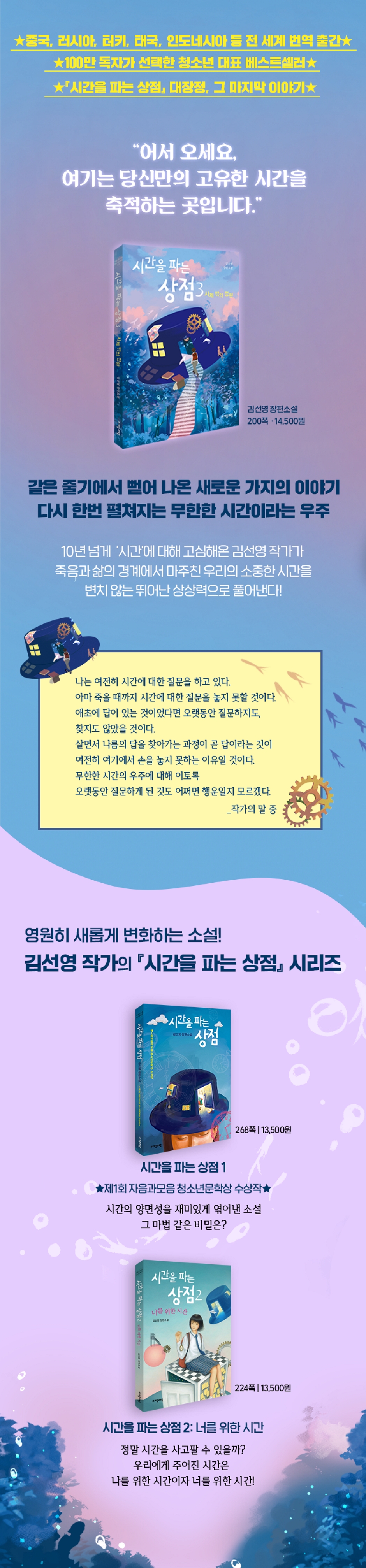
“Teacher, what is the time outside the clock?” The final story in the novel series "The Shop That Sells Time," chosen by 1 million readers! The 109th volume of Consonant and Vowel Youth Literature has been published. Volume 109, "The Shop That Sells Time 3: The Garden Outside the Clock," is the final story in the best-selling "The Shop That Sells Time" series, winner of the Jaum and Moeum Youth Literature Award. Mr. Park Han-sang, who always worked hard for his students as the head of the student guidance department, has passed away. He said he took his own life. The teacher's wife did not acknowledge the teacher's signature. The protagonist, Do-ha, loses consciousness in an accident while helping his teacher's wife protest to reveal the person responsible for driving her teacher to death. For some reason, he wakes up in front of 'Gap, No-Nil-Da', an old building that his grandfather had left him. And there he meets Mr. Park Han-sang, who is clearly dead. How and why did Doha and the teacher meet? And why did the teacher and Doha end up in Nonilda, a place even Doha had forgotten about? The protagonist, following in the footsteps of Onjo, "Chronos," begins a new story about time. |
- You can preview some of the book's contents.
Preview
index
The teacher died
Teacher and Doha
Teacher and Sihoon
gap, wander
history
door
Unique time
Yellow Hollyhock Gardener
Graveyard of Books
Timeline clothes
Can you see me in your eyes?
Author's Note
Teacher and Doha
Teacher and Sihoon
gap, wander
history
door
Unique time
Yellow Hollyhock Gardener
Graveyard of Books
Timeline clothes
Can you see me in your eyes?
Author's Note
Detailed image
Into the book
The children had to shut their eyes tightly and endure the sound of their mother's voice, as if they were listening to the principal's lecture under the scorching midsummer sun.
That was the only thing the children could do for their teacher.
The children could not offer even one chrysanthemum flower for their teacher.
Incense burner
I couldn't light it up.
Doing so means that the incident is over and that you acknowledge and accept the teacher's death.
The spirit Sam, who followed Mr. Park Han-sang, said that this is the punishment we must endure, the punishment we inflict on ourselves.
Just like the death of my third-year senior, Si-Hoon, last spring.
--- p.8
What kind of chain of events is Doha himself in right now?
An incident here brings about another incident, and these incidents pile up one after another, and are they expressed in the word life?
Even when people leave, traces of events remain with time, and is that what we call the world?
My curiosity kept growing.
If my grandfather were here, he would have run over and answered this question right away.
Grandfather left Doha's side like dust in the wind.
However, the traces of my grandfather's life remain intact.
It is used in the gap, in the play.
So, as Lovely said, the 'traces of the incident' are right here before Doha's eyes.
--- p.33
Doha watched for a long time in front of the cafe as Ju-ryeong Sam took his wife home.
This will also put Ju-ryeong Sam in a difficult position at school.
Because no matter what happens at school, the principal, who is ultimately responsible, will remain silent and watch everything.
Nevertheless, Ju-ryeong Sam took courage.
So Doha decided to muster up his courage.
Like the seniors of the 'Time Selling Store' who prevented the school security guard from being fired.
The more I thought about how he had the courage to do something that would put his entire future on the line, the more I thought about how amazing it was.
The interview materials at the time included a statement that if something like that happened right before your eyes, anyone would have no choice but to come forward.
The seniors also said that they were able to move because of the time of dedication and kindness shown by the sheriff.
--- p.60
“The teacher is confident that he would not have taken his own life.
That goes for me and for Ju-ryeong Sam.
“Then we must have missed something too, right?”
A man who said he was going out for a walk came back as a cold corpse.
Mr. Kwak Myeong-hu testified that he did not know whether it was a slip or a jump.
“Now you can tell me what happened.”
“I thought that was the extent of my destiny.
The shadow of my death has been cast over me since I lost Sihun.
That day, I felt like my life was over.
There was a loud exchange of words between Mr. Kwak and the principal in the office.
Even though the prosecution and the Board of Education took turns investigating Si-Hoon's death, Mr. Kwak remained silent.
As the student guidance director, I definitely had some responsibilities, but Mr. Kwak, the third-year director, also went around the classrooms that day.
I was against window cleaning from the beginning.
The person who said that even cleaning the windows would make it seem like the environment has been beautified was Mr. Kwak.
It is unknown whether Mr. Kwak instructed Si-Hoon to clean the window.
“Only Mr. Kwak and Si-Hoon would know.”
--- p.71~72
When I welcomed the teacher in, I felt like a guest.
Jinsol and the teacher seemed settled and free, but Doha himself still felt like he was wandering somewhere.
Doha headed to the second floor with his teacher.
I felt like my grandfather was somewhere.
If this is where the dead stay, then maybe my grandfather is here too.
So that may be why Doha was called here.
It occurred to me that the reason he had left this place behind and the reason he was here now might be intertwined.
--- p.118
“People dream of living forever, but they don’t know how.
Isn't that answer ultimately determined by the way we lived? Look, even our fate after death is ultimately determined by the traces of our lives.
“Like the two of you here.”
Grandma Plate Flower said, pointing to Park Han-sang and Jin-sol.
Park Han-sang and Jin-sol nodded and fell into deep thought.
“But isn’t it strange? People have a very strong tendency to spend their time the way they used to.
So, the qualifications to enter here are also limited.
Only the most precious people would have entered here.
So, I want to live differently than before, and if you think so, you just have to use your time differently than before.
“Isn’t it simple?”
--- p.136~137
“Even if the world changes and I am doing something that has become useless, I have to keep living, so I thought that I shouldn’t let my existence disappear anyway.
I didn't mind that the hundreds of thousands of books I had collected became the mound of my grave.
Oh, by the way, if you ever leave this place, could you do me a favor?
“Can you take me to Suam Bookstore?”
Doha took a step back after hearing Mr. Suam's words.
Can I even get out of here? I don't understand why everyone assumes they can.
--- p.153
Doha closed his eyes and pictured the hallway where Jinsol's room was, along with several studios.
It was so vivid in my memory that I could make it exactly as it was.
It seemed like Jinsol was going to jump down from the second floor.
It seemed like Mr. Suam was about to walk out of the cafe, having been drowsy.
It seemed like the dining teacher was about to run out, wiping his hands on his apron.
From the comforting smile of Grandma Dish Flower to Dal-kong's bare feet.
Everything was so vivid.
“That’s strange.”
My mother muttered to herself as she approached the long table in the banquet hall.
“Doha, can you come and see for a moment? I can smell food.
It's so vivid, like it was just cooked a moment ago.
“Don’t you smell freshly baked bread? And the soup.”
Doha stood between the long table in the banquet hall and the kitchen.
I thought the teacher was cooking again today.
My mouth was watering.
I laughed.
That was the only thing the children could do for their teacher.
The children could not offer even one chrysanthemum flower for their teacher.
Incense burner
I couldn't light it up.
Doing so means that the incident is over and that you acknowledge and accept the teacher's death.
The spirit Sam, who followed Mr. Park Han-sang, said that this is the punishment we must endure, the punishment we inflict on ourselves.
Just like the death of my third-year senior, Si-Hoon, last spring.
--- p.8
What kind of chain of events is Doha himself in right now?
An incident here brings about another incident, and these incidents pile up one after another, and are they expressed in the word life?
Even when people leave, traces of events remain with time, and is that what we call the world?
My curiosity kept growing.
If my grandfather were here, he would have run over and answered this question right away.
Grandfather left Doha's side like dust in the wind.
However, the traces of my grandfather's life remain intact.
It is used in the gap, in the play.
So, as Lovely said, the 'traces of the incident' are right here before Doha's eyes.
--- p.33
Doha watched for a long time in front of the cafe as Ju-ryeong Sam took his wife home.
This will also put Ju-ryeong Sam in a difficult position at school.
Because no matter what happens at school, the principal, who is ultimately responsible, will remain silent and watch everything.
Nevertheless, Ju-ryeong Sam took courage.
So Doha decided to muster up his courage.
Like the seniors of the 'Time Selling Store' who prevented the school security guard from being fired.
The more I thought about how he had the courage to do something that would put his entire future on the line, the more I thought about how amazing it was.
The interview materials at the time included a statement that if something like that happened right before your eyes, anyone would have no choice but to come forward.
The seniors also said that they were able to move because of the time of dedication and kindness shown by the sheriff.
--- p.60
“The teacher is confident that he would not have taken his own life.
That goes for me and for Ju-ryeong Sam.
“Then we must have missed something too, right?”
A man who said he was going out for a walk came back as a cold corpse.
Mr. Kwak Myeong-hu testified that he did not know whether it was a slip or a jump.
“Now you can tell me what happened.”
“I thought that was the extent of my destiny.
The shadow of my death has been cast over me since I lost Sihun.
That day, I felt like my life was over.
There was a loud exchange of words between Mr. Kwak and the principal in the office.
Even though the prosecution and the Board of Education took turns investigating Si-Hoon's death, Mr. Kwak remained silent.
As the student guidance director, I definitely had some responsibilities, but Mr. Kwak, the third-year director, also went around the classrooms that day.
I was against window cleaning from the beginning.
The person who said that even cleaning the windows would make it seem like the environment has been beautified was Mr. Kwak.
It is unknown whether Mr. Kwak instructed Si-Hoon to clean the window.
“Only Mr. Kwak and Si-Hoon would know.”
--- p.71~72
When I welcomed the teacher in, I felt like a guest.
Jinsol and the teacher seemed settled and free, but Doha himself still felt like he was wandering somewhere.
Doha headed to the second floor with his teacher.
I felt like my grandfather was somewhere.
If this is where the dead stay, then maybe my grandfather is here too.
So that may be why Doha was called here.
It occurred to me that the reason he had left this place behind and the reason he was here now might be intertwined.
--- p.118
“People dream of living forever, but they don’t know how.
Isn't that answer ultimately determined by the way we lived? Look, even our fate after death is ultimately determined by the traces of our lives.
“Like the two of you here.”
Grandma Plate Flower said, pointing to Park Han-sang and Jin-sol.
Park Han-sang and Jin-sol nodded and fell into deep thought.
“But isn’t it strange? People have a very strong tendency to spend their time the way they used to.
So, the qualifications to enter here are also limited.
Only the most precious people would have entered here.
So, I want to live differently than before, and if you think so, you just have to use your time differently than before.
“Isn’t it simple?”
--- p.136~137
“Even if the world changes and I am doing something that has become useless, I have to keep living, so I thought that I shouldn’t let my existence disappear anyway.
I didn't mind that the hundreds of thousands of books I had collected became the mound of my grave.
Oh, by the way, if you ever leave this place, could you do me a favor?
“Can you take me to Suam Bookstore?”
Doha took a step back after hearing Mr. Suam's words.
Can I even get out of here? I don't understand why everyone assumes they can.
--- p.153
Doha closed his eyes and pictured the hallway where Jinsol's room was, along with several studios.
It was so vivid in my memory that I could make it exactly as it was.
It seemed like Jinsol was going to jump down from the second floor.
It seemed like Mr. Suam was about to walk out of the cafe, having been drowsy.
It seemed like the dining teacher was about to run out, wiping his hands on his apron.
From the comforting smile of Grandma Dish Flower to Dal-kong's bare feet.
Everything was so vivid.
“That’s strange.”
My mother muttered to herself as she approached the long table in the banquet hall.
“Doha, can you come and see for a moment? I can smell food.
It's so vivid, like it was just cooked a moment ago.
“Don’t you smell freshly baked bread? And the soup.”
Doha stood between the long table in the banquet hall and the kitchen.
I thought the teacher was cooking again today.
My mouth was watering.
I laughed.
--- p.177
Publisher's Review
A series of translations published worldwide, including in China, Russia, Türkiye, Thailand, and Indonesia!
A youth bestseller chosen by 1 million readers!
The final story of the epic journey of "The Shop That Sells Time"!
“Welcome,
This is where you accumulate your own unique time.”
Can we continue to use the time that someone has left behind?
Author Kim Seon-yeong's "The Shop That Sells Time 3: The Garden Outside the Clock" was published as the 109th volume of the Consonant and Vowel Youth Literature series.
The "Time Selling Shop" series, winner of the Jaum and Moeum Youth Literature Award, is a representative steady seller that has brought the concept of "time" into youth literature, allowing growing students to look at time and life from a new perspective.
"The Shop That Sells Time 3: The Garden Outside the Clock" is the final story in the series by author Kim Seon-yeong.
The author, who has been contemplating the topic of 'time' for over ten years, has expressed the realizations and stories he wanted to share with young people through his unwavering imagination.
The protagonist, Do-ha, is investigating the death of his club teacher, Mr. Park Han-sang, but is pushed to the ground by the second-year class president who tried to stop him, and his memory is blacked out.
Do-ha wakes up feeling like he's being sucked into a black cave and meets Mr. Park Han-sang, whom he thought was dead, in front of 'Nipsae, Nolilda', a building and space of memories left to him as a legacy by his grandfather.
Doha is the owner of the building, so he can easily enter through the gaps and play areas, but the teacher is afraid, saying that he wants to go inside but his feet won't move.
“Oh, that’s weird.
Why is this happening?
“What is it?”
“My feet won’t come off.
“It was stuck to the floor as if it had been glued on.”
“No way.”
Doha tried to pull Park Han-sang's arm, but he couldn't catch it.
The hand just passed through Park Han-sang's body as if it had no form.
Suddenly, he appeared to be waving his hands in the air.
“What’s going on? I can’t get a hold of you, teacher.”
“It was the same for me.
“I couldn’t touch you earlier.”
“Are your feet really not moving? They were moving just now, weren’t they?”
(……)
Why can't teachers come in here?
I remembered the image of the teacher holding the door frame and hanging his head helplessly.
What is stopping the teacher?
What does this place mean to you, teacher?
And why did Doha himself come here?
_In the text
While they were thinking about how to get into the gap, they met a child named Jinsol.
Unlike the teacher, Do-ha, who sees Jin-sol easily slipping into the gaps and playing, realizes that the condition for entering this place is 'the awareness and will to live'.
Upon hearing this, Mr. Park Han-sang once again moves his feet with earnestness, and finally crosses the threshold of the gap, No-nil-da.
In fact, the gap, the space built on the border between life and death, was where people who lost their lives in situations not of their own will could finish their unfinished time.
It was a place where they accumulated their own unique time, prepared to ascend to the sky by setting the counter in the room with their name written on it to zero through the hearts of those who drew them.
Teacher Park Han-sang, Jin-sol, and Do-ha meet the caretaker of this place, Grandma Plate Flower, and hear the stories of the people staying here.
After that, the teacher and Jinsol start using the time that was left behind by the person who ended his life and the person related to him in his room, and Doha finally returns to reality when he hears his grandfather's voice calling him.
A story of a new branch growing from the same background
The universe of infinite time unfolds once again
In this novel, Do-ha, observing his teacher, Jin-sol, and other people, continues to ponder what 'his own unique time' is and what happens to the time of the dead, and eventually finds the answer that reflects his own life.
Like Onjo, the main character of Volumes 1 and 2 of "The Shop That Sells Time," it provides readers with various things to think about regarding time, while simultaneously drawing them into the deep world of time in which they live and move.
"The Shop That Sells Time 3: The Garden Beyond the Clock" is a story set slightly further into the future, sharing the same space as the previous installments. Readers of the "The Shop That Sells Time" series will encounter a completely new story set in a familiar setting.
Even if you haven't read her previous works, you'll be instantly drawn into this captivating story, despite the difficult subject of "time," thanks to the author's uniquely beautiful writing style and meticulous sensibility that has been praised for elevating youth literature to the next level.
“Teacher, what is the time outside the clock?”
"Huh, out of the blue? Time outside the clock? Well, does that mean time that can't be measured by a clock? You're interested in time, too, aren't you?"
"yes.
Well, sometimes I wonder what eternity is, so I guess that's what it is."
“Among your seniors, there were some who thought about time, applied it to reality, and put it into practice.
You must have heard it too.”
“Yes, he is a legend to us.
“Seniors Baek On-jo, Jeong I-hyeon, Hong Nan-ju, and Oh Hye-ji, who ran a store that sells time.”
“Oh, you know everything.”
_In the text
Me, who met on the border between life and death,
And our precious time
The author visualizes the process of someone else taking over the time that someone has left behind and accumulating new time through realistic worldviews and fantastical settings that cross the line between life and death.
The author's thoughts on the concept of 'time' to recognize the changes in things go further in 'The Shop That Sells Time' volumes 1 and 2, and in 'The Shop That Sells Time 3: The Garden Outside the Clock', enriching the final chapter of the series.
The author also poses philosophical questions to young people through the mouths of characters such as Do-ha, Mr. Park Han-sang, and Jin-sol, such as, “How does time flow differently for the dead and the living?” and “Why is it important to continue living?”
These questions, which make us think about our past, present, and future lives, can help young people realize that cherishing the time given to them and living it to the end is for 'me' and, further, for 'us.'
This book, which constantly raises various topics about time, will be an ever-changing gift to both those who grew up reading the "The Shop That Sells Time" series or those who are encountering it for the first time, allowing them to endlessly reflect on the trajectory of their lives and our own.
I still have questions about time.
I will probably never let go of the question of time until I die.
If there was an answer in the first place, I wouldn't have asked or searched for so long.
The reason I still can't let go of this is probably because the process of finding my own answers while living is the answer itself.
Perhaps it is fortunate that I have been able to ask questions about the infinite universe for so long.
_From the author's note
A youth bestseller chosen by 1 million readers!
The final story of the epic journey of "The Shop That Sells Time"!
“Welcome,
This is where you accumulate your own unique time.”
Can we continue to use the time that someone has left behind?
Author Kim Seon-yeong's "The Shop That Sells Time 3: The Garden Outside the Clock" was published as the 109th volume of the Consonant and Vowel Youth Literature series.
The "Time Selling Shop" series, winner of the Jaum and Moeum Youth Literature Award, is a representative steady seller that has brought the concept of "time" into youth literature, allowing growing students to look at time and life from a new perspective.
"The Shop That Sells Time 3: The Garden Outside the Clock" is the final story in the series by author Kim Seon-yeong.
The author, who has been contemplating the topic of 'time' for over ten years, has expressed the realizations and stories he wanted to share with young people through his unwavering imagination.
The protagonist, Do-ha, is investigating the death of his club teacher, Mr. Park Han-sang, but is pushed to the ground by the second-year class president who tried to stop him, and his memory is blacked out.
Do-ha wakes up feeling like he's being sucked into a black cave and meets Mr. Park Han-sang, whom he thought was dead, in front of 'Nipsae, Nolilda', a building and space of memories left to him as a legacy by his grandfather.
Doha is the owner of the building, so he can easily enter through the gaps and play areas, but the teacher is afraid, saying that he wants to go inside but his feet won't move.
“Oh, that’s weird.
Why is this happening?
“What is it?”
“My feet won’t come off.
“It was stuck to the floor as if it had been glued on.”
“No way.”
Doha tried to pull Park Han-sang's arm, but he couldn't catch it.
The hand just passed through Park Han-sang's body as if it had no form.
Suddenly, he appeared to be waving his hands in the air.
“What’s going on? I can’t get a hold of you, teacher.”
“It was the same for me.
“I couldn’t touch you earlier.”
“Are your feet really not moving? They were moving just now, weren’t they?”
(……)
Why can't teachers come in here?
I remembered the image of the teacher holding the door frame and hanging his head helplessly.
What is stopping the teacher?
What does this place mean to you, teacher?
And why did Doha himself come here?
_In the text
While they were thinking about how to get into the gap, they met a child named Jinsol.
Unlike the teacher, Do-ha, who sees Jin-sol easily slipping into the gaps and playing, realizes that the condition for entering this place is 'the awareness and will to live'.
Upon hearing this, Mr. Park Han-sang once again moves his feet with earnestness, and finally crosses the threshold of the gap, No-nil-da.
In fact, the gap, the space built on the border between life and death, was where people who lost their lives in situations not of their own will could finish their unfinished time.
It was a place where they accumulated their own unique time, prepared to ascend to the sky by setting the counter in the room with their name written on it to zero through the hearts of those who drew them.
Teacher Park Han-sang, Jin-sol, and Do-ha meet the caretaker of this place, Grandma Plate Flower, and hear the stories of the people staying here.
After that, the teacher and Jinsol start using the time that was left behind by the person who ended his life and the person related to him in his room, and Doha finally returns to reality when he hears his grandfather's voice calling him.
A story of a new branch growing from the same background
The universe of infinite time unfolds once again
In this novel, Do-ha, observing his teacher, Jin-sol, and other people, continues to ponder what 'his own unique time' is and what happens to the time of the dead, and eventually finds the answer that reflects his own life.
Like Onjo, the main character of Volumes 1 and 2 of "The Shop That Sells Time," it provides readers with various things to think about regarding time, while simultaneously drawing them into the deep world of time in which they live and move.
"The Shop That Sells Time 3: The Garden Beyond the Clock" is a story set slightly further into the future, sharing the same space as the previous installments. Readers of the "The Shop That Sells Time" series will encounter a completely new story set in a familiar setting.
Even if you haven't read her previous works, you'll be instantly drawn into this captivating story, despite the difficult subject of "time," thanks to the author's uniquely beautiful writing style and meticulous sensibility that has been praised for elevating youth literature to the next level.
“Teacher, what is the time outside the clock?”
"Huh, out of the blue? Time outside the clock? Well, does that mean time that can't be measured by a clock? You're interested in time, too, aren't you?"
"yes.
Well, sometimes I wonder what eternity is, so I guess that's what it is."
“Among your seniors, there were some who thought about time, applied it to reality, and put it into practice.
You must have heard it too.”
“Yes, he is a legend to us.
“Seniors Baek On-jo, Jeong I-hyeon, Hong Nan-ju, and Oh Hye-ji, who ran a store that sells time.”
“Oh, you know everything.”
_In the text
Me, who met on the border between life and death,
And our precious time
The author visualizes the process of someone else taking over the time that someone has left behind and accumulating new time through realistic worldviews and fantastical settings that cross the line between life and death.
The author's thoughts on the concept of 'time' to recognize the changes in things go further in 'The Shop That Sells Time' volumes 1 and 2, and in 'The Shop That Sells Time 3: The Garden Outside the Clock', enriching the final chapter of the series.
The author also poses philosophical questions to young people through the mouths of characters such as Do-ha, Mr. Park Han-sang, and Jin-sol, such as, “How does time flow differently for the dead and the living?” and “Why is it important to continue living?”
These questions, which make us think about our past, present, and future lives, can help young people realize that cherishing the time given to them and living it to the end is for 'me' and, further, for 'us.'
This book, which constantly raises various topics about time, will be an ever-changing gift to both those who grew up reading the "The Shop That Sells Time" series or those who are encountering it for the first time, allowing them to endlessly reflect on the trajectory of their lives and our own.
I still have questions about time.
I will probably never let go of the question of time until I die.
If there was an answer in the first place, I wouldn't have asked or searched for so long.
The reason I still can't let go of this is probably because the process of finding my own answers while living is the answer itself.
Perhaps it is fortunate that I have been able to ask questions about the infinite universe for so long.
_From the author's note
GOODS SPECIFICS
- Date of issue: October 31, 2023
- Page count, weight, size: 200 pages | 292g | 140*205*10mm
- ISBN13: 9788954449663
You may also like
카테고리
korean


korean

![GQ KOREA Mark (Monthly): December [2025]](http://librairie.coreenne.fr/cdn/shop/files/8ef265dbbfbf186523ed75ba7319009d.jpg?v=1765340328&width=3840)


