

No Human's Land
 |
Description
Book Introduction
The 3rd Changbi × Kakao Page English Adult Novel Award Grand Prize Winner In an empty Seoul, unidentified beings appear. A sci-fi disaster blockbuster that will captivate you this summer. A powerful sci-fi blockbuster with a sweeping narrative and unparalleled imagination awaits readers this summer. Kim Jeong's full-length novel, "No Human's Land" (Changbi Youth Literature 120), won the grand prize at the 3rd Changbi x Kakao Page English Adult Novel Award and was praised for its "outstanding ability to create an elaborate world with events that could happen in the near future." It deals with the adventures of climate refugee youth "Mia" who is dispatched to a devastated Korea as a member of an investigation team. The narrative unfolds at a rapid pace from the beginning, providing an overwhelming sense of immersion. The relentless mystery keeps you glued to the screen until the very end, and the unexpected twists leave an unforgettable aftertaste. While the spectacular narrative unfolding on a global scale captivates viewers, the images of people struggling amidst climate disaster evoke a chilling empathy for those of us living in the age of climate crisis. This is an irresistible work of magic that represents the evolution of English adult novels and signals the start of Korean-style climate fiction. |
- You can preview some of the book's contents.
Preview
index
Part 1
No Human's Land
Hidden Mission
A city of the past
house made of sand
proviso
A night where you can't see an inch ahead
A moment of confusion
Unspeakable
Revealed identity
dead end
Lost and gained
Strange and unfamiliar
Following the stars
Part 2
Questions faced
The only answer
Coming events
Need to get it back
Hidden Story
puzzle
some enlightenment
cornered
The flowers will bloom anyway
Things that must be done
Should be, should not be
It's not over yet
Part 3
Beyond the border
Time remaining
Last choice
Breathtakingly
Moonlit night
Explosion, and after that
Epilogue
Author's Note
No Human's Land
Hidden Mission
A city of the past
house made of sand
proviso
A night where you can't see an inch ahead
A moment of confusion
Unspeakable
Revealed identity
dead end
Lost and gained
Strange and unfamiliar
Following the stars
Part 2
Questions faced
The only answer
Coming events
Need to get it back
Hidden Story
puzzle
some enlightenment
cornered
The flowers will bloom anyway
Things that must be done
Should be, should not be
It's not over yet
Part 3
Beyond the border
Time remaining
Last choice
Breathtakingly
Moonlit night
Explosion, and after that
Epilogue
Author's Note
Detailed image
.jpg)
Into the book
Grandma thought fondly of No Human Land.
To be precise, my hometown has become a no-human land.
Whenever she had the chance, my grandmother would talk about her hometown and express her desire to return there.
Every time that happened, I felt uncomfortable.
--- p.12
We arrived at No Human Land, Seoul, South Korea.
--- p.16
I thought Hannah was a bit of a strange person.
It was common knowledge even among the people of Gray City that the wildflowers of No Human Land had contributed significantly to alleviating the climate crisis.
The Auckland Convention is considered the most successful international environmental agreement since the Montreal Protocol.
That's why many people are denouncing the need to expand No Human Land, which currently covers 57 percent of the Earth's land surface, to 70 or 80 percent.
That way, the Earth will recover faster.
That way we can go back to the past faster.
--- p.22
Climate disasters are beginning to occur one after another around the world.
Heat waves, heavy snow, droughts, cold waves, earthquakes, tsunamis, hurricanes, and wildfires came like debt collectors, stirring up all around.
Casualties were high and climate refugees grew explosively.
It was a world disaster.
--- p.30
Suddenly Hannah stops.
His gaze is fixed somewhere and he is trembling anxiously.
Follow that gaze.
At the end of your gaze, there is something familiar, yet unnatural, something that shouldn't be there.
From the look in our eyes, Hannah and I share the same thought.
There's someone here besides us.
--- p.33
I also follow Hannah and sit in the shade.
A long, stick-like stem reaches the tip of my finger.
I raise my head and carefully observe my surroundings.
Wherever there is even a little dirt, dried leaves cling like dead starfish, and on top of them, these stems are scattered in a messy manner.
I break the stem.
At the end of the stem are spherical flowers that look like dandelion seeds at first glance, but are larger than my fist and smaller than my face.
The flowers are unusually large compared to the leaves and stems.
Unlike dandelion seeds that fly away when blown, the flowers are quite hard and maintain their round shape.
--- p.102
“Mia.
“What the CEO missed was just Seoul, just the company?”
Anne roughly snatches the tablet from my hand.
"What the CEO longed for was Seoul before the disaster, and the company as it was then! It wasn't the future, it was the past! The CEO, too busy protecting his pride, couldn't accept that the world had changed.
I was only chewing on the past, the past.
Mia, tell me.
Do you think I'm wrong too?
--- p.161
“It’s not things like rice that need to be improved.
People can get better.
Becoming a better person for yourself, others, and the environment.
The representative probably thought I was wrong until the very end.
That's so… … disintegrating.
So much so that I would like to bring the representative back to life if I could.
Then we can clearly show who was right.
Anyway, I'm glad you're here."
--- p.168
“People who have attained such transcendent enlightenment do not cause problems.
I don't necessarily try to take anything away from others.
Because that's like taking something away from me.
It doesn't hurt anyone or destroy anything.
In this way, all kinds of problems created by humans will naturally disappear.
Violence, theft, war, and even climate problems.
Phlon will free people forever from pain, sorrow, loneliness and fear.
--- p.174
The cultivation room door closes again with a dull thud.
Anne speaks as if refreshed, as if she had just finished her morning exercise.
“Anyway, they’ll go out and bloom.
And it will live forever.
“You don’t have to worry.”
That's exactly what I'm worried about.
The fact that Flon exists forever.
--- p.193
I approach Anne and say:
“Listen carefully.
My grandmother was right, and the director was wrong.
What the director is trying to do is not solve the problem, but destroy the problem.
If you destroy a problem, you will never have a chance to solve it.
“That’s the end of it.”
--- pp.219~220
I am everything and yet nothing.
I can feel everything but I can't feel anything.
Have you ever felt this at ease in your life?
I flow between countless selves.
Nonchalantly and naturally.
To be precise, my hometown has become a no-human land.
Whenever she had the chance, my grandmother would talk about her hometown and express her desire to return there.
Every time that happened, I felt uncomfortable.
--- p.12
We arrived at No Human Land, Seoul, South Korea.
--- p.16
I thought Hannah was a bit of a strange person.
It was common knowledge even among the people of Gray City that the wildflowers of No Human Land had contributed significantly to alleviating the climate crisis.
The Auckland Convention is considered the most successful international environmental agreement since the Montreal Protocol.
That's why many people are denouncing the need to expand No Human Land, which currently covers 57 percent of the Earth's land surface, to 70 or 80 percent.
That way, the Earth will recover faster.
That way we can go back to the past faster.
--- p.22
Climate disasters are beginning to occur one after another around the world.
Heat waves, heavy snow, droughts, cold waves, earthquakes, tsunamis, hurricanes, and wildfires came like debt collectors, stirring up all around.
Casualties were high and climate refugees grew explosively.
It was a world disaster.
--- p.30
Suddenly Hannah stops.
His gaze is fixed somewhere and he is trembling anxiously.
Follow that gaze.
At the end of your gaze, there is something familiar, yet unnatural, something that shouldn't be there.
From the look in our eyes, Hannah and I share the same thought.
There's someone here besides us.
--- p.33
I also follow Hannah and sit in the shade.
A long, stick-like stem reaches the tip of my finger.
I raise my head and carefully observe my surroundings.
Wherever there is even a little dirt, dried leaves cling like dead starfish, and on top of them, these stems are scattered in a messy manner.
I break the stem.
At the end of the stem are spherical flowers that look like dandelion seeds at first glance, but are larger than my fist and smaller than my face.
The flowers are unusually large compared to the leaves and stems.
Unlike dandelion seeds that fly away when blown, the flowers are quite hard and maintain their round shape.
--- p.102
“Mia.
“What the CEO missed was just Seoul, just the company?”
Anne roughly snatches the tablet from my hand.
"What the CEO longed for was Seoul before the disaster, and the company as it was then! It wasn't the future, it was the past! The CEO, too busy protecting his pride, couldn't accept that the world had changed.
I was only chewing on the past, the past.
Mia, tell me.
Do you think I'm wrong too?
--- p.161
“It’s not things like rice that need to be improved.
People can get better.
Becoming a better person for yourself, others, and the environment.
The representative probably thought I was wrong until the very end.
That's so… … disintegrating.
So much so that I would like to bring the representative back to life if I could.
Then we can clearly show who was right.
Anyway, I'm glad you're here."
--- p.168
“People who have attained such transcendent enlightenment do not cause problems.
I don't necessarily try to take anything away from others.
Because that's like taking something away from me.
It doesn't hurt anyone or destroy anything.
In this way, all kinds of problems created by humans will naturally disappear.
Violence, theft, war, and even climate problems.
Phlon will free people forever from pain, sorrow, loneliness and fear.
--- p.174
The cultivation room door closes again with a dull thud.
Anne speaks as if refreshed, as if she had just finished her morning exercise.
“Anyway, they’ll go out and bloom.
And it will live forever.
“You don’t have to worry.”
That's exactly what I'm worried about.
The fact that Flon exists forever.
--- p.193
I approach Anne and say:
“Listen carefully.
My grandmother was right, and the director was wrong.
What the director is trying to do is not solve the problem, but destroy the problem.
If you destroy a problem, you will never have a chance to solve it.
“That’s the end of it.”
--- pp.219~220
I am everything and yet nothing.
I can feel everything but I can't feel anything.
Have you ever felt this at ease in your life?
I flow between countless selves.
Nonchalantly and naturally.
--- p.235
Publisher's Review
Seoul, a place where no one lives
An adventure beyond imagination unfolds there
Seoul is a city where nearly ten million people live together today.
What would happen if all the people in Seoul disappeared? "No Human Land" takes readers into a unique, never-before-seen worldview where Seoul becomes a "land where no one lives."
In 2044, an unprecedented climate disaster strikes the world.
Heat waves, heavy snow, droughts, cold waves, earthquakes, and tsunamis occur in major cities around the world, causing a sharp decline in food production and leading to a great famine.
And in 2050, another massive climate disaster strikes.
The United Nations, recognizing the severity of the climate problem, designates parts of the world as "no human lands."
Korea has become a no-man's land, and all the people have left.
The story begins in 2070, with the protagonist Mia arriving in Seoul, South Korea, where no one is around.
Mia infiltrates the No Human Land Investigation Team under the name 'Si-eun' at someone's secret request.
Mia's mission is to report anything suspicious.
The investigation team consisting of Parker, Hannah, Chris, Adrian, and Mia set up base camp in Yongsan Park, and Mia carefully observes the desolate appearance of Seoul.
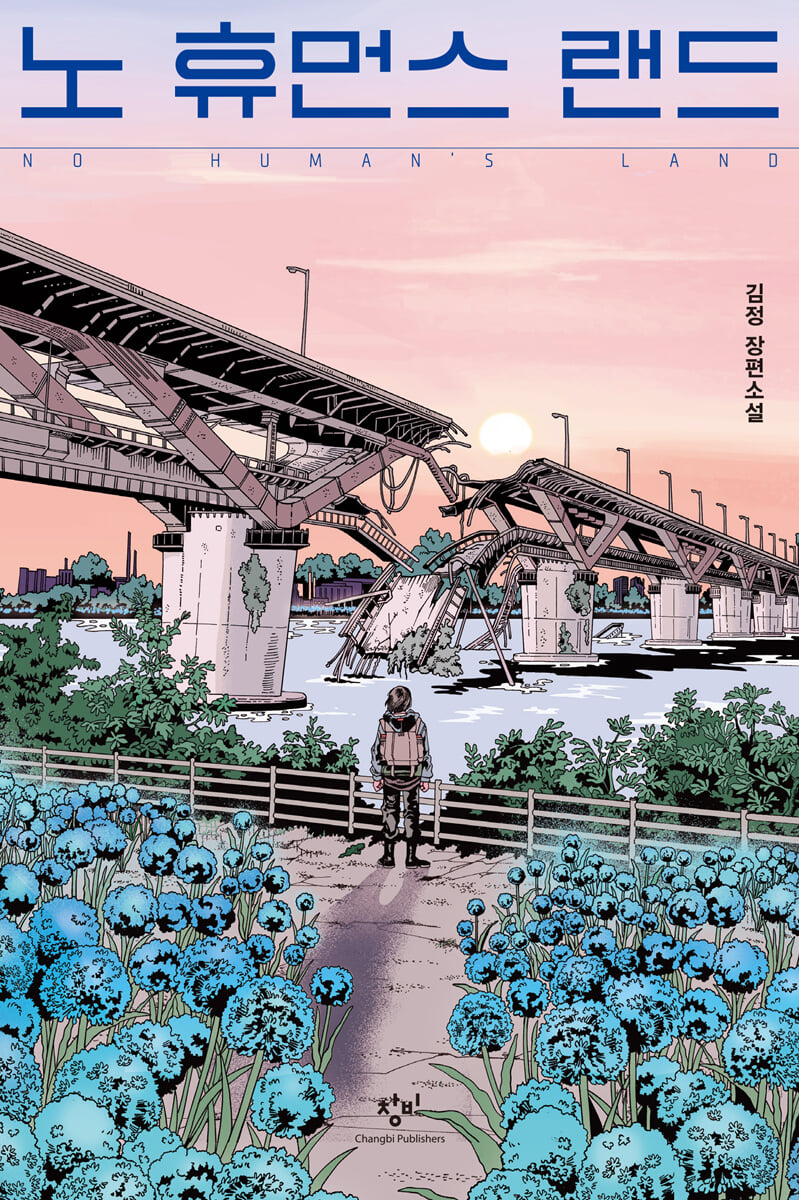
The sights Mia sees—the ruined Yongsan Park, the broken Han River Bridge, and abandoned cars on the road—are unfamiliar yet leave a strong impression on us.
What will Mia and her friends encounter in Seoul, a city filled with a lonely and eerie atmosphere?
Powerful narrative, incredible immersion, and unforgettable twists
A new trend in Korean climate novels
Mia goes to Namsan with Hannah and Parker to conduct an ecological survey.
As Mia and her group leave Yongsan Park and enter the Namsan hiking trail, the walkie-talkie suddenly rings and Chris's urgent voice, who had remained at base camp, is heard.
“Oh, it’s Chris.
Adrian… … disappeared.”
“What does that mean?”
Parker takes a breath and answers nervously.
“It disappeared.
“Suddenly… …it disappeared.” (Page 25)
Suddenly, when they hear that one of their members has disappeared, Mia and her group return to base camp and begin searching for Adrian.
And then, as Hannah and Mia were looking for Adrian, a strange object appeared before their eyes.
It was a sand castle that looked like it had just been built.
Mia's mind races at the thought that there might be someone in Seoul, a place she thought was deserted.
Suddenly Hannah stops.
His gaze is fixed somewhere and he is trembling anxiously.
Follow that gaze.
At the end of your gaze, there is something familiar, yet unnatural, something that shouldn't be there.
From the look in our eyes, Hannah and I share the same thought.
There's someone here besides us.
(Page 37)
Another shocking incident unfolds before Mia, who is confused by the disappearance of her unit member.
In this way, 『No Human's Land』 presents a surprising sense of immersion from the very beginning, with incident after incident.
As the YA judges commented, “Countless foreshadowing keeps you turning the pages,” this is a page-turner novel that will have you reading without realizing how much time has passed.
Meanwhile, the widespread climate disaster depicted in the novel makes us reflect on the climate crisis, an urgent issue facing us today.
Global heat waves and cold spells, droughts and floods, hurricanes and wildfires are no longer things of the distant future.
In recent climate crisis issues, 'climate inequality' has emerged as an important topic.
The novel's world, divided into a prosperous "city of the past" and a destitute "climate refugee camp," highlights the issue of climate justice.
"No Human's Land" is a work that will lead the new trend of Korean climate novels that has recently begun to appear actively.
What is the right way to save humanity and the planet?
A surprising question that shakes conventional wisdom about good and evil, destruction and salvation.
"No Human's Land" presents a unique charm that cannot be found in existing science fiction or English adult novels.
Although it is a Korean novel, it has a unique feel with its multinational characters, and it creates a fresh atmosphere as it is a post-apocalyptic novel set in Korea.
In addition, the protagonist, who has a calm personality but sometimes acts boldly and proactively solves cases, remains in the memory for a long time.
The 'English Adult Novel Award', jointly hosted by Changbi and Kakao Page, has expanded the scope of Korean English adult novels by selecting award-winning works that are recognized for both popularity and literary quality, such as 'Snowball' and 'The Night the Storm Chases'.
The three-time grand prize winner, "No Human Land," also stands out for its "visual urgency, reminiscent of a science fiction adventure film" (Dahye Lee's recommendation), while also movingly and persuasively depicting the teenage protagonist Mia overcoming adversity with those around her in the midst of a climate disaster.
Mia, who has learned a particularly shocking secret, questions whether it is right to manipulate and transform humans, even if it is for the sake of a better world, and the process resonates deeply, shaking our common sense of good and evil.
It's time to listen to the message of a young protagonist, a stakeholder in the climate crisis, who confronts the problem and seeks new hope, standing up to adults who try to cover up and hush up the problem.
Recommendation
"No Human's Land" depicts the adventures of a climate refugee youth who is sent to a devastated Korea as part of a research team.
It excels at creating an elaborate world that could happen in the near future, and its setting in Korea sets it apart from other post-apocalyptic works.
Another advantage was that each character, including the protagonist, had a clear purpose and that it was intertwined with structural conflict.
The smooth development makes it easy to immerse yourself in the story, and the fact that it reads as a story with suspense is also a major strength.
-Judges: Cheon Seon-ran, Lee Da-hye, Lee Su-hyeon, Kakao Page, Changbi
The narrative tension that comes from the onslaught of events is intense.
Countless foreshadowings keep you turning the pages.
-YA Jury
Character introduction
"We have arrived in Seoul, South Korea, in No Human Land." - Mia
An eighteen-year-old climate refugee born in the midst of a disaster.
At someone's secret request
He infiltrated the No Human Land investigation team under the name 'Si-eun'.
“Let’s go back to base camp first.” — Parker
Geologist.
No Human Land Investigation Team Leader.
Even though he is the leader, he rarely makes eye contact with the members and walks around alone.
"I heard your next posting is Singapore. Should I apply?" - Hanna
Meteorologist.
Member of the No Human's Land Investigation Team.
He has extensive experience in dispatching to No Human Land and is skilled in investigation team activities.
“Who else is here besides us?” - Chris
Student intern.
Member of the No Human Land Investigation Team.
Mia is the only one who knows that Si-eun is not her.
"Sieun, is my pronunciation strange?" - Adrian
Animal behaviorist.
Member of the No Human Land Investigation Team.
Although he joined the investigation team late, he quickly adapted thanks to his outstanding sociability.
An adventure beyond imagination unfolds there
Seoul is a city where nearly ten million people live together today.
What would happen if all the people in Seoul disappeared? "No Human Land" takes readers into a unique, never-before-seen worldview where Seoul becomes a "land where no one lives."
In 2044, an unprecedented climate disaster strikes the world.
Heat waves, heavy snow, droughts, cold waves, earthquakes, and tsunamis occur in major cities around the world, causing a sharp decline in food production and leading to a great famine.
And in 2050, another massive climate disaster strikes.
The United Nations, recognizing the severity of the climate problem, designates parts of the world as "no human lands."
Korea has become a no-man's land, and all the people have left.
The story begins in 2070, with the protagonist Mia arriving in Seoul, South Korea, where no one is around.
Mia infiltrates the No Human Land Investigation Team under the name 'Si-eun' at someone's secret request.
Mia's mission is to report anything suspicious.
The investigation team consisting of Parker, Hannah, Chris, Adrian, and Mia set up base camp in Yongsan Park, and Mia carefully observes the desolate appearance of Seoul.
The sights Mia sees—the ruined Yongsan Park, the broken Han River Bridge, and abandoned cars on the road—are unfamiliar yet leave a strong impression on us.
What will Mia and her friends encounter in Seoul, a city filled with a lonely and eerie atmosphere?
Powerful narrative, incredible immersion, and unforgettable twists
A new trend in Korean climate novels
Mia goes to Namsan with Hannah and Parker to conduct an ecological survey.
As Mia and her group leave Yongsan Park and enter the Namsan hiking trail, the walkie-talkie suddenly rings and Chris's urgent voice, who had remained at base camp, is heard.
“Oh, it’s Chris.
Adrian… … disappeared.”
“What does that mean?”
Parker takes a breath and answers nervously.
“It disappeared.
“Suddenly… …it disappeared.” (Page 25)
Suddenly, when they hear that one of their members has disappeared, Mia and her group return to base camp and begin searching for Adrian.
And then, as Hannah and Mia were looking for Adrian, a strange object appeared before their eyes.
It was a sand castle that looked like it had just been built.
Mia's mind races at the thought that there might be someone in Seoul, a place she thought was deserted.
Suddenly Hannah stops.
His gaze is fixed somewhere and he is trembling anxiously.
Follow that gaze.
At the end of your gaze, there is something familiar, yet unnatural, something that shouldn't be there.
From the look in our eyes, Hannah and I share the same thought.
There's someone here besides us.
(Page 37)
Another shocking incident unfolds before Mia, who is confused by the disappearance of her unit member.
In this way, 『No Human's Land』 presents a surprising sense of immersion from the very beginning, with incident after incident.
As the YA judges commented, “Countless foreshadowing keeps you turning the pages,” this is a page-turner novel that will have you reading without realizing how much time has passed.
Meanwhile, the widespread climate disaster depicted in the novel makes us reflect on the climate crisis, an urgent issue facing us today.
Global heat waves and cold spells, droughts and floods, hurricanes and wildfires are no longer things of the distant future.
In recent climate crisis issues, 'climate inequality' has emerged as an important topic.
The novel's world, divided into a prosperous "city of the past" and a destitute "climate refugee camp," highlights the issue of climate justice.
"No Human's Land" is a work that will lead the new trend of Korean climate novels that has recently begun to appear actively.
What is the right way to save humanity and the planet?
A surprising question that shakes conventional wisdom about good and evil, destruction and salvation.
"No Human's Land" presents a unique charm that cannot be found in existing science fiction or English adult novels.
Although it is a Korean novel, it has a unique feel with its multinational characters, and it creates a fresh atmosphere as it is a post-apocalyptic novel set in Korea.
In addition, the protagonist, who has a calm personality but sometimes acts boldly and proactively solves cases, remains in the memory for a long time.
The 'English Adult Novel Award', jointly hosted by Changbi and Kakao Page, has expanded the scope of Korean English adult novels by selecting award-winning works that are recognized for both popularity and literary quality, such as 'Snowball' and 'The Night the Storm Chases'.
The three-time grand prize winner, "No Human Land," also stands out for its "visual urgency, reminiscent of a science fiction adventure film" (Dahye Lee's recommendation), while also movingly and persuasively depicting the teenage protagonist Mia overcoming adversity with those around her in the midst of a climate disaster.
Mia, who has learned a particularly shocking secret, questions whether it is right to manipulate and transform humans, even if it is for the sake of a better world, and the process resonates deeply, shaking our common sense of good and evil.
It's time to listen to the message of a young protagonist, a stakeholder in the climate crisis, who confronts the problem and seeks new hope, standing up to adults who try to cover up and hush up the problem.
Recommendation
"No Human's Land" depicts the adventures of a climate refugee youth who is sent to a devastated Korea as part of a research team.
It excels at creating an elaborate world that could happen in the near future, and its setting in Korea sets it apart from other post-apocalyptic works.
Another advantage was that each character, including the protagonist, had a clear purpose and that it was intertwined with structural conflict.
The smooth development makes it easy to immerse yourself in the story, and the fact that it reads as a story with suspense is also a major strength.
-Judges: Cheon Seon-ran, Lee Da-hye, Lee Su-hyeon, Kakao Page, Changbi
The narrative tension that comes from the onslaught of events is intense.
Countless foreshadowings keep you turning the pages.
-YA Jury
Character introduction
"We have arrived in Seoul, South Korea, in No Human Land." - Mia
An eighteen-year-old climate refugee born in the midst of a disaster.
At someone's secret request
He infiltrated the No Human Land investigation team under the name 'Si-eun'.
“Let’s go back to base camp first.” — Parker
Geologist.
No Human Land Investigation Team Leader.
Even though he is the leader, he rarely makes eye contact with the members and walks around alone.
"I heard your next posting is Singapore. Should I apply?" - Hanna
Meteorologist.
Member of the No Human's Land Investigation Team.
He has extensive experience in dispatching to No Human Land and is skilled in investigation team activities.
“Who else is here besides us?” - Chris
Student intern.
Member of the No Human Land Investigation Team.
Mia is the only one who knows that Si-eun is not her.
"Sieun, is my pronunciation strange?" - Adrian
Animal behaviorist.
Member of the No Human Land Investigation Team.
Although he joined the investigation team late, he quickly adapted thanks to his outstanding sociability.
GOODS SPECIFICS
- Date of issue: July 14, 2023
- Format: Paperback book binding method guide
- Page count, weight, size: 288 pages | 376g | 140*210*12mm
- ISBN13: 9788936457204
- ISBN10: 8936457209
You may also like
카테고리
korean


korean

![GQ KOREA Mark (Monthly): December [2025]](http://librairie.coreenne.fr/cdn/shop/files/8ef265dbbfbf186523ed75ba7319009d.jpg?v=1765340328&width=3840)


