

Money Lessons for Teens
 |
Description
Book Introduction
So that ‘money’ does not become an obstacle for children with dreams,
A 'money management' class that will become a lifelong asset for teenagers!
Highly recommended by Ok Hyo-jin, teacher of "Children Who Pay Taxes," and Kwon Oh-sang, CEO of "Economics School for Twelve-Year-Olds"!
Warren Buffett, a world-renowned rich man, began studying money and investing at the age of 11.
Because I learned the truth at a young age that money grows over time.
In a world dominated by capital, the reality is that without money, even dreams cannot come true.
The sooner you become familiar with money, the better, if only to achieve your dreams.
If you later regret, “If only I had studied money sooner…” it will already be too late.
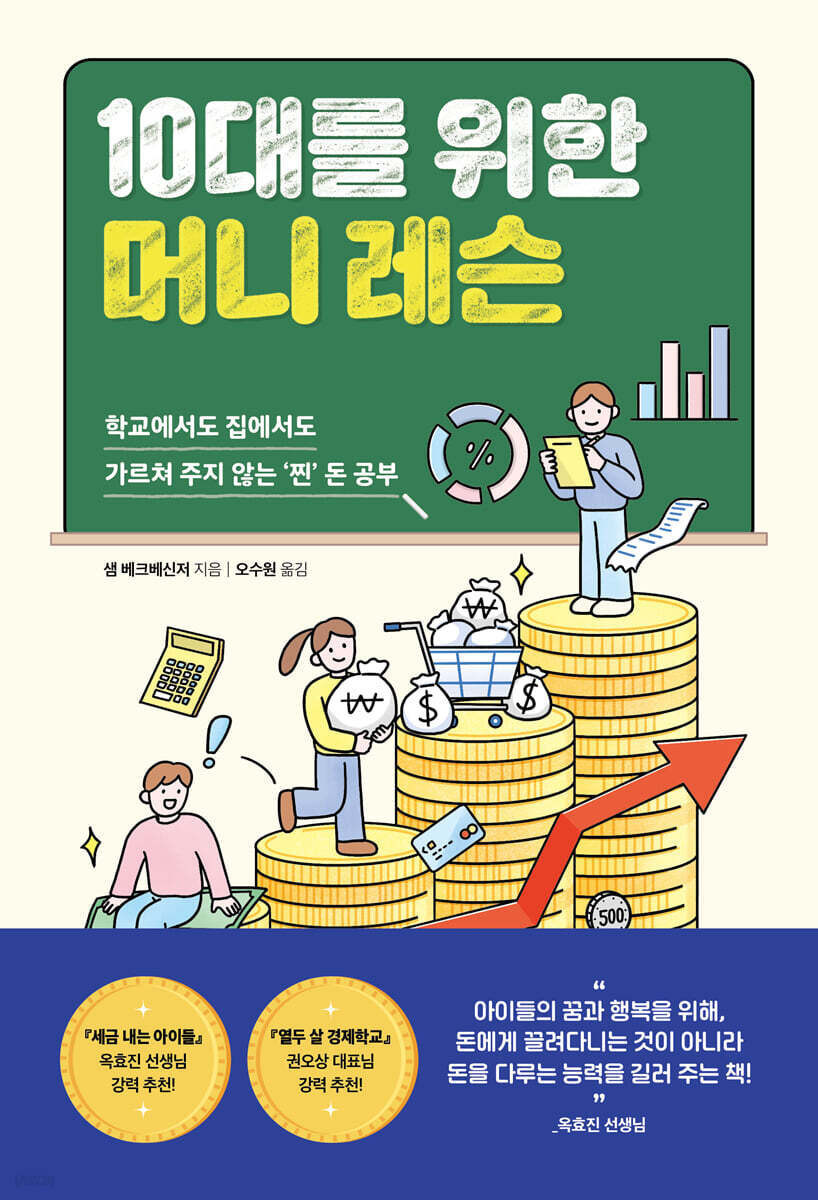
That's why "Money Lessons for Teens" was published to help teens learn about money right now.
The author of this book is a successful businessman and writer.
But when I was a teenager, no one taught me about money, so in my twenties, instead of achieving my dreams, I was buried in debt and had to endure painful days.
The author wrote this book with the earnest hope that young people will not repeat the same mistakes he made.
"Money Lessons for Teens" is not an economics textbook you have to learn for school.
This is a realistic and practical guidebook that teaches you the economic concepts essential to living your life and can be applied immediately in real life.
From basic concepts about money flow to allowances, income and expenses, asset management, savings and deposits, and stock investment, it is written in an easy-to-understand and user-friendly way, with abundant diagrams, graphs, illustrations, and specific examples.
If you follow the lessons step by step, you will soon acquire the ability to manage money, which will become an asset for life.
The day will soon come when I will enjoy the 'economic freedom' to achieve my dreams.
A 'money management' class that will become a lifelong asset for teenagers!
Highly recommended by Ok Hyo-jin, teacher of "Children Who Pay Taxes," and Kwon Oh-sang, CEO of "Economics School for Twelve-Year-Olds"!
Warren Buffett, a world-renowned rich man, began studying money and investing at the age of 11.
Because I learned the truth at a young age that money grows over time.
In a world dominated by capital, the reality is that without money, even dreams cannot come true.
The sooner you become familiar with money, the better, if only to achieve your dreams.
If you later regret, “If only I had studied money sooner…” it will already be too late.
That's why "Money Lessons for Teens" was published to help teens learn about money right now.
The author of this book is a successful businessman and writer.
But when I was a teenager, no one taught me about money, so in my twenties, instead of achieving my dreams, I was buried in debt and had to endure painful days.
The author wrote this book with the earnest hope that young people will not repeat the same mistakes he made.
"Money Lessons for Teens" is not an economics textbook you have to learn for school.
This is a realistic and practical guidebook that teaches you the economic concepts essential to living your life and can be applied immediately in real life.
From basic concepts about money flow to allowances, income and expenses, asset management, savings and deposits, and stock investment, it is written in an easy-to-understand and user-friendly way, with abundant diagrams, graphs, illustrations, and specific examples.
If you follow the lessons step by step, you will soon acquire the ability to manage money, which will become an asset for life.
The day will soon come when I will enjoy the 'economic freedom' to achieve my dreams.
- You can preview some of the book's contents.
Preview
index
A story to be passed over
Economic Terms You Should Know
Prologue | Before Starting Class
Your dreams are precious
Oh, come to my senses! Hello!
Too young? Who said that?
Money = Responsibility
What you will learn in this book
*Key Summary Notes
Lesson One | What is Money?
1st Period | Money and Family
Family and animals
A story you learn as a child
Our family's money culture
Family income
How do you inherit property or money?
Family living expenses
What on earth is money?
*Key Summary Notes
2nd Period | The Magic of Compound Interest
magic money
Don't be a slave to work
What is an asset?
Who wants to be a millionaire?
*Key Summary Notes
3rd Period | The World Surrounding Us
Some people's lives are harder
gender wage gap
Rich countries, poor countries
What on earth is a billionaire?
*Key Summary Notes
Lesson 2 | How to Make Money?
1st period | Allowance
Practice makes perfect
Different types of allowance
Project to get pocket money
What if I don't get my allowance?
*Key Summary Notes
2nd Period | Side Job Skills
Should I start a side job?
How should I price my product?
Think big
Looking for customers
Avoid danger
Make a plan
*Key Summary Notes
3rd Period | Future Careers
What do I want to be when I grow up?
The correlation between money and happiness
Why do some jobs pay more?
Income range
Do I really have to go to college?
Third option
A job with no worries about the future
*Key Summary Notes
Lesson 3 | How to Manage Money
1st Period | The Beginning of Money Management
The envelope is better than the budget
Cash rather than card
Money Mission Control
Use your time wisely
Lastly, the money to spend on playing
*Key Summary Notes
2nd Period | Let's Make Money!
For my future self
It starts from a savings account
Inflation is the enemy of savings
Understand your assets
Roller coaster investment
A smarter and safer way to invest
*Key Summary Notes
3rd Period | Spending Smartly
Resist advertising
To become a smart consumer
Dealing with fraud
*Key Summary Notes
Supplementary Lessons | Money is a Power for Good
Charity donations
duty
ethical consumption
active participation
Enjoy life
References
Acknowledgements
Economic Terms You Should Know
Prologue | Before Starting Class
Your dreams are precious
Oh, come to my senses! Hello!
Too young? Who said that?
Money = Responsibility
What you will learn in this book
*Key Summary Notes
Lesson One | What is Money?
1st Period | Money and Family
Family and animals
A story you learn as a child
Our family's money culture
Family income
How do you inherit property or money?
Family living expenses
What on earth is money?
*Key Summary Notes
2nd Period | The Magic of Compound Interest
magic money
Don't be a slave to work
What is an asset?
Who wants to be a millionaire?
*Key Summary Notes
3rd Period | The World Surrounding Us
Some people's lives are harder
gender wage gap
Rich countries, poor countries
What on earth is a billionaire?
*Key Summary Notes
Lesson 2 | How to Make Money?
1st period | Allowance
Practice makes perfect
Different types of allowance
Project to get pocket money
What if I don't get my allowance?
*Key Summary Notes
2nd Period | Side Job Skills
Should I start a side job?
How should I price my product?
Think big
Looking for customers
Avoid danger
Make a plan
*Key Summary Notes
3rd Period | Future Careers
What do I want to be when I grow up?
The correlation between money and happiness
Why do some jobs pay more?
Income range
Do I really have to go to college?
Third option
A job with no worries about the future
*Key Summary Notes
Lesson 3 | How to Manage Money
1st Period | The Beginning of Money Management
The envelope is better than the budget
Cash rather than card
Money Mission Control
Use your time wisely
Lastly, the money to spend on playing
*Key Summary Notes
2nd Period | Let's Make Money!
For my future self
It starts from a savings account
Inflation is the enemy of savings
Understand your assets
Roller coaster investment
A smarter and safer way to invest
*Key Summary Notes
3rd Period | Spending Smartly
Resist advertising
To become a smart consumer
Dealing with fraud
*Key Summary Notes
Supplementary Lessons | Money is a Power for Good
Charity donations
duty
ethical consumption
active participation
Enjoy life
References
Acknowledgements
Detailed image

Into the book
This book is about 'freedom'.
yes that's right.
Of course I know I said it was a book about money.
Actually, what I really want to talk to you about is how to live the life you actually want, not the life the world forces on you.
--- p.22
The more you understand the money ecosystem, the more you can use it as a beneficial tool in your life.
If you don't master and control your money, any money that comes into your life will just disappear.
It means that you have to spend a lot of time every day thinking about how you can earn even just a penny more.
Interestingly enough, the best way to avoid being obsessed with money is to understand it very well.
Understanding money means you don't have to stress about it, so you can think about other, more interesting things.
--- p.25
In the end, I learned everything there was to learn about money.
I even worked in finance to find out what goes on in the heart of money.
And then I found out a shocking secret.
What's that? Okay, one, two, three, opening night! It turns out that understanding money is actually quite easy! When I discovered this truth, I was really upset.
Because I had this thought.
"Why on earth didn't anyone teach me how money works when I was a kid? If they had, I'd be so much better off!" It's really simple.
You will learn from now on too.
--- p.28
Do you feel too young to start earning, saving, and investing money? Not at all.
Now is the best time to learn good habits and take big risks!
--- p.37
If you give up good things, you can have many better things when you get older.
People with a lot of wealth have much more money than they can spend.
But that takes time and patience.
This is a very important and big issue that you all need to understand very well.
Even if you sweep up all the money in the world, you can't become rich if you don't save.
You can achieve financial freedom by practicing saving more than your salary.
No matter how small the amount is.
The magic of compound interest only works on the money you save.
So learning how to save money at a young age is like getting your Hogwarts acceptance letter.
Because it's proof that you are a wizard.
You can do magic with money.
Isn't it really cool?
--- p.93
What kind of world will be in the future depends on your generation.
I hope your generation will create a world with fewer unfortunate people, a world where all children have equal opportunities, no matter where they are born.
--- p.102
This book will help you learn to use your money wisely, but keep in mind that becoming wealthy later in life doesn't mean you're better than anyone else.
You shouldn't criticize poor people for being poor.
Poor people aren't poor because they don't work hard, aren't smart, or aren't good at managing their money.
The reason they are poor is because the economic system has collapsed, and the situation is now working against everyone except the few at the top.
--- p.111
One of the most important lessons you need to remember as you go through life is that it's okay to fail.
There are definitely things we can learn from failure.
Don't be afraid to try new things and fail.
It's difficult to keep moving forward after failure.
But once you overcome that hurdle, you can grow and develop much further.
It took me a really long time to learn this lesson.
When I was young, I was so afraid of failure that I only did things I was sure I could do well.
So I hated gym class the most and made all kinds of excuses to avoid doing sports.
It wasn't until much later that I realized that doing only what I was already good at was just missing out on new experiences, making me a very boring person, and blocking my path to a fulfilling life.
--- p.133
Don't stress yourself out thinking about what you want to be when you grow up.
Focus on honing your skills.
Focus on what you can do.
Find something you enjoy doing and practice it until you become good at it.
It would be even better if the technology were uncommon.
--- p.159
Some people are really looking for a job that will pay them the most money.
Then, you start planning your life based on making a lot of money.
I don't think that's a good way to live happily.
However, it's important to gather information about different careers (how much they earn, what they can offer, etc.) and be realistic about which careers might be difficult to earn.
When choosing a career, choose one that provides you with not only financial stability but also enjoyment and meaning, and strive to learn skills that you can pursue as a side hustle in your spare time.
--- p.165
Money is a part of the life you live.
No one is an exception.
Money gives us choices.
Money can either imprison you or give you freedom.
The important thing is that learning how to handle money well is something we all have to do throughout our lives.
There will never come a day when you become a master of money and say, “Wow, I’m a money expert now.”
There will be times when you make mistakes and go wrong.
But the important thing is not to try to be perfect, but to just try to be a little better and a little more conscious.
I'm trying to give myself more choices.
You are moving towards the life you truly want, a happier life.
yes that's right.
Of course I know I said it was a book about money.
Actually, what I really want to talk to you about is how to live the life you actually want, not the life the world forces on you.
--- p.22
The more you understand the money ecosystem, the more you can use it as a beneficial tool in your life.
If you don't master and control your money, any money that comes into your life will just disappear.
It means that you have to spend a lot of time every day thinking about how you can earn even just a penny more.
Interestingly enough, the best way to avoid being obsessed with money is to understand it very well.
Understanding money means you don't have to stress about it, so you can think about other, more interesting things.
--- p.25
In the end, I learned everything there was to learn about money.
I even worked in finance to find out what goes on in the heart of money.
And then I found out a shocking secret.
What's that? Okay, one, two, three, opening night! It turns out that understanding money is actually quite easy! When I discovered this truth, I was really upset.
Because I had this thought.
"Why on earth didn't anyone teach me how money works when I was a kid? If they had, I'd be so much better off!" It's really simple.
You will learn from now on too.
--- p.28
Do you feel too young to start earning, saving, and investing money? Not at all.
Now is the best time to learn good habits and take big risks!
--- p.37
If you give up good things, you can have many better things when you get older.
People with a lot of wealth have much more money than they can spend.
But that takes time and patience.
This is a very important and big issue that you all need to understand very well.
Even if you sweep up all the money in the world, you can't become rich if you don't save.
You can achieve financial freedom by practicing saving more than your salary.
No matter how small the amount is.
The magic of compound interest only works on the money you save.
So learning how to save money at a young age is like getting your Hogwarts acceptance letter.
Because it's proof that you are a wizard.
You can do magic with money.
Isn't it really cool?
--- p.93
What kind of world will be in the future depends on your generation.
I hope your generation will create a world with fewer unfortunate people, a world where all children have equal opportunities, no matter where they are born.
--- p.102
This book will help you learn to use your money wisely, but keep in mind that becoming wealthy later in life doesn't mean you're better than anyone else.
You shouldn't criticize poor people for being poor.
Poor people aren't poor because they don't work hard, aren't smart, or aren't good at managing their money.
The reason they are poor is because the economic system has collapsed, and the situation is now working against everyone except the few at the top.
--- p.111
One of the most important lessons you need to remember as you go through life is that it's okay to fail.
There are definitely things we can learn from failure.
Don't be afraid to try new things and fail.
It's difficult to keep moving forward after failure.
But once you overcome that hurdle, you can grow and develop much further.
It took me a really long time to learn this lesson.
When I was young, I was so afraid of failure that I only did things I was sure I could do well.
So I hated gym class the most and made all kinds of excuses to avoid doing sports.
It wasn't until much later that I realized that doing only what I was already good at was just missing out on new experiences, making me a very boring person, and blocking my path to a fulfilling life.
--- p.133
Don't stress yourself out thinking about what you want to be when you grow up.
Focus on honing your skills.
Focus on what you can do.
Find something you enjoy doing and practice it until you become good at it.
It would be even better if the technology were uncommon.
--- p.159
Some people are really looking for a job that will pay them the most money.
Then, you start planning your life based on making a lot of money.
I don't think that's a good way to live happily.
However, it's important to gather information about different careers (how much they earn, what they can offer, etc.) and be realistic about which careers might be difficult to earn.
When choosing a career, choose one that provides you with not only financial stability but also enjoyment and meaning, and strive to learn skills that you can pursue as a side hustle in your spare time.
--- p.165
Money is a part of the life you live.
No one is an exception.
Money gives us choices.
Money can either imprison you or give you freedom.
The important thing is that learning how to handle money well is something we all have to do throughout our lives.
There will never come a day when you become a master of money and say, “Wow, I’m a money expert now.”
There will be times when you make mistakes and go wrong.
But the important thing is not to try to be perfect, but to just try to be a little better and a little more conscious.
I'm trying to give myself more choices.
You are moving towards the life you truly want, a happier life.
--- p.269
Publisher's Review
Worried about money? No more inheritance!
"Money Lessons for Teens" is an economics book written for teenagers by an author who personally experienced the need for early financial education.
The author is now a successful businessman and writer.
But when I was a teenager, no one taught me about money, so in my twenties, instead of achieving my dreams, I was buried in debt and had to endure painful days.
I have been interested in writing since I was young, and I have set a life goal of writing.
However, he realized early on that writing wouldn't pay the bills, and he decided to earn a good living to support his work.
After much trial and error, I now teach 'Money Lessons' to the public and write books on the subject.
The author wrote this book with the earnest hope that today's youth will not repeat the same mistake he made when he was young: wasting money.
It's similar to the feelings of parents who don't want to pass down poverty to their children.
If we don't want our children to regret learning about money, economics, and capitalism sooner, we need to prepare thoroughly from now on, while they are still in their teens.
Becoming the true master of money
The book is largely divided into three lessons.
In the first lesson, you will learn the basic concepts of money.
By understanding the flow of money and reflecting on your family's financial culture, you will come to understand what money is.
The second lesson covers making money.
If you don't have money, you can't practice managing money.
In this class, we will focus on 'allowance management,' which can be considered the beginning of children's economic education.
The third and final lesson teaches you how to manage your money wisely through saving and spending.
This book is not an economics textbook to be learned for school, but rather a practical and realistic guide that teaches the economic concepts essential for life and can be applied immediately in real life.
It is written in a simple and friendly manner, with abundant diagrams, illustrations, and specific examples tailored to the level of teenagers, so that it is easy to understand.
If you follow the lessons step by step, you will soon acquire the ability to manage money, which will become an asset for life.
The day will soon come when I will enjoy the 'economic freedom' to achieve my dreams.
“Money brings freedom.”
There was a time when talking about money in public was taboo, but now the era of having to be humble when it comes to money is over.
We live in a world where dreams are more diverse than ever before, but what good are they if money becomes an obstacle? While not everything in life, understanding the essentials of money has become a crucial task in the capitalist era.
Knowing how to manage money well is a fundamental stepping stone to living a satisfying life.
The author introduces this book as “a book about freedom.”
This book will give children the gift of financial freedom.
We will help children grow into adults, freely pursue their dreams, and become true protagonists of their own lives, allowing them more choices.
"Money Lessons for Teens" is an economics book written for teenagers by an author who personally experienced the need for early financial education.
The author is now a successful businessman and writer.
But when I was a teenager, no one taught me about money, so in my twenties, instead of achieving my dreams, I was buried in debt and had to endure painful days.
I have been interested in writing since I was young, and I have set a life goal of writing.
However, he realized early on that writing wouldn't pay the bills, and he decided to earn a good living to support his work.
After much trial and error, I now teach 'Money Lessons' to the public and write books on the subject.
The author wrote this book with the earnest hope that today's youth will not repeat the same mistake he made when he was young: wasting money.
It's similar to the feelings of parents who don't want to pass down poverty to their children.
If we don't want our children to regret learning about money, economics, and capitalism sooner, we need to prepare thoroughly from now on, while they are still in their teens.
Becoming the true master of money
The book is largely divided into three lessons.
In the first lesson, you will learn the basic concepts of money.
By understanding the flow of money and reflecting on your family's financial culture, you will come to understand what money is.
The second lesson covers making money.
If you don't have money, you can't practice managing money.
In this class, we will focus on 'allowance management,' which can be considered the beginning of children's economic education.
The third and final lesson teaches you how to manage your money wisely through saving and spending.
This book is not an economics textbook to be learned for school, but rather a practical and realistic guide that teaches the economic concepts essential for life and can be applied immediately in real life.
It is written in a simple and friendly manner, with abundant diagrams, illustrations, and specific examples tailored to the level of teenagers, so that it is easy to understand.
If you follow the lessons step by step, you will soon acquire the ability to manage money, which will become an asset for life.
The day will soon come when I will enjoy the 'economic freedom' to achieve my dreams.
“Money brings freedom.”
There was a time when talking about money in public was taboo, but now the era of having to be humble when it comes to money is over.
We live in a world where dreams are more diverse than ever before, but what good are they if money becomes an obstacle? While not everything in life, understanding the essentials of money has become a crucial task in the capitalist era.
Knowing how to manage money well is a fundamental stepping stone to living a satisfying life.
The author introduces this book as “a book about freedom.”
This book will give children the gift of financial freedom.
We will help children grow into adults, freely pursue their dreams, and become true protagonists of their own lives, allowing them more choices.
GOODS SPECIFICS
- Date of issue: April 20, 2023
- Page count, weight, size: 280 pages | 494g | 150*220*16mm
- ISBN13: 9791139710854
- ISBN10: 1139710850
- KC Certification: Certification Type: Conformity Confirmation
You may also like
카테고리
korean


korean

![GQ KOREA Mark (Monthly): December [2025]](http://librairie.coreenne.fr/cdn/shop/files/8ef265dbbfbf186523ed75ba7319009d.jpg?v=1765340328&width=3840)


