

Park Ji-won's novel collection
 |
Description
Book Introduction
Eleven Chinese novels written by the Silhak scholar Yeonam Park Ji-won.
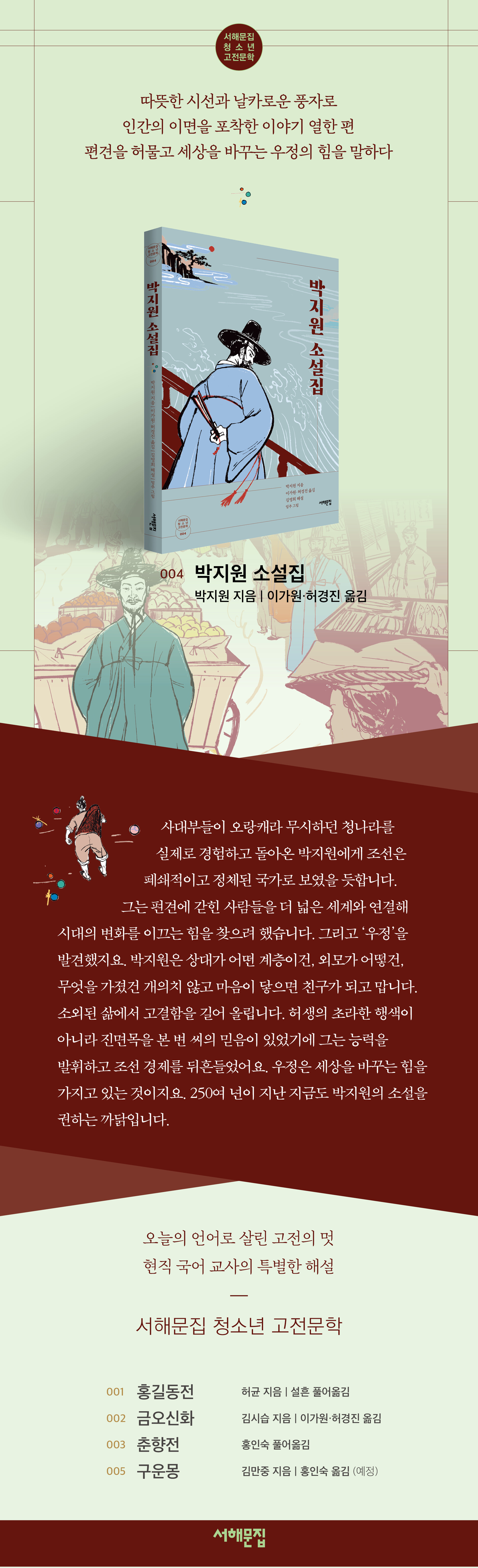
The story unfolds with sharp satire and dignified humor, exposing the stale true face of the aristocracy, and with a warm gaze, elevating the nobility within the marginalized.
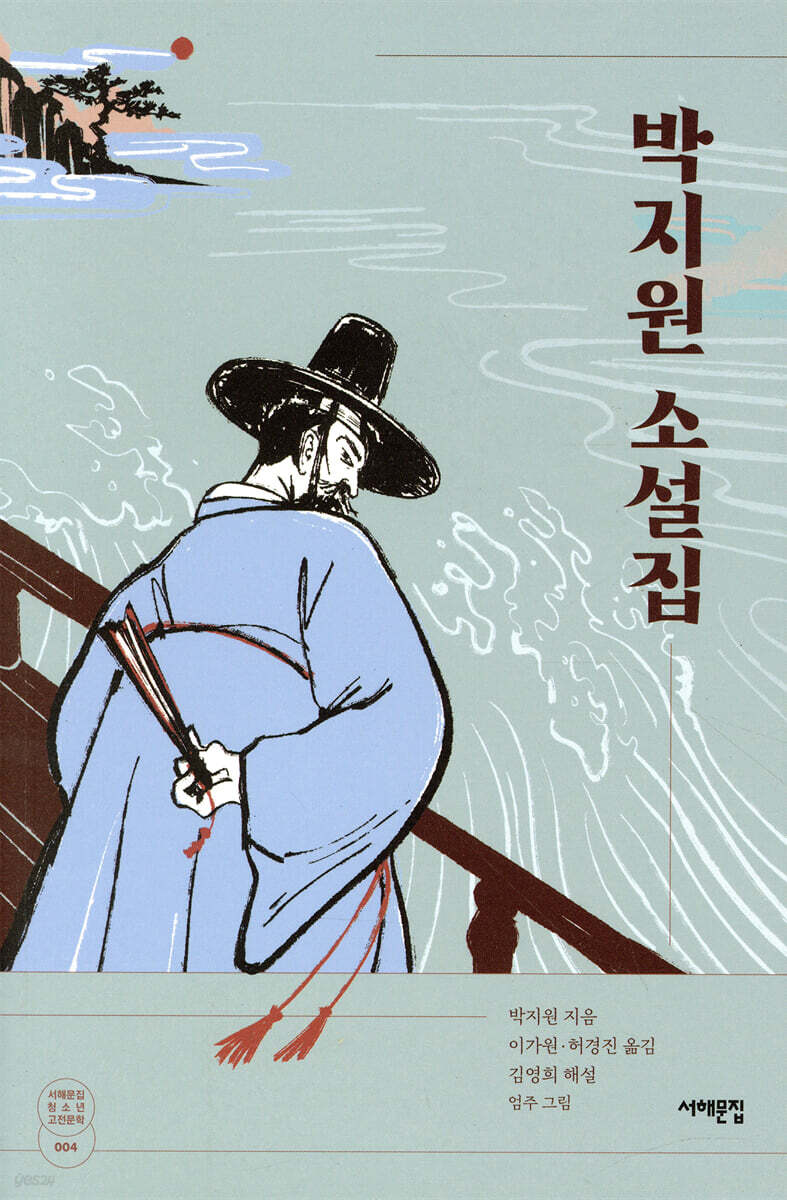
Alongside the passages that reveal empathy and respect for the middle class, women, and the common people, there are bold drawings and sophisticated illustrations with restrained colors that capture the attention of young readers.
Park Ji-won sought ways to break down the class barriers and prejudices that hindered reform in Joseon society.
And I found 'friendship'.
He urged people to reject relationships based on profit and flattery and instead communicate with diverse others through true friendship that seeks to see into the essence of the other person.
The commentary helps readers discover these desires in each work and read Park Ji-won's multi-layered novel world as a single thread.
The story unfolds with sharp satire and dignified humor, exposing the stale true face of the aristocracy, and with a warm gaze, elevating the nobility within the marginalized.
Alongside the passages that reveal empathy and respect for the middle class, women, and the common people, there are bold drawings and sophisticated illustrations with restrained colors that capture the attention of young readers.
Park Ji-won sought ways to break down the class barriers and prejudices that hindered reform in Joseon society.
And I found 'friendship'.
He urged people to reject relationships based on profit and flattery and instead communicate with diverse others through true friendship that seeks to see into the essence of the other person.
The commentary helps readers discover these desires in each work and read Park Ji-won's multi-layered novel world as a single thread.
- You can preview some of the book's contents.
Preview
index
preface
Horse Battle
Biography of Teacher Yedeok
Minongjeon (閔翁傳)
Yangbanjeon (兩班傳)
Story of Kim Shin-seon
Gwangmunjajeon (Biographies of Broad Writers)
The story behind the Gwangmunjajeon
The story of Woosangjeon (虞裳傳)
Tiger's claws
The story behind Hojil
Jade Box Night Story
Heo Saeng
Heo Saeng's Backstory 1
Heo Saeng's Backstory 2
The Tale of the Chaste Woman, Hamyang Park Clan
The Joy of Reading Park Ji-won's Novel Collection
Horse Battle
Biography of Teacher Yedeok
Minongjeon (閔翁傳)
Yangbanjeon (兩班傳)
Story of Kim Shin-seon
Gwangmunjajeon (Biographies of Broad Writers)
The story behind the Gwangmunjajeon
The story of Woosangjeon (虞裳傳)
Tiger's claws
The story behind Hojil
Jade Box Night Story
Heo Saeng
Heo Saeng's Backstory 1
Heo Saeng's Backstory 2
The Tale of the Chaste Woman, Hamyang Park Clan
The Joy of Reading Park Ji-won's Novel Collection
Detailed image
Into the book
When the headman finished reading, the rich man said that he was in a daze for a while.
"Are you saying this is all a nobleman has? I've heard that noblemen are like immortals, but if this is really all they have, then they've been unfairly robbed of their grain.
“Please fix it so that it is more beneficial.”
So I made another certificate.
When heaven gave birth to the people, it divided them into four branches.
Among the four classes of people, the most noble is the scholar, and this scholar is called a yangban.
There is no greater advantage in the world than that of a nobleman.
They neither farm nor do business.
…even if you live in the countryside as a poor scholar, you can act as you please.
Even if I drive the neighbor's cow to plow my field first and catch the local farmer to weed my field, who would dare look down on me?
Even if I pour lye down your nose, mess up your topknot, and pull out your beard, I won't be able to complain.
The rich man stopped making the deed and stuck out his tongue.
“Stop it.
Please stop.
That's really reckless.
“Are you planning to make a thief out of me?” Then he shook his head and ran away.
After that, he never said the word 'Yangban' until he died.
---From "Yangbanjeon"
You might say that Eom Hang-su is 'not very humble' because he carries dung and manure on his back to make his own food.
But the way he prepared his food was extremely fragrant, and although his conduct was extremely dirty, his attitude toward justice was extremely upright. If you look at his intentions, you will find that he would not change them even if you gave him ten thousand shillings.
If we look at it this way, there are people in the world who are said to be modest but are not modest, and there are people who are said to be dirty but are not dirty.
---From "The Story of Mr. Yedeok"
Young women in the common houses and widows in the back alleys are not forced by their parents to remarry, nor are their descendants' paths to government positions blocked. However, they believe that 'just growing old while maintaining a widow's body is not enough to be called chaste.'
So, I hope that she will put out her meaningless life like a candle in broad daylight and follow her husband to the afterlife.
They throw themselves into water and fire, drink poison, and strangle themselves with ropes, but they think they are treading on paradise.
They are very passionate, but how can you not say that they are excessive?
---From "The Tale of Chaste Woman Hamyang Park"
“There are five ways to make friends.
If you want to praise him in the future, you must first expose his faults and rebuke him; if you want to show him joy in the future, you must first reveal his anger.
If you want to be friendly in the future, you must first be firm in your intentions and act shyly. If you want others to trust you, you must deliberately create a question and wait until it is resolved.
Usually, martyrs are sad and beauties cry a lot, but the reason heroes cry a lot is because they want to move the hearts of others.
“These five methods are the secret plan of a gentleman, and they are beautiful ways to live in the world.”
…Topta said with a sad and pitiful blush on his face.
“I would rather not make a single friend in my entire life than have a ‘gentleman’s association’ as you say.”
---From "The Horse Race"
When Heo Saeng left, everyone was very surprised and asked, “Do you know that guest?”
When Mr. Byun said, “I don’t know,” he said, “So you threw away ten thousand nyang overnight to someone you didn’t even know and didn’t even ask his name? Why did you do that?”
Mr. Byun said this.
“This is none of your business.
People who have something to ask of others usually show their sincerity first by exaggerating their own plans.
Yet, his face is ashamed and cowardly, and his words are often repetitive.
But this guest, although he was out of clothes and shoes, spoke simply and had arrogant eyes.
Judging by the lack of shame on his face, he is a person who is satisfied with himself before waiting for material things to come his way.
It's no small thing for him to want to try it out, but I also have something to try out for him.
“If you hadn’t given it to me, I wouldn’t have known, but if you’ve already given me ten thousand nyang, what’s the point of asking for my name?”
"Are you saying this is all a nobleman has? I've heard that noblemen are like immortals, but if this is really all they have, then they've been unfairly robbed of their grain.
“Please fix it so that it is more beneficial.”
So I made another certificate.
When heaven gave birth to the people, it divided them into four branches.
Among the four classes of people, the most noble is the scholar, and this scholar is called a yangban.
There is no greater advantage in the world than that of a nobleman.
They neither farm nor do business.
…even if you live in the countryside as a poor scholar, you can act as you please.
Even if I drive the neighbor's cow to plow my field first and catch the local farmer to weed my field, who would dare look down on me?
Even if I pour lye down your nose, mess up your topknot, and pull out your beard, I won't be able to complain.
The rich man stopped making the deed and stuck out his tongue.
“Stop it.
Please stop.
That's really reckless.
“Are you planning to make a thief out of me?” Then he shook his head and ran away.
After that, he never said the word 'Yangban' until he died.
---From "Yangbanjeon"
You might say that Eom Hang-su is 'not very humble' because he carries dung and manure on his back to make his own food.
But the way he prepared his food was extremely fragrant, and although his conduct was extremely dirty, his attitude toward justice was extremely upright. If you look at his intentions, you will find that he would not change them even if you gave him ten thousand shillings.
If we look at it this way, there are people in the world who are said to be modest but are not modest, and there are people who are said to be dirty but are not dirty.
---From "The Story of Mr. Yedeok"
Young women in the common houses and widows in the back alleys are not forced by their parents to remarry, nor are their descendants' paths to government positions blocked. However, they believe that 'just growing old while maintaining a widow's body is not enough to be called chaste.'
So, I hope that she will put out her meaningless life like a candle in broad daylight and follow her husband to the afterlife.
They throw themselves into water and fire, drink poison, and strangle themselves with ropes, but they think they are treading on paradise.
They are very passionate, but how can you not say that they are excessive?
---From "The Tale of Chaste Woman Hamyang Park"
“There are five ways to make friends.
If you want to praise him in the future, you must first expose his faults and rebuke him; if you want to show him joy in the future, you must first reveal his anger.
If you want to be friendly in the future, you must first be firm in your intentions and act shyly. If you want others to trust you, you must deliberately create a question and wait until it is resolved.
Usually, martyrs are sad and beauties cry a lot, but the reason heroes cry a lot is because they want to move the hearts of others.
“These five methods are the secret plan of a gentleman, and they are beautiful ways to live in the world.”
…Topta said with a sad and pitiful blush on his face.
“I would rather not make a single friend in my entire life than have a ‘gentleman’s association’ as you say.”
---From "The Horse Race"
When Heo Saeng left, everyone was very surprised and asked, “Do you know that guest?”
When Mr. Byun said, “I don’t know,” he said, “So you threw away ten thousand nyang overnight to someone you didn’t even know and didn’t even ask his name? Why did you do that?”
Mr. Byun said this.
“This is none of your business.
People who have something to ask of others usually show their sincerity first by exaggerating their own plans.
Yet, his face is ashamed and cowardly, and his words are often repetitive.
But this guest, although he was out of clothes and shoes, spoke simply and had arrogant eyes.
Judging by the lack of shame on his face, he is a person who is satisfied with himself before waiting for material things to come his way.
It's no small thing for him to want to try it out, but I also have something to try out for him.
“If you hadn’t given it to me, I wouldn’t have known, but if you’ve already given me ten thousand nyang, what’s the point of asking for my name?”
---From "Heosaeng"
Publisher's Review
With sharp satire and warm gaze
Eleven stories that capture the other side of humanity
Among the novels written by Park Ji-won, the most well-known are “Yangbanjeon,” “Hojil,” and “Heosaeng.”
All three pieces target the Joseon Dynasty's aristocracy.
It criticizes the tyranny of those who believe in privilege and pour lye down the noses of the people, the hypocrisy of discussing the principles of humanity while exploiting and harming others, and the narrow-mindedness of those who look down on the Qing Dynasty even a hundred years after the fall of the Ming Dynasty.
With sharp satire and dignified humor, he exposes the true face of the old-fashioned aristocrats and gives refreshing laughter that “makes the rice in your mouth fly away like bees” (《Yeolha Diary》, 〈Gwannaejeongsa〉).
The cool-headed, realistic judgment and insight of the Bukhak School Silhak scholars, glimpsed here and there between interesting stories, reveal what the ills of Joseon society were at the time and what kind of reform was needed.
Park Ji-won didn't stop at pointing out the problem.
He sought ways to break down the class barriers and prejudices that hinder reform.
And I found 'friendship'.
Traces of the exploration are contained in the remaining eight chapters.
The novel features people from all walks of life as its protagonists, including a horse dealer (The Story of a Horseman), a man who takes out manure (The Story of Mr. Yedeok), a reclusive scholar (The Story of Minong, The Story of Kim Sinseon), a beggar (The Story of Gwangmunja), an interpreter (The Story of Usang, The Story of Okgap Night), and a chaste woman (The Story of Chaste Woman Hamyang Park).
With a warm gaze, we bring out the sorrow, joy, and nobility that are embedded in their lives.
It shows that you can become friends with someone if you “relate only with your heart and befriend with virtue,” regardless of their class, appearance, or possessions.
Alongside the passages that reveal empathy and respect for those outside the mainstream of Joseon, sophisticated illustrations with bold drawings and restrained colors capture the reader's attention.
Breaking down prejudice and changing the world
Speaking of the power of friendship
In fact, in the late Joseon Dynasty, there was a 'theory of friendship', and Park Ji-won suggested and led one direction of this discourse.
He rejected the 'sociability of a gentleman', which involved flattery for profit and advancement, and associating with illegitimate children whose paths to officialdom were limited.
I wanted to gain true friendship that understands the other person's true nature.
Rather than being confined to the distinctions of legitimate and illegitimate children, nobles and commoners, scholars and barbarians, he urged communication with diverse others.
The commentary helps readers discover these desires in each work and read Park Ji-won's multi-layered novel world as a single thread.
In the novel, Park Ji-won actively collects stories from the common people wandering the streets.
When they hear rumors of a strange person, they travel a long way to find him and even invite him to their home.
It is implied that Heo Saeng was able to control the economy of a country because there was a rich man named Byun who believed in Heo Saeng's extraordinary talent instead of his shabby appearance.
It speaks to the immense change that true friendship can bring.
This is why, even after 250 years, I still recommend Park Ji-won's short story collection to young people.
Eleven stories that capture the other side of humanity
Among the novels written by Park Ji-won, the most well-known are “Yangbanjeon,” “Hojil,” and “Heosaeng.”
All three pieces target the Joseon Dynasty's aristocracy.
It criticizes the tyranny of those who believe in privilege and pour lye down the noses of the people, the hypocrisy of discussing the principles of humanity while exploiting and harming others, and the narrow-mindedness of those who look down on the Qing Dynasty even a hundred years after the fall of the Ming Dynasty.
With sharp satire and dignified humor, he exposes the true face of the old-fashioned aristocrats and gives refreshing laughter that “makes the rice in your mouth fly away like bees” (《Yeolha Diary》, 〈Gwannaejeongsa〉).
The cool-headed, realistic judgment and insight of the Bukhak School Silhak scholars, glimpsed here and there between interesting stories, reveal what the ills of Joseon society were at the time and what kind of reform was needed.
Park Ji-won didn't stop at pointing out the problem.
He sought ways to break down the class barriers and prejudices that hinder reform.
And I found 'friendship'.
Traces of the exploration are contained in the remaining eight chapters.
The novel features people from all walks of life as its protagonists, including a horse dealer (The Story of a Horseman), a man who takes out manure (The Story of Mr. Yedeok), a reclusive scholar (The Story of Minong, The Story of Kim Sinseon), a beggar (The Story of Gwangmunja), an interpreter (The Story of Usang, The Story of Okgap Night), and a chaste woman (The Story of Chaste Woman Hamyang Park).
With a warm gaze, we bring out the sorrow, joy, and nobility that are embedded in their lives.
It shows that you can become friends with someone if you “relate only with your heart and befriend with virtue,” regardless of their class, appearance, or possessions.
Alongside the passages that reveal empathy and respect for those outside the mainstream of Joseon, sophisticated illustrations with bold drawings and restrained colors capture the reader's attention.
Breaking down prejudice and changing the world
Speaking of the power of friendship
In fact, in the late Joseon Dynasty, there was a 'theory of friendship', and Park Ji-won suggested and led one direction of this discourse.
He rejected the 'sociability of a gentleman', which involved flattery for profit and advancement, and associating with illegitimate children whose paths to officialdom were limited.
I wanted to gain true friendship that understands the other person's true nature.
Rather than being confined to the distinctions of legitimate and illegitimate children, nobles and commoners, scholars and barbarians, he urged communication with diverse others.
The commentary helps readers discover these desires in each work and read Park Ji-won's multi-layered novel world as a single thread.
In the novel, Park Ji-won actively collects stories from the common people wandering the streets.
When they hear rumors of a strange person, they travel a long way to find him and even invite him to their home.
It is implied that Heo Saeng was able to control the economy of a country because there was a rich man named Byun who believed in Heo Saeng's extraordinary talent instead of his shabby appearance.
It speaks to the immense change that true friendship can bring.
This is why, even after 250 years, I still recommend Park Ji-won's short story collection to young people.
GOODS SPECIFICS
- Publication date: October 25, 2022
- Page count, weight, size: 184 pages | 232g | 135*205*20mm
- ISBN13: 9791192085692
- ISBN10: 1192085698
You may also like
카테고리
korean


korean

![GQ KOREA Mark (Monthly): December [2025]](http://librairie.coreenne.fr/cdn/shop/files/8ef265dbbfbf186523ed75ba7319009d.jpg?v=1765340328&width=3840)


