

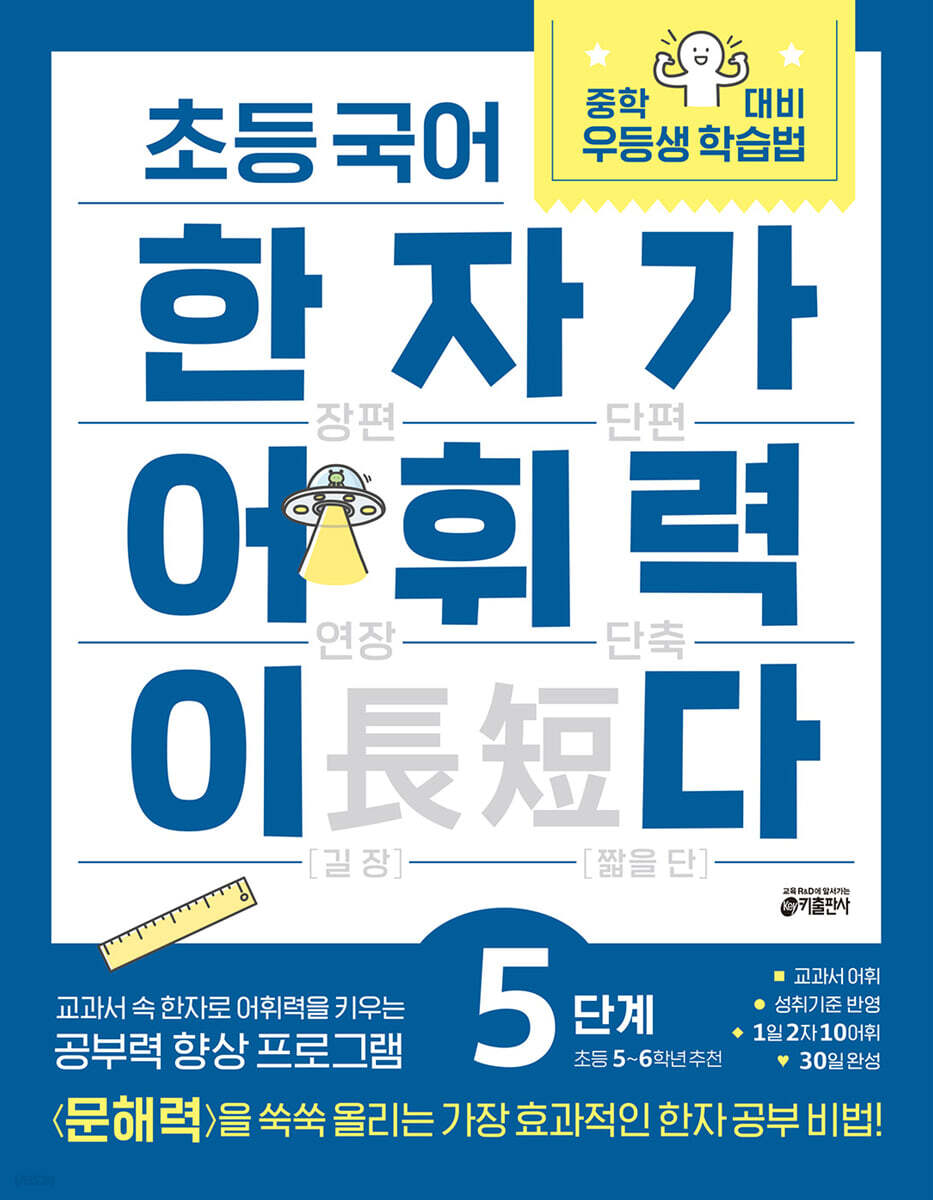
Elementary Korean Chinese Character Vocabulary Level 5 Recommended for 5th and 6th graders
 |
Description
Book Introduction
Chinese characters: the key to vocabulary and study skills! How should you get started? Say goodbye to Hanja for Hanja! Here's a more advanced Hanja textbook designed to enhance your vocabulary! Let's prepare to become a top middle school student with the most effective Chinese character study method that will rapidly improve literacy! The vocabulary for elementary school textbooks for 5th and 6th graders was determined at the basic Chinese character level. If you start with familiar words and follow them step by step, you will be able to guess the meaning of unfamiliar words on your own and even discover the meaning of hidden Chinese characters to distinguish the words. In steps 1 to 4, the focus was on recognizing that Chinese characters are hidden in the vocabulary I use and understanding the meaning of the Chinese characters hidden in those words. In step 5, we go one step further and identify the semantic relationships between Chinese characters and even distinguish between words. |
- You can preview some of the book's contents.
Preview
index
* This book
Unit 1 Daily Life
Lesson 1 Short and long ↔short
Lesson 2 Gain Gain↔Loss
3. There is a zone. There is a zone.
Lesson 4 Drinking Drink + Food
Lesson 5 Surname Surname Surname + given name
Strengthening Vocabulary 1
Unit 2 Social Studies
Lesson 1 Musa Mu Mun↔Mu
Lesson 2 Private Private Public ↔ Private
Lesson 3: Comfortable side ≒ inside
Lesson 4: Collecting Houses House≒sum
Lesson 5 Boundary System Se+ System
Strengthening your vocabulary 2
Unit 3 School Life
Lesson 1 Answer Questions and Answers
2. Different from other words
Lesson 3 Words Language≒Word
Lesson 4 Objects Water + Water
Lesson 5 Peace + Peace
Strengthening your vocabulary 3
Unit 4 Art
Lesson 1 Now Gold ↔ Gold
Lesson 2 Darkness Darkness Light↔Darkness
Lesson 3 Clothes ≒ Clothes
Lesson 4 Straight ≒ Straight
Lesson 5: Ability, Talent, Talent + Ability
Strengthening your vocabulary 4
Unit 5 Science
Lesson 1 Earth Heaven↔Earth
Lesson 2: No No Yes↔No
Lesson 3 Calculation Calculation≒Calculation
Lesson 4: Divide by ≒Star
Lesson 5: Fast Speed + Power
Strengthen your vocabulary 5
Unit 6 Nature
1. Less than ↔ less than
Lesson 2 Life and Death
Lesson 3 Root Root≒Bone
Lesson 4 Trees Number of trees = number of trees
Lesson 5: Formation + Seong
Strengthening Your Vocabulary 6
*Correct answer
*Chinese character index
Unit 1 Daily Life
Lesson 1 Short and long ↔short
Lesson 2 Gain Gain↔Loss
3. There is a zone. There is a zone.
Lesson 4 Drinking Drink + Food
Lesson 5 Surname Surname Surname + given name
Strengthening Vocabulary 1
Unit 2 Social Studies
Lesson 1 Musa Mu Mun↔Mu
Lesson 2 Private Private Public ↔ Private
Lesson 3: Comfortable side ≒ inside
Lesson 4: Collecting Houses House≒sum
Lesson 5 Boundary System Se+ System
Strengthening your vocabulary 2
Unit 3 School Life
Lesson 1 Answer Questions and Answers
2. Different from other words
Lesson 3 Words Language≒Word
Lesson 4 Objects Water + Water
Lesson 5 Peace + Peace
Strengthening your vocabulary 3
Unit 4 Art
Lesson 1 Now Gold ↔ Gold
Lesson 2 Darkness Darkness Light↔Darkness
Lesson 3 Clothes ≒ Clothes
Lesson 4 Straight ≒ Straight
Lesson 5: Ability, Talent, Talent + Ability
Strengthening your vocabulary 4
Unit 5 Science
Lesson 1 Earth Heaven↔Earth
Lesson 2: No No Yes↔No
Lesson 3 Calculation Calculation≒Calculation
Lesson 4: Divide by ≒Star
Lesson 5: Fast Speed + Power
Strengthen your vocabulary 5
Unit 6 Nature
1. Less than ↔ less than
Lesson 2 Life and Death
Lesson 3 Root Root≒Bone
Lesson 4 Trees Number of trees = number of trees
Lesson 5: Formation + Seong
Strengthening Your Vocabulary 6
*Correct answer
*Chinese character index
Detailed image

Publisher's Review
Chinese characters, the key to vocabulary and study skills! How should I get started?
Say goodbye to Hanja for Hanja! Here's a more advanced Hanja textbook designed to enhance your vocabulary!
Prepare to become a top middle school student with the most effective Chinese character study method that will dramatically improve your literacy skills!
Instead of spending effort memorizing and writing difficult Chinese characters, you can study Chinese characters, which are the foundation of literacy, in the most effective way.
We strengthen children's vocabulary by recognizing that Chinese characters are hidden in the vocabulary we use, inductively understanding the meaning of those characters through various vocabulary, and further by taking a meta-approach to their meaning.
In steps 1 to 4, we focused on recognizing that Chinese characters are hidden in the vocabulary we use and understanding the meaning of the Chinese characters hidden in those words. In step 5, we go one step further and identify the semantic relationships between Chinese characters and even distinguish between words.
I have compiled vocabulary from textbooks for 5th and 6th graders at the basic Chinese character level.
If you start with familiar words and follow them step by step, you will be able to guess the meaning of unfamiliar words on your own and even discover the meaning of hidden Chinese characters to distinguish the words.
① Easy and fun way to learn Chinese characters without overwhelming children! A textbook children love!
Start with familiar vocabulary that your child already knows.
First of all, this is not a Chinese character textbook that teaches you to write and memorize the suggested Chinese characters.
By realizing for yourself that the letters in common in vocabulary are Chinese characters and knowing the meaning of those Chinese characters,
Develop the ability to infer the meaning of words encountered in long texts.
② Closely linked to the textbook! Complete in 30 days with '2 characters, 8 vocabulary per day'!
Learn two Chinese characters a day and master the eight vocabulary words hidden within those characters.
This activity involves discerning the meaning of two words and inserting the appropriate word into a sentence, allowing children to think more deeply about the meaning of Chinese characters.
Then, find the vocabulary you learned in the long text.
▶ Chinese characters: Classify basic Chinese characters of level 8-6 into an order that children can easily understand.
▶ Vocabulary: Focused on vocabulary from textbooks for 5th and 6th graders
▶ Long text: A text written on the topic of the 5th and 6th grade elementary school curriculum achievement standards
It is longer than the previous stage's long text, which helps improve the child's reading comprehension.
③ Learning Korean etymology to develop your inferential skills!
Improve your vocabulary, which is the foundation for all school subjects, through Chinese characters.
If you know Chinese characters, the meaning of vocabulary you already know becomes clearer.
Children can guess the meaning of new vocabulary by inferring it on their own.
By starting the process of building vocabulary with Chinese characters, you will establish a more solid and solid foundation.
By learning Chinese characters, which are the origin of many Korean words, you can study vocabulary by rote memorization.
Develop a real vocabulary that allows children to infer meaning on their own.
▶ Learners who don't know how to start studying Chinese characters that are connected to vocabulary!
▶ Learners who find studying Chinese characters difficult and boring and feel burdened!
▶ Learners who want to study Chinese characters to improve literacy, not for the purpose of obtaining a passing grade!
▶ Learners who want to learn vocabulary in conjunction with elementary school textbooks!
▶ Learners who have too many unfamiliar words when reading books
▶ Learners who want to become familiar with the Korean dictionary and develop self-directed study habits!
What Chinese characters do you learn?
Basic Chinese characters (levels 8-6) are classified according to specially designed selection criteria.
Even if the characters are not at levels 8-6, there are also upper-level characters included according to priority.
It is an order that is easy for children to accept, not a gradual order.
1.
Many Chinese characters in vocabulary of textbooks for 5th and 6th graders
2.
Chinese characters closely related to the daily lives of 5th and 6th grade elementary school students
What vocabulary do you learn?
It is mostly composed of textbook vocabulary that 5th and 6th graders learn in school.
In some cases, only the root of a word is presented, making it appropriate for learning vocabulary.
By looking at the Chinese characters that make up a word, you can understand the meaning of the word more clearly.
Furthermore, we realize what kind of semantic relationships those Chinese characters have to form words.
1.
Textbook vocabulary for 5th and 6th grade elementary school students
2.
Vocabulary closely related to the daily lives of 5th and 6th grade elementary school students
The curriculum is aligned with the achievement standards for 5th and 6th grade elementary school students!
All fingerprints are about the lives of peers, and the content is linked to the '5th and 6th grade achievement standards' that children learn at school.
In texts on familiar topics, recall the meaning of the Chinese characters hidden in the words.
Help your child learn to infer unfamiliar words without giving up.
It is structured so that you can follow along step by step and gain a sense of accomplishment!
If your child has discovered that there are Chinese characters with special meanings hidden within words in the 1-4 level textbooks,
In steps 5 and 6, you will develop the ability to discriminate words by deeply considering the meaning of the Chinese characters.
It explains the principles and concepts of Chinese characters through engaging illustrations.
Reference was made to the National Institute of the Korean Language's Standard Korean Dictionary and Basic Korean Dictionary.
Children develop the habit of self-directed learning both inside and outside of the classroom.
Say goodbye to Hanja for Hanja! Here's a more advanced Hanja textbook designed to enhance your vocabulary!
Prepare to become a top middle school student with the most effective Chinese character study method that will dramatically improve your literacy skills!
Instead of spending effort memorizing and writing difficult Chinese characters, you can study Chinese characters, which are the foundation of literacy, in the most effective way.
We strengthen children's vocabulary by recognizing that Chinese characters are hidden in the vocabulary we use, inductively understanding the meaning of those characters through various vocabulary, and further by taking a meta-approach to their meaning.
In steps 1 to 4, we focused on recognizing that Chinese characters are hidden in the vocabulary we use and understanding the meaning of the Chinese characters hidden in those words. In step 5, we go one step further and identify the semantic relationships between Chinese characters and even distinguish between words.
I have compiled vocabulary from textbooks for 5th and 6th graders at the basic Chinese character level.
If you start with familiar words and follow them step by step, you will be able to guess the meaning of unfamiliar words on your own and even discover the meaning of hidden Chinese characters to distinguish the words.
① Easy and fun way to learn Chinese characters without overwhelming children! A textbook children love!
Start with familiar vocabulary that your child already knows.
First of all, this is not a Chinese character textbook that teaches you to write and memorize the suggested Chinese characters.
By realizing for yourself that the letters in common in vocabulary are Chinese characters and knowing the meaning of those Chinese characters,
Develop the ability to infer the meaning of words encountered in long texts.
② Closely linked to the textbook! Complete in 30 days with '2 characters, 8 vocabulary per day'!
Learn two Chinese characters a day and master the eight vocabulary words hidden within those characters.
This activity involves discerning the meaning of two words and inserting the appropriate word into a sentence, allowing children to think more deeply about the meaning of Chinese characters.
Then, find the vocabulary you learned in the long text.
▶ Chinese characters: Classify basic Chinese characters of level 8-6 into an order that children can easily understand.
▶ Vocabulary: Focused on vocabulary from textbooks for 5th and 6th graders
▶ Long text: A text written on the topic of the 5th and 6th grade elementary school curriculum achievement standards
It is longer than the previous stage's long text, which helps improve the child's reading comprehension.
③ Learning Korean etymology to develop your inferential skills!
Improve your vocabulary, which is the foundation for all school subjects, through Chinese characters.
If you know Chinese characters, the meaning of vocabulary you already know becomes clearer.
Children can guess the meaning of new vocabulary by inferring it on their own.
By starting the process of building vocabulary with Chinese characters, you will establish a more solid and solid foundation.
By learning Chinese characters, which are the origin of many Korean words, you can study vocabulary by rote memorization.
Develop a real vocabulary that allows children to infer meaning on their own.
▶ Learners who don't know how to start studying Chinese characters that are connected to vocabulary!
▶ Learners who find studying Chinese characters difficult and boring and feel burdened!
▶ Learners who want to study Chinese characters to improve literacy, not for the purpose of obtaining a passing grade!
▶ Learners who want to learn vocabulary in conjunction with elementary school textbooks!
▶ Learners who have too many unfamiliar words when reading books
▶ Learners who want to become familiar with the Korean dictionary and develop self-directed study habits!
What Chinese characters do you learn?
Basic Chinese characters (levels 8-6) are classified according to specially designed selection criteria.
Even if the characters are not at levels 8-6, there are also upper-level characters included according to priority.
It is an order that is easy for children to accept, not a gradual order.
1.
Many Chinese characters in vocabulary of textbooks for 5th and 6th graders
2.
Chinese characters closely related to the daily lives of 5th and 6th grade elementary school students
What vocabulary do you learn?
It is mostly composed of textbook vocabulary that 5th and 6th graders learn in school.
In some cases, only the root of a word is presented, making it appropriate for learning vocabulary.
By looking at the Chinese characters that make up a word, you can understand the meaning of the word more clearly.
Furthermore, we realize what kind of semantic relationships those Chinese characters have to form words.
1.
Textbook vocabulary for 5th and 6th grade elementary school students
2.
Vocabulary closely related to the daily lives of 5th and 6th grade elementary school students
The curriculum is aligned with the achievement standards for 5th and 6th grade elementary school students!
All fingerprints are about the lives of peers, and the content is linked to the '5th and 6th grade achievement standards' that children learn at school.
In texts on familiar topics, recall the meaning of the Chinese characters hidden in the words.
Help your child learn to infer unfamiliar words without giving up.
It is structured so that you can follow along step by step and gain a sense of accomplishment!
If your child has discovered that there are Chinese characters with special meanings hidden within words in the 1-4 level textbooks,
In steps 5 and 6, you will develop the ability to discriminate words by deeply considering the meaning of the Chinese characters.
It explains the principles and concepts of Chinese characters through engaging illustrations.
Reference was made to the National Institute of the Korean Language's Standard Korean Dictionary and Basic Korean Dictionary.
Children develop the habit of self-directed learning both inside and outside of the classroom.
GOODS SPECIFICS
- Date of issue: July 7, 2021
- Page count, weight, size: 178 pages | 536g | 210*270*11mm
- ISBN13: 9791165260903
- ISBN10: 1165260905
- Reference book grade: Elementary school common
- Reference book usage semester: Common semester
- Reference book difficulty level: Easy Reference book difficulty level guide
- KC Certification: Certification Type: Conformity Confirmation
You may also like
카테고리
korean


korean

![GQ KOREA Mark (Monthly): December [2025]](http://librairie.coreenne.fr/cdn/shop/files/8ef265dbbfbf186523ed75ba7319009d.jpg?v=1765340328&width=3840)


