

What is normal?
 |
Description
Book Introduction
What do we need to know right now?
Globalization, the audition program craze… This time, it's 'cultural bias'!
Wolfgang Korn, a world-renowned German non-fiction writer, returns with a new book.
"What's Normal? _ The Truth About Our Cultural Prejudices" is a book that talks about the "cultural prejudices" that we, living in the global era, must know at this very moment.
In this day and age, when the world is increasingly becoming a daily life zone thanks to the advancement of aviation technology, and when we access global news in real time through the Internet and communicate freely with people from various countries, author Wolfgang Korn allows us to view world cultures without the 'cultural bias' that has ingrained itself deep in our hearts.
Drawing on the wealth of information and broad insight into history, science, and society from a former journalist, he invites readers on a unique global cultural journey, exploring everything from the cultures of little-known African minorities to the cutting-edge culture of major European cities.
In 2010, Wolfgang Korn published a book titled "The World Travels of the Red Vest - The Truth About Globalization Unfolding Before Us". It told the world's youth about globalization, which they must know, in an easy and fun way, and made them think about what we can do to change the problems of globalization and the true meaning of globalization.
In 2012, he published a book titled “Tomorrow’s a Star: The Inconvenient Truth Hidden in Audition Programs,” which tells the story of the “audition program craze” sweeping the globe, and makes us think about the reality of the media and broadcasting, and how we should accept the vast amount of information pouring in from the media.
These two books have won major awards both domestically and internationally, and are becoming must-reads for young people around the world.
Globalization, the audition program craze… This time, it's 'cultural bias'!
Wolfgang Korn, a world-renowned German non-fiction writer, returns with a new book.
"What's Normal? _ The Truth About Our Cultural Prejudices" is a book that talks about the "cultural prejudices" that we, living in the global era, must know at this very moment.
In this day and age, when the world is increasingly becoming a daily life zone thanks to the advancement of aviation technology, and when we access global news in real time through the Internet and communicate freely with people from various countries, author Wolfgang Korn allows us to view world cultures without the 'cultural bias' that has ingrained itself deep in our hearts.
Drawing on the wealth of information and broad insight into history, science, and society from a former journalist, he invites readers on a unique global cultural journey, exploring everything from the cultures of little-known African minorities to the cutting-edge culture of major European cities.
In 2010, Wolfgang Korn published a book titled "The World Travels of the Red Vest - The Truth About Globalization Unfolding Before Us". It told the world's youth about globalization, which they must know, in an easy and fun way, and made them think about what we can do to change the problems of globalization and the true meaning of globalization.
In 2012, he published a book titled “Tomorrow’s a Star: The Inconvenient Truth Hidden in Audition Programs,” which tells the story of the “audition program craze” sweeping the globe, and makes us think about the reality of the media and broadcasting, and how we should accept the vast amount of information pouring in from the media.
These two books have won major awards both domestically and internationally, and are becoming must-reads for young people around the world.
index
Chapter 1.
Same but different - Can culture be divided into normal and abnormal?
Chapter 2.
What if we gave a thumbs up? - What can we say with just hand gestures?
Chapter 3.
Chinese people don't call themselves Chinese! - Is 'ethnicity' better than 'race'?
Chapter 4.
Chocolate-Covered Grasshoppers - Why Are They All So Delicious?
Chapter 5.
Where is north here? - Do the standards for determining direction also vary across cultures?
Chapter 6.
Sharing, copying, trading, stealing - how did conquest and exchange change culture?
Chapter 7.
Between kindergartens, primeval forests, and garbage dumps - how do children in each country grow up?
Chapter 8.
Does time pass the same everywhere on Earth? - What happens when the concept of time is different?
Chapter 9.
Becoming an Adult - How Do Coming-of-Age Ceremonies Differ Around the World?
Chapter 10.
Natives aim their spears at Europeans! - What happens when you don't understand other cultures?
Chapter 11.
What Gifts Leave Us - Why Do We Give Gifts?
Chapter 12.
The Marriage Scene - Should You Really Marry Just One Woman?
Chapter 13.
People go to the temple to get their computers fixed - Why do people need magic?
Chapter 14.
When British people are unwell, they worry about their gut first - what's the connection between illness and culture?
Chapter 15.
You want to fight? - What kind of wrongdoing can be considered a crime?
Chapter 16.
A human next to a giraffe next to a monkey - are the natives really symbols of primitiveness and savagery?
Chapter 17.
Faster is better - How do traffic cultures differ across countries?
Chapter 18.
Why are tattoos cool but black teeth terrible? - What do we find beautiful?
Chapter 19.
An Anthropologist's Fake Cultural Studies - How to Study Culture Properly?
Chapter 20.
Our Attitude Toward Death - Should We Always Be Sad When Someone Dies?
Chapter 21.
Different but Same - What Makes Cultural Differences?
Same but different - Can culture be divided into normal and abnormal?
Chapter 2.
What if we gave a thumbs up? - What can we say with just hand gestures?
Chapter 3.
Chinese people don't call themselves Chinese! - Is 'ethnicity' better than 'race'?
Chapter 4.
Chocolate-Covered Grasshoppers - Why Are They All So Delicious?
Chapter 5.
Where is north here? - Do the standards for determining direction also vary across cultures?
Chapter 6.
Sharing, copying, trading, stealing - how did conquest and exchange change culture?
Chapter 7.
Between kindergartens, primeval forests, and garbage dumps - how do children in each country grow up?
Chapter 8.
Does time pass the same everywhere on Earth? - What happens when the concept of time is different?
Chapter 9.
Becoming an Adult - How Do Coming-of-Age Ceremonies Differ Around the World?
Chapter 10.
Natives aim their spears at Europeans! - What happens when you don't understand other cultures?
Chapter 11.
What Gifts Leave Us - Why Do We Give Gifts?
Chapter 12.
The Marriage Scene - Should You Really Marry Just One Woman?
Chapter 13.
People go to the temple to get their computers fixed - Why do people need magic?
Chapter 14.
When British people are unwell, they worry about their gut first - what's the connection between illness and culture?
Chapter 15.
You want to fight? - What kind of wrongdoing can be considered a crime?
Chapter 16.
A human next to a giraffe next to a monkey - are the natives really symbols of primitiveness and savagery?
Chapter 17.
Faster is better - How do traffic cultures differ across countries?
Chapter 18.
Why are tattoos cool but black teeth terrible? - What do we find beautiful?
Chapter 19.
An Anthropologist's Fake Cultural Studies - How to Study Culture Properly?
Chapter 20.
Our Attitude Toward Death - Should We Always Be Sad When Someone Dies?
Chapter 21.
Different but Same - What Makes Cultural Differences?
Detailed image
Publisher's Review
Why do Cambodians eat poisonous spiders?
Why do Japanese people give gifts more than 300 times a year?
Discover the diverse and interesting world cultures that are similar yet different, and different yet similar!
These days, with overseas travel becoming more common, children travel to different parts of the world during school breaks and vacations.
Overseas travel and language training have positive aspects, such as broadening children's horizons and allowing them to experience different cultures. However, they can also lead to ethnocentrism (ethnocentrism) and a devaluation of other cultures.
“Why do those people eat with their hands in such an unsanitary way? Don’t they even have spoons or forks?” But culture changes depending on who’s looking at it.
For people who have always eaten with their hands, spoons and forks are just cumbersome and inconvenient tools.
Rather than forcing readers to think, "This is how you should view culture!", author Wolfgang Korn presents a wealth of examples of diverse yet interesting cultures from around the world, similar yet different, different yet similar, and shows how humanity has gradually evolved from its roots.
And it allows us to understand the social and economic reasons behind the change.
For example, [Chapter 4.
[Chocolate-covered fried grasshoppers] introduces the food culture of people from each country.
It tells the story of why Cambodians roast and eat whole tarantulas, why Venetians enjoy spaghetti with clams caught from heavily polluted lagoons, and why Indians and Mexicans enjoy 'spicy food', helping us understand that these differences in food culture are due to different natural environments and cultural customs.
It also reveals the common eating habits of humanity hidden within seemingly different food cultures, giving us new perspectives on people with different eating habits.
Beyond this, "What's Normal?" is full of captivating stories about world cultures that will keep you glued to your books.
[Chapter 2.
[#234] ...
[Chapter 5.
[Where is North?] tells the story of the Australian Aboriginal people, Guugu Imitir, who find their way through the barren desert without any signs or guideposts, using their absolute sense of direction, showing that there are various senses of direction in the world.
[Chapter 14.
In [British people worry about their intestines when they are not feeling well], it is explained why countries in similar regions such as Germany, France, and the UK have different common illnesses.
It also tells the story of how people have created a new discipline called 'ethnic medicine', which attempts to explain the causes of disease through cultural differences, and through this, they are trying to properly look at each country.
As you follow Wolfgang Korn and gradually encounter world cultures, you will naturally come to understand that no two cultures are the same and that each deserves its own unique respect.
You will also feel that 'cultural diversity', in which people do the same thing differently, is a treasure chest of infinite possibilities for humanity.
Take a fresh look at world culture through thought-provoking paintings!
This book is written so that it can be read anywhere, without being tied to a specific order.
Because culture is something equal that cannot be divided into normal and abnormal, valuable and worthless, it is to tell diverse cultural stories equally and without bias.
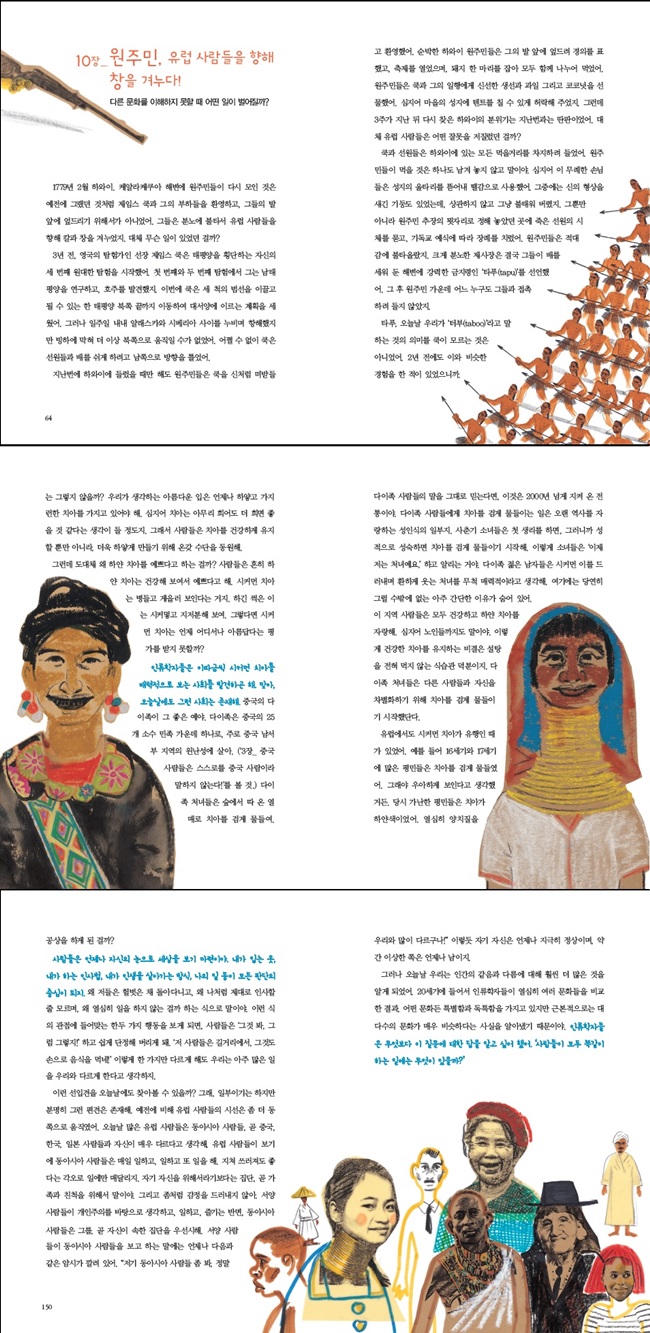
The illustrations, too, are based on facts, without any cultural leaps or historical distortions, and express the core message of each chapter in a witty and symbolic way.
The engaging story of Wolfgang Korn is well-balanced with illustrations that help readers understand unfamiliar cultures and expand their thinking, allowing readers to embark on an exciting cultural journey around the world while reading this book with a light heart.
Why do Japanese people give gifts more than 300 times a year?
Discover the diverse and interesting world cultures that are similar yet different, and different yet similar!
These days, with overseas travel becoming more common, children travel to different parts of the world during school breaks and vacations.
Overseas travel and language training have positive aspects, such as broadening children's horizons and allowing them to experience different cultures. However, they can also lead to ethnocentrism (ethnocentrism) and a devaluation of other cultures.
“Why do those people eat with their hands in such an unsanitary way? Don’t they even have spoons or forks?” But culture changes depending on who’s looking at it.
For people who have always eaten with their hands, spoons and forks are just cumbersome and inconvenient tools.
Rather than forcing readers to think, "This is how you should view culture!", author Wolfgang Korn presents a wealth of examples of diverse yet interesting cultures from around the world, similar yet different, different yet similar, and shows how humanity has gradually evolved from its roots.
And it allows us to understand the social and economic reasons behind the change.
For example, [Chapter 4.
[Chocolate-covered fried grasshoppers] introduces the food culture of people from each country.
It tells the story of why Cambodians roast and eat whole tarantulas, why Venetians enjoy spaghetti with clams caught from heavily polluted lagoons, and why Indians and Mexicans enjoy 'spicy food', helping us understand that these differences in food culture are due to different natural environments and cultural customs.
It also reveals the common eating habits of humanity hidden within seemingly different food cultures, giving us new perspectives on people with different eating habits.
Beyond this, "What's Normal?" is full of captivating stories about world cultures that will keep you glued to your books.
[Chapter 2.
[#234] ...
[Chapter 5.
[Where is North?] tells the story of the Australian Aboriginal people, Guugu Imitir, who find their way through the barren desert without any signs or guideposts, using their absolute sense of direction, showing that there are various senses of direction in the world.
[Chapter 14.
In [British people worry about their intestines when they are not feeling well], it is explained why countries in similar regions such as Germany, France, and the UK have different common illnesses.
It also tells the story of how people have created a new discipline called 'ethnic medicine', which attempts to explain the causes of disease through cultural differences, and through this, they are trying to properly look at each country.
As you follow Wolfgang Korn and gradually encounter world cultures, you will naturally come to understand that no two cultures are the same and that each deserves its own unique respect.
You will also feel that 'cultural diversity', in which people do the same thing differently, is a treasure chest of infinite possibilities for humanity.
Take a fresh look at world culture through thought-provoking paintings!
This book is written so that it can be read anywhere, without being tied to a specific order.
Because culture is something equal that cannot be divided into normal and abnormal, valuable and worthless, it is to tell diverse cultural stories equally and without bias.
The illustrations, too, are based on facts, without any cultural leaps or historical distortions, and express the core message of each chapter in a witty and symbolic way.
The engaging story of Wolfgang Korn is well-balanced with illustrations that help readers understand unfamiliar cultures and expand their thinking, allowing readers to embark on an exciting cultural journey around the world while reading this book with a light heart.
GOODS SPECIFICS
- Date of publication: February 25, 2014
- Page count, weight, size: 160 pages | 344g | 165*225*20mm
- ISBN13: 9788901163000
- ISBN10: 8901163004
You may also like
카테고리
korean


korean

![GQ KOREA Mark (Monthly): December [2025]](http://librairie.coreenne.fr/cdn/shop/files/8ef265dbbfbf186523ed75ba7319009d.jpg?v=1765340328&width=3840)


