

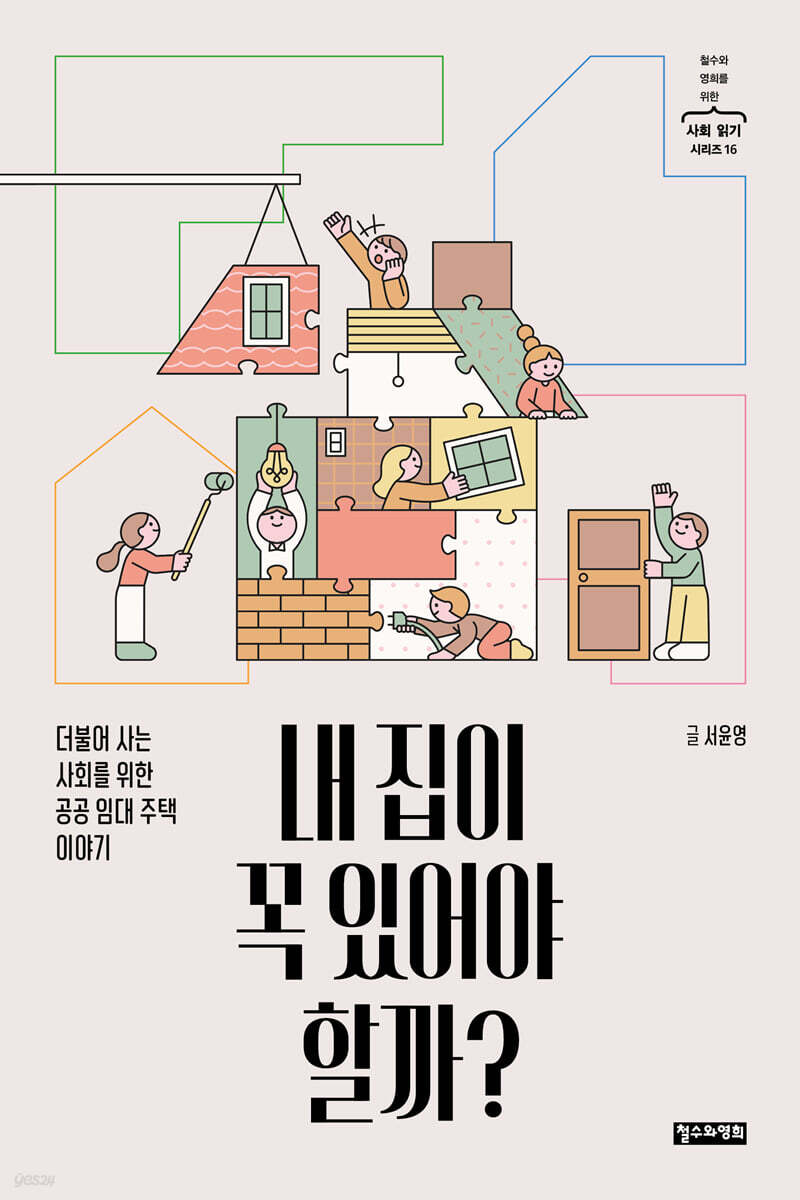
Do I really need to have my own house?
 |
Description
Book Introduction
Why should you know about public housing?
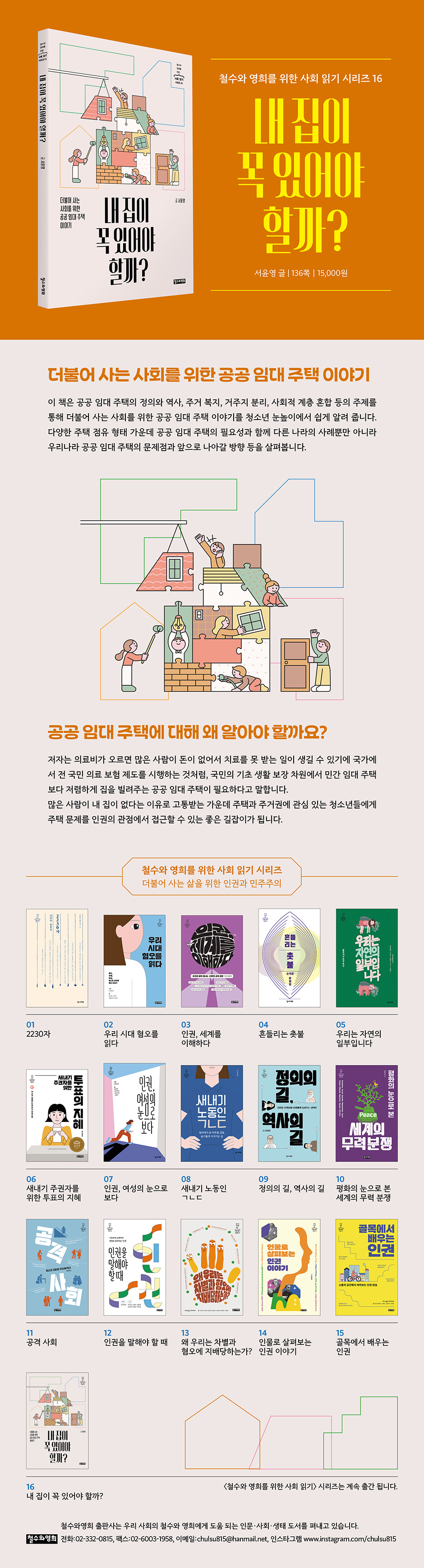
This book provides an easy-to-understand explanation of public rental housing for a society where we live together, from a young person's perspective, through topics such as the definition and history of public rental housing, housing welfare, residential segregation, and social class mixing.
Among the various forms of housing tenure, we will examine the necessity of public rental housing, as well as the problems and future directions of public rental housing in Korea, as well as cases from other countries.
The author argues that, just as the government implements a national health insurance system to protect people from rising medical costs, which could lead to many people not being able to afford treatment, public rental housing that rents out homes at a lower price than private rental housing is needed to ensure the basic livelihood of the people.
Developed European countries have a similar homeownership rate of 55-60% to Korea, but they say that a high proportion of homeless people live in public rental housing, and that they live in high-quality public rental housing while paying affordable rent.
Our country also emphasizes that one of the effective ways to expand housing welfare is to widely supply high-quality public rental housing.
The author points out that countries with high levels of social welfare, especially welfare for the elderly, tend to have lower rates of home ownership, and in fact, countries with good welfare for the elderly, such as Germany, Austria, Belgium, Denmark, the Netherlands, and Sweden, have low rates of home ownership.
However, our country is the opposite, and it is said that we consider housing as a means of securing old age.
To improve the standard of housing welfare in our country, we need to expand the number of affordable public rental housing units, and we need to create a stable society where people can live in their own homes for a long time with low rents without having to spend a lot of money to buy a house.
Furthermore, he emphasizes that while housing is private property, it also has the characteristics of a public good essential for human survival.
He points out that understanding the right to housing as a fundamental right that all citizens should enjoy leads to the conclusion that the state has no choice but to intervene in the housing rental market.
This book serves as a valuable guide for young people interested in housing and housing rights, as many people suffer from homelessness, to approach housing issues from a human rights perspective.
This book provides an easy-to-understand explanation of public rental housing for a society where we live together, from a young person's perspective, through topics such as the definition and history of public rental housing, housing welfare, residential segregation, and social class mixing.
Among the various forms of housing tenure, we will examine the necessity of public rental housing, as well as the problems and future directions of public rental housing in Korea, as well as cases from other countries.
The author argues that, just as the government implements a national health insurance system to protect people from rising medical costs, which could lead to many people not being able to afford treatment, public rental housing that rents out homes at a lower price than private rental housing is needed to ensure the basic livelihood of the people.
Developed European countries have a similar homeownership rate of 55-60% to Korea, but they say that a high proportion of homeless people live in public rental housing, and that they live in high-quality public rental housing while paying affordable rent.
Our country also emphasizes that one of the effective ways to expand housing welfare is to widely supply high-quality public rental housing.
The author points out that countries with high levels of social welfare, especially welfare for the elderly, tend to have lower rates of home ownership, and in fact, countries with good welfare for the elderly, such as Germany, Austria, Belgium, Denmark, the Netherlands, and Sweden, have low rates of home ownership.
However, our country is the opposite, and it is said that we consider housing as a means of securing old age.
To improve the standard of housing welfare in our country, we need to expand the number of affordable public rental housing units, and we need to create a stable society where people can live in their own homes for a long time with low rents without having to spend a lot of money to buy a house.
Furthermore, he emphasizes that while housing is private property, it also has the characteristics of a public good essential for human survival.
He points out that understanding the right to housing as a fundamental right that all citizens should enjoy leads to the conclusion that the state has no choice but to intervene in the housing rental market.
This book serves as a valuable guide for young people interested in housing and housing rights, as many people suffer from homelessness, to approach housing issues from a human rights perspective.
- You can preview some of the book's contents.
Preview
index
Introduction: Why Should You Know About Public Housing?
1.
What is public rental housing?
Types of housing and public rental
Why the country rents out houses
2.
Housing conditions in Europe immediately after World War II
Changes in damage patterns due to the emergence of fighter jets
Workers' Housing Conference held in 19th-century France
The emergence of the large-scale rental housing complex 'Grand Ensemble'
Light and Shadow in French Rental Housing
3.
Housing welfare and public rental housing
Transforming UK Rental Housing Policy
America's housing voucher system
Germans who don't need to buy a house
Cooperative-led rental housing in the Netherlands
Expanding or Contracting? - The Debate Surrounding Public Housing
4.
History of Public Rental Housing in Korea
The first large-scale apartment complex appeared in 1964
The struggle of eviction victims and public rental housing before and after the Olympics
Types and characteristics of public rental housing by period
Advice for qualitative improvement in public rental housing
5.
A History of European Co-op Housing
The deterioration of workers' living conditions since the Industrial Revolution
The ideal community dreamed of by Charles Fourier
Godin's large-scale residential project
Sweden's cooperative housing boasts the world's best
6.
Lessons from the case of residential segregation
“The Palace of Versailles for the common people”
Racial segregation in the Pruitt-Igoe complex in the United States
The problem of housing conflict and social stigma
7.
Social Mix: The Path to Communication and Harmony
People who cannot leave their rental homes
Alternatives for Social Class Mixing
8.
The Old Myth of Homeownership
Owning a home, a lifelong dream
The Correlation Between Elderly Welfare and Homeownership
The tragedy brought about by the unstable real estate market
Stable housing is the starting point for future welfare.
1.
What is public rental housing?
Types of housing and public rental
Why the country rents out houses
2.
Housing conditions in Europe immediately after World War II
Changes in damage patterns due to the emergence of fighter jets
Workers' Housing Conference held in 19th-century France
The emergence of the large-scale rental housing complex 'Grand Ensemble'
Light and Shadow in French Rental Housing
3.
Housing welfare and public rental housing
Transforming UK Rental Housing Policy
America's housing voucher system
Germans who don't need to buy a house
Cooperative-led rental housing in the Netherlands
Expanding or Contracting? - The Debate Surrounding Public Housing
4.
History of Public Rental Housing in Korea
The first large-scale apartment complex appeared in 1964
The struggle of eviction victims and public rental housing before and after the Olympics
Types and characteristics of public rental housing by period
Advice for qualitative improvement in public rental housing
5.
A History of European Co-op Housing
The deterioration of workers' living conditions since the Industrial Revolution
The ideal community dreamed of by Charles Fourier
Godin's large-scale residential project
Sweden's cooperative housing boasts the world's best
6.
Lessons from the case of residential segregation
“The Palace of Versailles for the common people”
Racial segregation in the Pruitt-Igoe complex in the United States
The problem of housing conflict and social stigma
7.
Social Mix: The Path to Communication and Harmony
People who cannot leave their rental homes
Alternatives for Social Class Mixing
8.
The Old Myth of Homeownership
Owning a home, a lifelong dream
The Correlation Between Elderly Welfare and Homeownership
The tragedy brought about by the unstable real estate market
Stable housing is the starting point for future welfare.
Detailed image
Into the book
As medical costs rise, many people may not be able to afford treatment.
So the government is stepping in and implementing a national health insurance system.
Housing should be considered in the same way. Public rental housing is a system that provides housing at a lower cost than private rental housing to ensure the basic livelihood of citizens.
This is also closely related to the people's right to housing.
--- From the text
The home ownership rate in advanced European countries is 55-60%, which is similar to that of Korea.
The rest of the population rents homes, especially public rental housing.
Paying affordable rents and living in quality public housing is a hallmark of European housing welfare.
As our country strives to become a welfare state, we must expand housing welfare, and one effective way to achieve this is to provide a wide range of high-quality public rental housing.
--- From the text
France changed its policy direction from the 1980s to the 1990s.
First, we will build small-scale public rental housing throughout the city center to promote social mix rather than segregation.
In addition, the qualifications for renting were significantly relaxed to improve the perception that residents are poor.
By accepting 80% of the entire population based on income, we made it possible for most of the population except the top 20% to move in.
Public rental housing has become a true national and mass housing that lives up to its name of affordable rental housing.
--- From the text
In 1973, President Nixon announced a temporary moratorium on public housing construction.
Instead, the policy shifted to a housing voucher system starting in 1974.
Low-income people were encouraged to live in private rental housing rather than public rental housing, and the government subsidized part of their rent.
--- From the text
Half of all households in Germany live in private rental housing.
In other words, I live in a privately owned house on a monthly rent basis and do not feel any great inconvenience.
Because, unlike our country, the rental market is stable.
In Germany, the rights of tenants who rent a home are guaranteed.
A representative example is the automatic lease renewal right, which means that the landlord cannot terminate the lease agreement at will unless there is a clear reason, such as the tenant not paying rent or damaging the house.
Secondly, the monthly rent must be stabilized, so the monthly rent cannot be raised by more than a certain percentage each year.
--- From the text
With the advent of neoliberalism, many countries, including the UK and the US, have implemented policies to reduce rental housing.
Europe was also influenced by it.
As a result, public rental housing is pushed to the periphery.
It has become a home for people who are unable to integrate into mainstream society, such as low-income people, people with disabilities, the elderly, and immigrants.
We too must prepare in advance before something like this happens.
--- From the text
Mapo Apartment, built in the 1960s, was the first large-scale apartment complex in Korea.
Although apartment complexes like Jongam and Gaemyeong were built in the 1950s, they were small, consisting of one or three buildings.
However, Mapo Apartment was comprised of 10 buildings and 642 households, making it a large complex at the time.
Not only that, it was also public housing.
--- From the text
In the 19th century, factory owners built company housing, also to secure a stable workforce.
Company housing or dormitories are similar to public rental housing in that they cannot be sold or distributed and residents pay management fees to live there.
Although the supplier was a private company rather than a state or public enterprise, the form was very similar.
--- From the text
Sweden's home ownership rate is 50%, which is low compared to the European average.
Instead, the proportion of people living in cooperative housing is balanced at 16%, the proportion of people living in private rental housing at 17%, and the proportion of people living in public rental housing at 16%.
Citizens receive government housing subsidies based on their income level, regardless of where they live, whether in public, private, or cooperative housing.
--- From the text
Large-scale public housing complexes built on the outskirts of Paris created social segregation.
The rich lived among the rich, and the poor lived among the poor.
No matter how much it was built to imitate the Palace of Versailles, it could not prevent the extreme class division from creating negative social perceptions and further leading to slums.
--- From the text
In our country, problems such as racial residential segregation do not occur.
However, as our country becomes a welfare state, the number of rental houses and the number of foreigners will increase.
If you want to prepare for what will happen 10 or 20 years from now, you need to start preparing now.
--- From the text
The keynote of our country's housing policy, past and present, has been to expand home ownership.
It may seem natural that every citizen should own a home, but this too may be a prejudice.
After all, a house is a place to live, not something you own.
--- From the text
In general, the higher the level of social welfare, especially welfare for the elderly, the lower the rate of home ownership tends to be.
In fact, countries with good elderly welfare systems, such as Germany, Austria, Belgium, Denmark, the Netherlands, and Sweden, have low rates of home ownership.
It's the opposite of our country.
We think of our homes as a means of retirement security.
So somehow I'm trying to buy my own house while I'm young.
The level of welfare for the elderly, including pensions, is extremely low.
--- From the text
To reduce the burden of debt and improve housing welfare, we need to expand affordable public rental housing.
Public rental housing is a shortcut to a stable society where people don't have to spend a lot of money to buy a house, and where they can live in their own home for a long time at a low rent.
So the government is stepping in and implementing a national health insurance system.
Housing should be considered in the same way. Public rental housing is a system that provides housing at a lower cost than private rental housing to ensure the basic livelihood of citizens.
This is also closely related to the people's right to housing.
--- From the text
The home ownership rate in advanced European countries is 55-60%, which is similar to that of Korea.
The rest of the population rents homes, especially public rental housing.
Paying affordable rents and living in quality public housing is a hallmark of European housing welfare.
As our country strives to become a welfare state, we must expand housing welfare, and one effective way to achieve this is to provide a wide range of high-quality public rental housing.
--- From the text
France changed its policy direction from the 1980s to the 1990s.
First, we will build small-scale public rental housing throughout the city center to promote social mix rather than segregation.
In addition, the qualifications for renting were significantly relaxed to improve the perception that residents are poor.
By accepting 80% of the entire population based on income, we made it possible for most of the population except the top 20% to move in.
Public rental housing has become a true national and mass housing that lives up to its name of affordable rental housing.
--- From the text
In 1973, President Nixon announced a temporary moratorium on public housing construction.
Instead, the policy shifted to a housing voucher system starting in 1974.
Low-income people were encouraged to live in private rental housing rather than public rental housing, and the government subsidized part of their rent.
--- From the text
Half of all households in Germany live in private rental housing.
In other words, I live in a privately owned house on a monthly rent basis and do not feel any great inconvenience.
Because, unlike our country, the rental market is stable.
In Germany, the rights of tenants who rent a home are guaranteed.
A representative example is the automatic lease renewal right, which means that the landlord cannot terminate the lease agreement at will unless there is a clear reason, such as the tenant not paying rent or damaging the house.
Secondly, the monthly rent must be stabilized, so the monthly rent cannot be raised by more than a certain percentage each year.
--- From the text
With the advent of neoliberalism, many countries, including the UK and the US, have implemented policies to reduce rental housing.
Europe was also influenced by it.
As a result, public rental housing is pushed to the periphery.
It has become a home for people who are unable to integrate into mainstream society, such as low-income people, people with disabilities, the elderly, and immigrants.
We too must prepare in advance before something like this happens.
--- From the text
Mapo Apartment, built in the 1960s, was the first large-scale apartment complex in Korea.
Although apartment complexes like Jongam and Gaemyeong were built in the 1950s, they were small, consisting of one or three buildings.
However, Mapo Apartment was comprised of 10 buildings and 642 households, making it a large complex at the time.
Not only that, it was also public housing.
--- From the text
In the 19th century, factory owners built company housing, also to secure a stable workforce.
Company housing or dormitories are similar to public rental housing in that they cannot be sold or distributed and residents pay management fees to live there.
Although the supplier was a private company rather than a state or public enterprise, the form was very similar.
--- From the text
Sweden's home ownership rate is 50%, which is low compared to the European average.
Instead, the proportion of people living in cooperative housing is balanced at 16%, the proportion of people living in private rental housing at 17%, and the proportion of people living in public rental housing at 16%.
Citizens receive government housing subsidies based on their income level, regardless of where they live, whether in public, private, or cooperative housing.
--- From the text
Large-scale public housing complexes built on the outskirts of Paris created social segregation.
The rich lived among the rich, and the poor lived among the poor.
No matter how much it was built to imitate the Palace of Versailles, it could not prevent the extreme class division from creating negative social perceptions and further leading to slums.
--- From the text
In our country, problems such as racial residential segregation do not occur.
However, as our country becomes a welfare state, the number of rental houses and the number of foreigners will increase.
If you want to prepare for what will happen 10 or 20 years from now, you need to start preparing now.
--- From the text
The keynote of our country's housing policy, past and present, has been to expand home ownership.
It may seem natural that every citizen should own a home, but this too may be a prejudice.
After all, a house is a place to live, not something you own.
--- From the text
In general, the higher the level of social welfare, especially welfare for the elderly, the lower the rate of home ownership tends to be.
In fact, countries with good elderly welfare systems, such as Germany, Austria, Belgium, Denmark, the Netherlands, and Sweden, have low rates of home ownership.
It's the opposite of our country.
We think of our homes as a means of retirement security.
So somehow I'm trying to buy my own house while I'm young.
The level of welfare for the elderly, including pensions, is extremely low.
--- From the text
To reduce the burden of debt and improve housing welfare, we need to expand affordable public rental housing.
Public rental housing is a shortcut to a stable society where people don't have to spend a lot of money to buy a house, and where they can live in their own home for a long time at a low rent.
--- From the text
GOODS SPECIFICS
- Date of issue: October 6, 2025
- Page count, weight, size: 136 pages | 246g | 140*210*10mm
- ISBN13: 9791171530366
- ISBN10: 1171530366
You may also like
카테고리
korean


korean

![GQ KOREA Mark (Monthly): December [2025]](http://librairie.coreenne.fr/cdn/shop/files/8ef265dbbfbf186523ed75ba7319009d.jpg?v=1765340328&width=3840)


