

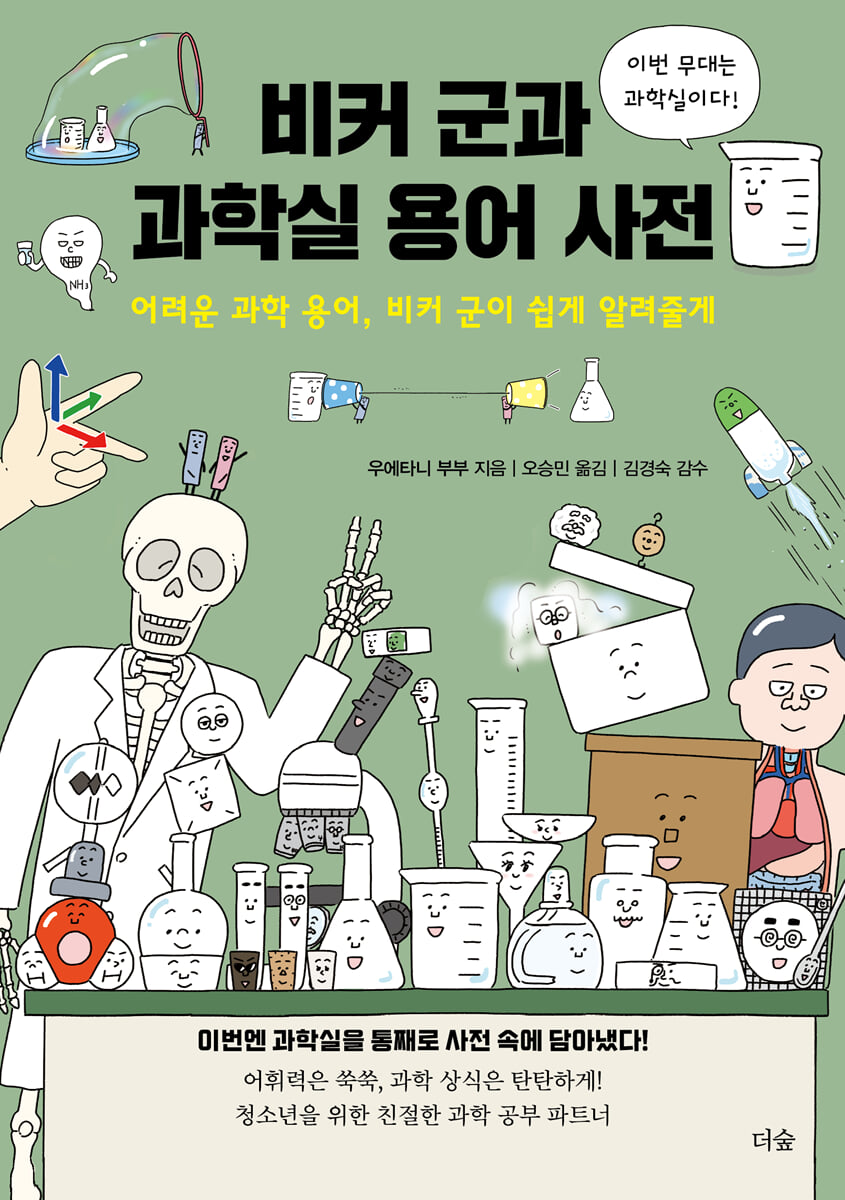
Beaker Group and a Dictionary of Science Lab Terms
 |
Description
Book Introduction
Clever Beaker! This time, he's captured the entire science lab in a dictionary!
Experimental tools, chemicals, units, and even scientific concepts
Those words that confused me every time I was in science class,
With over 400 key terms hidden in the science lab
End science!
The Uetani couple, authors of the "Beaker-kun" series, which has been consistently loved by everyone from teenagers to parents and teachers, have returned with a new book.
This book focuses on the "science lab," the perfect place to study science, and explores over 400 scientific terms found in the lab.
The science lab is a special classroom where you can have hands-on experience through experiments and observations.
However, it can be a difficult space to approach due to unfamiliar experimental tools, human anatomical models, chemicals, etc.
The authors of this book, Mr. and Mrs. Uetani, compiled a dictionary of terms that can be used in a science lab, one by one, in the authors' cheerful and friendly drawing style, in order to make the science lab a more familiar and interesting space.
Experimental tools, chemicals, units, and even scientific concepts
Those words that confused me every time I was in science class,
With over 400 key terms hidden in the science lab
End science!
The Uetani couple, authors of the "Beaker-kun" series, which has been consistently loved by everyone from teenagers to parents and teachers, have returned with a new book.
This book focuses on the "science lab," the perfect place to study science, and explores over 400 scientific terms found in the lab.
The science lab is a special classroom where you can have hands-on experience through experiments and observations.
However, it can be a difficult space to approach due to unfamiliar experimental tools, human anatomical models, chemicals, etc.
The authors of this book, Mr. and Mrs. Uetani, compiled a dictionary of terms that can be used in a science lab, one by one, in the authors' cheerful and friendly drawing style, in order to make the science lab a more familiar and interesting space.
- You can preview some of the book's contents.
Preview
index
preface
Reviewer's note
Dictionary of Science Lab Terms
Conclusion
Acknowledgements
References
Reviewer's note
Dictionary of Science Lab Terms
Conclusion
Acknowledgements
References
Detailed image

Into the book
Science labs are often portrayed as scary places in movies and dramas, but I hope that going to the lab is always an exciting experience for students.
It makes me happy to see students' eyes sparkle more when we're working in the lab than when we're teaching in the classroom, but as exciting as it is, it's also a place where there are always elements of danger, so it's always a tense place for me as a teacher.
I hope that this book will help students become familiar with the science lab.
And furthermore, if you are curious about something and want to know more, I hope that this will be an opportunity to ask questions and read more books to get a little closer to science.
--- From the text “Editor’s Note”
The various units that exist today were originally determined based on natural objects or natural phenomena.
For example, the standard for length is the circumference of the Earth, and the standard for temperature is the temperature at which water freezes or boils.
However, because it changes depending on conditions and detailed measurement is difficult, as science and technology advance, artificial objects that serve as standards began to be created.
As technology advances, standards need to become more stringent.
In the computer world, units of time such as ten-millionths of a second have become necessary.
Even in the field of technology, precision began to be required, such as the distance an object moves over a very short period of time or the extremely small changes in weight.
Then, with a tangible standard like the original energy, even a slight change in temperature or material (such as oxygen combining) causes an error that cannot be ignored.
So we adopted a method based on physical constants (human-defined values).
Most units have been changed to a standard based on physical constants, but the standard for the second has not changed yet.
Throughout human history, changes in the standard of units have occurred in response to great discoveries.
So, if everyone changes, I expect that the way science views matter will change dramatically.
The completion of the Kilogram Wonki's mission was a heart-pounding historical event that led to the great transformation.
--- From the main text, “Column 2: What the End of Won-gi’s Mission Means”
Likewise, science and other academic disciplines also have a growing number of related terms as you progress through high school and college.
Especially when you do research at a university, the scope narrows to your own field of expertise, so you need to understand the terminology in more detail.
For example, in chemical experiments, water with these impurities removed is used because other components (impurities) in the water can interfere with the experiment.
Water from which impurities have been removed is called 'purified water', and there are many types of purified water, including distilled water, deionized water (ion exchange water), ultrapure water, and reverse osmosis water.
(…) The important thing is that the results will vary depending on the type of water used in the experiment, so it is necessary to use them differently.
As elementary and middle school students advance to high school and college, they will encounter countless terms, and I hope they experience the same excitement as I did.
And from there, I hope to further broaden your perspective on the world.
It makes me happy to see students' eyes sparkle more when we're working in the lab than when we're teaching in the classroom, but as exciting as it is, it's also a place where there are always elements of danger, so it's always a tense place for me as a teacher.
I hope that this book will help students become familiar with the science lab.
And furthermore, if you are curious about something and want to know more, I hope that this will be an opportunity to ask questions and read more books to get a little closer to science.
--- From the text “Editor’s Note”
The various units that exist today were originally determined based on natural objects or natural phenomena.
For example, the standard for length is the circumference of the Earth, and the standard for temperature is the temperature at which water freezes or boils.
However, because it changes depending on conditions and detailed measurement is difficult, as science and technology advance, artificial objects that serve as standards began to be created.
As technology advances, standards need to become more stringent.
In the computer world, units of time such as ten-millionths of a second have become necessary.
Even in the field of technology, precision began to be required, such as the distance an object moves over a very short period of time or the extremely small changes in weight.
Then, with a tangible standard like the original energy, even a slight change in temperature or material (such as oxygen combining) causes an error that cannot be ignored.
So we adopted a method based on physical constants (human-defined values).
Most units have been changed to a standard based on physical constants, but the standard for the second has not changed yet.
Throughout human history, changes in the standard of units have occurred in response to great discoveries.
So, if everyone changes, I expect that the way science views matter will change dramatically.
The completion of the Kilogram Wonki's mission was a heart-pounding historical event that led to the great transformation.
--- From the main text, “Column 2: What the End of Won-gi’s Mission Means”
Likewise, science and other academic disciplines also have a growing number of related terms as you progress through high school and college.
Especially when you do research at a university, the scope narrows to your own field of expertise, so you need to understand the terminology in more detail.
For example, in chemical experiments, water with these impurities removed is used because other components (impurities) in the water can interfere with the experiment.
Water from which impurities have been removed is called 'purified water', and there are many types of purified water, including distilled water, deionized water (ion exchange water), ultrapure water, and reverse osmosis water.
(…) The important thing is that the results will vary depending on the type of water used in the experiment, so it is necessary to use them differently.
As elementary and middle school students advance to high school and college, they will encounter countless terms, and I hope they experience the same excitement as I did.
And from there, I hope to further broaden your perspective on the world.
--- From the “Conclusion” of the main text
Publisher's Review
Clever Beaker! This time, he's captured the entire science lab in a dictionary!
Experimental tools, chemicals, units, and even scientific concepts
Those words that confused me every time I was in science class,
With over 400 key terms hidden in the science lab
End science!
The Uetani couple, authors of the "Beaker-kun" series, which has been consistently loved by everyone from teenagers to parents and teachers, have returned with a new book.
This book focuses on the "science lab," the perfect place to study science, and explores over 400 scientific terms found in the lab.
The science lab is a special classroom where you can have hands-on experience through experiments and observations.
However, it can be a difficult space to approach due to unfamiliar experimental tools, human anatomical models, chemicals, etc.
The authors of this book, Mr. and Mrs. Uetani, compiled a dictionary of terms that can be used in a science lab, one by one, in the authors' cheerful and friendly drawing style, in order to make the science lab a more familiar and interesting space.
Knowing the terms makes science easier.
But this book goes beyond simply listing terms.
It carefully organizes concepts and interesting experimental methods that are often encountered but easily confused when studying science so that they can be visually understood.
Each term is linked to other related terms, allowing you to follow the flow of scientific thought naturally.
Additionally, the interesting stories in comic format and witty science columns allow readers to view science from a broader perspective and bring out the true fun of science.
When science labs are fun, science naturally becomes fun.
If you sort through what you know and don't know in the science lab with Beaker Gun and learn its meaning and significance, the science lab will become a treasure island where you can discover new facts and have fun.
Accuracy and professionalism were enhanced through the review of a chemistry teacher with long-term experience in the educational field.
From chemistry, physics, earth science, and life science
When science labs are fun, science becomes fun.
What's in a science lab? Beginning with a diagram that provides a quick overview of the lab, this book meticulously details the preparation and hands-on process for experiments and observations, everything that happens in the lab, and even precautions to take. It covers everything anyone interested in science needs to know, from the lab itself.
In particular, through terminology exploration, there are many interesting experiments that can be done directly in various scientific fields such as chemistry, physics, earth science, and life science, such as making ice cream, ammonia fountain experiments, experiments creating geological layers, and creating clouds.
In relation to various experiments, not only the major scientific theories that appear in textbooks, such as the law of action and reaction, the law of inertia, and the law of conservation of mass, but also the experimental equipment, chemical substances, units, various phenomena that appear during experiments, and even the principles and laws of science are broadly explained with illustrations.
The program captures the real-world spaces where science is encountered at school, including a science preparation room where teachers store and prepare experimental equipment and chemicals, a corner displaying past experimental tools and stuffed animals, a bulletin board with student work and posters, and even a space outside the school where plants are grown for observation, all of which stimulate interest in studying science.
Why 'science lab term'?
The exciting world of science unfolds in the science lab!
Increase your vocabulary and solidify your scientific knowledge!
A friendly science study partner for teenagers
What does the "science lab terminology" mentioned in the title of this book mean? "Science lab terminology" refers to both the terms used in science labs and the terms associated with them.
For elementary and middle school students, science lab terminology goes beyond simple memorization and enables a deeper understanding of experimental processes and scientific concepts.
Terms frequently used in science labs are useful for learning and verifying abstract concepts concretely through experiments.
In addition, since accuracy in experimental procedures and equipment use is important in the science lab, accurately understanding terminology on site helps prevent safety accidents by using experimental tools correctly.
During the experiment, students use scientific terminology to record procedures and analyze results, thereby developing scientific thinking and inquiry skills.
Additionally, you will develop your communication and expressive skills by gaining experience using accurate terminology when presenting or discussing experimental results.
For students interested in science-related careers, such as medicine, life sciences, and chemical engineering, the scientific terminology learned in the laboratory will become the basic language of the field and have a positive impact on their career exploration and preparation process.
This book will be a practical guide and resource for both beginners and learners of science, guiding readers into the exciting world of science that begins in the science lab.
The moment you learn unfamiliar terms, the science lab becomes an exciting place of exploration rather than a boring classroom, broadening not only your understanding of science but also your perspective on the world.
As the reviewer said, this book will provide a spark of new curiosity to anyone who is just beginning to learn.
Experimental tools, chemicals, units, and even scientific concepts
Those words that confused me every time I was in science class,
With over 400 key terms hidden in the science lab
End science!
The Uetani couple, authors of the "Beaker-kun" series, which has been consistently loved by everyone from teenagers to parents and teachers, have returned with a new book.
This book focuses on the "science lab," the perfect place to study science, and explores over 400 scientific terms found in the lab.
The science lab is a special classroom where you can have hands-on experience through experiments and observations.
However, it can be a difficult space to approach due to unfamiliar experimental tools, human anatomical models, chemicals, etc.
The authors of this book, Mr. and Mrs. Uetani, compiled a dictionary of terms that can be used in a science lab, one by one, in the authors' cheerful and friendly drawing style, in order to make the science lab a more familiar and interesting space.
Knowing the terms makes science easier.
But this book goes beyond simply listing terms.
It carefully organizes concepts and interesting experimental methods that are often encountered but easily confused when studying science so that they can be visually understood.
Each term is linked to other related terms, allowing you to follow the flow of scientific thought naturally.
Additionally, the interesting stories in comic format and witty science columns allow readers to view science from a broader perspective and bring out the true fun of science.
When science labs are fun, science naturally becomes fun.
If you sort through what you know and don't know in the science lab with Beaker Gun and learn its meaning and significance, the science lab will become a treasure island where you can discover new facts and have fun.
Accuracy and professionalism were enhanced through the review of a chemistry teacher with long-term experience in the educational field.
From chemistry, physics, earth science, and life science
When science labs are fun, science becomes fun.
What's in a science lab? Beginning with a diagram that provides a quick overview of the lab, this book meticulously details the preparation and hands-on process for experiments and observations, everything that happens in the lab, and even precautions to take. It covers everything anyone interested in science needs to know, from the lab itself.
In particular, through terminology exploration, there are many interesting experiments that can be done directly in various scientific fields such as chemistry, physics, earth science, and life science, such as making ice cream, ammonia fountain experiments, experiments creating geological layers, and creating clouds.
In relation to various experiments, not only the major scientific theories that appear in textbooks, such as the law of action and reaction, the law of inertia, and the law of conservation of mass, but also the experimental equipment, chemical substances, units, various phenomena that appear during experiments, and even the principles and laws of science are broadly explained with illustrations.
The program captures the real-world spaces where science is encountered at school, including a science preparation room where teachers store and prepare experimental equipment and chemicals, a corner displaying past experimental tools and stuffed animals, a bulletin board with student work and posters, and even a space outside the school where plants are grown for observation, all of which stimulate interest in studying science.
Why 'science lab term'?
The exciting world of science unfolds in the science lab!
Increase your vocabulary and solidify your scientific knowledge!
A friendly science study partner for teenagers
What does the "science lab terminology" mentioned in the title of this book mean? "Science lab terminology" refers to both the terms used in science labs and the terms associated with them.
For elementary and middle school students, science lab terminology goes beyond simple memorization and enables a deeper understanding of experimental processes and scientific concepts.
Terms frequently used in science labs are useful for learning and verifying abstract concepts concretely through experiments.
In addition, since accuracy in experimental procedures and equipment use is important in the science lab, accurately understanding terminology on site helps prevent safety accidents by using experimental tools correctly.
During the experiment, students use scientific terminology to record procedures and analyze results, thereby developing scientific thinking and inquiry skills.
Additionally, you will develop your communication and expressive skills by gaining experience using accurate terminology when presenting or discussing experimental results.
For students interested in science-related careers, such as medicine, life sciences, and chemical engineering, the scientific terminology learned in the laboratory will become the basic language of the field and have a positive impact on their career exploration and preparation process.
This book will be a practical guide and resource for both beginners and learners of science, guiding readers into the exciting world of science that begins in the science lab.
The moment you learn unfamiliar terms, the science lab becomes an exciting place of exploration rather than a boring classroom, broadening not only your understanding of science but also your perspective on the world.
As the reviewer said, this book will provide a spark of new curiosity to anyone who is just beginning to learn.
GOODS SPECIFICS
- Date of issue: August 21, 2025
- Page count, weight, size: 210 pages | 360g | 148*210*12mm
- ISBN13: 9791194273219
- ISBN10: 1194273211
You may also like
카테고리
korean


korean

![GQ KOREA Mark (Monthly): December [2025]](http://librairie.coreenne.fr/cdn/shop/files/8ef265dbbfbf186523ed75ba7319009d.jpg?v=1765340328&width=3840)


