

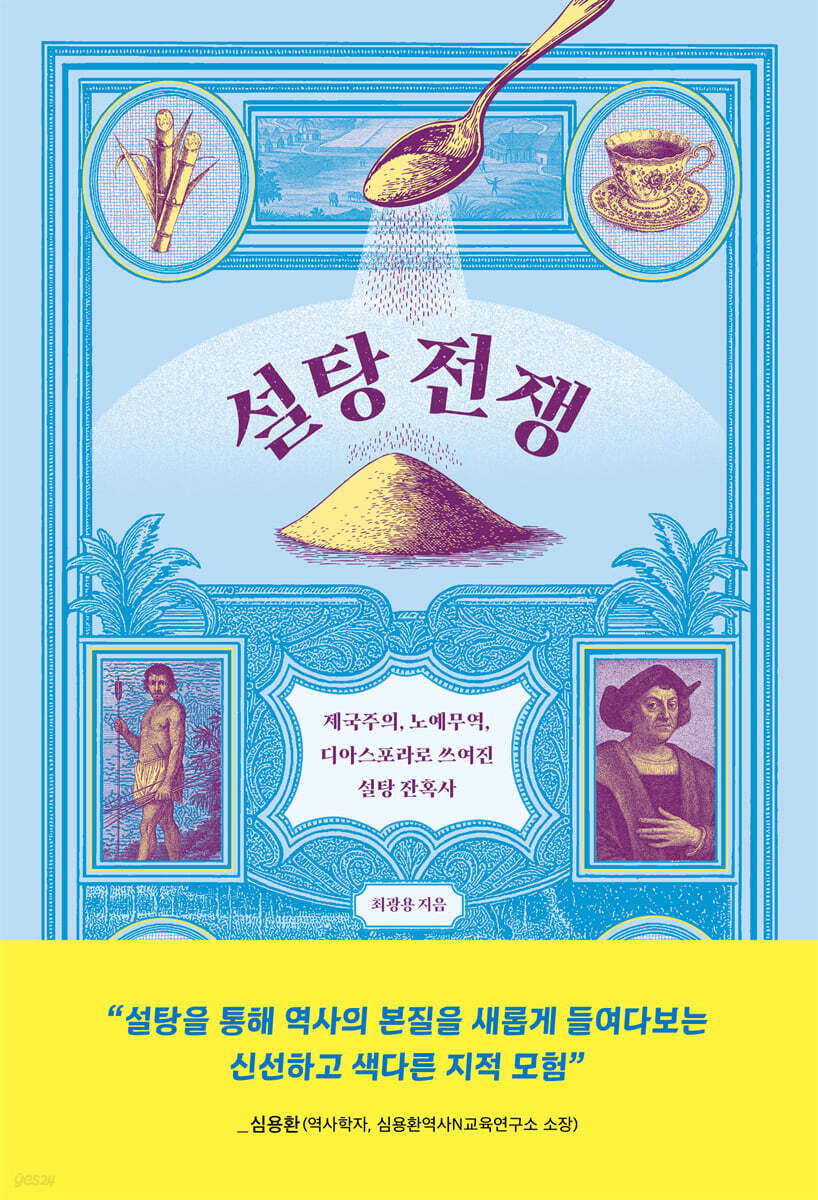
Sugar War
 |
Description
Book Introduction
"A fresh and unique intellectual adventure that delves into the essence of history."
_Sim Yong-hwan (historian)
The rise and fall of empires, adventure and greed
A Panorama of World History Woven by Sugar
Why are we drawn to sweetness? Sweetness comes from glucose, the primary energy source for mammals.
This is why humans have evolved to instinctively prefer sweet tastes.
The craving for sweetness was originally an instinct directly related to human survival.
For thousands of years, humans have been obtaining sweetness from honey and plant sap, and have continuously developed the sugar industry since sugar refining technology was first invented in India around 500 BC.
This sugar stimulated human desires and gave birth to various scenes in world history.
For example, the 'tea culture' that represents Britain today was able to take root in conjunction with the spread of sugar.
Nothing is more suitable than sugar to neutralize the unique astringent and bitter taste of tea leaves. Unlike honey, sugar has almost no aroma, so it adds a soft and sweet taste without harming the unique flavor of the tea.
As tea culture became popular, the demand for sugar also increased rapidly, and the popularization of sugar in turn promoted tea consumption, leading to today.
"Sugar Wars" traces the global spread of sugar, a ubiquitous part of our daily lives, and vividly captures the hidden world of adventure and greed.
The author has developed a historical sensibility and curiosity through his business travels to many countries, including Sri Lanka, Thailand, Angola, Cuba, and Europe, over the past 30 years.
Based on this, I have been reading various books and materials to explore the movement of goods and population, especially the traces of Western imperialism.
The first fruit of this, the previous work 『The Spice Wars』, received a great response for its interesting portrayal of key scenes in world history, such as the birth of the East India Company, the first joint-stock company, focusing on the fierce competition among the great powers over spices.
This sequel, "The Sugar Wars," follows the tumultuous journey of the desire for sugar as it spreads across the globe, intertwined with the expansion of European imperialism.
It also examines the history of indigenous people and black slaves who were brutally sacrificed due to slavery triggered by the sugar industry, revealing the dark shadow of human history cast behind the sweet taste of sugar.
Furthermore, it traces the history of Korean immigration to Hawaii and the diaspora brought about by the sugar industry, and illuminates the intersection of the global history of sugar and our own history.
"The Sugar Wars" is a fascinating educational book that offers a fresh intellectual stimulation by looking at world history through the lens of sugar.
_Sim Yong-hwan (historian)
The rise and fall of empires, adventure and greed
A Panorama of World History Woven by Sugar
Why are we drawn to sweetness? Sweetness comes from glucose, the primary energy source for mammals.
This is why humans have evolved to instinctively prefer sweet tastes.
The craving for sweetness was originally an instinct directly related to human survival.
For thousands of years, humans have been obtaining sweetness from honey and plant sap, and have continuously developed the sugar industry since sugar refining technology was first invented in India around 500 BC.
This sugar stimulated human desires and gave birth to various scenes in world history.
For example, the 'tea culture' that represents Britain today was able to take root in conjunction with the spread of sugar.
Nothing is more suitable than sugar to neutralize the unique astringent and bitter taste of tea leaves. Unlike honey, sugar has almost no aroma, so it adds a soft and sweet taste without harming the unique flavor of the tea.
As tea culture became popular, the demand for sugar also increased rapidly, and the popularization of sugar in turn promoted tea consumption, leading to today.
"Sugar Wars" traces the global spread of sugar, a ubiquitous part of our daily lives, and vividly captures the hidden world of adventure and greed.
The author has developed a historical sensibility and curiosity through his business travels to many countries, including Sri Lanka, Thailand, Angola, Cuba, and Europe, over the past 30 years.
Based on this, I have been reading various books and materials to explore the movement of goods and population, especially the traces of Western imperialism.
The first fruit of this, the previous work 『The Spice Wars』, received a great response for its interesting portrayal of key scenes in world history, such as the birth of the East India Company, the first joint-stock company, focusing on the fierce competition among the great powers over spices.
This sequel, "The Sugar Wars," follows the tumultuous journey of the desire for sugar as it spreads across the globe, intertwined with the expansion of European imperialism.
It also examines the history of indigenous people and black slaves who were brutally sacrificed due to slavery triggered by the sugar industry, revealing the dark shadow of human history cast behind the sweet taste of sugar.
Furthermore, it traces the history of Korean immigration to Hawaii and the diaspora brought about by the sugar industry, and illuminates the intersection of the global history of sugar and our own history.
"The Sugar Wars" is a fascinating educational book that offers a fresh intellectual stimulation by looking at world history through the lens of sugar.
- You can preview some of the book's contents.
Preview
index
Introduction: Sugar that changed world history, following its bittersweet story.
Chapter 1: A Cup of Tea, a Spoonful of Sugar Changed the World
An Empire in a Sri Lankan Teacup | Tea Time in Britain: Beginning with a Portuguese Princess | Sugar Cane Crosses the Atlantic | Columbus and Sugar Cane
Chapter 2: Sweet Temptation Across Civilizations
Islamic Civilization and the Darkness of the West | The Crusades Encounter the "Sweet Reed" | Where Did Sugar Come From in the Beginning?
Chapter 3: Plantations and the Tears of Black Slaves
Plantations, the Heart of the Colonial Economy | Black Africans Dragged to Sugarcane Fields | Britain's Pirate King and Jamaica's Land Heroes | The Miserable Lives of Black Slaves | A Horrifying Record from a Slave Overseer
Chapter 4: A Black Slave Community Built Together Under the Whip
Black Africans Rise from Slaves to Warriors | Black Warriors Who Fought Empire | Two Nations on One Island: The Story of Hispaniola
Chapter 5 The First Black Republic Founded in America
The One-Armed Leader Who Became Immortal | The Haitian Revolution, Began with Voodoo Rituals | Toussaint L'Ouverture and the Birth of the Republic of Haiti | The 'Sweet Root' Chosen by Napoleon
Chapter 6: Brazil, the Land of Sugar and Gold
The Beginning of the Portuguese Colonial Model, Madeira | Pedro Alvarez Cabral and the Unknown Land | The Birth of Brazil, the Sugar Kingdom | The Expansion of Brazil's Colonial Economy and the Barbaric Exploitation of Labor | Bandeira, the Slave Hunter | How the Dutch Stolen Brazil | The Dutch Colonial Governor-General, Called the Brazilian | The Gold Rush that Shook Brazil | Minas Gerais, the Land of Gold
Chapter 7: Cuba, the Island of Sugarcane, Rum, Cigars, and Romance
The Land of the Sugar Bowl | The Smoky Dry Grass That Captivated Columbus | The Cuban Spirit in Cigar Smoke and Rum | The Flavor of Bacardi Rum That Captivated the World | Dreaming of a World Without Discrimination | Cuban Independence, the Fall of Spain, and the Rise of the United States
Chapter 8: America's Ambition Nurtured by Sugarcane Fields
Before the Stars and Stripes, There Was Sugar | The Treaty of Paris and the Birth of the United States | The Mississippi River: The Lifeline of a New Independent Nation | How Louisiana Became the Heart of America's Sugar Industry | Napoleon's Sale of Louisiana and the Beginning of a 'God-given Destiny' | What the Tragedy of America's Cotton Fields Created
Chapter 9: Hawaii, Sugar, and Us
The Sugar Road, Crossing the Pacific to Hawaii | A New Land in America Created by Sugar | How Koreans Came to the Hawaiian Sugarcane Fields | The Beginning of Korean Immigration History | Korean Youths Who Willingly Sacrificed Their Lives for Their Country | The 'Picture Bride' Who Came to Hawaii | From the Island of Sugar Barons to the Island Beloved by the World
Chapter 1: A Cup of Tea, a Spoonful of Sugar Changed the World
An Empire in a Sri Lankan Teacup | Tea Time in Britain: Beginning with a Portuguese Princess | Sugar Cane Crosses the Atlantic | Columbus and Sugar Cane
Chapter 2: Sweet Temptation Across Civilizations
Islamic Civilization and the Darkness of the West | The Crusades Encounter the "Sweet Reed" | Where Did Sugar Come From in the Beginning?
Chapter 3: Plantations and the Tears of Black Slaves
Plantations, the Heart of the Colonial Economy | Black Africans Dragged to Sugarcane Fields | Britain's Pirate King and Jamaica's Land Heroes | The Miserable Lives of Black Slaves | A Horrifying Record from a Slave Overseer
Chapter 4: A Black Slave Community Built Together Under the Whip
Black Africans Rise from Slaves to Warriors | Black Warriors Who Fought Empire | Two Nations on One Island: The Story of Hispaniola
Chapter 5 The First Black Republic Founded in America
The One-Armed Leader Who Became Immortal | The Haitian Revolution, Began with Voodoo Rituals | Toussaint L'Ouverture and the Birth of the Republic of Haiti | The 'Sweet Root' Chosen by Napoleon
Chapter 6: Brazil, the Land of Sugar and Gold
The Beginning of the Portuguese Colonial Model, Madeira | Pedro Alvarez Cabral and the Unknown Land | The Birth of Brazil, the Sugar Kingdom | The Expansion of Brazil's Colonial Economy and the Barbaric Exploitation of Labor | Bandeira, the Slave Hunter | How the Dutch Stolen Brazil | The Dutch Colonial Governor-General, Called the Brazilian | The Gold Rush that Shook Brazil | Minas Gerais, the Land of Gold
Chapter 7: Cuba, the Island of Sugarcane, Rum, Cigars, and Romance
The Land of the Sugar Bowl | The Smoky Dry Grass That Captivated Columbus | The Cuban Spirit in Cigar Smoke and Rum | The Flavor of Bacardi Rum That Captivated the World | Dreaming of a World Without Discrimination | Cuban Independence, the Fall of Spain, and the Rise of the United States
Chapter 8: America's Ambition Nurtured by Sugarcane Fields
Before the Stars and Stripes, There Was Sugar | The Treaty of Paris and the Birth of the United States | The Mississippi River: The Lifeline of a New Independent Nation | How Louisiana Became the Heart of America's Sugar Industry | Napoleon's Sale of Louisiana and the Beginning of a 'God-given Destiny' | What the Tragedy of America's Cotton Fields Created
Chapter 9: Hawaii, Sugar, and Us
The Sugar Road, Crossing the Pacific to Hawaii | A New Land in America Created by Sugar | How Koreans Came to the Hawaiian Sugarcane Fields | The Beginning of Korean Immigration History | Korean Youths Who Willingly Sacrificed Their Lives for Their Country | The 'Picture Bride' Who Came to Hawaii | From the Island of Sugar Barons to the Island Beloved by the World
Detailed image

Into the book
“Do you know what that drink the princess is drinking? She’s been drinking that all day long.”
“It’s called ‘chai’ and ‘chaa’.
“They say it comes from somewhere in the East, but I’m not sure if it’s ‘India’ or ‘China’.”
“China? Where is that?”
“First of all, that cup and teapot are truly works of art.
Yesterday it was pure white, but today it has a beautiful floral pattern on it.
“It’s a beautiful pattern I’ve never seen before.”
“What on earth does that ‘chai’ taste like?” (omitted)
Who could have imagined that the drink so enthralled by the ladies of Portsmouth would later become known as "tea," a cornerstone of British culture, a key to establishing Britain as an empire on which the sun never sets? They could never have imagined that the sugar in their tea would be imbued with the pain and "ethnic migration" of Africans, Chinese, Indians, and, later, Japanese and Koreans.
Most Africans living in the Americas today are descendants of slaves who were sold to work in the sugarcane fields run by the British, French, Portuguese, and Dutch.
--- p.21~22
The English words 'sugar' and 'candy' also trace their origins back to ancient India.
In ancient Sanskrit, sugar was called sharkara.
Sharkara originally meant gravel or sand, but it was given this name because the sugar, which was refined by boiling sugarcane juice, resembled grains of sand.
Sharkara was transmitted to Persia and became the Persian word shaker, and in Islam it became the Arabic word sukkar, which influenced the creation of the English word 'sugar'.
Also, 'sugar piece' was called 'khanda' in Sanskrit, from which the English word 'candy' was derived.
Sugar is truly an 'invention' of ancient Indians.
--- p.44~45
Watching Jamaican athletes like Usain Bolt, Elaine Thompson and Serika Jackson, who are today's world-class sprinters, I often think of their ancestors who toiled in the sugarcane fields.
Who is the 'real hero' between Francis Drake, the British pirate who sailed the seas under the pirate flag, and the Jamaican track and field athletes who raced on two legs?
--- p.58~59
Local administrators devised a way to 'legally' enslave the inland natives: they deliberately provoked them into conflict and then subdued them by force.
At that time, there was a long-standing tradition in indigenous societies that 'the victor in battle could take the defeated as a prisoner and use them.'
Portugal took advantage of this very point by intentionally engaging in battles with the natives, taking the defeated natives as prisoners, and then enslaving them.
In addition, the exploitation of indigenous people was carried out in despicable and barbaric ways, such as secretly kidnapping them and selling them to mines or farms, or offering them high loans and then turning them into slaves if they failed to repay.
--- p.127
During a period when plantation and gold mining developments overlapped and labor shortages worsened, the profession of "slave hunter" emerged in Brazil.
They organized themselves into teams to hunt the natives, and these hunting expeditions or slave hunting expeditions were called 'bandeira'.
Bandeira means 'flag' in Portuguese, and the name comes from the flags that slave hunters carried.
(syncopation)
Unlike the Jesuit missionaries who were friendly to the natives, viewing them as objects of proselytization and enlightenment, the plantation owners and miners constantly kidnapped and enslaved the natives of the inland villages established by the Jesuit missionaries through the bandeira.
The missionaries, of course, tried to stop their atrocities, and eventually Bandeira and the missionaries became hostile to each other, clashing wherever they encountered each other.
--- p.128~130
Although a million black African slaves were once brought into Cuba through the slave trade, they did not become the "owners" of Cuba.
According to the most recent data from 2012, Cuba's racial distribution is 64.2 percent white, 26.6 percent mestizo (mixed European and Native American descent) and mulatto (mixed European and African descent), 9.2 percent black, and less than 1 percent Asian.
Unlike Haiti and Jamaica, Cuba is a predominantly white and mixed-race society.
(Omitted) I experienced this fact anew when I attended the Cuban Expo in 1998 on business and observed the crowds of people flocking in like clouds.
There were few black people with dark skin, and most had faces that looked mixed or white.
Among them, meeting two Korean girls who visited the Korean booth remains a special memory for me.
The girls were descendants of Korean women and local men who immigrated through Mexico to work in Cuba's sugarcane fields in the early 20th century.
--- p.156~157
Rum is a liquor made from sugarcane juice, and it began to be produced naturally on large-scale sugarcane plantations in the Caribbean.
African slaves working on the plantation secretly made alcohol from sugarcane juice and drank it to forget the pain of reality.
The fact that alcohol could be produced from grains and fruits was a long-held knowledge shared by mankind, and black slaves were also well aware of this.
(Omitted) There are famous liquors all over the world that reflect the local specialties, culture, and tastes of the local people.
China is famous for its white liquor made from grains such as sorghum, France is famous for its wine and brandy made from grapes, and there are also traditional Turkish liquor called Laki, also made from grapes, Mexican tequila made from agave, and Russian vodka, which is made by fermenting and distilling wheat, barley, rye, etc.
Of course, Korea also has soju, cheongju, and makgeolli.
Just as rum was born on the sugarcane plantations of Cuba, perhaps liquors from around the world were also created from the deep hardships and tears of life.
--- p.166~167
The ports along the eastern coast of North America were already bustling with trading ships as early as the 1720s, before the United States gained independence.
At that time, British, French, and Spanish colonies in the Caribbean were enjoying enormous wealth by growing sugarcane, producing molasses and sugar, and selling them to Europe.
In particular, Barbados, Jamaica (British), and Saint-Domingue (French), which were the main sources of income for the home country, sold sugar to the nearby east coast of North America and also received necessary goods from North America. Half of the ships entering and leaving New York Harbor were trading ships from the Caribbean.
The largest buildings erected in New York at this time were Trinity Church, still a famous tourist attraction, and the equally large sugar warehouse built on the corner of the Hudson River.
--- p.187~188
As explained above, the assistance of Cuban technicians and exquisite business timing played a crucial role in Borre's success in the sugar business, but it is said that Antoine Morin, a free black man from Saint-Domingue, also provided him with great help.
It is not certain whether he was born a slave or free, but he was a chemist and botanist who graduated from a famous university in Paris and gained fame in New Orleans.
Morin was instrumental in developing sugar crystallization technology when Borre transitioned from indigo farming to sugarcane farming, a technological innovation that enabled Borre to successfully produce fine white sugar.
However, Charles Gayarre, a Louisiana historian and grandson of Borret, deliberately omitted Morin's achievements in his book on the Borret family's history in the sugar industry.
--- p.200~201
The assassination of Stevens by Jang In-hwan and Jeon Myeong-un was a decisive turning point in the Korean-American independence movement.
This incident led to the unification of about ten Korean independence movement groups scattered throughout the United States, which led to the founding of the Korean National Association, which became the core organization of the American independence movement.
Jang In-hwan was born in 1876 and was 32 years old at the time, and Jeon Myeong-un was born in 1884 and was only 24 years old.
Both men were immigrant workers who came to the United States from the Hawaiian sugarcane plantations to San Francisco. Jang In-hwan came to the United States in 1904, and Jeon Myeong-un came to the United States in 1903.
The two young men, who were making a living as railroad workers and fishermen in San Francisco, took up the cause with a burning desire for their country's independence.
“It’s called ‘chai’ and ‘chaa’.
“They say it comes from somewhere in the East, but I’m not sure if it’s ‘India’ or ‘China’.”
“China? Where is that?”
“First of all, that cup and teapot are truly works of art.
Yesterday it was pure white, but today it has a beautiful floral pattern on it.
“It’s a beautiful pattern I’ve never seen before.”
“What on earth does that ‘chai’ taste like?” (omitted)
Who could have imagined that the drink so enthralled by the ladies of Portsmouth would later become known as "tea," a cornerstone of British culture, a key to establishing Britain as an empire on which the sun never sets? They could never have imagined that the sugar in their tea would be imbued with the pain and "ethnic migration" of Africans, Chinese, Indians, and, later, Japanese and Koreans.
Most Africans living in the Americas today are descendants of slaves who were sold to work in the sugarcane fields run by the British, French, Portuguese, and Dutch.
--- p.21~22
The English words 'sugar' and 'candy' also trace their origins back to ancient India.
In ancient Sanskrit, sugar was called sharkara.
Sharkara originally meant gravel or sand, but it was given this name because the sugar, which was refined by boiling sugarcane juice, resembled grains of sand.
Sharkara was transmitted to Persia and became the Persian word shaker, and in Islam it became the Arabic word sukkar, which influenced the creation of the English word 'sugar'.
Also, 'sugar piece' was called 'khanda' in Sanskrit, from which the English word 'candy' was derived.
Sugar is truly an 'invention' of ancient Indians.
--- p.44~45
Watching Jamaican athletes like Usain Bolt, Elaine Thompson and Serika Jackson, who are today's world-class sprinters, I often think of their ancestors who toiled in the sugarcane fields.
Who is the 'real hero' between Francis Drake, the British pirate who sailed the seas under the pirate flag, and the Jamaican track and field athletes who raced on two legs?
--- p.58~59
Local administrators devised a way to 'legally' enslave the inland natives: they deliberately provoked them into conflict and then subdued them by force.
At that time, there was a long-standing tradition in indigenous societies that 'the victor in battle could take the defeated as a prisoner and use them.'
Portugal took advantage of this very point by intentionally engaging in battles with the natives, taking the defeated natives as prisoners, and then enslaving them.
In addition, the exploitation of indigenous people was carried out in despicable and barbaric ways, such as secretly kidnapping them and selling them to mines or farms, or offering them high loans and then turning them into slaves if they failed to repay.
--- p.127
During a period when plantation and gold mining developments overlapped and labor shortages worsened, the profession of "slave hunter" emerged in Brazil.
They organized themselves into teams to hunt the natives, and these hunting expeditions or slave hunting expeditions were called 'bandeira'.
Bandeira means 'flag' in Portuguese, and the name comes from the flags that slave hunters carried.
(syncopation)
Unlike the Jesuit missionaries who were friendly to the natives, viewing them as objects of proselytization and enlightenment, the plantation owners and miners constantly kidnapped and enslaved the natives of the inland villages established by the Jesuit missionaries through the bandeira.
The missionaries, of course, tried to stop their atrocities, and eventually Bandeira and the missionaries became hostile to each other, clashing wherever they encountered each other.
--- p.128~130
Although a million black African slaves were once brought into Cuba through the slave trade, they did not become the "owners" of Cuba.
According to the most recent data from 2012, Cuba's racial distribution is 64.2 percent white, 26.6 percent mestizo (mixed European and Native American descent) and mulatto (mixed European and African descent), 9.2 percent black, and less than 1 percent Asian.
Unlike Haiti and Jamaica, Cuba is a predominantly white and mixed-race society.
(Omitted) I experienced this fact anew when I attended the Cuban Expo in 1998 on business and observed the crowds of people flocking in like clouds.
There were few black people with dark skin, and most had faces that looked mixed or white.
Among them, meeting two Korean girls who visited the Korean booth remains a special memory for me.
The girls were descendants of Korean women and local men who immigrated through Mexico to work in Cuba's sugarcane fields in the early 20th century.
--- p.156~157
Rum is a liquor made from sugarcane juice, and it began to be produced naturally on large-scale sugarcane plantations in the Caribbean.
African slaves working on the plantation secretly made alcohol from sugarcane juice and drank it to forget the pain of reality.
The fact that alcohol could be produced from grains and fruits was a long-held knowledge shared by mankind, and black slaves were also well aware of this.
(Omitted) There are famous liquors all over the world that reflect the local specialties, culture, and tastes of the local people.
China is famous for its white liquor made from grains such as sorghum, France is famous for its wine and brandy made from grapes, and there are also traditional Turkish liquor called Laki, also made from grapes, Mexican tequila made from agave, and Russian vodka, which is made by fermenting and distilling wheat, barley, rye, etc.
Of course, Korea also has soju, cheongju, and makgeolli.
Just as rum was born on the sugarcane plantations of Cuba, perhaps liquors from around the world were also created from the deep hardships and tears of life.
--- p.166~167
The ports along the eastern coast of North America were already bustling with trading ships as early as the 1720s, before the United States gained independence.
At that time, British, French, and Spanish colonies in the Caribbean were enjoying enormous wealth by growing sugarcane, producing molasses and sugar, and selling them to Europe.
In particular, Barbados, Jamaica (British), and Saint-Domingue (French), which were the main sources of income for the home country, sold sugar to the nearby east coast of North America and also received necessary goods from North America. Half of the ships entering and leaving New York Harbor were trading ships from the Caribbean.
The largest buildings erected in New York at this time were Trinity Church, still a famous tourist attraction, and the equally large sugar warehouse built on the corner of the Hudson River.
--- p.187~188
As explained above, the assistance of Cuban technicians and exquisite business timing played a crucial role in Borre's success in the sugar business, but it is said that Antoine Morin, a free black man from Saint-Domingue, also provided him with great help.
It is not certain whether he was born a slave or free, but he was a chemist and botanist who graduated from a famous university in Paris and gained fame in New Orleans.
Morin was instrumental in developing sugar crystallization technology when Borre transitioned from indigo farming to sugarcane farming, a technological innovation that enabled Borre to successfully produce fine white sugar.
However, Charles Gayarre, a Louisiana historian and grandson of Borret, deliberately omitted Morin's achievements in his book on the Borret family's history in the sugar industry.
--- p.200~201
The assassination of Stevens by Jang In-hwan and Jeon Myeong-un was a decisive turning point in the Korean-American independence movement.
This incident led to the unification of about ten Korean independence movement groups scattered throughout the United States, which led to the founding of the Korean National Association, which became the core organization of the American independence movement.
Jang In-hwan was born in 1876 and was 32 years old at the time, and Jeon Myeong-un was born in 1884 and was only 24 years old.
Both men were immigrant workers who came to the United States from the Hawaiian sugarcane plantations to San Francisco. Jang In-hwan came to the United States in 1904, and Jeon Myeong-un came to the United States in 1903.
The two young men, who were making a living as railroad workers and fishermen in San Francisco, took up the cause with a burning desire for their country's independence.
--- p.236
Publisher's Review
The sweet temptation of sugar that fueled imperialism
During the Age of Exploration, which began in the late 15th century, European powers, including Portugal, Spain, England, France, and the Netherlands, competed to expand their influence across the Atlantic Ocean to the Americas, Africa, and Asia.
Historical adventurers like Christopher Columbus and Vasco da Gama also appeared around the same time.
Their life-threatening voyage is often portrayed in later generations as a romantic adventure, but in reality, it was not something that could be undertaken simply out of a sense of adventure or heroism.
At the time, long-distance navigation was impossible without the full support of the state, so the great voyages led and sponsored by the great powers had a clear purpose: conquering the New World and exploiting its resources.
The Sugar Wars interestingly reveals that at the heart of it all was the desire for sugar.
Sugarcane was a crop that could only be grown in hot and humid tropical climates, so production was impossible in Europe.
Accordingly, several European countries established colonies and large-scale plantations in places with climates suitable for sugarcane cultivation, such as the African coast, Caribbean islands, and the American continent.
For example, Portugal made Madeira and Brazil the bases of its sugar industry, Spain the Canary Islands, France the island of Hispaniola, and Britain the bases of Jamaica and Barbados.
Based on plantations in the colonies, the sugar industry grew by leaps and bounds, and by the 19th century, 90 percent of Europe's sugar demand was met by Caribbean islands. (p. 23) The New World gradually transformed into a "sugar base" that satisfied Europeans' desire for sugar.
"The Sugar Wars" organically links the colonization process of Hispaniola, Jamaica, and Brazil to the history of the sugar industry, and specifically reveals the scars of colonial exploitation by European powers.
Europeans not only threatened the natives and made them practically slaves on their plantations, but also ruthlessly destroyed their own history and culture under the pretext of exploring the interior.
In addition, the natives had no immunity to the pathogens introduced from Europe, so they had no choice but to die helplessly.
Traces of this tragedy can also be seen in the demographic makeup of modern Brazil.
Today, Brazil has a population of whites and mixed race people, each making up more than 40 percent of the total population, while indigenous people make up less than 1 percent.
A few hundred years ago, Brazil was home to an indigenous population comparable to that of mainland Portugal, but now little remains of them.
The greed of the great powers for sugar has even changed the demographic composition of a country.
Meanwhile, Brazil was also a stage for fierce competition among major powers to take over sugar production areas.
The Netherlands, a latecomer to the Age of Exploration, secured maritime hegemony through the spice trade and then attempted to drive out the Portuguese from the Pernambuco region in northern Brazil and establish rule there for a time.
Johan Maurice, who took office as governor during this period, highly valued Brazil's potential and focused on developing the capital, Recife. The infrastructure built at the time was so advanced that it surprised even the Netherlands.
Even today, traces of the urban planning created by Johann Maurice remain in Recife.
Brazil, the only Portuguese-speaking country in South America, yet with traces of Dutch colonial rule still visible throughout the country, is a vivid example of imperial greed and colonial exploitation surrounding sugar.
The worst atrocity in human history, perpetrated in a sugarcane field.
The development of sugarcane plantations and the sugar industry in the colonies led to a large influx of black Africans.
From growing and harvesting sugarcane to boiling and refining the sugarcane juice to turning it into sugar, the entire process requires a huge amount of labor.
Initially, they tried to mobilize the indigenous people to meet this demand, but this soon reached its limits, and Europeans turned their attention to the African continent.
Afterwards, the slave trade began to flourish to provide the labor needed for the sugar industry.
The exploitation of black slaves in the sugar industry was one of the most horrific acts of violence committed by human beings against human beings.
It is estimated that approximately 12.5 million black Africans crossed the Atlantic Ocean on slave ships between 1519 and 1867.
Many of them died during the voyage from disease, starvation, and abuse, and about 10.7 million people ultimately arrived in the Caribbean and the Americas.
There has never been a forced migration on a greater scale in human history. (p. 55) These slaves were subjected to extreme abuse by white plantation owners and overseers, and the extent of the cruelty is evident in the account left by Thomas Thistlewood, a slave overseer on a plantation in Jamaica.
Records of a slave having his ear cut off and being whipped dozens of times for inviting a fellow slave over for a meal, or of another slave being forced to defecate in the mouth of a slave caught secretly eating sugar cane, reveal the extent of the cruelty. (p. 67) 『Sugar Wars』 vividly shows a cross-section of the brutal abuse of black slaves that was prevalent throughout Western society at the time, including Thistlewood's account, and makes us deeply reflect on a history that humanity must never repeat.
Meanwhile, the constant exploitation and violence on the plantations inflamed the anger of black slaves, and sparks of resistance ignited throughout the Caribbean islands.
Among them, Haitian independence is a very unique and important scene in the history of slave liberation.
Haiti, a region known as 'Saint-Domingue' during the French colonial period, was once the world's largest sugar producer.
The slaves here, unable to endure the harsh labor, ran away, formed a community called the 'Maroons', and fought a war of independence against the colonial authorities for about 13 years.
However, Toussaint L'Ouverture, the leader of the black people during this period, receives an offer of alliance from Spain while fighting fiercely against the French army.
Spain intended to use Toussaint's resistance to drive the French from the island and take over Saint-Domingue, then a key base for the sugar industry.
However, the French revolutionary commissioner, Sontona, who judged that this would turn the tide of the war, suddenly declared the emancipation of the slaves.
The situation changed abruptly, and the suddenly liberated black resistance found itself at a critical juncture.
They had to decide whether to believe the French declaration of liberation or to continue the union with Spain as promised.
At a crossroads, Toussaint and the black resistance fighters joined hands with the French army, which had long exploited them.
As a result, not only Spain but also the British, who joined the war late, were driven out of the island of Hispaniola, and the Republic of Haiti, the world's first independent black slave state, was born.
In this way, Haitian independence was the result of several historical contradictions: the exploitation of black slaves and resistance against it, the greed of the great powers surrounding sugar production areas, the strategic emancipation of slaves in Songtona, and the choice of black resistance forces to ally with the white French who had oppressed them.
Beyond the case of Haiti, "The Sugar War" tells a variety of stories about how the fate of black slaves in other sugar-producing regions was influenced by the interests of European powers, making us reflect on how much blood and tears the desire for sugar brought about.
Our Footsteps Engraved on the 'World History of Sugar'
The sugar industry was one of the main drivers of mass population migration and diaspora.
The migration of black slaves to Jamaica, which was a major sugar producing area along with Saint-Domingue, clearly demonstrates this.
In Jamaica, two Maroon Wars against British colonial authorities took place, during which about 600 black people were forcibly relocated by the British to Nova Scotia in North America.
For black people who had lived in tropical climates their entire lives, the winters in Nova Scotia were so harsh that many of them eventually lost their lives there.
Those who barely survived petitioned to be sent back to Africa, their 'ancestral land', and were relocated to Sierra Leone in West Africa.
The irony is that some of those who moved to Sierra Leone then ended up in Jamaica again as contract workers.
Their descendants settled in Jamaica and have continued to live there to this day.
The arduous journey of Jamaican black slaves, forced by Britain to migrate from Africa to the Caribbean, North America, and back to the Caribbean, vividly reveals the tragic side of the diaspora brought about by the sugar industry.
Hawaii, which emerged as another major stage for the sugar industry under American influence in the early to mid-20th century, was the site of the first official Korean immigration, and is not only a site of the sugar-driven diaspora but also deeply connected to our history.
Beginning in the late 19th century, large-scale sugarcane plantations began to be established in Hawaii. The plantation owners, most of whom were white Americans, turned to Asia in search of cheap labor after the abolition of slavery, as they could no longer employ black slaves.
Afterwards, following Japan and China, Korea also began accepting labor immigrants, and in 1902, with the permission of Emperor Gojong, Korean immigration to Hawaii began.
Immigrants, like black slaves, had to endure inhumane working conditions and discriminatory treatment on plantations.
Some immigrants who could not endure this returned to their homeland, but most survived tenaciously and gradually became rooted in Hawaiian society.
The 'photo marriage' system that emerged during this process is very interesting.
Photo marriage is a marriage practiced among Koreans in Hawaii from 1910 to 1924.
A Korean man in Hawaii would send his photo to a Korean woman through a matchmaker, and if the woman liked the man in the photo, she would send her own photo to Hawaii, and the marriage would be arranged.
As the picture marriage system allowed Korean women to legally come to Hawaii as "picture brides," Koreans gradually began to settle in Hawaii in family units, and later, from these families, they also immigrated to farms in Mexico and Cuba.
The lives of Koreans who settled in Hawaii were no easier than those of their homeland, which had been taken away.
However, even in these harsh conditions, Koreans in Hawaii formed a community, supported each other, and willingly contributed some of the money they earned through sweat and tears to the independence movement.
Korean immigrants to the Americas, who suffered hardships no less than those of colonial Koreans in a distant land, were passionate independence activists who carried on the cause of national salvation.
Jang In-hwan and Jeon Myeong-un, who are well known for the 'Stevens sniper incident', were also young men who worked as sugarcane workers in Hawaii before moving to San Francisco and working for Korean independence.
The two men announced the Korean people's will for independence to the world by assassinating pro-Japanese diplomat Stevens in 1908.
This incident had a great impact on the Korean-American community as well as on independence movement groups scattered throughout the country and abroad, and later became a trigger for the anti-Japanese movement.
The first Korean immigration to Hawaii and the subsequent history of Koreans in the Americas are important intersections where the global history of sugar and the history of the Korean people, past and present, meet.
"Sugar Wars" serves as a poignant reminder that the lives of Korean immigrants in Hawaii, cultivated on sugarcane farms, were a clear mark left by our own efforts amidst the maelstrom of world history swept by imperialism and colonial exploitation.
During the Age of Exploration, which began in the late 15th century, European powers, including Portugal, Spain, England, France, and the Netherlands, competed to expand their influence across the Atlantic Ocean to the Americas, Africa, and Asia.
Historical adventurers like Christopher Columbus and Vasco da Gama also appeared around the same time.
Their life-threatening voyage is often portrayed in later generations as a romantic adventure, but in reality, it was not something that could be undertaken simply out of a sense of adventure or heroism.
At the time, long-distance navigation was impossible without the full support of the state, so the great voyages led and sponsored by the great powers had a clear purpose: conquering the New World and exploiting its resources.
The Sugar Wars interestingly reveals that at the heart of it all was the desire for sugar.
Sugarcane was a crop that could only be grown in hot and humid tropical climates, so production was impossible in Europe.
Accordingly, several European countries established colonies and large-scale plantations in places with climates suitable for sugarcane cultivation, such as the African coast, Caribbean islands, and the American continent.
For example, Portugal made Madeira and Brazil the bases of its sugar industry, Spain the Canary Islands, France the island of Hispaniola, and Britain the bases of Jamaica and Barbados.
Based on plantations in the colonies, the sugar industry grew by leaps and bounds, and by the 19th century, 90 percent of Europe's sugar demand was met by Caribbean islands. (p. 23) The New World gradually transformed into a "sugar base" that satisfied Europeans' desire for sugar.
"The Sugar Wars" organically links the colonization process of Hispaniola, Jamaica, and Brazil to the history of the sugar industry, and specifically reveals the scars of colonial exploitation by European powers.
Europeans not only threatened the natives and made them practically slaves on their plantations, but also ruthlessly destroyed their own history and culture under the pretext of exploring the interior.
In addition, the natives had no immunity to the pathogens introduced from Europe, so they had no choice but to die helplessly.
Traces of this tragedy can also be seen in the demographic makeup of modern Brazil.
Today, Brazil has a population of whites and mixed race people, each making up more than 40 percent of the total population, while indigenous people make up less than 1 percent.
A few hundred years ago, Brazil was home to an indigenous population comparable to that of mainland Portugal, but now little remains of them.
The greed of the great powers for sugar has even changed the demographic composition of a country.
Meanwhile, Brazil was also a stage for fierce competition among major powers to take over sugar production areas.
The Netherlands, a latecomer to the Age of Exploration, secured maritime hegemony through the spice trade and then attempted to drive out the Portuguese from the Pernambuco region in northern Brazil and establish rule there for a time.
Johan Maurice, who took office as governor during this period, highly valued Brazil's potential and focused on developing the capital, Recife. The infrastructure built at the time was so advanced that it surprised even the Netherlands.
Even today, traces of the urban planning created by Johann Maurice remain in Recife.
Brazil, the only Portuguese-speaking country in South America, yet with traces of Dutch colonial rule still visible throughout the country, is a vivid example of imperial greed and colonial exploitation surrounding sugar.
The worst atrocity in human history, perpetrated in a sugarcane field.
The development of sugarcane plantations and the sugar industry in the colonies led to a large influx of black Africans.
From growing and harvesting sugarcane to boiling and refining the sugarcane juice to turning it into sugar, the entire process requires a huge amount of labor.
Initially, they tried to mobilize the indigenous people to meet this demand, but this soon reached its limits, and Europeans turned their attention to the African continent.
Afterwards, the slave trade began to flourish to provide the labor needed for the sugar industry.
The exploitation of black slaves in the sugar industry was one of the most horrific acts of violence committed by human beings against human beings.
It is estimated that approximately 12.5 million black Africans crossed the Atlantic Ocean on slave ships between 1519 and 1867.
Many of them died during the voyage from disease, starvation, and abuse, and about 10.7 million people ultimately arrived in the Caribbean and the Americas.
There has never been a forced migration on a greater scale in human history. (p. 55) These slaves were subjected to extreme abuse by white plantation owners and overseers, and the extent of the cruelty is evident in the account left by Thomas Thistlewood, a slave overseer on a plantation in Jamaica.
Records of a slave having his ear cut off and being whipped dozens of times for inviting a fellow slave over for a meal, or of another slave being forced to defecate in the mouth of a slave caught secretly eating sugar cane, reveal the extent of the cruelty. (p. 67) 『Sugar Wars』 vividly shows a cross-section of the brutal abuse of black slaves that was prevalent throughout Western society at the time, including Thistlewood's account, and makes us deeply reflect on a history that humanity must never repeat.
Meanwhile, the constant exploitation and violence on the plantations inflamed the anger of black slaves, and sparks of resistance ignited throughout the Caribbean islands.
Among them, Haitian independence is a very unique and important scene in the history of slave liberation.
Haiti, a region known as 'Saint-Domingue' during the French colonial period, was once the world's largest sugar producer.
The slaves here, unable to endure the harsh labor, ran away, formed a community called the 'Maroons', and fought a war of independence against the colonial authorities for about 13 years.
However, Toussaint L'Ouverture, the leader of the black people during this period, receives an offer of alliance from Spain while fighting fiercely against the French army.
Spain intended to use Toussaint's resistance to drive the French from the island and take over Saint-Domingue, then a key base for the sugar industry.
However, the French revolutionary commissioner, Sontona, who judged that this would turn the tide of the war, suddenly declared the emancipation of the slaves.
The situation changed abruptly, and the suddenly liberated black resistance found itself at a critical juncture.
They had to decide whether to believe the French declaration of liberation or to continue the union with Spain as promised.
At a crossroads, Toussaint and the black resistance fighters joined hands with the French army, which had long exploited them.
As a result, not only Spain but also the British, who joined the war late, were driven out of the island of Hispaniola, and the Republic of Haiti, the world's first independent black slave state, was born.
In this way, Haitian independence was the result of several historical contradictions: the exploitation of black slaves and resistance against it, the greed of the great powers surrounding sugar production areas, the strategic emancipation of slaves in Songtona, and the choice of black resistance forces to ally with the white French who had oppressed them.
Beyond the case of Haiti, "The Sugar War" tells a variety of stories about how the fate of black slaves in other sugar-producing regions was influenced by the interests of European powers, making us reflect on how much blood and tears the desire for sugar brought about.
Our Footsteps Engraved on the 'World History of Sugar'
The sugar industry was one of the main drivers of mass population migration and diaspora.
The migration of black slaves to Jamaica, which was a major sugar producing area along with Saint-Domingue, clearly demonstrates this.
In Jamaica, two Maroon Wars against British colonial authorities took place, during which about 600 black people were forcibly relocated by the British to Nova Scotia in North America.
For black people who had lived in tropical climates their entire lives, the winters in Nova Scotia were so harsh that many of them eventually lost their lives there.
Those who barely survived petitioned to be sent back to Africa, their 'ancestral land', and were relocated to Sierra Leone in West Africa.
The irony is that some of those who moved to Sierra Leone then ended up in Jamaica again as contract workers.
Their descendants settled in Jamaica and have continued to live there to this day.
The arduous journey of Jamaican black slaves, forced by Britain to migrate from Africa to the Caribbean, North America, and back to the Caribbean, vividly reveals the tragic side of the diaspora brought about by the sugar industry.
Hawaii, which emerged as another major stage for the sugar industry under American influence in the early to mid-20th century, was the site of the first official Korean immigration, and is not only a site of the sugar-driven diaspora but also deeply connected to our history.
Beginning in the late 19th century, large-scale sugarcane plantations began to be established in Hawaii. The plantation owners, most of whom were white Americans, turned to Asia in search of cheap labor after the abolition of slavery, as they could no longer employ black slaves.
Afterwards, following Japan and China, Korea also began accepting labor immigrants, and in 1902, with the permission of Emperor Gojong, Korean immigration to Hawaii began.
Immigrants, like black slaves, had to endure inhumane working conditions and discriminatory treatment on plantations.
Some immigrants who could not endure this returned to their homeland, but most survived tenaciously and gradually became rooted in Hawaiian society.
The 'photo marriage' system that emerged during this process is very interesting.
Photo marriage is a marriage practiced among Koreans in Hawaii from 1910 to 1924.
A Korean man in Hawaii would send his photo to a Korean woman through a matchmaker, and if the woman liked the man in the photo, she would send her own photo to Hawaii, and the marriage would be arranged.
As the picture marriage system allowed Korean women to legally come to Hawaii as "picture brides," Koreans gradually began to settle in Hawaii in family units, and later, from these families, they also immigrated to farms in Mexico and Cuba.
The lives of Koreans who settled in Hawaii were no easier than those of their homeland, which had been taken away.
However, even in these harsh conditions, Koreans in Hawaii formed a community, supported each other, and willingly contributed some of the money they earned through sweat and tears to the independence movement.
Korean immigrants to the Americas, who suffered hardships no less than those of colonial Koreans in a distant land, were passionate independence activists who carried on the cause of national salvation.
Jang In-hwan and Jeon Myeong-un, who are well known for the 'Stevens sniper incident', were also young men who worked as sugarcane workers in Hawaii before moving to San Francisco and working for Korean independence.
The two men announced the Korean people's will for independence to the world by assassinating pro-Japanese diplomat Stevens in 1908.
This incident had a great impact on the Korean-American community as well as on independence movement groups scattered throughout the country and abroad, and later became a trigger for the anti-Japanese movement.
The first Korean immigration to Hawaii and the subsequent history of Koreans in the Americas are important intersections where the global history of sugar and the history of the Korean people, past and present, meet.
"Sugar Wars" serves as a poignant reminder that the lives of Korean immigrants in Hawaii, cultivated on sugarcane farms, were a clear mark left by our own efforts amidst the maelstrom of world history swept by imperialism and colonial exploitation.
GOODS SPECIFICS
- Date of issue: August 18, 2025
- Page count, weight, size: 248 pages | 366g | 149*216*16mm
- ISBN13: 9791172132873
You may also like
카테고리
korean


korean

![GQ KOREA Mark (Monthly): December [2025]](http://librairie.coreenne.fr/cdn/shop/files/8ef265dbbfbf186523ed75ba7319009d.jpg?v=1765340328&width=3840)


