

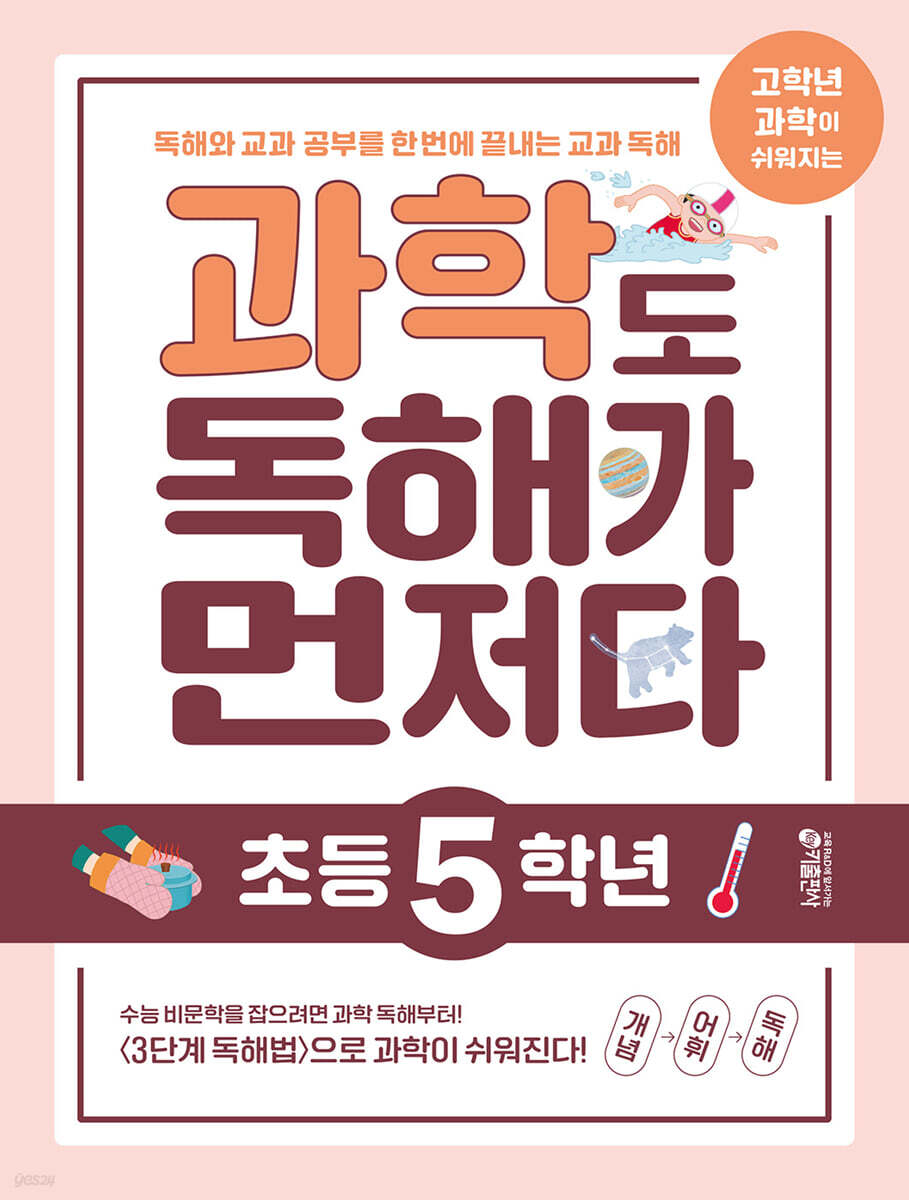
Reading comes first in science, 5th grade
 |
Description
Book Introduction
『Science also requires reading first』
This is a reading program that completes reading and textbook study at the same time. Grasp the concepts and make textbooks easier to understand! We've included illustrations that help you understand complex textbook concepts at a glance. Build strong reading comprehension with the 3-step reading method! This method is designed to help you solidify your reading comprehension skills in three steps: concept, vocabulary, and reading comprehension. Study your subjects and improve your reading comprehension skills at the same time! With the first and second semester textbooks in one volume, you can complete both your subject and reading comprehension studies in one go. With "Science is Reading First in 5th Grade," higher grade science, where difficult vocabulary is introduced and there is a lot to study, will become easier. |
- You can preview some of the book's contents.
Preview
index
Unit 1 Motion and Energy
01 | How do you measure temperature?
02 | How does heat move in a solid?
03 | How does heat move in liquids and gases?
04 | How do we represent the motion of an object?
05 | What is speed?
06 | What safety devices and traffic safety rules are there regarding speed?
Confirmation Learning: Integrated Reading / Concept Organization
Unit 2 Earth and Space
01 | What is the solar system?
02 | How do I find Polaris in the night sky?
03 | How do you measure humidity?
04 | How are dew, fog, and clouds formed?
05 | Why does the wind blow?
06 | What are the seasonal weather characteristics of our country?
Confirmation Learning: Integrated Reading / Concept Organization
Unit 3 Materials
01 | What is melting?
02 | How do we compare the concentrations of solutions?
03 | How can we classify solutions?
04 | How do we classify solutions using indicators?
05 | What happens when you mix an acidic solution and a basic solution?
06 | How to use acidic and basic solutions?
Confirmation Learning: Integrated Reading / Concept Organization
Unit 4 Life
01 | What kind of creatures live around us?
02 | How do various living things affect our lives?
03 | What is an ecosystem?
04 | What kind of feeding relationships do living things have?
05 | How do abiotic environmental factors affect living things?
06 | How does environmental pollution affect living things?
Confirmation Learning: Integrated Reading / Concept Organization
Surprise Reading: How Do Scientists Explore?
*Answers and explanations (separated from the textbook and included in a book-within-a-book format)
01 | How do you measure temperature?
02 | How does heat move in a solid?
03 | How does heat move in liquids and gases?
04 | How do we represent the motion of an object?
05 | What is speed?
06 | What safety devices and traffic safety rules are there regarding speed?
Confirmation Learning: Integrated Reading / Concept Organization
Unit 2 Earth and Space
01 | What is the solar system?
02 | How do I find Polaris in the night sky?
03 | How do you measure humidity?
04 | How are dew, fog, and clouds formed?
05 | Why does the wind blow?
06 | What are the seasonal weather characteristics of our country?
Confirmation Learning: Integrated Reading / Concept Organization
Unit 3 Materials
01 | What is melting?
02 | How do we compare the concentrations of solutions?
03 | How can we classify solutions?
04 | How do we classify solutions using indicators?
05 | What happens when you mix an acidic solution and a basic solution?
06 | How to use acidic and basic solutions?
Confirmation Learning: Integrated Reading / Concept Organization
Unit 4 Life
01 | What kind of creatures live around us?
02 | How do various living things affect our lives?
03 | What is an ecosystem?
04 | What kind of feeding relationships do living things have?
05 | How do abiotic environmental factors affect living things?
06 | How does environmental pollution affect living things?
Confirmation Learning: Integrated Reading / Concept Organization
Surprise Reading: How Do Scientists Explore?
*Answers and explanations (separated from the textbook and included in a book-within-a-book format)
Detailed image

Publisher's Review
“Science requires reading first” is a reading comprehension program that completes reading comprehension and textbook study at the same time.
▶ Grasp the concept and easily understand the textbook!
Complex curriculum concepts can be visualized at a glance.
▶ Strengthen your reading comprehension with the 3-step reading method!
You can develop your reading comprehension skills in three stages: concept, vocabulary, and reading comprehension.
▶ Study your subjects and improve your reading comprehension skills together!
You can complete both textbooks for the first and second semesters in one volume, allowing you to complete both coursework and reading comprehension at the same time.
〈Science also requires reading comprehension first _ 5th grade elementary school〉
Advanced science becomes easier with the barrage of difficult vocabulary and material to study.
▶ Get a clear grasp of concepts and vocabulary!
You can grasp key concepts at a glance with pictures and learn conceptual vocabulary with sentences.
▶ Build a solid foundation in reading comprehension!
[Find key vocabulary in each paragraph's central sentence → Read correctly → Read in depth → Write a summary in a structure diagram → Write a narrative] You can systematically build your reading skills from basic reading to advanced reading and narrative writing.
● Why should science students also study reading comprehension?
As the grade level increases, the content covered in 'science' textbooks becomes more in-depth and diverse.
So, 'science' can feel increasingly difficult and daunting.
There are many new scientific concepts and vocabulary, so it is difficult to understand the contents of the textbook at once.
To study 'science' easily and enjoyably
First, you need to learn important concepts and vocabulary, and then practice reading.
Reading practice isn't just for Korean language subjects.
Even science, which has many unfamiliar concepts and vocabulary to read, requires reading practice.
With the step-by-step reading practice of “Science also requires reading first”
Difficult ‘science’ becomes easy and fun!
● Why do we need to learn science concepts and vocabulary?
‘Science’ is a subject where the basics are important, like mathematics.
Because the concepts are tightly connected and the depth and breadth of the content expand as the grade level advances.
If you don't understand the previous content, it's difficult to understand the following content.
So, it is important to properly understand each and every concept from the beginning when learning ‘science’.
Studying science becomes easier when you learn concepts that are well organized and systematic with pictures.
In 'science', understanding the concepts is most important.
Even unfamiliar and difficult subject matter can be easily understood if you just grasp the concept.
Through systematic concept learning of “Science also requires reading comprehension first”
The concept of ‘science’, which was confusing, is now clearly explained!
〉〉 Composition and features
Complete the 3 stages of concept - vocabulary - reading comprehension
[Concept] Easy with pictures
① Read the title first!
You can figure out what you want to know.
② Let’s grasp the concept through pictures!
You can grasp key concepts at a glance and memorize them in chunks of pictures.
[Vocabulary] Smart with sentences
③ Learn conceptual vocabulary through sentences!
You can solidify the concepts by putting vocabulary directly into sentences.
④ Summarize the concept in one sentence!
You can clearly summarize the key concept in one sentence.
[Reading] Read + Write for sure
⑤ Read the text while checking the key concepts!
ㆍYou can preview the key concepts covered in the text using paragraph summaries.
ㆍThe content scattered across multiple pages of the textbook is organized into a single passage, allowing you to clearly understand key concepts, grasp the structure of the text, and read effectively.
⑥ Develop basic reading comprehension skills!
ㆍFinding Key Vocabulary: You can check the central sentence of each paragraph in the reading passage and find the key vocabulary that goes into the central sentence.
ㆍReading Correctly: You can develop the ability to ‘factually understand’ by reading a given passage correctly and accurately understanding the content.
⑦ Develop your in-depth reading skills!
ㆍReading in detail: You can develop the ability to 'analyze comprehension' by reading the text in detail and grasping the details of the text.
ㆍDeep Reading: You can develop the ability to ‘inferentially understand’ by reading in connection with the text in <Example> and drawing different judgments based on the given information.
⑧ Let’s summarize it with a structural diagram!
ㆍWrite a summary [short answer]: You can organize the content of the text in a coherent manner by filling in the appropriate vocabulary in the structured diagram of the text.
⑨ Learn to write descriptively!
ㆍDescriptive Writing [Descriptive]: You can develop the ability to express your knowledge logically and appropriately by describing what you understand, and internalize the learning content.
▶ Grasp the concept and easily understand the textbook!
Complex curriculum concepts can be visualized at a glance.
▶ Strengthen your reading comprehension with the 3-step reading method!
You can develop your reading comprehension skills in three stages: concept, vocabulary, and reading comprehension.
▶ Study your subjects and improve your reading comprehension skills together!
You can complete both textbooks for the first and second semesters in one volume, allowing you to complete both coursework and reading comprehension at the same time.
〈Science also requires reading comprehension first _ 5th grade elementary school〉
Advanced science becomes easier with the barrage of difficult vocabulary and material to study.
▶ Get a clear grasp of concepts and vocabulary!
You can grasp key concepts at a glance with pictures and learn conceptual vocabulary with sentences.
▶ Build a solid foundation in reading comprehension!
[Find key vocabulary in each paragraph's central sentence → Read correctly → Read in depth → Write a summary in a structure diagram → Write a narrative] You can systematically build your reading skills from basic reading to advanced reading and narrative writing.
● Why should science students also study reading comprehension?
As the grade level increases, the content covered in 'science' textbooks becomes more in-depth and diverse.
So, 'science' can feel increasingly difficult and daunting.
There are many new scientific concepts and vocabulary, so it is difficult to understand the contents of the textbook at once.
To study 'science' easily and enjoyably
First, you need to learn important concepts and vocabulary, and then practice reading.
Reading practice isn't just for Korean language subjects.
Even science, which has many unfamiliar concepts and vocabulary to read, requires reading practice.
With the step-by-step reading practice of “Science also requires reading first”
Difficult ‘science’ becomes easy and fun!
● Why do we need to learn science concepts and vocabulary?
‘Science’ is a subject where the basics are important, like mathematics.
Because the concepts are tightly connected and the depth and breadth of the content expand as the grade level advances.
If you don't understand the previous content, it's difficult to understand the following content.
So, it is important to properly understand each and every concept from the beginning when learning ‘science’.
Studying science becomes easier when you learn concepts that are well organized and systematic with pictures.
In 'science', understanding the concepts is most important.
Even unfamiliar and difficult subject matter can be easily understood if you just grasp the concept.
Through systematic concept learning of “Science also requires reading comprehension first”
The concept of ‘science’, which was confusing, is now clearly explained!
〉〉 Composition and features
Complete the 3 stages of concept - vocabulary - reading comprehension
[Concept] Easy with pictures
① Read the title first!
You can figure out what you want to know.
② Let’s grasp the concept through pictures!
You can grasp key concepts at a glance and memorize them in chunks of pictures.
[Vocabulary] Smart with sentences
③ Learn conceptual vocabulary through sentences!
You can solidify the concepts by putting vocabulary directly into sentences.
④ Summarize the concept in one sentence!
You can clearly summarize the key concept in one sentence.
[Reading] Read + Write for sure
⑤ Read the text while checking the key concepts!
ㆍYou can preview the key concepts covered in the text using paragraph summaries.
ㆍThe content scattered across multiple pages of the textbook is organized into a single passage, allowing you to clearly understand key concepts, grasp the structure of the text, and read effectively.
⑥ Develop basic reading comprehension skills!
ㆍFinding Key Vocabulary: You can check the central sentence of each paragraph in the reading passage and find the key vocabulary that goes into the central sentence.
ㆍReading Correctly: You can develop the ability to ‘factually understand’ by reading a given passage correctly and accurately understanding the content.
⑦ Develop your in-depth reading skills!
ㆍReading in detail: You can develop the ability to 'analyze comprehension' by reading the text in detail and grasping the details of the text.
ㆍDeep Reading: You can develop the ability to ‘inferentially understand’ by reading in connection with the text in <Example> and drawing different judgments based on the given information.
⑧ Let’s summarize it with a structural diagram!
ㆍWrite a summary [short answer]: You can organize the content of the text in a coherent manner by filling in the appropriate vocabulary in the structured diagram of the text.
⑨ Learn to write descriptively!
ㆍDescriptive Writing [Descriptive]: You can develop the ability to express your knowledge logically and appropriately by describing what you understand, and internalize the learning content.
GOODS SPECIFICS
- Publication date: June 29, 2023
- Page count, weight, size: 204 pages | 210*277*13mm
- ISBN13: 9791165263843
- ISBN10: 116526384X
- Reference book for use in grades: 5th grade
- Reference book usage semester: Common semester
- Reference book difficulty: Normal, Hard Reference book difficulty guide
- KC Certification: Certification Type: Conformity Confirmation
You may also like
카테고리
korean


korean

![GQ KOREA Mark (Monthly): December [2025]](http://librairie.coreenne.fr/cdn/shop/files/8ef265dbbfbf186523ed75ba7319009d.jpg?v=1765340328&width=3840)


