

Various things in Korean history
 |
Description
Book Introduction
If they had never met, would history have been different?
From 'Go Jumong X Soseono' to 'Kim Gu X Kim Wonbong',
The various events that shook Korean history
Figures in history never exist alone.
The direction of history is determined through their encounters, cooperation, conflicts, and confrontations.
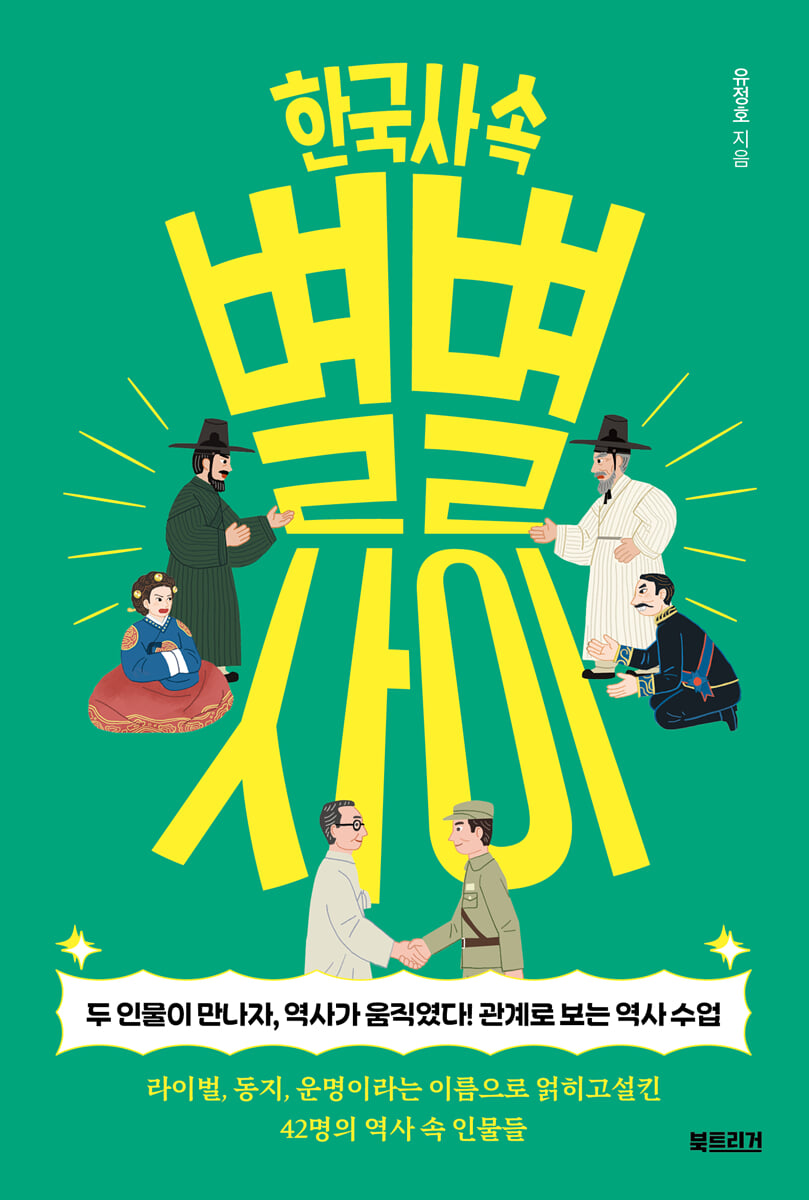
『The Stars and Stripes of Korean History』 is a history book that focuses on the relationships and interactions between key figures in Korean history, rather than looking at them individually.
The fierce battle between King Seong and King Jinheung, the tragic power struggle between King Danjong and King Sejo, the starkly different choices made by Han Gyu-seol and Yi Wan-yong…
The relationship between these two, whose names alone create a sense of tension, contains choices and changes that shook an era.
By following the trajectory of the relationships between each character, from king and subject, teacher and student, and comrades turned rivals, you can see the flow of Korean history at a glance.
The author, a current history teacher, vividly captures various moments that occurred in the relationships of 21 special figures that permeate Korean history, spanning from ancient times to modern times.
Rather than simply listing events, it illuminates the human stories created by the choices of people within a historical context, helping to provide a more three-dimensional and interesting understanding of Korean history.
Additionally, we reconstructed the fictional conversations between characters to make it easier for young readers to understand historical events, adding a sense of familiarity.
Additionally, you can download a post-reading activity sheet summarizing the main content through the QR code included in the book, making it effective for independent study as well as at school or academy.
From 'Go Jumong X Soseono' to 'Kim Gu X Kim Wonbong',
The various events that shook Korean history
Figures in history never exist alone.
The direction of history is determined through their encounters, cooperation, conflicts, and confrontations.
『The Stars and Stripes of Korean History』 is a history book that focuses on the relationships and interactions between key figures in Korean history, rather than looking at them individually.
The fierce battle between King Seong and King Jinheung, the tragic power struggle between King Danjong and King Sejo, the starkly different choices made by Han Gyu-seol and Yi Wan-yong…
The relationship between these two, whose names alone create a sense of tension, contains choices and changes that shook an era.
By following the trajectory of the relationships between each character, from king and subject, teacher and student, and comrades turned rivals, you can see the flow of Korean history at a glance.
The author, a current history teacher, vividly captures various moments that occurred in the relationships of 21 special figures that permeate Korean history, spanning from ancient times to modern times.
Rather than simply listing events, it illuminates the human stories created by the choices of people within a historical context, helping to provide a more three-dimensional and interesting understanding of Korean history.
Additionally, we reconstructed the fictional conversations between characters to make it easier for young readers to understand historical events, adding a sense of familiarity.
Additionally, you can download a post-reading activity sheet summarizing the main content through the QR code included in the book, making it effective for independent study as well as at school or academy.
- You can preview some of the book's contents.
Preview
index
Introduction: History is born among people.
Part 1: From Comrades to Enemies: A History of Power and Conflict
1 Love or the Throne ▶ Jumong × Soseono
2 Yesterday's Comrade, Today's Enemy ▶ King Seong × King Jinheung
3 Righteous Blade, Becomes Tragedy ▶ Mokjong × Emphasis
4. With Goryeo collapsing before our eyes ▶ Choi Young × Lee Seong-gye
5 From Comrades Who Led the Founding of Joseon to Strife ▶ Jeong Do-jeon × Yi Bang-won
6 From nephew to uncle, the throne was stolen ▶ Danjong × Sejo
7 Twisted Relationships between the Rich and the Poor ▶ Heungseon Daewongun × Gojong
Part 2: A clash of differing convictions, a choice made over the same issue.
8 In the sea of chaos during the Imjin War ▶ Yi Sun-sin × Won Gyun
9 War or Surrender ▶ Kim Sang-heon × Choi Myung-gil
10. The love for the country was the same ▶ Kim Ok-gyun × Hong Jong-woo
11 To blossom or to reject, that is the question ▶ Yu Gil-jun × Yu In-seok
12 Those who want to protect the royal seal and those who want to steal it ▶ Empress Sunjeong × Yun Deok-yeong
13 Diplomatic Rights, Should We Protect Them? ▶ Should We Hand Them Over? ▶ Han Gyu-seol × Lee Wan-yong
14 Same era, different literature ▶ Kim Dong-in × Lee Sang-hwa
Part 3: Cooperation and Unity: Leading Change
15 The Best Partners of the Late Joseon Dynasty ▶ Jeongjo × Jeong Yak-yong
16 Dreaming of an Independent and Equal Joseon ▶ Seo Jae-pil × Yun Chi-ho
17 Fighting the Japanese with a Pen ▶ Ernest Bethel × Yang Gi-tak
18 Different but Same Dreams ▶ Lim Byeong-chan × Park Sang-jin
19 One Day, One Time, One Gun ▶ Jeon Myeong-un × Jang In-hwan
20 Seeking Independence Beyond Ideology ▶ Kim Gu × Kim Won-bong
21 Seeking Change in the Provisional Government of the Republic of Korea ▶ Shin Chae-ho × Ahn Chang-ho
Part 1: From Comrades to Enemies: A History of Power and Conflict
1 Love or the Throne ▶ Jumong × Soseono
2 Yesterday's Comrade, Today's Enemy ▶ King Seong × King Jinheung
3 Righteous Blade, Becomes Tragedy ▶ Mokjong × Emphasis
4. With Goryeo collapsing before our eyes ▶ Choi Young × Lee Seong-gye
5 From Comrades Who Led the Founding of Joseon to Strife ▶ Jeong Do-jeon × Yi Bang-won
6 From nephew to uncle, the throne was stolen ▶ Danjong × Sejo
7 Twisted Relationships between the Rich and the Poor ▶ Heungseon Daewongun × Gojong
Part 2: A clash of differing convictions, a choice made over the same issue.
8 In the sea of chaos during the Imjin War ▶ Yi Sun-sin × Won Gyun
9 War or Surrender ▶ Kim Sang-heon × Choi Myung-gil
10. The love for the country was the same ▶ Kim Ok-gyun × Hong Jong-woo
11 To blossom or to reject, that is the question ▶ Yu Gil-jun × Yu In-seok
12 Those who want to protect the royal seal and those who want to steal it ▶ Empress Sunjeong × Yun Deok-yeong
13 Diplomatic Rights, Should We Protect Them? ▶ Should We Hand Them Over? ▶ Han Gyu-seol × Lee Wan-yong
14 Same era, different literature ▶ Kim Dong-in × Lee Sang-hwa
Part 3: Cooperation and Unity: Leading Change
15 The Best Partners of the Late Joseon Dynasty ▶ Jeongjo × Jeong Yak-yong
16 Dreaming of an Independent and Equal Joseon ▶ Seo Jae-pil × Yun Chi-ho
17 Fighting the Japanese with a Pen ▶ Ernest Bethel × Yang Gi-tak
18 Different but Same Dreams ▶ Lim Byeong-chan × Park Sang-jin
19 One Day, One Time, One Gun ▶ Jeon Myeong-un × Jang In-hwan
20 Seeking Independence Beyond Ideology ▶ Kim Gu × Kim Won-bong
21 Seeking Change in the Provisional Government of the Republic of Korea ▶ Shin Chae-ho × Ahn Chang-ho
Detailed image

Into the book
History is the result of what people have done.
Although values and ways of life may have differed depending on the times and circumstances, the essence of what humans pursue and hope for is not very different.
Because human emotions such as joy, anger, sorrow, and pleasure, such as happiness, anger, sorrow, and pleasure, are not much different now than they were in the past.
Based on this, we comfort those who are sad, console those who are angry, take risks for those we love, and pursue things we enjoy and enjoy.
Moreover, when we see injustice, we try to correct it, we strive to overcome difficulties, and sometimes we move forward with allies, but sometimes we encounter those who stand in our way.
Yet, throughout history, those who chose the right thing have always triumphed, and as a result, a better world has been created.
Through this book, I hope you will meet countless people who, from the Three Kingdoms period to the Japanese colonial period, lived fiercely to create a better world.
I hope you can learn wisdom from how they overcame hardship and apply it to your own life.
---p.7-8 From “Introduction: History is Born Between People”
Yi Bang-won and Jeong Do-jeon, who were the main players in the founding of Joseon and political partners, became less friendly with each other after the founding of the country.
The complicated relationship between the two ended only after Lee Bang-won killed Jeong Do-jeon.
After that, Jeong Do-jeon was branded a traitor for 500 years during the Joseon Dynasty.
Ironically, Jeong Do-jeon, who conceived and designed the nation called Joseon, was not recognized in Joseon history, and was only reinstated during the reign of King Gojong.
What's even more ironic is that the first thing Yi Bang-won did after ascending to the throne was to abolish the private army.
He also understood that in order to stabilize the monarchy, the military base of the king's relatives and those in power had to be destroyed.
In addition to this, King Taejong Lee Bang-won laid the foundation for the Joseon Dynasty by utilizing the policies proposed by Jeong Do-jeon during his lifetime as needed.
Thanks to Taejong's political stability and economic prosperity, his son Sejong was able to usher in an era of peace in Joseon.
Perhaps Jeong Do-jeon's intentions were passed on to Yi Bang-won and blossomed.
A close comrade becomes an arch-enemy in an instant, and he inherits the will of the person he killed with his own hands… .
I guess history is a series of ironies.
---p.73-75 From “From Comrades to Strife Who Led the Founding of Joseon”
Unfortunately, Lee Sang-hwa passed away from stomach cancer in 1943 without seeing the liberation he had so desperately hoped for.
However, even after his death, efforts to honor Lee Sang-hwa, a representative resistance poet of the nation, continued.
(…) greeting
If Lee Sang-hwa used literature as a weapon to constantly resist Japanese imperialism, Kim Dong-in used literature as a useful tool to show loyalty to Japan.
After liberation, he used literature as a means of justification by writing the autobiographical novels “The Influence of a Ruined Country” and “The Influence of a Ruined Country” to justify his pro-Japanese activities.
---p.194 From “14 Same Era, Different Literature”
In the late 1930s, China, which was fighting the Second Sino-Japanese War, was pushed into a disadvantageous position due to Japan's fierce offensive.
China, which had been a stronghold for the independence movement abroad, was in danger of falling into the hands of Japan.
Accordingly, Kim Gu and Kim Won-bong met in Chongqing, China, and decided to cooperate beyond the ideologies of nationalism and socialism.
In particular, Kim Gu said, “Now is not the time to discuss ideology.
After liberation, we decided to unite according to our own principles.
“Now is the time to unite and unify each group,” he said, strongly advocating for the unification of independence movement forces.
Kim Gu, who had promised cooperation with the Korean National Revolutionary Party, including Kim Won-bong, sent letters to independence movement groups in China and the Americas asking them to join him.
Let's join forces with an eye on independence rather than ideology.
But not everyone agreed.
Among them, the Korean National Association in the Americas said, “We agree with the purpose, but Kim Won-bong is a communist.
He strongly opposed the idea, saying, “If you collaborate with the Communist Party, you should know that your relationship with us Koreans living in the United States will be severed.”
But Kim Gu and Kim Won-bong did not give in to this.
We persuaded people, reconciled differences of opinion, and continued cooperation.
Although values and ways of life may have differed depending on the times and circumstances, the essence of what humans pursue and hope for is not very different.
Because human emotions such as joy, anger, sorrow, and pleasure, such as happiness, anger, sorrow, and pleasure, are not much different now than they were in the past.
Based on this, we comfort those who are sad, console those who are angry, take risks for those we love, and pursue things we enjoy and enjoy.
Moreover, when we see injustice, we try to correct it, we strive to overcome difficulties, and sometimes we move forward with allies, but sometimes we encounter those who stand in our way.
Yet, throughout history, those who chose the right thing have always triumphed, and as a result, a better world has been created.
Through this book, I hope you will meet countless people who, from the Three Kingdoms period to the Japanese colonial period, lived fiercely to create a better world.
I hope you can learn wisdom from how they overcame hardship and apply it to your own life.
---p.7-8 From “Introduction: History is Born Between People”
Yi Bang-won and Jeong Do-jeon, who were the main players in the founding of Joseon and political partners, became less friendly with each other after the founding of the country.
The complicated relationship between the two ended only after Lee Bang-won killed Jeong Do-jeon.
After that, Jeong Do-jeon was branded a traitor for 500 years during the Joseon Dynasty.
Ironically, Jeong Do-jeon, who conceived and designed the nation called Joseon, was not recognized in Joseon history, and was only reinstated during the reign of King Gojong.
What's even more ironic is that the first thing Yi Bang-won did after ascending to the throne was to abolish the private army.
He also understood that in order to stabilize the monarchy, the military base of the king's relatives and those in power had to be destroyed.
In addition to this, King Taejong Lee Bang-won laid the foundation for the Joseon Dynasty by utilizing the policies proposed by Jeong Do-jeon during his lifetime as needed.
Thanks to Taejong's political stability and economic prosperity, his son Sejong was able to usher in an era of peace in Joseon.
Perhaps Jeong Do-jeon's intentions were passed on to Yi Bang-won and blossomed.
A close comrade becomes an arch-enemy in an instant, and he inherits the will of the person he killed with his own hands… .
I guess history is a series of ironies.
---p.73-75 From “From Comrades to Strife Who Led the Founding of Joseon”
Unfortunately, Lee Sang-hwa passed away from stomach cancer in 1943 without seeing the liberation he had so desperately hoped for.
However, even after his death, efforts to honor Lee Sang-hwa, a representative resistance poet of the nation, continued.
(…) greeting
If Lee Sang-hwa used literature as a weapon to constantly resist Japanese imperialism, Kim Dong-in used literature as a useful tool to show loyalty to Japan.
After liberation, he used literature as a means of justification by writing the autobiographical novels “The Influence of a Ruined Country” and “The Influence of a Ruined Country” to justify his pro-Japanese activities.
---p.194 From “14 Same Era, Different Literature”
In the late 1930s, China, which was fighting the Second Sino-Japanese War, was pushed into a disadvantageous position due to Japan's fierce offensive.
China, which had been a stronghold for the independence movement abroad, was in danger of falling into the hands of Japan.
Accordingly, Kim Gu and Kim Won-bong met in Chongqing, China, and decided to cooperate beyond the ideologies of nationalism and socialism.
In particular, Kim Gu said, “Now is not the time to discuss ideology.
After liberation, we decided to unite according to our own principles.
“Now is the time to unite and unify each group,” he said, strongly advocating for the unification of independence movement forces.
Kim Gu, who had promised cooperation with the Korean National Revolutionary Party, including Kim Won-bong, sent letters to independence movement groups in China and the Americas asking them to join him.
Let's join forces with an eye on independence rather than ideology.
But not everyone agreed.
Among them, the Korean National Association in the Americas said, “We agree with the purpose, but Kim Won-bong is a communist.
He strongly opposed the idea, saying, “If you collaborate with the Communist Party, you should know that your relationship with us Koreans living in the United States will be severed.”
But Kim Gu and Kim Won-bong did not give in to this.
We persuaded people, reconciled differences of opinion, and continued cooperation.
---p.273 From “20 Seeking Independence Beyond Ideology”
Publisher's Review
Parting paths, joining hands, a fateful encounter, a historic confrontation!
The moment when two people meet and change each other's fates - their choices change the world!
“I deeply believe that it is we who create our own history.
“The course of history is determined by the choices we make, and our choices stem from the thoughts, beliefs, values, and dreams of people.”
― Eleanor Roosevelt
History has developed and changed through the relationships between people.
As we follow the stories of historical figures who sometimes clashed and sometimes joined forces to create great events, even the rigid knowledge contained in textbooks becomes a three-dimensional and living history.
Author Yoo Jeong-ho, a history teacher at school and author of numerous history books including 『Dictionary of Korean History Concepts』 and 『Korean Modern and Contemporary History Every Teenager Should Know』, has come to meet readers again with 『The Mysteries of Korean History』.
It unravels the major historical events that permeate 21 Korean chapters not in chronological order, but rather through the keywords of "relationships and encounters," showing how the dynamics between people have driven historical change.
Through the dramatic relationships of forty-two historical figures, who were intertwined as rivals, comrades, and sometimes teachers and students, you can grasp the main trends of Korean history at a glance.
Through their relationship, this book provides insight into 'why' such historical decisions were made and how those decisions changed the course of history.
Additionally, it provides an opportunity to develop historical thinking skills by understanding the influence and moments of choice that historical figures received from those around them and the circumstances of the times.
By following the author's guidance and going beyond simply learning "what," to finding answers to "how" and "why," readers will gain a new perspective on Korean history and a deeper historical perspective that will take root in their hearts.
History is born among people.
The diverse love and hate relationships that shaped Korea
The flow of history, which was not visible through the achievements of one person alone, becomes clearer through the relationship between two people.
《The Various Interactions in Korean History》 focuses on the relationships and conflict structures of historical figures, and organizes them into three types.
Part 1, "From Comrades to Enemies, a History of Power and Conflict," focuses on the flow of history surrounding royal authority and power, dealing with historical figures and events that ultimately led to their turning their backs on each other due to differing directions.
Part 2, "A Clash of Differing Beliefs, Divided Choices on the Same Issue," sheds light on the stories of people who faced the same problems in the same era but chose different paths.
We delve deeply into the choices made by people who struggled and clashed between beliefs and reality, or between different beliefs, and how those choices influenced history.
Part 3, “Collaboration and Unity, Leading Change,” highlights the relationships between people who created change through cooperation rather than confrontation.
It explores the historical turning points created by people from different backgrounds and ideologies who joined hands for the same goal.
Another strength of this book is that it reconstructs fictional conversations between characters in each chapter, allowing young readers to easily and interestingly understand the relationships between historical figures.
Through this, middle school students and other young readers can experience historical events more vividly and learn key concepts in a natural flow.
Additionally, you can download post-reading activity sheets that solve problems related to the main content through the QR codes included in each chapter, making them useful as study materials.
It provides an opportunity to go beyond simple reading and learn about history more deeply by solving problems and thinking.
Not only young people, but also any reader interested in history will be able to gain a new perspective on Korean history.
The moment when two people meet and change each other's fates - their choices change the world!
“I deeply believe that it is we who create our own history.
“The course of history is determined by the choices we make, and our choices stem from the thoughts, beliefs, values, and dreams of people.”
― Eleanor Roosevelt
History has developed and changed through the relationships between people.
As we follow the stories of historical figures who sometimes clashed and sometimes joined forces to create great events, even the rigid knowledge contained in textbooks becomes a three-dimensional and living history.
Author Yoo Jeong-ho, a history teacher at school and author of numerous history books including 『Dictionary of Korean History Concepts』 and 『Korean Modern and Contemporary History Every Teenager Should Know』, has come to meet readers again with 『The Mysteries of Korean History』.
It unravels the major historical events that permeate 21 Korean chapters not in chronological order, but rather through the keywords of "relationships and encounters," showing how the dynamics between people have driven historical change.
Through the dramatic relationships of forty-two historical figures, who were intertwined as rivals, comrades, and sometimes teachers and students, you can grasp the main trends of Korean history at a glance.
Through their relationship, this book provides insight into 'why' such historical decisions were made and how those decisions changed the course of history.
Additionally, it provides an opportunity to develop historical thinking skills by understanding the influence and moments of choice that historical figures received from those around them and the circumstances of the times.
By following the author's guidance and going beyond simply learning "what," to finding answers to "how" and "why," readers will gain a new perspective on Korean history and a deeper historical perspective that will take root in their hearts.
History is born among people.
The diverse love and hate relationships that shaped Korea
The flow of history, which was not visible through the achievements of one person alone, becomes clearer through the relationship between two people.
《The Various Interactions in Korean History》 focuses on the relationships and conflict structures of historical figures, and organizes them into three types.
Part 1, "From Comrades to Enemies, a History of Power and Conflict," focuses on the flow of history surrounding royal authority and power, dealing with historical figures and events that ultimately led to their turning their backs on each other due to differing directions.
Part 2, "A Clash of Differing Beliefs, Divided Choices on the Same Issue," sheds light on the stories of people who faced the same problems in the same era but chose different paths.
We delve deeply into the choices made by people who struggled and clashed between beliefs and reality, or between different beliefs, and how those choices influenced history.
Part 3, “Collaboration and Unity, Leading Change,” highlights the relationships between people who created change through cooperation rather than confrontation.
It explores the historical turning points created by people from different backgrounds and ideologies who joined hands for the same goal.
Another strength of this book is that it reconstructs fictional conversations between characters in each chapter, allowing young readers to easily and interestingly understand the relationships between historical figures.
Through this, middle school students and other young readers can experience historical events more vividly and learn key concepts in a natural flow.
Additionally, you can download post-reading activity sheets that solve problems related to the main content through the QR codes included in each chapter, making them useful as study materials.
It provides an opportunity to go beyond simple reading and learn about history more deeply by solving problems and thinking.
Not only young people, but also any reader interested in history will be able to gain a new perspective on Korean history.
GOODS SPECIFICS
- Date of issue: April 15, 2025
- Page count, weight, size: 288 pages | 424g | 135*200*17mm
- ISBN13: 9791193378403
- ISBN10: 1193378400
You may also like
카테고리
korean


korean

![GQ KOREA Mark (Monthly): December [2025]](http://librairie.coreenne.fr/cdn/shop/files/8ef265dbbfbf186523ed75ba7319009d.jpg?v=1765340328&width=3840)


