

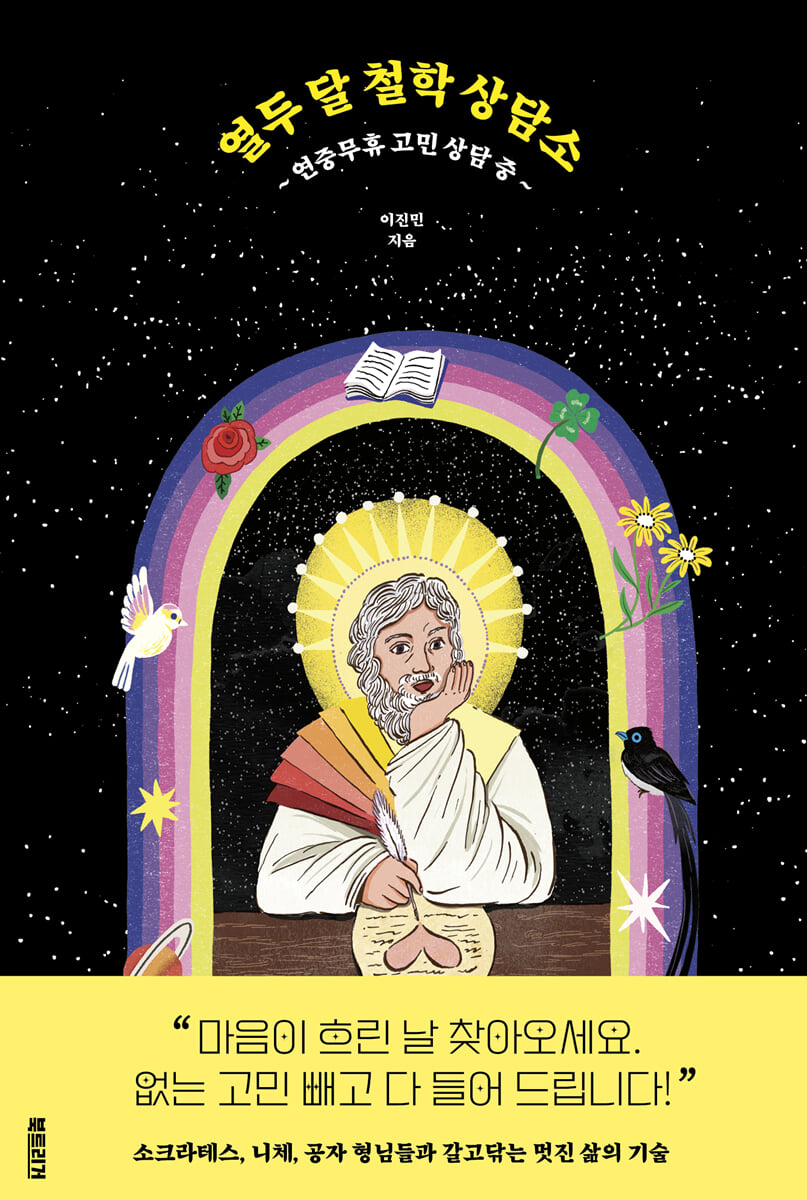
Twelve Months Philosophy Counseling Center
 |
Description
Book Introduction
Does philosophy listen to these concerns?
A life of uncertainty, a leap forward with a breather through philosophy.
"I wish I was popular, but is this life ruined?" "Why does everyone have to study so hard?" "Is it harder to be a woman, or a man?" Philosophers have stepped forward to help teenagers who are struggling with unanswerable questions! This book speaks to teenagers struggling with unresolved questions and tangled concerns.
If you want to find wise answers without being swayed by others, then knock on the door of philosophy.
You might wonder what use philosophy has for solving our problems, but in fact, the questions we face in life are not much different from those that philosophers have been struggling with for hundreds of years.
Jinmin Lee, the "philosophical mother," bridges the gap between the concerns of teenagers about friends, grades, family, love, and career paths and the thoughts of philosophers, leading readers to delve deeper into questions that have no right answers.
The thoughts of philosophers who have spent their lives intensely contemplating what constitutes a better life impart the wisdom and insight essential for facing the world with confidence.
As you read the book, you will realize that having many worries is not a problem at all.
The author encourages all those who are struggling, saying, “It means that you diligently examine your own mind and try to find the answer.”
As you slowly confront the worries and concerns that have been bothersome and troubling with the author, you will realize that philosophy, which had previously felt distant, was not so troublesome after all.
A life of uncertainty, a leap forward with a breather through philosophy.
"I wish I was popular, but is this life ruined?" "Why does everyone have to study so hard?" "Is it harder to be a woman, or a man?" Philosophers have stepped forward to help teenagers who are struggling with unanswerable questions! This book speaks to teenagers struggling with unresolved questions and tangled concerns.
If you want to find wise answers without being swayed by others, then knock on the door of philosophy.
You might wonder what use philosophy has for solving our problems, but in fact, the questions we face in life are not much different from those that philosophers have been struggling with for hundreds of years.
Jinmin Lee, the "philosophical mother," bridges the gap between the concerns of teenagers about friends, grades, family, love, and career paths and the thoughts of philosophers, leading readers to delve deeper into questions that have no right answers.
The thoughts of philosophers who have spent their lives intensely contemplating what constitutes a better life impart the wisdom and insight essential for facing the world with confidence.
As you read the book, you will realize that having many worries is not a problem at all.
The author encourages all those who are struggling, saying, “It means that you diligently examine your own mind and try to find the answer.”
As you slowly confront the worries and concerns that have been bothersome and troubling with the author, you will realize that philosophy, which had previously felt distant, was not so troublesome after all.
- You can preview some of the book's contents.
Preview
index
Open the prologue door
january
Escape from the three-day resolution
Just do it, Aristotle's advice like New Year's money
A philosopher's words that really hit home: Nothing is stronger than habit!
february
The agony of being solo
Self-esteem-boosting relationship advice from Buddha and Kierkegaard
A Quirky Philosopher's Thoughts: Finding My Other Half
March
Chain of comparison
If Rousseau and Aurelius came to the jungle-like classroom of March
A somewhat interesting philosopher's perspective: What is beauty?
april
The meaning of laughter is more diverse than you might think.
To you who bursts into laughter at the mere sight of a rolling leaf, Hobbes speaks.
A slightly cheeky philosopher's words: A laughter that seems the same but is different
May
The meaning of learning
Wait a minute, I'll let Confucius and Simone Weil study.
A somewhat cool philosopher's thoughts: Studying for myself, studying for others
June
Living in the Age of Science
How to be fearless in the face of artificial intelligence, as taught by Descartes and Socrates.
Advice beyond the slightly sharp philosophy: Don't blindly trust AI!
July
Philosophy of Gender
If you are tired of 'women are this and men are that', go to Beauvoir and Zhuangzi.
A Refreshing Philosopher's Perspective: Breaking Free from the Gender Dichotomy
August
Blossoming humanity
Mencius' words, like ice cream, to calm the 'Summer of Wrath'
A refreshing philosopher's words: For those who enjoy using the word "insect"
September
Justice and Injustice
If living righteously is burdensome, confide in the Shukla Trio.
A somewhat meaningful philosopher's assumption: the violence of anonymity
october
A surprisingly powerful language
When we call each other by name, may we engrave Confucius's rectification of names
A somewhat paradoxical philosopher's words: The world of clever words
November
Thoughts on God and Man
Does God Really Exist? Let's Hear Nietzsche's Words
Advice from a somewhat elegant philosopher: Music that saves lives
december
Familiarity and novelty
Again, words of encouragement from Plato and Socrates to you as you embark on a new journey.
Some nice philosopher's advice: Open the handle!
I'll keep the epilogue door open.
january
Escape from the three-day resolution
Just do it, Aristotle's advice like New Year's money
A philosopher's words that really hit home: Nothing is stronger than habit!
february
The agony of being solo
Self-esteem-boosting relationship advice from Buddha and Kierkegaard
A Quirky Philosopher's Thoughts: Finding My Other Half
March
Chain of comparison
If Rousseau and Aurelius came to the jungle-like classroom of March
A somewhat interesting philosopher's perspective: What is beauty?
april
The meaning of laughter is more diverse than you might think.
To you who bursts into laughter at the mere sight of a rolling leaf, Hobbes speaks.
A slightly cheeky philosopher's words: A laughter that seems the same but is different
May
The meaning of learning
Wait a minute, I'll let Confucius and Simone Weil study.
A somewhat cool philosopher's thoughts: Studying for myself, studying for others
June
Living in the Age of Science
How to be fearless in the face of artificial intelligence, as taught by Descartes and Socrates.
Advice beyond the slightly sharp philosophy: Don't blindly trust AI!
July
Philosophy of Gender
If you are tired of 'women are this and men are that', go to Beauvoir and Zhuangzi.
A Refreshing Philosopher's Perspective: Breaking Free from the Gender Dichotomy
August
Blossoming humanity
Mencius' words, like ice cream, to calm the 'Summer of Wrath'
A refreshing philosopher's words: For those who enjoy using the word "insect"
September
Justice and Injustice
If living righteously is burdensome, confide in the Shukla Trio.
A somewhat meaningful philosopher's assumption: the violence of anonymity
october
A surprisingly powerful language
When we call each other by name, may we engrave Confucius's rectification of names
A somewhat paradoxical philosopher's words: The world of clever words
November
Thoughts on God and Man
Does God Really Exist? Let's Hear Nietzsche's Words
Advice from a somewhat elegant philosopher: Music that saves lives
december
Familiarity and novelty
Again, words of encouragement from Plato and Socrates to you as you embark on a new journey.
Some nice philosopher's advice: Open the handle!
I'll keep the epilogue door open.
Detailed image

Into the book
Philosophy, in a word, is ‘the act of looking back at oneself and reading the world.’
Most of my worries start from the point where I don't know myself (or my mind), but having philosophy by my side makes me keep asking questions about myself.
And then, little by little, I begin to understand myself and this world.
People often compare philosophy to a weapon, saying things like, "Philosophy becomes a weapon for life," but I believe that philosophy should not be a tool for harming others, but rather a tool for saving people and supporting the world.
So I think it's closer to a staff than a weapon.
It is an essential item for people who are unsteady on their feet.
--- p.8 From "Prologue: Opening the Door"
Most of our problems with love stem from thinking of love as passive rather than active.
The problem arises not from having the ability to 'love', that is, to love properly, but from thinking about 'being loved', that is, how to be loved and popular.
Note that the title of the book is The Art of 'Loving', not The Art of 'Love'.
It's about 'loving'.
The biggest clue is in the title.
Just realizing that love is active, not passive, will solve a lot of your worries.
--- p.38~39 From “February: The Trouble of Solo”
Rousseau thought that human society was degenerate.
Within this chain of comparison, no one is free, and the vicious cycle continues, with everyone chained together and ultimately destroying themselves.
This is why Rousseau called savages 'noble savages'.
The savages who lived peacefully, focusing on themselves, had noble spirits, but the noble humans who were touched by civilization became envious of each other and became corrupted beings.
Therefore, he made a sharp judgment, like broken glass, that the savages who lived simply and roughly in nature were much more noble than the civilized people of noble status.
--- p.56 From "March: Chain of Comparison"
Hobbes says that most people who laugh at themselves are 'people who think themselves to be worthless.'
That's why we find joy in seeing other people's flaws.
So Hobbes says, “To laugh out loud at another’s faults is a sign of cowardice.”
It is said that great people rather help those who are objects of contempt and ridicule to escape from it, and compare themselves with the most capable and outstanding people.
It's not about feeling superior and happy by comparing yourself to people who are worse off than you.
--- p.81~82 From “April: The Meaning of Laughter, More Diverse Than You Think”
Confucius, the Chinese philosopher from around 500 BC and the main character of the Analects, first spoke of the joy of learning when he said, “Isn’t it a joy to learn and practice from time to time?”
But we are generally not happy when we learn and sometimes master it.
Why is that? It's because there's no "self" as the subject in studying.
Because I don't think about how I want to live my life, I just get pushed into studying.
I'm forced to do it because I'm told to, but it's boring, difficult, and sometimes even painful, so how can I be happy about it?
On the one hand, it is because we think of studying as something limited to 'memorizing textbooks and solving problems to get good grades.'
In other words, it is because we have such narrow and distorted stereotypes about studying.
Let me warn you in advance: Confucius said that the kind of knowledge acquisition that involves sitting at a desk and reading is the lowest of all studies, and should be done when you have spare time.
How about it, doesn't Grandpa Confucius look a little better?
--- p.87~88 From “May: The Meaning of Learning”
To avoid asking, "AI will do everything, so what are we going to do?" we must think and philosophize. To confront the threat of survival as competitive humans in the AI era, we must steadfastly ask, "Do we really need to be the ones who survive? Can't we create a way for people to live enjoyable lives even if they're not competitive?"
To protect human rights and to prevent human life from being flattened by technology.
Technology is not responsible.
We must be the ones to take responsibility for the science that can run wild.
--- p.115~116 From “June: Living in the Age of Science”
Going back to the first question, “Is it harder to live as a woman or as a man?”, it is difficult to live as a man or as a woman.
It's harder if you teach.
In order for everyone to live happily, we must think of each other as fellow human beings and respect each other.
Finally, let me quote Beauvoir:
I hope the aftertaste of these words lingers in your hearts for a long time.
“I am really greedy.
I want to enjoy everything in life.
I want to be a woman and a man, have lots of friends and enjoy loneliness at the same time, work hard, write good books, travel, and have fun.
“I want to be both selfish and altruistic.”
--- p.136 From “July: Philosophy of Gender”
Earlier, I said that I recommend listening to Mencius's stories as if you were eating ice cream, and that is not an exaggeration; Mencius's grandfather's words are refreshing and sweet.
What makes humans human is not intelligence or cleverness, but the ability to empathize with the emotions of others and be concerned for them.
We are driven by authority, anxiety, pain, and profit, but in fact, I am a wonderful being who holds values within me that transcend those.
Although we are not perfect, if we put our minds to it, we can make our foundation bloom and become good.
So, even if we are not completely good, let's try to believe in our goodness.
--- p.148~149 From "August: Blossoming Humanity"
As Martin Heidegger, the philosopher who represented 20th-century German existentialism, said, we are all “beings thrown” into the world.
We begin life completely helpless and have to face countless hardships and threats along the way.
No one came into this world by choice, but was thrown into this world when they were born.
However, in the process of living life by being thrown like that, we sometimes throw ourselves into places or throw others into certain situations.
(…)
Although Heidegger isn't actually making this argument to emphasize justice, I'd like to see this passage lead to the conclusion that we must each care for one another with the goodwill and courage we possess.
For the sole reason that beings thrown into the world without any protection must look after and protect each other.
--- p.136 From "September: Justice and Injustice"
Do not call people "bugs," "niggers," or food names carelessly.
Furthermore, do not call them by harsh words like ‘retard’, ‘red’, ‘kimchi girl’, and ‘hannam’.
Recognizing and correcting all the crumbs of prejudice that have seeped into names.
This is the very definition of righteousness that Confucius emphasized when he lost his temper.
I really wish you would sometimes think of this grandfather's anger when you call someone.
I hope we can all think together about the importance of calling each other by our names properly and cultivating beautiful names for everyone.
Because all relationships start with a name.
--- p.185~186 From “October: A Surprisingly Powerful Language”
“I think, therefore I am.” If we take Descartes’ famous saying literally, it could be said that “thought determines existence” or “without thought, there is no existence.”
But after twelve months of philosophical counseling, I want to put this before you, interpreting it above all else, as pointing to the immense power that thoughts have over our being.
Thoughts can make us exist, that is, 'thoughts can save us'.
So, I hope you will think about it constantly and save yourself.
Most of my worries start from the point where I don't know myself (or my mind), but having philosophy by my side makes me keep asking questions about myself.
And then, little by little, I begin to understand myself and this world.
People often compare philosophy to a weapon, saying things like, "Philosophy becomes a weapon for life," but I believe that philosophy should not be a tool for harming others, but rather a tool for saving people and supporting the world.
So I think it's closer to a staff than a weapon.
It is an essential item for people who are unsteady on their feet.
--- p.8 From "Prologue: Opening the Door"
Most of our problems with love stem from thinking of love as passive rather than active.
The problem arises not from having the ability to 'love', that is, to love properly, but from thinking about 'being loved', that is, how to be loved and popular.
Note that the title of the book is The Art of 'Loving', not The Art of 'Love'.
It's about 'loving'.
The biggest clue is in the title.
Just realizing that love is active, not passive, will solve a lot of your worries.
--- p.38~39 From “February: The Trouble of Solo”
Rousseau thought that human society was degenerate.
Within this chain of comparison, no one is free, and the vicious cycle continues, with everyone chained together and ultimately destroying themselves.
This is why Rousseau called savages 'noble savages'.
The savages who lived peacefully, focusing on themselves, had noble spirits, but the noble humans who were touched by civilization became envious of each other and became corrupted beings.
Therefore, he made a sharp judgment, like broken glass, that the savages who lived simply and roughly in nature were much more noble than the civilized people of noble status.
--- p.56 From "March: Chain of Comparison"
Hobbes says that most people who laugh at themselves are 'people who think themselves to be worthless.'
That's why we find joy in seeing other people's flaws.
So Hobbes says, “To laugh out loud at another’s faults is a sign of cowardice.”
It is said that great people rather help those who are objects of contempt and ridicule to escape from it, and compare themselves with the most capable and outstanding people.
It's not about feeling superior and happy by comparing yourself to people who are worse off than you.
--- p.81~82 From “April: The Meaning of Laughter, More Diverse Than You Think”
Confucius, the Chinese philosopher from around 500 BC and the main character of the Analects, first spoke of the joy of learning when he said, “Isn’t it a joy to learn and practice from time to time?”
But we are generally not happy when we learn and sometimes master it.
Why is that? It's because there's no "self" as the subject in studying.
Because I don't think about how I want to live my life, I just get pushed into studying.
I'm forced to do it because I'm told to, but it's boring, difficult, and sometimes even painful, so how can I be happy about it?
On the one hand, it is because we think of studying as something limited to 'memorizing textbooks and solving problems to get good grades.'
In other words, it is because we have such narrow and distorted stereotypes about studying.
Let me warn you in advance: Confucius said that the kind of knowledge acquisition that involves sitting at a desk and reading is the lowest of all studies, and should be done when you have spare time.
How about it, doesn't Grandpa Confucius look a little better?
--- p.87~88 From “May: The Meaning of Learning”
To avoid asking, "AI will do everything, so what are we going to do?" we must think and philosophize. To confront the threat of survival as competitive humans in the AI era, we must steadfastly ask, "Do we really need to be the ones who survive? Can't we create a way for people to live enjoyable lives even if they're not competitive?"
To protect human rights and to prevent human life from being flattened by technology.
Technology is not responsible.
We must be the ones to take responsibility for the science that can run wild.
--- p.115~116 From “June: Living in the Age of Science”
Going back to the first question, “Is it harder to live as a woman or as a man?”, it is difficult to live as a man or as a woman.
It's harder if you teach.
In order for everyone to live happily, we must think of each other as fellow human beings and respect each other.
Finally, let me quote Beauvoir:
I hope the aftertaste of these words lingers in your hearts for a long time.
“I am really greedy.
I want to enjoy everything in life.
I want to be a woman and a man, have lots of friends and enjoy loneliness at the same time, work hard, write good books, travel, and have fun.
“I want to be both selfish and altruistic.”
--- p.136 From “July: Philosophy of Gender”
Earlier, I said that I recommend listening to Mencius's stories as if you were eating ice cream, and that is not an exaggeration; Mencius's grandfather's words are refreshing and sweet.
What makes humans human is not intelligence or cleverness, but the ability to empathize with the emotions of others and be concerned for them.
We are driven by authority, anxiety, pain, and profit, but in fact, I am a wonderful being who holds values within me that transcend those.
Although we are not perfect, if we put our minds to it, we can make our foundation bloom and become good.
So, even if we are not completely good, let's try to believe in our goodness.
--- p.148~149 From "August: Blossoming Humanity"
As Martin Heidegger, the philosopher who represented 20th-century German existentialism, said, we are all “beings thrown” into the world.
We begin life completely helpless and have to face countless hardships and threats along the way.
No one came into this world by choice, but was thrown into this world when they were born.
However, in the process of living life by being thrown like that, we sometimes throw ourselves into places or throw others into certain situations.
(…)
Although Heidegger isn't actually making this argument to emphasize justice, I'd like to see this passage lead to the conclusion that we must each care for one another with the goodwill and courage we possess.
For the sole reason that beings thrown into the world without any protection must look after and protect each other.
--- p.136 From "September: Justice and Injustice"
Do not call people "bugs," "niggers," or food names carelessly.
Furthermore, do not call them by harsh words like ‘retard’, ‘red’, ‘kimchi girl’, and ‘hannam’.
Recognizing and correcting all the crumbs of prejudice that have seeped into names.
This is the very definition of righteousness that Confucius emphasized when he lost his temper.
I really wish you would sometimes think of this grandfather's anger when you call someone.
I hope we can all think together about the importance of calling each other by our names properly and cultivating beautiful names for everyone.
Because all relationships start with a name.
--- p.185~186 From “October: A Surprisingly Powerful Language”
“I think, therefore I am.” If we take Descartes’ famous saying literally, it could be said that “thought determines existence” or “without thought, there is no existence.”
But after twelve months of philosophical counseling, I want to put this before you, interpreting it above all else, as pointing to the immense power that thoughts have over our being.
Thoughts can make us exist, that is, 'thoughts can save us'.
So, I hope you will think about it constantly and save yourself.
--- p.232 From "Epilogue: I'll Keep the Door Open"
Publisher's Review
“Unanswerable questions, welcome!”
Ask questions bravely and freely
You are invited to the Sisikolkol Philosophy Counseling Center.
The title itself might seem like an awkward combination of ‘philosophy’ and ‘counseling.’
Counseling is usually seen as a process of warm comfort and practical solutions, but philosophy seems like a headache that involves wrapping your head around complicated thoughts.
But sometimes we need more than just comfort; we need the strength to face the essence of the problem and look at it with new eyes.
Philosophy becomes a strong advisor at that very point.
In the "Twelve Months Philosophy Counseling Center," the vivid concerns of teenagers come together with philosophy every month.
It follows the 'seasonal concerns' that are tailored to the twelve months of a year that teenagers go through, and is designed to help you look back on the eventful year of your teenage years.
In January, when the new year begins, we look at resolutions that don't last three days; in February, when Valentine's Day comes, we look at the excitement and anxiety about love; in March, when the new semester begins, we look at the inferiority complex that comes from comparison; in April, when April Fool's Day comes, we look at the dark side of laughter; and in May, when midterms come, we look at the unwillingness to study. We provide year-round counseling on your worries.
It doesn't miss out on issues that today's youth have probably thought about at least once.
The binary structure and sharp conflict between men and women are among the most sensitive topics in today's classrooms, and the growing concern about human identity as we enter the age of artificial intelligence is also a significant concern for teenagers.
The author expands the gender conflict beyond simple confrontation into a broader discussion of gender, and points out issues that humans must consider to maintain their balance in an age of runaway technology.
Digging deeper into any problem ultimately leads to fundamental questions about who we are and what values we should uphold.
In a word, philosophy is ‘looking back on myself and reading the world.’
The author says that “philosophy has the power of healing that flows from the process of understanding oneself and perceiving the world through thought,” and encourages us to listen to the comfort that philosophy provides.
Philosophers who are serious about 'how to live well'
I set out to find a mind-blowing answer!
The book summons appropriate philosophers to address the concerns of each of the twelve months of the year.
What's interesting is that not just one philosopher appears for each concern.
The author brings together Eastern and Western philosophers who have grappled with similar problems, and, by fitting their thoughts together like a puzzle, sets out to find a new perspective that can overcome the problem.
In the face of the worry of not wanting to study, we prepare mental coaching from Confucius and Simone Weil, and when we hear complaints that things like Valentine's Day would just go away, we prepare love counseling from Buddha and Kierkegaard, and for teenagers who keep feeling cowardly, we hold a special lecture on justice from the Three Musketeers of Niemoller, Heidegger, and Shklar.
The endless journey of thought that unfolds in this book is far from the 'study' of philosophy.
In a world without right answers, what's needed more than anything else is not studying diligently by underlining the logic of philosophers, but rather the attitude of underlining the questions you have and constantly thinking about them.
The author calls this philosophy becoming a “verb” rather than an “object.”
Therefore, the solutions presented in this book do not simply list and repeat the thoughts of philosophers.
The philosophy of Aristotle, the 'habit expert', and the thought of Lao Tzu, who emphasized the 'virtue of leisure', faced the difficult problem of 'three-day resolutions' and led to the ingenious and creative(!) solution of 'it's okay if you make a resolution for three days consistently several times'.
It is a kind of philosophical comfort that tells teenagers who are struggling to live that they don't have to push themselves too hard.
Even when we juxtapose the words of Beauvoir (“One is not born, but becomes a woman”) and Zhuangzi (“The Way is made by walking it”), we gain a beautiful insight into coexistence.
"Since neither man nor woman is pre-made, if we walk together and create something new, that will become the Way." The author overlaps, compares, and connects the grand questions of philosophers from different eras, countries, and spheres of thought, opening up a deeper and broader philosophical space.
Finally, leading me to a wider world
Philosophical thoughts and drawings
This book is filled with unique reading material and sights throughout, ensuring that the comfort of philosophy lingers like a lingering aftertaste.
At the end of each month, a special corner is added as a bonus, connecting the philosopher's thoughts to the concerns of each month and providing easy-to-understand explanations.
Why do we have belly buttons? Did you know you can kill love with laughter? Have you ever heard of the term "feminine brain"? What would Kant say about new types of "human bugs" like the "food bug," the "mom bug," and the "serious bug"? What would you do if you were invisible? The author poses absurd questions that make you wonder, "Has philosophy even considered such things?" and unfolds "quirky," "fun," "sassy," "cool," and "sharp" insights into habits, love, beauty, laughter, learning, dignity, and language.
Tarot cards that appear at the end of each season also add to the fun.
Tarot, which brings to mind invisible worries through images, is like a mirror that allows you to face the depths of your inner self.
Illustrator Yeji Yoon has tied seasonal concerns into a single keyword and visualized them like four tarot card illustrations, and author Jinmin Lee has added philosophical thoughts and intuition-filled explanations on the back.
When you overlap the text and pictures, you feel as if you are discovering the profound messages of philosophers from long ago.
A single card and poetic phrase found between the bookshelves may provide a clue to the problem you are currently struggling with.
“The power of words and the power to work miracles are within me.
Depending on how I address others, a whole new world will open up before me.
“Believe that the power to create miracles lies within us, and break out of your shell and step out with courage.” (p. 230)
Ask questions bravely and freely
You are invited to the Sisikolkol Philosophy Counseling Center.
The title itself might seem like an awkward combination of ‘philosophy’ and ‘counseling.’
Counseling is usually seen as a process of warm comfort and practical solutions, but philosophy seems like a headache that involves wrapping your head around complicated thoughts.
But sometimes we need more than just comfort; we need the strength to face the essence of the problem and look at it with new eyes.
Philosophy becomes a strong advisor at that very point.
In the "Twelve Months Philosophy Counseling Center," the vivid concerns of teenagers come together with philosophy every month.
It follows the 'seasonal concerns' that are tailored to the twelve months of a year that teenagers go through, and is designed to help you look back on the eventful year of your teenage years.
In January, when the new year begins, we look at resolutions that don't last three days; in February, when Valentine's Day comes, we look at the excitement and anxiety about love; in March, when the new semester begins, we look at the inferiority complex that comes from comparison; in April, when April Fool's Day comes, we look at the dark side of laughter; and in May, when midterms come, we look at the unwillingness to study. We provide year-round counseling on your worries.
It doesn't miss out on issues that today's youth have probably thought about at least once.
The binary structure and sharp conflict between men and women are among the most sensitive topics in today's classrooms, and the growing concern about human identity as we enter the age of artificial intelligence is also a significant concern for teenagers.
The author expands the gender conflict beyond simple confrontation into a broader discussion of gender, and points out issues that humans must consider to maintain their balance in an age of runaway technology.
Digging deeper into any problem ultimately leads to fundamental questions about who we are and what values we should uphold.
In a word, philosophy is ‘looking back on myself and reading the world.’
The author says that “philosophy has the power of healing that flows from the process of understanding oneself and perceiving the world through thought,” and encourages us to listen to the comfort that philosophy provides.
Philosophers who are serious about 'how to live well'
I set out to find a mind-blowing answer!
The book summons appropriate philosophers to address the concerns of each of the twelve months of the year.
What's interesting is that not just one philosopher appears for each concern.
The author brings together Eastern and Western philosophers who have grappled with similar problems, and, by fitting their thoughts together like a puzzle, sets out to find a new perspective that can overcome the problem.
In the face of the worry of not wanting to study, we prepare mental coaching from Confucius and Simone Weil, and when we hear complaints that things like Valentine's Day would just go away, we prepare love counseling from Buddha and Kierkegaard, and for teenagers who keep feeling cowardly, we hold a special lecture on justice from the Three Musketeers of Niemoller, Heidegger, and Shklar.
The endless journey of thought that unfolds in this book is far from the 'study' of philosophy.
In a world without right answers, what's needed more than anything else is not studying diligently by underlining the logic of philosophers, but rather the attitude of underlining the questions you have and constantly thinking about them.
The author calls this philosophy becoming a “verb” rather than an “object.”
Therefore, the solutions presented in this book do not simply list and repeat the thoughts of philosophers.
The philosophy of Aristotle, the 'habit expert', and the thought of Lao Tzu, who emphasized the 'virtue of leisure', faced the difficult problem of 'three-day resolutions' and led to the ingenious and creative(!) solution of 'it's okay if you make a resolution for three days consistently several times'.
It is a kind of philosophical comfort that tells teenagers who are struggling to live that they don't have to push themselves too hard.
Even when we juxtapose the words of Beauvoir (“One is not born, but becomes a woman”) and Zhuangzi (“The Way is made by walking it”), we gain a beautiful insight into coexistence.
"Since neither man nor woman is pre-made, if we walk together and create something new, that will become the Way." The author overlaps, compares, and connects the grand questions of philosophers from different eras, countries, and spheres of thought, opening up a deeper and broader philosophical space.
Finally, leading me to a wider world
Philosophical thoughts and drawings
This book is filled with unique reading material and sights throughout, ensuring that the comfort of philosophy lingers like a lingering aftertaste.
At the end of each month, a special corner is added as a bonus, connecting the philosopher's thoughts to the concerns of each month and providing easy-to-understand explanations.
Why do we have belly buttons? Did you know you can kill love with laughter? Have you ever heard of the term "feminine brain"? What would Kant say about new types of "human bugs" like the "food bug," the "mom bug," and the "serious bug"? What would you do if you were invisible? The author poses absurd questions that make you wonder, "Has philosophy even considered such things?" and unfolds "quirky," "fun," "sassy," "cool," and "sharp" insights into habits, love, beauty, laughter, learning, dignity, and language.
Tarot cards that appear at the end of each season also add to the fun.
Tarot, which brings to mind invisible worries through images, is like a mirror that allows you to face the depths of your inner self.
Illustrator Yeji Yoon has tied seasonal concerns into a single keyword and visualized them like four tarot card illustrations, and author Jinmin Lee has added philosophical thoughts and intuition-filled explanations on the back.
When you overlap the text and pictures, you feel as if you are discovering the profound messages of philosophers from long ago.
A single card and poetic phrase found between the bookshelves may provide a clue to the problem you are currently struggling with.
“The power of words and the power to work miracles are within me.
Depending on how I address others, a whole new world will open up before me.
“Believe that the power to create miracles lies within us, and break out of your shell and step out with courage.” (p. 230)
GOODS SPECIFICS
- Date of issue: March 20, 2025
- Page count, weight, size: 240 pages | 380g | 138*205*16mm
- ISBN13: 9791193378397
- ISBN10: 1193378397
You may also like
카테고리
korean


korean

![GQ KOREA Mark (Monthly): December [2025]](http://librairie.coreenne.fr/cdn/shop/files/8ef265dbbfbf186523ed75ba7319009d.jpg?v=1765340328&width=3840)


